
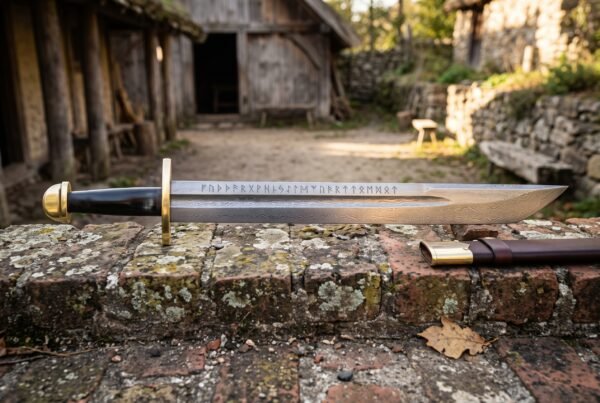
A falchion is a single edged medieval sword with a broad belly near the point. In profile the back runs nearly straight from the guard, the edge curves away from it, and the last third widens before both lines sweep up to a clipped point. That widening is the whole design. It gathers percussion mass forward, so the sword arrives at the target with more behind the cutting section than a straight double edged blade of the same weight. Sharpening only one side lets the other stay thick, the same trick the messers use.
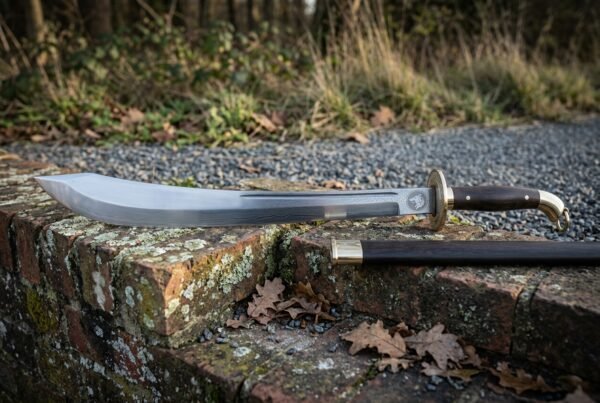
The blades here run 29 to 31 inches overall with 23 to 25 inches of edge, between 1.9 and 2.2 inches wide at the broadest point, and weigh 2 lb 4 oz to 2 lb 8 oz. Two are plain 1095 high carbon hardened to 54 to 58 HRC. Two are Damascus of 1095 and 15N20, forge welded and etched at 58 to 60 HRC. Grips are 6 inches of dark hardwood or rosewood with brass, gilt brass or steel fittings, and every one comes with a leather scabbard.
Heavier than it looks in a photograph, which the first sword guide also warns about.
Free US shipping
On most pieces. Heavier and oversized ones carry a flat charge.
Hand Forged
Heated, hammered and ground by hand.
Engraving available
Names, dates or Norse runes on most pieces.
Ships from Chicago
Inspected and dispatched from our Chicago warehouse. No import duty, no customs delay on US orders.
Falchions
Why the blade widens near the point
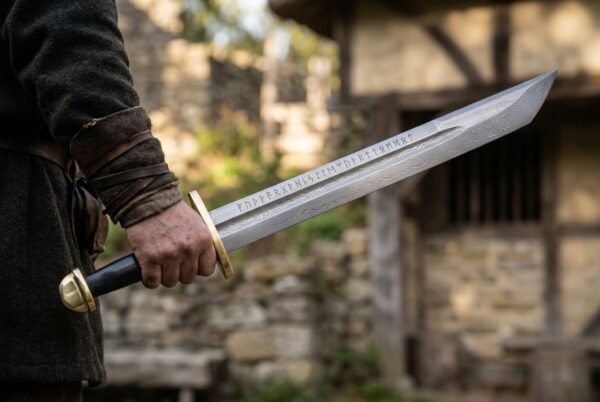
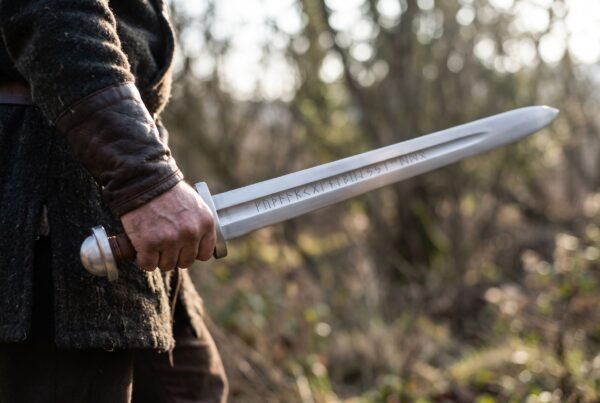
Hold a falchion at the guard and look down the spine. The back is nearly straight for the first half, then the edge swells outward into a pronounced belly before both lines converge at a clipped point. That belly is where the sword does its work. Moving steel forward raises the point of percussion and puts more mass behind the section of edge that actually meets the target, which is why a falchion of modest weight cuts harder than its numbers suggest.
Sharpening one side only is the other half of the design. On a double edged sword both sides have to be ground thin, so the cross section is a shallow diamond and the spine can only be so thick. A falchion keeps a flat, thick back and puts all the taper into one bevel. You get a stiffer blade for the same weight, a stronger edge because there is more steel behind it, and something that resists bending sideways when a cut lands slightly off line.
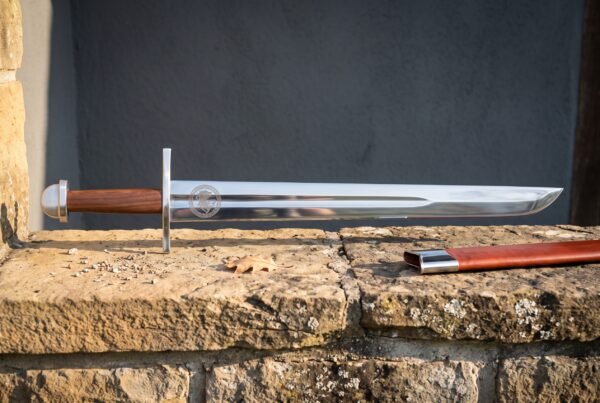
The clipped point is the concession. A blade this broad would otherwise finish in a heavy rounded tip that does nothing useful, so the back is cut away for the last few inches and brought down to meet the edge. That gives back a usable point without taking mass out of the belly, which is the part that matters.
What the medieval falchion actually was
Falchions turn up in European manuscripts from roughly the thirteenth century onward, and the surviving examples are not consistent with each other. Some are broad cleaving blades with a heavy forward belly. Some are almost straight and look closer to a large single edged knife. The famous Conyers falchion in Durham is squat, wide and dramatic. The Thorpe falchion is a good deal more restrained.
What they share is the single edge and the forward weight, and what the sources share is a habit of showing them in the hands of footmen, huntsmen and townspeople rather than mounted knights. That is probably a matter of cost as much as anything. A single edged blade takes less grinding, less finishing and less steel than a double edged one, and it does not need the same precision through the cross section. The falchion was a practical sword rather than a prestigious one, which is exactly why it is interesting.
The pieces here follow the shape rather than reconstructing a specific find. They are collector and display swords, and they are described that way on every product page.
The falchions in this collection
Four blades, split by steel and by how much curve is in the back.
In 1095 high carbon
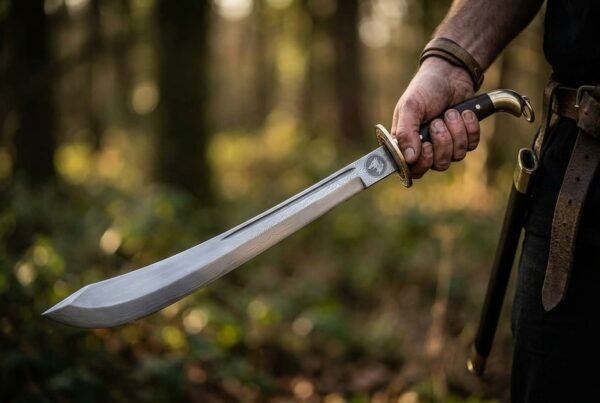
Two of these. The first is 30 inches overall with a 24 inch blade, 2.1 inches at its widest, on a dark hardwood grip of 6 inches with a brass cross guard and brass pommel. Its scabbard is black leather with a brass throat and chape. It weighs about 2 pounds 6 ounces.
The second is the straight backed one, 31 inches overall with a 25 inch blade and 1.9 inches of width, on a rosewood grip with a steel cross guard and pommel cap, in a russet red leather scabbard, weighing about 2 pounds 4 ounces. A curved falchion carries its weight forward and rewards a heavy committed swing. A straight backed one spreads that weight along the blade instead of piling it into the last few inches, so it still cleaves, because the edge is broad and the spine thick, but it comes back on line quickly and points where you expect. For anyone learning cutting patterns, that predictability is worth more than raw chopping power.
In Damascus
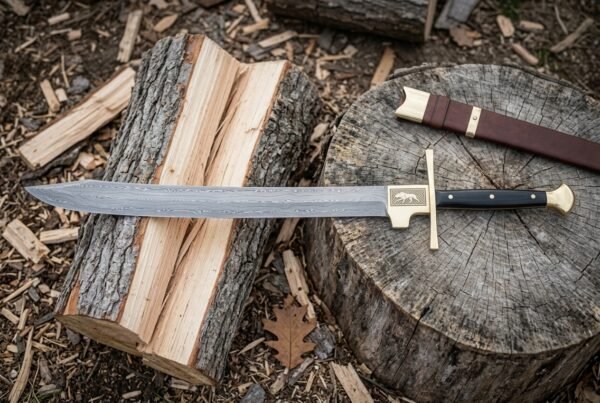
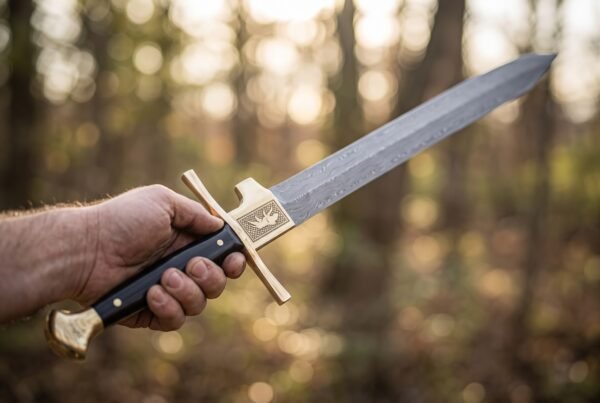
Two more, both forge welded 1095 and 15N20 hardened to 58 to 60 HRC and acid etched so the layers read as light and dark bands across the belly. One is 30 inches overall with a 24 inch blade and the widest blade on this page at 2.2 inches, on a dark hardwood grip with a gilt brass ring guard and brass pommel, in a brown leather scabbard with brass fittings, at about 2 pounds 8 ounces. The ring guard is the distinguishing detail, a loop coming off the cross that gives the forefinger somewhere to sit and protects it when the hand is forward on the grip.
The other is the shortest and the most decorated. It runs 29 inches overall with a 23 inch blade at 2 inches wide, and carries an Elder Futhark rune line cut along the upper flat. Fittings are gilt brass cross guard and pommel on dark hardwood, and the scabbard is tan leather. About 2 pounds 5 ounces.
Sizes, steel and fittings across the range
Every figure below comes from the specification panel of a piece on this page. These are forged and ground by hand, so read the numbers as what to expect rather than as a guarantee to the millimetre.
| Piece | Steel and hardness | Overall | Blade length and width | Grip and fittings | Weight and scabbard |
|---|---|---|---|---|---|
| Rustwarden | 1095 at 54 to 58 HRC | 31 in | 25 in, 1.9 in at the widest | Rosewood, steel cross guard and pommel cap, 6 in | About 2 lb 4 oz, russet red leather |
| Grimwake | 1095 at 54 to 58 HRC | 30 in | 24 in, 2.1 in at the widest | Dark hardwood, brass cross guard and pommel, 6 in | About 2 lb 6 oz, black leather with brass throat and chape |
| Emberfall | Damascus at 58 to 60 HRC | 30 in | 24 in, 2.2 in at the widest | Dark hardwood, gilt brass ring guard and pommel, 6 in | About 2 lb 8 oz, brown leather with brass throat and chape |
| Runemarch | Damascus at 58 to 60 HRC | 29 in | 23 in, 2 in at the widest | Dark hardwood, gilt brass cross guard and pommel, 6 in | About 2 lb 5 oz, tan leather |
The number people misread is the width. Two inches sounds narrow written down and looks enormous in the hand, because a typical arming sword blade is a little over half that at the base and tapers from there. Blade width is the single figure that makes a falchion look and feel like a falchion.
Weight, balance and how it handles
Between 2 lb 4 oz and 2 lb 8 oz puts these squarely in the range of real medieval single hand swords, which surprises people who expect a broad blade to weigh four or five pounds. It does not. What it does is carry its weight further from the hand, so the sword feels heavier than an arming sword of the same mass and takes more effort to stop once it is moving.
That forward balance is the point. It also means the grip length matters. Six inches is a genuine single hand grip with room for the heel of your palm against the pommel, and a falchion is meant to be held that way rather than gripped in the middle. Let the pommel sit against the base of your hand and the sword rotates around a sensible axis. Choke up on the grip and it wants to fall out of line.
If you are comparing across the range, the straight backed blade is the easiest of the four to control, the widest Damascus piece is the most dramatic and the most front heavy, and the two remaining sit between them.
Steel and hardness
Two steels run through this page. Plain 1095 high carbon is hardened to 54 to 58 HRC, which is the range that gives a sword an edge that holds and a body that bends rather than shatters. On a broad single edged blade that toughness matters, because a wide blade has more surface to catch a bad angle. Damascus of 1095 and 15N20 is forge welded, folded, drawn and acid etched, hardened to 58 to 60 HRC. The 15N20 carries nickel, which resists the etch, and that is why the layers come up as light and dark bands rather than as a flat grey face.
Neither is stainless and both will rust. That is the cost of a steel that takes and holds a proper edge, and the fix is a wipe of oil. Our guide to Damascus and high carbon steel sets out the trade properly, and the steel and hardness page covers what the HRC numbers mean.
Grips, guards and pommels
All four grips are 6 inches. Two are dark hardwood, one is rosewood, and the difference is more than colour. Rosewood is dense, oily and close grained, so it polishes up and shrugs off moisture on its own. Dark hardwoods are drier and want a wipe of oil once or twice a year, especially where a hand has been on them.
Guards come in three forms here. A steel cross guard is the plainest and the toughest. A brass cross guard is softer, warmer in colour and will darken over months. A gilt brass ring guard adds a loop off the cross for the forefinger, which is a later feature than the earliest falchions and is on the sword because it looks right and works well rather than because it is documented on a specific find.
Pommels are brass, gilt brass or a steel cap, and their job is counterweight as much as decoration. Take the pommel off a forward balanced sword and it becomes almost unusable, which is a good way to understand what it is doing. Brass fittings darken with time. A metal polish on a cloth brings them back, or leave them and let the sword age.
Scabbards
Every piece here comes with a leather scabbard, in black, russet red, brown or tan. Two carry brass throats and chapes, the metal fittings at the mouth and at the tip, which protect the two places a scabbard wears out first.
New leather is stiff and takes a few weeks of drawing and sheathing to settle to the shape of its own blade. Scabbards are made to their sword and are not interchangeable across the range, since a 2.2 inch blade will not enter a scabbard cut for a 1.9 inch one. Draw the sword by pushing your thumb against the throat rather than by pulling on the grip alone, and never force a blade back in at an angle.
Replacements and spares are in the scabbards and sheaths category.
Care and storage
Wipe the blade dry after handling and leave a light film of mineral, camellia or food safe oil on it. Fingerprints are acidic and they etch into a polished flat within days, which is worth knowing before you hand a sword round at a party. Grey patina is stable and harmless. Orange spotting lifts with fine abrasive and oil, and you should work along the blade rather than across it so any marks follow the grinding lines.
Do not store a carbon steel blade in its leather scabbard for months at a time. Leather holds moisture directly against steel and a damp scabbard is the single most common reason a well kept sword still comes out spotted. Hang the sword or lay it on a stand and keep the scabbard beside it. The sword stands and displays category has table top stands and wall mounts sized for blades this length.
Keep the whole thing out of direct sun and off exterior walls that get cold, because condensation forms on steel in an unheated room exactly as it does on a window.
Engraving
The upper flat of a falchion blade is broad and unobstructed, which makes it one of the better surfaces we work on. One piece here already carries an Elder Futhark line cut along that flat. Elder Futhark has twenty four characters, all built from straight strokes, which is not decoration but engineering, since the alphabet was designed to be carved across the grain of wood and cut into metal with a chisel. The same property is why it reads cleanly on a blade flat.
It is phonetic, so a name is transliterated by sound and there is no rune for the letter C. Where a piece already carries an engraved design, your engraving replaces it rather than sitting alongside it. Text engraving is 19 dollars, a symbol is 39 dollars and a family crest is 49 dollars. It is permanent, an engraved piece cannot be returned, and the spelling you send is the spelling that gets cut. Read it twice.
Where these come from and how they ship
Ransack Viking is a US company based in Chicago, Illinois. The pieces are handmade in the Czech Republic, then imported, inspected and shipped from Chicago. Engraving is done in the US after arrival. Because every blade is forged and ground by hand, small differences in profile, etch figure, grip colour and leather tone between two swords of the same name are normal. Dimensions, steel and fittings are the same every time.
How to choose
Take the straight backed 1095 blade if you want the easiest of the four to handle and the lowest upkeep. Take the curved 1095 blade if you want a more pronounced belly and brass fittings. Take the wide Damascus with the ring guard if the layered pattern and the drama are what brought you here, and accept that it is the heaviest and the most forward balanced. Take the rune engraved Damascus if it is a gift, since it is the shortest, the lightest of the two Damascus pieces and the one that reads best on a wall.
Browse related categories
- Messers, the other broad single edged medieval blade
- Arming swords with straight double edged blades
- Damascus swords across every pattern
- Short swords and side blades
- Cutlasses, the naval descendant of this shape
- Scimitars and curved single edged swords
Guides worth reading first
- How to buy your first sword
- Display sword vs battle ready, what the difference is
- What Damascus steel actually is
- Elder Futhark runes and how a name is transliterated
Frequently asked questions
What is a falchion?
A single edged medieval sword with a broad belly toward the point and a nearly straight back. The width gathers percussion mass forward, so it cuts harder than its weight suggests, and grinding only one side lets the spine stay thick and stiff.
How is a falchion different from a machete?
Weight distribution and cross section. A machete is thin, light and flexible, built to sweep through vegetation. A falchion is thick through the spine, weighs over two pounds, and puts that mass behind a broad edge. One is a garden tool and the other is a sword.
How heavy are these?
Between about 2 pounds 4 ounces and 2 pounds 8 ounces, which is normal for a real single hand sword. They feel heavier than that because the weight sits forward in the belly rather than near the hand, and a forward balanced sword takes more effort to stop than to start.
Is a falchion a real medieval sword?
Yes. Falchions appear in European manuscripts from about the thirteenth century and several originals survive, including the Conyers and Thorpe falchions in England. They vary considerably, and the pieces here follow the general shape rather than reconstructing one particular find.
Which steel should I choose?
Plain 1095 at 54 to 58 HRC if you want the tougher blade and the least maintenance. Damascus at 58 to 60 HRC if the forge welded pattern is what you came for and you will keep it wiped and oiled. Neither is stainless.
Do these come sharp?
They arrive ground and finished by hand with a working edge, sharp enough to take skin and not honed to a razor. These are sold as collector and display pieces, so keep them out of reach of anyone who has not been told what they are holding.
Is a scabbard included?
Yes, every falchion here comes with its own leather scabbard, and two of them carry brass throats and chapes. Scabbards are cut to their own blade and are not interchangeable, since blade widths on this page run from 1.9 to 2.2 inches.
Where are these made?
They are handmade in the Czech Republic, then imported, inspected and shipped by Ransack Viking from Chicago, Illinois. Engraving is added in the US after arrival.
The falchion's German cousin
The messer is a German relative of the falchion, a single edged blade with a knife style grip, and it is still fenced today. Our HEMA messers are the training versions, and the messer guide explains how they are held and used. The Skarnvald grosses messer has the side nagel you will see in the old manuals.