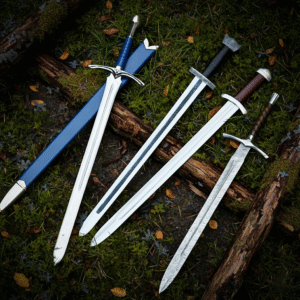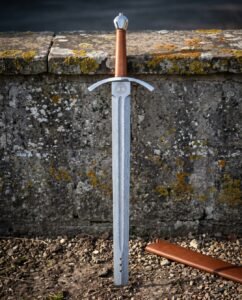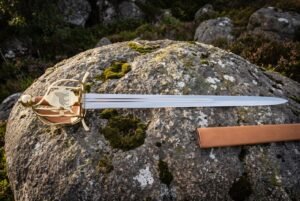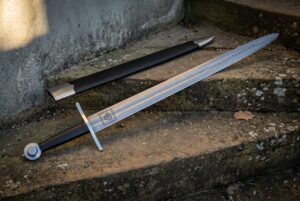
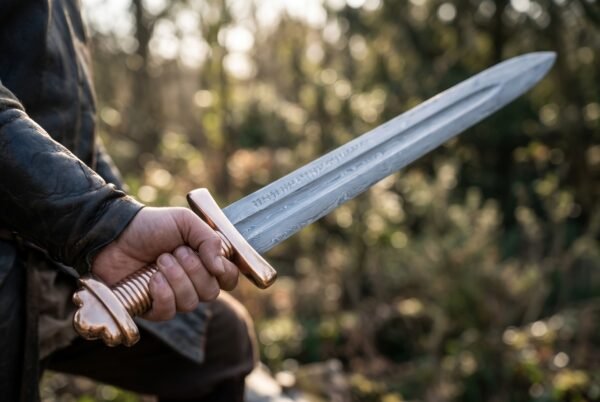
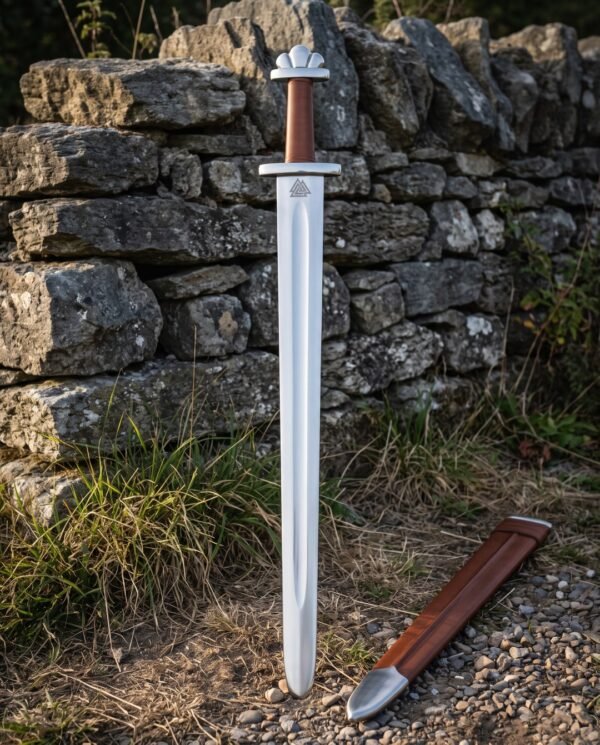
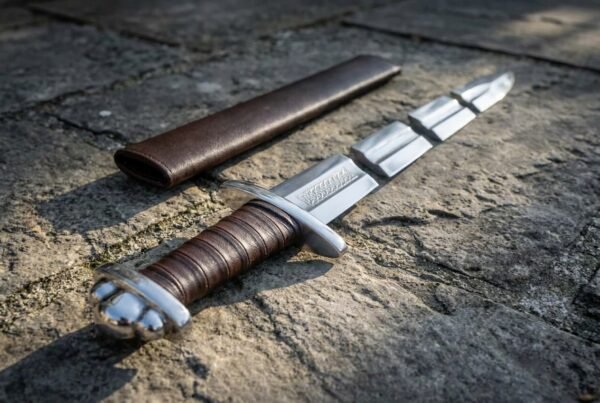
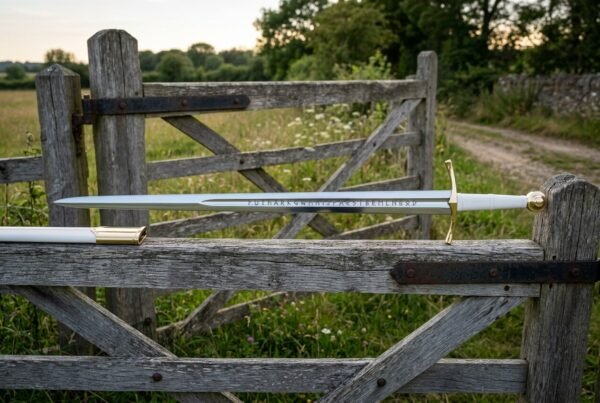
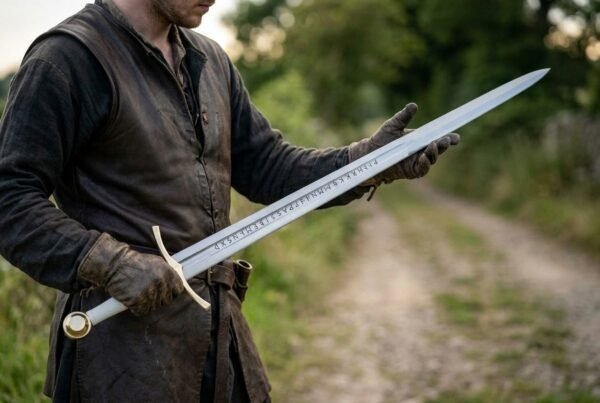
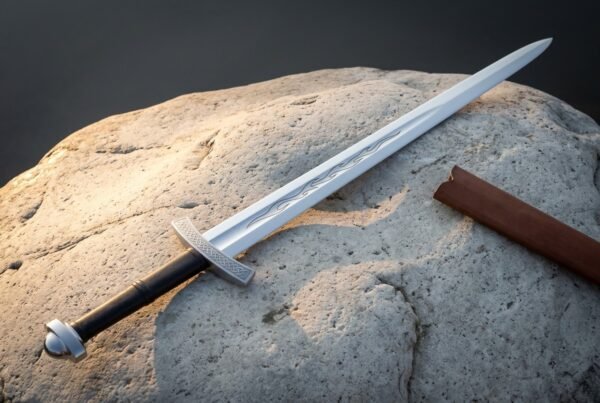
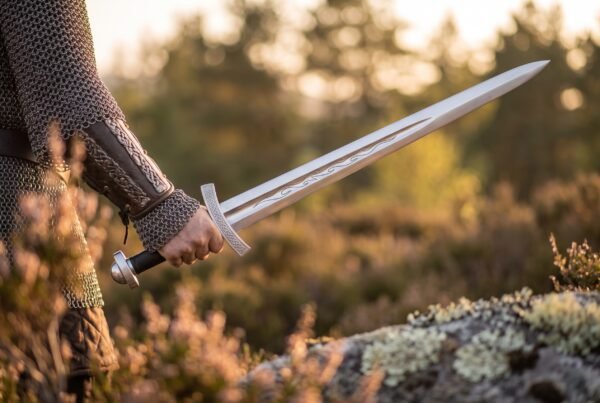
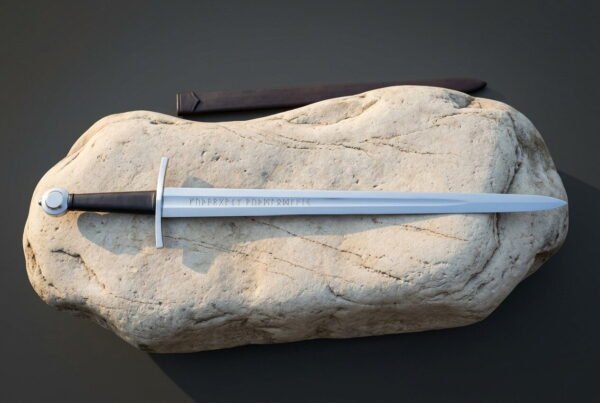
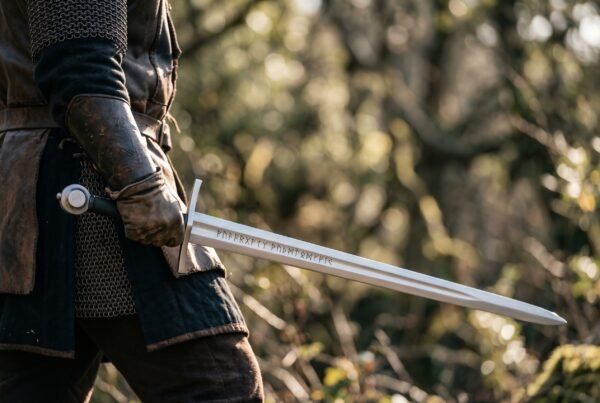
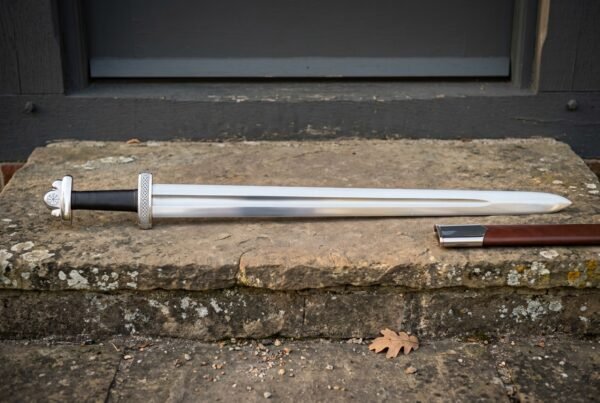
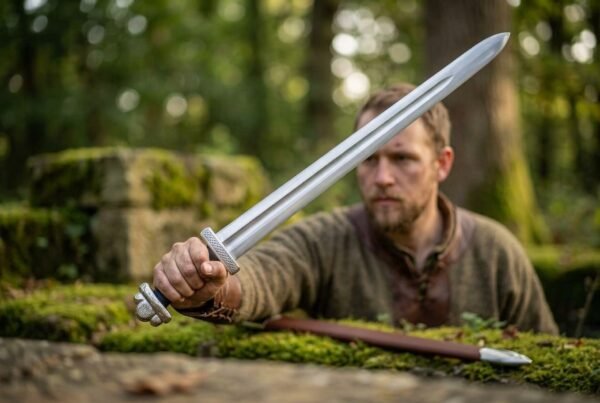
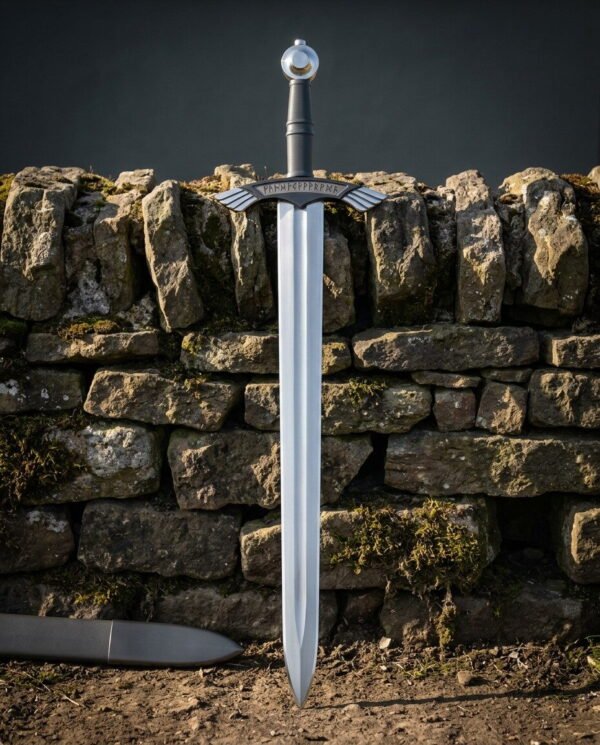
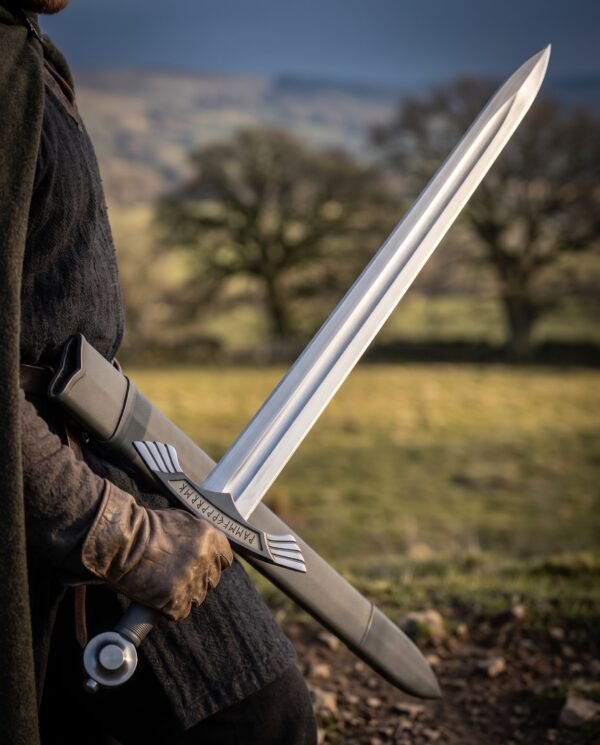
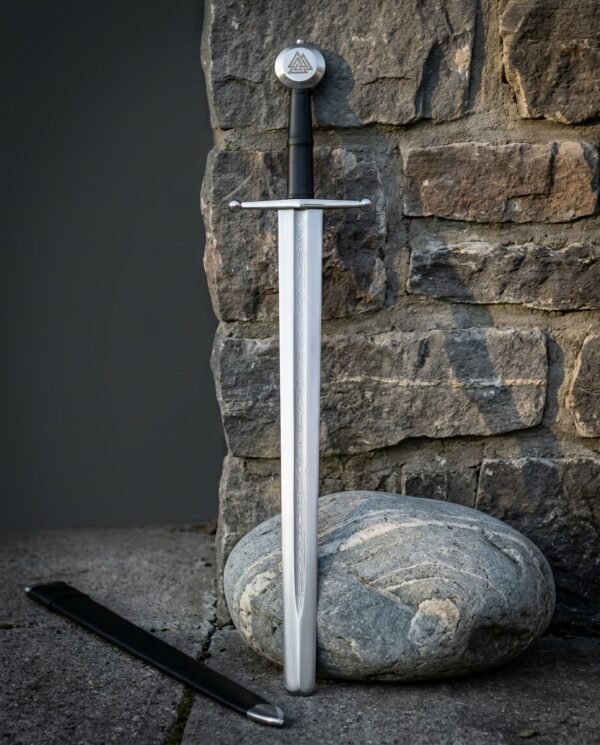
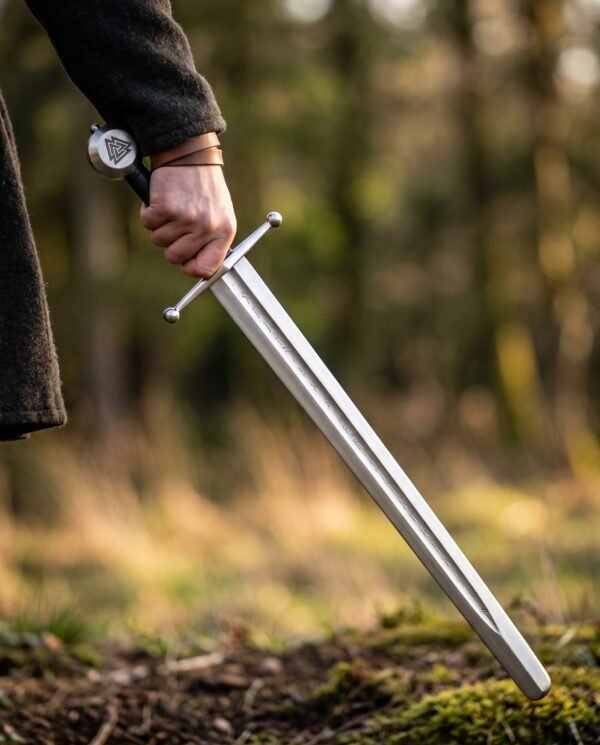
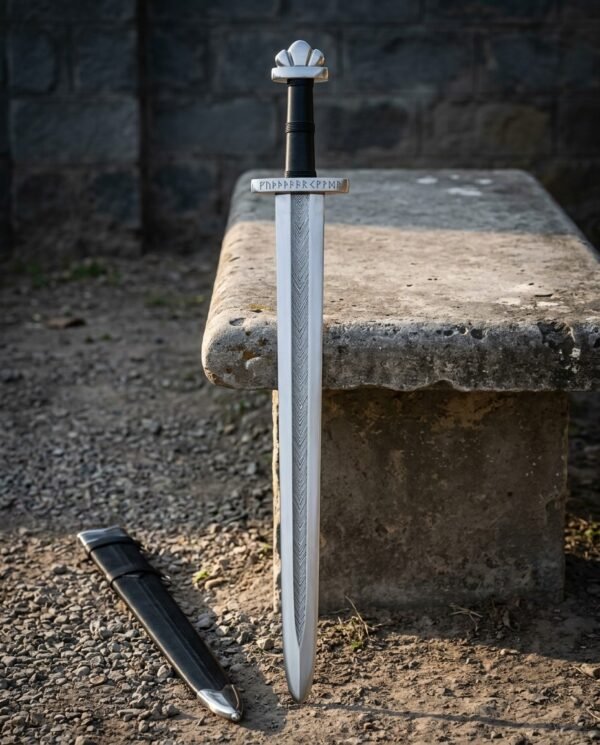
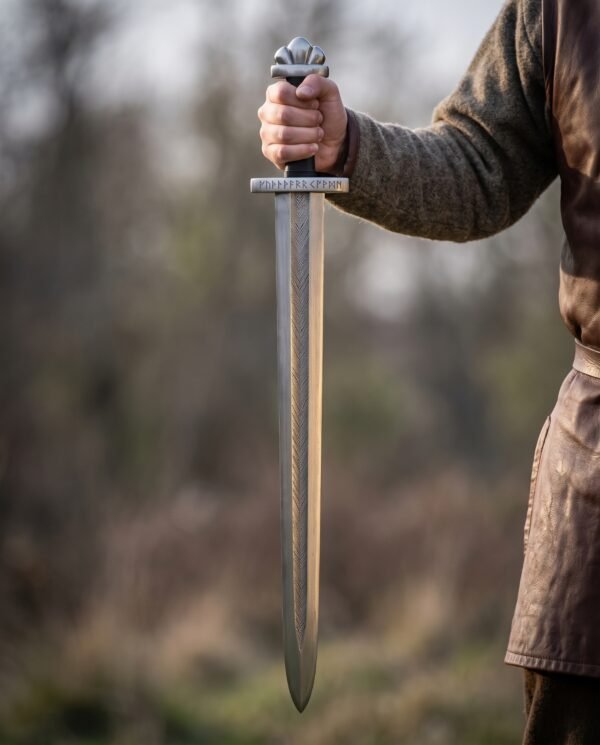
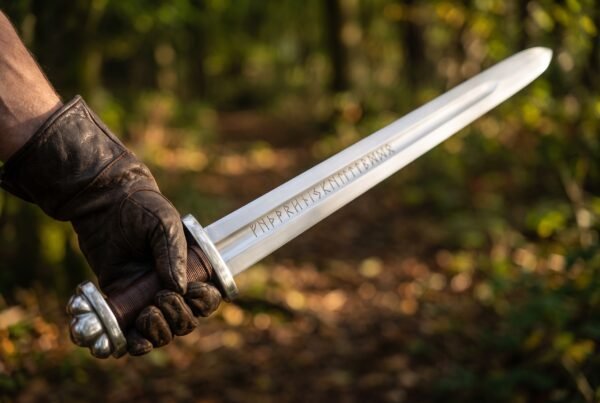
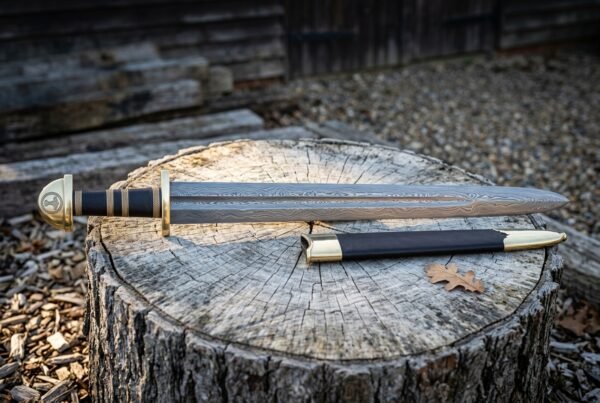
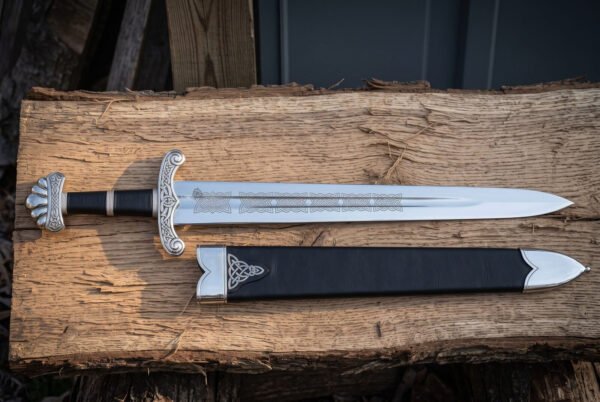
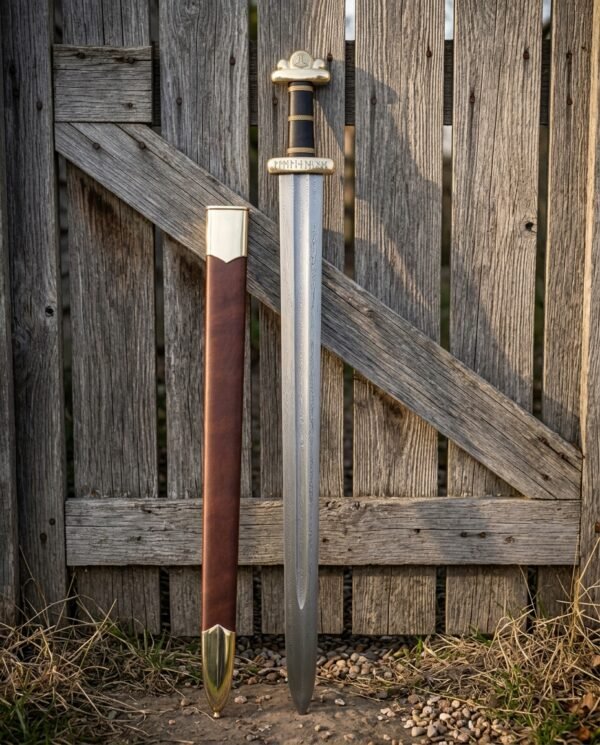
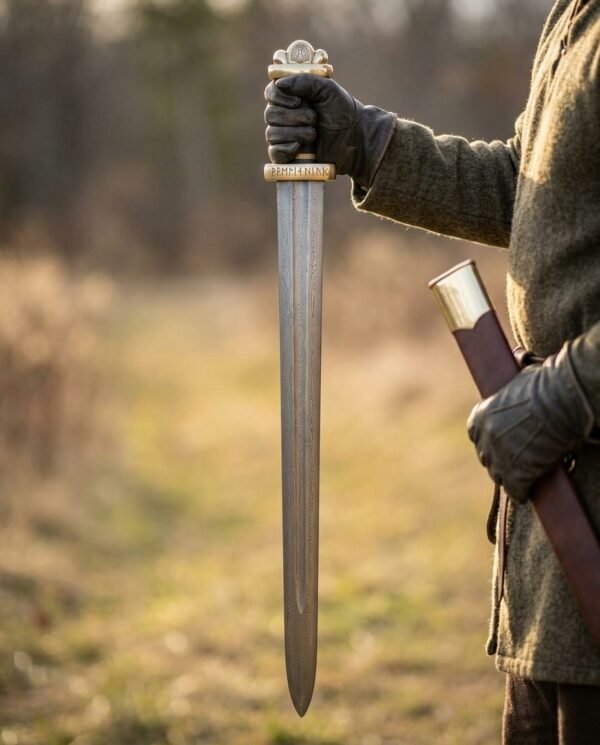
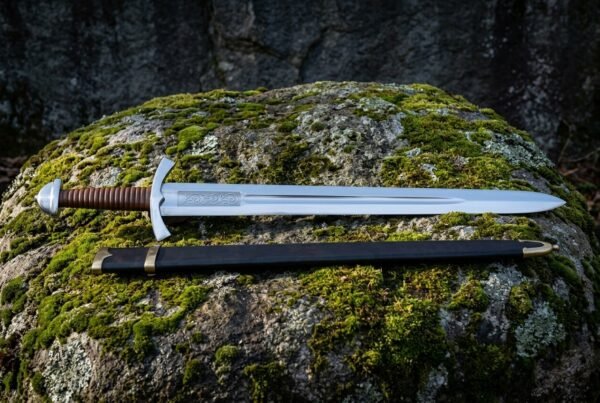
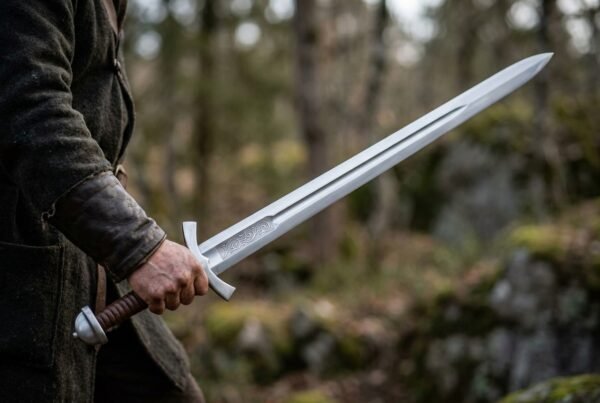
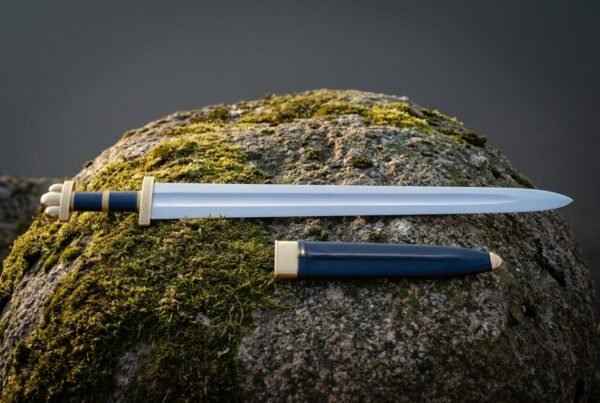
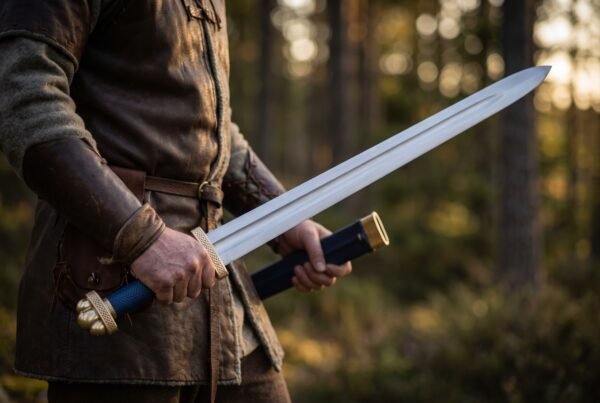
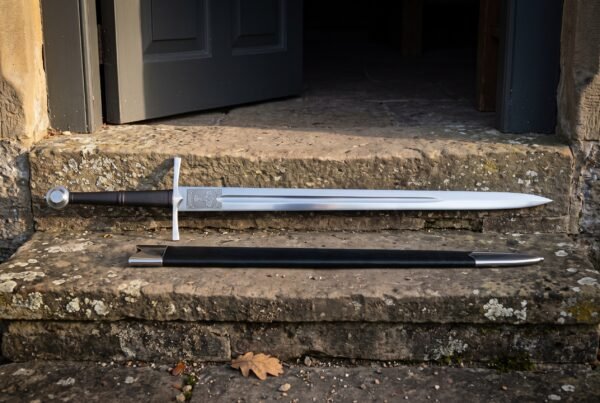
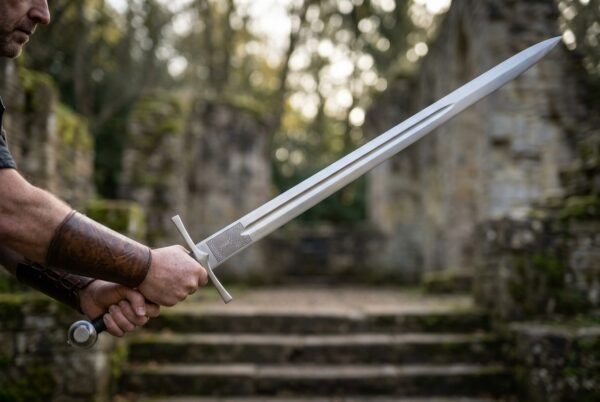
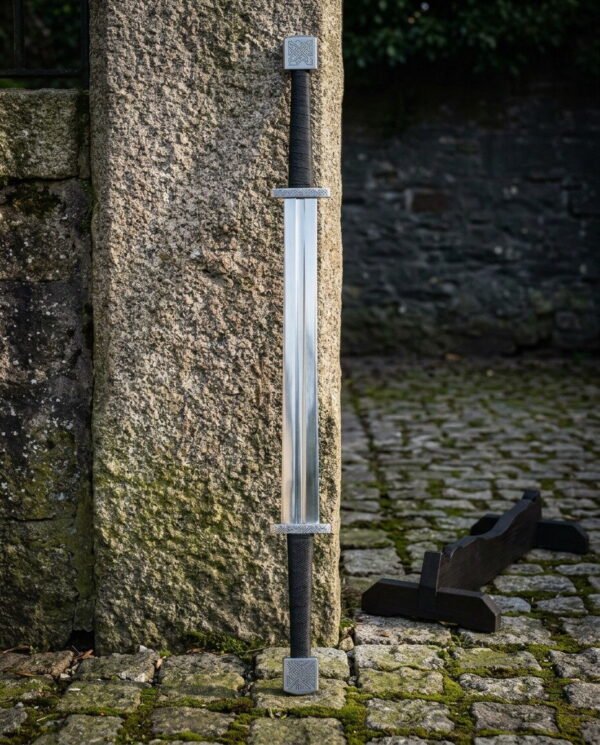
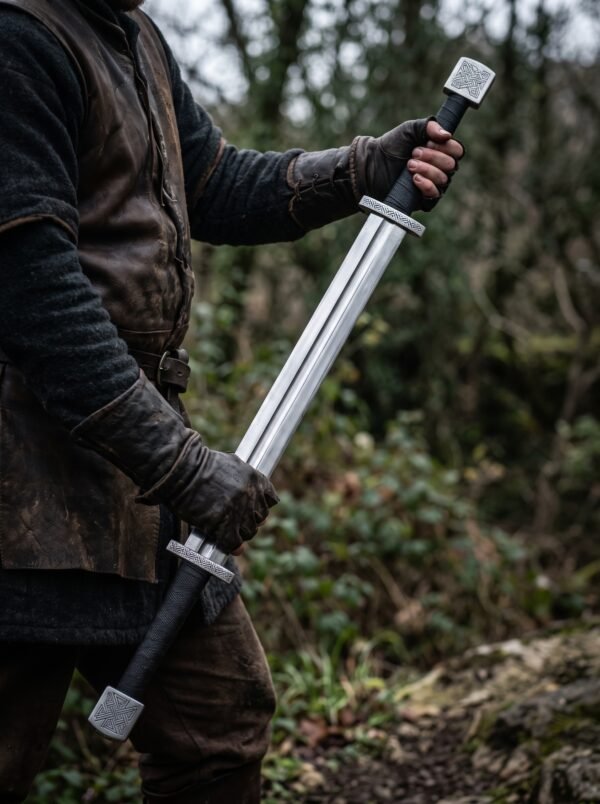
Viking swords are the broad, double edged, single handed blades of the Norse and Carolingian world, and this is the largest single group in the sword range here. The pattern is consistent. A blade of roughly 29 to 31 inches with a wide shallow fuller running almost to the point, a short straight lower guard, a grip barely long enough for one hand, and a heavy pommel above it in a lobed, brazil nut, disc, wheel or annular ring form. A run of Ulfberht style pieces sits inside the collection alongside the plainer working shapes.
Two steels run through the group. Plain 1095 high carbon is hardened to 54 to 58 HRC. Damascus is 1095 and 15N20 forge welded and acid etched, hardened to 58 to 60 HRC. Overall lengths run from about 26 inches on the short pieces up to 38 inches, and bare weights on the listings that state one sit between 1 lb 14 oz and 3 lb 2 oz.
Choose the pommel form first, since that is what places a sword in a period, then read the edge line in the product’s own specification table before you buy. The names attached to these shapes belong to real people, and the Vikings behind the sagas is worth reading first. So is what the sources actually say about Valhalla, since most of what gets sold under that name gets it wrong.
Most swords here take a custom engraving on the blade or guard, chosen on the product page.
If you want a Viking sword built to your own hand, start with the sword builder and set the blade length, the fuller, the guard, the pommel and the grip wrap.
Free US shipping
On most pieces. Heavier and oversized ones carry a flat charge.
Hand Forged
Heated, hammered and ground by hand.
Engraving available
Names, dates or Norse runes on most pieces.
Ships from Chicago
Inspected and dispatched from our Chicago warehouse. No import duty, no customs delay on US orders.
Viking Swords

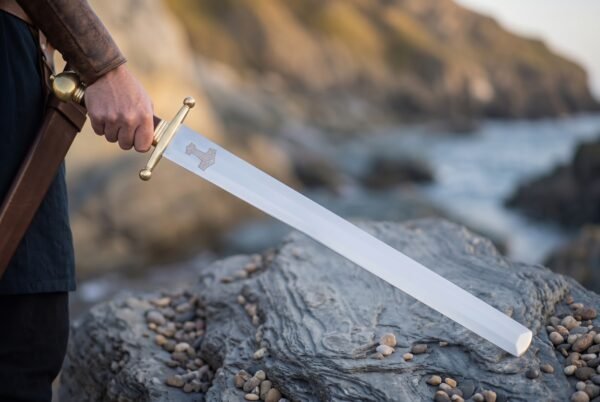
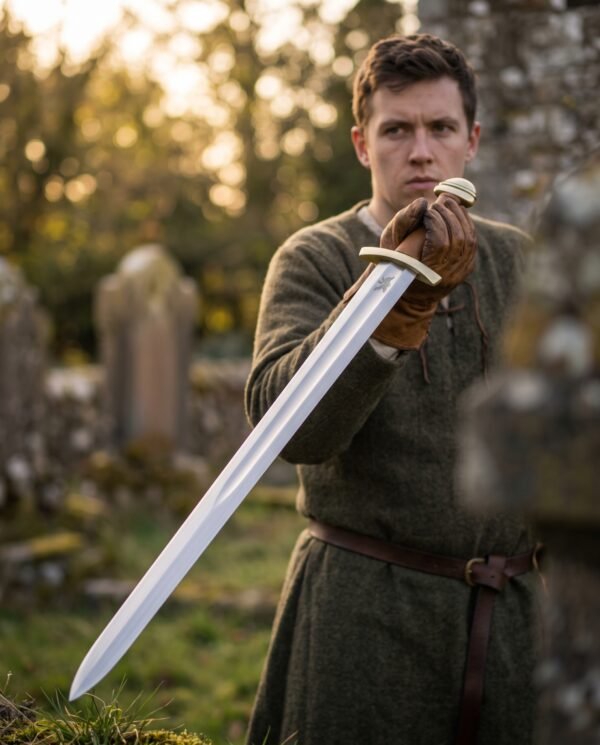
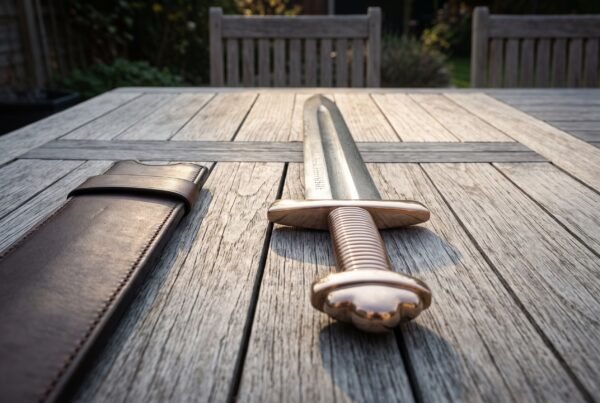
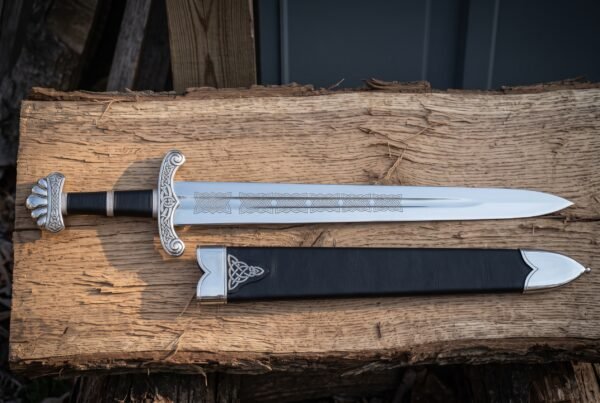
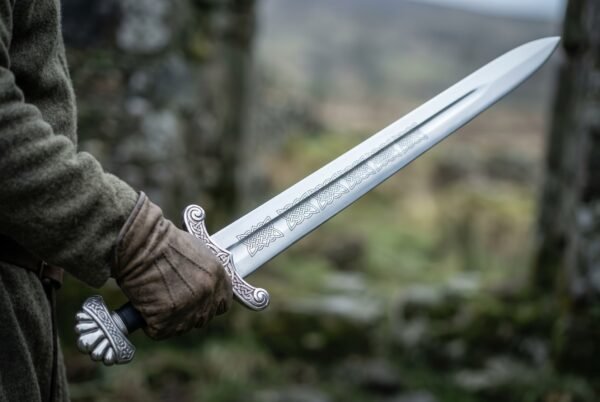
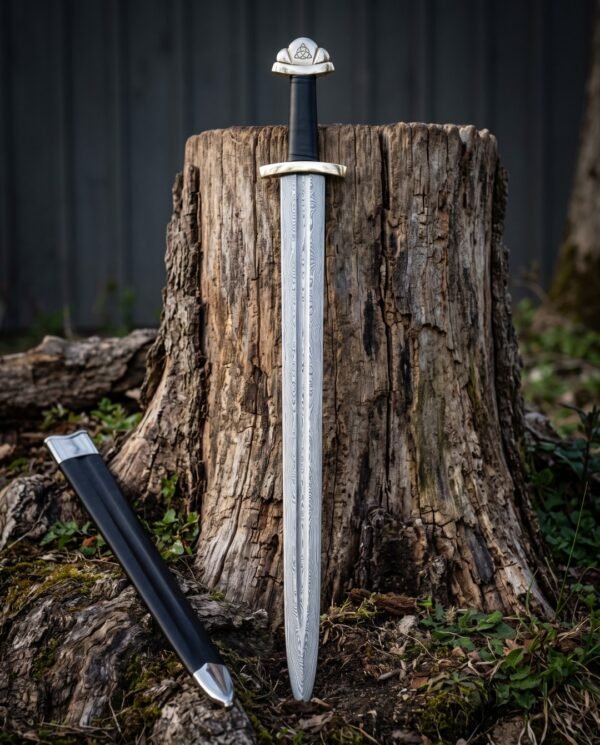
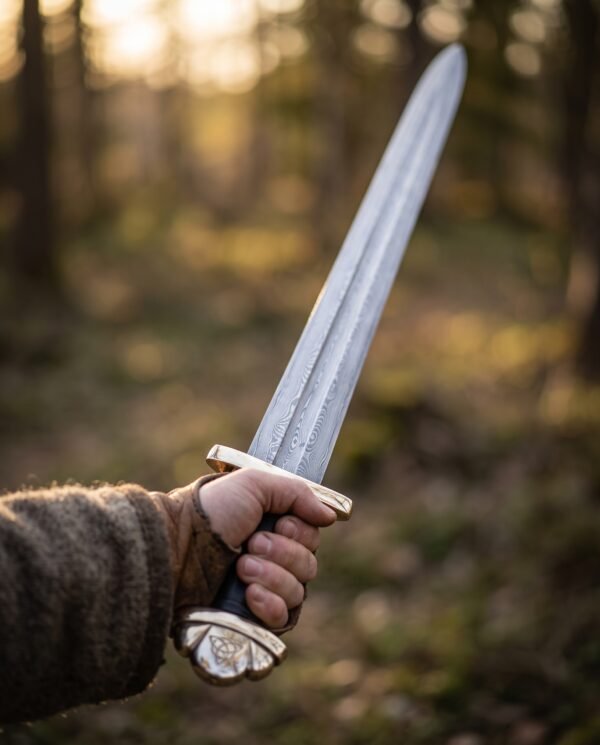
What makes a sword a Viking sword
The Norse did not build their swords in isolation. Most of the blades carried in Scandinavia between roughly 800 and 1050 came out of Frankish workshops along the Rhine, and they were traded, gifted or taken rather than made at home. What marks a sword out as Norse is the proportion of the whole thing rather than the origin of the steel.
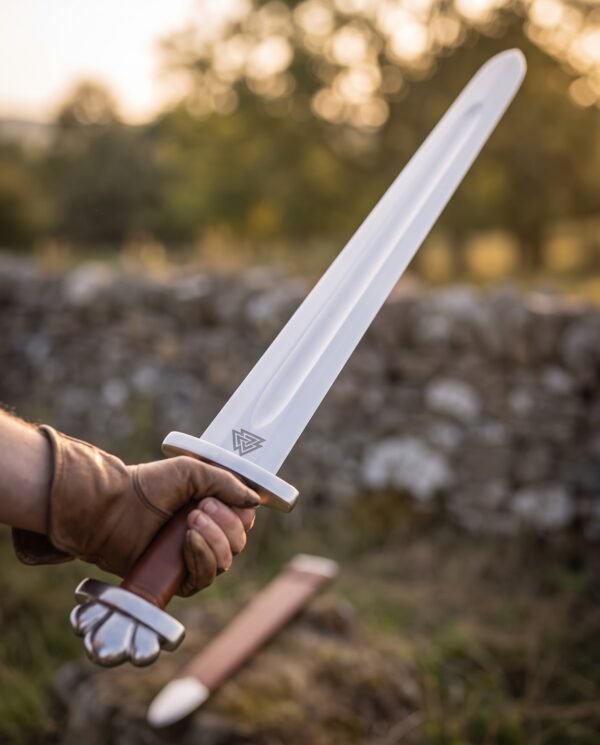
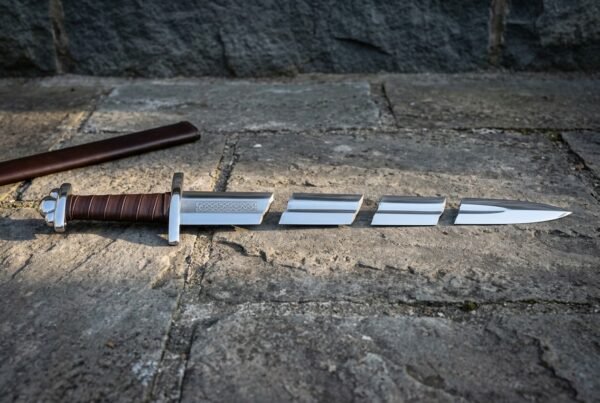
The blade is broad. On the pieces here it measures around two inches at the shoulder, stays close to parallel for most of its length and carries a wide shallow fuller that runs almost to the tip. The taper is slight and the point is often rounded rather than acute. That geometry follows from the job. A sword of this shape was made to cut against mail, padded cloth and a limewood shield, not to find a gap in plate, so the makers put the mass where the cut happens and left the point comparatively blunt.
The hilt is the other half of the answer. A Norse hilt is short, generally three to four inches of grip between the guards, sized so the hand fills it completely and cannot slide. Below the grip is a straight lower guard, little more than a bar. Above it sits the pommel, and the pommel is doing real work rather than decoration. It counterweights the blade so the balance point falls a hand's width in front of the guard instead of out towards the tip. Remove the pommel and the same sword becomes an unmanageable length of steel.
Later medieval swords move away from all of this. Blades narrow and taper harder, grips lengthen, guards grow into long quillons. If a sword has a long tapering point and a grip you can get two hands onto, it belongs on the longsword page rather than this one.
Petersen types and what the pommel tells you
Jan Petersen published his survey of Norwegian sword finds in 1919 and sorted the hilts into lettered groups. Archaeologists still work from it, sometimes alongside the later Wheeler and Oakeshott schemes, because the blade of a Norse sword changed slowly across the period while the hilt changed a great deal. Look at the pommel and you have a rough date. Look at the blade alone and you have almost nothing.
None of the pieces here are sold as reproductions of a numbered find, and no listing on this page claims a Petersen letter. What the collection does carry is the family of pommel shapes the typology is built on, so the vocabulary is worth knowing before you choose.
Lobed pommels
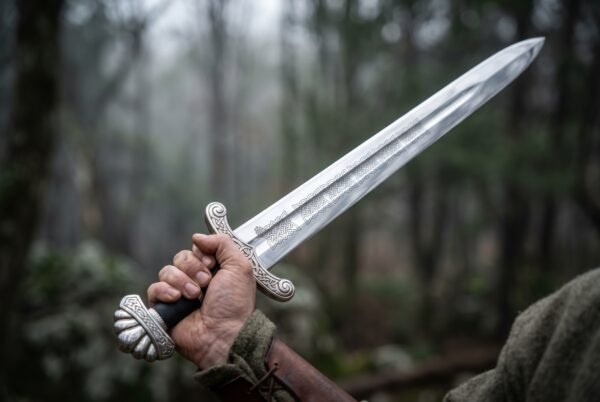
The shape most people picture. A cap divided into three or five rounded lobes, usually sitting on a straight upper guard bar so the two read as one unit. Three lobed and five lobed pommels are both common here, in polished steel, blackened steel and brass, and several carry an engraved Valknut, triquetra or Norse beast cut into the centre lobe. This family covers the early and middle part of the period and is the safest choice if you want a sword that reads as unambiguously Norse across a room.
Brazil nut and dome pommels
A solid rounded mass, either the flattened almond shape known as a brazil nut or a plain dome on a stepped collar, peened over the end of the tang. These belong to the late Viking and early Norman era and continue into the arming swords that followed. Several pieces here use solid brass for them, sometimes grooved across the crown, which shifts the balance back noticeably compared with a hollow steel cap of the same size.
Disc and wheel pommels
A flat circular plate, or a thicker wheel with a raised centre, often engraved. This is the form that outlives the period and becomes standard on medieval arming swords, so a disc pommel Viking sword sits at the very end of the timeline. Examples here carry engraved knotwork, a Valknut or a triquetra inside a ring on the face of the disc.
Annular and ring pommels
An open ring rather than a solid mass, sometimes with a contrasting metal lining the opening. The version on this page is blackened steel with a brass lined ring. It is a less common find historically and it is the lightest of the pommel families for its apparent size, since most of the volume is air.
Faceted, trumpet and tea cosy forms
The remainder. Faceted steel caps cut into flat planes, flared trumpet forms, and the rounded tea cosy shape banded with steel. These sit at the edges of the typology and turn up on individual pieces rather than across a whole group. Buy them because you like the look of them, not because they place the sword in a period.
Ulfberht blades and what the name meant
Roughly 170 surviving blades from the Viking age carry some version of the name +VLFBERH+T inlaid in iron letters down the fuller. They span two centuries, which is far too long for one smith, so the name worked as something between a workshop mark and a brand. Blades carrying it tend to be better than average, and a fair number of surviving examples spell it wrong or place the crosses in the wrong spot, which is the earliest recorded case of somebody counterfeiting a maker's mark on a blade.
The interest is metallurgical as much as historical. Several genuine Ulfberht blades test as high carbon crucible steel far cleaner than most European bloomery iron of the period, and the argument over where that steel came from and how it reached the Rhine has been running for decades. There is a longer account of all of it in the guide to the Ulfberht sword and what the inlaid name actually meant.
Two pieces on this page are built as Ulfberht style swords, one in high carbon steel and one in Damascus, both at 36 inches overall with a 30 inch blade and a listed bare weight around 2 lb 12 oz. They are modern interpretations of the look rather than reconstructions of a specific find, and no listing here claims to reproduce a museum piece.
Lengths, weights and steel across the range
Every figure in the table below is taken from the specification panel of a product on this page. Nothing is estimated. Sizes vary piece to piece because each blade is forged and ground by hand, so read a stated length as nominal rather than exact.
| Piece | Overall length | Blade length | Steel and hardness | Bare weight | Pommel or blade note |
|---|---|---|---|---|---|
| Knotreave knotwork Viking sword | About 36 in | About 29 in | 1095 at 54 to 58 HRC | About 2 lb 12 oz | Five lobed steel cap on a straight upper guard |
| Stormvine Damascus Viking sword | About 38 in | About 30 in | Damascus at 58 to 60 HRC | Not listed | Round blackened pommel with a raised Mjolnir |
| Hammerlight Viking arming sword | About 36 in | About 29 in | 1095 at 54 to 58 HRC | Not listed | Solid brass brazil nut |
| Bindoath Viking sword | About 36 in | About 30 in | 1095 at 54 to 58 HRC | About 2 lb 9 oz | About 2 inches wide at the shoulder |
| Wyrmfall Damascus Viking sword | About 37 in | About 31 in | Damascus at 58 to 60 HRC | About 2 lb 14 oz | Double edged with a serpentine core panel |
| Runemarch pattern welded Viking sword | About 36 in | About 30 in | Damascus at 58 to 60 HRC | About 2 lb 12 oz | Double edged, pattern welded through |
| Runetooth rune sword | 38 in | 30 in | 1095 at 54 to 58 HRC | About 3 lb 2 oz | Single edged with a slanted clip point |
| Knotlobe Viking short sword | 26 in | 20 in | 1095 at 54 to 58 HRC | About 1 lb 14 oz | Shortest single handed piece in the group |
| Loopcrown Viking sword | About 36 in | About 29 in | Not listed | Not listed | Annular ring pommel with a brass lined opening |
| Wolfmark Ulfberht style Viking sword | 36 in | 30 in | Not listed | About 2 lb 12 oz | Ulfberht style, high carbon steel per the listing |
Two things are worth reading carefully. Weight figures are given bare in almost every case, so a sword listed at 2 lb 12 oz will feel heavier in the hand once a scabbard and belt rig are hanging off it. And overall length includes the pommel, which on a brass brazil nut piece is a real fraction of the total, so two swords quoted at 36 inches can have blades an inch apart.
Steel, hardness and the edge you actually get
There are two steels presented as a house standard across this site and no others. A handful of older listings state a different grade in their own specification table, and where they do, that table is the accurate answer for that piece.
Plain 1095 is a simple high carbon steel hardened here to 54 to 58 HRC. On a sword that range matters more than it does on a knife. A sword is a long lever, and a blade taken too hard snaps instead of bending. Keeping 1095 in the middle fifties buys toughness through the length of the blade at the cost of a little edge retention, which is the correct trade for a piece this size. It sharpens quickly, takes a fine edge, and it will rust the moment you leave it damp.
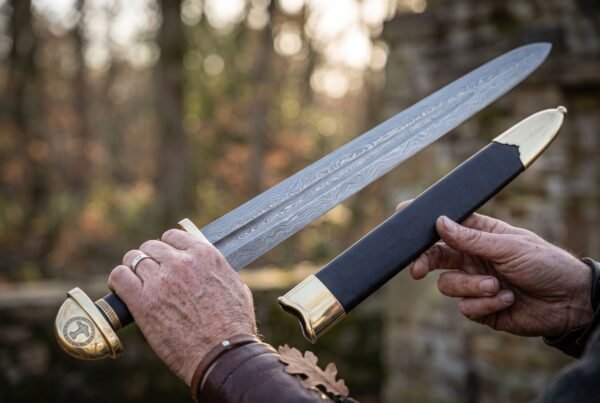
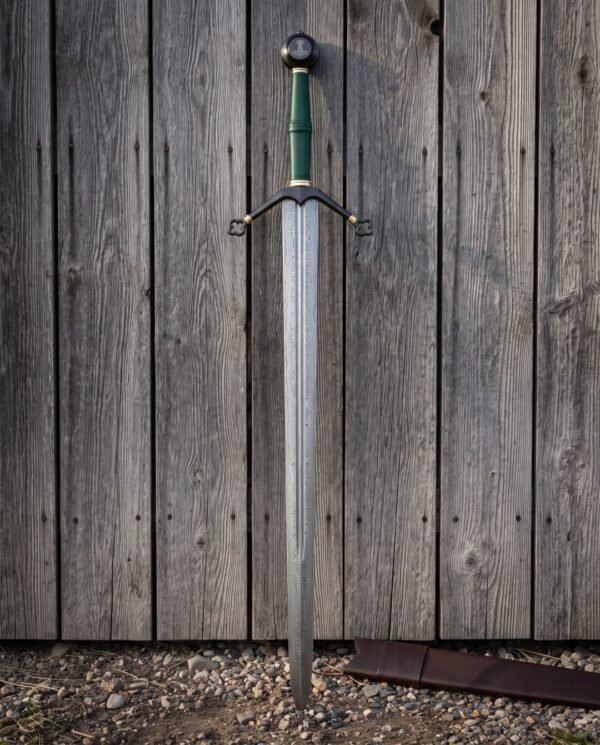
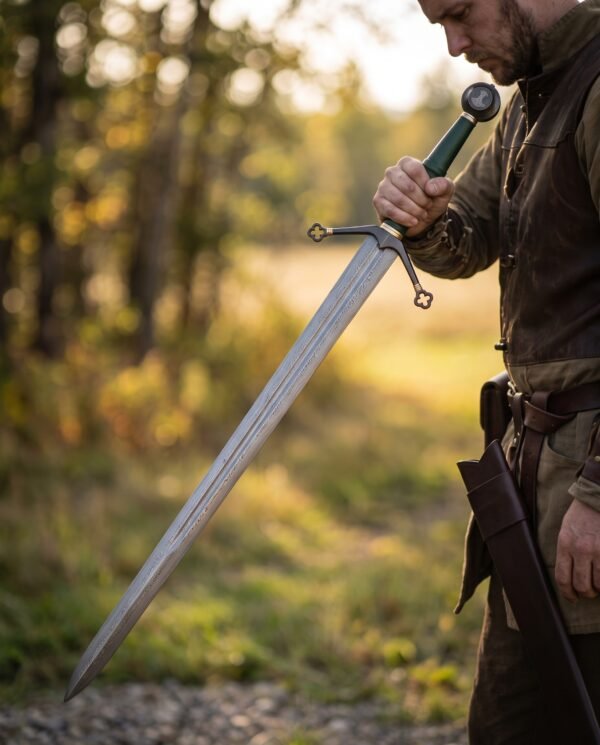
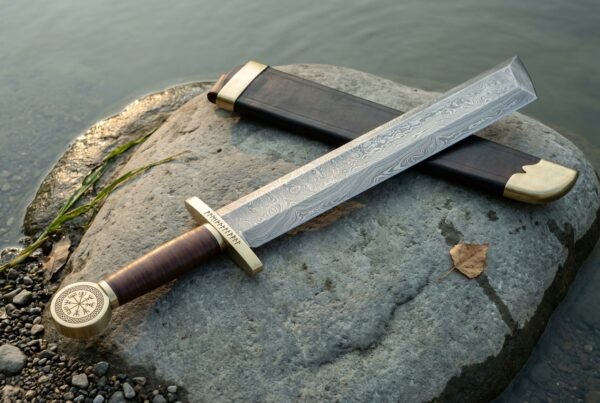
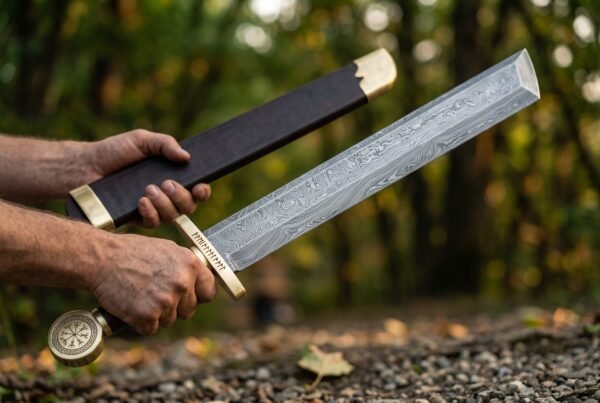
Damascus here is 1095 and 15N20 forge welded in alternating layers, drawn out, folded and etched so the nickel bearing 15N20 stays bright while the 1095 darkens. Hardened to 58 to 60 HRC, it holds an edge a little longer and takes more work to bring back. Most of the billet is still 1095, so it rusts exactly like carbon steel and the etched surface needs the same oil.
For a Viking sword the practical rule is short. If the sword will be handled, cut with or drilled, take 1095. If it is going on a wall, being given as a gift, or being bought because the pattern is the point, take Damascus. The price gap reflects the labour in forge welding a billet long enough to make a sword, not a jump in performance.
Read the edge line on the product page as well, because it varies piece to piece across this group. Some listings state an unsharpened display edge with a rounded point. Others state sharpened on both edges, or sharpened and ready to use. A number of listings say nothing at all about the edge, in which case treat it as a display grind and assume you will be finishing it yourself if you want it keen.
A display edge is not a safety feature. It is a blunt bar of hardened steel roughly a yard long and it will break bone. Keep it out of reach of children, do not hand it to somebody who has not held a sword before without saying so first, and do not swing it indoors.
If a sword arrives sharpened, it arrives with a working edge rather than a razor. A very thin edge on a long blade chips against anything solid, so the grind is deliberately sturdy. A few passes with a coarse stone or a file, followed by a finer stone, will take any of these further if you want them there.
Fittings, scabbards, care and where these swords are made
Grips through this group are leather or cord over a shaped timber core, sometimes divided by steel or brass rings, sometimes ribbed or risered under the wrap. Guards and pommels are steel or solid brass, blackened, blued or polished, and the tang is peened over the pommel rather than threaded on a nut. A peened tang is permanent. You cannot dismantle one of these swords for cleaning without ruining it, which is worth knowing before you try.
Many pieces ship with a leather scabbard, and a few come with a belt rig as well. A leather scabbard is a storage risk rather than a storage solution. Vegetable tanned leather holds moisture and the tannins in it are mildly acidic, so a carbon steel blade left sheathed for a season comes out spotted. Store the sword out of the scabbard, oil the blade, hang the scabbard separately, and put the two together when the sword is being carried or shown.
Oil the steel with mineral, camellia or any food safe oil. Wipe fingerprints off the same day, because salt from a hand etches a print into a polished blade within a week in a humid room. Grey patina is stable and does no harm. Orange spotting is not, and comes off with fine abrasive and oil before it pits.
Every sword on this page is made by hand in the Czech Republic. Finished pieces are imported into the United States, inspected by Ransack Viking in Chicago, Illinois, and shipped from there, with engraving added after arrival. Two swords of the same name will differ a little in grind, colour and the figure of the wood, because two people made them on two different days.
Browse related sword categories
- Arming swords, the single handed medieval sword that followed
- Damascus swords in forge welded 1095 and 15N20
- Short swords, seaxes and gladius shapes under 32 inches
- Longswords and hand and a half swords for two hands
- Broadswords with wide, heavy cutting blades
- The full sword range across every period and shape
- Viking axes, the other half of a Norse fighting kit
- Viking knives and seaxes for the belt
Guides worth reading first
- The Ulfberht sword: the inlaid name, the steel and the fakes
- Best Viking swords for collectors and what separates them
- How to buy your first sword without wasting money
- Display sword or battle ready: what the terms actually mean
- Steel and hardness explained, from 1095 to Damascus
- How to display swords and axes on a wall safely
- Famous Vikings, the people behind the sagas
- Valhalla, what the sources actually say
Frequently asked questions
What is a Viking sword?
It is a broad, double edged, single handed sword of the Norse and Carolingian period, roughly 800 to 1050. The blade runs about 29 to 31 inches with a wide shallow fuller and very little taper, the grip takes one hand only, and a heavy pommel counterweights the blade. The pommel shape is what dates the sword.
How heavy is a Viking sword?
Lighter than most people expect. The listings on this page that state a weight run from about 1 lb 14 oz on a 26 inch short sword to about 3 lb 2 oz on a 38 inch piece, with most single handed swords sitting between 2 lb 6 oz and 2 lb 14 oz bare. Anything advertised at eight or ten pounds is not a Viking sword.
What is an Ulfberht sword?
Ulfberht is a name inlaid in iron letters down the fuller of roughly 170 surviving Viking age blades, spanning about two centuries. It functioned as a workshop mark rather than one smith's signature, and misspelled copies survive alongside the correct ones. The two Ulfberht style pieces here are modern interpretations of the look, not reconstructions of a specific find.
Are these Viking swords sharp?
It depends on the piece and the product page says which. Some are listed with an unsharpened display edge and a rounded point, some are listed as sharpened on both edges. Where the edge line is absent, treat the sword as a display grind. A blunt sword of this size is still dangerous.
What is the difference between 1095 and Damascus here?
1095 is plain high carbon steel hardened to 54 to 58 HRC, tougher and easier to sharpen, which suits the length of a sword. Damascus is 1095 and 15N20 forge welded and etched, hardened to 58 to 60 HRC, with more edge retention and a visible layered pattern. Both rust and both need oil.
Will a Viking sword rust?
Yes, both steels will. Keep a light film of oil on the blade, wipe fingerprints off promptly, and store the sword out of its leather scabbard rather than in it. Leather traps moisture and will spot a carbon steel blade over a season.
Can I have runes or a name engraved on the blade?
Yes, on most pieces. Engraving is carried out in the United States after the sword arrives, so send the exact spelling. Elder Futhark is phonetic rather than a letter for letter cipher, and there is no rune for the letter C, so names transliterate by sound. An engraved piece cannot be returned.
Where are these swords made?
They are made by hand in the Czech Republic, then imported, inspected and shipped by Ransack Viking from Chicago, Illinois, with engraving added in the United States after arrival.
From Viking hilts to sparring
The arming sword grew out of the Viking sword, and if you want that one hand style in a form you can spar with, see our HEMA arming swords. Choosing your first HEMA sword will save you a few expensive mistakes. The Skarnvik arming sword keeps a migration era look on a 51CrV4 blade.
Featured pieces
 Valkbrand Hand Forged 1095 Steel Viking Sword with Valknut Engraved Guard
$429.00
 Stavelight Hand Forged Viking Sword with a Full Elder Futhark Blade Row
$389.00
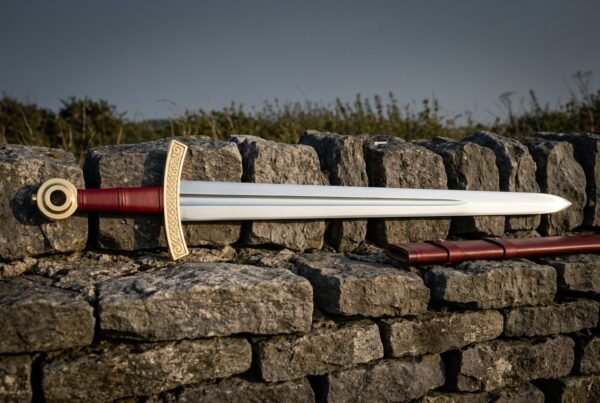 Redoath Hand Forged 1095 Carbon Steel Viking Sword with Knotwork Brass Guard
$469.00
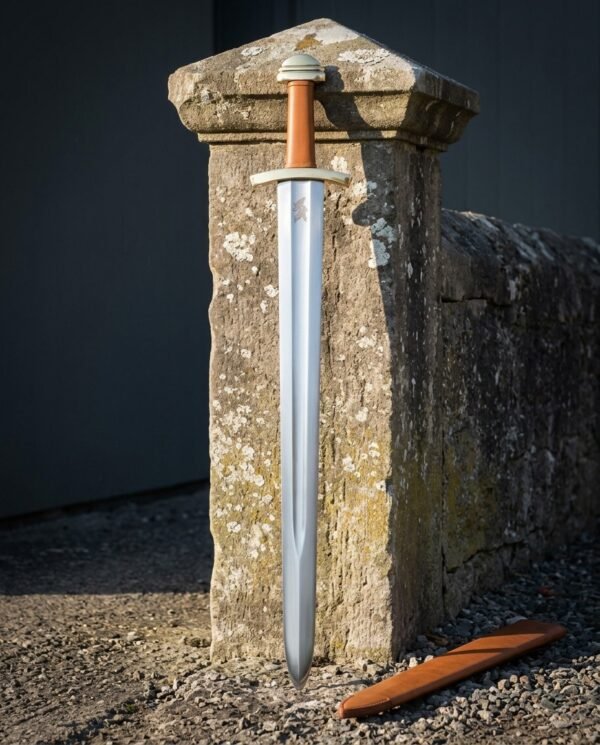 Emberhilt Hand Forged 1095 Steel Viking Sword with Brass Dome Pommel
$459.00