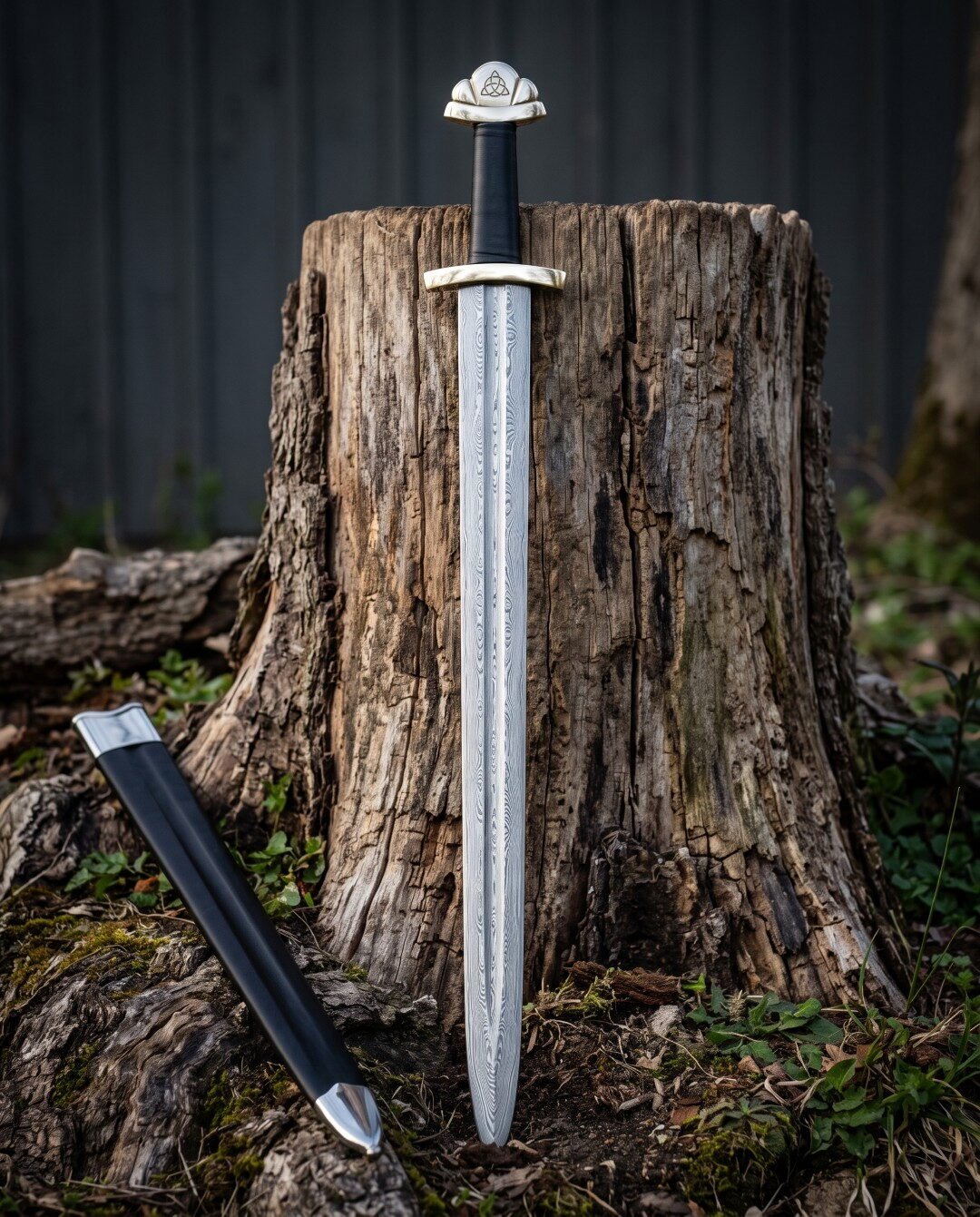
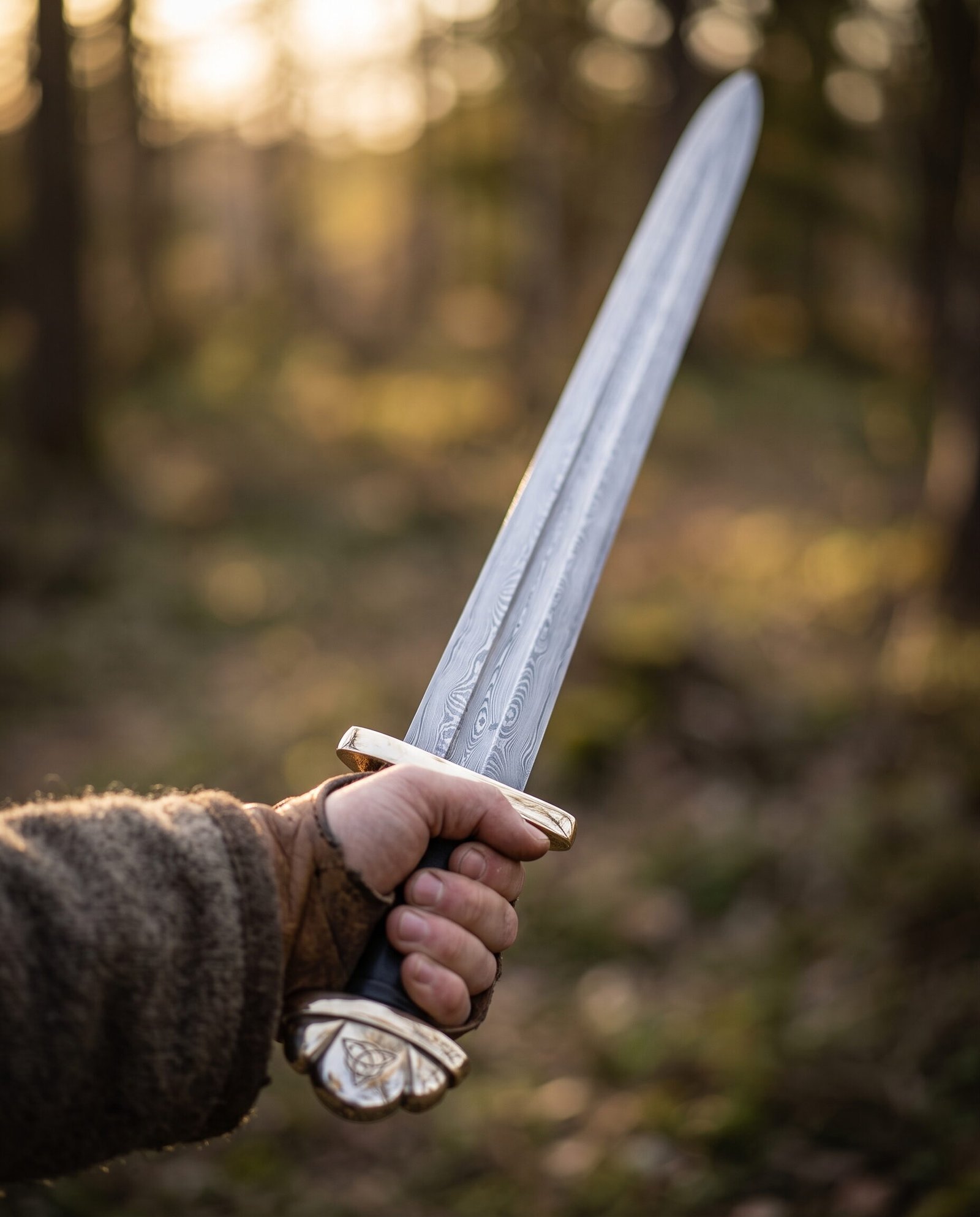
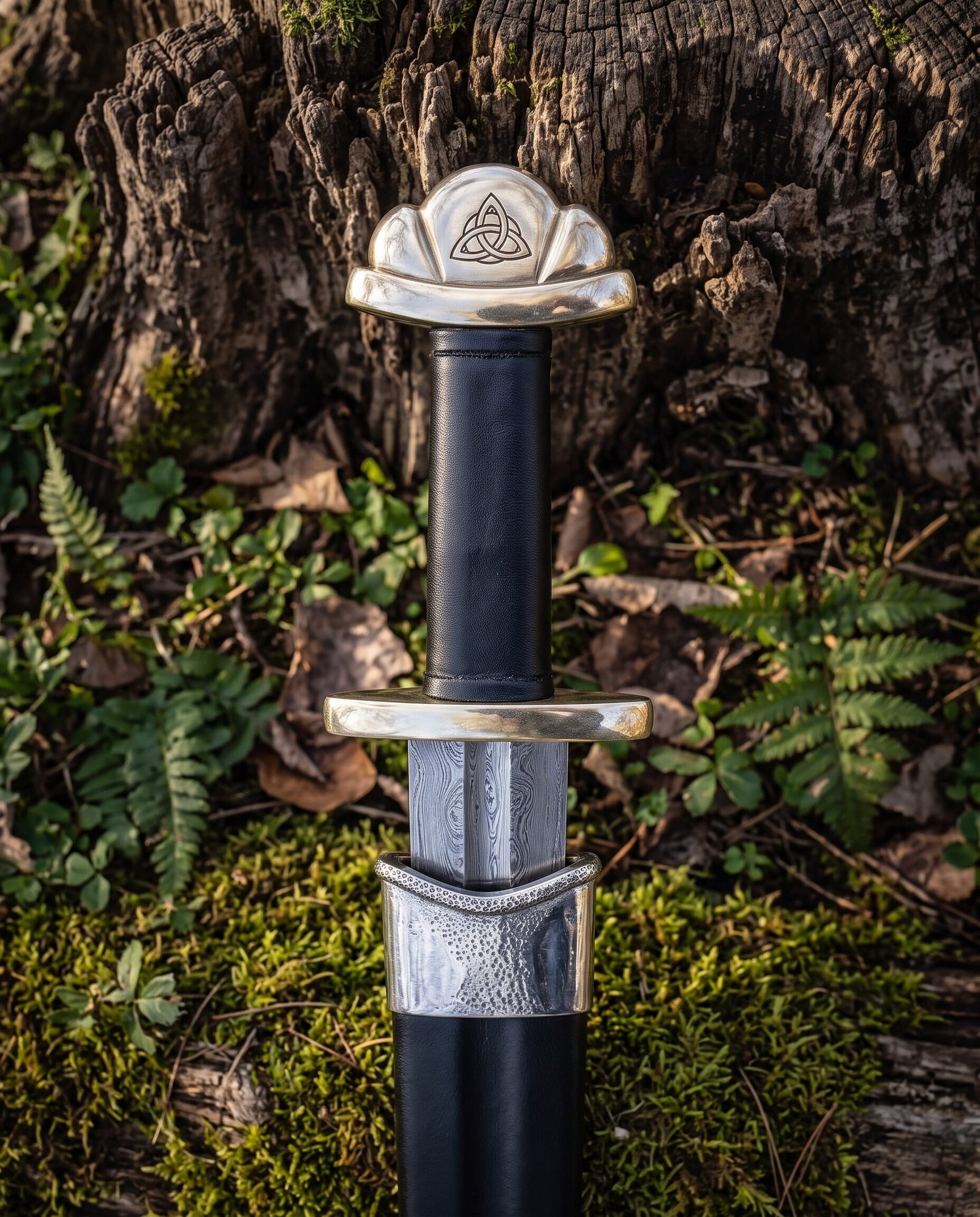
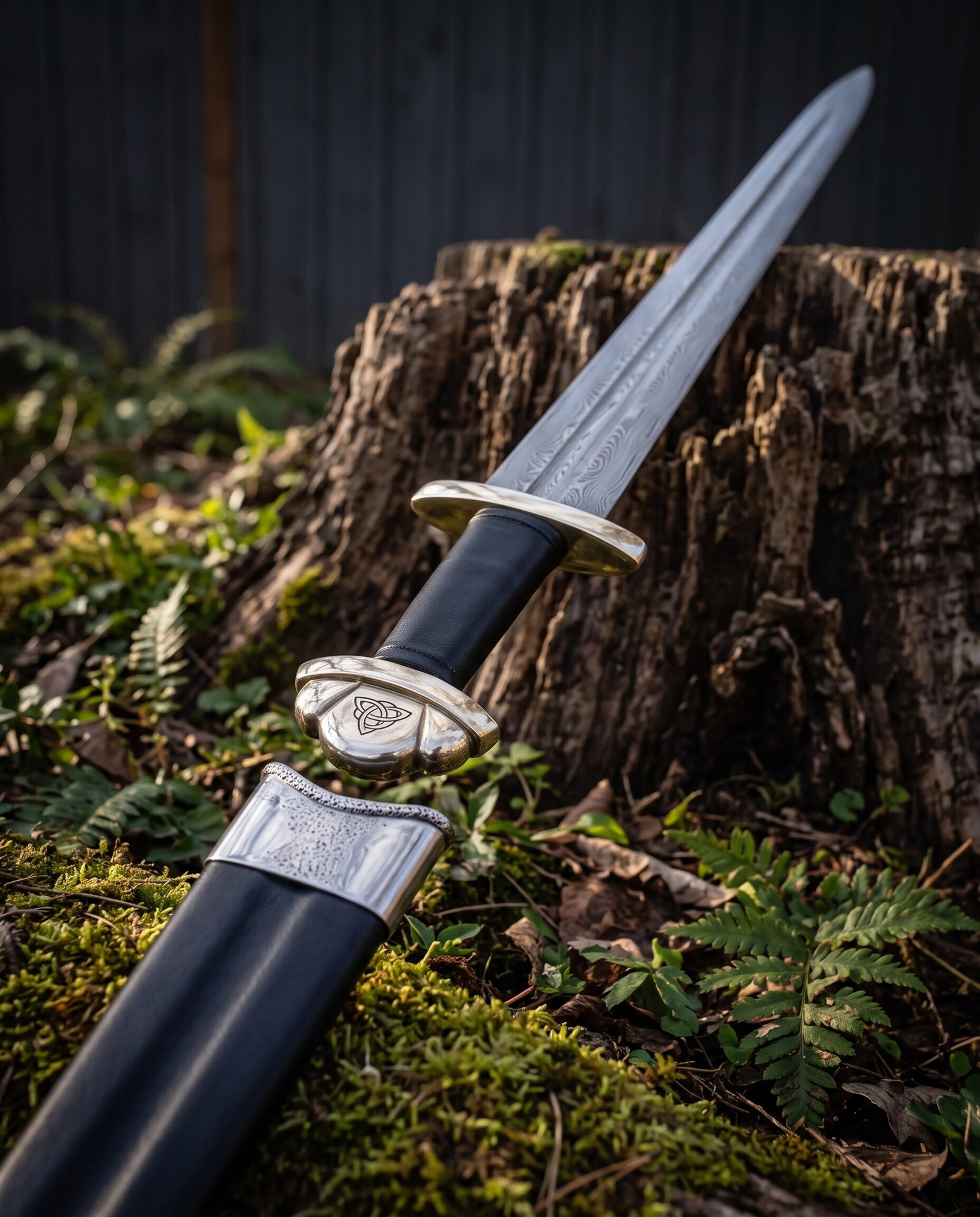
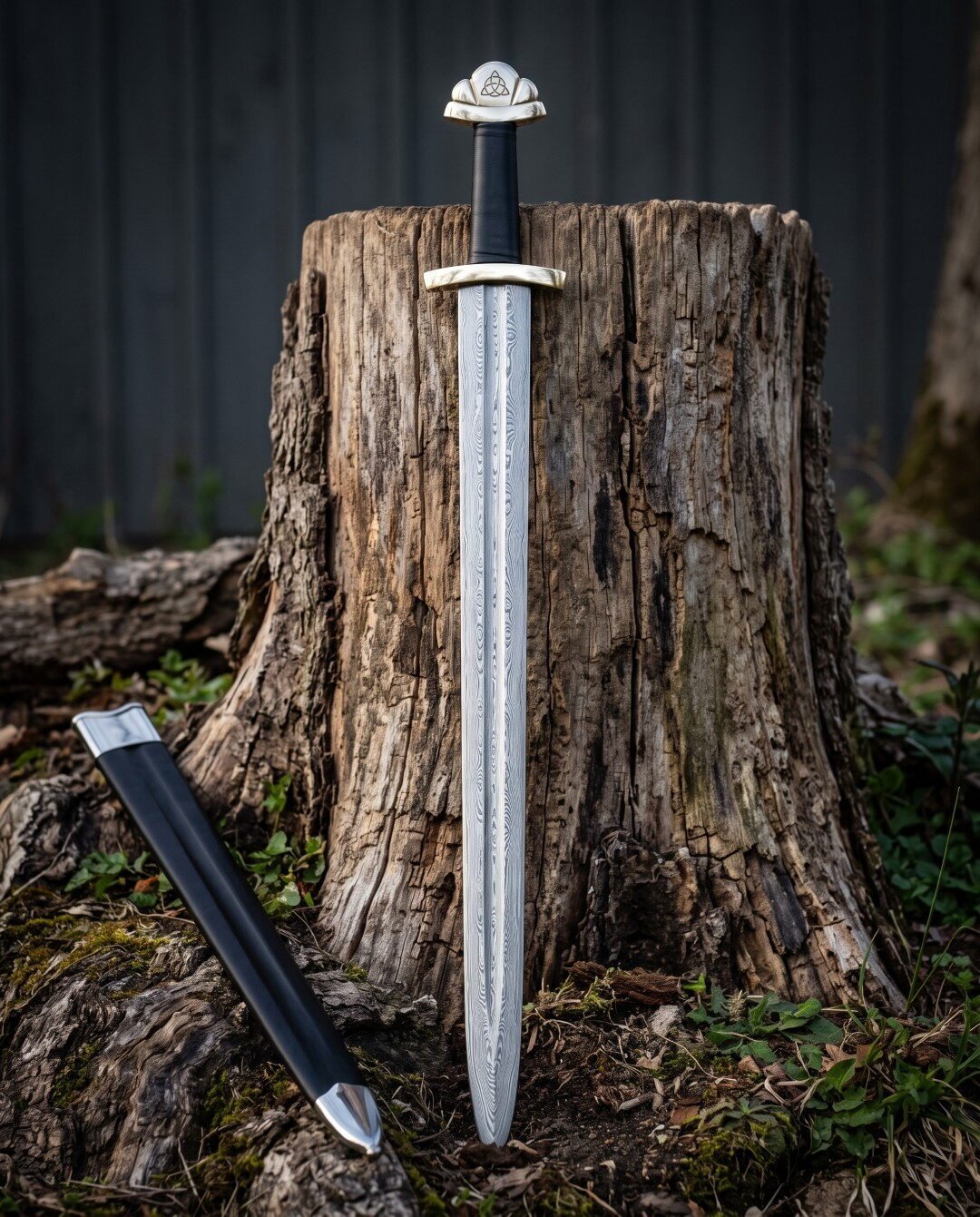
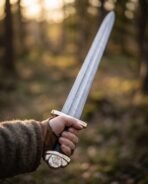
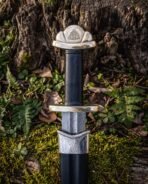
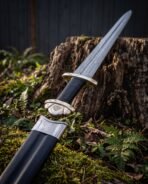
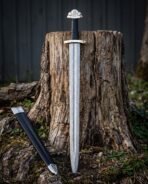
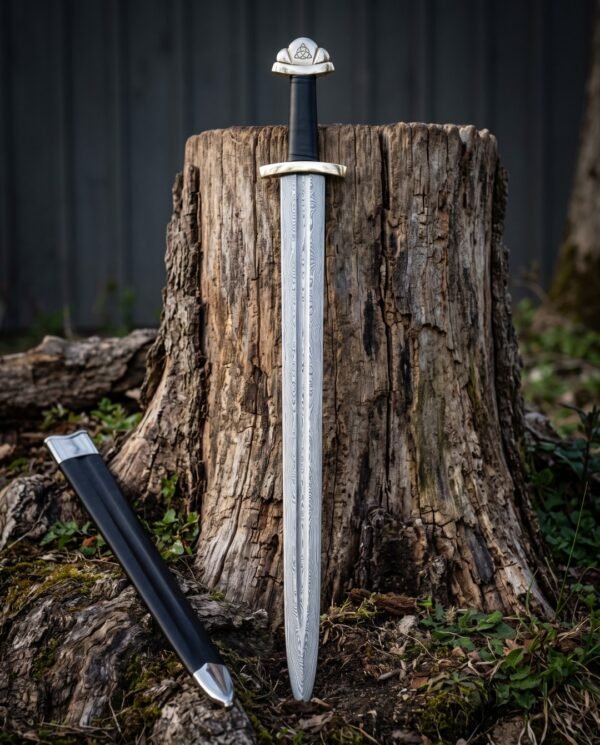
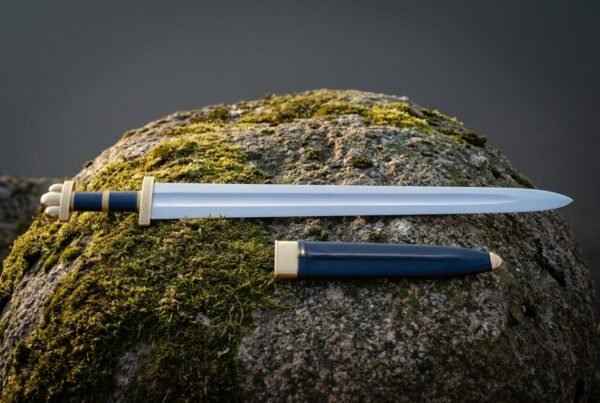
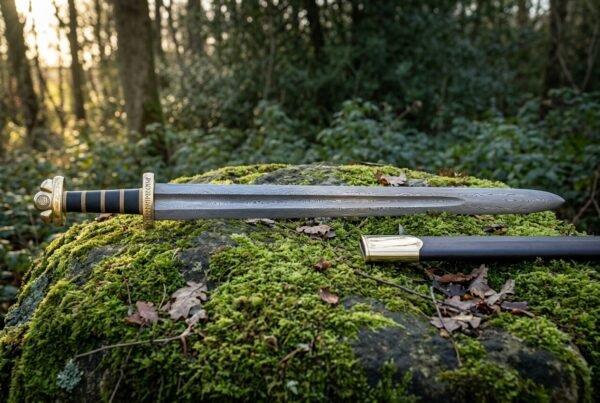
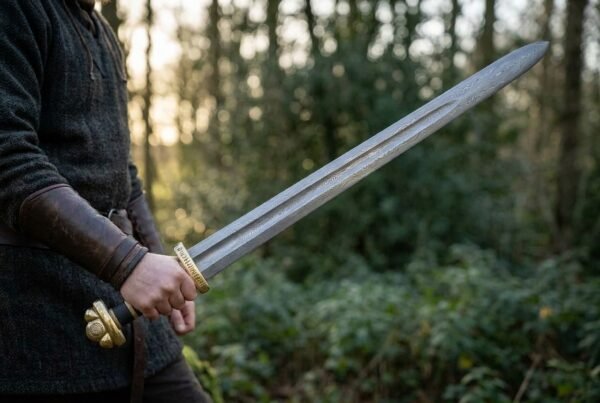
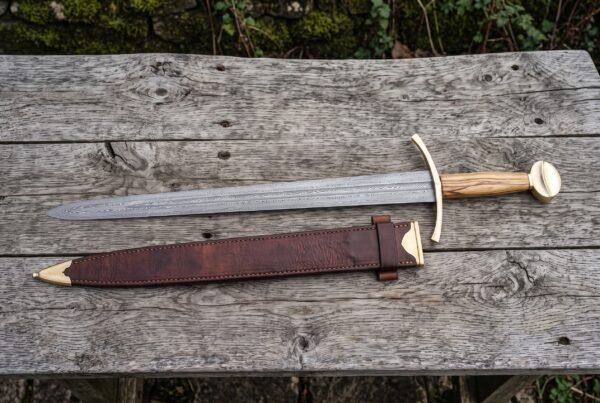
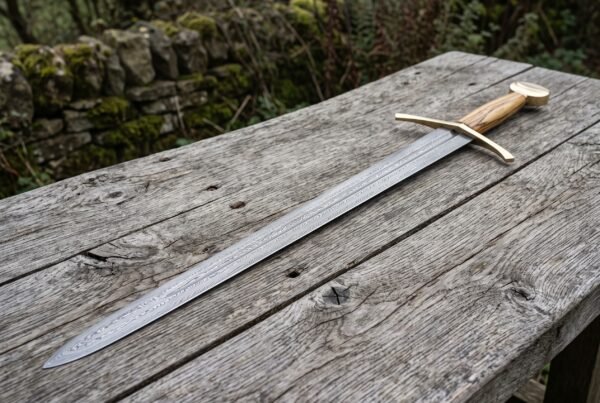
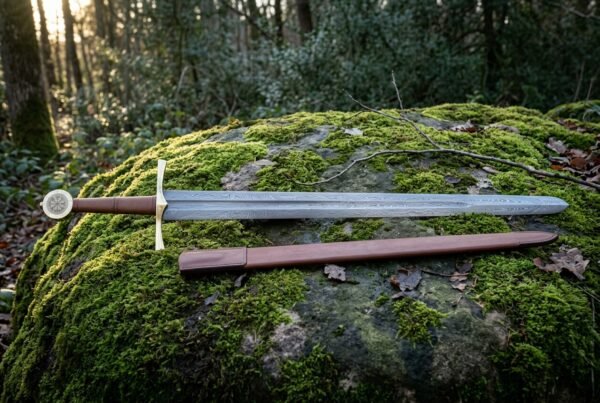
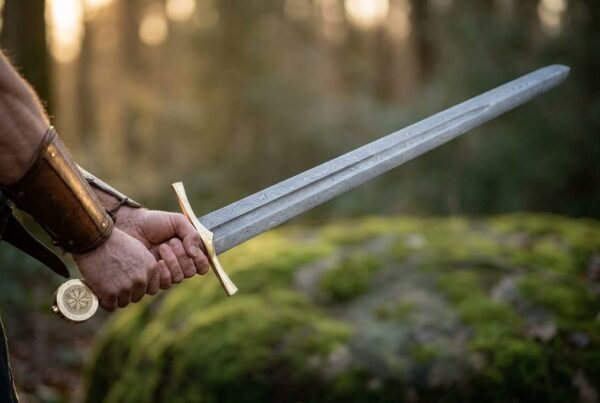
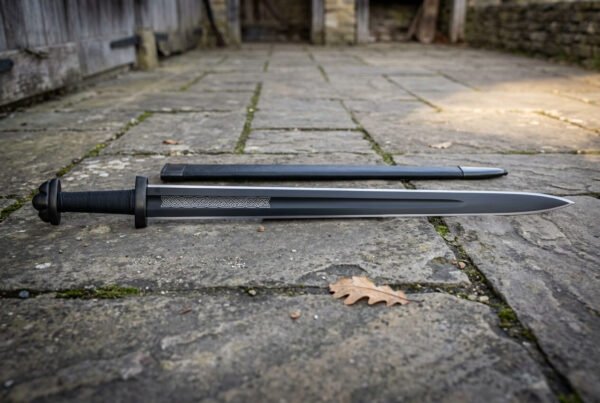
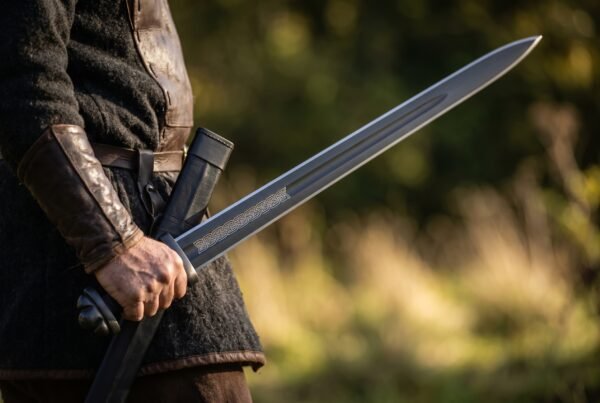
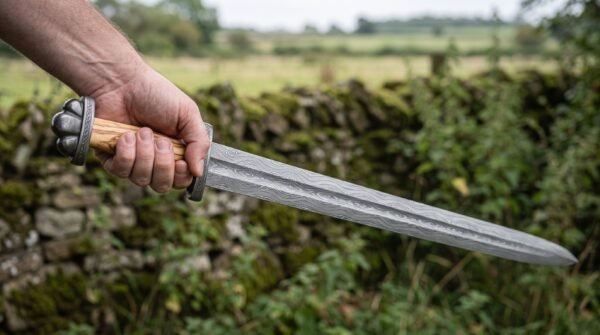
The Skeinfell is a Viking sword with a pattern welded Damascus blade, a three lobed pommel carrying an engraved triquetra, and a straight lower guard. The blade is broad, double edged and shallowly fullered, and the folded pattern runs the full length of it in long ripples. The grip is wrapped in black leather between two bars of polished bright metal, and the sword ships in a black scabbard with a fitted throat and chape.
The three lobed pommel is not decoration for its own sake. It is one of the most recognisable Viking hilt forms and it is the reason we can date and place a sword found in a river or a grave. In 1919 the Norwegian archaeologist Jan Petersen sorted several hundred Norwegian Viking sword hilts into an alphabet of types based purely on the shape of the guards and the pommel, and lobed pommels run right through that sequence. Three and five lobes are the common counts. The lobes began as separate pieces riveted onto a pommel bar and only later became a single cast or forged unit, which is why so many surviving examples show a visible seam. Every one of these is welded, ground, heat treated and fitted in a Czech Republic workshop, and each ships with the fitted scabbard shown and our lifetime warranty against defects in forging, grind, heat treat and fittings.
Pommel, fuller and grip length are what separate a good Norse sword from a prop, and what to look for in a Viking sword goes through them. That three cornered knot is a triquetra, one of several covered in our run through the Norse symbols. A board from the round shields is what usually stands beside one.
Specifications
| Blade material | 1095 and 15N20 pattern welded Damascus, hardened to 58 to 60 HRC |
|---|
| Overall length | About 33 inches |
|---|
| Blade length | About 27 inches |
|---|
| Blade type | Double edged with a broad shallow fuller |
|---|
| Grip | Black leather wrap over a shaped core, single hand |
|---|
| Guard | Straight lower guard bar in polished bright metal |
|---|
| Pommel | Three lobed pommel on an upper guard bar, triquetra in a ring engraved on the centre lobe |
|---|
| Finish | Acid etched and polished Damascus blade, polished hilt furniture |
|---|
| Scabbard | Black scabbard with a polished metal throat and chape, both finely engraved |
|---|
| SKU | RK-1955 |
|---|
Reading a Viking hilt
A Viking sword hilt is built in three parts and almost nobody notices the middle one. There is a lower guard sitting on top of the blade shoulders, a grip, and then an upper guard bar with the pommel on top of that. The upper guard is a separate piece. On original swords the tang passes through all of it and is peened over the crown of the pommel, which is why the top of a genuine Viking sword usually shows a small flattened stub of steel rather than a smooth dome.
Those two guard bars are what carry the shape. The lobes sit above the upper bar and give the sword its silhouette from thirty paces, which mattered on a beach or in a shield wall where recognising the man was as useful as recognising the blade. The triquetra on the centre lobe is a three cornered interlace, an old Insular and Norse decorative form found on stone crosses, on Gotland picture stones and on coins of Olaf Guthfrithsson in tenth century Northumbria. It is a knot of three loops drawn from one continuous line.
Pattern welded Damascus
The blade is folded and forge welded from 1095 and 15N20 in alternating layers, then drawn out, ground and etched. The two steels are chosen for what happens after the acid rather than before it. 1095 is plain high carbon and it darkens deeply when etched. 15N20 carries around two percent nickel, and nickel resists the acid, so those layers stay bright. Every light and dark line you can see on this blade is one of those layers cut through at an angle by the grind.
The pattern is therefore not printed, stamped or laser marked. It is the internal structure of the steel showing through the surface, and if you sharpen the blade back over the years the pattern will change slightly at the edge because you are exposing a new depth of the same stack. Heat treated together, the two steels finish at 58 to 60 HRC, a little harder than a plain 1095 blade of the same size, which is why a Damascus blade will hold an edge longer and needs a slightly gentler hand on the stone.
Engraving, runes and your own design
Use the rune converter on this page to turn a name, a date or a short phrase into Elder Futhark and we will cut it into the steel or the leather. If you would rather have a Viking pattern than a rune line, choose your own design in the engraving option above the add to cart button and tell us where it goes. Where a piece already carries an engraved design, your chosen engraving replaces it rather than sitting alongside it. On the Skeinfell that means the triquetra on the centre lobe. We can also cut a rune line into the lower guard or into the scabbard leather and leave the triquetra untouched, which is what most people choose. See the engraving page.
Handling and balance
Viking swords are single handed cutters and this one behaves like one. The lobed pommel is heavy for its size and it sits directly behind your fist, which drags the balance point back to roughly three inches ahead of the lower guard. The result is a sword that feels shorter in the hand than it looks on a table. It rolls from one cutting line to another with wrist movement alone.
The grip is short by modern expectations. That is correct for the period. A Viking sword grip is meant to be filled completely by one hand with the pommel pressing into the heel of the palm, not gripped loosely with room to spare. This is a sharp forged blade and it is not for sparring or reenactment. Do not use it in contact work against a person or another blade.
Care
Damascus needs more attention than plain steel, not less. The etched surface is very slightly textured at a microscopic level, so it holds moisture and fingerprints better than a mirror polish does, and rust will show first in the darker 1095 bands. Wipe the blade after every handling and keep a light film of mineral or camellia oil on it. Never store it in the scabbard for long stretches. Detailed guidance is in our steel care notes.
If a spot of rust does appear, do not attack it with a wire wheel or coarse abrasive, because that will flatten the etch and grey out the pattern in that area. Oil it, leave it, then work it very gently with a brass brush or a cork and oil. The hilt furniture takes a soft cloth and nothing stronger. Feed the scabbard leather once or twice a year.
Damascus wants oil more than plain steel does, because the etch that shows the pattern also opens the surface, and caring for a Damascus pattern covers what to use.
Made in the Czech Republic
Every piece we sell is made by hand in the Czech Republic. The smiths there work the way the trade has been worked for a long time, heating and hammering the steel, taking the bevels down by eye, and fitting the handle and the leather one at a time. There is no automated line anywhere in it, so small differences from one piece to the next are normal and expected.
Ransack Viking is a United States company based in Chicago, Illinois. We bring the pieces in ourselves, inspect them on arrival and ship them from our own warehouse. If you add engraving, that is carried out here in the United States before your order goes out.
A note on handmade variation
This sword is hand made and not machine made or bulk produced, so what arrives will not be a pixel for pixel copy of the photograph. Damascus especially cannot be repeated. The exact swirl and drift of the pattern depends on how that particular billet moved under the hammer, how deep the grind cut into the layers and how long the acid sat, so your blade will carry a pattern that no other sword has. The lobe shaping, the tone of the hilt metal, the leather wrap and the depth of the triquetra engraving vary too. The length, the steels, the heat treat and the construction do not.
Frequently asked questions
Is the Damascus pattern real or is it etched on
Real. The light and dark lines are alternating layers of 1095 and 15N20 forge welded into one billet and then cut through by the grind. Acid only reveals what is already there.
Will my blade have the same pattern as the photograph
No, and it cannot. Every billet moves differently under the hammer. Yours will be the same style of pattern with a layout unique to it.
Is it sharp on arrival
Yes. Damascus at 58 to 60 HRC takes and holds a keen edge, and it ships with one.
What are the hilt fittings made of
Polished bright metal furniture, buffed to a high shine. We describe the finish rather than claiming a specific alloy because the tone shifts between batches.
Is this a battle ready sparring sword
No. It is a sharp forged sword for cutting practice, display and collection. It must not be used for contact fighting or reenactment combat.
How soon will it ship
Processing is one to two weeks, then transit. Free inside the United States. Engraved orders take a few days longer.
What is in the box
- Skeinfell Damascus Viking sword in 1095 and 15N20 pattern welded steel
- Fitted black scabbard with metal throat and chape
- Protective oil film on the blade for transit
- Care card and lifetime warranty against defects in forging, grind, heat treat and fittings
- Forged and finished in the Czech Republic
Explore the range
More in Damascus swords, Viking swords and swords, or read the guides on pattern welding and how to look after an etched blade.
Near neighbours in the shop
If this one is not quite right, there is the Lobecrown Viking sword, pattern welded Damascus. Also in this group is the Knotdrift Viking sword, pattern welded Damascus. Sitting beside it in the catalogue is the Staveholm Viking sword, 35 inches overall.
From the same corner of the shop, there is the Gildhawk sabre. You can have this made your way instead on the custom Viking sword page.

Perfect gift. Perfect quality. No complaints. Weight and balance make it feel like a real functional piece not some cheap replica. Highly recommend this one.
Perfect gift. Perfect quality. No complaints. Already planning my next purchase from this shop.
So happy I finally pulled the trigger on this one. The wood handle feels amazing and the balance is perfect. Came in a nice gift box which made it feel even more special. Highly recommend this one.