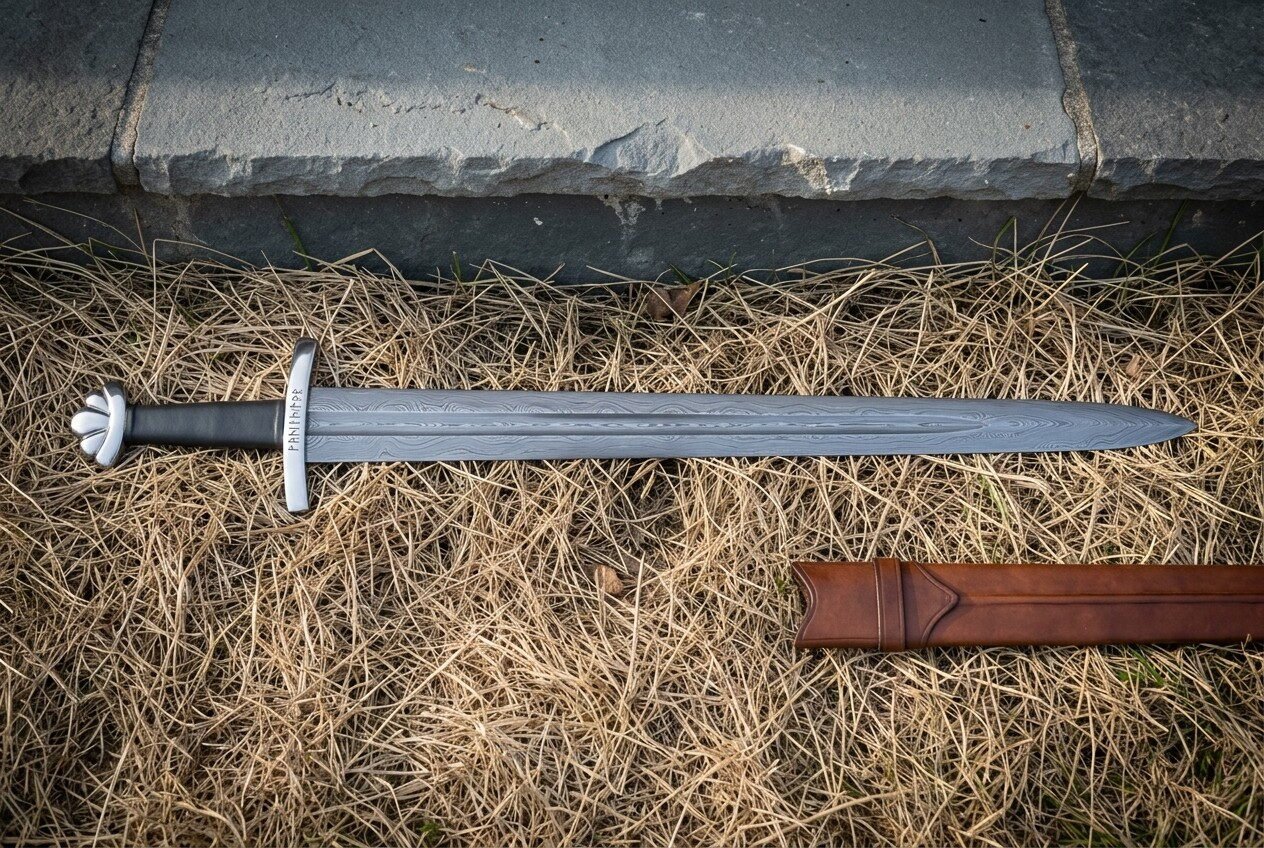
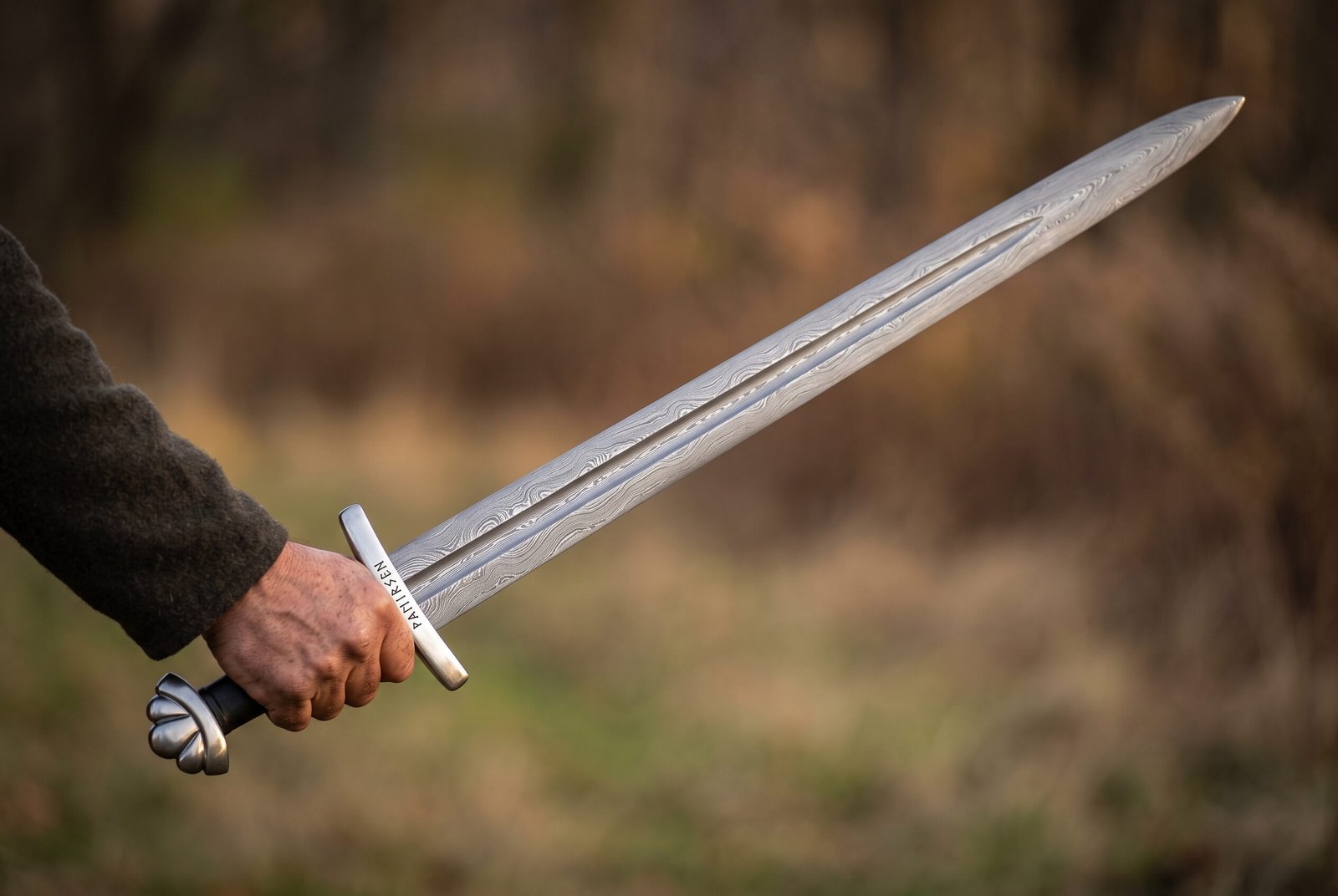
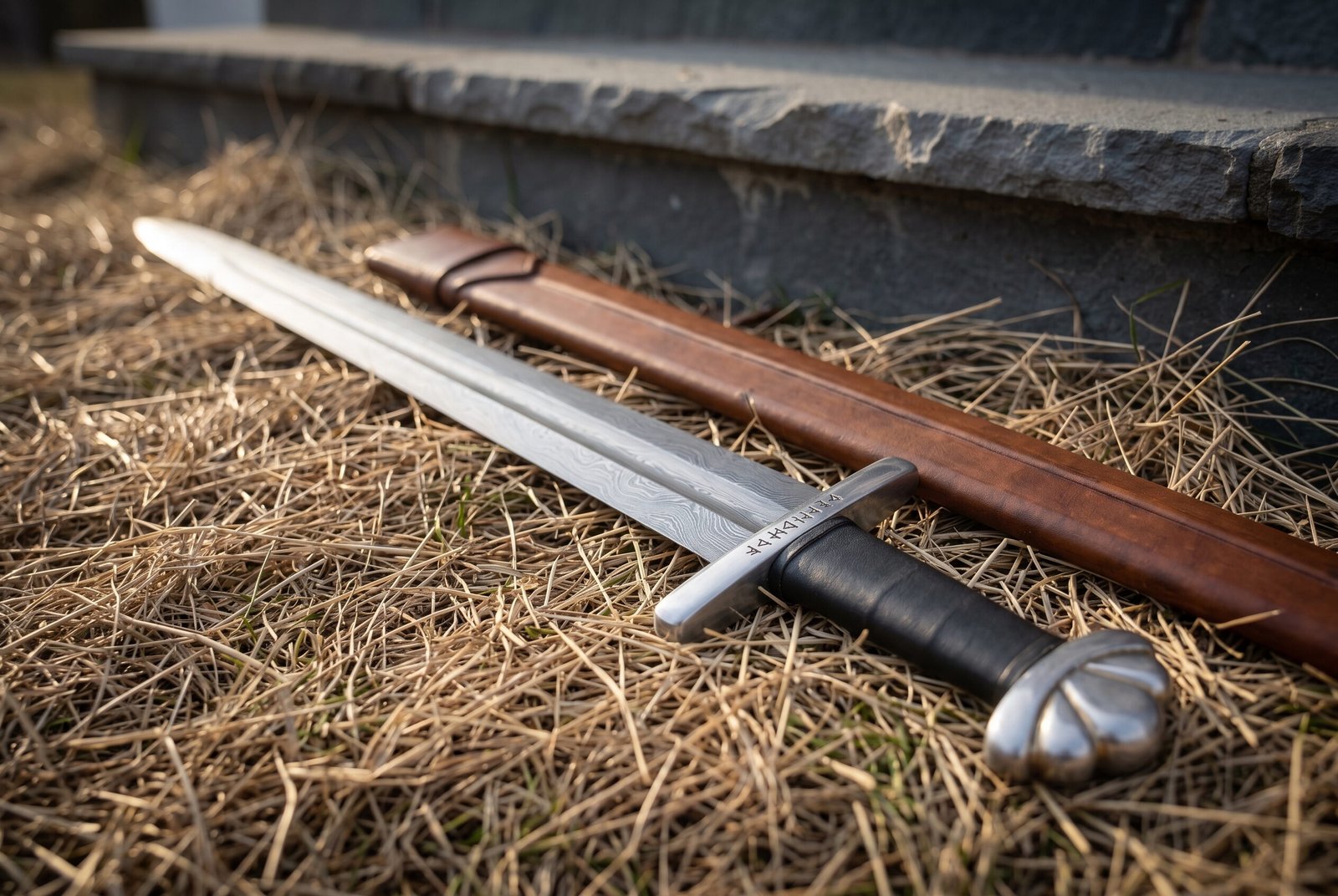
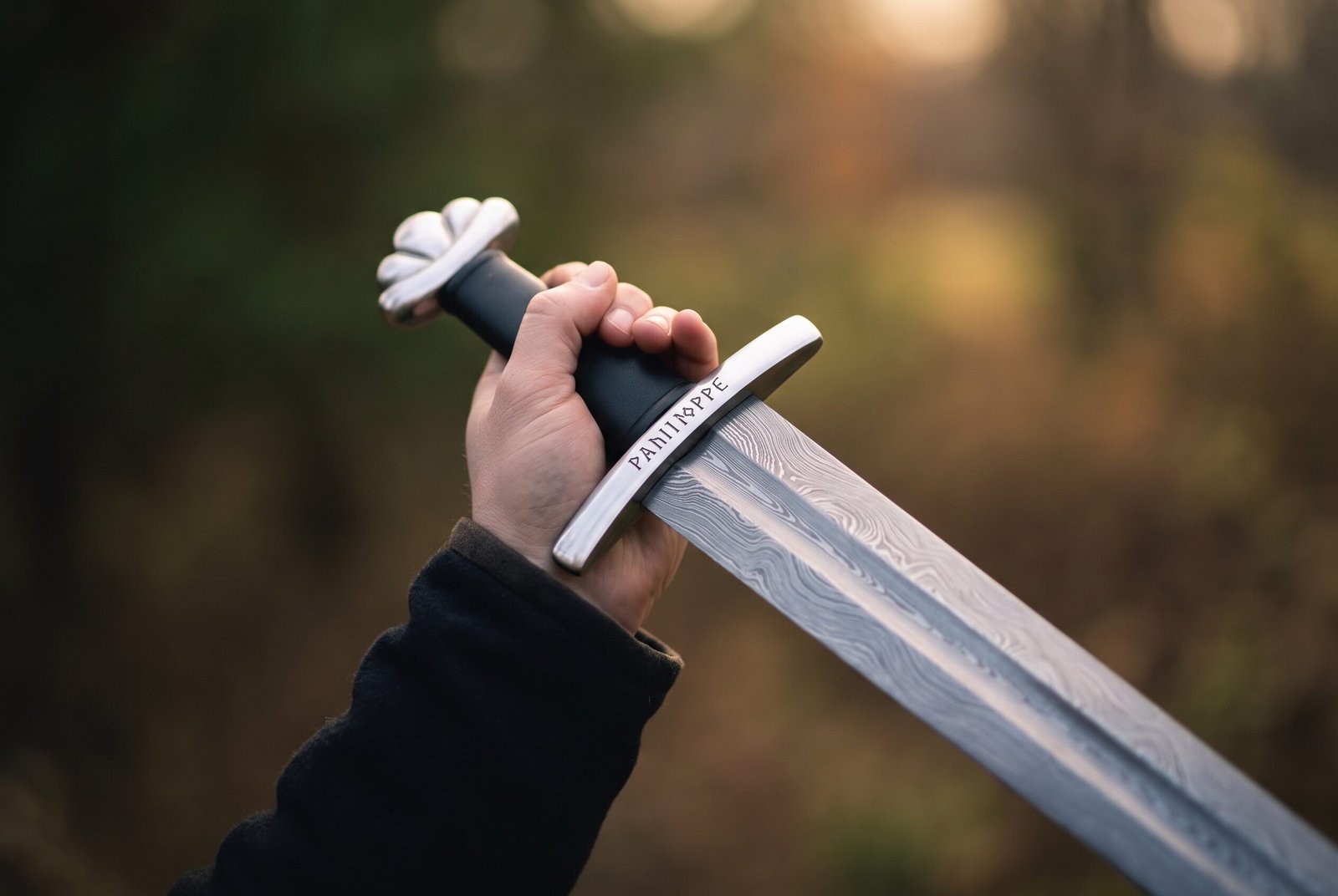
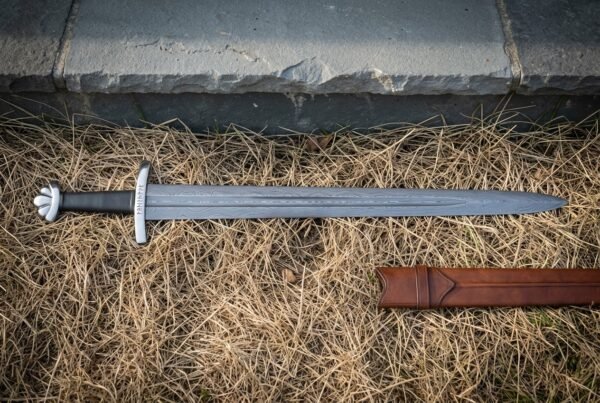
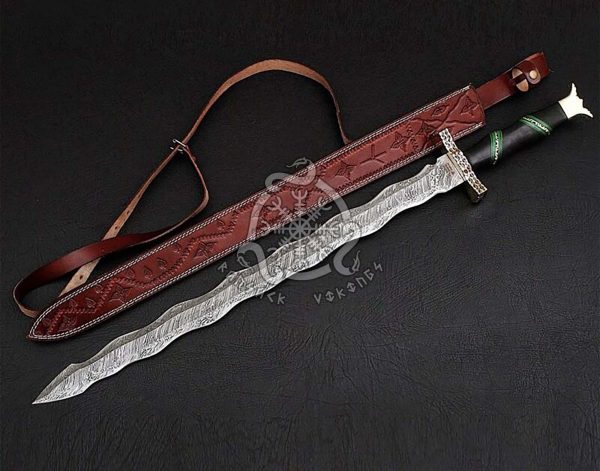
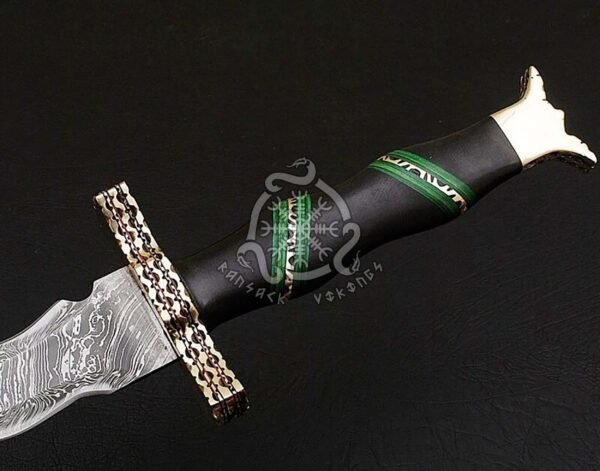
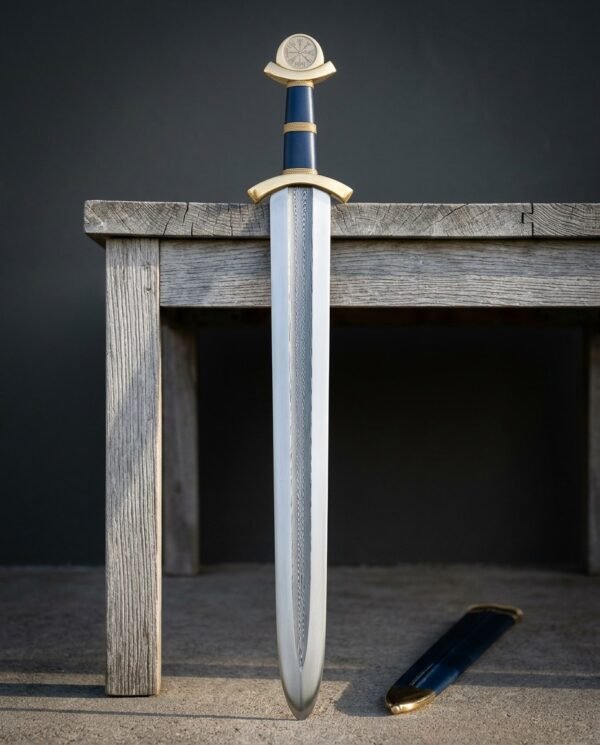
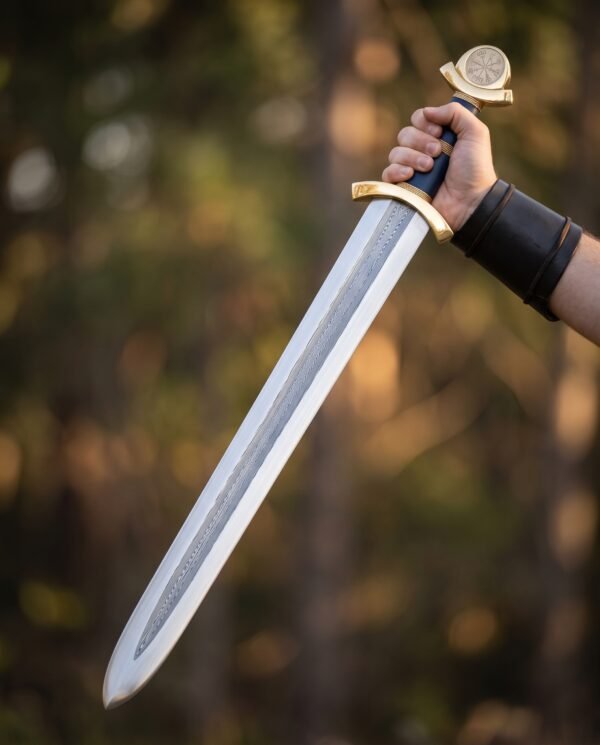
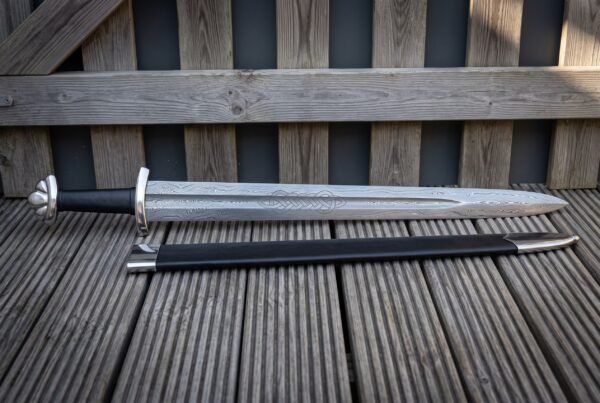
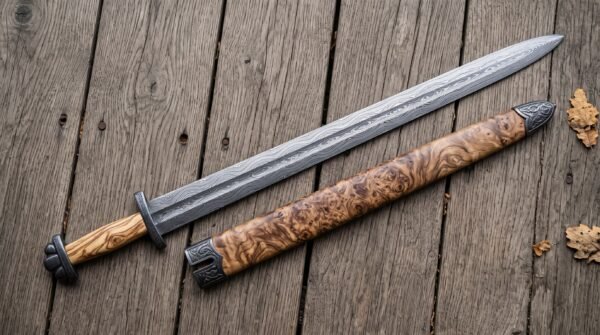
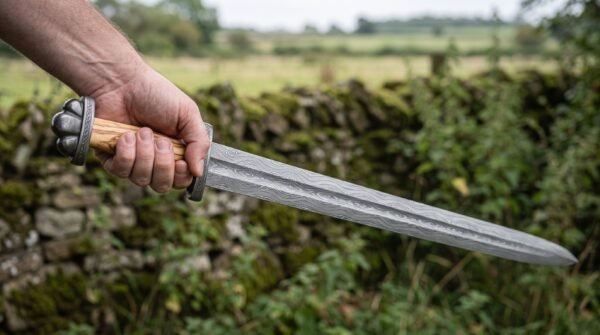
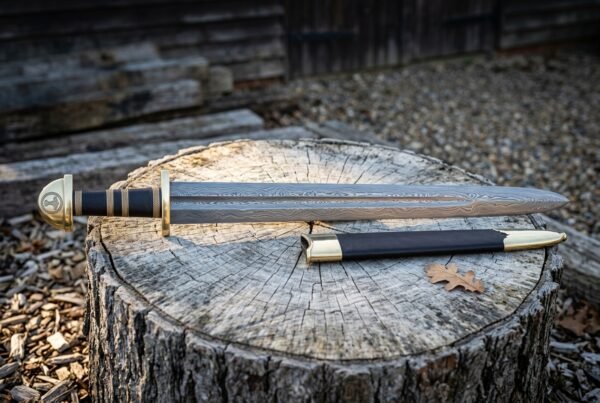
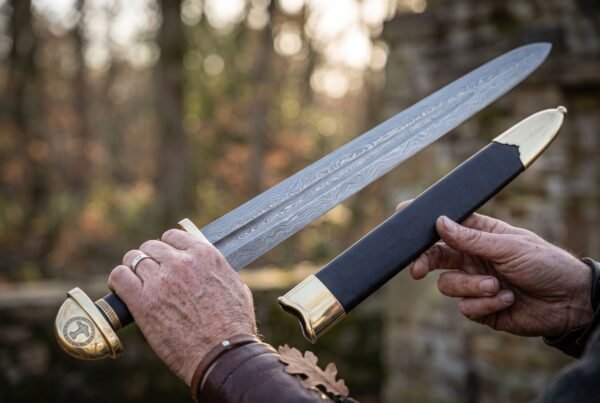
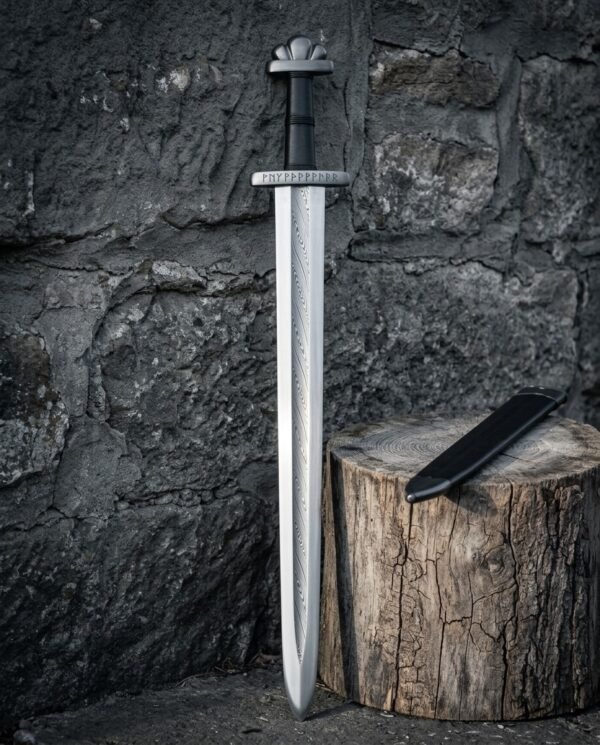
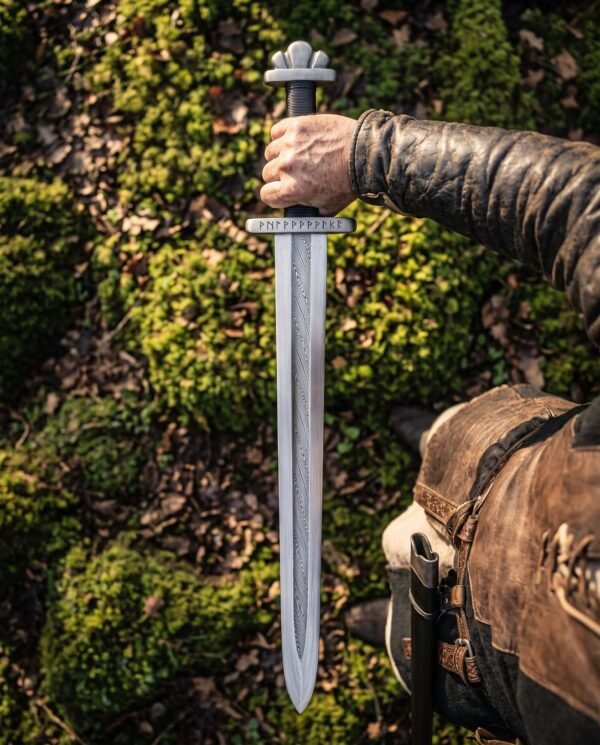
The Lobecrown is a Viking age sword with a broad, fullered, double edged blade in pattern welded Damascus, a gently curved lower guard, a black leather wrapped grip and a five lobed pommel. A short line of Elder Futhark runes is cut into the face of the steel crossguard, and the blade itself is left clean. It comes with a brown leather scabbard.
The pattern in this blade is not just a finish. Viking smiths pattern welded because they had to. Bloomery iron came out of the furnace as a spongy mass with carbon scattered unevenly through it, so one bar might be soft wrought iron and the next hard enough to be brittle. The answer was to forge weld rods of different iron together, twist them, draw them out and fold them, which averaged the properties across the whole blade and gave a blade that would flex rather than snap. The surface pattern was a side effect that smiths quickly learned to control and show off. By the time high quality crucible steel began reaching the north in the tenth century, pattern welding was already sliding from necessity into ornament. This sword is forged and finished in the Czech Republic, and ships with its scabbard.
Screen Norse kit gets the sword wrong more often than it gets it right, and the screen arms rated for accuracy rates the ones you have seen. The staves are Elder Futhark, the oldest of the Norse alphabets, and every Elder Futhark rune is written out with the name and sound of each one. A board from the round shields is what usually stands beside one.
Specifications
| Blade | Pattern welded Damascus in 1095 and 15N20, hardened to 58 to 60 HRC |
|---|
| Blade profile | Broad double edged blade with a wide central fuller, tapering to a point |
|---|
| Overall length | Approximately 36 inches |
|---|
| Blade length | Approximately 30 inches |
|---|
| Grip | Black leather over a shaped wooden core, single hand |
|---|
| Pommel | Five lobed polished steel cap on a straight upper guard |
|---|
| Guard | Gently curved lower guard, polished steel |
|---|
| Engraving | Elder Futhark rune line cut into the face of the crossguard |
|---|
| Scabbard | Brown leather over a wooden core |
|---|
| Included | Sword and leather scabbard |
|---|
| SKU | RK-1872 |
|---|
What the five lobes are actually doing
Norse sword pommels are not one lump of metal. They are built in two parts: a flat bar called the upper guard that sits against the top of the grip, and a pommel cap riveted or welded onto it. The lobes are the shape of that cap. Jan Petersen, who catalogued Norwegian sword finds in 1919 and gave us the typology archaeologists still use, sorted the hilts largely by how many lobes the cap carried and how the guards were shaped. Three and five lobe caps dominate the ninth and tenth century material, with the centre lobe usually the tallest.
The reason the cap exists at all is practical. It is the counterweight. A Viking blade is broad and thin, and without mass behind the hand the sword would feel tip heavy and slow to recover after a cut. Putting that mass in a separate cap let a smith tune the balance late in the build, and let him decorate it separately in silver or copper wire inlay without risking the structural weld. The lobes themselves reduce the cap weight while keeping its width, which is why the shape survived for two hundred years across a huge area.
The steel and the pattern
The billet is forged from alternating layers of 1095 high carbon steel and 15N20. 1095 gives the hardness and the edge. 15N20 carries roughly two percent nickel, which resists the acid etch, so the two steels finish at different tones and the pattern appears. On this blade the layers run as long contour lines along the length of the fuller, which is what you get when a folded billet is drawn out and then ground into a fullered profile: the grinding cuts through the layers at a shallow angle and exposes them as flowing bands.
The blade is hardened to 58 to 60 HRC, which is where 1095 and 15N20 do their best work. The wide fuller down the centre is not a blood groove, whatever the internet says. It is a stiffening rib in reverse: removing steel from the middle of the flat, where it contributes least to stiffness, takes weight out without much loss of strength, the same principle as an I beam.
Engraving, runes and your own design
Use the rune converter on this page to turn a name, a date or a short phrase into Elder Futhark and we will cut it into the steel or the leather. If you would rather have a Viking pattern than a rune line, choose your own design in the engraving option above the add to cart button and tell us where it goes. Where a piece already carries an engraved design, your chosen engraving replaces it rather than sitting alongside it. On this sword the rune line sits on the face of the crossguard, and the scabbard throat takes a second line if you want one. See the engraving page.
Handling and balance
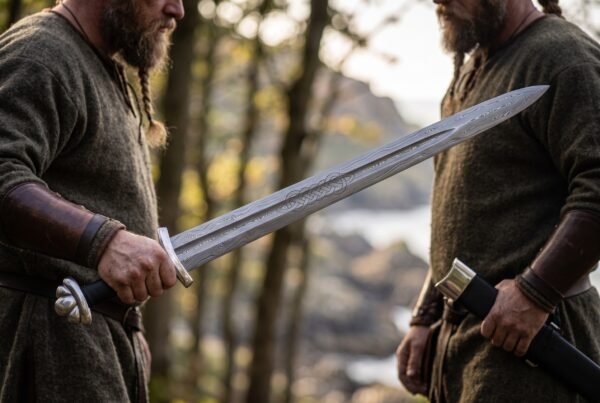
Viking swords are single hand blades and were carried alongside a shield, so they are lighter and shorter than the medieval longswords people usually picture. The grip on this one takes one hand with the pommel sitting against the heel, and the five lobed cap pulls the balance point back to a few inches in front of the guard. That makes the sword feel lively in the wrist and quick to change line, which is exactly what a shield wall sword needed.
The point is tapered but not needle fine, which suits a blade built mainly to cut, with the thrust a secondary option against an opponent already opened up. Do not use this for sparring. It is a sharp, hand forged sword for collection, display and careful handling, not a blunt trainer for full contact work.
Care
Carbon steel rusts, and an etched Damascus surface shows every fingerprint. Wipe the blade down after handling and keep a thin film of oil on it. Mineral oil or a purpose made blade oil, applied with a soft cloth, is enough. Do not leave the sword stored in the leather scabbard for months at a time, because vegetable tanned leather holds moisture against steel. Feed the scabbard with a leather balm once or twice a year and dry it naturally, never near a radiator. Our steel care page covers rust removal if a spot does appear.
Damascus wants oil more than plain steel does, because the etch that shows the pattern also opens the surface, and caring for a Damascus pattern covers what to use.
Made in the Czech Republic
The work behind this piece happens in a Czech Republic workshop that has kept to the old methods. Steel is forged and heat treated by hand, the grind is taken down by eye rather than by machine, and the handle, fittings and sheath are cut and finished one at a time. Because of that, every piece carries small marks of the hand that made it.
Ransack Viking is a United States company. We import direct, check each piece when it reaches us, and ship from our Chicago, Illinois warehouse. Engraving is added here in the United States after arrival, so the piece you receive is finished to your order.
A note on handmade variation
This is hand made, not machine made or bulk produced, so what arrives will not be a pixel for pixel copy of the photograph. Pattern welded steel varies more than any other part: layer count, etch depth and the flow of the bands change from billet to billet, so your blade will carry its own pattern. Hammer texture on the fittings, the tone and grain of the leather on the grip and scabbard, and the exact profile of the lobes all shift a little because each sword is worked by hand. The dimensions, the material and the build are the same every time. The character is not.
Frequently asked questions
Is the blade sharp when it arrives
Yes, it arrives sharpened on both edges. If you want it left blunt for display or because it is going into a household with children, put that in the order notes and we will do it at no extra cost.
Can I use this for reenactment or sparring
No. A sharp sword has no place in contact drilling of any kind. This is a collector and display piece for careful handling. Reenactment groups require blunt, rolled edge blades built to their own safety standards.
What do the runes on the guard say
The stock inscription is a short Elder Futhark line. If you want specific words, use the rune converter on this page and we will cut your text instead. Bear in mind Elder Futhark has no direct letters for some modern sounds, so the converter maps them to their closest historical equivalent.
Is the scabbard rigid or soft
It is leather over a shaped wooden core, so it holds its shape and protects the edges. It is not a soft sleeve. The mouth is fitted to this blade, so it will not swallow a different sword.
Will my sword look exactly like the photograph
The shape, size and build will match. The Damascus pattern will not, because it cannot: each billet folds differently. Most people find that the point of buying a pattern welded blade rather than a stamped one.
How long before it ships
One to two weeks of processing, then free shipping within the US. Tell us in the order notes if you have a date to hit and we will let you know honestly whether it is possible.
What is in the box
- Lobecrown pattern welded Damascus Viking sword with five lobed pommel
- Brown leather scabbard over a wooden core
- Care card for carbon steel and leather
- Lifetime warranty against defects in forging, grind, heat treat and fittings
- Forged and finished in the Czech Republic
Explore the range
See more in Viking swords, Damascus swords and arming swords, or read the guides on Petersen hilt types and pattern welded steel.
If this one is not it
Also in this group is the Skeinfell Viking sword, 33 inches overall. Sitting beside it in the catalogue is the Runeflame Viking sword, 37 inches overall. Another in the same line is the Knotdrift Viking sword, pattern welded Damascus.
For a different piece from the same family, look at the Trinehilt wakizashi. Pick the steel, the length and the fittings yourself on the custom Viking sword page.


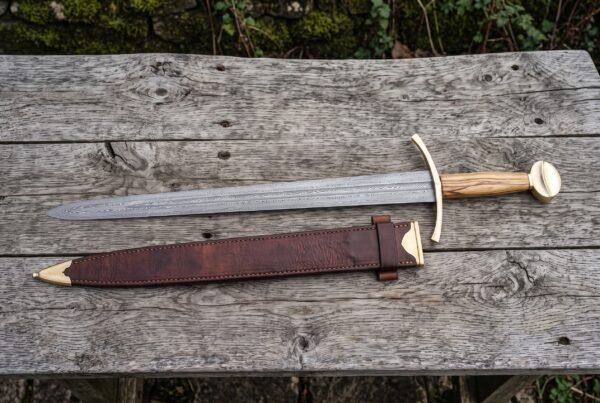
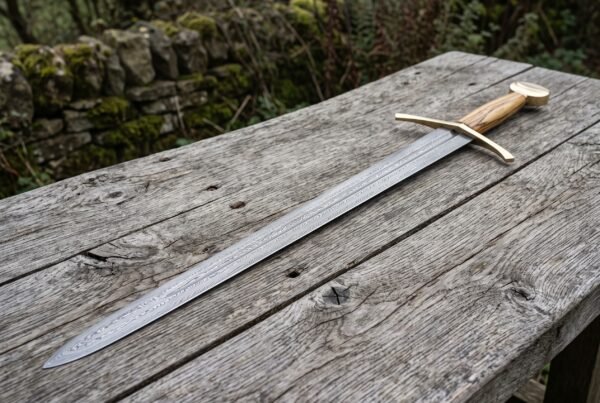
Good quality sword for the price. Blade quality is solid. Arrived a bit less sharp than expected but a few passes on a strop fixed it. Wood handle looks great though it’s a little smaller than I imagined. Nice that it ships from a US warehouse even though the craftsmanship is Czech. Would still tell others to give this a try.
My husband was speechless when he opened this. Damascus blade holds a razor edge right out of the box. This will be a family heirloom for sure.
Solid sword. Glad I ordered it. Ransack Viking usually delivers solid quality and this was no exception.