
A flamberge is a sword with a waved edge. The blade runs in regular undulations from the ricasso to the point instead of in a straight line, which is harder to forge and much harder to grind, and that is most of the reason it exists. The wave was a mark of status on German and Swiss blades in the sixteenth and seventeenth centuries long before it was anything else.
The pieces here run 27 to 43 inches overall with 20 to 33 inches of blade, so the group covers short swords, one handed arming swords and full two handed longswords. Eight are 1095 high carbon hardened to 54 to 58 HRC. Five are Damascus of 1095 and 15N20, forge welded and acid etched, hardened to 58 to 60 HRC. Guards run from a plain steel crossbar to blackened swept hilts with knuckle bows, and three carry parrying hooks or lugs below the cross.
Several of the longer swords ship with a rounded display edge. Each product page says which.
Free US shipping
On most pieces. Heavier and oversized ones carry a flat charge.
Hand Forged
Heated, hammered and ground by hand.
Engraving available
Names, dates or Norse runes on most pieces.
Ships from Chicago
Inspected and dispatched from our Chicago warehouse. No import duty, no customs delay on US orders.
Flamberge Swords
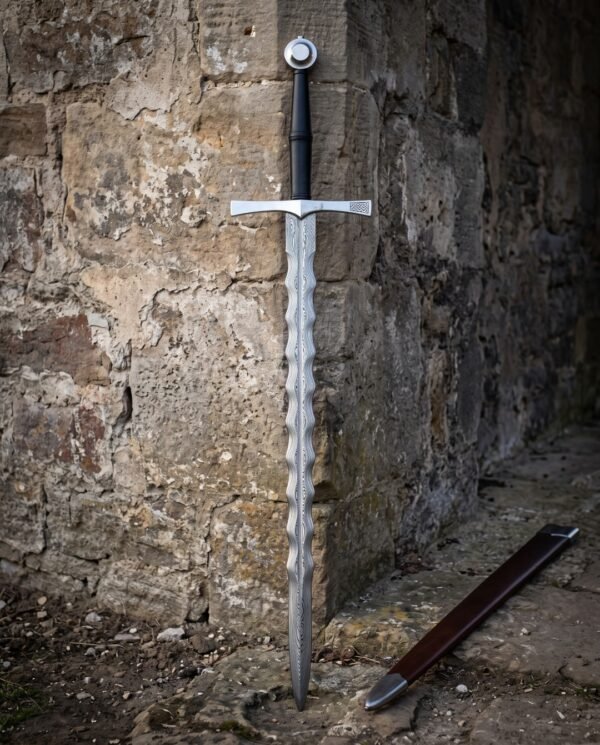
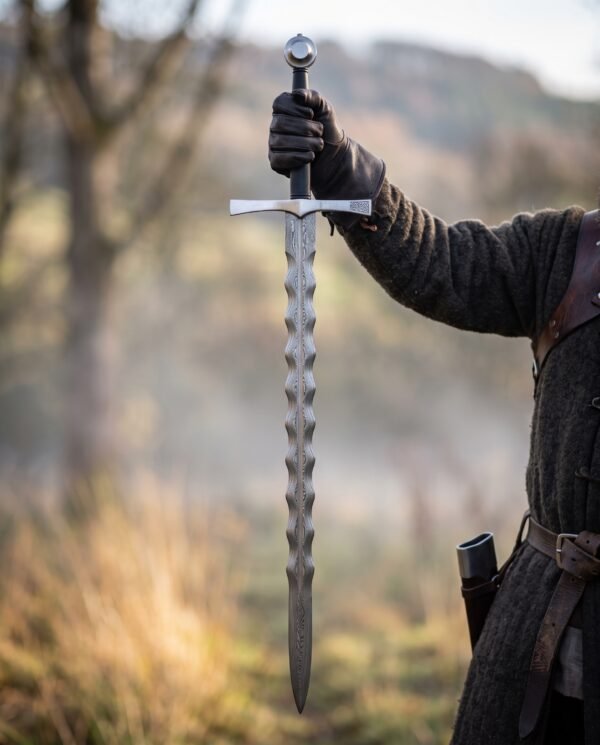
Knotflame Hand Forged Damascus Flamberge Sword with Knotwork Cut Guard | 38 Inch Overall and 31 Inch Blade | Flame Blade and Black Grip and Steel Tipped Scabbard | Collector Gift | RK-2130
Original price was: $599.00.$509.15Current price is: $509.15.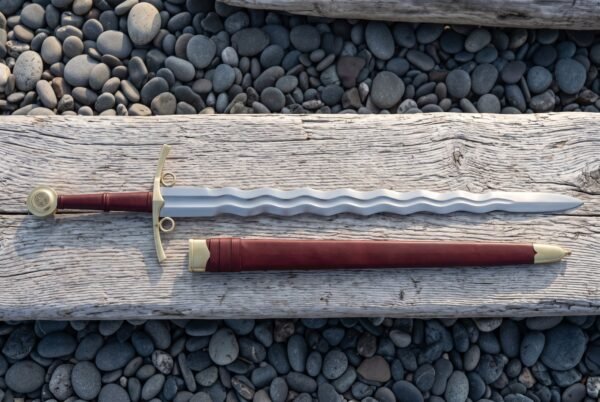
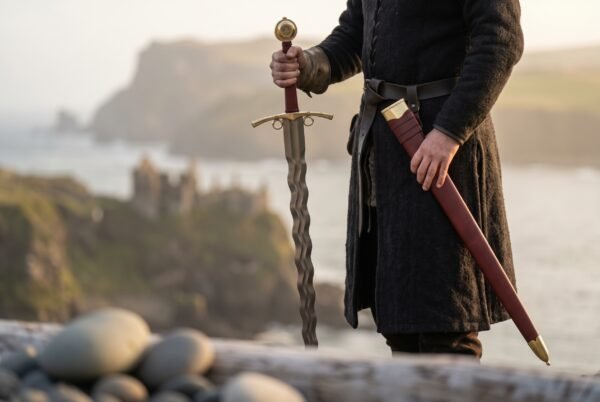
Ringflame Hand Forged High Carbon Steel Flamberge Sword | 35 Inch Overall Length | Brass Side Ring Hilt with Celtic Cross Pommel | Norse Collector Gift | RK-2160
Original price was: $469.00.$398.65Current price is: $398.65.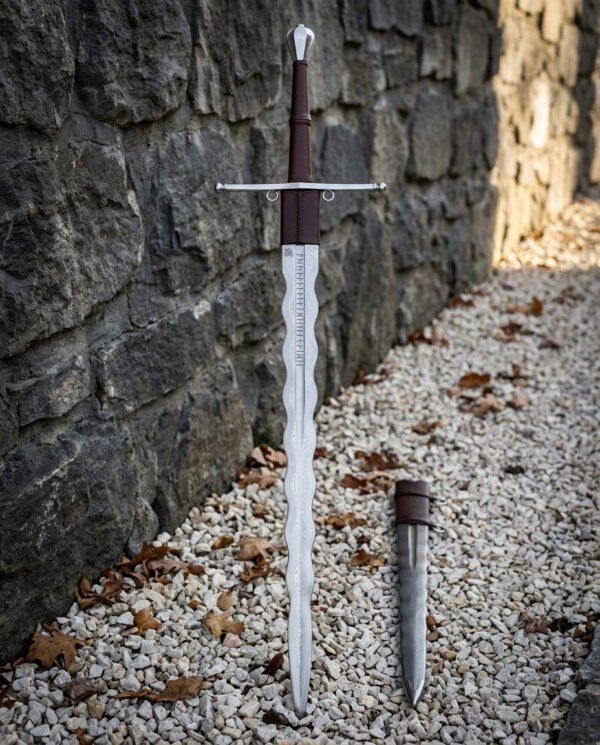
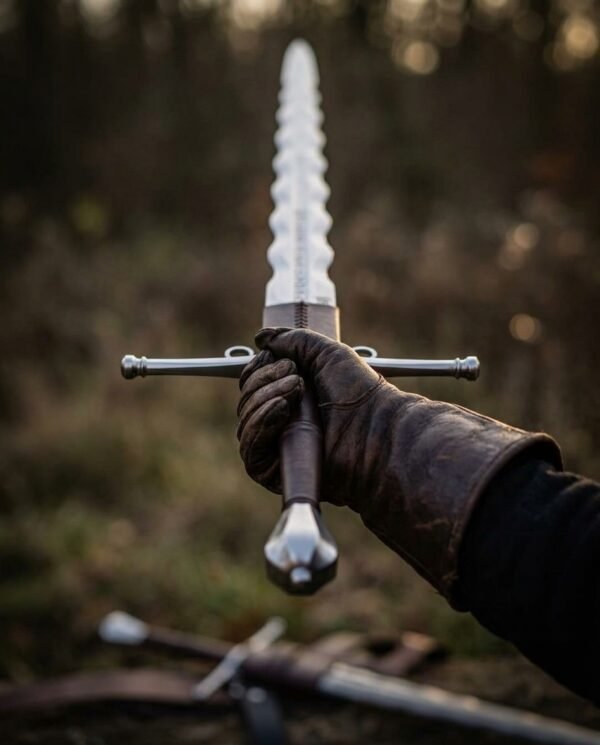
Wyrmtide Hand Forged 1095 Steel Flame Bladed Longsword with Matching Dagger | 43 Inch Sword and 15 Inch Dagger | Rune Etched Ricasso and Leather Wrapped Grips | Norse Collector Gift | RK-1751
Original price was: $549.00.$466.65Current price is: $466.65.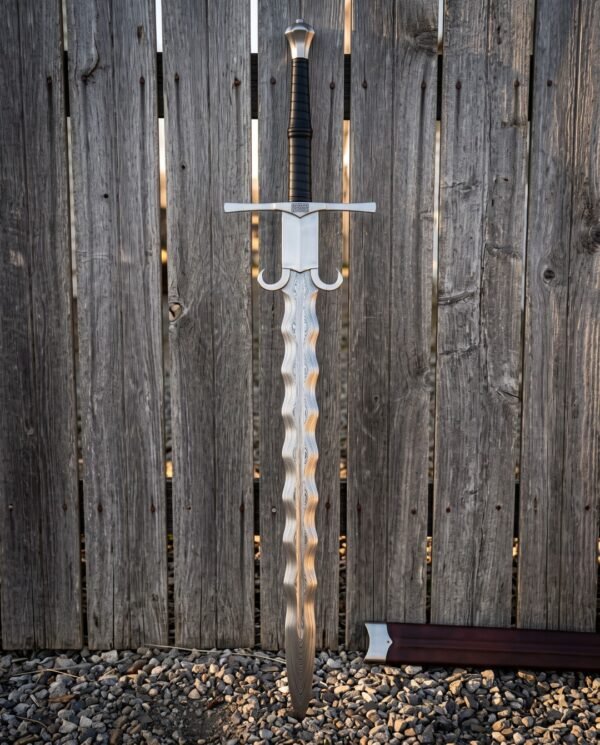
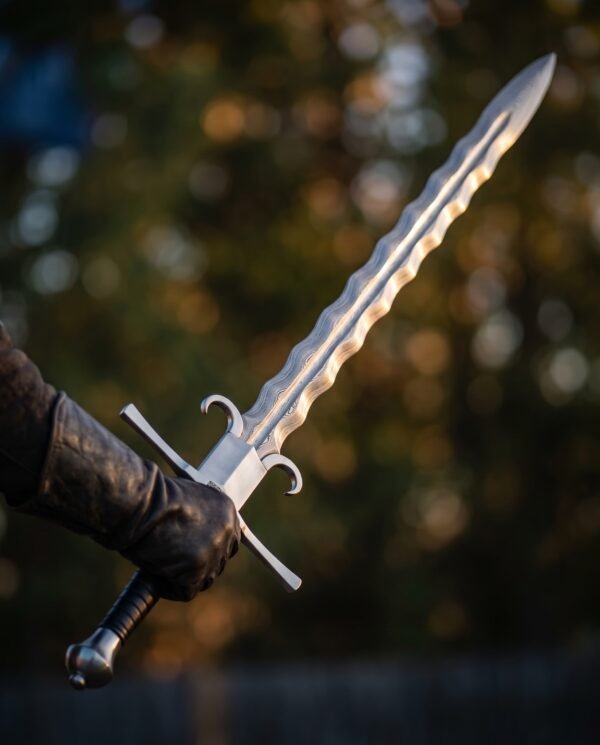
Flamewave Hand Forged Damascus Flamberge Longsword with Wave Cut Blade | Parrying Hook Guard | Leather Wrapped Grip and Wooden Scabbard | Display Collector Gift | RK-2174
Original price was: $669.00.$568.65Current price is: $568.65.
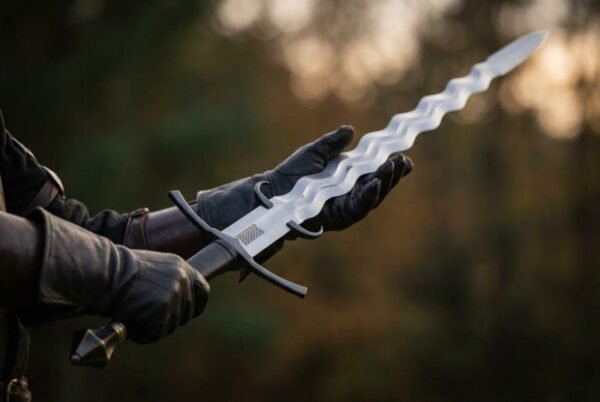
Ripplehook Hand Forged High Carbon Steel Flamberge Sword | 35 Inch Overall Length | Blackened Hooked Guard with Knotwork Etched Wave Blade | Fantasy Gift | RK-2155
Original price was: $429.00.$364.65Current price is: $364.65.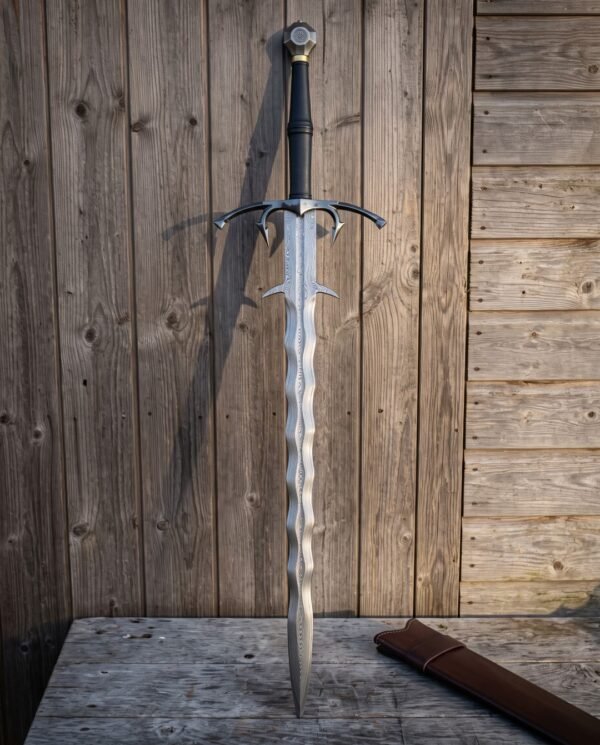
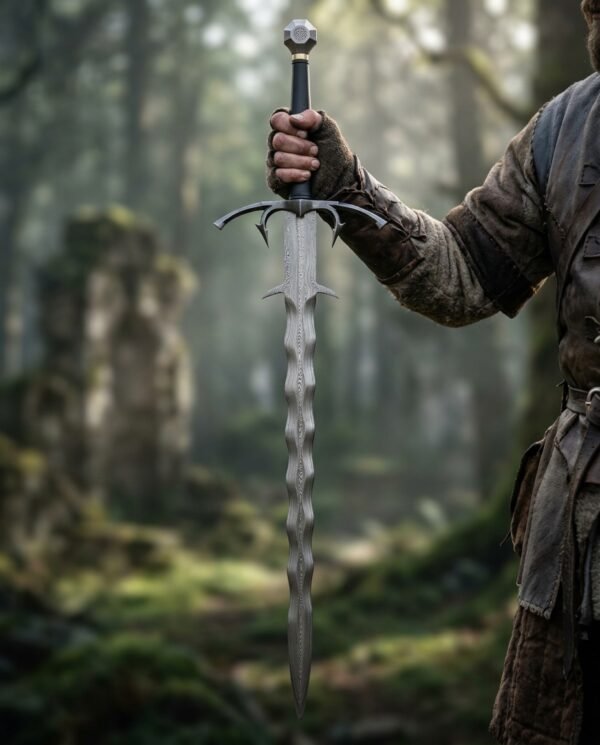
Thornbite Hand Forged Damascus Fantasy Sword with Barbed Guard | 40 Inch Overall and 32 Inch Blade | Wave Blade and Blackened Fittings and Faceted Pommel | Collector Gift | RK-2132
Original price was: $669.00.$568.65Current price is: $568.65.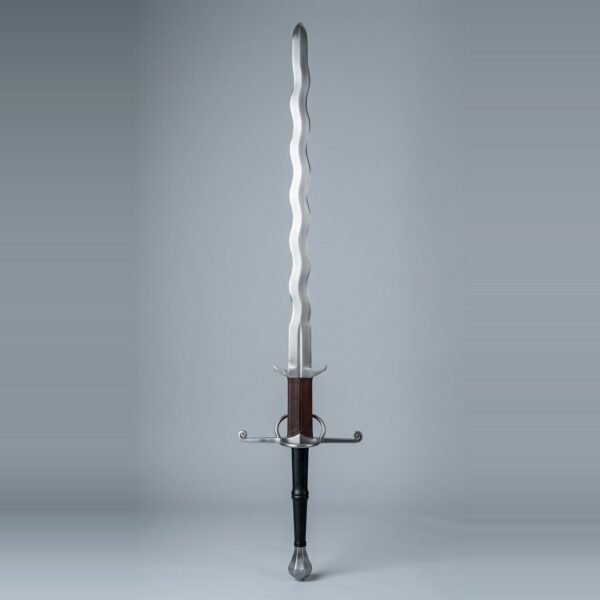
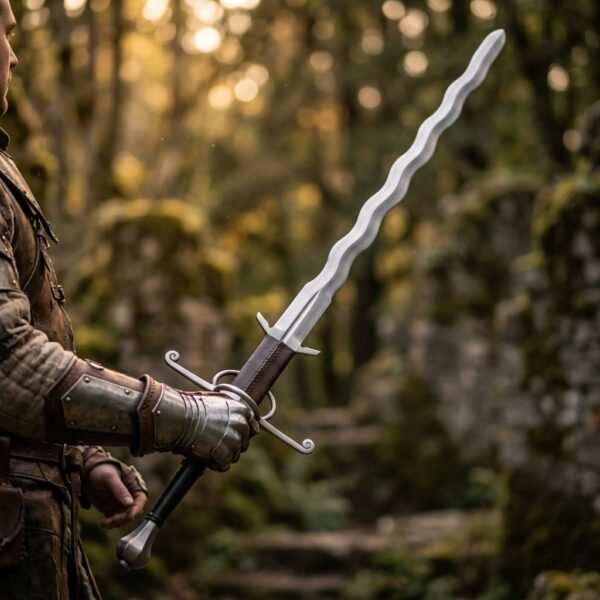
Vulkbrand Hand Forged 51CrV4 Steel Flame Bladed Greatsword with Parierhaken & Scrolled Quillons | About 66 Inches Overall | Leather Ricasso and Blunt Blade | Collector Gift | RK-3028
Original price was: $749.00.$636.65Current price is: $636.65.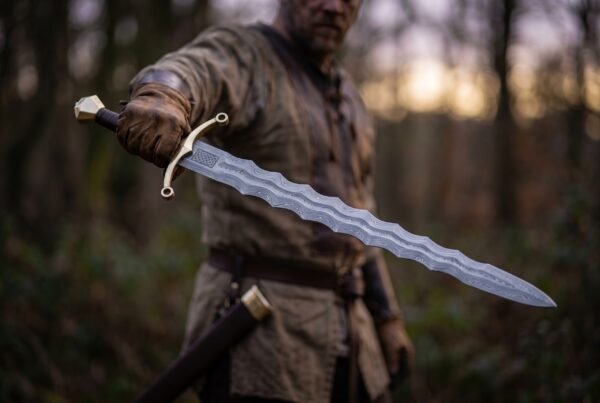
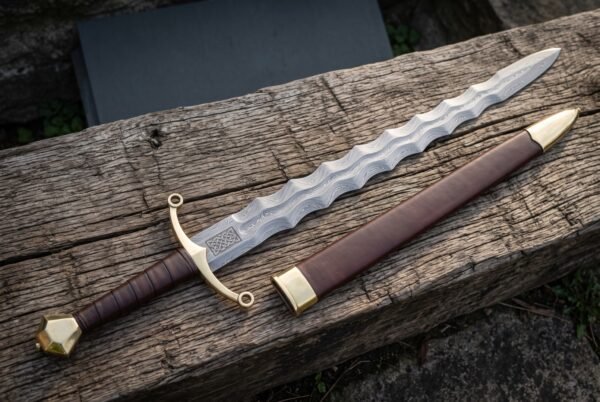
Brassflame Hand Forged Damascus Flame Blade Short Sword | 27 Inch Overall | Brass Ring Guard and Faceted Pommel with Knotwork Panel and Brown Leather Scabbard | Collector Gift | RK-2112
Original price was: $469.00.$398.65Current price is: $398.65.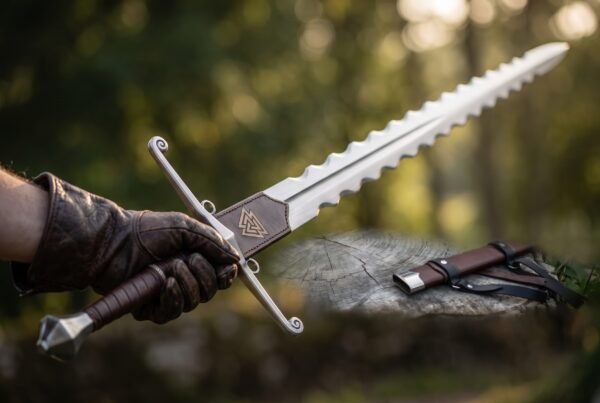
Scrollward Hand Forged 1095 Steel Flame Bladed Arming Sword with Scrolled Crossguard | 36 Inch Overall | Valknut Rain Guard and Leather Scabbard | Norse Collector Gift | RK-1764
Original price was: $469.00.$398.65Current price is: $398.65.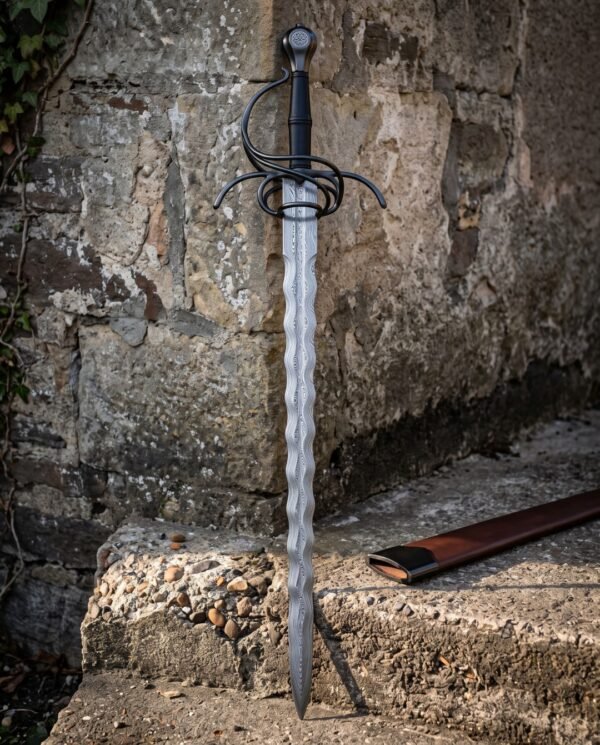
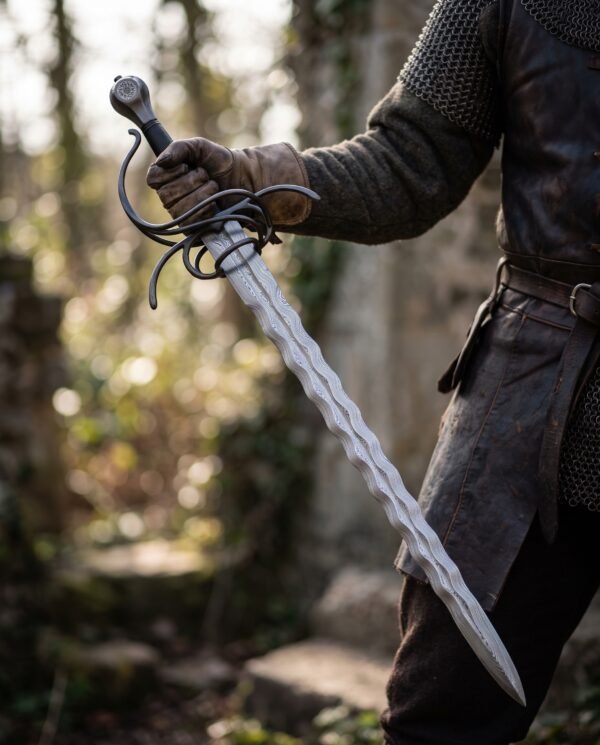
Nightflame Hand Forged Damascus Flame Bladed Sword with Blackened Swept Hilt & Knuckle Bow | About 40 Inches Overall | Ribbed Grip and Brown Scabbard | Display Gift | RK-2206
Original price was: $615.00.$522.75Current price is: $522.75.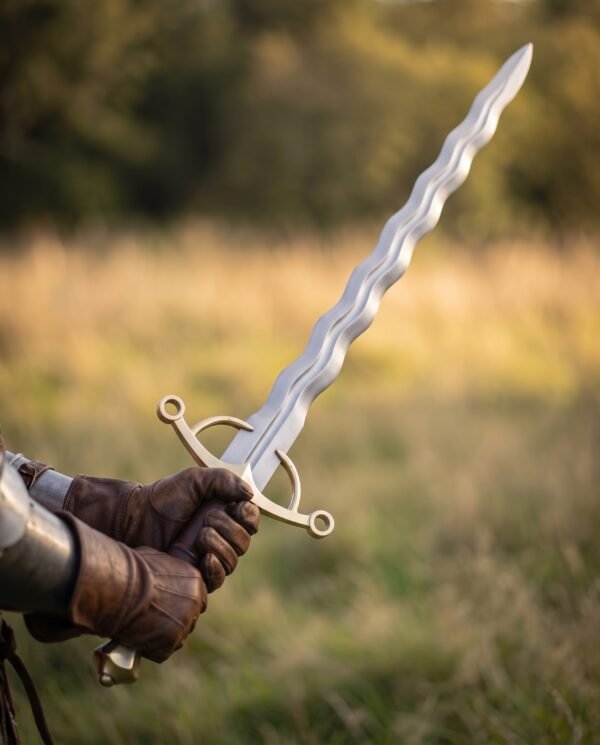
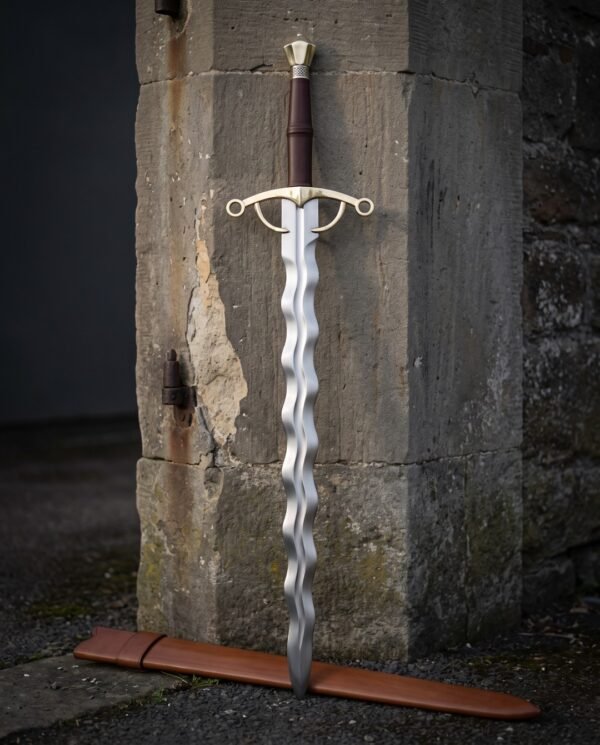
Brazenmere Hand Forged 1095 Steel Flamberge Sword with Brass Ring Guard | 33 Inch Overall and 26 Inch Blade | Flame Blade and Leather Grip and Brass Pommel | Collector Gift | RK-2127
Original price was: $409.00.$347.65Current price is: $347.65.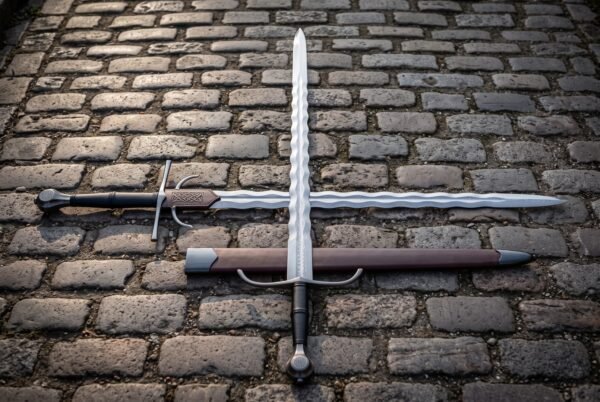
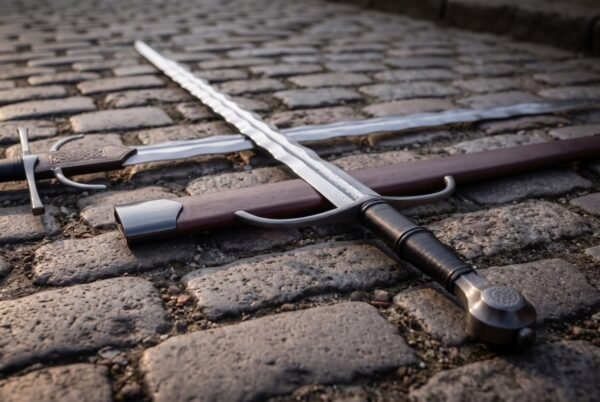
Flamewake Hand Forged Flame Bladed Longsword with S Curved Crossguard & Engraved Pommel | About 42 Inches Overall | Leather Grip and Brown Scabbard | Display Gift | RK-2199
Original price was: $499.00.$424.15Current price is: $424.15.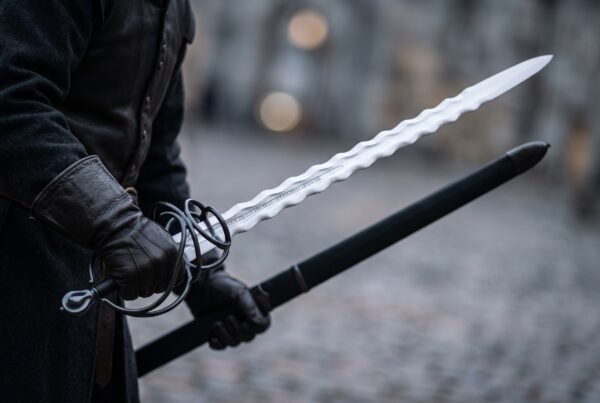
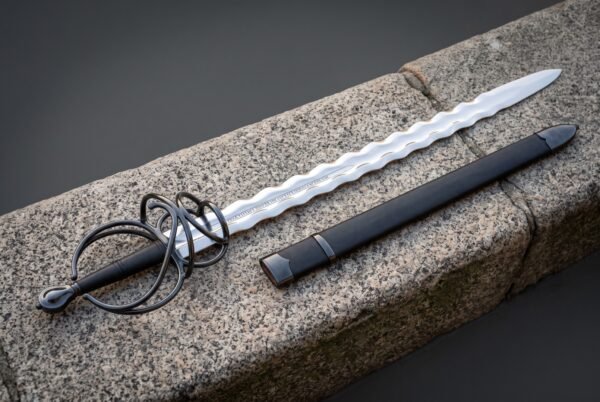
Flamewhorl Hand Forged 1095 Steel Flame Blade Short Sword | 28 Inch Overall | Blackened Swept Ring Hilt with Teardrop Pommel and Black Leather Scabbard | Collector Gift | RK-2108
Original price was: $349.00.$296.65Current price is: $296.65.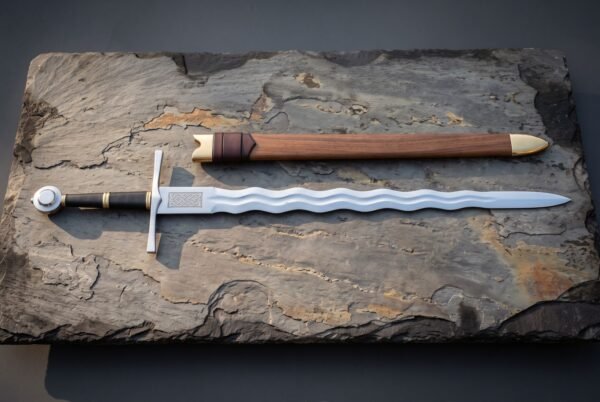
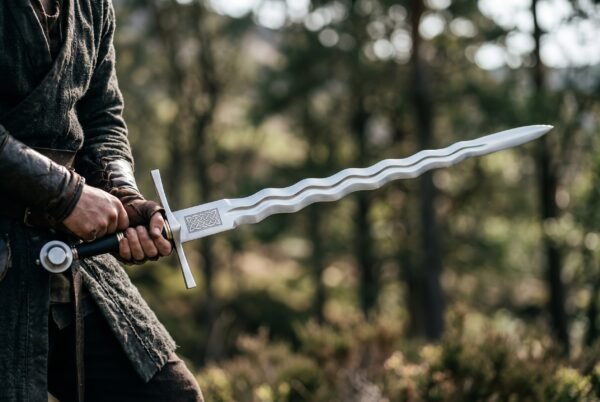
Wavecrown Hand Forged High Carbon Steel Flamberge Sword | 35 Inch Overall Length | Wave Bladed Sword with Disc Pommel and Timber Scabbard | Collector Gift | RK-2154
Original price was: $449.00.$381.65Current price is: $381.65.Why the edge waves
Take a straight sword blade and push a series of even curves into both edges so they mirror each other. That is a flamberge, or a flammard, and the shape has attracted more nonsense than almost any other sword form. The two claims you will hear are that the wave saws through flesh and that it causes a wound nobody can close. Neither survives contact with the sword itself. The undulations on these blades are shallow and long, more like a slow ripple than a bread knife, and a cut from one behaves much like a cut from a straight blade of the same weight.
What the wave does do is real but smaller. A curved section of edge meets a target at a slicing angle rather than square on, so the same push travels a longer path through the material. In a bind, where two blades are pressed together and sliding, the waves catch and release against the opposing edge instead of running smooth, which the fencer on the other end feels as a stutter through the hands. On the great two handed swords of the German schools, that stutter was useful when you were pushing aside a spear shaft or a polearm.
Mostly, though, it was expense. Forging a matched wave into both edges and then grinding the bevels around every curve is slow work, and it was slow work in 1580 as well. A waved blade said the owner could afford one. That is why the form shows up on parade swords, on the arms of officers, and in every fantasy illustration since.
Grinding is still the hard part. On a straight blade the edge runs along a wheel in one pass. On a flame blade the bevel has to follow the curve in and out at the same width and angle, and the ridge down the centre has to stay straight while the edges wander. Sight along the flat from the ricasso and you can see whether that was done properly.
The flamberges in this collection
Thirteen pieces, and they split three ways. By size, from a 27 inch short sword to a 43 inch longsword. By steel, eight in plain 1095 and five in Damascus. By what the guard is doing, which is where these get interesting.
Short and one handed flame blades
Four pieces under 34 inches. The shortest is a 27 inch Damascus short sword on a brass ring guard with a faceted pommel and a knotwork panel cut at the base of the blade. Beside it sits a 28 inch piece in 1095 with a blackened swept ring hilt and a teardrop pommel. A 33 inch flamberge carries a curved brass guard with closed ring terminals and a finger loop. The 36 inch arming sword has a scrolled steel crossbar and a shaped leather rain guard stamped with a Valknut. These you can pick up indoors without moving the furniture.
Hand and a half and two handed swords
The longer group runs 35 to 43 inches. Three sit at 35 inches with 28 inch blades and differ entirely at the guard. One has a straight cross with squared terminals, a disc pommel with a raised boss and a timber scabbard. One has a blackened reverse curved guard with two parrying hooks hanging below it. One has a brass bar with a side ring and a brass wheel pommel carrying a Celtic cross knot. Above those sit a 42 inch two handed sword on an S curved crossguard with cord risers under the wrap, and a 43 inch longsword that ships with a matching 15 inch dagger.
Flamberges in Damascus
Five blades are pattern welded from 1095 and 15N20, forge welded, acid etched and hardened to 58 to 60 HRC. On a flame blade the etch does something a straight blade cannot. The layer lines follow the wave, so the pattern bends with the edge and pools where the curve turns. The 38 inch piece pairs it with a flat polished steel bar guard cut with a knotwork panel and a steel wheel pommel. The 40 inch fantasy sword sets it against blackened steel swept forward into clawed terminals with a pair of standing barbs above the ricasso. The other 40 inch Damascus blade sits under a blackened swept hilt with a knuckle bow, side bars and curved quillons.
Guards with hooks and lugs
Three pieces carry something below the cross. One has two hooks hanging from a reverse curved guard, one has forward curved parrying lugs on a long straight crossguard, and one has barbs standing up above the ricasso. On the historical swords these came from, that hardware caught an opposing blade sliding down toward the hands, and on the two handed pieces it also gave you somewhere to put your off hand when you gripped the ricasso to shorten the sword. The squared unsharpened ricasso on the Damascus longsword here is there for exactly that reason.
Lengths, steel and fittings across the range
Every figure comes from the specification panel of a piece on this page. These are forged by hand and the listings say so, which is why several read as approximate.
| Guard and pommel | Overall length | Blade length | Steel and hardness | Grip | Scabbard or extras |
|---|---|---|---|---|---|
| Brass crossguard with ring finials, faceted brass pommel | 27 in | 20 in | Damascus at 58 to 60 HRC | Brown leather over wood, 5 in | Brown leather with brass locket and chape |
| Blackened swept guard with side rings, teardrop pommel | 28 in | 21 in | 1095 at 54 to 58 HRC | Blackened slim grip, 5 in | Black leather with steel locket and chape |
| Curved brass ring guard with finger loop, faceted brass pommel | 33 in | 26 in | 1095 at 54 to 58 HRC | Brown leather over wood with wire wrap | Brown leather scabbard |
| Straight steel cross with squared terminals, disc pommel with raised boss | 35 in | 28 in | 1095 at 54 to 58 HRC | Black leather with brass collars | Timber scabbard, brass throat and chape |
| Blackened reverse curved guard with two parrying hooks, faceted cone pommel | 35 in | 28 in | 1095 at 54 to 58 HRC | Black leather with a brass band | Fitted brown leather scabbard |
| Straight brass bar with side ring, brass wheel pommel with Celtic cross roundel | 35 in | 28 in | 1095 at 54 to 58 HRC | Deep red leather over a shaped core | Red brown leather, brass throat and chape |
| Steel crossbar with scrolled terminals and scrolled pommel | 36 in | 29 in | 1095 at 54 to 58 HRC | Mid brown leather over wood, 4.5 in | Leather over timber core, steel chape, Valknut rain guard |
| Flat polished steel bar cut with a knotwork panel, steel wheel pommel | 38 in | 31 in | Damascus at 58 to 60 HRC | Black leather over a wooden core | Dark brown leather with polished steel chape |
| Blackened steel swept forward with clawed terminals, faceted block pommel | 40 in | 32 in | Damascus at 58 to 60 HRC | Black over wood with a brass ferrule | Brown leather scabbard |
| Blackened swept hilt with knuckle bow, side bars and curved quillons | 40 in | 32 in | Damascus at 58 to 60 HRC | Ribbed dark grip | Brown leather with a steel throat |
| S curved steel crossguard, teardrop pommel with engraved rosette | 42 in | 32 in | 1095 at 54 to 58 HRC | Two handed, black leather over cord risers | Brown leather, steel throat and chape, knotwork rain guard |
| Polished steel cross with ring terminals, faceted pommel | 43 in | 33 in | 1095 at 54 to 58 HRC | Dark brown leather over wood, 8 in | Matching 15 in dagger on a 10 in flame blade |
| Long straight cross with forward curved parrying lugs, faceted steel pommel | Not listed | Not listed | Damascus at 58 to 60 HRC | Two handed, leather over a wooden core | Fitted scabbard, squared ricasso for a half sword grip |
Several listings give lengths as approximate. That is honest rather than evasive. A hand forged blade is ground to shape by eye and a quarter inch either way across a 32 inch blade is normal.
Sizing and reach
Overall length decides whether the sword fits your space. Blade length decides how it handles. The short swords here, at 20 and 21 inches of blade, are one handed and quick. The 26 to 29 inch group is arming sword territory, single handed on a grip of four to five inches, and it is the size most people mean when they say sword.
Above 31 inches of blade you are into hand and a half and two handed pieces with grips of eight inches or more. Those need two hands to control properly and they need floor or wall space to match. A 43 inch sword on a bracket wants a clear five feet of wall by the time you allow for the mount, and it wants a wall stud rather than a plasterboard anchor.
The wave itself adds nothing to reach. A 32 inch flame blade measures 32 inches point to ricasso along the straight line, not along the curve, so it reaches exactly as far as a straight blade of the same listed length.
Steel and hardness
Eight blades are plain 1095 high carbon hardened to 54 to 58 HRC, the working range for a long blade. It is tough, it flexes rather than snapping, and it sharpens on an ordinary stone. It also rusts, because there is no chromium in it.
The other five are Damascus, forge welded from 1095 and 15N20 and hardened to 58 to 60 HRC. The 15N20 carries nickel, which stands up to the acid etch better than the 1095 does, so the two steels finish at slightly different depths and the layers read as light and dark. As noted above, the wave stretches and compresses that pattern along the blade, and the effect is the main reason to buy one.
Neither steel is stainless and neither pretends to be. If you want the comparison set out properly, read Damascus versus high carbon steel, and steel and hardness for what those HRC numbers actually mean.
Sharp edges and display edges
Three of the longer swords here are listed with an unsharpened display edge and a rounded point. That is a deliberate choice on a two handed sword built to hang on a wall, and it is worth understanding before you order. A display edge is still hardened steel with mass behind it. It will not cut you the way a shaving edge will, but it will break a bone if you swing it into something.
Everything else on this page arrives with a working edge and a real point. Treat all of them as sharp until the specification panel tells you otherwise, and read display sword versus battle ready if the distinction matters to you.
Grips, guards and fittings
Grips are leather over a wood core, and the two handed pieces build cord risers under the wrap so your hands land in the same place. One grip is wire wrapped through the middle, which holds when your hands are damp. Pommels run from teardrops through wheels and discs to faceted blocks, and on a sword this length the pommel works as a counterweight rather than decoration.
Fittings are steel or brass, polished, satin or blackened. The blackened ones are a surface finish, not a coating, so never scour them. Guards are peened over the tang rather than screwed on, which is the right way to do it and also means a loose fitting is a job for someone with a hammer and not for you.
Care and storage
Wipe the blade after handling. Skin acid is what marks a polished flame blade first, and it shows in the hollows of the waves before it shows anywhere else, because that is where a careless wipe misses. Use a soft cloth and follow the curve rather than dragging straight down the blade.
Then oil it. A thin film of mineral oil wiped almost dry is enough. Do not store the sword in its leather scabbard for months at a time, because leather holds damp against steel and a snug scabbard through a wet season will leave you with a spotted blade. Hang the sword, stand the scabbard next to it. The knife care guide covers oiling, rust removal and storage, and it applies to a sword as much as to a knife.
Engraving
Most pieces here can be engraved after they arrive in the United States. On a flame blade the ricasso and the pommel are the usable flats, since the waved section is a poor surface for lettering. Several of these already carry etched work, a rune panel, a Celtic interlace band or a knotwork panel above the ricasso.
Text engraving is 19 dollars, a symbol is 39 dollars and a family crest is 49 dollars. Elder Futhark is a phonetic alphabet, so names are transliterated by sound and there is no rune for the letter C. Engraving is permanent and an engraved piece cannot be returned, so check the spelling twice before you order.
Where these come from and how they ship
Ransack Viking is a US company based in Chicago, Illinois. The pieces are handmade in the Czech Republic, then imported, inspected and shipped from Chicago. Engraving is done in the US after arrival.
Because a wave is cut by hand, no two of these are identical. The depth and spacing of the undulations vary slightly, the etch figure on the Damascus varies more, and leather colour varies with the hide. The longer swords ship in a long box that someone has to be there to receive.
How to choose
Decide first whether this is a sword you want to hold or one you want to look at. To hold it, stay under 30 inches of blade and pick something with a sharpened edge. For a wall, go long, because a 42 inch flame blade across a chimney breast is the point of owning one.
Then choose the guard, since that is what carries the character. Plain crossbars read as historical. Brass ring guards read as renaissance. Blackened swept hilts and clawed terminals read as fantasy, and the barbed piece here is openly that. Steel is the last call. Plain 1095 covers eight of the thirteen and is the sensible default. Damascus costs more and shows the wave better than anything else can. Prices on this page run from 349 to 669 dollars.
Browse related categories
- Longswords, straight bladed and two handed
- Arming swords, the single handed medieval standard
- Zweihanders, the great two handed swords
- Fantasy and movie swords
- Damascus swords in forge welded 1095 and 15N20
- Sword stands and display mounts
- HEMA swords, including the flame bladed greatsword and the blunt trainers
Guides worth reading first
- How to buy your first sword
- Display sword versus battle ready
- How to display swords and axes safely
- Damascus versus high carbon steel
Frequently asked questions
What is a flamberge?
A sword with a waved edge rather than a straight one. The name covers two things, the great two handed German sword with a flame blade and the later waved rapier blade. Here it means any sword with a flame cut edge, from 20 to 33 inches of blade.
Does the wave make the sword cut better?
Slightly, and not in the way the stories claim. A curved edge meets the target at a slicing angle, so the same push travels further through the material. It does not saw, and it does not cause a wound that cannot be closed. Most of the reason the shape exists is that it was expensive to make.
Are these sharp?
Most are. Three of the longer swords are listed with an unsharpened display edge and a rounded point, which is stated in the specification panel on the product page. Everything else arrives with a working edge and a real point.
Can a flame blade be sharpened at home?
Yes, but not on a bench stone. Use a rod or a small round stone that fits inside the curves and follow the wave section by section rather than running the whole edge in one stroke. A flat stone flattens the crests and leaves the hollows dull.
Which one has the biggest Damascus pattern?
The 38 inch piece with the knotwork cut guard. It has the widest blade of the etched group, so the layers spread further across the flat and the wave shows more of the figure. The two 40 inch Damascus swords are narrower and the pattern reads tighter.
What are the hooks under the guard for?
They catch a blade that is sliding down toward your hands, and on a two handed sword they mark where the sharpened edge starts. The Damascus longsword here also has a squared unsharpened ricasso above the guard so you can grip the blade itself to shorten the sword, which is what the lugs are protecting.
Does one come with a matching dagger?
Yes. The 43 inch longsword ships with a 15 inch dagger on a 10 inch flame blade, both with leather wrapped grips and a rune etched panel at the ricasso. It is the only matched set on this page.
How do I hang one of the long ones?
On a horizontal bracket fixed into a stud, with the blade supported near the ricasso and near the point rather than at one end. A 42 inch sword hanging from a single point puts all its mass on one screw and will eventually find the weak spot in your wall.
A flame blade you can train with
A flamberge makes a fine wall piece, and the two hand fencing behind it is still taught at clubs, where most people learn it on HEMA feders. The blunt versus sharp guide sets out what changes when the edge comes off. For a wavy blade in the HEMA line, look at the Vulkbrand flame bladed greatsword.
Featured pieces
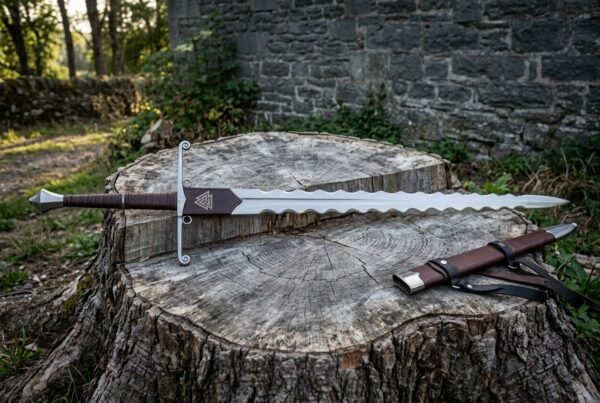 Scrollward Hand Forged 1095 Steel Flame Bladed Arming Sword with Scrolled Crossguard
Original price was: $469.00.$398.65Current price is: $398.65.
 Flamewhorl Hand Forged 1095 Steel Flame Blade Short Sword
Original price was: $349.00.$296.65Current price is: $296.65.
 Brassflame Hand Forged Damascus Flame Blade Short Sword
Original price was: $469.00.$398.65Current price is: $398.65.
 Brazenmere Hand Forged 1095 Steel Flamberge Sword with Brass Ring Guard
Original price was: $409.00.$347.65Current price is: $347.65.