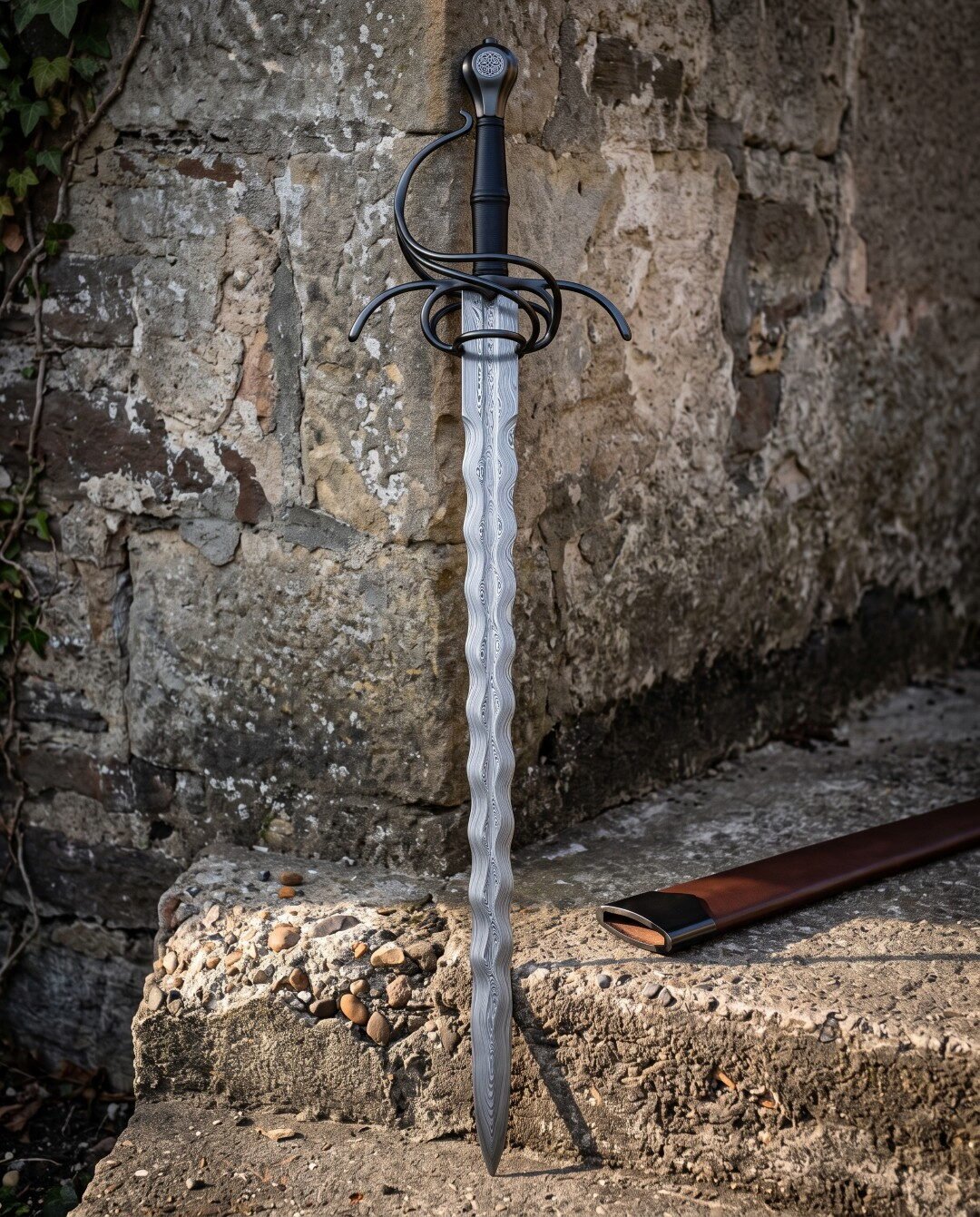
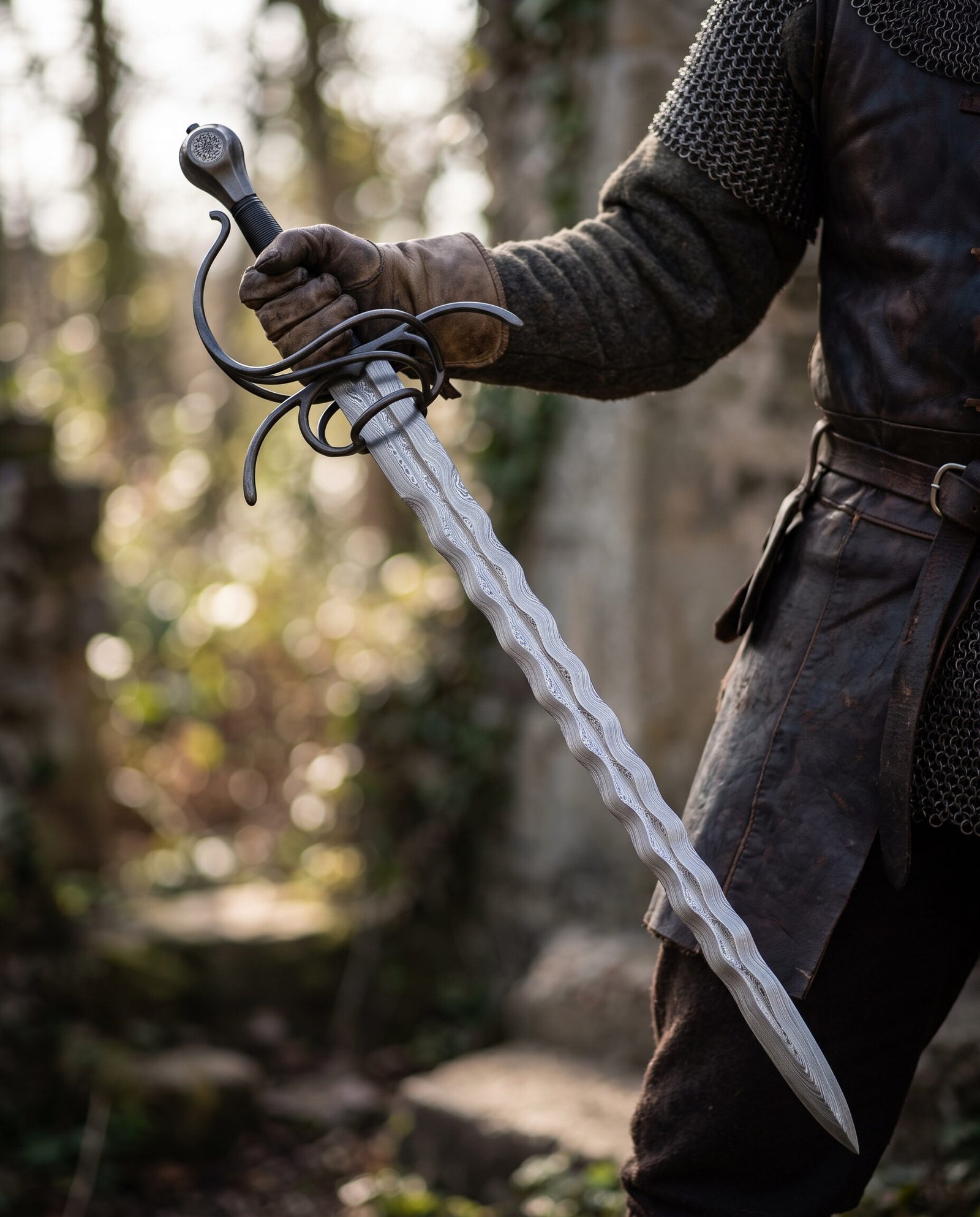
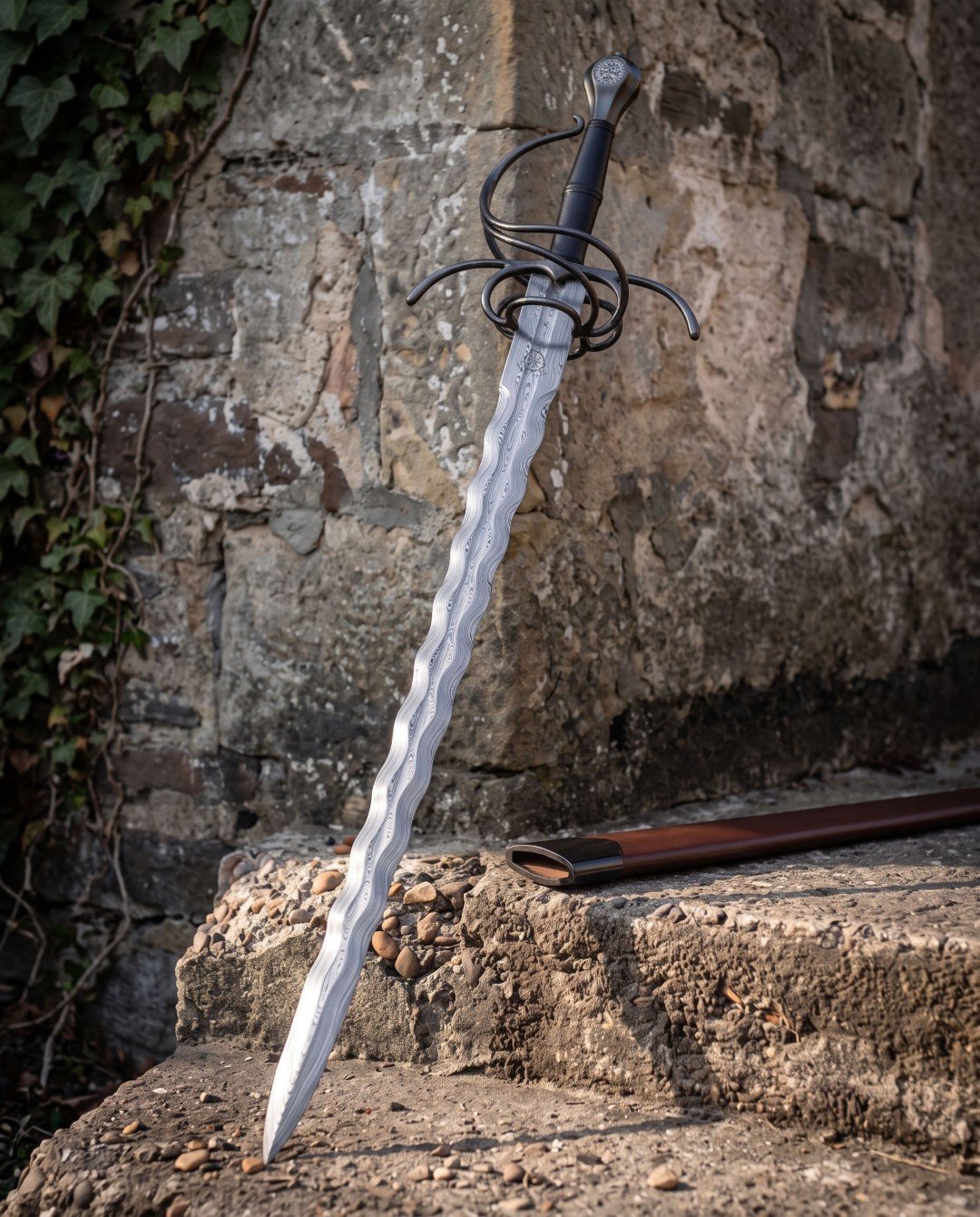
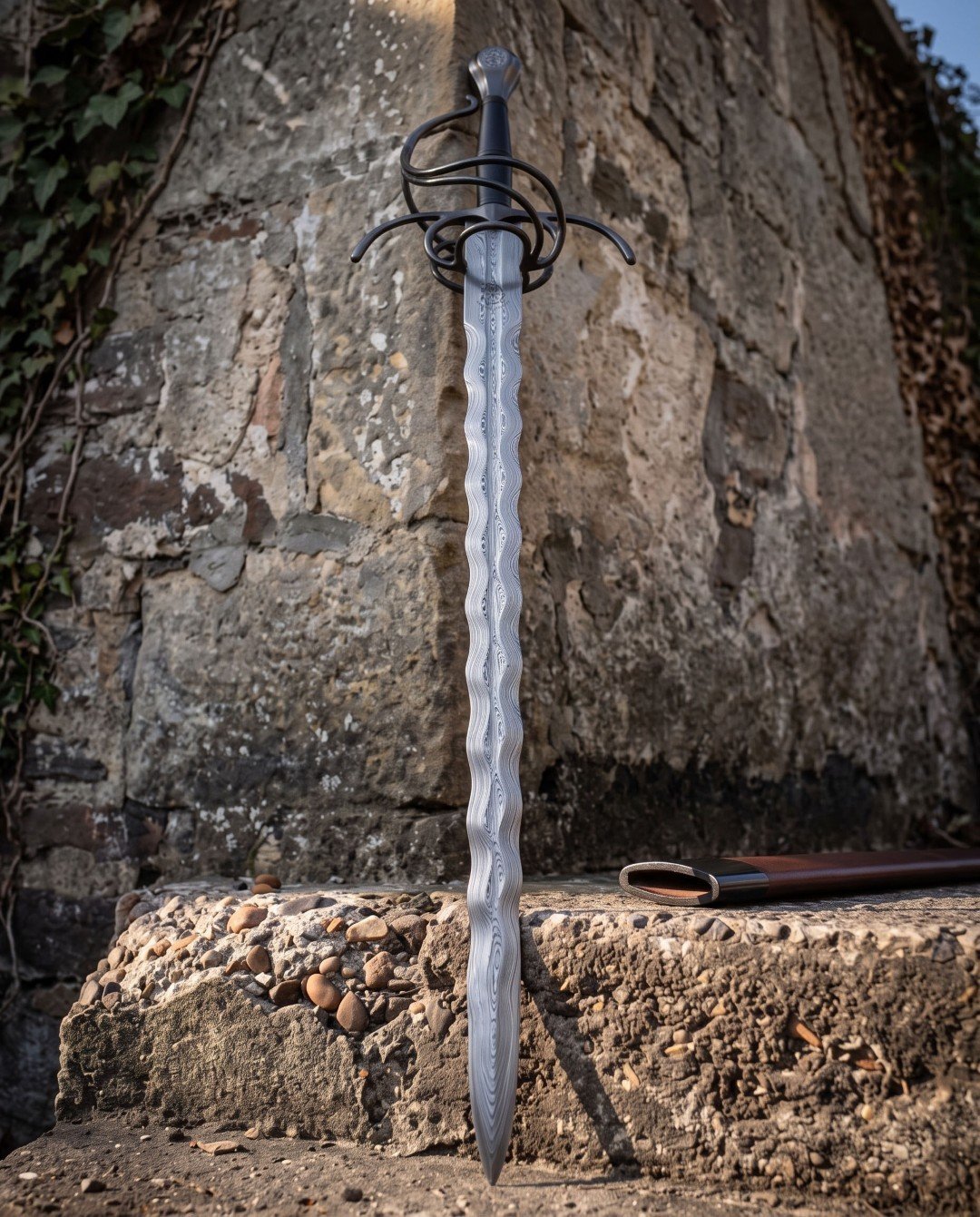
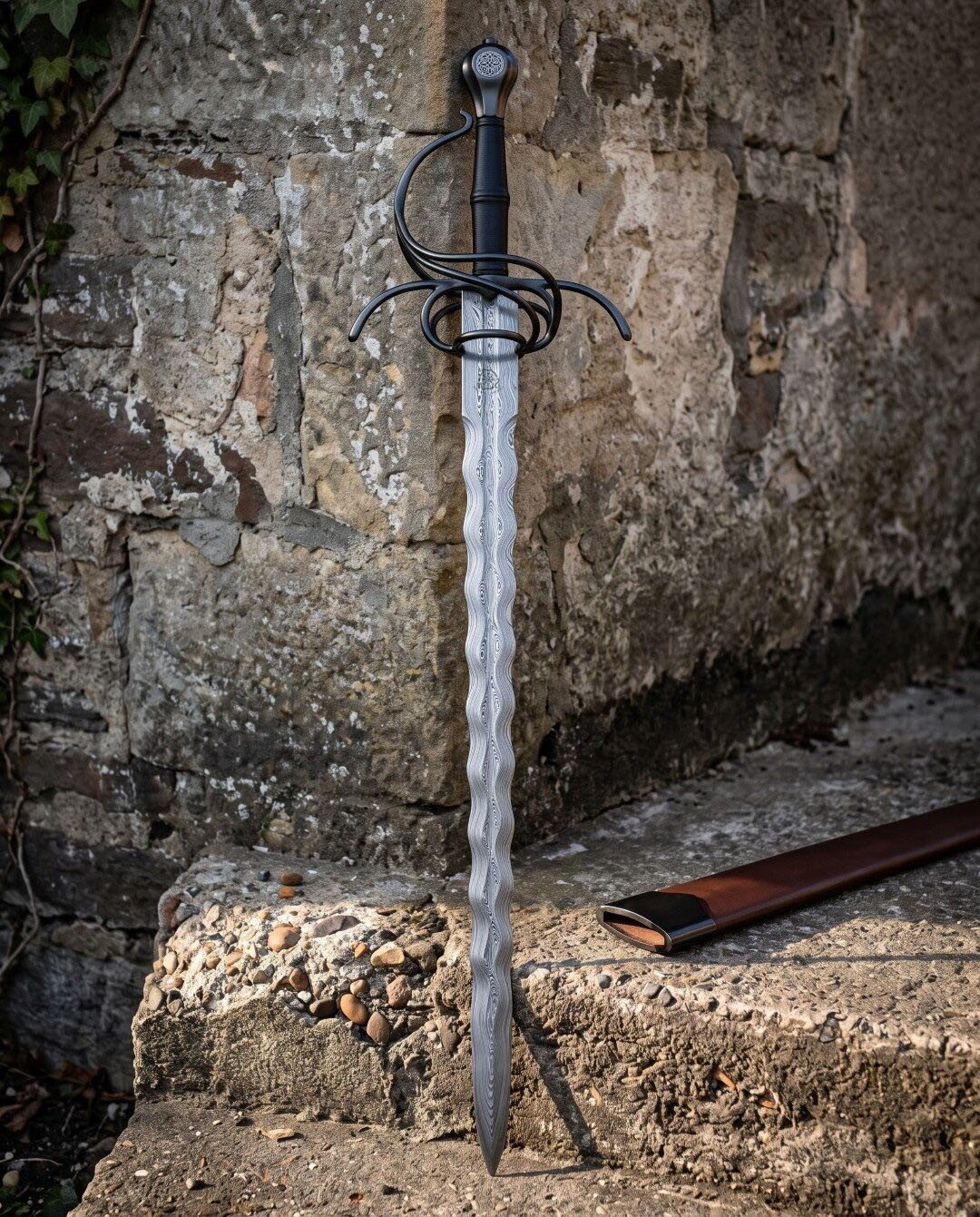
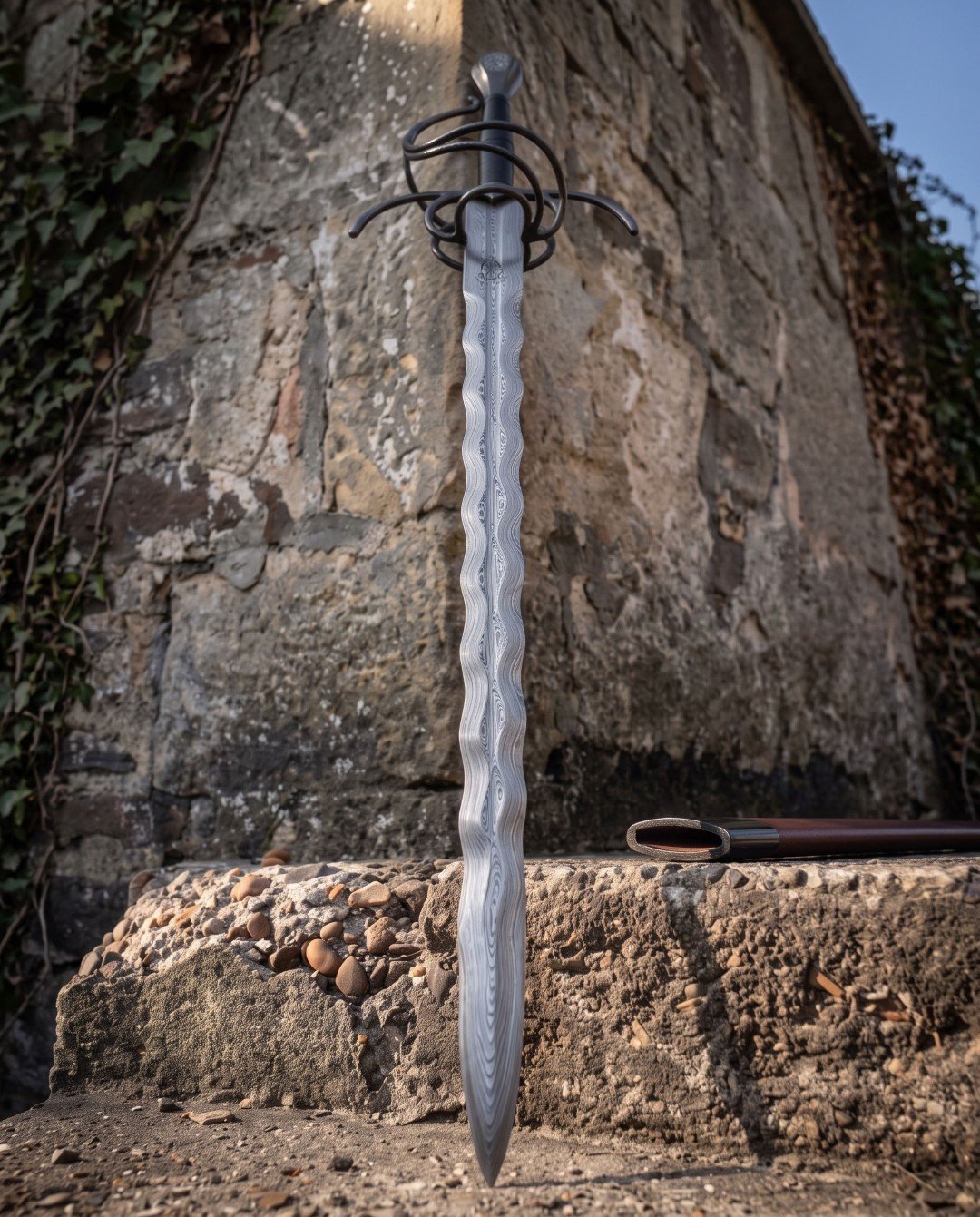
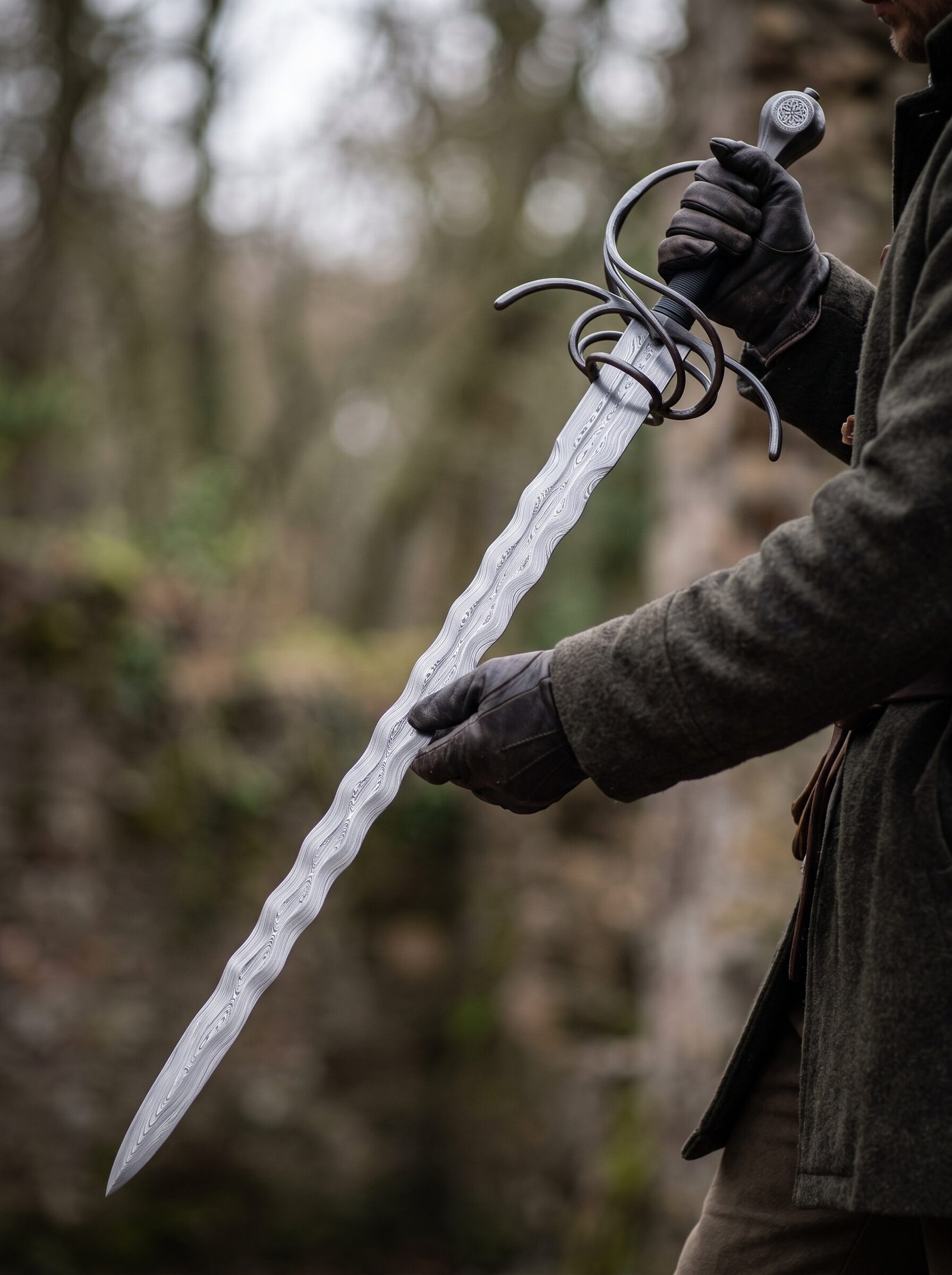
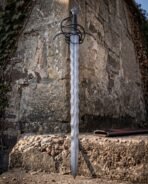
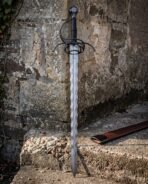
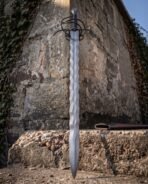
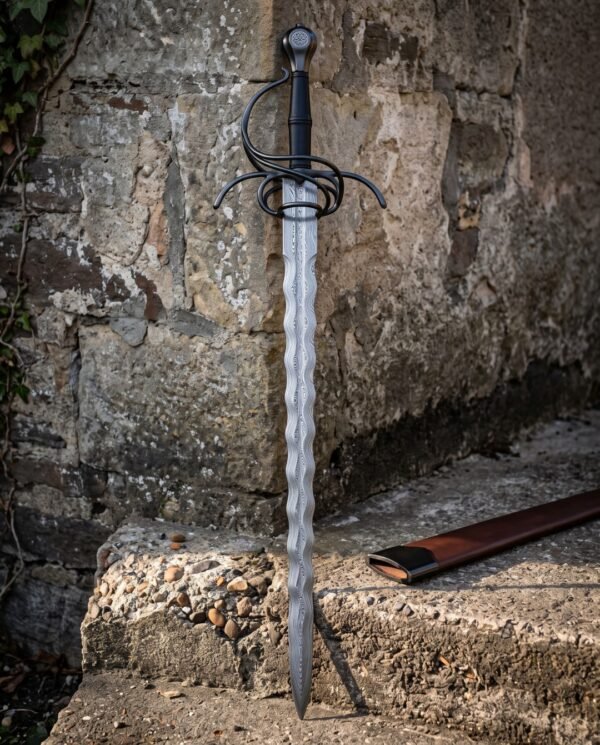
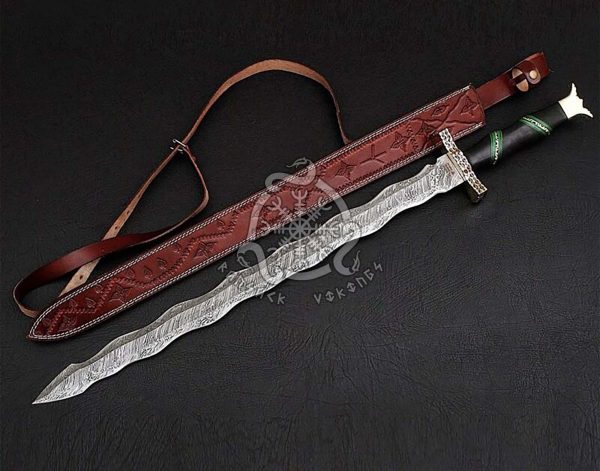
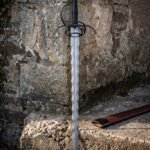
The Nightflame is a Damascus sidesword with a wave ground blade and a blackened swept hilt. It is the piece in this range that most clearly belongs to the sixteenth century rather than the Middle Ages, because everything about the hilt is a response to a specific historical problem. Once men started wearing swords in towns rather than on battlefields, the hand stopped being protected by a gauntlet. Within two generations the simple crossguard grew a knuckle bow, then side rings, then curved counter guards, until the whole assembly wrapped the hand in a cage of bars.
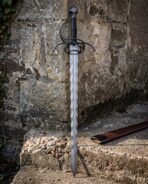
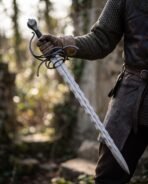
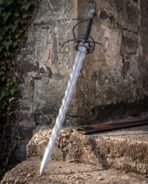
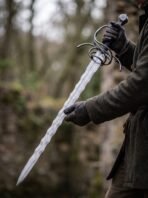
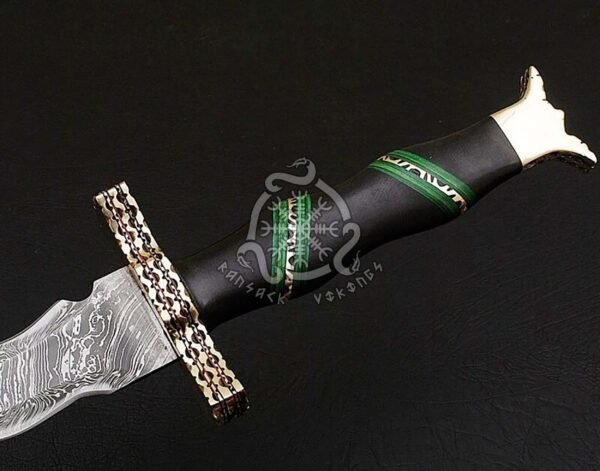
The blade is folded 1095 and 15N20 Damascus, ground in a regular series of waves from the ricasso to the point, so the etched pattern and the undulating edge play against each other along the whole length. The hilt is blackened steel throughout, with a knuckle bow, swept side bars and a rounded pommel carrying a cut rosette. The grip is ribbed and dark. Every one is made by hand in the Czech Republic. Ransack Viking imports them, checks the hilt assembly, the pommel seating and the scabbard fit at our Chicago, Illinois warehouse, and ships from there. A brown leather scabbard with a steel throat is included.
A wave cut edge is a display feature before it is anything else, and display or battle ready explains the difference. The pattern is real forge welding rather than a print, and five checks before you buy shows you how to tell. Thrusting blades with the same kind of hilt sit in the rapiers.
Specifications
| Material | Folded 1095 and 15N20 Damascus steel, hardened to 58 to 60 HRC |
|---|
| Overall length | About 40 inches, hand made so it varies a little piece to piece |
|---|
| Blade length | About 32 inches |
|---|
| Blade style | Double edged flame blade with regular undulations along the full length |
|---|
| Hilt | Blackened steel swept hilt with a knuckle bow, looped side bars and curved quillons |
|---|
| Grip | Ribbed black grip |
|---|
| Pommel | Rounded blackened pommel with a cut rosette |
|---|
| Finish | Acid etched Damascus blade, blackened fittings |
|---|
| Edge | Unsharpened display edge with a rounded point |
|---|
| Included | Brown leather scabbard with a steel throat |
|---|
| SKU | RK-2206 |
|---|
How a swept hilt is put together
Start at the grip and work outwards. The straight bar running across at right angles to the blade is the original crossguard, and on its own it protects almost nothing except against a blade sliding straight down your edge. The bar that curves up from one quillon to meet the pommel is the knuckle bow, and it is the single most valuable addition, because it stops a cut from taking the fingers off the outside of the hand and it keeps the sword in your grip if someone tries to beat it away. The rings and curved bars sweeping around the outside of the guard are counter guards. They close off the gaps a thrust could otherwise slip through, and on the inside they protect the forefinger where it hooks over the quillon for point control.
All of that came at a price, which is why it did not last. A swept hilt is heavy, it catches on a cloak, and it makes the sword much harder to draw quickly. By the mid seventeenth century the fashion had moved on to the lighter cup and shell hilts, and then to the small sword. What survives from the swept hilt period is a body of sword design that many people consider the most visually accomplished ever made, and the reason is that every one of those curves was doing a job.
Damascus, the wave grind and the blackening
The blade is folded 1095 and 15N20, forge welded, drawn, folded and welded again until several hundred layers are stacked through the thickness. Grinding the bevels cuts across the layers and an acid etch darkens the 1095 while leaving the 15N20 bright, which is what makes the pattern visible. Doing that on a wave ground blade is considerably more work than on a straight one, because every undulation has to be ground in by hand and the layers have to be followed round each curve.
The hilt is blackened rather than polished. Blackening is an applied oxide and finish on the surface of the steel, chosen here for contrast against the bright etch of the blade. It is durable in normal handling and it will wear at the high points over many years, showing bright steel underneath, which is honest wear rather than a defect. The blade is drawn to 58 to 60 HRC, hard enough to stay stiff over forty inches.
Engraving, runes and your own design
Use the rune converter on this page to turn a name, a date or a short phrase into Elder Futhark and we will cut it into the steel, the leather or the wood. If you would rather have a Viking pattern than a rune line, choose your own design in the engraving option above the add to cart button and tell us where it goes. Where a piece already carries an engraved design, your chosen engraving replaces it rather than sitting alongside it, so a design on the pommel would take the place of the existing rosette. On a blackened hilt a cut line shows as bright steel and reads beautifully. See the engraving page.
Handling and display
This is a display and collector sword. The edges are unsharpened and the point is rounded, so it is not a cutting sword and it must not be used for full contact sparring or any drill where it is struck. Said plainly. Picked up, it feels like what it is, a long civilian sword with the weight sitting close to the hand because the hilt assembly is heavy in its own right, which is exactly how a swept hilt behaves in life.
On display it is the hilt that earns the money, so mount it where the hilt is at eye level and where light can get through the bars. A swept hilt hung flat against a wall loses all its depth. If you can, mount it on standoffs so there is an inch of air behind it and the shadows of the bars fall on the wall. Do not hang it in a bathroom or an unheated garage.
Care
Keep a thin film of oil on the blade and wipe it after handling, because skin oils will print into an etched Damascus surface if they are left on it for weeks. Mineral oil, camellia oil or a light machine oil all work. Never use an abrasive polish on the blade, because Damascus is an etched relief and abrasive flattens it permanently. The blackened hilt needs nothing beyond a dry wipe, and it should not be polished at all unless you want the black taken off. Feed the grip and the scabbard leather twice a year with a neutral cream. Store the sword out of the scabbard for long periods. More detail sits in our knife care guide.
Damascus wants oil more than plain steel does, because the etch that shows the pattern also opens the surface, and caring for a Damascus pattern covers what to use.
Made in the Czech Republic
Made by hand in the Czech Republic and imported by Ransack Viking. Nothing goes from an importer catalogue straight to a customer’s door. Every sword arrives at our Chicago warehouse, is unpacked, and has the hilt bars checked for alignment and the scabbard checked for fit before it goes on sale as in stock. That is the honest reason processing runs one to two weeks. United States shipping is free, returns run for seven days, and there is a genuine lifetime warranty against defects in forging, grind, heat treat and fittings, with no end date and no receipt needed.
A note on handmade variation
This is hand made, not machine made or bulk produced, so what arrives will not be a pixel for pixel copy of the photograph. Each Damascus billet folds differently, so no two blades carry the same pattern. Every wave is ground by eye, so the rhythm and depth of the undulations vary from sword to sword. Hand bent hilt bars sit at slightly different angles on each piece, which is part of why swept hilts have so much personality. Blackening takes with slightly different depth every time. The dimensions, the steel and the build are the same on every sword. The character is not.
Frequently asked questions
Is this sword sharp
No. It has an unsharpened display edge and a rounded point. It is finished as a collector and display sword and is not sold as a cutting sword.
Can I use it for stage combat or sparring
No. It is not built or certified for contact of any kind. Keep it for display, photography and static costume, and use purpose built equipment for anything where blades meet.
Why does the edge wave
A wave packs more edge length into the same blade length and it catches against an opposing blade in a bind instead of sliding smoothly. It is a genuine period design feature, not a fantasy shape.
Will the blackening rub off the hilt
It will wear at the high points over years of handling, showing bright steel underneath. That is normal for any blackened finish and most collectors think it improves with age.
Is the scabbard included
Yes. A brown leather scabbard with a steel throat comes with every sword. Store the blade out of it if the sword is going away for months.
How long will it take to arrive
One to two weeks of processing while the sword is checked at the Chicago warehouse, then standard United States shipping. Engraved pieces take a few days longer.
What is in the box
- Nightflame Damascus flame bladed sword
- Brown leather scabbard with a steel throat
- Care and warranty card
- Hand made in the Czech Republic, shipped from our Chicago, Illinois warehouse
Explore the range
See more in Damascus swords, swords, Norse arms and scabbards and sheaths, or read the guides.
Other pieces in this group
Another in the same line is the Knotflame flamberge sword, 38 inches overall. Next along the rack is the Brassflame flamberge sword, 27 inches overall. For a straight comparison, see the Brazenmere flamberge sword, 33 inches overall.
The Runecage sword covers the other half of the same kit. Nothing here exactly right, build one to your own spec on the custom Viking sword page.
For partner drills and sparring we carry the Vulkbrand flame bladed greatsword, and our intro to HEMA is a good place to start.


This sword beat every expectation I had. This will be a family heirloom for sure.
I collect stuff like this and this sword is on another level. Weight and balance make it feel like a real functional piece not some cheap replica. Edge retention has been great even after regular use. Highly recommend this one.
Incredible craftsmanship on this one. Ransack Viking is quickly becoming my go to shop for anything Norse themed. Came in a nice gift box which made it feel even more special. Leather sheath is thick and well stitched. Not the cheap stuff you usually get. Can’t recommend this enough.