
Blog
Real vs Fake Damascus Steel: 5 Checks Before You Buy

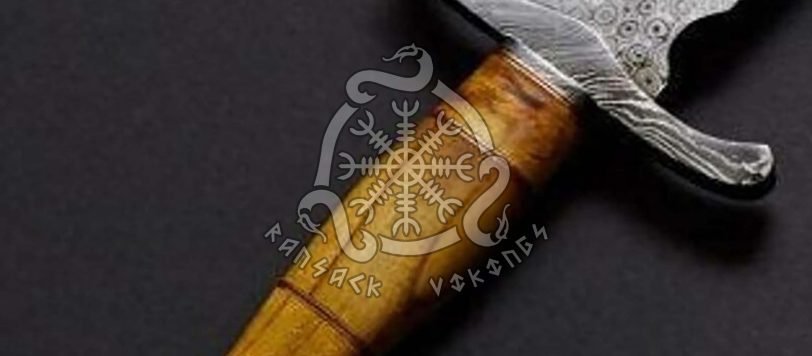
The fastest way to tell if Damascus steel is real is to look at where the pattern goes. On a genuine pattern welded blade the layers run through the steel, so the pattern continues over the spine, the edge bevel and any filework, and it never repeats exactly. On a fake, the “pattern” is printed, laser etched or acid stenciled onto the surface of a plain blade, so it stops at grind lines, repeats like wallpaper and sands off. A printed pattern looks entirely convincing in a photograph, which is where most of them are sold. Below are the five checks worth running before you spend money, the myths that sell fakes, and an honest answer to the question behind all of it: is Damascus steel any good?
Why Fake Damascus Exists
Genuine Damascus takes labor. A smith forge welds bars of 1095 high carbon steel and 15N20 nickel steel, folds the billet through repeated welding cycles, grinds the blade and acid etches it to reveal the layers. Because buyers love the look but cannot always inspect the steel, some sellers shortcut the process by decorating a plain stainless or mild steel blade with a printed or laser burned pattern. The result looks convincing in photos and fails in use. The surface pattern wears away, and the steel underneath is usually mystery metal that nobody heat treated on purpose. Five quick checks protect you from paying hand-forged prices for a printed picture.
The 5 Checks: Real vs Fake Damascus
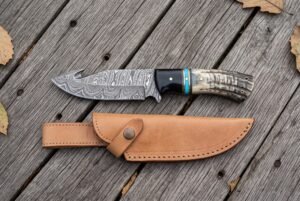 Hornreaver Hand Forged Damascus Gut Hook Hunting Knife with Buffalo Horn and Ram Horn Handle and Turquoise and Brass Spacers | Hunting Gift | RK-360
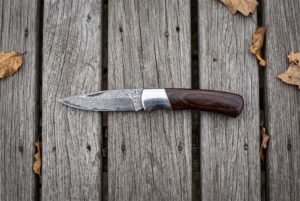
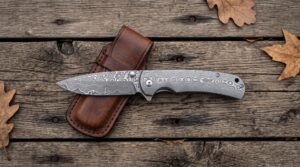 Leafcarry Hand Forged Damascus Folding Pocket Knife with Damascus Steel Handle Ready for Engraving & Cowhide Leather Sheath | Everyday Carry Collector Gift | RK-375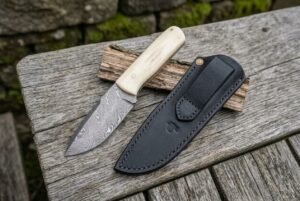
Check 1: Does the pattern continue over every surface?
Pick the blade up and rotate it under light. Real pattern welding runs through the full thickness of the steel, so the layers must appear on the spine, wrap around the edge bevel and show inside any fuller or filework. A pattern that lives only on the flat sides of the blade, with a bare, plain spine or bevel, is the single most reliable sign of an etched fake, and it is visible in about three seconds.
Check 2: Does the pattern repeat?
Fold forged layers form organic, fingerprint like figures. No two square inches are identical, and the two sides of the blade never mirror each other exactly. Laser and roll printed fakes are generated from a template, so the same motif recurs at regular intervals, and both sides of the blade often carry an identical image. If you can find the same swirl twice, walk away.
Check 3: Can you feel the topography?
Acid etching bites the 1095 layers deeper than the nickel rich 15N20, leaving a subtle relief you can feel with a fingernail dragged across the flat: faint ridges where the bright layers stand proud. Printed patterns are dead flat, and painted ones may even sit on top of the surface. This check takes two seconds and requires nothing but your thumbnail.
Check 4: The sand and re-etch test (for a blade you already own)
This one is destructive to the finish, so use it only to settle a dispute on a blade in hand. Lightly sand a small spot near the spine with fine paper. On real Damascus the pattern fades to uniform silver but returns when the spot is re-etched with a little ferric chloride or even hot vinegar, because the layers are still there. On a fake, sanding erases the pattern permanently, because there was never anything underneath it to bring back.
Check 5: Does the seller answer steel questions?
A legitimate maker will tell you the exact steels in the billet, typically 1095 and 15N20, the approximate layer count and the hardness range after heat treatment. Evasive answers (“high quality Damascus steel”), claims of “stainless Damascus” at bargain prices with no alloy names, or listings that avoid the words “pattern welded” entirely are all warning signs. Honest sellers are specific because specificity is the product. For what those steel names mean, see our knife steel glossary.
Real vs Fake Damascus: Quick Reference
| What to Inspect | Real Pattern Welded Damascus | Fake or Etched Imitation |
|---|---|---|
| Spine and edge bevel | Pattern wraps and continues everywhere | Pattern stops at grind lines; plain spine |
| Pattern repetition | Organic, never repeats; sides differ | Template motif repeats; sides identical |
| Surface feel | Faint etched relief between layers | Perfectly flat or painted on |
| After light sanding | Pattern returns with re-etch | Pattern gone permanently |
| Steel disclosure | Named alloys, e.g. 1095 and 15N20, HRC range | Vague “Damascus steel,” no specifics |
What Real Damascus Looks Like in Hand
Genuine blades share a family resemblance: high contrast between dark and bright layers, patterns that flow around the blade’s geometry, and a visible story in the steel, the twists, ladders and raindrops that follow the smith’s work on that exact billet. You can see the standard on our Damascus knives, in working blades like the Damascus skinners and hunting knives, where the pattern wraps every ground surface, or in larger forged pieces like Bowie knives and daggers where the layer flow is easy to trace from guard to tip. Every one of them is handmade in the Czech Republic the old way, then inspected and shipped from Chicago, Illinois.
Real Damascus made from 1095 and 15N20 is carbon steel. It needs a wipe of oil now and then, and that maintenance requirement is itself a quiet authenticity signal. A “Damascus” blade sold as completely rust proof deserves extra scrutiny.
Is Damascus Steel Good? Myths and Facts
Yes, Damascus steel is good, provided it is genuine pattern welded steel made from quality components and properly heat treated. A well forged blade of 1095 and 15N20 takes a very keen edge, holds it well, and is tough enough for hard field use. What Damascus is not is a magic metal. It will not outcut every modern steel, and it will rust if you neglect it. Damascus is a construction method, not a single alloy, so quality varies with three things: the steels inside it, the soundness of the forge welds, and the heat treatment. When those are right the blade performs like the excellent high carbon knife it is. When the welds are dirty or the heat treatment is skipped, no amount of pattern can save it. Judge the maker, not the word “Damascus.” The myths below are the ones that sell fakes.
Myth 1: Damascus is the sharpest steel in the world
Fact: sharpness comes from geometry and heat treatment, not from layering. A Damascus blade can be brought to a scalpel edge, but so can many plain steels. What quality Damascus offers is a hard edge, 58 to 60 HRC on our blades, that takes a fine polish and resharpens easily. The layers supply the look. The heat treatment supplies the edge.
Myth 2: Modern Damascus is the lost steel of ancient legend
Fact: the legendary blades of Damascus were forged from wootz, a crucible steel whose production process was lost centuries ago. Modern Damascus is pattern welded, layered steels forge welded together, which is a different and equally historic technique used by Viking age smiths. It is not fake. It is a different craft carrying the same name.
Myth 3: More layers means a better knife
Fact: layer count is cosmetic. Around 100 to 500 layers is typical; beyond that the pattern gets finer, not stronger. Every extra welding cycle is also another chance for a flaw, so a clean 200 layer blade beats a sloppy 1,000 layer one every time.
Myth 4: Damascus does not rust
Fact: pattern welded Damascus made from 1095 and 15N20 is high carbon steel and will corrode if stored wet or dirty. The fix is simple, wipe it dry and oil it lightly, and our knife care guide covers the whole routine. If you want zero maintenance, a stainless blade suits you better, and there is no shame in that.
Myth 5: All affordable Damascus is fake
Fact: hand forging takes labor, but genuine pattern welded blades are made at a wide range of prices. What matters is that the seller names the steels, the pattern runs through the blade rather than sitting printed on the surface, and the maker stands behind the forge welds. Fakes do exist, usually laser etched patterns on plain stainless, and the five checks above expose them.
Damascus Steel: Honest Pros and Cons
| Aspect | Strength | Limitation |
|---|---|---|
| Edge performance | Takes a very keen edge; good retention from hardened 1095 layers | Not superior to every modern premium steel |
| Toughness | Nickel bearing 15N20 layers resist chipping | Poor welds can delaminate under abuse |
| Corrosion | Light oil keeps it clean indefinitely | Rusts if neglected; not for wet storage |
| Appearance | Every blade is one of a kind | Pattern fades if heavily sanded or polished |
| Maintenance | Easy to resharpen with basic stones | Needs drying and oiling after use |
| Value | Hand work and material you can see | You pay a premium over plain carbon steel |
How Damascus Performs in Real Use
In the field, a good pattern welded blade behaves like a top shelf high carbon knife. Hunters use Damascus skinners because the hard edge glides through hide without constant touch ups, and full size hunting knives in Damascus handle everything from camp chores to processing game. Larger blades such as Bowies benefit from the nickel layers’ toughness when batoning or chopping. For everyday carry, a Damascus folding pocket knife is one of the few tools that gets compliments while opening boxes. The one habit all of them demand: wipe the blade dry before it goes back in the sheath or pocket.
Damascus is a good fit if you appreciate hand-forged character, want strong cutting performance, and can spare thirty seconds of care after use. It is the wrong choice if the knife will live on a boat, sit in a wet sheath, or be treated as a disposable tool. Many owners split the difference: stainless for daily abuse, Damascus for the hunts, kitchens and collections where a blade with a story earns its keep. The same layered steel goes into our Damascus steel jewelry, if you want the pattern without the blade.
Does Price Prove Anything?
Price is a weaker signal than most buyers assume, in both directions. Skilled workshops in regions with lower labor costs produce genuine hand-forged pattern welded blades at accessible prices, while some expensive knives ride the word “Damascus” on an etched stainless blade. That is why the five physical checks outrank the price tag. Judge the steel, the pattern behavior and the seller’s transparency. Let price be a tiebreaker, not the test.
What the layers are and how they are welded is set out in our explainer on Damascus steel. If the question is whether to buy pattern welded at all, see Damascus or plain high carbon, and for a small piece to test the difference on there are the Damascus pocket knife picks.
Real vs Fake Damascus Questions
What is the easiest way to tell if Damascus steel is real?
Look at the spine and the sharpened edge bevel. On real pattern welded Damascus the layered pattern continues over both, because the layers run through the whole blade. If the pattern exists only on the flat sides and stops at the grind lines, it is an etched or printed fake.
Does a magnet test work on Damascus steel?
No. Real Damascus made from 1095 and 15N20 is magnetic, but so are most steels used in fakes, including many stainless blade steels. A magnet tells you almost nothing, despite how confidently it gets recommended. Pattern continuity, repetition and surface relief are far more reliable.
Will fake Damascus patterns wear off?
Yes. Laser etched and printed patterns sit on the surface, so they fade with sharpening, scrubbing and daily wear. A real pattern dulls slightly as the etch polishes back but can always be restored with a fresh etch, because the layers are the blade itself.
Can real Damascus steel be stainless?
Stainless pattern welded steel exists, but it is a specialty product that requires difficult high temperature bonding, and it is priced accordingly. The overwhelming majority of affordable genuine Damascus is carbon steel, 1095 and 15N20, so a cheap blade marketed as “stainless Damascus” is usually an etched imitation.
Is Damascus steel worth the money?
If you value hand-forged construction and a one of a kind pattern along with real cutting performance, yes. If you only care about raw specifications per dollar, a plain carbon or stainless blade delivers similar cutting ability for less, and that is a perfectly sensible way to buy a knife.
Does Damascus steel break easily?
No. A soundly welded Damascus blade is tough, and the nickel rich 15N20 layers actively resist cracking. Failures almost always trace back to poor forge welds or abusive prying rather than to the pattern welding method. A knife used as a pry bar will fail whatever is inside it.
If you would rather have one made to your own spec, build a custom Damascus knife and choose the pattern, the profile, the handle material and the sheath.
What the shop carries
In the shop right now, the Woodgrain skinner knife and the Olivefold folding pocket knife. The Olivespire dagger knife and the Wengechef chef knife sit next to them.
One more check worth knowing
Telling real Damascus from fake has a cousin on the training floor, which is telling a blunt trainer from a sharp. Blunt versus sharp training swords covers those checks, the Faskvar blunt arming sword is the blunt kind, and HEMA arming swords has the rest.
Shop the range
Hornreaver Hand Forged Damascus Gut Hook Hunting Knife with Buffalo Horn and Ram Horn Handle and Turquoise and Brass Spacers | Hunting Gift | RK-360Leafcarry Hand Forged Damascus Folding Pocket Knife with Damascus Steel Handle Ready for Engraving & Cowhide Leather Sheath | Everyday Carry Collector Gift | RK-375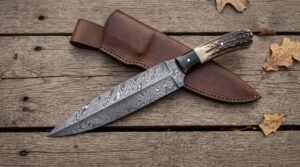

One thought on “Real vs Fake Damascus Steel: 5 Checks Before You Buy”
Comments are closed.