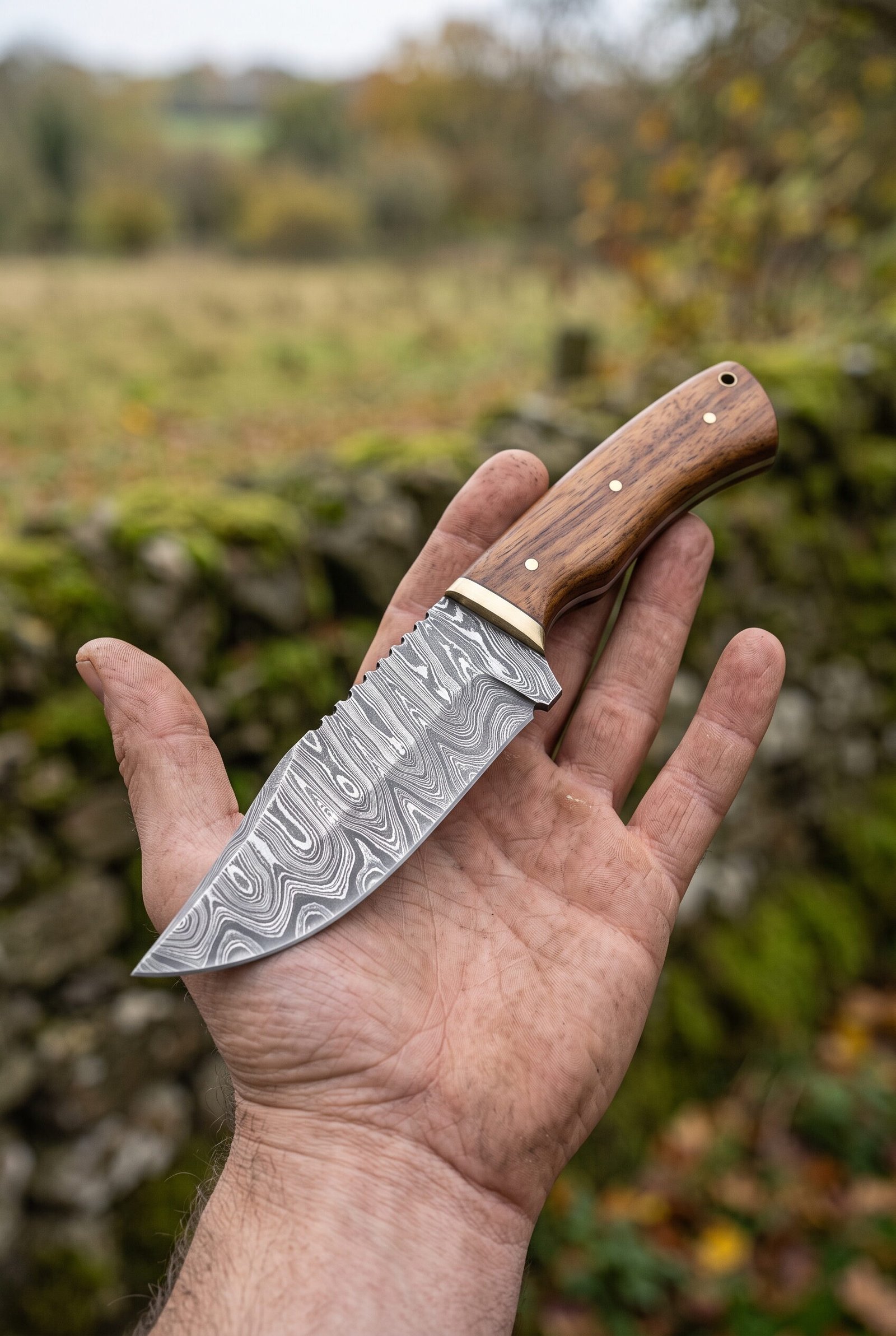
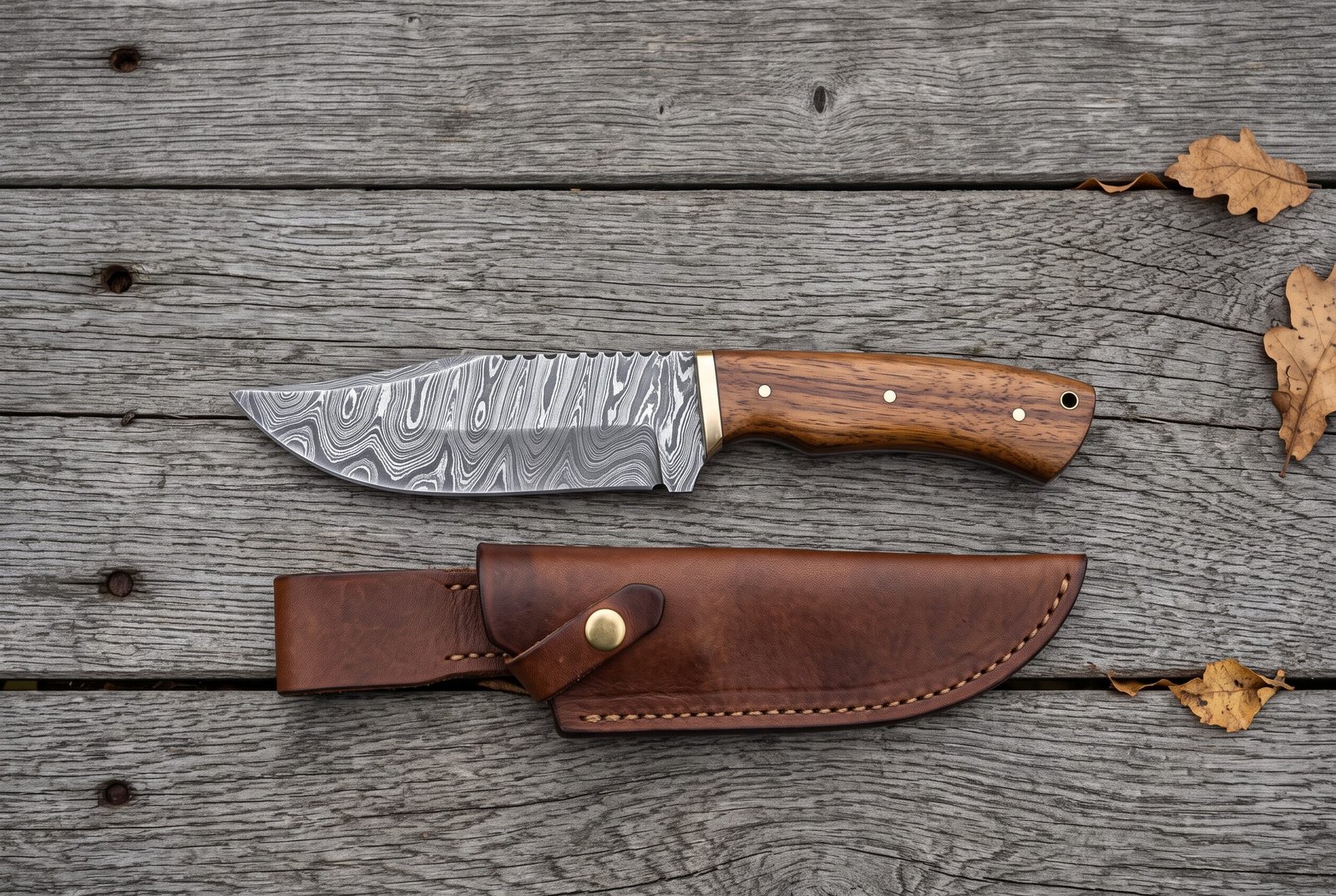
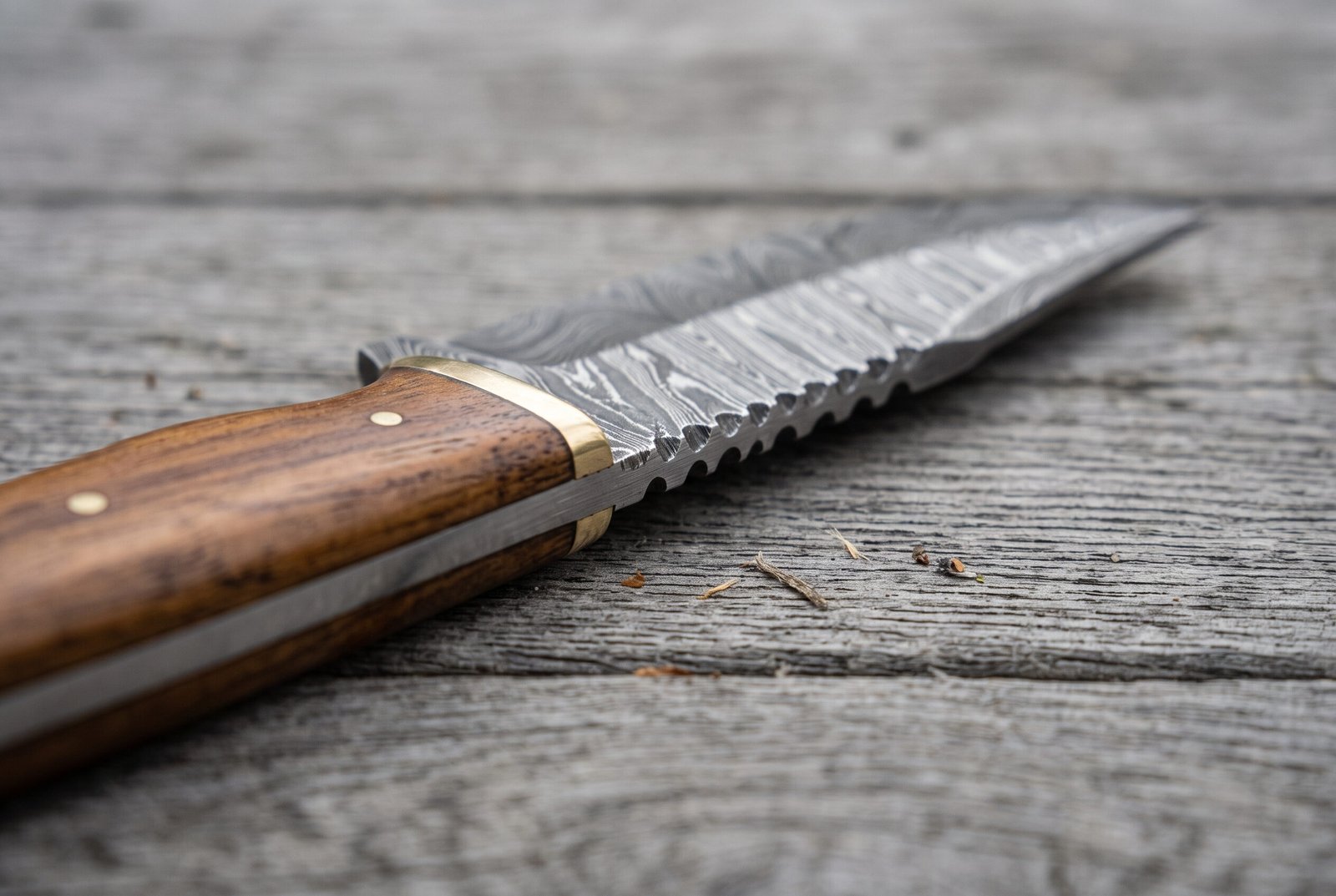
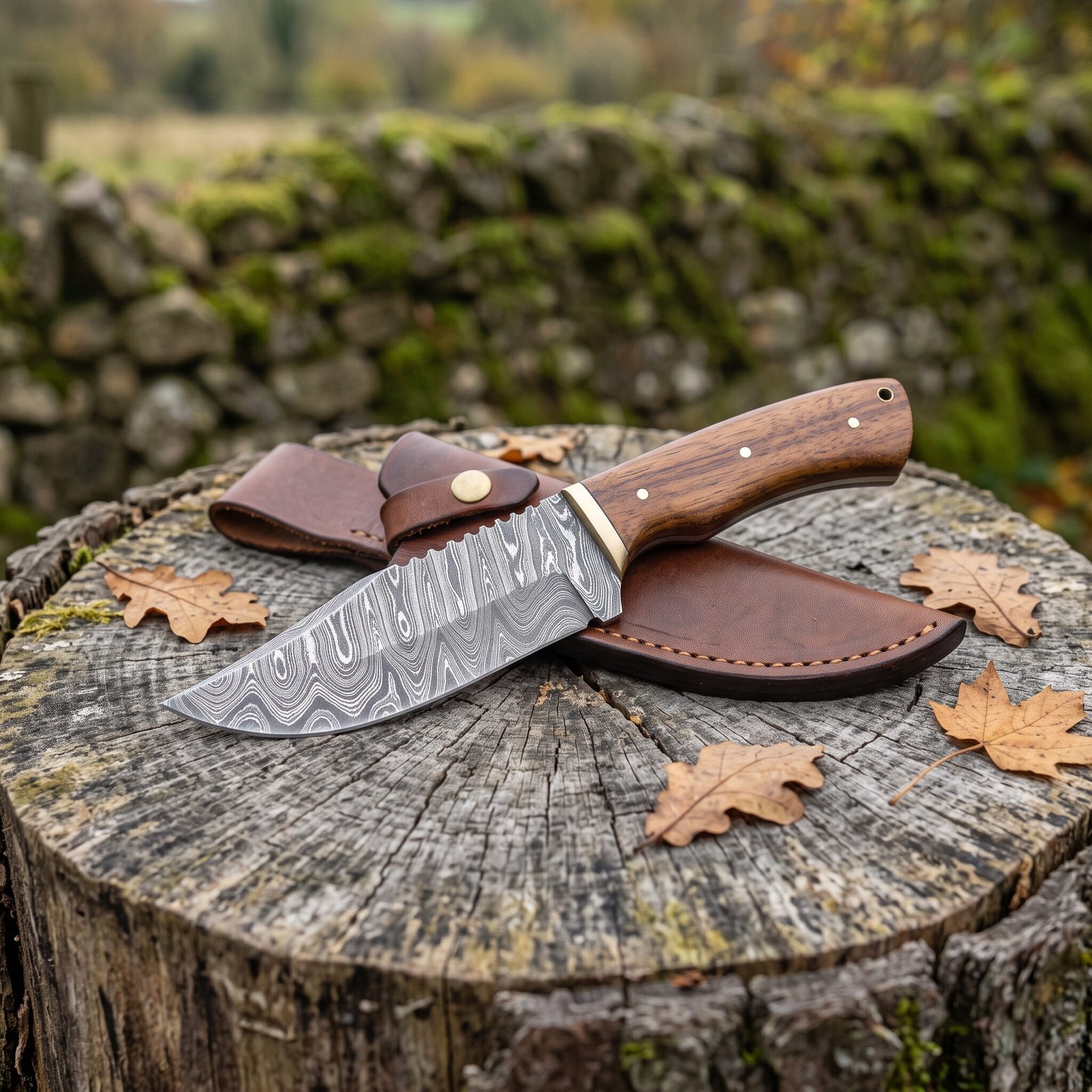
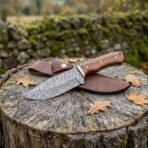
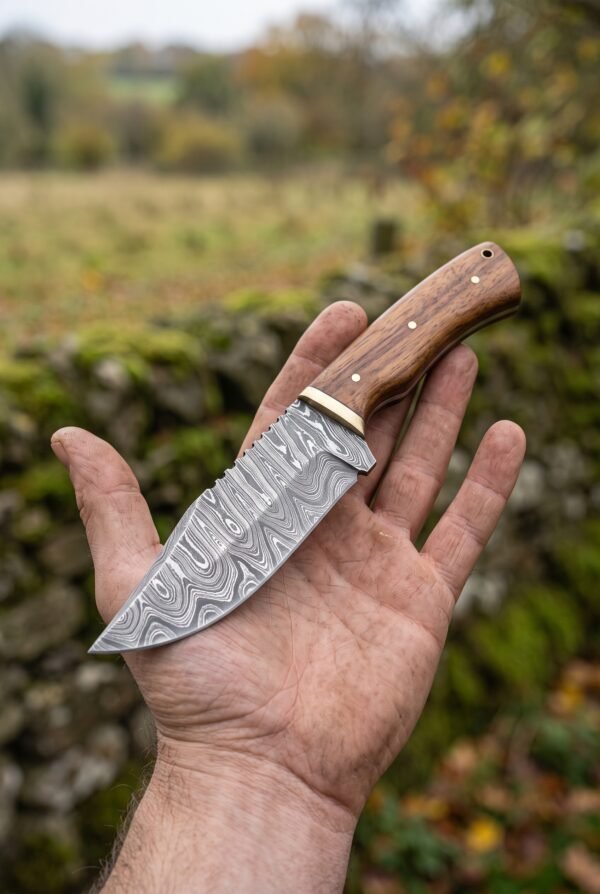
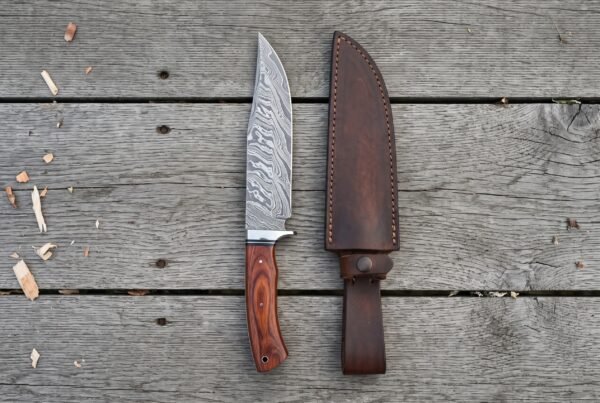
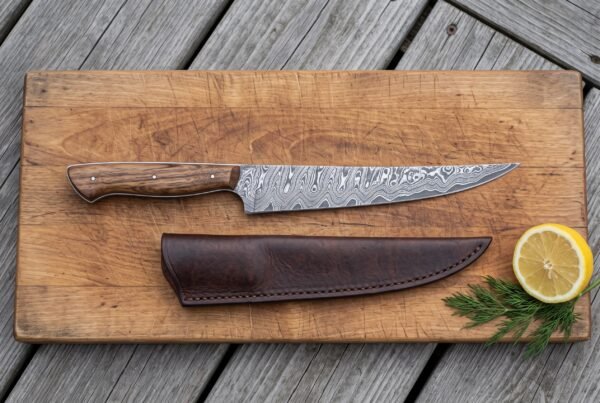
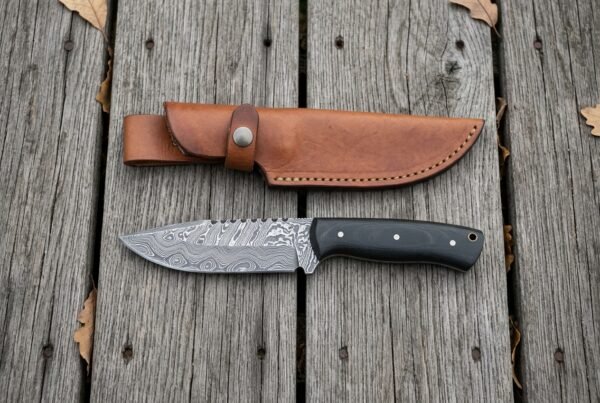
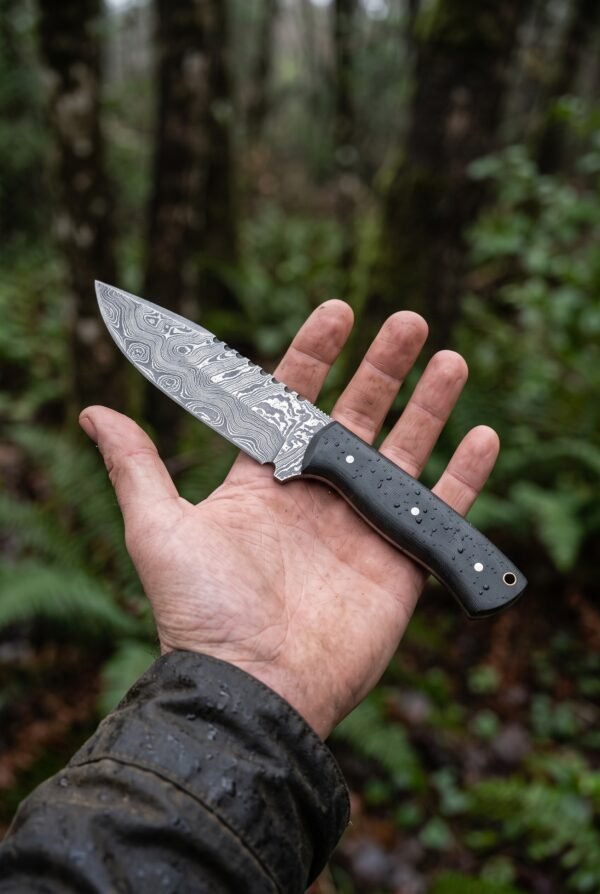
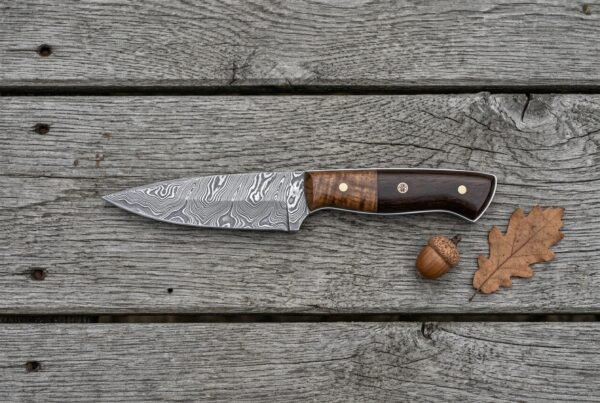
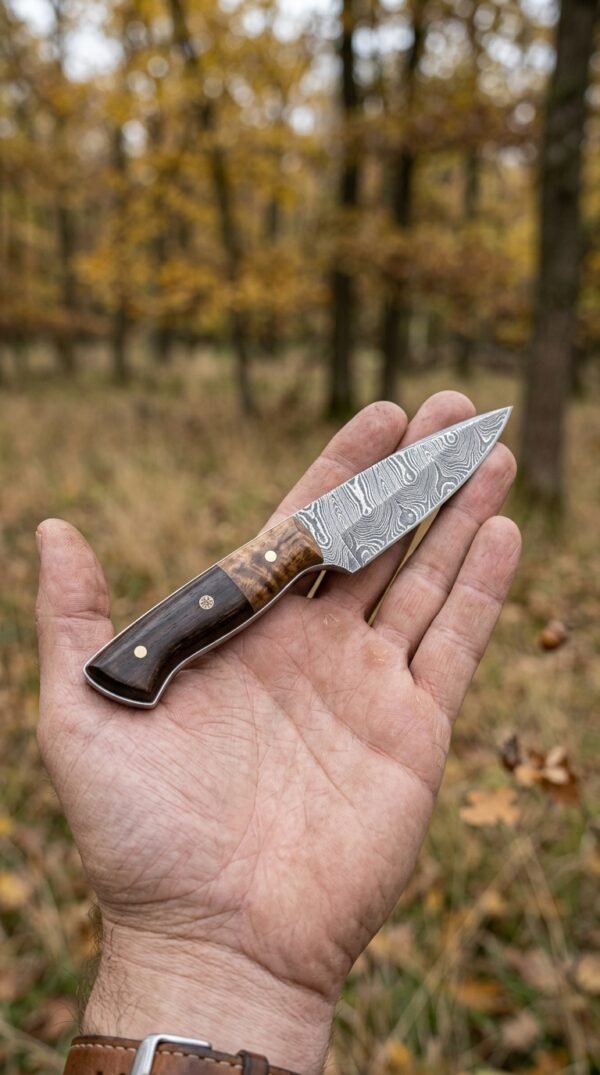
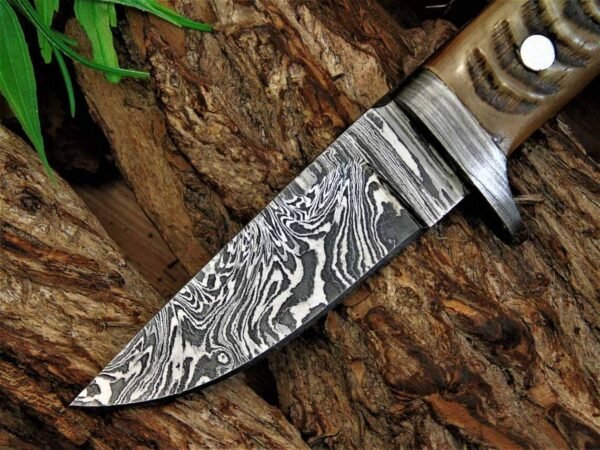
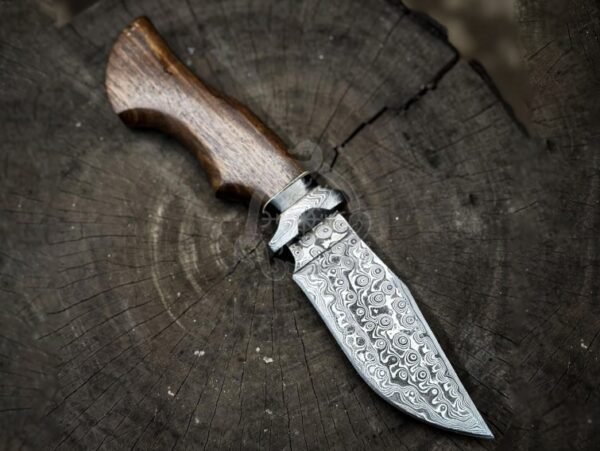
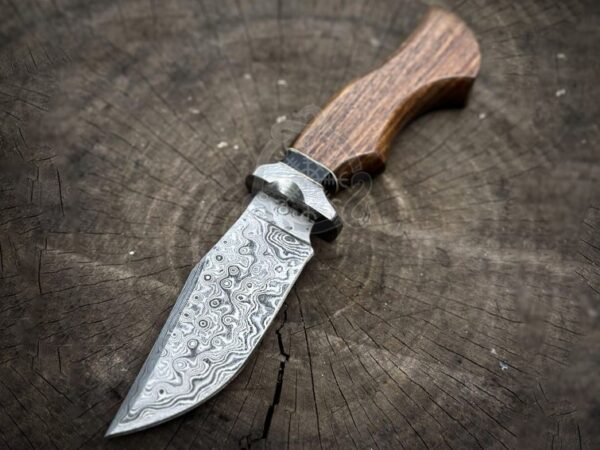
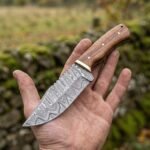
The Woodgrain is a working skinner, not a display piece with a hunting label on it. The blade is 4.0 inches of hand forged fire pattern Damascus, 393 layers deep, with the sweeping belly the pattern is built around. The wood handle runs another 4.0 inches, giving 8.0 inches overall and a knife that balances almost exactly at the finger guard. What makes a good skinner is set out in what makes a good skinning knife.
Skinning knives are one of the few blade shapes where the design is older than metallurgy. Flint skinning tools from tens of thousands of years ago already show the same curved working edge and the same absent point, because the problem has never changed: you are separating hide from muscle along a surface, and a straight edge with a spear point is the wrong tool for a curved surface. The moment a hunter picks up a blade with a long sweeping belly the job goes faster, and every skinner made since has been a refinement of that one insight.
This one is forged, hardened, ground and fitted in the Czech Republic, and it ships sharpened with a fitted leather sheath and free shipping inside the United States.
Specifications
| Steel | Hand forged Damascus, 1095 and 15N20 forge welded |
|---|
| Hardness | 58 to 60 HRC |
|---|
| Damascus layers | 393 layers |
|---|
| Pattern | Wind and mix twist fire pattern with brass file work |
|---|
| Overall length | 8.0 inches |
|---|
| Blade length | 4.0 inches |
|---|
| Handle length | 4.0 inches |
|---|
| Handle | Wood |
|---|
| Sheath | Leather sheath |
|---|
| SKU | RK-454 |
|---|
Why a skinner has a sweeping belly and almost no point
Everything about a skinner comes from the fact that the cut is a peel, not a stab. When you take a hide off an animal you are running the edge along the plane between skin and fascia, and you want as much of the blade as possible in contact with that plane at once. That is what the deep continuous curve gives you. A long belly means one drawing stroke does the work of three chopping ones, and it keeps the contact patch travelling along the edge instead of wearing out a single spot.
The point is deliberately soft. On a skinner the tip is swept upward and rounded off compared with a hunting drop point or a clip point Bowie, and that is not a compromise, it is the whole idea. A fine point punctures hide from the wrong side and ruins the pelt, and it nicks the gut wall, which is the fastest way to spoil meat. A skinner is designed to make that mistake difficult.
Four inches is the honest working size. It is long enough to open a deer or a hog and short enough that you can choke right up on the blade for close work around the legs and head, and it does not fight you inside a body cavity the way a big Bowie does. The handle is the same length as the blade, which is what lets you keep a full fist on it when your hands are cold, wet and bloody, which is the condition this knife will usually be used in.
Why Damascus and not stainless
The blade is forge welded from 1095 and 15N20, folded and drawn out to 393 layers, then profiled and etched. The pattern runs through the steel rather than sitting on it, which is what separates real pattern welded Damascus from a laser etched print. If you are buying Damascus anywhere, run through the checks in Damascus versus stainless first.
For field dressing the case for carbon steel is edge retention under a very specific kind of abuse. Hide is loaded with grit and hair, and it dulls a soft stainless edge fast. At 58 to 60 HRC this steel keeps a working edge through a whole animal and takes only a few minutes on a stone to come back. The price you pay is that blood is corrosive and this steel is not rust proof, so it wants a rinse and a dry before you go to bed rather than a week in a damp sheath.
The wooden handle
Wood is still the best material for a knife you will use with wet hands in cold weather. It does not conduct heat out of your palm the way steel or a synthetic scale does, it develops a slight tack rather than going slippery when it is damp, and it can be reshaped or refinished at home instead of being thrown away.
Every handle on this pattern is cut from a different piece of timber, so the figure, the grain direction and the colour shift from one knife to the next. Feed it once or twice a year with a light oil, keep it out of long soaks and away from dry heat, and it will stay tight on the tang for decades. The method is written up in wooden handle care.
Engraving, runes and your own design
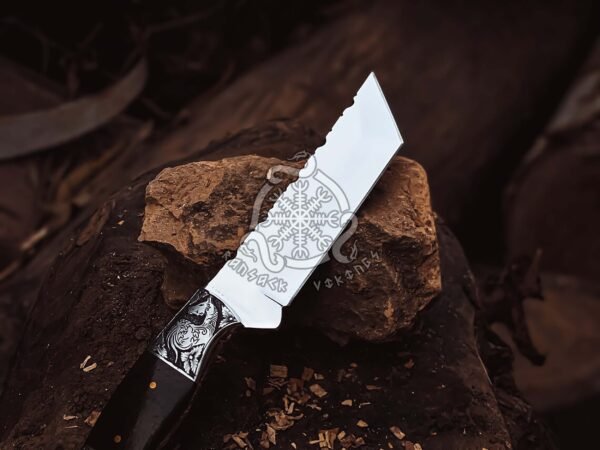
Use the rune converter on this page to turn a name, a date or a short phrase into Elder Futhark and we will cut it into the steel or the handle. If you would rather have a Viking pattern than a rune line, choose your own design in the engraving option above the add to cart button and tell us whether it goes on the blade or the handle. Where a piece already carries an engraved design, your chosen engraving replaces it rather than sitting alongside it.
On a skinner most people put initials or a date on the wood and keep the blade flat clear, since that is the surface that gets worked and wiped hardest. Everything is cut here before the knife is packed, not sent out afterwards. Options are on the engraving page.
Care and sharpening
Two rules cover almost everything. Dry it, and oil it. After field use, rinse the blade, dry it properly including the area right at the guard where blood collects, and put a thin film of mineral or camellia oil on the steel. Do not store it in the sheath for months, because leather holds moisture against steel.
Sharpening a curved belly is a matter of sweeping rather than pushing. Start at the heel with the blade square to the stone and rotate the handle up as you draw the knife back, so the tip comes off the stone last and the whole curve gets equal passes. A 1000 grit stone resets it. Detail in steel care and sharpening with a whetstone.
Made in the Czech Republic
The work behind this piece happens in a Czech Republic workshop that has kept to the old methods. Steel is forged and heat treated by hand, the grind is taken down by eye rather than by machine, and the handle, fittings and sheath are cut and finished one at a time. Because of that, every piece carries small marks of the hand that made it.
Ransack Viking is a United States company. We import direct, check each piece when it reaches us, and ship from our Chicago, Illinois warehouse. Engraving is added here in the United States after arrival, so the piece you receive is finished to your order.
A note on handmade variation
This skinner is hand forged. It is not machine made and it is not bulk produced, so the knife that arrives will not be a pixel for pixel copy of the photograph on this page. The Damascus figure comes out of every billet differently and the handle is cut from a different piece of timber, so the grain, the tone and the exact profile of the grind will be their own.
The dimensions, the steel, the layer count, the hardness and the build are the same on every one. The character is not, because each is worked by hand from natural materials. That is the difference between something made and something moulded.
Frequently asked questions
Is the Woodgrain sharp enough to field dress an animal on arrival
Yes. It is sharpened on a stone before packing and will open hide cleanly straight out of the sheath. Take a stone or a small rod with you anyway, because a whole deer will take the fine edge off any knife regardless of steel.
What is the difference between a skinner and a gut hook knife
A skinner is a curved blade for separating hide from carcass over a wide area. A gut hook is a small sharpened notch cut into the spine, used to unzip the belly without the tip touching the intestines. This blade has no gut hook, so open the belly by lifting the hide and cutting upward with the edge, which is the traditional method and works perfectly well.
Is it full tang
Yes. The tang runs the full length and profile of the handle with the wood fitted either side, which is what you want in a knife that gets levered and twisted during butchery.
Will the blood and the field use ruin the Damascus
Not if you rinse and dry it the same day. Carbon steel will take a grey patina from blood and fat over the seasons, which many hunters actually prefer since a patina slows further corrosion. Rust only shows up when a wet blade is put away in a closed sheath.
Can this be given as an engraved gift for a first hunt
It is one of the most common reasons people buy it. A name and a year on the wood, cut here before the knife ships, and it becomes the piece somebody keeps for forty years.
How long does it take to get here
Processing is one to two weeks while the piece is forged and finished by hand, with engraving at the longer end. Shipping inside the United States is free, and returns are open for seven days from delivery.
What is in the box
- One Woodgrain Damascus skinner knife
- Leather sheath
- Protective packaging
- Forged and finished in the Czech Republic
Explore the range
See what else sits alongside it in Damascus Skinner Knives, Hunting Knives and Bowie Knives. The material detail is written up in the guides.
Compare it with these
Closest to this in the range is the Greyfell Damascus skinner knife, pattern welded Damascus. If this one is not quite right, there is the Rosecamp Damascus skinner knife, pattern welded Damascus. Also in this group is the Copperskin Damascus skinner knife, pattern welded Damascus.
If you are putting a set together, the Bonespire dagger knife sits alongside it. Pick the steel, the length and the fittings yourself on the custom Damascus knife page.




No regrets on this purchase at all. Even the small engravings are crisp and clean. This shop clearly takes pride in their work.
This knife is a genuine work of art. Can’t recommend this enough. Ordered from Ransack Viking before and the quality stays consistent every time. Made overseas in the Czech Republic yet shipped from a US location so no long customs wait.
Got this as a gift and now I want one for myself too. Fit and finish is museum quality. You can tell real craftsmen made this by hand. Edge retention has been great even after regular use. Came in a nice gift box which made it feel even more special. Ordered from Ransack Viking before and the quality stays consistent every time. Great buy overall.
This knife is fine. Just didn’t wow me. Handle material felt a bit different than pictured. Might work for casual use or display. It’s Czech made and US shipped. Packaging was just okay though.
This is exactly what I wanted and then some. Great buy overall.
My husband was speechless when he opened this. Leather sheath is thick and well stitched. Not the cheap stuff you usually get. Edge retention has been great even after regular use. Fit and finish is museum quality. You can tell real craftsmen made this by hand. Beyond happy with how this turned out. Ordered from Ransack Viking before and the quality stays consistent every time.
Did not expect this level of quality for the price. The wood handle feels amazing and the balance is perfect. Leather sheath is thick and well stitched. Not the cheap stuff you usually get. Beyond happy with how this turned out.
No regrets on this purchase at all. Worth every penny.
Was nervous ordering something like this online but so glad I did. Damascus blade holds a razor edge right out of the box. Leather sheath is thick and well stitched. Not the cheap stuff you usually get. This shop clearly takes pride in their work.
Pretty impressed. Just a couple minor things I’d tweak. Minor nitpicks aside, good quality piece.