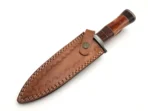
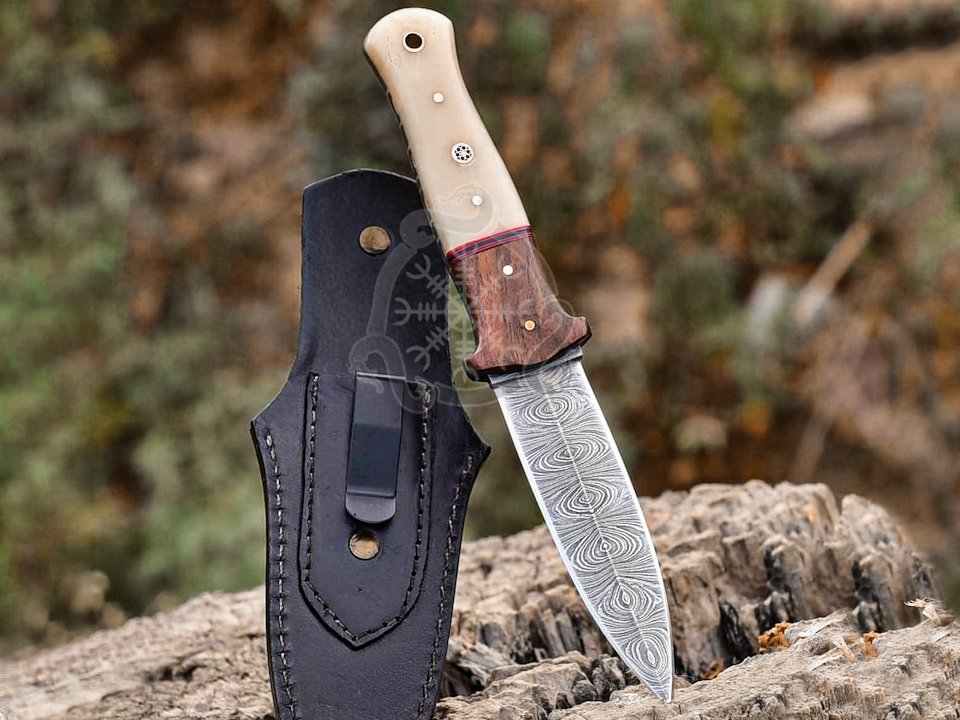
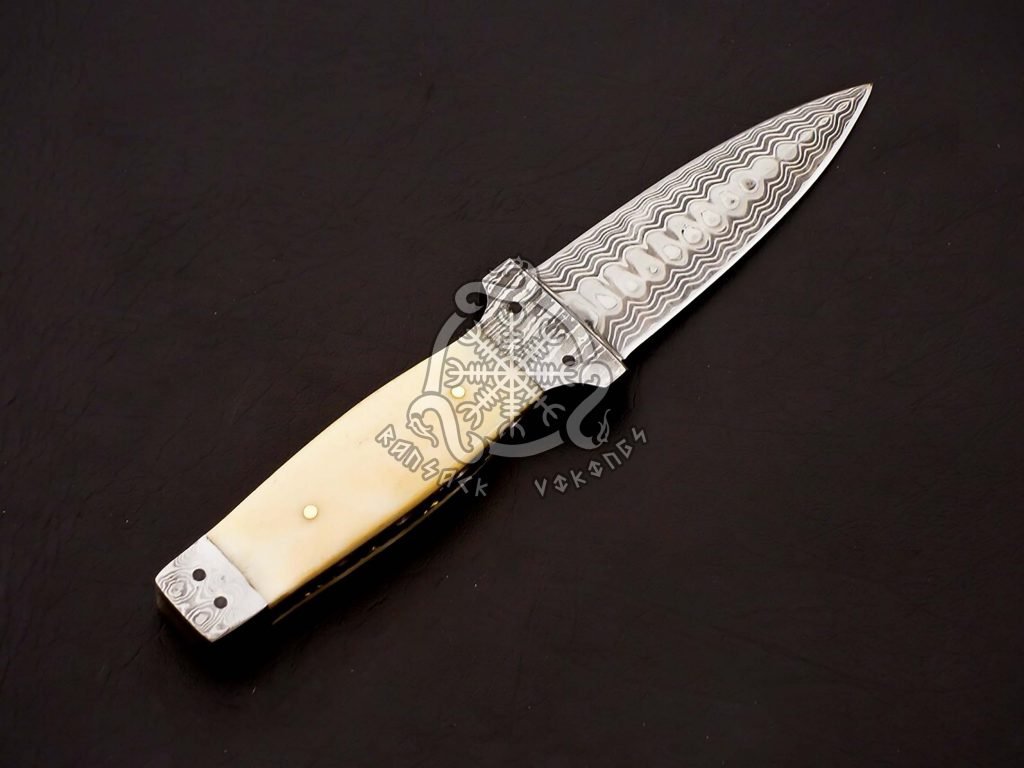
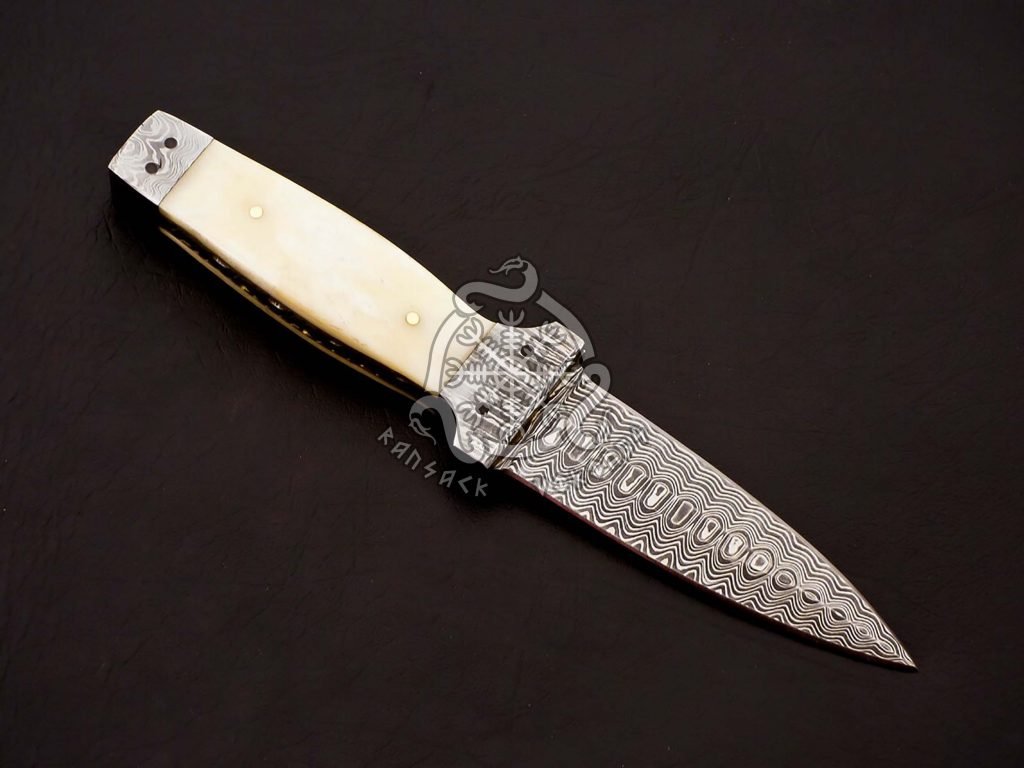
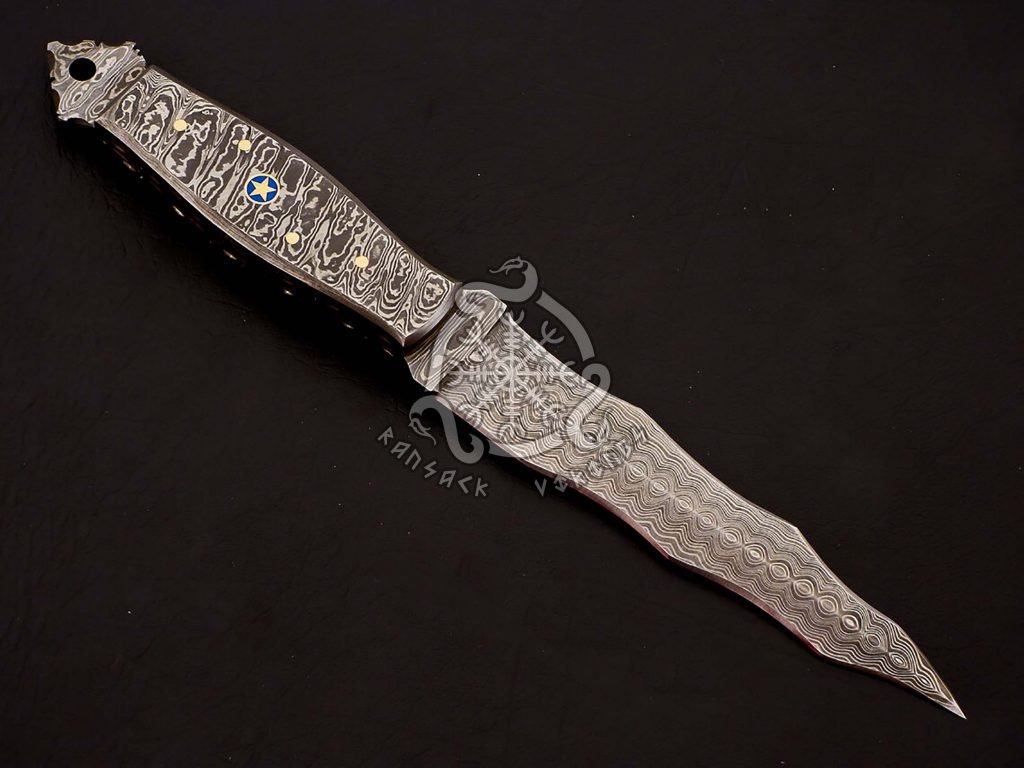
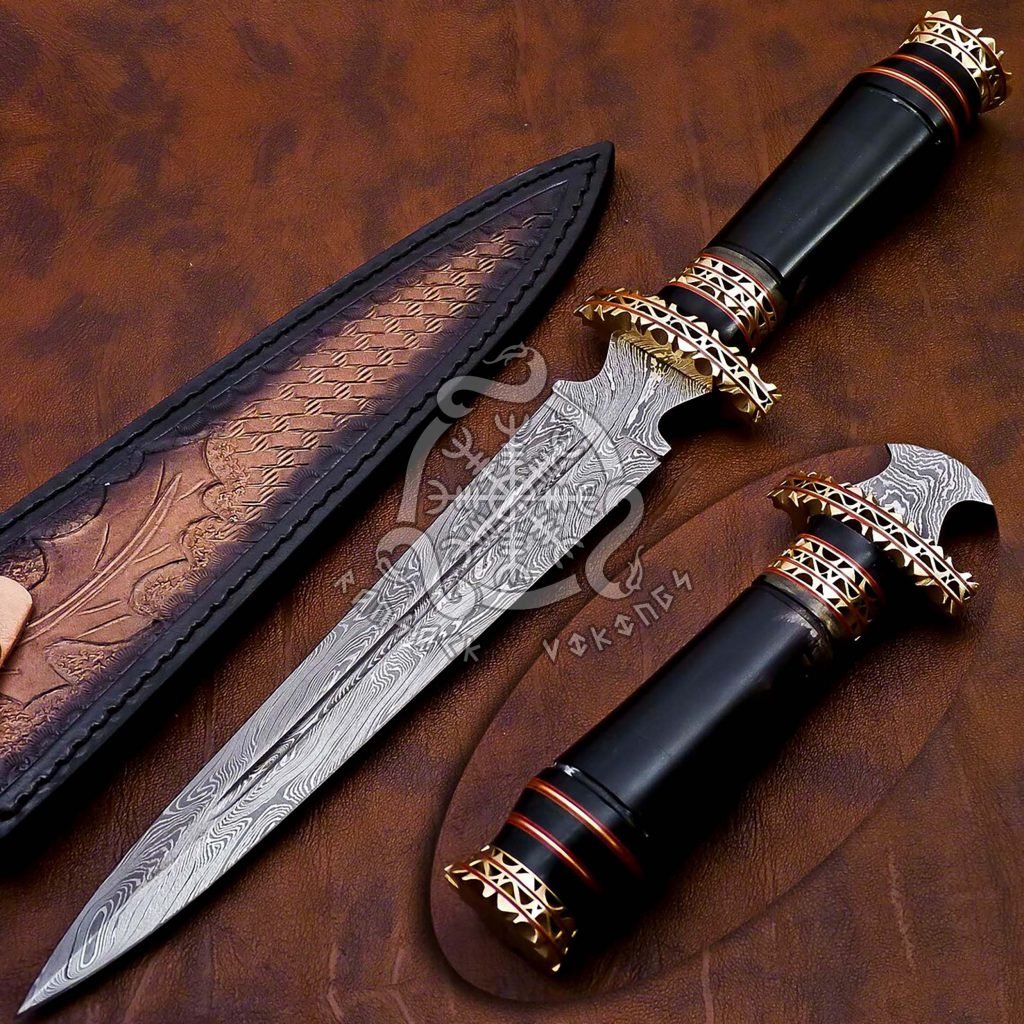
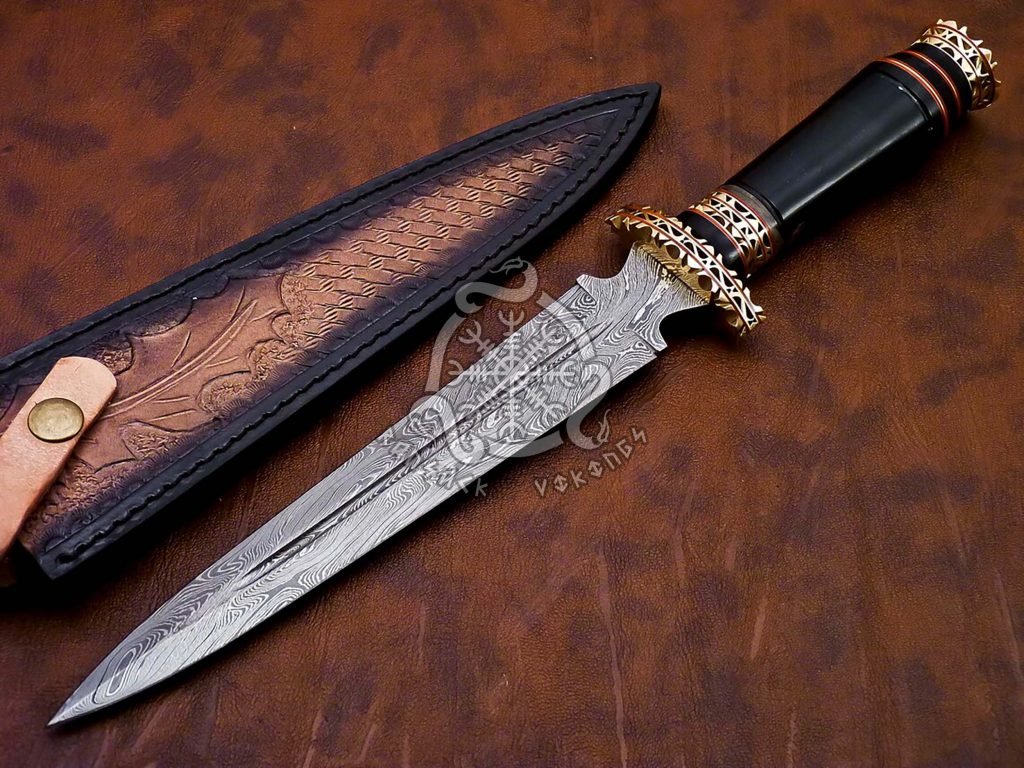
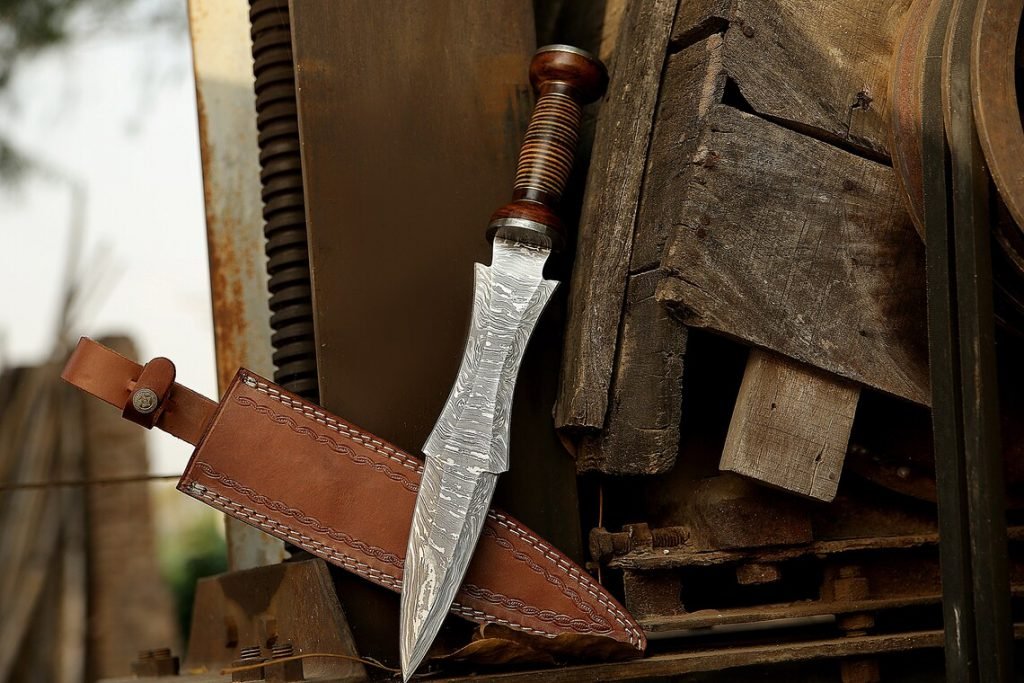
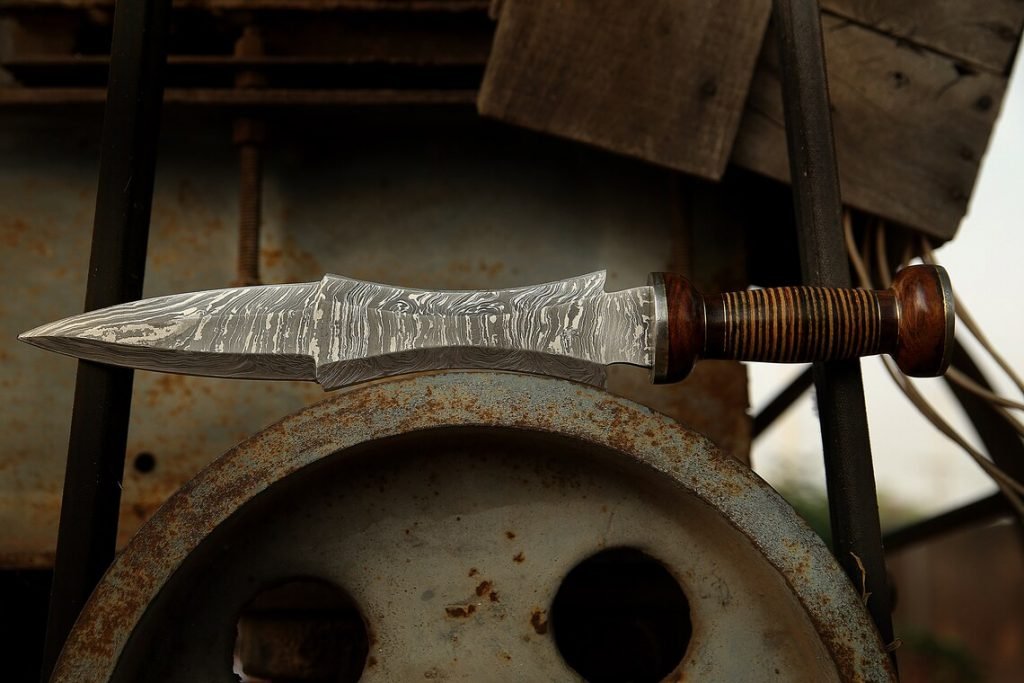
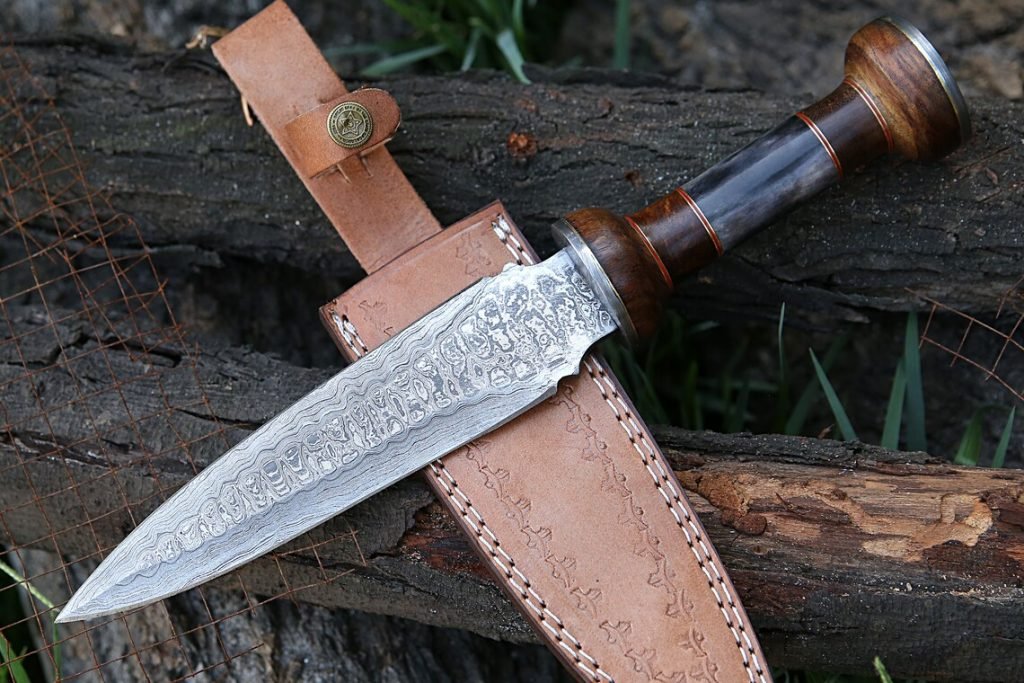
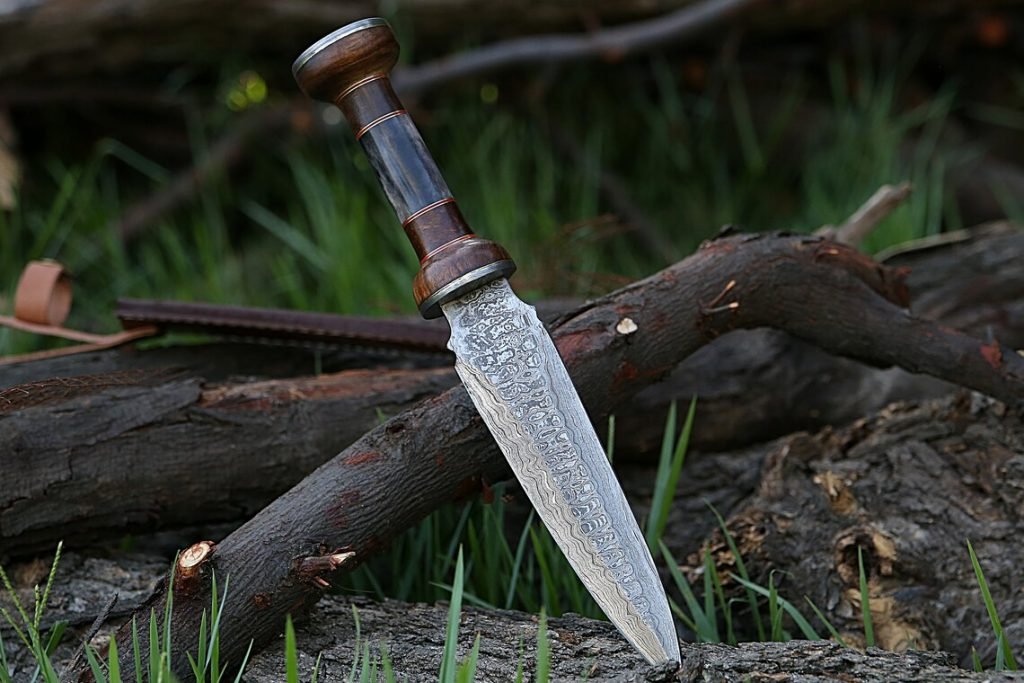
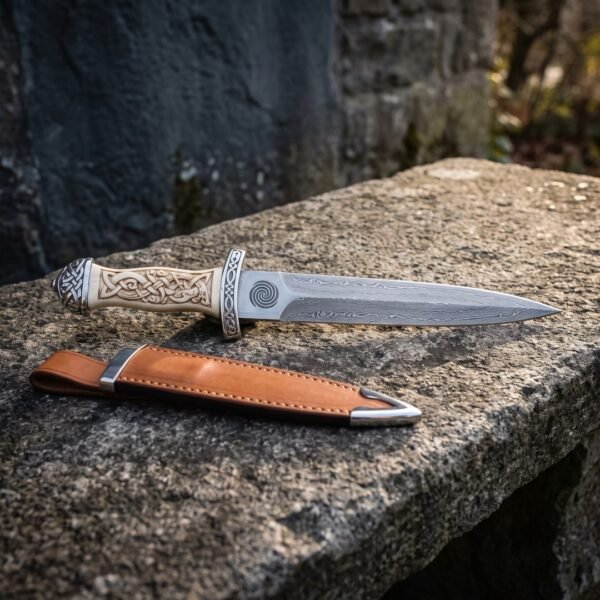
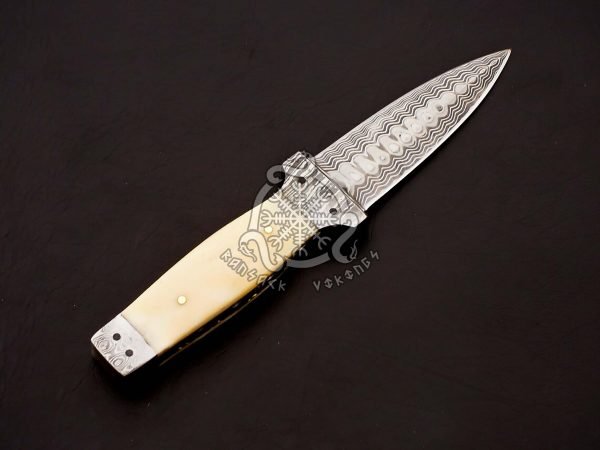
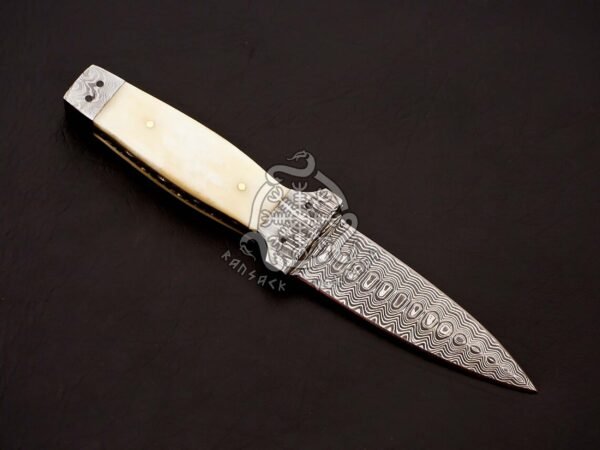
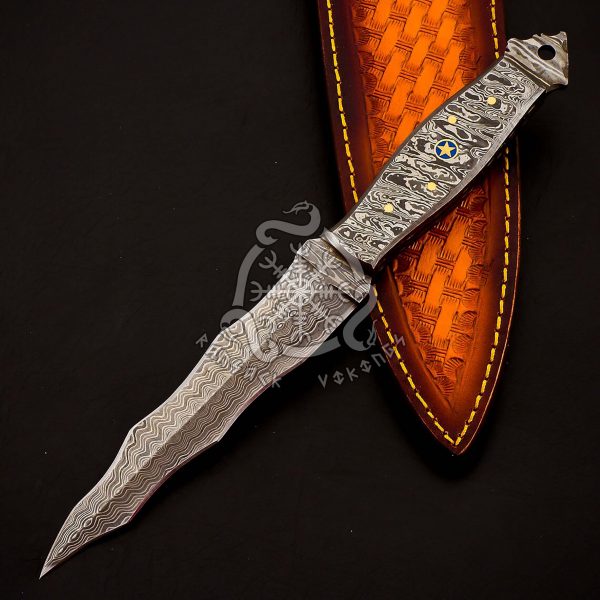
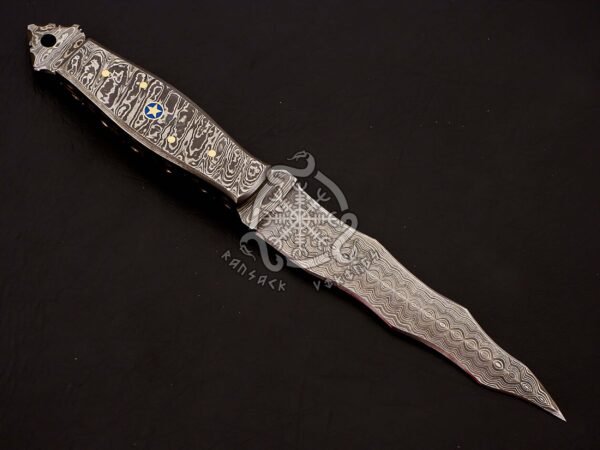
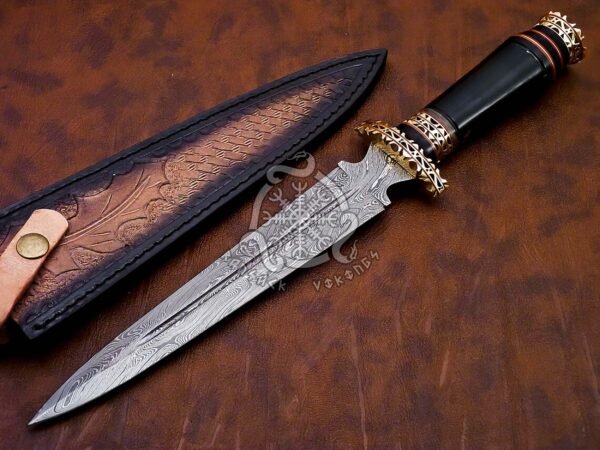
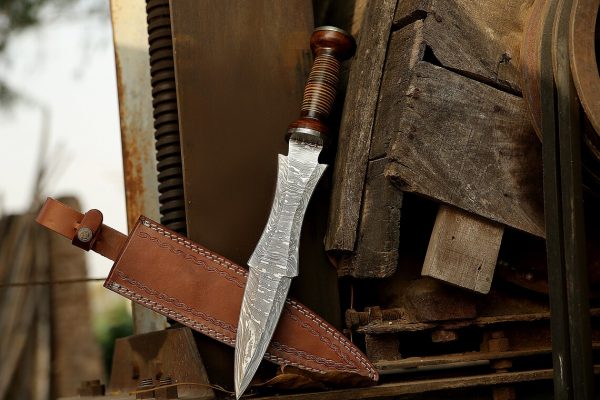
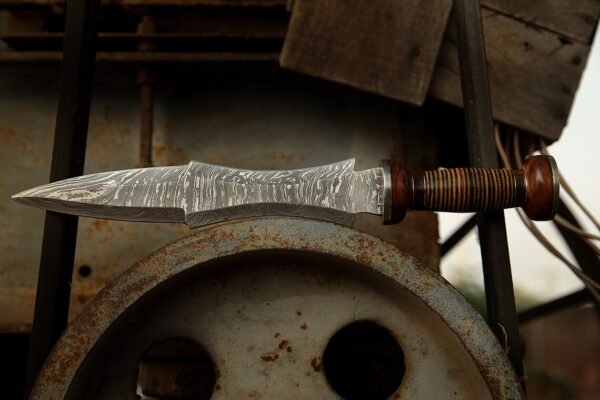
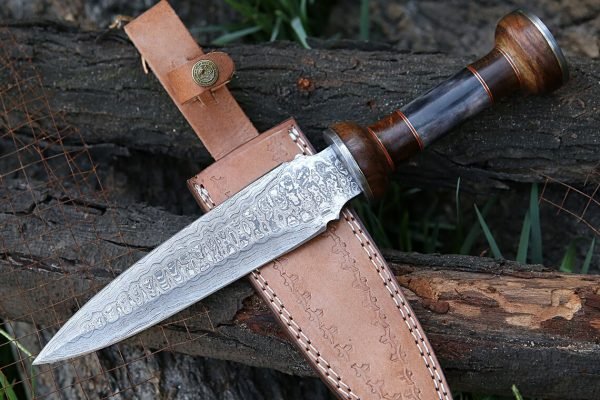
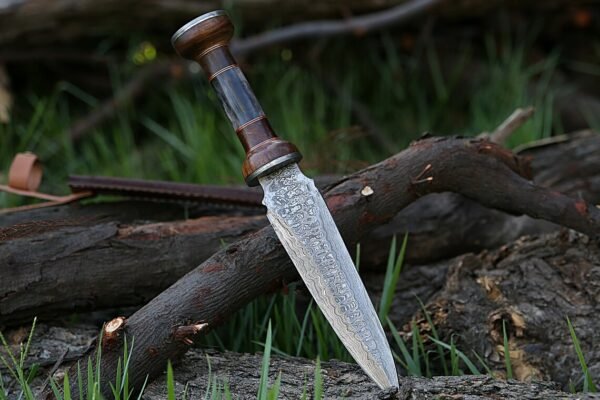
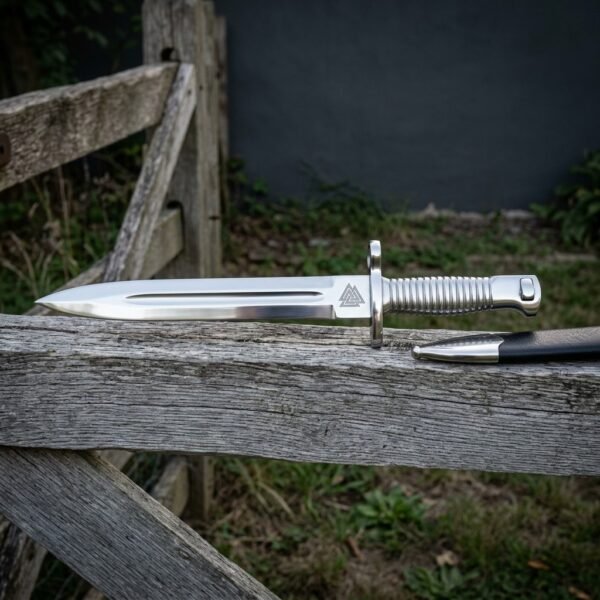
The Steelpommel is a double edged Damascus dagger with a 7.0 inch blade, a 5.0 inch grip of wood and dyed bone, and a steel bolster and pommel at either end of the handle to bracket it. Overall it runs 12.0 inches. The steel furniture is not decoration. It is what puts the balance point back at your hand on a blade that is otherwise all reach. Rondel, bollock, dirk and stiletto are all different animals, sorted in the types of dagger.
A dagger is defined by symmetry, and symmetry is the reason smiths respect the form. On a single edged knife you can hide a great deal in the spine, because only one side has to be right. On a dagger both edges have to meet the centre line at the same angle, the two bevels have to be the same width all the way to the point, and the point itself has to land exactly on the axis of the blade or the whole piece looks wrong from six feet away. Medieval European daggers were often ground with a diamond cross section for precisely this reason, since a raised central ridge gives the smith a datum to grind against and gives the blade stiffness along its length.
This one is forged, hardened, ground, fitted and finished in the Czech Republic, and it ships in a fitted leather sheath with free shipping inside the United States.
Specifications
| Steel | Hand forged Damascus, 1095 and 15N20 forge welded |
|---|
| Hardness | 58 to 60 HRC |
|---|
| Pattern | Wind and mix twist fire pattern, double edged |
|---|
| Overall length | 12.0 inches |
|---|
| Blade length | 7.0 inches |
|---|
| Handle length | 5.0 inches |
|---|
| Handle | Wood and dyed bone with steel bolster and pommel |
|---|
| Sheath | Leather sheath |
|---|
| SKU | RK-468 |
|---|
What makes a dagger a dagger
Two edges and a centred point. That is the whole definition, and everything else follows from it.
Because the blade is symmetrical it has no natural spine to rest a thumb on, so a dagger is not a utility knife and was never meant to be one. It is a thrusting form. The taper runs continuously from the shoulders to the tip, which concentrates force at the point rather than spreading it along an edge, and the stiffness comes from thickness at the centre line rather than from a thick back. That is why a well made dagger feels rigid in a way a similarly sized knife does not.
The grinding is the hard part and it is where you can judge one at a glance. Sight down the blade from the pommel. The centre line should run dead straight to the point, the two bevels should be the same width along their whole length, and the plunge lines where the grind stops at the shoulders should sit level with each other on both sides. Getting all of that right freehand takes twice as long as grinding a single bevel, and there is nowhere to hide a mistake.
The steel bolster and pommel on this piece are a functional part of the same problem. A long symmetrical blade wants to pull the balance forward. Steel at both ends of the grip pulls it back, so the knife sits alive in the hand rather than nose heavy in it.
Why Damascus and not stainless
The blade is 1095 and 15N20 forge welded into a single billet, folded, drawn out and etched, so the pattern is two different steels lying through the full thickness of the blade rather than a finish applied to the outside of one.
On a piece like this the steel choice is about how the edges hold up and how the pattern reads. High carbon 1095 at 58 to 60 HRC takes and keeps a fine edge on both bevels, and the nickel in the 15N20 gives the toughness a long slender blade needs so it flexes rather than snaps under load. Stainless would resist rust better and would take neither as fine an edge nor as clear a pattern, since stainless alloys do not give the same contrast under etch. What you accept in return is that this blade wants oiling. We lay the comparison out in Damascus versus stainless.
Wood, dyed bone and steel in the hand
The grip stacks three materials. Wood gives the body and the warmth, dyed bone gives a hard contrasting band with its own depth of colour, and the steel bolster and pommel cap both ends and carry the weight. Stacked handles like this are an old construction, and they are used because different materials in sequence give the hand something to register against, so you know where you are on the grip without looking.
Both the wood and the bone are natural materials, so the figure, the tone and the way the dye has taken will differ from one piece to the next. Neither wants much attention. Keep the handle dry, keep it away from direct heat, and give it a wipe of light oil once or twice a year to stop the wood shrinking away from the bolster. The method is in wooden handle care, and it applies to the bone as well as the timber.
Engraving, runes and your own design
Use the rune converter on this page to turn a name, a date or a short phrase into Elder Futhark and we will cut it into the steel or the handle. If you would rather have a Viking pattern than a rune line, choose your own design in the engraving option above the add to cart button and tell us whether it goes on the blade or the handle. Where a piece already carries an engraved design, your chosen engraving replaces it rather than sitting alongside it.
A dagger takes engraving unusually well because the eye already reads the blade symmetrically, so a rune line down the centre of one face sits naturally. The steel pommel is the other favourite surface for a set of initials. All of it is cut here before the piece is packed. Options are on the engraving page.
Care and sharpening
Wipe it dry after handling, because fingerprints on carbon steel are acidic and will etch themselves into the pattern if they sit. A thin film of mineral or camellia oil before it goes back on the shelf is enough. Store it out of the sheath for long periods, since vegetable tanned leather holds moisture and will mark a blade left in it for months.
Sharpening a dagger means doing everything twice and keeping both sides matched, so count your passes rather than working by feel. Hold a consistent angle, work one bevel until you raise a burr along its length, then do the same on the other side and finish with light alternating strokes. Detail in steel care and sharpening with a whetstone.
Made in the Czech Republic
The work behind this piece happens in a Czech Republic workshop that has kept to the old methods. Steel is forged and heat treated by hand, the grind is taken down by eye rather than by machine, and the handle, fittings and sheath are cut and finished one at a time. Because of that, every piece carries small marks of the hand that made it.
Ransack Viking is a United States company. We import direct, check each piece when it reaches us, and ship from our Memphis, Tennessee warehouse. Engraving is added here in the United States after arrival, so the piece you receive is finished to your order.
A note on handmade variation
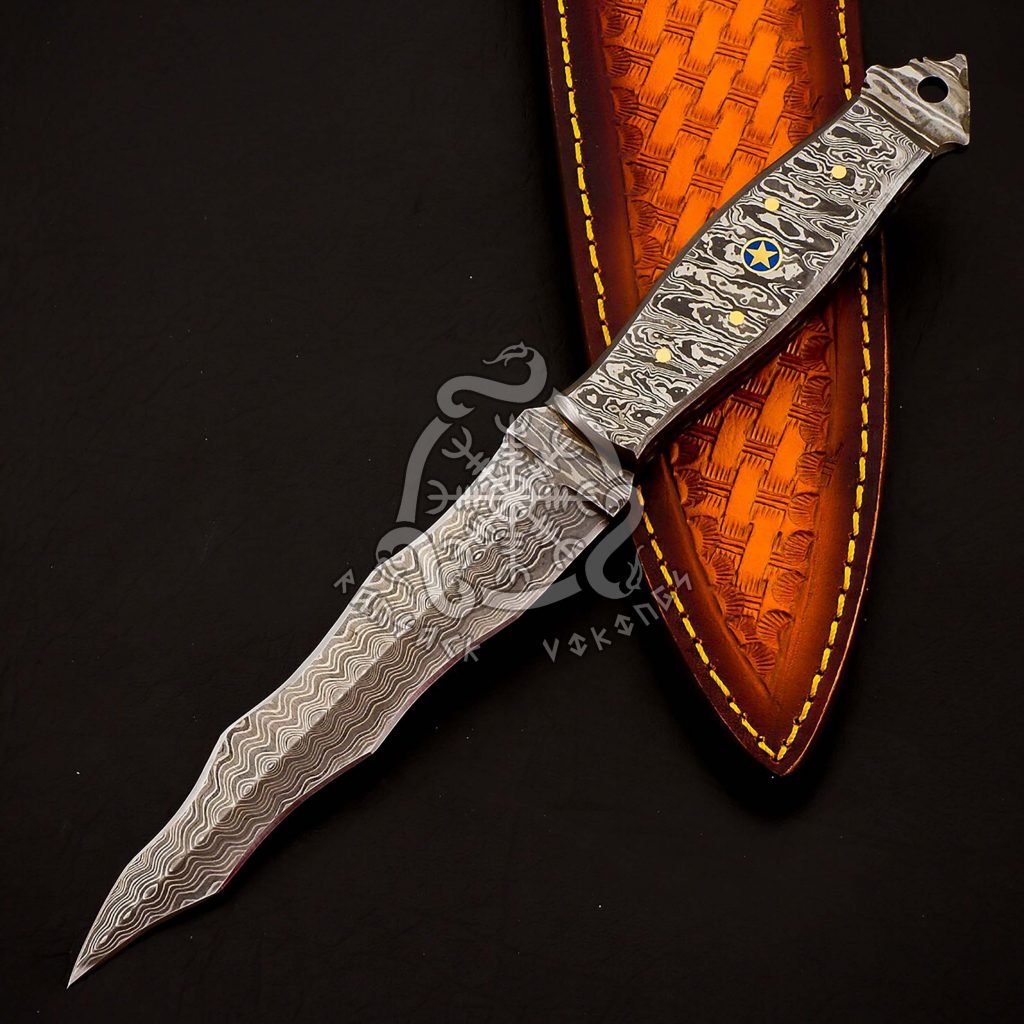
This dagger is hand forged. It is not machine made and it is not bulk produced, so what arrives will not be a pixel for pixel copy of the photograph. The Damascus pattern moves differently in every billet, the wood is cut from a different board and the bone takes the dye differently every time.
The dimensions, the steel, the hardness and the build are the same on every one of these. The grain, the tone, the pattern and the exact profile are not, because each is worked by hand from natural materials. If two of them looked identical, something would have gone wrong.
Frequently asked questions
Are both edges sharpened
Yes. Both edges are ground and sharpened, which is what makes it a dagger rather than a double bevelled display blade. Handle it accordingly, because there is no safe spine to put a thumb on.
Is this a display piece or can it be used
It is built as a collector and display piece and that is how most owners keep it. The construction is real, the steel is hardened and the edges are sharp, but the symmetrical profile is a poor utility shape, so if you want a knife for cutting jobs, buy a drop point or a Bowie and keep this one for the wall and the hand.
What does the steel bolster and pommel actually do
They add mass at the back of the grip so the balance point sits at or just ahead of your hand, and they lock the wood and bone stack tight against the tang so nothing can move. They also protect the ends of the handle, which are the first places a stacked grip would otherwise wear.
Will mine look exactly like the photograph
The measurements and the build will match. The Damascus figure and the colour of the wood and dyed bone will be different, because those come out of natural materials worked by hand rather than out of a mould.
Is it legal to own a double edged knife
Owning one is unrestricted almost everywhere in the United States, and it is carry that is regulated. Several states restrict carrying double edged blades concealed regardless of length. Since this is bought as a collector piece rather than a carry knife, that rarely matters, but check your state rules before you take it anywhere.
How long does delivery take
Processing is one to two weeks while the piece is made and finished by hand, with engraved orders at the longer end. Shipping inside the United States is free and returns are open for seven days after delivery.
What is in the box
- One Steelpommel Damascus dagger knife
- Leather sheath
- Protective packaging
- Forged and finished in the Czech Republic
Explore the range
Sitting beside it in the catalogue: Dagger Knives, Swords and Viking Knives. The background reading lives in the guides.

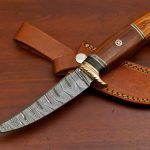
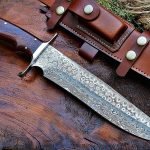


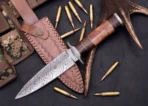
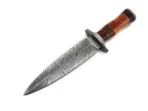
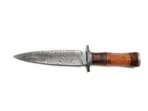
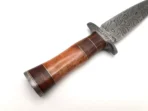
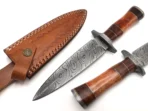




This thing is a beast in the best way. Even the small engravings are crisp and clean. The bone handle feels amazing and the balance is perfect. Already planning my next purchase from this shop.