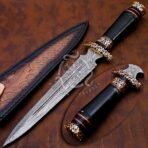
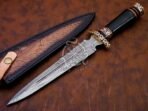
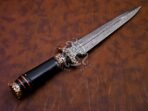
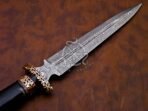
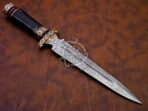
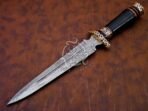
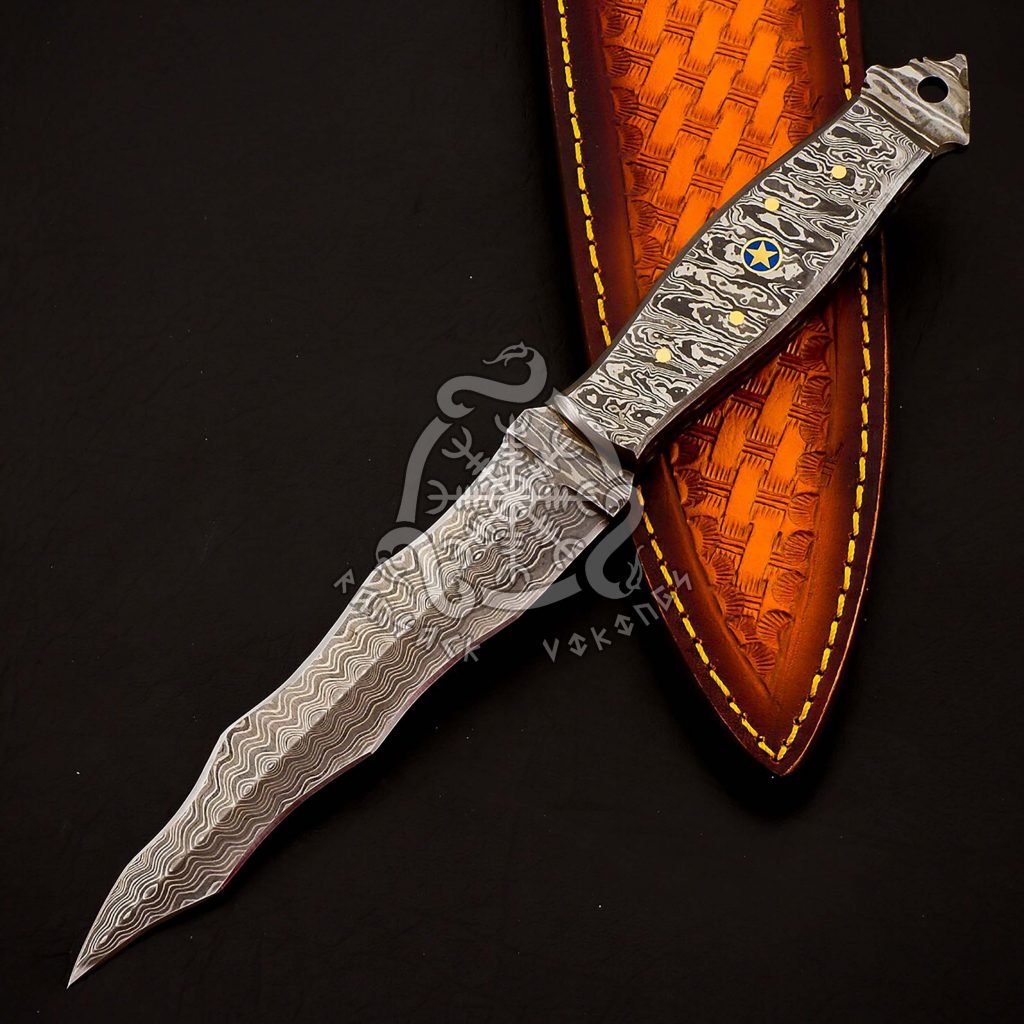
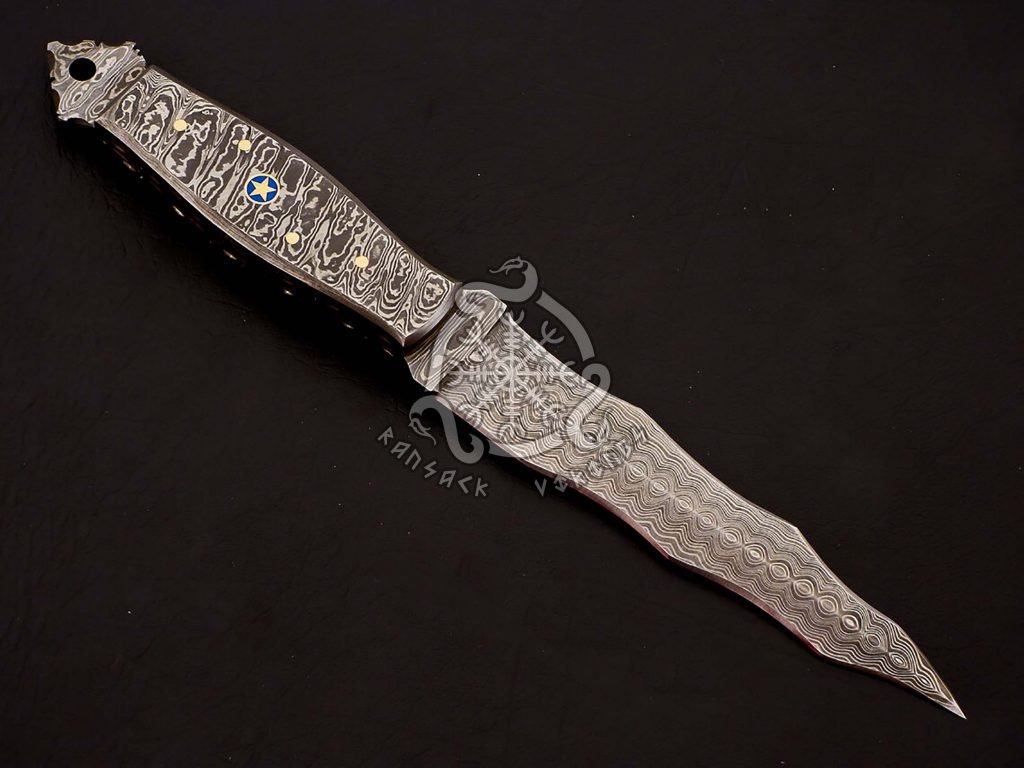
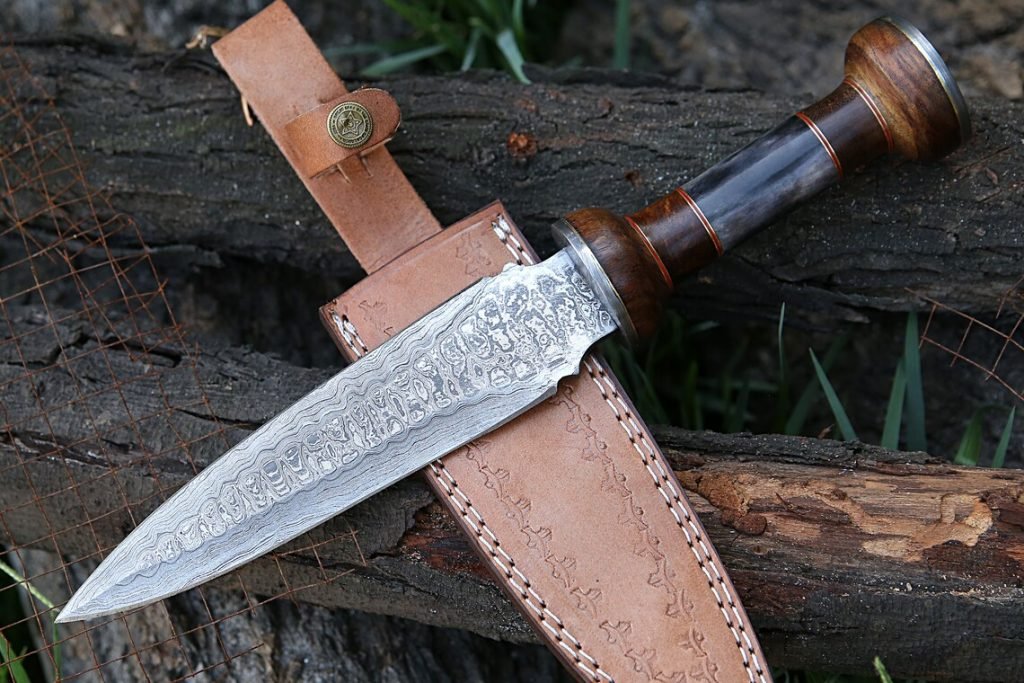
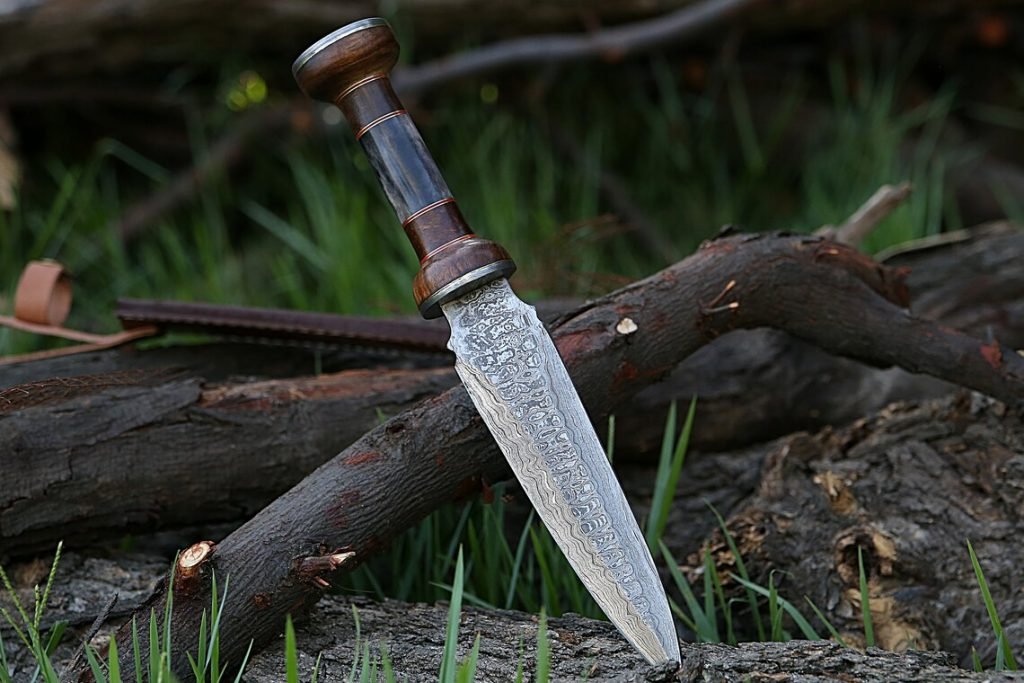
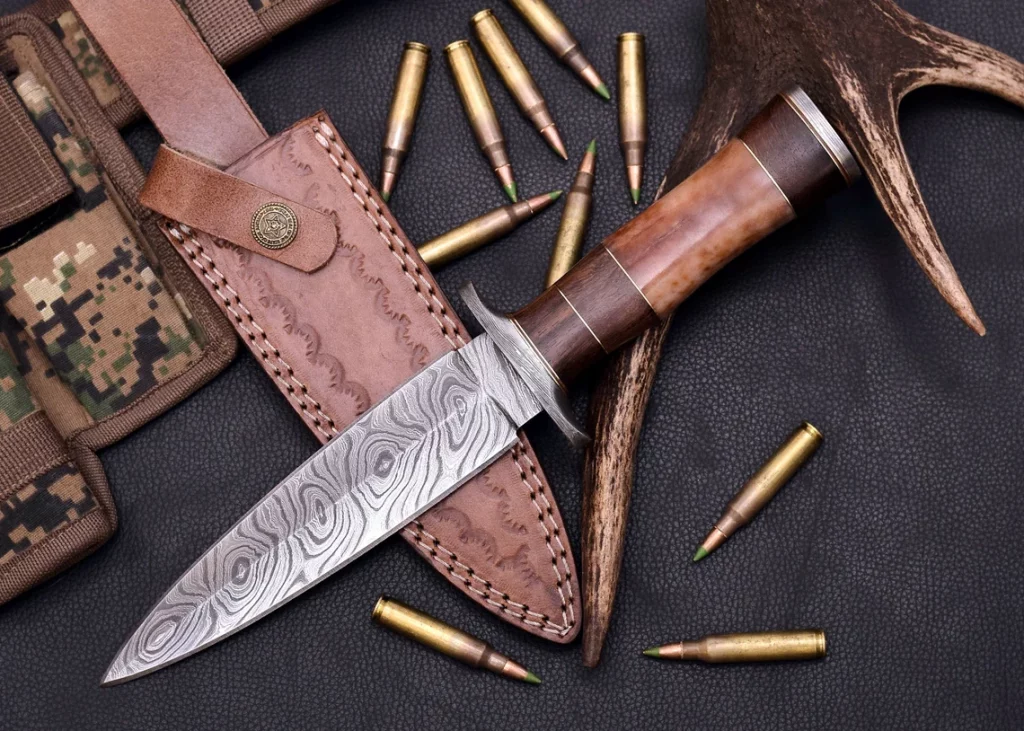
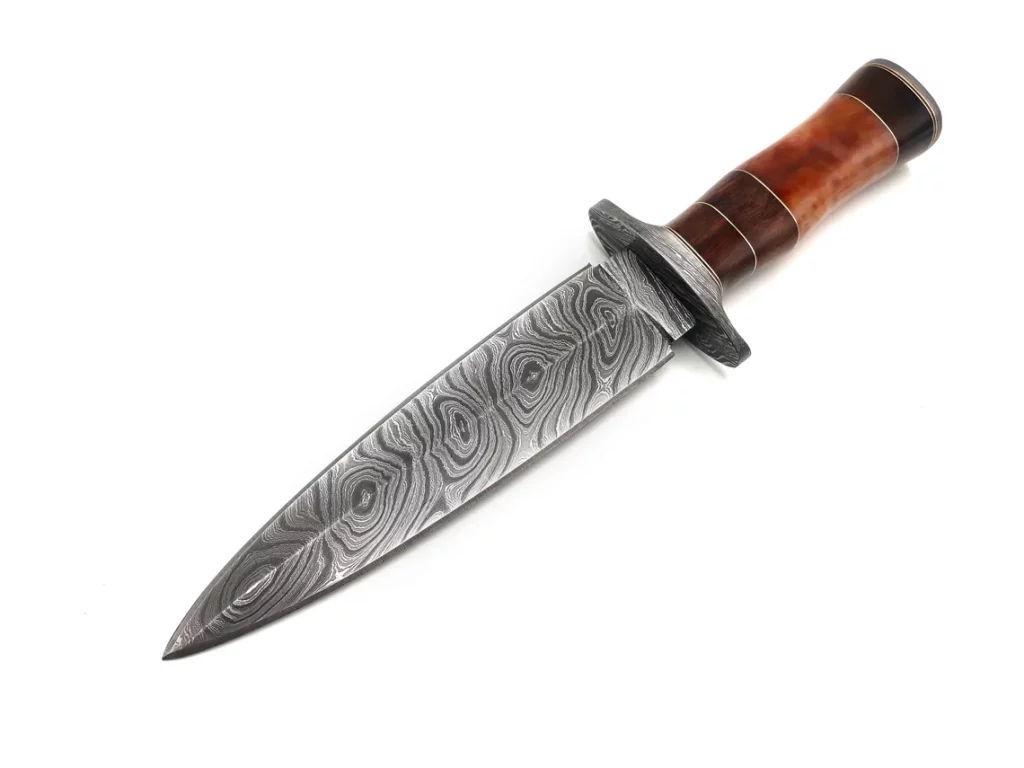
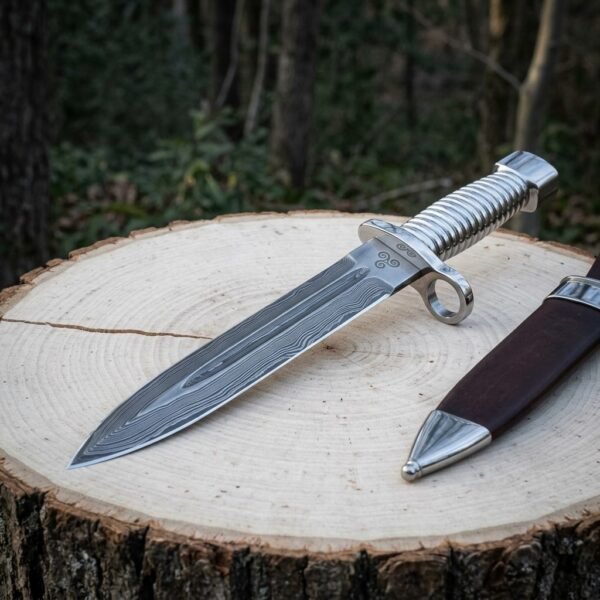
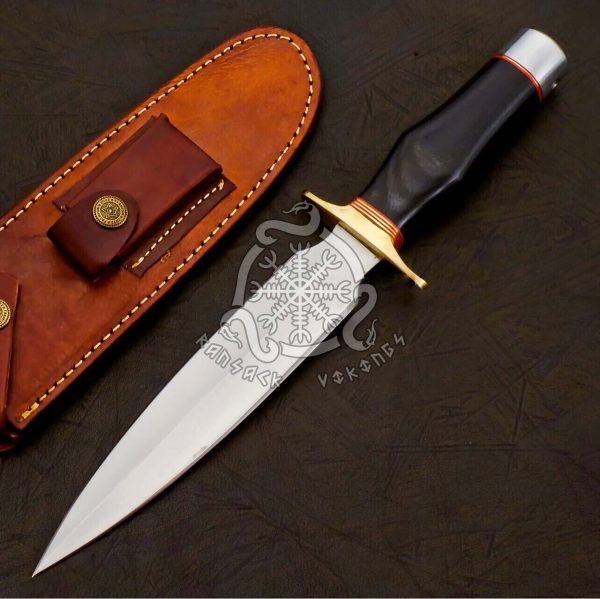
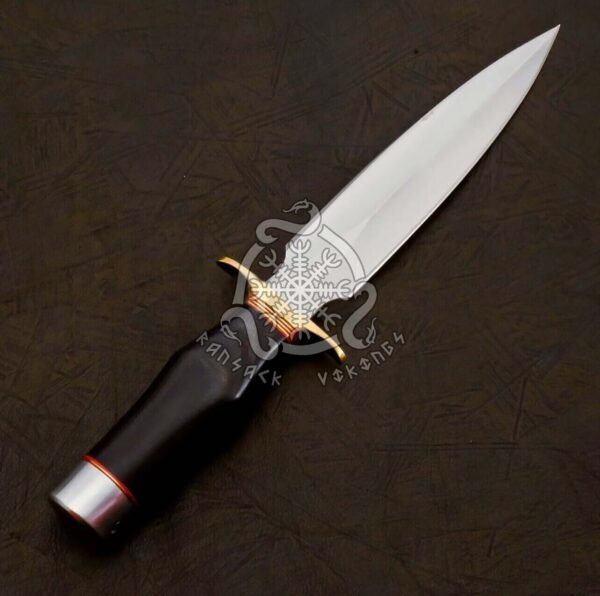
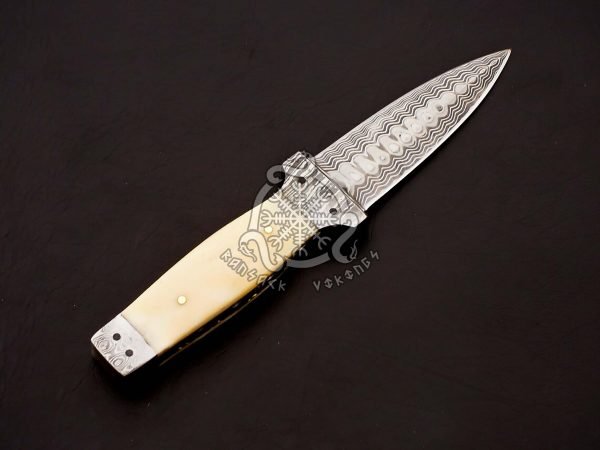
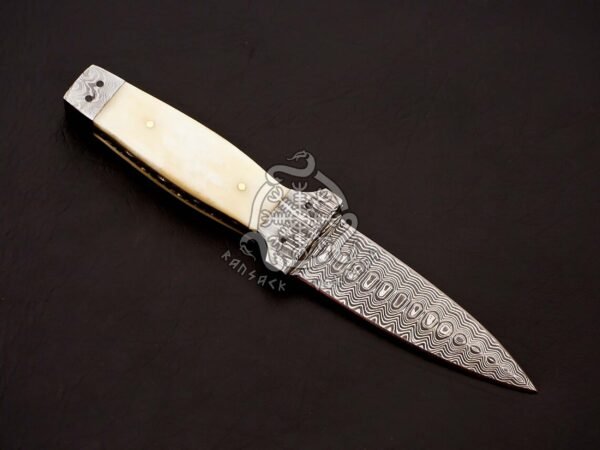
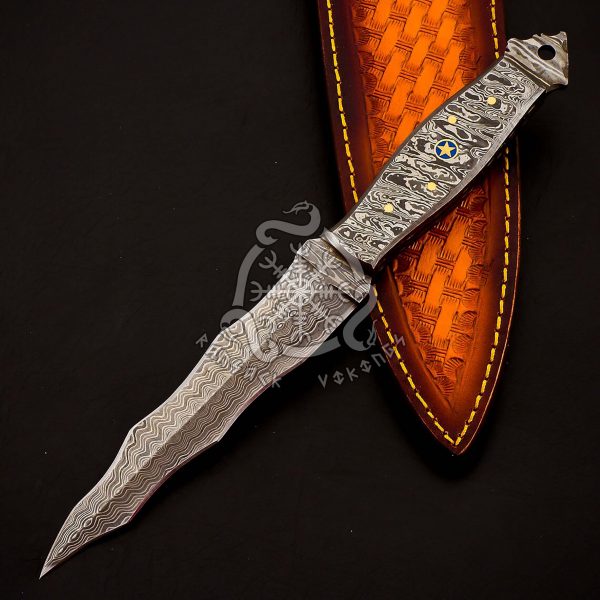
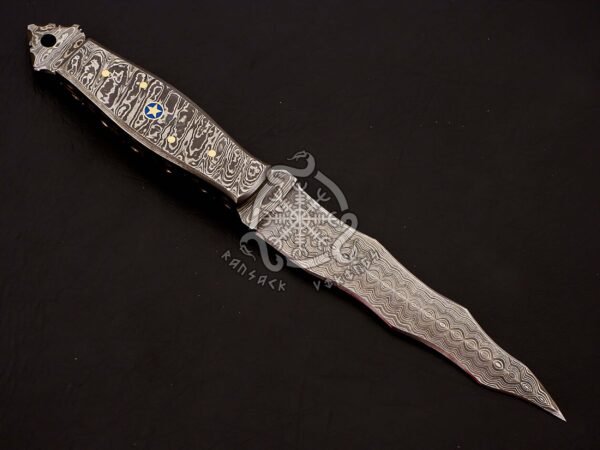
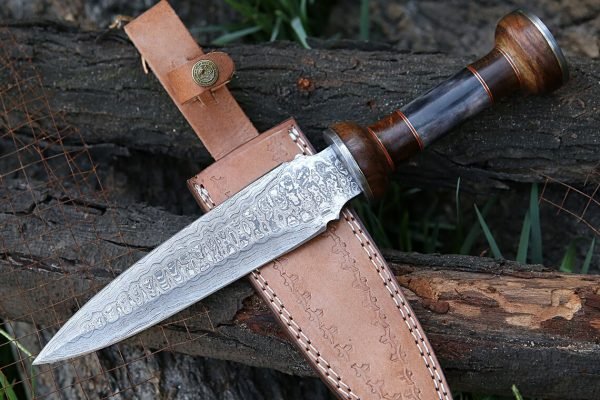
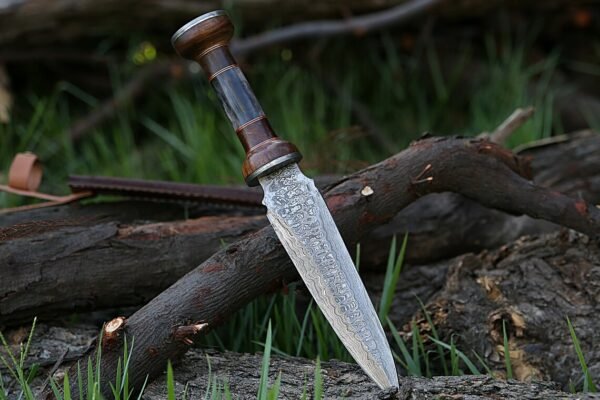
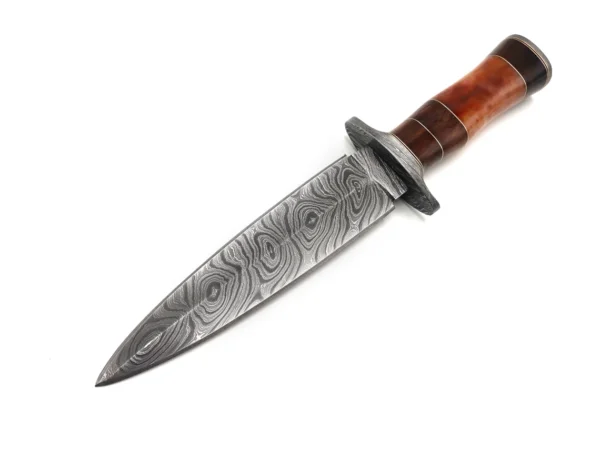
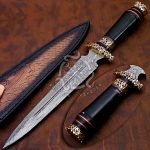
Horn at both ends of the grip and 352 layers of fire pattern Damascus in the blade. The Hornspire is a double edged dagger with an 8.0 inch blade on a 5.0 inch handle of stag horn and bull horn, 13.0 inches overall. It is made one at a time, so the grind, the pattern and the fit belong to this knife and to no other. For the full spread of dagger shapes, read the dagger family.
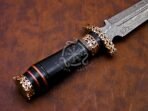
Horn is one of the oldest handle materials in the world and it behaves like nothing else. It is keratin, the same protein as fingernail and hoof, laid down in layers, which means it can be heated, pressed and shaped in ways no wood will tolerate, and it takes a polish deep enough that early modern craftsmen used it as a substitute for tortoiseshell. Stag horn is antler, solid bone rather than true horn, hard and lightly textured on the outside. Bull horn is the sheath from a bovine horn core, denser, darker and translucent at the edges. Putting the two together on one grip gives you both a grippy surface and a deep polished contrast on the same handle.
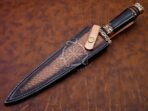
This one is forged, hardened, ground and fitted in the Czech Republic, and it ships in a fitted leather sheath with free shipping inside the United States.
Specifications
| Steel | Hand forged Damascus, 1095 and 15N20 forge welded |
|---|
| Hardness | 58 to 60 HRC |
|---|
| Damascus layers | 352 layers |
|---|
| Pattern | Wind and mix twist fire pattern, double edged |
|---|
| Overall length | 13.0 inches |
|---|
| Blade length | 8.0 inches |
|---|
| Handle length | 5.0 inches |
|---|
| Handle | Stag horn and bull horn |
|---|
| Sheath | Leather sheath |
|---|
| SKU | RK-501 |
|---|
What separates a dagger from a dirk, a stiletto and a seax
People use all four words as though they were interchangeable and they are not, and the differences tell you what each blade was designed to do.
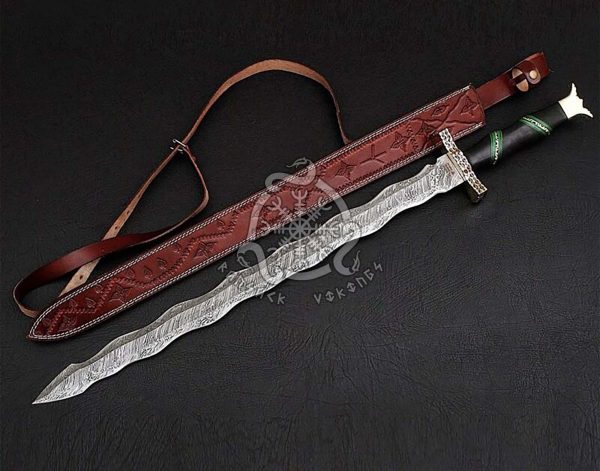
A dagger, which is what this is, has two ground and sharpened edges meeting at a point on the centre line of the blade. It cuts on both sides and thrusts, and the symmetry is what makes it hard to make well. A dirk is the Scottish long knife, typically single edged with a thick back and a straight profile, made for cutting rather than for symmetry. A stiletto is the opposite extreme, a narrow spike with a triangular or square section and often no cutting edge at all, made purely to penetrate and useless for anything else. A seax is the Viking and Anglo Saxon single edged knife, heavy at the spine with an angled back, built as a general working tool that could also fight.
Look at the family and you can see what the dagger is for. It is the balanced form, the one that gives you a real point without giving up two working edges, and it is the shape that survived longest as an item of dress precisely because it looks as good as it functions. The cost of that balance is that both bevels have to be ground to the same width, both have to reach the point on the centre line, and the plunge lines at the shoulders have to sit level on both faces. There is nowhere to hide, which is why a well made dagger is a fair test of a smith.
Why Damascus and not stainless
The billet is built from alternating layers of 1095 and 15N20, forge welded, folded and drawn down to 352 layers before the blade is cut from it. That is why the pattern follows the grind instead of running flat across the surface, and why it cannot be sharpened or polished away.
The functional argument is that the pairing gives hardness and toughness together. The 1095 reaches 58 to 60 HRC and holds a fine edge on both bevels. The 15N20 carries nickel, which resists the etch and gives the pattern its contrast, and which keeps a slim symmetrical blade tough enough to flex rather than snap. A stainless dagger would be easier to neglect and would take a duller edge and a flatter pattern. The price of carbon steel is a wipe of oil, which is a small thing. We set the case out in Damascus versus stainless.
Stag horn and bull horn in the hand
Horn does two things wood cannot. It warms to skin temperature faster than almost any other natural material, and it holds a polish with a depth that looks wet under light. Stag horn brings the texture, since the outer surface of antler is naturally slightly rough and gives real grip even when your hands are damp. Bull horn brings the depth of colour, running from near black through amber where the material thins.
Neither is a manufactured material, so neither is uniform. Every antler and every horn carries its own marking, its own density variation and its own tone, and a grip made from both will never be repeated. Care is the same as for wood and bone. Keep it out of long soaks, keep it well away from radiators, dashboards and direct sun, since dry heat is the one thing that makes horn check, and give it a wipe of light oil once or twice a year to keep the surface from going chalky. The routine is in wooden handle care and applies directly to horn and antler.
Engraving, runes and your own design
Use the rune converter on this page to turn a name, a date or a short phrase into Elder Futhark and we will cut it into the steel or the handle. If you would rather have a Viking pattern than a rune line, choose your own design in the engraving option above the add to cart button and tell us whether it goes on the blade or the handle. Where a piece already carries an engraved design, your chosen engraving replaces it rather than sitting alongside it.
On a horn handled piece the blade is usually the better surface, because a cut line in polished Damascus reads sharply and horn is already busy with its own figure. An eight inch symmetrical blade takes a rune line down the centre very naturally. All engraving is cut in this workshop before the piece is packed. Options are on the engraving page.
Care and sharpening
A minute after handling is all it asks. Wipe the blade dry, since skin oils are acidic enough to print themselves into a polished Damascus surface over weeks, and put a thin film of mineral or camellia oil on the steel. Store it out of the sheath for long periods, because vegetable tanned leather holds moisture against a blade.
Sharpening a dagger means matching two bevels, so count passes instead of working by feel. Raise a burr along the full length of one edge, do the same on the other side, then finish with light alternating strokes to drop the burr. Detail in steel care and sharpening with a whetstone.
Made in the Czech Republic
The work behind this piece happens in a Czech Republic workshop that has kept to the old methods. Steel is forged and heat treated by hand, the grind is taken down by eye rather than by machine, and the handle, fittings and sheath are cut and finished one at a time. Because of that, every piece carries small marks of the hand that made it.
Ransack Viking is a United States company. We import direct, check each piece when it reaches us, and ship from our Memphis, Tennessee warehouse. Engraving is added here in the United States after arrival, so the piece you receive is finished to your order.
A note on handmade variation
This dagger is hand forged. It is not machine made and it is not bulk produced, so the piece that arrives will not be a pixel for pixel copy of the photograph on this page. The Damascus pattern comes out of every billet differently, and horn is about as variable as natural material gets, so the colour, the translucency and the surface texture of your grip will be its own.
The dimensions, the steel, the layer count, the hardness and the build are the same on every one of these. The grain, the tone, the pattern and the exact profile are not, because each is worked by hand from natural materials. Nobody can promise you two identical pieces of antler.
Frequently asked questions
What is the difference between stag horn and bull horn
Stag horn is antler, which is solid bone that a deer grows and sheds each year. It is hard, pale and lightly textured on the outside. Bull horn is the keratin sheath from a bovine horn, darker, denser, smoother and translucent where it thins. This handle uses both, so you get the grip of one and the depth of the other.
Are both edges sharpened
Yes, both are ground and given a working edge, which is what makes it a dagger. There is no safe spine anywhere on the blade, so pick it up by the handle rather than by the steel.
Will the horn crack
Not under normal indoor conditions. Horn checks when it is dried out quickly, so the things to avoid are direct sunlight through a window, a radiator, a car dashboard in summer and a very dry room in winter. An occasional wipe of light oil keeps the surface fed.
Is this for display or for use
It is built as a collector and display piece and that is how most owners keep it. The steel is properly hardened and both edges are sharp, but a symmetrical profile is a poor shape for utility work, so keep a drop point or a Bowie for cutting jobs.
Can I have runes cut into the horn
You can, and it works, though the blade usually reads better because horn already carries so much natural figure. Tell us which surface you want in the engraving option and we will lay it out to suit the material.
How long does it take to ship
Processing is one to two weeks while the piece is forged, ground and fitted by hand, plus transit. Shipping inside the United States is free and returns are open for seven days after delivery.
What is in the box
- One Hornspire Damascus dagger knife
- Leather sheath
- Protective packaging
- Forged and finished in the Czech Republic
Explore the range
Compare it against Dagger Knives, Bowie Knives and Viking Knives. The reasoning behind the steel and the leather is in the guides.





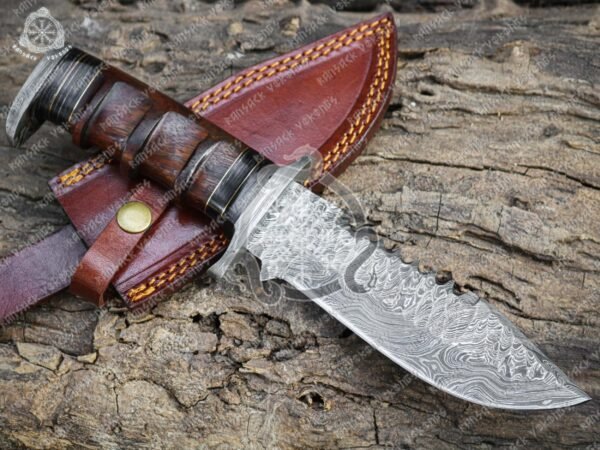
This knife is fine. Just didn’t wow me. Handle material felt a bit different than pictured. Blade edge needed some sharpening out of the box. Wouldn’t say no to it but wouldn’t rave about it either.