
The smallsword is the light thrusting sword that replaced the rapier. By about 1715 the long Italian and Spanish blades were out of fashion and the gentleman’s sword had shrunk to roughly 0.3 to 0.5 kg, with a triangular hollow ground blade, a shell or dish guard and a wire wrapped grip. It is the direct ancestor of modern fencing foil and epee, and four pieces sit in this part of the HEMA sword range: two smallswords and two spadroons.
The spadroon is the straight single edged cousin. Same light build, same shell hilt language, but a cutting edge and a groove down the flat, which makes it a cut and thrust sword rather than a pure thruster. The five ball hilt is its signature form. Read the smallsword and spadroon guide before you choose between them, because the two handle very differently despite looking like siblings on a shelf.
All four are blunt trainers in 51CrV4 spring steel hardened to 49 to 52 HRC, running about 37 to 39 inches overall with blades near 31 to 32 inches, and flex sits in the light to medium band. Spring steel bends and returns instead of taking a set under a bind. The longer thrusting swords that came before these live in HEMA rapiers, and the single edged side of the art continues in HEMA sabres.
Most pieces here take a custom engraving on the blade, the shell or the grip, chosen on the product page.
If you would rather have a sword built to your own reach, start with the sword builder and set the blade, the guard, the pommel and the grip wrap yourself.
Free US shipping
On most pieces. Heavier and oversized ones carry a flat charge.
Hand Forged
Heated, hammered and ground by hand.
Engraving available
Names, dates or Norse runes on most pieces.
Ships from New York
Inspected and dispatched from our New York warehouse. No import duty, no customs delay on US orders.
Smallswords & Spadroons
The sword that ended the rapier
By the last decades of the seventeenth century the rapier was finished as a fashionable sword. It was long, it was heavy on the hip, it caught on furniture, and the fencing it supported had grown so specialised that a gentleman who did not train constantly could not use one well. What replaced it was smaller in every dimension and far more dangerous in the hands of an ordinary man.
The smallsword weighs roughly 0.3 to 0.5 kg. Its blade is short by rapier standards, stiff, triangular in section and hollow ground down each face. It has almost no cutting edge and it does not need one. It carries a shell or dish guard, twin loops beneath that guard for the fingers, and a wire wrapped grip barely long enough for one hand. By about 1715 it was the sword worn in every European capital, and it stayed that way until men stopped wearing swords at all.
Everything that followed comes out of it. The duelling sword of the nineteenth century is a smallsword with the decoration stripped off. The modern fencing foil is a smallsword built for practice, and the epee is the duelling form standardised for sport. If you fence modern sport epee and you want to know where the rules came from, this is where.
The triangular hollow ground blade
The section is the technical heart of the type, and it is the thing most reproductions get wrong.
A smallsword blade is triangular in cross section, with three faces and three raised corners. Each face is ground hollow, scooped inward so that the steel is thin in the middle of the face and thick at the corners. That is a structural trick borrowed from bridge building long before anyone called it that. The raised corners act as ribs, the hollow faces remove the weight that is not doing any work, and the result is a blade that is extremely stiff along its length and extremely light in the hand.
A stiff, light, short blade does one thing superbly. It goes forward in a straight line faster than the eye follows and it does not deflect when it meets resistance. That is why the smallsword killed so efficiently and why it needed no edge. The corners are sharp enough to cut a hand that grabs the blade and that is the whole extent of its cutting ability.
The trade is that a smallsword cannot parry the way a broader sword can. You do not block a blow with the flat, you displace the incoming blade with a small, precise movement of your own point and hilt. The whole art follows from the geometry.
The colichemarde
The colichemarde is the most recognisable smallsword blade and it deserves its own explanation, because it looks like a manufacturing error to anyone who has not met one.
The forte, the third of the blade nearest the hand, is unusually wide. Then, roughly a third of the way along, the blade steps down sharply to a thin thrusting section that carries on to the point. The transition is abrupt and visible, not a gentle taper.
The purpose is straightforward. A wide forte gives you mass and stiffness exactly where parries happen, which makes the sword feel secure in the bind against a heavier blade. A thin foible gives you speed exactly where the point is, which is where the sword does its work. The colichemarde appears in the 1680s, dominates for several decades, then falls out of fashion as blade making improved enough to get similar behaviour from a smooth taper.
One of the smallswords in this group carries a stepped forte thinning hard to the point, which is that idea applied to a blunt trainer. In a modern club it earns its keep for the same reason it did in 1690. The hand end of the blade holds firm and the point end moves.
The shell, the dish and the arms of the hilt
The smallsword hilt is a small assembly with a lot going on, and the names matter when you are comparing listings.
The shell or dish
The guard plate sits directly in front of the hand. It can be a plain oval dish, a pierced oval shell, a figure of eight double shell or a scalloped form. Its job is to stop a point that has come down the outside of your blade. A dish is smaller than a rapier cup because the smallsword fights at a shorter measure and relies on displacing the blade rather than absorbing it.
The arms of the hilt
Beneath the dish sit two small loops of steel, running from the quillon block towards the blade. These are the arms of the hilt, also called the pas d'ane. The index and middle fingers pass through them, which locks the hand into the sword, gives you point control that a plain grip cannot, and stops the blade rotating on impact. On many later smallswords the loops shrink to a vestigial size and become decorative, which tells you the fashion for fingering the blade had passed. On the trainers here they are full size and functional.
The quillons, the knuckle bow and the pommel
A short rear quillon balances the assembly. A knuckle bow runs from the quillon block up to the pommel on most smallswords and on every spadroon, closing the hilt. The pommel is small, usually urn shaped or olive shaped, peened over the tang, and it counterweights the blade rather than acting as a striking surface the way a longsword pommel does.
The grip
Smallsword grips are short, waisted and bound. Twisted brass or steel wire over a shaped wooden core is the common arrangement, and ray skin under the wire is the luxury version, because the rough surface stops the wire creeping and holds the hand when the palm is wet. A grip that is too long is the commonest fault on a modern reproduction. On the real thing there is only enough room for the hand once the fingers are through the arms of the hilt.
The spadroon, the straight single edged cousin
The spadroon is what you get when you take the smallsword's light build and its hilt language and put a cutting blade on it.
The blade is straight, single edged, usually with a narrow groove running down the flat or near the spine, and it has a real edge. That makes it a cut and thrust sword rather than a pure thruster. It served as an infantry officer's sword through the late eighteenth and early nineteenth centuries, and it has a mixed reputation in the period sources, some of which complain that it cuts poorly for a cutting sword and thrusts poorly for a thrusting one. That criticism is fair about the worst examples and unfair about the good ones.
The five ball hilt is the spadroon's signature form. Small steel beads are set along the guard and the knuckle bow, five of them on the classic arrangement, and once you have seen one you can spot the type across a room. The other common spadroon guard is a pierced openwork shell with a single quillon ending in a ball finial, which is the form on the second spadroon in this group.
The British 1786 and 1796 infantry officer patterns are the spadroons most often studied, and the drill written for them treats the sword as a cutting instrument first and a thrusting one second. That is worth knowing before you buy, because a spadroon rewards a fencer who already has some sabre in their hands. If you have only ever thrust, the cutting half of the system will feel like learning a new sword.
In the modern art the spadroon sits between smallsword and sabre. It rewards anyone who has trained one of those and wants a sword that asks for both sets of answers. Both spadroons here are blunted practice pieces, and one of them carries a round steel blunting ball fitted over the point rather than a rolled tip, which is the older and simpler way of making a point safe for drill.
Why the decoration is period correct, not fantasy
There is a good instinct in this hobby that says heavily decorated swords are usually wrong. Chiselled guards, gold wash, blackened steel and jewelled pommels are the calling cards of the costume trade, and on a Viking sword or a longsword that instinct is right.
The smallsword is the one type where it is exactly backwards.
A smallsword was worn, in public, every day, with formal dress, by men whose entire position depended on being seen to be a gentleman. It was jewellery that could kill you. Surviving examples are chiselled, pierced, gilded, silver hilted, blued, inlaid with gold, set with cut steel beads that sparkle like diamonds under candlelight, and fitted with grips of silver wire, gold wire and ray skin. Whole workshops in Paris and London did nothing else. Cut steel hilts from Woodstock were luxury goods in their own right.
So when you see a smallsword with a pierced openwork shell, a blackened finish, an urn pommel with facets cut into it or a ray skin grip bound with twisted wire, that is not fantasy creep. That is the type behaving normally. The pieces in this group are decorated modestly by historical standards. A genuine 1750 court sword would make all four look plain.
Steel, flex and what these are for
All four pieces here are blunt trainers in 51CrV4 spring steel hardened to 49 to 52 HRC. That is softer than the 1095 at 54 to 58 HRC used on the sharps elsewhere on this site, and the reason matters. Hard steel does not bend, it breaks, and a thin thrusting blade that snaps under pressure leaves a sharp stub travelling forward. Spring steel at this hardness bends and returns.
Flex sits in the light to medium band across all four, which is the range a light thrusting blade lives in. On a smallsword the give is held in the last third so the blade loads on a thrust and unloads cleanly without throwing the point off line. The flex guide explains how the tiers are measured and why published numbers differ between makers.
On tips, read the specification panel and then read your own ruleset. The Berlin HEMA Cup gear requirements ask for spatulated or rolled tips with a minimum diameter of 1.5 cm. One of the smallswords here carries a rolled and flared button about 15 mm across. The others are blunted and rounded off, or fitted with a steel blunting ball, and the product pages say so plainly. Never accept a claim of tournament legality from any seller without the ruleset named. The gear rules guide covers the rest of the kit.
The four pieces on this page compared
Every figure in the table below is taken from the specification panel of a product on this page. Nothing is estimated. Sizes vary piece to piece because each blade is forged and ground by hand, so read a stated length as nominal rather than exact.
| Piece | Overall length | Blade type | Steel and hardness | Flex | Guard or tip note |
|---|---|---|---|---|---|
| Skaldrun five ball spadroon trainer, RK-3003 | About 37 inches | Straight single edged blade with a narrow groove down the flat | 51CrV4 spring steel, 49 to 52 HRC | Light to medium tier, the give sits forward of the middle | Five ball hilt, beads set along the guard and the knuckle bow. Tip blunted and rounded off, measure it against your ruleset before an event |
| Hrafnstede blackened smallsword trainer, RK-3010 | About 39 inches | Hollow ground section, stiff through the forte, tapering hard to the foible | 51CrV4 spring steel, 49 to 52 HRC | Light to medium tier, the range a thrusting blade lives in | Pierced oval shell, blackened. Rolled and flared button, about 15 mm across |
| Lindmoor smallsword, RK-3025 | About 39 inches | Narrow thrusting blade with a stepped forte, thinning hard to the point | 51CrV4 spring steel, 49 to 52 HRC | Light to medium, with the give held in the last third | Plain oval dish with a short rear quillon, twin arms of the hilt beneath. Tip blunted and rounded off, not a spatulated tournament tip |
| Orlunde openwork shell spadroon, RK-3030 | About 38 inches | Straight single edged spadroon blade with a narrow groove running near the spine | 51CrV4 spring steel, 49 to 52 HRC | Light to medium, the range single sword drill wants | Pierced openwork shell with one quillon ending in a ball finial. Round steel blunting ball fitted over the point |
Browse related sword categories
- HEMA rapiers, the longer thrusting swords these replaced
- HEMA sabres and dussacks for single edged cut and thrust play
- HEMA sideswords with finger rings and complex hilts
- HEMA arming swords for sword and buckler work
- The full HEMA sword range, all forty nine pieces in one place
- Basket and shell hilt swords across the wider collection
- The wider rapier collection, including display and collector pieces
- Engraved and personalised blades, runes, symbols and crests
Guides worth reading first
- The smallsword and spadroon guide, blades, hilts and history
- Rapier against sidesword, told apart by blade and hilt
- What is HEMA, and what a club night actually looks like
- How to choose your first HEMA sword without wasting money
- HEMA sword flex explained, tier by tier
- Blunt against sharp training swords, and which you need
- HEMA tournament gear rules, tips, edges and masks
- The HEMA sabre guide, for the cutting side of single sword
Frequently asked questions
What is the difference between a smallsword and a spadroon?
A smallsword is a pure thrusting sword with a triangular hollow ground blade and effectively no cutting edge. A spadroon is straight, single edged and grooved, so it cuts as well as thrusts. They share the light build and the shell hilt language, which is why they sit together here.
What is a colichemarde?
A smallsword blade with an unusually wide forte that steps down sharply to a thin thrusting section about a third of the way along. The wide part gives security in the bind and the thin part gives speed at the point. It appears in the 1680s and was fashionable for several decades.
What are the arms of the hilt for?
The two small loops beneath the guard, also called the pas d'ane, take the index and middle fingers. That locks the hand to the sword, gives finer point control than a plain grip, and stops the blade turning when it is struck.
Is a smallsword a good first HEMA sword?
It is a good first sword if your club teaches smallsword, and a poor one otherwise, because the source material and the training partners are the thing that makes any type worth owning. Ask your club what they run on a Tuesday before you buy.
Why is a decorated smallsword still historically correct?
Because the smallsword was worn in public with formal dress by men whose standing depended on it. Surviving examples are chiselled, gilded, blued, silver hilted and set with cut steel beads. Heavy decoration on this one type is normal rather than fantasy.
Can I take these to a tournament?
Read the tip row on the product page against your own ruleset. The Berlin HEMA Cup gear requirements ask for spatulated or rolled tips at least 1.5 cm across. One piece here has a rolled and flared button, two are rounded off and one carries a steel blunting ball.
Do these come with a scabbard?
No. Nothing in this group ships with a scabbard and none is offered. The specification panel on each product page lists what is in the box, which is the sword and a care card.
Can a smallsword be engraved?
Yes, on the blade, the shell or the grip. Engraving is done in the United States after the sword arrives from the Czech Republic, so it does not delay production. Text and runes are 19 dollars, a symbol is 39 dollars and a family crest is 49 dollars, chosen above the add to cart button.
Featured pieces
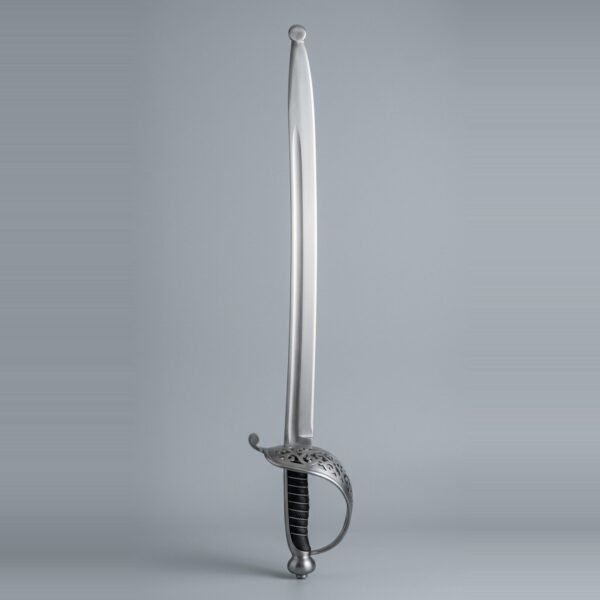 Orlunde Hand Forged 51CrV4 Spadroon with Pierced Openwork Shell & Steel Blunting Ball
$379.00
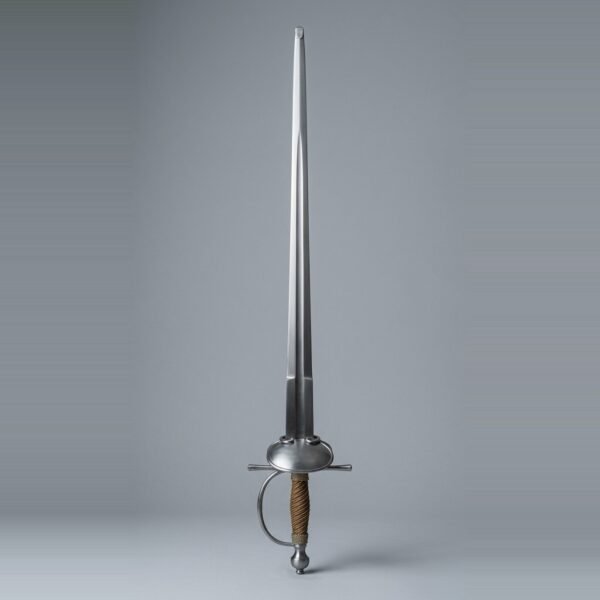 Lindmoor Hand Forged 51CrV4 Spring Steel Smallsword with Plain Oval Dish & Arms of the Hilt
$399.00
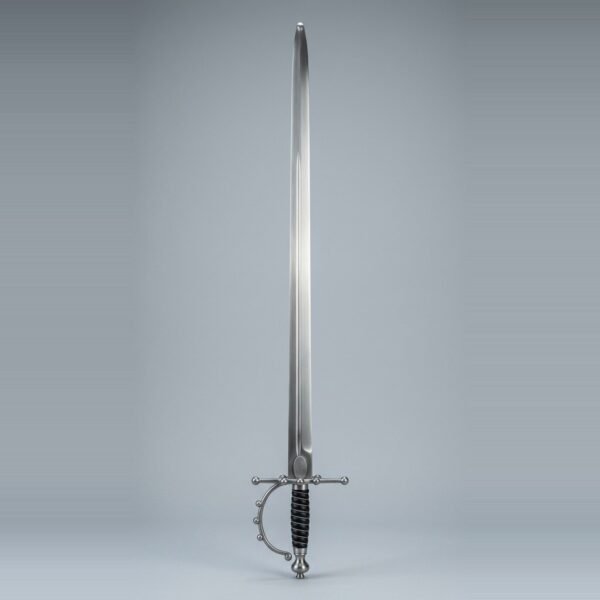 Skaldrun Hand Forged 51CrV4 Spring Steel Five Ball Spadroon Trainer with Urn Pommel & Narrow Groove
$359.00
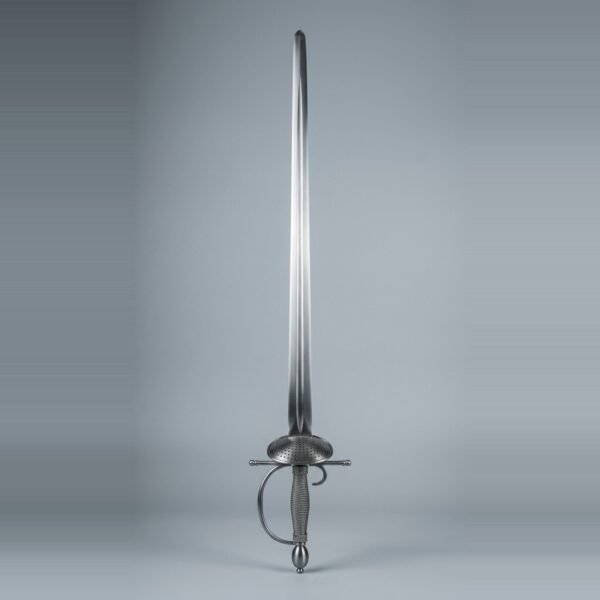 Hrafnstede Hand Forged 51CrV4 Blackened Smallsword Trainer with Pierced Oval Shell & Olive Pommel
$429.00