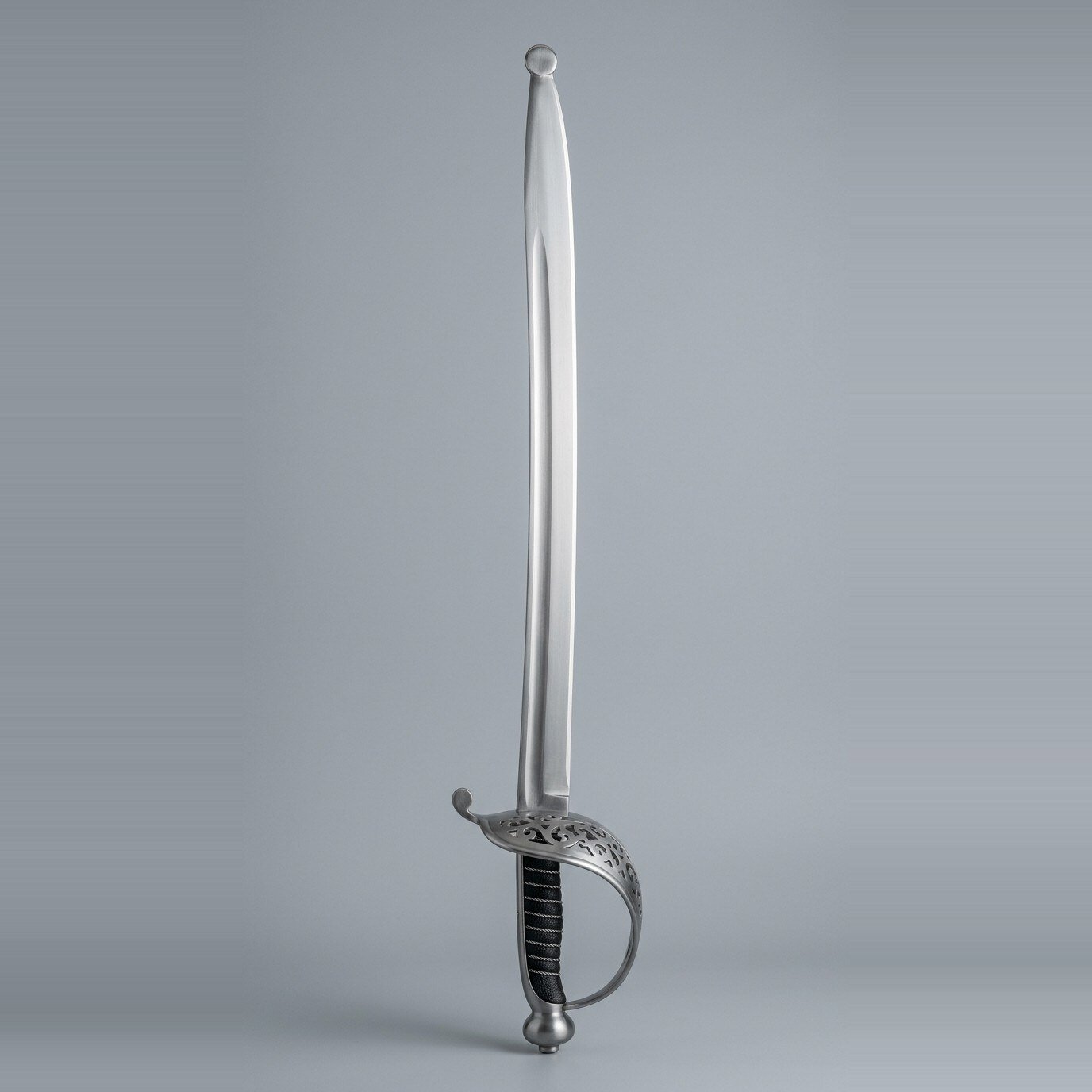
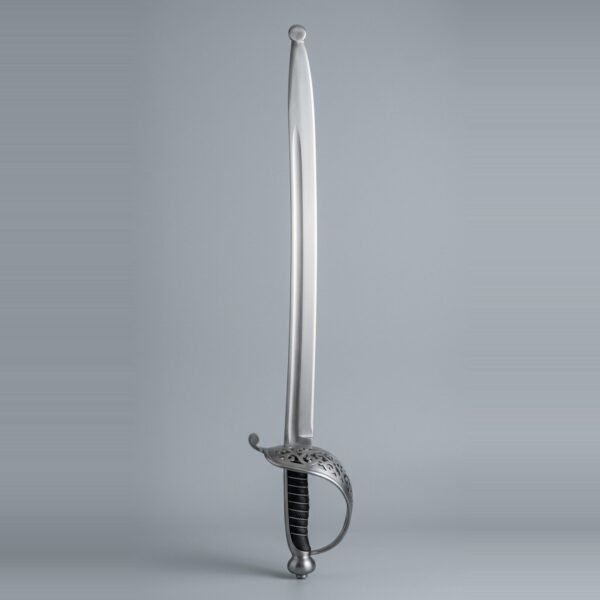
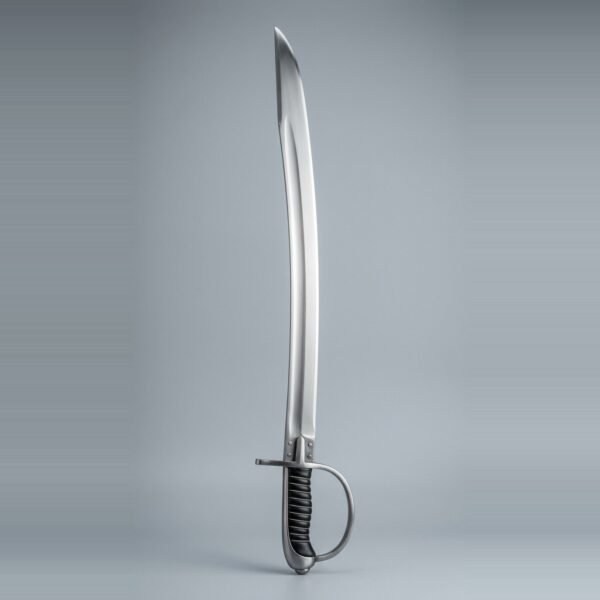
The Orlunde is a spadroon, the straight single edged sword that officers of the later eighteenth century carried when a sabre was too much blade and a smallsword too little. The guard is a pierced openwork shell with a single quillon that ends in a ball finial. The pommel is an onion, round and slightly drawn out at the top, and the grip is ray skin bound with wire so the hand holds on when it is wet.
This one is a practice piece, not a sharp. A round steel blunting ball is fitted over the point, so the end of the blade is a ball rather than a tip. Say it plainly and there is no confusion at the door of a club: this piece cannot thrust into anything. The edges are unsharpened as well. It is built for drill, for paired forms and for controlled bouting under supervision.
New to the later small hilts, read the smallsword and spadroon guide and blunt and sharp training swords compared before you choose. Everything in this family sits in smallswords and spadroons.
Specifications
| Material | 51CrV4 spring steel, hardened to 49 to 52 HRC |
|---|
| Overall length | About 38 inches, hand made so it varies a little piece to piece |
|---|
| Blade length | About 32 inches |
|---|
| Blade type | Straight single edged spadroon blade with a narrow groove running near the spine |
|---|
| Edge | Unsharpened, a practice piece and not a cutting sword |
|---|
| Tip | Round steel blunting ball fitted over the point |
|---|
| Guard | Pierced openwork shell with one quillon ending in a ball finial |
|---|
| Pommel | Onion form, peened over the tang |
|---|
| Grip | Ray skin bound with twisted wire |
|---|
| Flex | Light to medium, the range single sword drill wants |
|---|
| Included | Sword only, no scabbard, covered by the lifetime warranty |
|---|
| SKU | RK-3030 |
|---|
Where the spadroon sits between the smallsword and the sabre
The spadroon is what you get when an officer wants one sword that will do two jobs. The smallsword thrusts beautifully and cuts not at all. The sabre cuts beautifully and is heavy on the wrist for a day of parade and paperwork. The spadroon splits the difference with a straight light blade, a single edge and a false edge near the point, hung in a hilt that owes more to the smallsword than to the cavalry.
That compromise got it a bad reputation from officers who wanted it to be one thing or the other, and a much better one from the fencing masters who wrote for it. The English and Scottish systems of the period treat it as a broadsword blade held in a small hilt, with hanging guards, inside and outside parries and a cut delivered from the elbow rather than the shoulder. Angelo and the writers around him give it a complete syllabus.
For a modern club it is a useful bridge. If your members come from longsword and want a taste of later material, the spadroon asks for the same discipline of measure and a lighter hand. If they come from sabre, it slows the cut down and punishes a lazy parry. It also sits close enough to the military broadsword that the drill transfers both ways.
The blunting ball, the shell and what spring steel does in a bind
Start with the ball, because it is the first thing anyone will ask about. A round steel blunting ball is fitted over the point of this blade. That is a deliberate safety fitting, not damage and not a design flourish. It puts a wide blunt face where a tip would be, which is what makes paired drill at speed sane. It also means the sword will not be mistaken for a sharp in a bag check.
The blade is 51CrV4 spring steel hardened to 49 to 52 HRC. Spring steel is chosen because it bends and returns instead of taking a set or snapping under a hard bind. A spadroon blade is narrow and it lives in binds, so this matters more here than it does on a broad blade. The flex sits in the light to medium range, which is where a single sword drill wants it, and the narrow groove near the spine takes weight out of the blade without softening the flat.
The pierced openwork shell is a guard, not jewellery, but the piercing does reduce the mass hanging off the front of the hilt. With an onion pommel behind the fist and a shell that is lightened rather than solid, the sword sits in the hand the way a period spadroon should. Wire over ray skin gives grip when the hand sweats, which a plain leather wrap does not.
Engraving, runes and your own design
Use the rune converter on this page to turn a name, a date or a short phrase into Elder Futhark and we will cut it into the steel or the grip.
Engraving is cut in the United States once the sword reaches North Babylon. Runes and text are $19, a symbol is $39 and a family crest is $49. The flat of the blade below the shell is the usual place on a spadroon, and the shell itself will take a small mark in the open steel between the piercings.
If you would rather have your own design than a rune line, choose your own design in the engraving option above the add to cart button and tell us where it goes. Where a piece already carries an engraved design, your chosen engraving replaces it rather than sitting alongside it. More on the engraving page.
Handling and balance
No weight and no point of balance is published for this sword. The photograph carries no scale, every one is finished by hand, and a figure invented for a product page helps nobody. What can be said is how the parts are arranged and what that arrangement does.
Mass is kept low at the front. The shell is pierced rather than solid, the blade is narrow with a groove near the spine, and the onion pommel sits behind the hand as a counterweight. The result is a sword that turns on the fingers rather than the wrist, which is exactly what the hanging guards of the spadroon systems ask for.
The blunting ball does add a little weight right at the end of the blade, and honest sellers say so. It is a small ball and the effect is slight, but a fencer coming off a pointed trainer will feel the tip a fraction heavier for the first few minutes.
Care
Bright steel marks. Wipe the blade after every session and keep a light film of oil on it, and pay attention to the shell, because the piercings trap sweat and hold it. A cotton bud and a dry cloth get into the openwork where a rag will not.
Check the blunting ball each time you train. It is fitted over the point and it should not move. If it turns, works loose or rattles, stop using the sword and contact us before your next class. Wire wrapped grips also want a look every few months, since a loose turn of wire will bite the palm. Full detail sits in our care guide.
Made in the Czech Republic
Made by hand in the Czech Republic and imported by Ransack Viking. Nothing here is drop shipped out of an importer catalogue straight to a customer. Every one is checked for hilt tightness, pommel seating and blade straightness at our North Babylon, New York warehouse, and ships from there. Shipping in the United States is free, returns run for seven days, and the lifetime warranty against defects in the forging, the grind, the heat treat and the fittings has no end date and needs no receipt.
Engraving is the only part of this piece done in the United States, and it happens after the sword lands.
A note on handmade variation
This is hand forged. It is not machine made, not cast and not bulk produced, so what arrives will not be a pixel for pixel copy of the photograph on this page.
The piercings in the shell are cut and filed by hand, so no two shells are quite identical in the width of the openings or the sweep of the scrolls. The ray skin will run larger or smaller in its pebbling, and the wire will sit at a slightly different pitch. That is the nature of the thing.
A defect is different from a variation. A blade that takes a set in ordinary drill, a shell that cracks, a ball that comes off, a hilt that will not stay tight, all of that is covered for as long as you own the sword, with no receipt needed.
Frequently asked questions
Whether this spadroon is sharp
No. The edges are unsharpened and a round steel blunting ball is fitted over the point. It is a practice piece. It will not cut and it cannot thrust into a target.
Whether the blunting ball can be removed
Do not remove it. It is a safety fitting and the sword was specified as a trainer with the ball in place. We do not supply this piece as a sharp.
Whether it is legal for tournament use
We will not claim that, because it depends on the ruleset. Read the event handbook first, and note that some organisers set a minimum tip diameter and will measure it at the gear check.
What a spadroon actually is
A straight, light, single edged sword of the later eighteenth century, hilted like a smallsword and bladed more like a broadsword. It is the officer sword that sits between the two.
Whether a scabbard is included
No. This ships as the sword only and we do not supply a scabbard for it.
What the grip is made from
Ray skin over the core, bound with twisted wire. It holds well in a sweating hand and it is the period correct treatment for this class of hilt.
What is in the box
- One Orlunde spadroon, about 38 inches overall, blunting ball fitted.
- Care and handling card.
- Lifetime warranty against defects in the forging, the grind, the heat treat and the fittings.
- Your engraving already cut, if you chose it at checkout.
Explore the range
The rest of the later hilts are in smallswords and spadroons. For curved blades of the same era look at HEMA sabres, and for the thrusting swords that came before them try HEMA rapiers or HEMA sideswords. Everything in the training line is in the HEMA swords hub, and the background reading sits in the guides hub.
Also in this part of the catalogue
Sitting alongside it in the catalogue are Lindmoor smallsword, about 39 inches overall, Skaldrun spadroon, about 37 inches overall, Hrafnstede smallsword, about 39 inches overall, Ceravalt rapier, about 47 inches overall and Kjeldhar stirrup hilt sabre, about 36 inches overall.
See the smallsword and spadroon category and the HEMA sword hub for the full spread, and the custom sword builder if none of them is right.








Reviews
There are no reviews yet