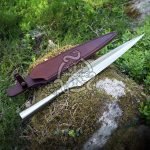
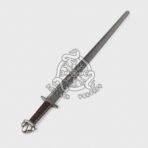
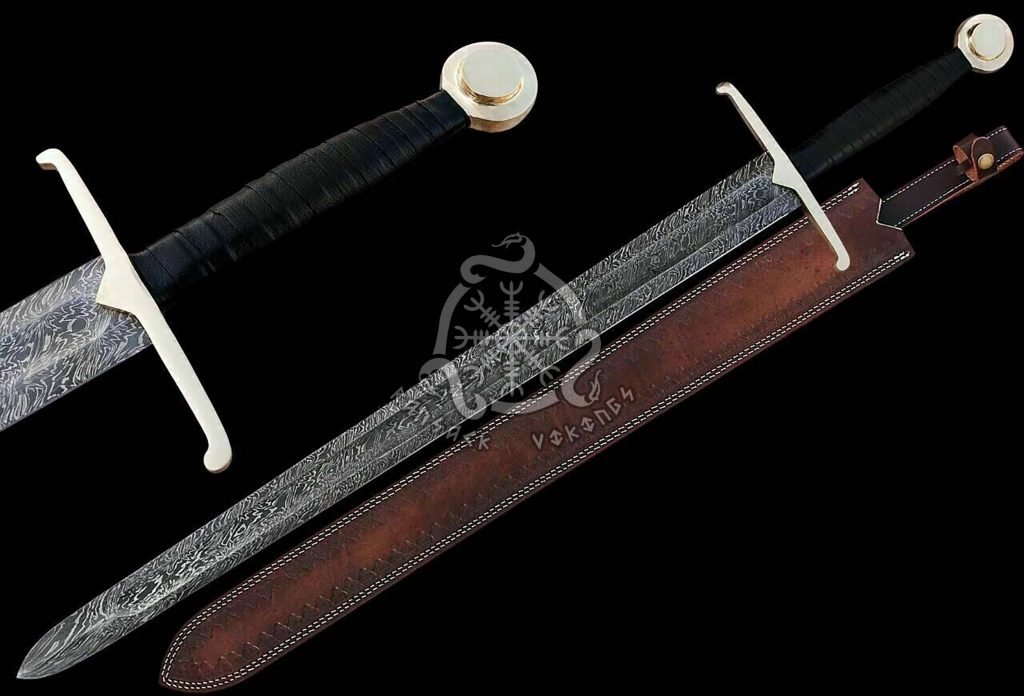
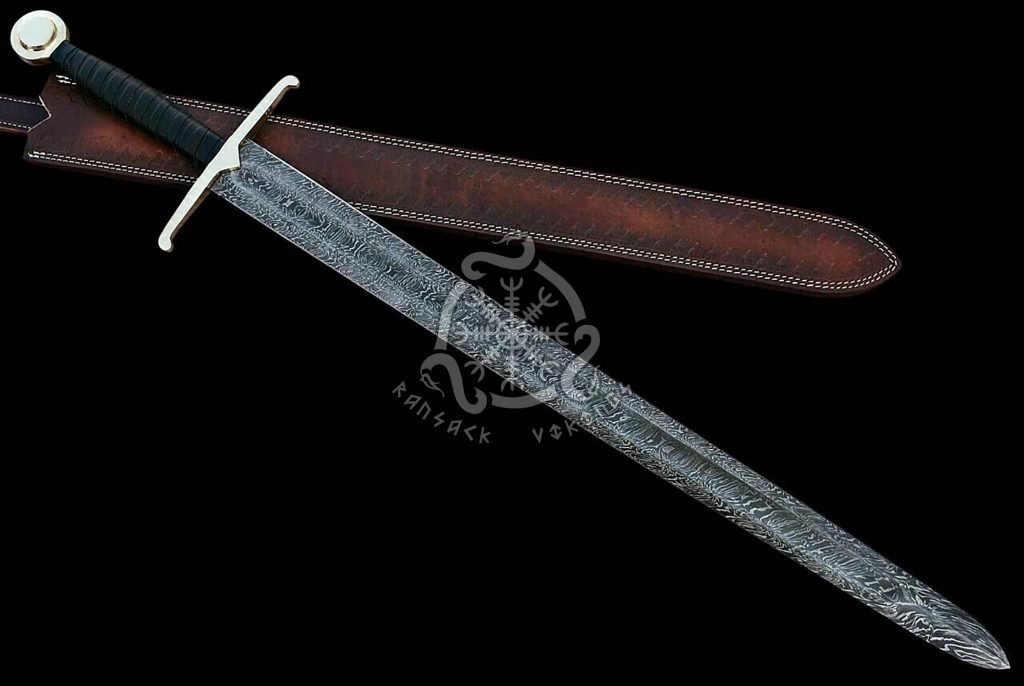
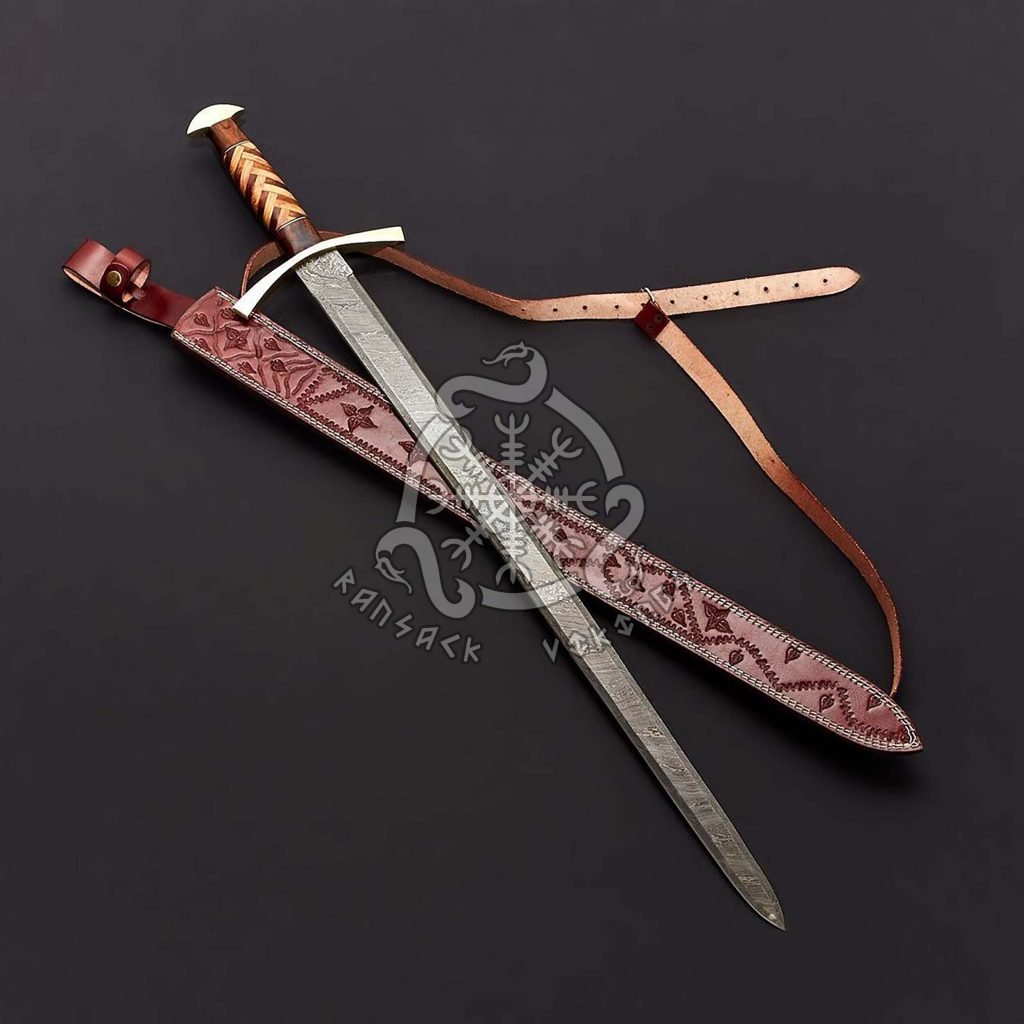
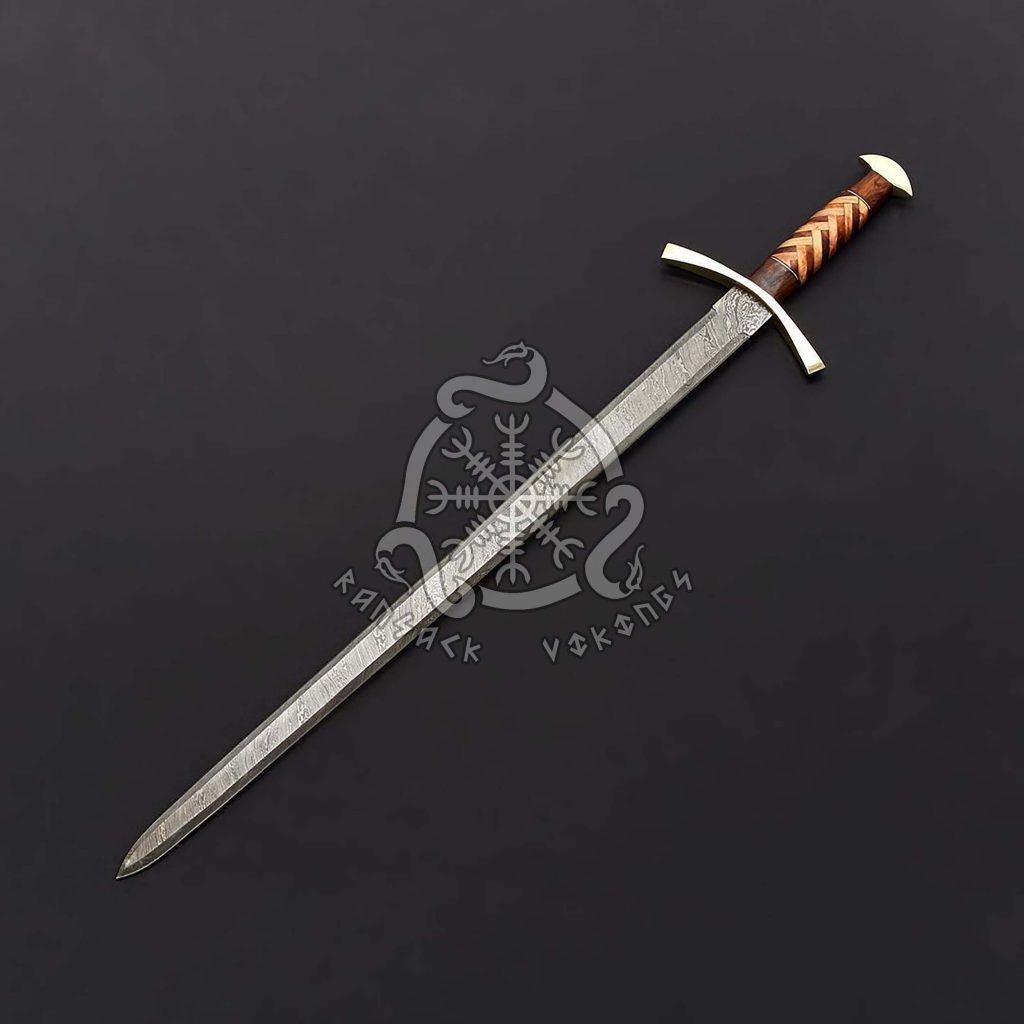
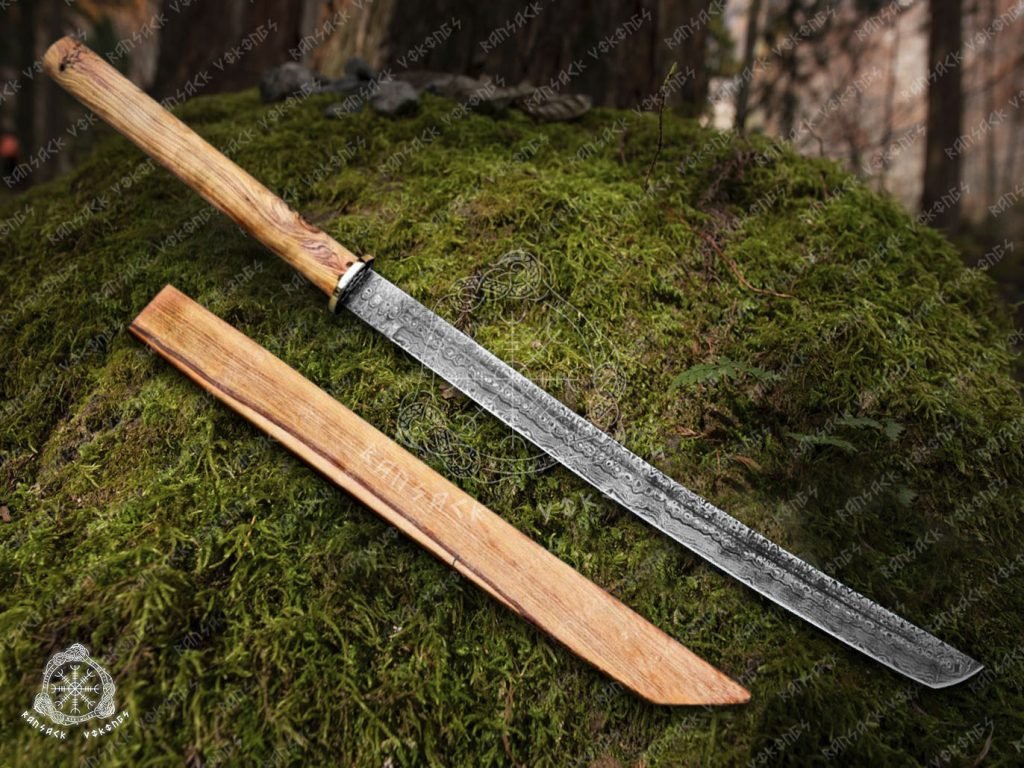
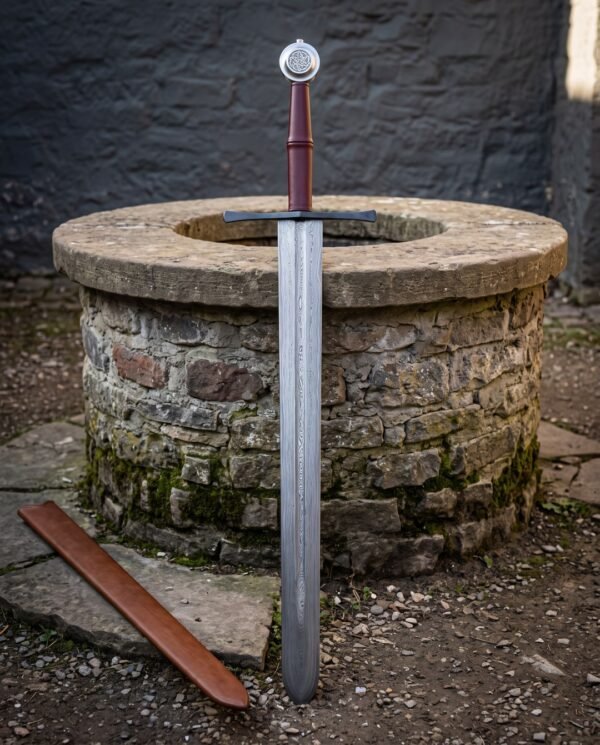
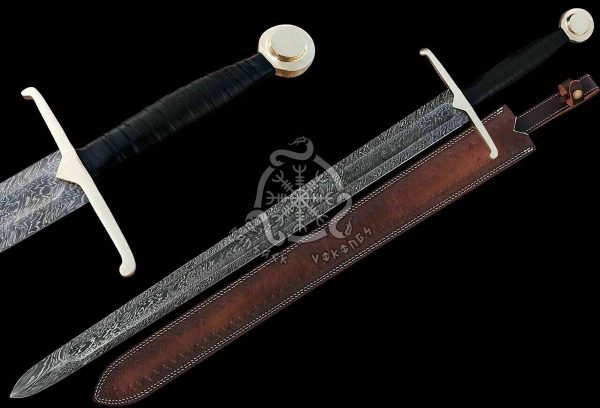
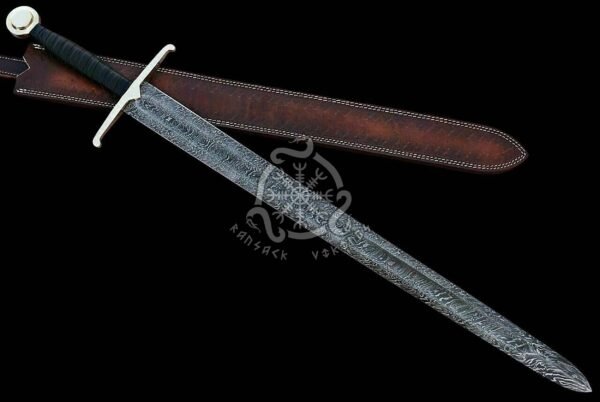
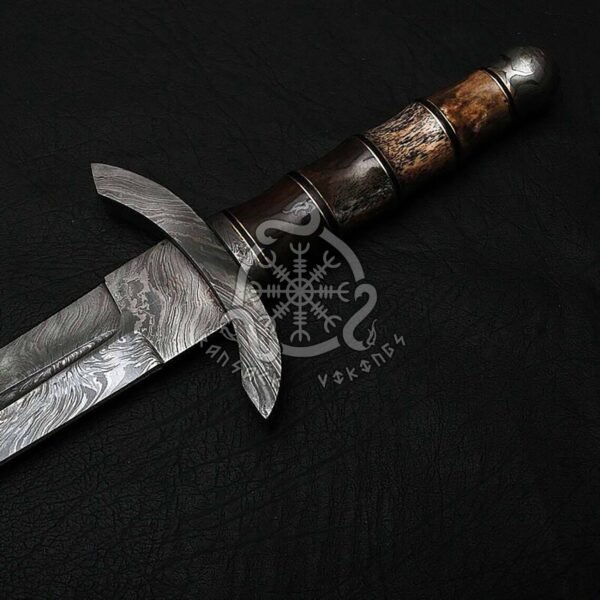
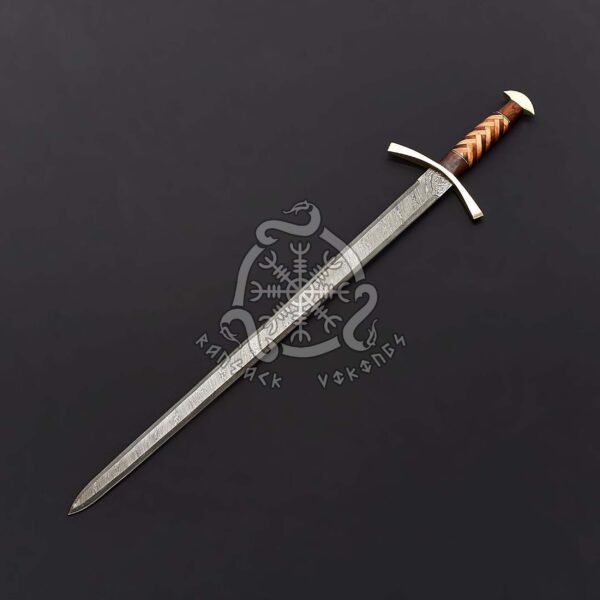
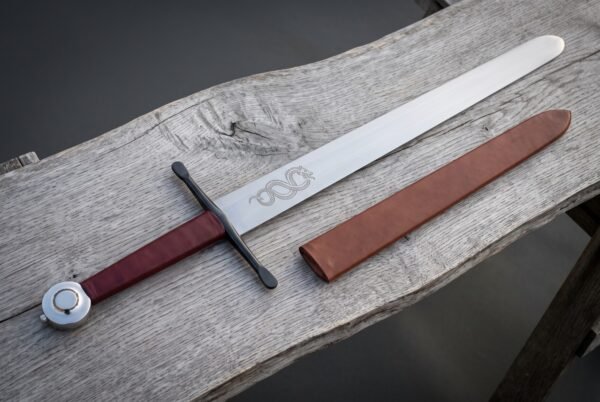
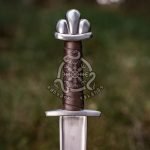
The Tenthcentury is a hand forged Viking sword built to the proportions of the tenth and eleventh century Norse originals. It is 89 centimetres overall, which is 35 inches, with a 70 centimetre forged steel blade, a 12 centimetre grip and a blade 5 centimetres wide at the cross. The edges are deliberately blunted to 2.5 millimetres for full contact reenactment safety, and the centre of balance sits 4.5 centimetres from the cross. What separates a good Norse sword from a poor one is set out in what to look for in a Viking sword.
Those numbers are the sword. Everything people argue about when they compare Viking swords comes down to the distribution of mass, and the tenth century is the period where the Norse got it right. A sword of this era typically weighs between one and one and a quarter kilograms, which is far lighter than most people expect from a metre of steel, and the reason it feels alive rather than heavy is that the weight is deliberately pulled back toward the hand by a substantial pommel. A balance point close to the cross means the blade pivots around your grip instead of dragging your arm after it.
Every Tenthcentury is forged, heat treated, ground, assembled and finished in a Czech Republic workshop and packed with the blade protected. Shipping inside the United States is free, processing takes one to two weeks, and returns are accepted within seven days.
Specifications
| Steel | Hand forged high carbon steel |
|---|
| Overall length | 89 cm, 35 inches |
|---|
| Blade length | 70 cm, forged steel |
|---|
| Blade width at the cross | 5 cm |
|---|
| Grip length | 12 cm |
|---|
| Edges | Blunted to 2.5 mm for full contact reenactment |
|---|
| Centre of balance | 4.5 cm from the cross |
|---|
| Period | Inspired by 10th and 11th century Norse swords |
|---|
| SKU | RK-661 |
|---|
The fuller, and the myth attached to it
Look at the broad shallow groove running down the centre of a Viking blade. It has a name, the fuller, and it has a persistent and completely wrong nickname, the blood groove. It is not there to let blood out, to break suction or to do anything else to a wound. It is a structural feature, and it is one of the most elegant pieces of engineering in early medieval Europe.
Here is what it does. Take a solid bar of steel and remove metal from the middle of each flat, and you have taken away the material that contributes least to the blade stiffness while keeping the material at the edges that contributes most. It is the same principle as an I beam. The result is a blade that loses a substantial fraction of its weight and almost none of its rigidity. On a metre long sword, that is the difference between a sword you can fence with and a bar of steel you can only swing.
The fuller was hammered in hot with a rounded tool rather than ground out, which meant no steel was wasted and the grain of the metal was compressed rather than cut through. Every one of those grooves you see on a museum blade represents a smith who understood the mechanics of stiffness centuries before anyone wrote the mathematics down.
The other detail worth knowing is distal taper. A good sword blade is not the same thickness from cross to point. It thins gradually along its length, which pulls yet more mass out of the far end. Between the fuller and the distal taper you get a metre of steel weighing not much more than a kilogram.
Why forged carbon steel and not stainless
Stainless swords exist and they are almost all wall decorations. There is a good reason for that. Stainless steel gets its corrosion resistance from a high chromium content, and chromium carbides make steel less tough in long thin sections. A metre long stainless blade under a hard lateral load does not bend and recover, it snaps, and a snapped sword blade is genuinely dangerous.
Carbon steel behaves the way a sword needs to behave. It takes a shock, flexes, and comes back. On a blade blunted for full contact work that property is the whole specification, because this sword is expected to be hit and to hit back. What carbon steel will not do is look after itself. Left damp it will spot within a day and it will develop a grey patina over time whether you encourage one or not. That is the entire cost, it takes about two minutes a month, and it is set out in Damascus versus stainless.
The grip, the cross and the pommel
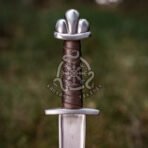
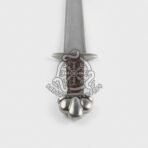
Twelve centimetres of grip is short by later medieval standards and exactly right for this period. A Viking sword is a single handed blade used with a shield in the other hand, and the grip is sized to be filled completely by one fist, wedged between a broad lower guard and a heavy pommel. You do not slide your hand up and down it. It locks in place.
The pommel is not decoration either. It is a counterweight, and it is the single component that decides where the balance point falls. The Norwegian archaeologist Jan Petersen built his entire 1919 sword typology, still the standard reference, around the shapes of hilts and pommels rather than blades, because blades corrode to similar profiles while hilts stay distinctive. Lobed pommels, tea cosy pommels, trilobate pommels and the great five lobed forms are how a Viking sword is dated and located.
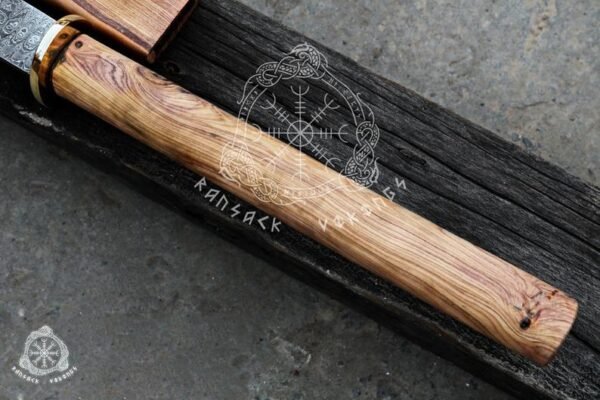
If your grip is a natural material such as wood, leather or horn, keep it dry and give it a light feed once or twice a year rather than soaking it. The method is in wooden handle care.
Engraving, runes and your own design
Use the rune converter on this page to turn a name, a date or a short phrase into Elder Futhark and we will cut it into the steel or the handle. If you would rather have a Viking pattern than a rune line, choose your own design in the engraving option above the add to cart button and tell us whether it goes on the blade or the handle. Where a piece already carries an engraved design, your chosen engraving replaces it rather than sitting alongside it. There is real precedent for it. The famous Ulfberht swords carry the maker name inlaid in iron down the fuller of the blade, roughly 170 of them are known, and putting a name into a sword blade is one of the oldest things smiths in this tradition did. Detail on the engraving page.
Care and upkeep
Wipe the blade down after every handling session, because fingerprints on bare carbon steel etch in within days. Put a thin film of light oil on the steel before it goes back on the wall or into a case, and keep it out of a damp basement or garage. If surface rust appears, fine abrasive and oil will lift it in minutes. The routine is in steel care.
Do not sharpen this sword. The 2.5 millimetre edge is a safety specification for full contact reenactment, and putting an edge on it would defeat the entire purpose of the piece and make it unusable in any organised group. If you own knives from the range, the whetstone technique for those is written up in sharpening with a whetstone. This blade needs only oil and a cloth.
Made in the Czech Republic
This piece is made by hand in the Czech Republic, in a workshop that still works the old way. The steel is forged, ground, heat treated and finished by smiths who learned the trade from the people before them, and the wood, horn and leather are cut and fitted by hand rather than pressed out on a line. That is also why no two pieces come out exactly the same.
Ransack Viking is a United States company. We import these pieces ourselves, check every one when it lands and ship from our warehouse in Memphis, Tennessee. Engraving is done here in the United States after the piece arrives, so your runes or your own design go on before it leaves for you.
A note on handmade variation
The Tenthcentury is hand forged. It is not machine made and it is not bulk produced, so what arrives will not be a pixel for pixel copy of the photograph. The surface finish along the blade, the exact line of the taper, the tone of the steel and the grain and colour of the grip all vary from one sword to the next, because each is worked by hand from natural materials. The dimensions, the steel, the balance and the build are the same every time. The character is not.
Frequently asked questions
Is this sharp?
No, and deliberately so. The edges are blunted to 2.5 millimetres, which is the standard specification for full contact reenactment. It is safe to handle and it will not cut.
Can I have it sharpened?
We do not sharpen this one. Its entire purpose is safe contact work and display, and an edge would take it out of use with every reenactment group that has a safety standard.
How heavy is it?
A sword of these proportions sits close to the historical range of one to one and a quarter kilograms. Most people who pick one up for the first time are surprised by how light it is, because the balance sits 4.5 centimetres from the cross.
What is the groove down the middle of the blade for?
It is a fuller, and it is there to remove weight without losing stiffness, exactly like the web of an I beam. It has nothing to do with blood, despite the nickname.
Is it a true Viking sword design?
It follows the proportions of tenth and eleventh century Norse swords, which is the late Viking Age. Double edged, single handed, broad at the cross and tapering toward the point, with the balance close to the hand.
How is a sword this long shipped?
Boxed with the blade fully protected and packed for the length. Processing runs one to two weeks and shipping inside the United States is free.
What is in the box
- One Tenthcentury hand forged Viking sword, 89 cm overall
- Protective packaging
- Forged and finished in the Czech Republic
Explore the range
Related collections: Swords, Viking Swords, Viking Shields and Viking Helmet. The typology, the steel and the care notes are in the guides.









Was nervous ordering something like this online but so glad I did. Edge retention has been great even after regular use. Love it.
Got this as a gift and now I want one for myself too. Edge retention has been great even after regular use. The wood handle feels amazing and the balance is perfect. Already planning my next purchase from this shop.
This sword is a genuine work of art. Fit and finish is museum quality. You can tell real craftsmen made this by hand. Beyond happy with how this turned out. I keep coming back to Ransack Viking because it’s always this good.