
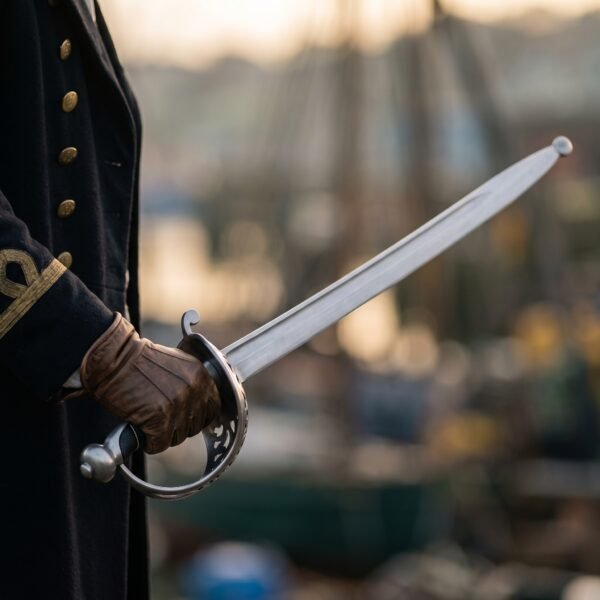
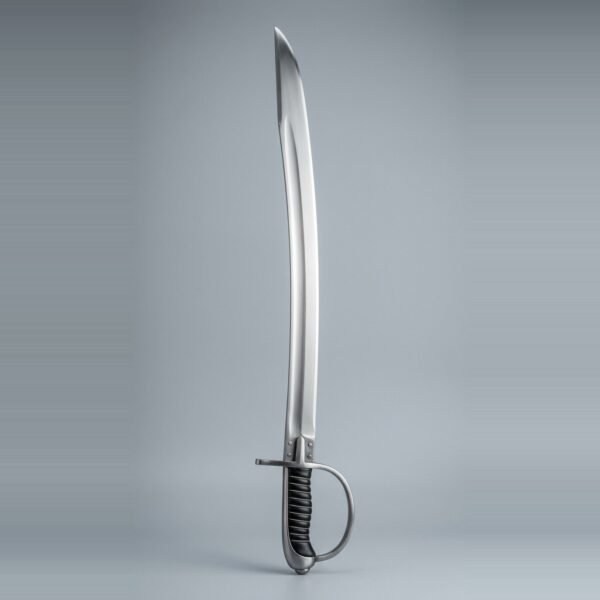
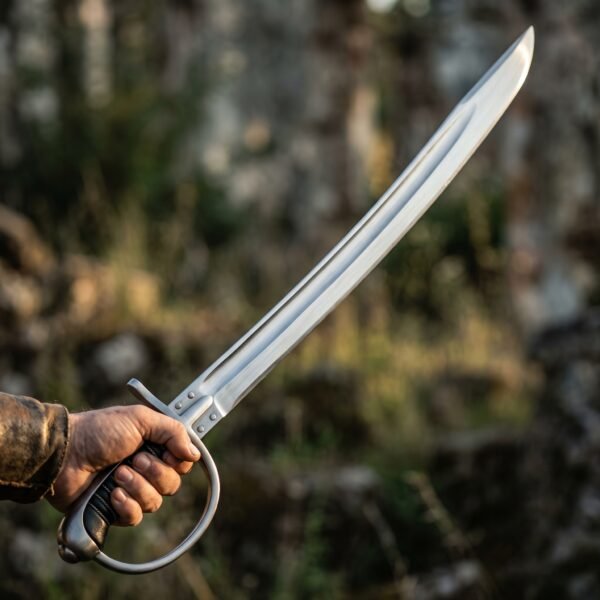
A sabre is a single edged sword with a curve, built to cut on the move. The curve does two things. It puts the edge into the target at an angle so the blade slices rather than chopping flat, the same argument behind the scimitars, and it drags that edge along as your arm travels. Add a knuckle bow over the fingers and you have the sword that cavalry carried for three hundred years, because a man on a horse needs his hand protected and needs the cut to work at speed.
The blades here run 32 to 37 inches overall with 26 to 31 inches of edge, in two steels. Plain 1095 high carbon is hardened to 54 to 58 HRC and takes an edge back quickly. Damascus of 1095 and 15N20 is forge welded and hand etched, hardened to 58 to 60 HRC. Guards run from a three bar knuckle guard to an open cross guard with a hooked quillon, and grips are ribbed leather, black horn or rosewood. Every piece ships in a leather scabbard, and a curved edge sharpens differently to a straight one.
If you want reach, start at 35 inches. If you want a sword that handles quickly, take a 32 or 33.
Free US shipping
On most pieces. Heavier and oversized ones carry a flat charge.
Hand Forged
Heated, hammered and ground by hand.
Engraving available
Names, dates or Norse runes on most pieces.
Ships from Chicago
Inspected and dispatched from our Chicago warehouse. No import duty, no customs delay on US orders.
Sabres
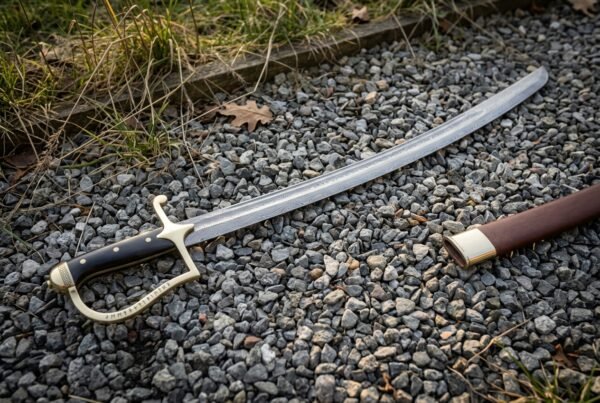
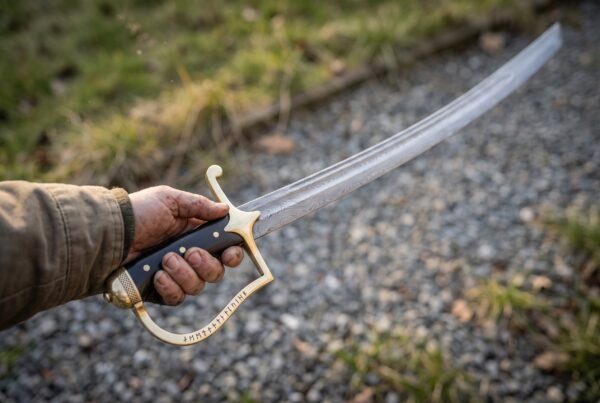
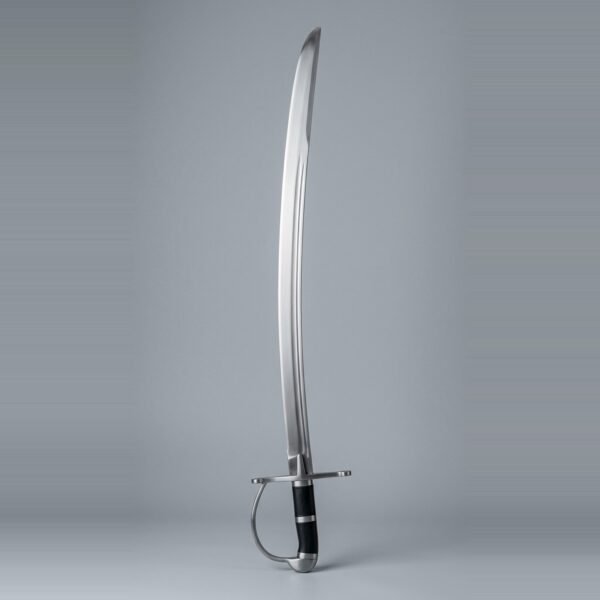
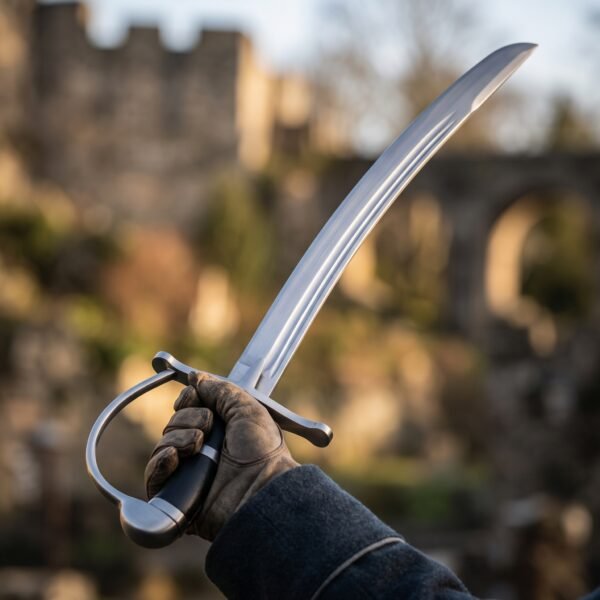
Why the blade curves
A straight sword cuts by arriving hard. A curved one cuts by arriving hard and then travelling. That is the whole argument for a sabre, and it is easier to feel than to read about. Lay a curved edge on a target and pull, and the contact point moves along the edge as your hand moves. The blade is slicing the whole time it is in contact, which lengthens the cut and reduces the force needed to open it.
The price is thrusting. Point the sword at something and the curve puts the tip off the line of your arm, so a sabre thrusts worse than a straight sword and considerably worse than a rapier. Sabre patterns spend centuries arguing about how much curve is worth losing point control for, and the shallow late cavalry blades are the compromise that won.
The sabres in this collection
Six blades. Two in plain high carbon steel, three in Damascus, and one Chinese dao that sits here because it is a curved single edged cutting sword by any sensible definition.
Sabres in 1095 high carbon
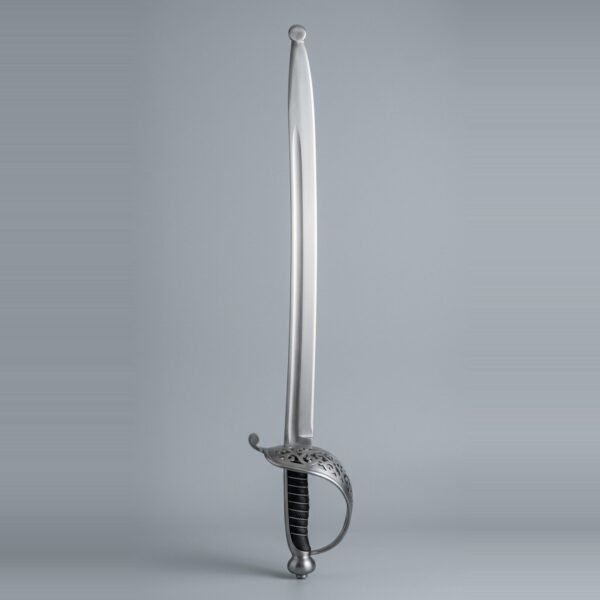
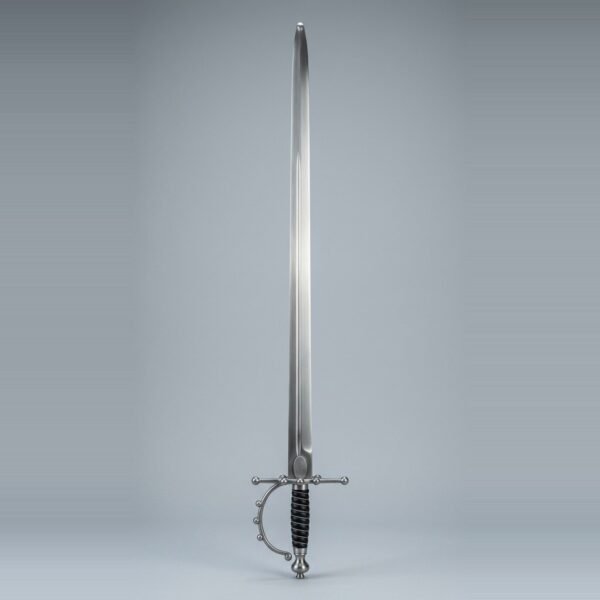
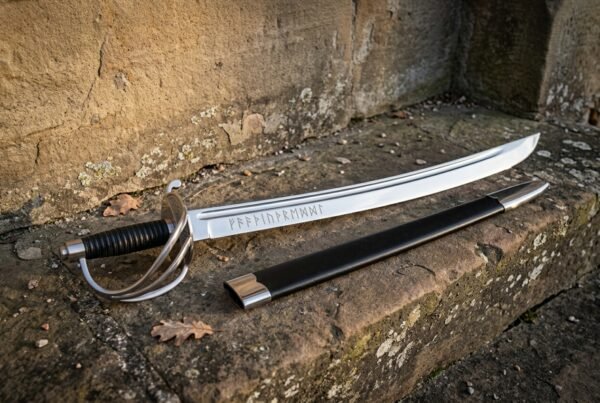
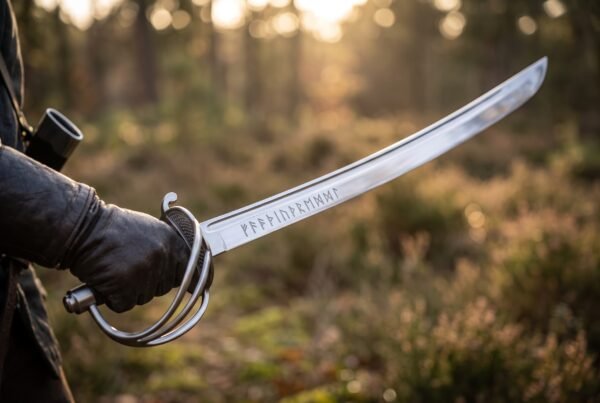
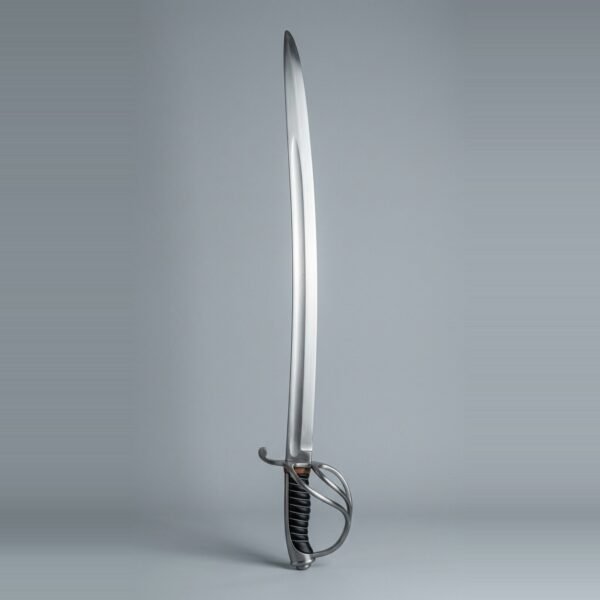
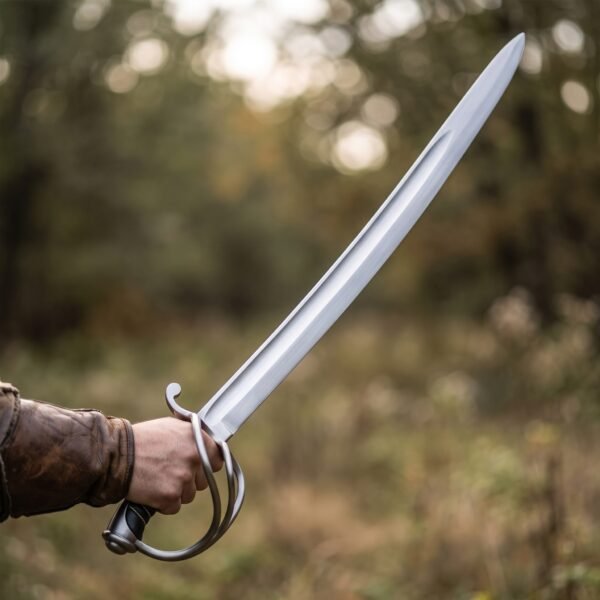
The cavalry sabre is the classic shape: 33 inches overall on a 27 inch blade, polished bright, with an Elder Futhark rune line engraved above the ricasso and a three bar steel knuckle guard carrying an engraved knotwork langet. The grip is ribbed black leather over a shaped core with a steel ferrule and steel pommel cap, and it ships in a black leather scabbard with a steel throat and chape. If you have handled a nineteenth century trooper sabre, this will feel familiar in the hand.
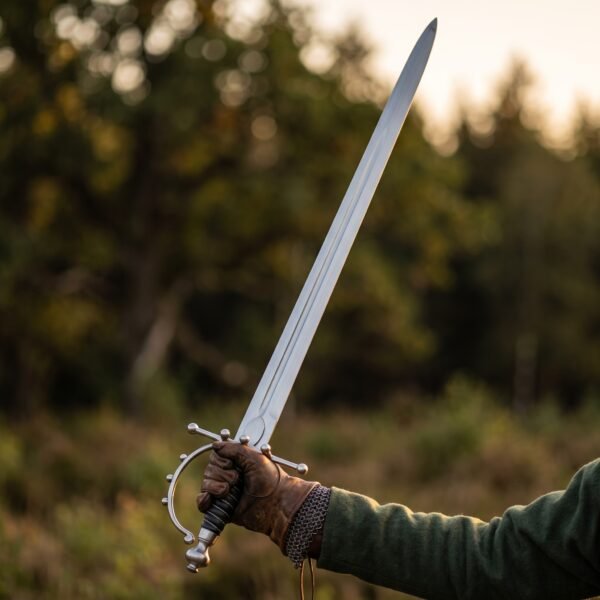
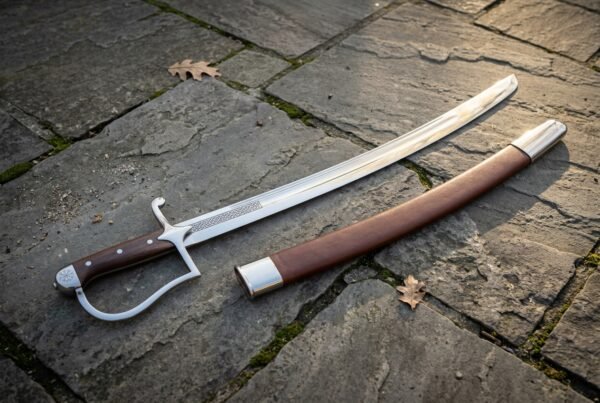
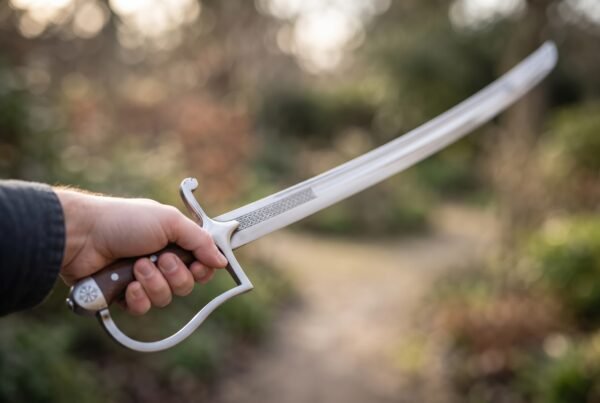
The second is shorter and lighter at 32 inches overall on a 26 inch blade, polished bright with an etched Norse knotwork panel above the ricasso. It uses a cross guard rather than a three bar, with an upturned hooked quillon and a full knuckle bow, and the grip is rosewood slab scales pinned with three steel rivets under a steel cap engraved with a compass star. Brown leather scabbard, steel throat and chape. It is the least expensive sabre on the page at 335 dollars and the easiest to swing.
Sabres in Damascus
Three blades are forge welded Damascus of 1095 and 15N20, hand etched to raise the pattern, hardened to 58 to 60 HRC.
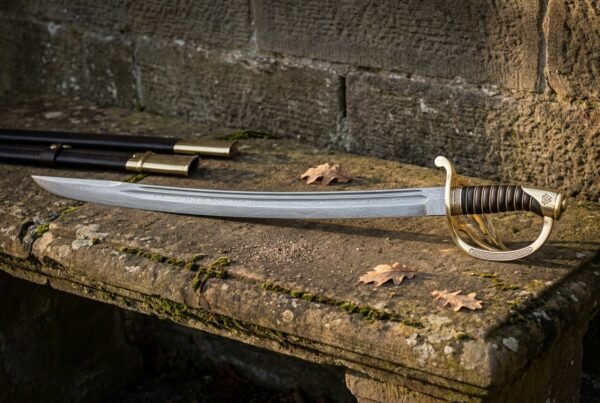
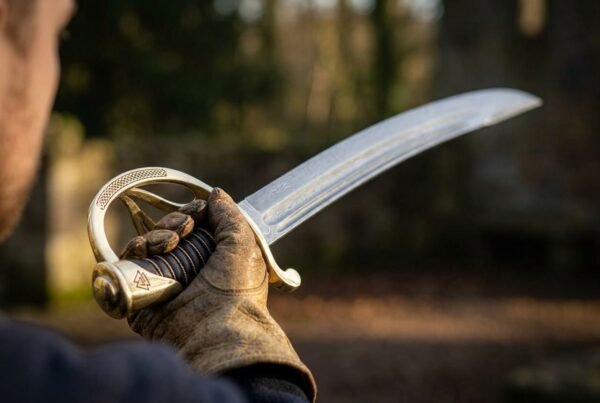
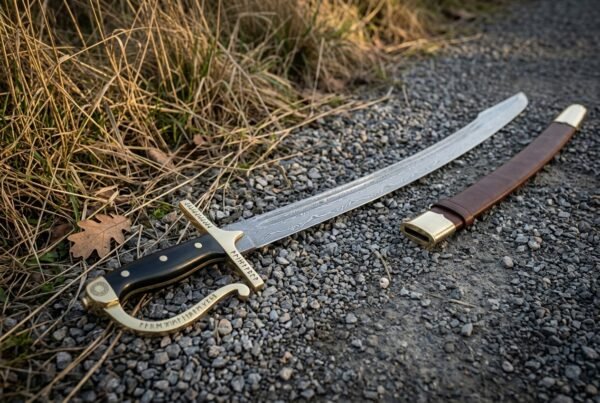
The Damascus cavalry sabre runs 35 inches overall on a 29 inch blade, with an engraved knotwork band at the ricasso and a three bar brass knuckle guard with a hooked quillon. Its grip is ribbed black leather bound with brass wire, with a brass ferrule and a brass pommel cap cut with a valknut. Black leather scabbard, brass throat and chape.
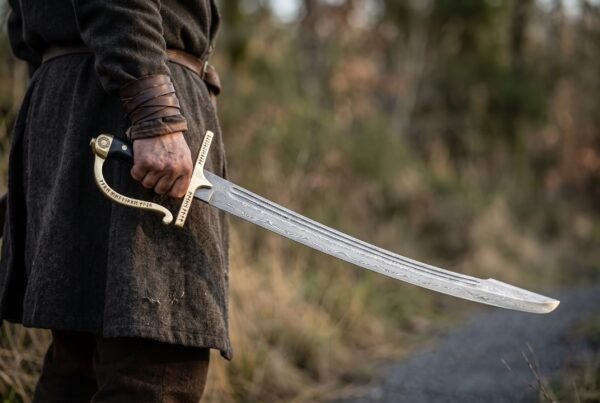
The larger szabla is the longest sword here at 37 inches overall on a 31 inch blade, slender, with a long even curve and no false edge at all. It carries an open brass cross guard with a forward hooked quillon and a full knuckle bow, black horn slab scales pinned with three brass rivets, a brass bolster and a filed brass pommel cap, in a brown leather scabbard with brass fittings.
The smaller szabla is 33 inches overall on a 27 inch blade, cut differently: a broad belly and a widened yelman at the tip, which is the flared section of the last few inches that puts mass where the cut lands. Its brass cross guard and knuckle bow are cut with a line of Elder Futhark runes, and the black horn scales sit between an engraved brass bolster and cap.
The Chinese dao
The dao is the odd one out and belongs here anyway. It is 1095 at 54 to 58 HRC, 36 inches overall on a 27 inch blade, 1.4 inches wide, with a black cord wrapped grip 8.5 inches long between a brass ferrule and collar, and a black scabbard. Listed weight is about 2 pounds 2 ounces, which is the only weight given for anything on this page. The long handle is the point. A dao is used with two hands as readily as one, and that extra grip length changes how the sword turns between cuts.
Lengths, steels and fittings across the range
Every figure below is taken from the specification panel of a piece on this page. These are forged and ground by hand, so read the numbers as what to expect rather than as a promise to the millimetre. Where a listing gives no figure, the table says so rather than inventing one.
| Pattern | Steel and hardness | Overall length | Blade length | Guard and grip | Scabbard |
|---|---|---|---|---|---|
| Cavalry sabre, bright polish | 1095 at 54 to 58 HRC | 33 in | 27 in | Three bar steel guard, ribbed black leather grip | Black leather, steel throat and chape |
| Sabre, knotwork panel | 1095 at 54 to 58 HRC | 32 in | 26 in | Steel cross guard and knuckle bow, rosewood scales | Brown leather, steel throat and chape |
| Cavalry sabre, Damascus | Damascus of 1095 and 15N20 at 58 to 60 HRC | 35 in | 29 in | Three bar brass guard, leather grip bound with brass wire | Black leather, brass throat and chape |
| Szabla, long slender curve | Damascus of 1095 and 15N20 at 58 to 60 HRC | 37 in | 31 in | Open brass cross guard, black horn slab scales | Brown leather, brass throat and chape |
| Szabla, broad belly with yelman | Damascus of 1095 and 15N20 at 58 to 60 HRC | 33 in | 27 in | Rune cut brass guard and bow, black horn scales | Brown leather, brass throat and chape |
| Chinese dao | 1095 at 54 to 58 HRC | 36 in | 27 in | Cord wrapped grip 8.5 in, brass ferrule and collar | Black scabbard |
Reach, balance and what the numbers mean
Overall length tells you how much room a sword needs. Blade length tells you what it can reach. Neither tells you how it handles, which comes down to where the mass sits along the blade.
A cavalry sabre carries its weight fairly far forward, because a mounted cut wants momentum out at the tip. That makes it feel heavier in the hand than it is on the scales, and it makes the cut land hard. A shorter blade with the same weight distributed closer to the guard turns faster and stops sooner, which is why the 32 inch piece here feels lively and the 37 inch szabla feels deliberate.
Only one sword on this page has a listed weight, the dao at about 2 pounds 2 ounces. That is normal for a sword of this size and construction, and the rest are in the same territory. No figure is quoted for the others here, because the listings do not give one and guessing at weight is how people end up disappointed by a parcel.
Steel and hardness
Two steels run through this page. Plain 1095 high carbon is hardened to 54 to 58 HRC. It comes back on a stone quickly, takes a bright polish, and is the sensible choice for a sword you intend to cut with. Damascus of 1095 and 15N20 is forge welded and hand etched, hardened to 58 to 60 HRC, and holds an edge slightly longer at the cost of taking longer to sharpen.
The Damascus pattern is in the steel rather than on it. The two alloys hold carbon differently, so the acid etch bites one more deeply than the other and the layers read as light and dark bands down the blade. A surface print washes out under a polish. This does not, though heavy polishing will flatten the contrast over time, which is a good reason to be gentle with it.
Neither steel is stainless. Both will rust if you leave them wet and both will take a grey patina that does no harm at all. Every blade here is shipped with a working edge and can be sharpened further on request at no charge.
Guards, grips and scabbards
Two guard types appear here. A three bar guard runs three steel or brass bars from the langet down to the pommel, forming a cage over the back of the hand. It is the cavalry answer, it protects well from the outside, and it slows down how quickly you can change grip. An open cross guard with a single knuckle bow is lighter and leaves the hand freer, and the hooked quillon on these turns up at the end to catch a blade sliding down toward your fingers.
Grips split the same way. Ribbed leather over a shaped core, with or without brass wire binding, is the military answer and it stays secure in a wet hand. Slab scales in black horn or rosewood, pinned through with three rivets, are the older pattern and they read better on a wall. Horn is the one to watch, because it dislikes dry heat and will shrink away from a pin if you keep it over a radiator.
Scabbards here are leather with steel or brass throats and chapes, matched to the fittings of each sword. Leather stiffens at first and takes the shape of its blade over a few weeks. Do not store a carbon steel blade in a leather scabbard for months at a time, because leather holds moisture against steel and that is how a well kept sword ends up spotted.
Sharpening a curved edge
A sabre cannot be sharpened by pushing it straight along a flat stone. That only touches the high points of the curve and flattens the belly, which is exactly the geometry the sword needs. Sweep instead, so the contact point travels along the curve from the ricasso toward the tip through each stroke, and match the angle already on the blade rather than imposing your own.
For 1095 at 54 to 58 HRC a 1000 grit stone puts a working edge back in a few minutes and a 3000 grit polishes it. Damascus at 58 to 60 HRC takes longer on the coarse stone and holds the result longer. Work in short sections, keep count of your strokes on each side, and stop when you can feel a burr along the whole edge.
The yelman on the smaller szabla wants a note of its own. That widened section near the tip has its own curve and its own thickness, and it is easy to thin it too far while chasing the rest of the edge. Slow down through the last four inches.
Rust, oil and storage
Both steels here are carbon steel and both will corrode if you let them. Wipe the blade down after handling, because fingerprints etch into a polished surface within days, and leave a light film of oil on the steel. Camellia, mineral or any food safe oil works.
Store a sword out of its scabbard if it is going to sit for months. On a wall rack, on a stand, or flat in a drawer with a cloth between the blade and anything else. Grey patina is stable and harmless. Orange spotting lifts with fine abrasive and oil if you catch it early, and pits if you do not.
Engraving and gifting
Most of these can be engraved after they arrive in the United States. Names, dates and rune lines go along the ricasso, onto a langet or onto the pommel cap, and several pieces already carry cut decoration, from an Elder Futhark line on a guard to a valknut on a brass cap. Text engraving is 19 dollars, a symbol is 39 dollars and a family crest is 49 dollars.
Elder Futhark is a phonetic alphabet rather than a cipher, so a name is written by sound rather than letter for letter, and there is no rune for the letter C. Engraving is permanent and an engraved piece cannot be returned, so send the exact spelling and read it back before you order.
Where these sabres come from and how they ship
Ransack Viking is a US company based in Chicago, Illinois. The pieces are handmade in the Czech Republic, then imported, inspected and shipped from Chicago. Engraving is done in the US after arrival.
Blades are forged and ground by hand, so grind lines, etch figure and the colour of horn or rosewood vary between two swords of the same name. Swords ship in a long box with the blade in its scabbard and the hilt wrapped. Check the guard is tight and the scabbard fittings are seated before you hang anything on a wall.
How to choose
For a first sabre, take the 33 inch cavalry piece in 1095. It is the standard shape, the steel is easy to maintain, and the three bar guard is the thing most people picture when they say sabre.
For a wall, take one of the Damascus blades. The etch reads from across a room in a way a polished blade does not, and the brass fittings warm up the whole piece under normal house lighting.
For reach, the 37 inch szabla is the longest here and the slenderest. For quickness, the 32 inch sabre turns fastest and asks least of your wrist.
Browse related categories
- Scimitars, the deeper curve
- Cutlasses, short and heavy with a full guard
- Messers, the single edged knife sword
- Falchions with a broad cleaving blade
- Basket and shell hilt swords
- Rapiers, if you would rather thrust than cut
- Damascus swords across the whole range
- Scabbards and replacement sheaths
- Sword stands and wall displays
- HEMA sabres, curved trainers and dussacks for club drilling
Guides worth reading first
- How to buy your first sword
- Display sword vs battle ready, what the terms mean
- How to sharpen a curved blade without flattening the belly
- Damascus vs high carbon steel, and which to buy
- What is a scimitar, and how it differs from a sabre
- How to display swords and axes at home
Frequently asked questions
What is the difference between a sabre and a scimitar?
Mostly the depth of the curve and where the tradition comes from. A sabre is the European cavalry pattern, usually a shallow curve on a longer blade with a knuckle bow over the hand. A scimitar covers the deeper curved blades of the Middle East and Central Asia, often with more belly and a simpler guard.
What is the yelman on the smaller szabla?
The widened section along the last few inches of the blade near the tip. Broadening the blade there moves mass out to where the cut lands, which makes the sword hit harder without adding length. It also thickens the part of the edge that does the most work.
Do these sabres arrive sharp?
Every sword here ships with a working edge, and any of them can be sharpened further on request at no extra charge. They are not razors out of the box, because a very fine edge on a long blade chips easily in transit and in handling.
Which should I choose, 1095 or Damascus?
Take 1095 if the sword will be used and sharpened, because it comes back on a stone faster and costs less. Take Damascus for the pattern and the slightly longer edge retention on a piece that will be handled and displayed. Neither is stainless and both want oil.
How do I sharpen a curved blade?
Sweep the blade across the stone so the contact point travels along the curve from the ricasso toward the tip, rather than pushing it straight as you would a kitchen knife. Match the angle already on the edge, work in sections, and stop when a burr runs the whole length.
Why does the Chinese dao have such a long handle?
Because a dao is used with one hand or two, depending on the cut. The 8.5 inch cord wrapped grip gives the second hand somewhere to go, which changes how quickly the sword turns between strokes and lets you put more of your body behind a cut.
Can I store the sword in its scabbard?
For weeks, yes. For months, no. Leather holds moisture against steel, and a blade left in a scabbard through a damp season is the most common reason a carefully kept sword comes out spotted. Oil the blade and store it out of the leather if it is going away for a while.
Where are these sabres made?
They are handmade in the Czech Republic, then imported, inspected and shipped by Ransack Viking from Chicago, Illinois. Any engraving is added in the United States after arrival.
The straighter end of the family
The spadroon is the straight bladed relative of the military sabre, and it sits beside the smallsword in our smallswords and spadroons range. The smallsword and spadroon guide explains how the two differ. The Orlunde spadroon has a pierced openwork shell and a steel blunting ball.