Blog
What Is a Scimitar? Talwar, Shamshir and Kilij Explained

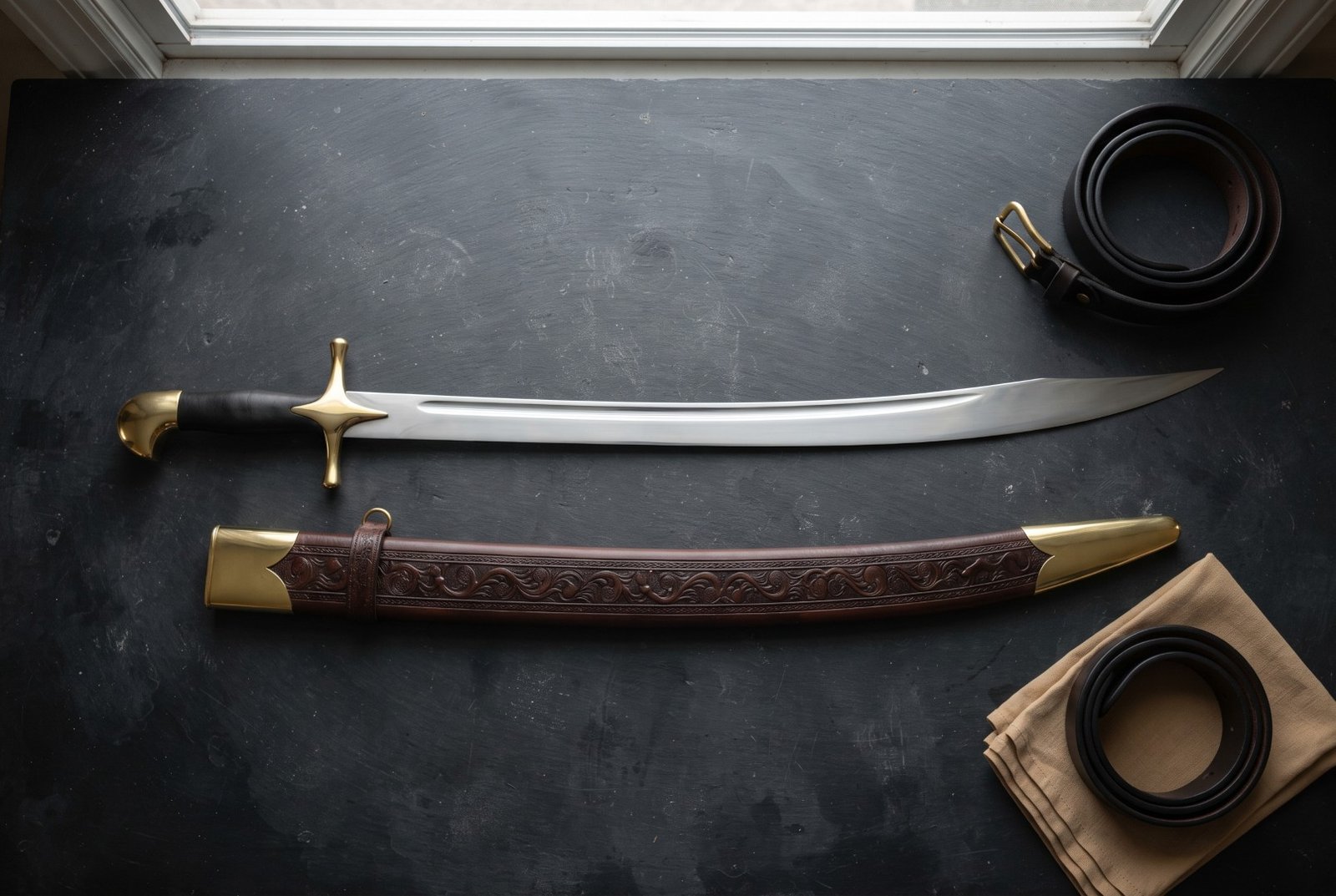
A scimitar is not one sword. It is a European catch all for the curved, single edged sabres of the Middle East, Central Asia, North Africa and South Asia. The people who made and carried those blades never used the word once. They said shamshir, talwar, kilij, saif, pulwar or nimcha, and each of those names points at a different shape with a different job. Scimitar is what happens when a category is named by the people on the receiving end.
Where the word comes from
Scimitar reaches English through Italian and French forms such as scimitarra and cimeterre, appearing in European writing from around the sixteenth century as trade and war brought Europeans into regular contact with Ottoman and Persian armies. The usual suggestion is that it derives from the Persian shamshir, though the sound changes are awkward and philologists have never fully agreed. Treat the etymology as unsettled, whatever confident thing you read elsewhere.
What matters more is how the word behaves. It is an outsider’s label, applied loosely, the way Europeans once used cutlass or falchion for anything short and curved. Using it as a shopping category is fine. Using it as a description of a specific historical sword is not, because it does not name one, and no amount of listing copy will make it name one.
Why the blade curves at all
 Sandreaver Hand Forged High Carbon Steel Scimitar | 36 Inch Overall with 30 Inch Blade | Leather Grip and Brass Cross Guard and Hooked Pommel | Collector and Display Gift | RK-1385
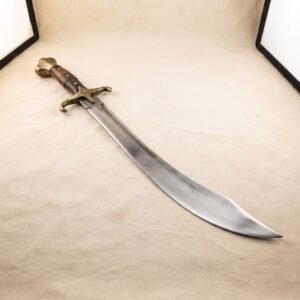 Duneclaw Hand Forged High Carbon Steel Scimitar | 33 Inch Overall with 27 Inch Blade | Riveted Hardwood Grip and Brass Quillons and Lobed Pommel | Collector Display Gift | RK-1386
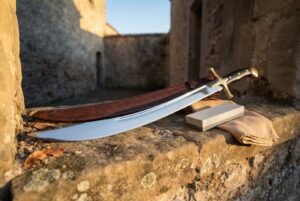 Emberledge Hand Forged High Carbon Steel Scimitar Sword | 37 Inch Overall with 31 Inch Blade | Collector Display Gift | RK-1388
The draw cut
A straight edge pressed into a target crushes and splits. A curved edge dragged across a target slices, because the point of contact travels along the edge as the blade moves. The curve turns a chop into a cut. That is the whole design argument in one sentence, and it explains why curved blades dominate wherever the primary target is unarmoured or lightly armoured.
From the saddle
Now put the swordsman on a horse. The horse supplies the speed and the direction. The rider’s job is to place the edge and let the animal’s momentum drag it through. A curved blade held out at the right angle does that almost automatically, and it comes free of the target instead of jamming. Curved sabres spread out of the Central Asian steppe with mounted archers and lancers, and the shape kept expanding westward through Turkic and Mongol contact from roughly the eighth century onward.
Straight swords never disappeared from these regions. The early Arab saif was straight, and straight blades stayed in ceremonial and religious use long after the curve took over on the battlefield.
The three families people actually mean
Shamshir, the Persian curve
The shamshir is the most extreme of the three. The blade is narrow, tapers evenly and curves deeply and consistently along its whole length, closer to a section of a circle than to a gentle arc. There is no widened flare near the point. The hilt is simple: a straight cross guard, a grip of horn, wood or ivory, and a pommel cap bent forward over the hand.
That deep curve makes the shamshir an outstanding cutter and a poor thruster. The point is so far off the line of the grip that any real thrust is awkward. Persian scabbards are built with a wide throat and a slit or an open side arrangement so the curve can be drawn at all. The form as we know it settles in Persia around the sixteenth century under Safavid rule.
Talwar, the Indian sabre
The identifying feature of a talwar is the hilt, not the blade. It has a disc shaped pommel sitting flat against the heel of the hand, short quillons, and often a knuckle bow. The grip is short and the disc closes the hand in, which limits wrist rotation and encourages a particular kind of drawing cut driven from the elbow and shoulder.
Talwar blades vary enormously, from nearly straight to strongly curved, wide to narrow, because talwar names a hilt style used across a huge region for centuries. Mughal and Rajput examples in museum collections cover the whole spread. Many of the finest carry crucible steel blades with a visible watered surface.
Kilij, the Ottoman sabre
The Turkish kilij is recognisable by the yelman: a widened section near the point, often with a sharpened back edge, that adds mass out where the cut lands. The blade is usually straight or gently curved for the first stretch and then breaks into a stronger curve for the last third. The result is a blade that hits harder at the tip than its weight suggests.
Later Ottoman forms grow shorter and more dramatically curved. The kilij is also the ancestor, through Hungarian and Polish intermediaries, of most European cavalry sabres, which is why a Napoleonic light cavalry sabre and an Ottoman kilij share so much of their logic.
The rest of the family
Saif is the general Arabic word for sword and gets attached to a range of North African and Arabian hilts. The nimcha is a Maghrebi sabre with a distinctive hilt of drooping quillons. The pulwar is an Afghan relative of the talwar with down curved quillons instead of a disc pommel. None of these are scimitars in their own languages. All of them get called scimitars in English.
How the blades were made
The great Persian and Indian blades were frequently forged from crucible steel, known in the trade as wootz. Iron and a carbon source were sealed in a clay crucible and held at heat until the charge melted, producing a small ingot of very high carbon steel. Forged carefully at a controlled temperature, that ingot develops bands of carbide that etch out as a flowing, watery surface pattern. Ingots were made in South India and Sri Lanka and traded across the Islamic world.
This is where a persistent confusion lives. Watered crucible steel and forge welded pattern welded steel are two different things that both get called Damascus. One is a pattern that emerges from the internal structure of a single high carbon ingot. The other is a pattern created by welding contrasting steels together and manipulating the layers. Our article on what Damascus steel is takes the two apart properly, and the steel glossary covers the terms you will meet on listings.
Hilts were their own craft. Watered blades were mounted with chiselled steel, gold overlay, enamel, jade and ivory, and the best surviving pieces are as much jeweller’s work as smith’s work. Museum collections in Istanbul, Tehran, London and New York hold the pieces most often reproduced, and the reproductions rarely mention how far short they fall.
What to look for if you are buying one
First, work out which shape you actually want, because a listing that says only scimitar is telling you nothing, and probably knows it. If you want the deep even curve, you want a shamshir. If you want the disc pommel, you want a talwar. If you want the flared tip, you want a kilij. Ask the seller which one it is.
Second, ask about the steel and the hardness. A curved cutting blade lives or dies on edge stability. A stated grade and a stated hardness range mean somebody controlled the heat treatment. A description that says only high carbon means nobody is willing to commit to a number in writing.
Third, check the tang. A full tang running the length of the grip and peened or threaded at the pommel is what you want in a sword you intend to swing. A short rat tail tang glued into a handle is a display fitting, and it will fail if you use it.
Fourth, handle the balance if you can. A good sabre of this family balances a few inches ahead of the guard. Too far forward and it is a club that fatigues the wrist. Too far back and the cut has nothing behind it.
Finally, be realistic about the pattern. A watered surface on an affordable modern sword is a forge welded pattern, not reconstructed wootz. That is a perfectly good thing to own, as long as the seller says so before you have to ask. If you want a broader sense of how curved and straight blades compare in hand, our roundup of the best Viking swords for collectors makes a useful contrast, since a Norse blade solves the opposite problem.
What we sell
Our swords range includes scimitars, talwars and shamshirs alongside straight blades, and each listing states the overall length, the blade length and the fittings so you can tell the shapes apart rather than guessing. House steel is plain 1095 run at 54 to 58 HRC. Where a piece is Damascus, it is 1095 and 15N20 forge welded and run at 58 to 60 HRC, which is a layered pattern rather than crucible wootz, and we say so. If your interest runs to curved blades generally, the katana and Japanese swords section solves the same cutting problem in a completely different tradition, and the daggers range covers the shorter side arms that travelled with these swords. If a sword is going on a wall, the sword stands and displays section has the racks. Ransack Viking is a US company in Chicago, Illinois. Every piece is handmade in the Czech Republic the old way, then imported, inspected and shipped from Chicago. Engraving is done in the US after arrival.
A curved edge needs its own sharpening method, set out in how to sharpen a curved blade. The other famous curve in the catalogue is covered in the kukri.
Questions people ask
Is a scimitar a real historical sword?
The curved swords are entirely real. The word is not native to them. Scimitar is a European umbrella term that entered English around the sixteenth century and was applied loosely to the curved sabres of the Ottoman, Persian, Arab, North African and South Asian worlds. If you want to name an actual historical sword, use shamshir, talwar, kilij, saif, nimcha or pulwar instead, and watch the conversation improve.
What is the difference between a shamshir and a talwar?
The shamshir is Persian and defined by its blade: narrow, tapering and deeply curved along its whole length with no flare near the point. The talwar is Indian and defined by its hilt: a flat disc pommel against the hand, short quillons and often a knuckle bow. Talwar blades vary from almost straight to strongly curved, so the hilt is what settles the name.
What is a yelman on a kilij?
The yelman is the widened section near the point of an Ottoman kilij, usually with a sharpened back edge. It moves mass forward to the part of the blade that does the cutting, so the sword strikes harder than its total weight suggests while the rest of the blade stays light. It is the clearest single feature for telling a kilij from a shamshir at a glance.
Why are scimitars curved?
A curve turns a chop into a slice. As the blade moves, the contact point travels along the edge, which cuts rather than crushes and releases cleanly instead of binding in the target. That matters most on horseback, where the animal supplies the speed and the rider only has to place the edge. Curved sabres spread west from the Central Asian steppe with mounted troops.
Is a scimitar made from Damascus steel?
Many historical Persian and Indian blades were forged from crucible steel, called wootz, whose watered surface comes from carbide banding inside a single high carbon ingot. That is a different thing from forge welded pattern steel, which gets the same name today. Modern affordable blades with a watery surface are almost always layered pattern steel, and an honest seller will tell you which one you are buying before you think to ask.
Can I use a scimitar for cutting practice?
Only if it was built for it. Check that the tang runs the full length of the grip and is peened or threaded at the pommel, that the steel grade and hardness are stated rather than described vaguely, and that the balance sits a few inches ahead of the guard. A short tang glued into a handle is a display fitting and will come apart under load, whatever the blade is made of, and whatever the photograph suggested.
From the shop
In the shop right now, the Sandreaver scimitar and the Slatecrown talwar. The Weavewind shamshir and the Sandspire Arabian sword sit next to them.
The European cousins
Europe had its own long affair with the curved blade and kept at it long enough to write manuals about it. The HEMA sabre guide covers the patterns clubs train with today. The Sturvang sabre trainer carries a three bar guard, and the full set is under HEMA sabres.
Shop the range
Sandreaver Hand Forged High Carbon Steel Scimitar | 36 Inch Overall with 30 Inch Blade | Leather Grip and Brass Cross Guard and Hooked Pommel | Collector and Display Gift | RK-1385Duneclaw Hand Forged High Carbon Steel Scimitar | 33 Inch Overall with 27 Inch Blade | Riveted Hardwood Grip and Brass Quillons and Lobed Pommel | Collector Display Gift | RK-1386Emberledge Hand Forged High Carbon Steel Scimitar Sword | 37 Inch Overall with 31 Inch Blade | Collector Display Gift | RK-1388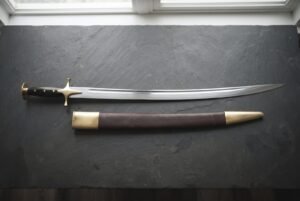 Slatecrown Hand Forged High Carbon Steel Talwar | 36 Inch Overall with 30 Inch Blade | Collector Display Gift | RK-1389
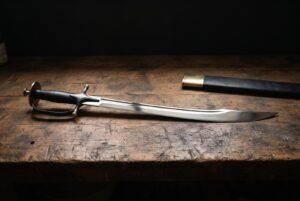 Nightwheel Hand Forged High Carbon Steel Talwar Sword | 35 Inch Overall with 29 Inch Blade | Collector Display Gift | RK-1391
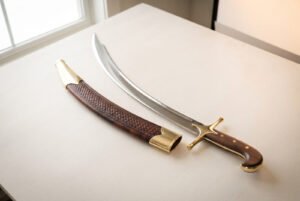 Weavewind Hand Forged High Carbon Steel Shamshir | 37 Inch Overall with 31 Inch Blade | Collector Display Gift | RK-1394