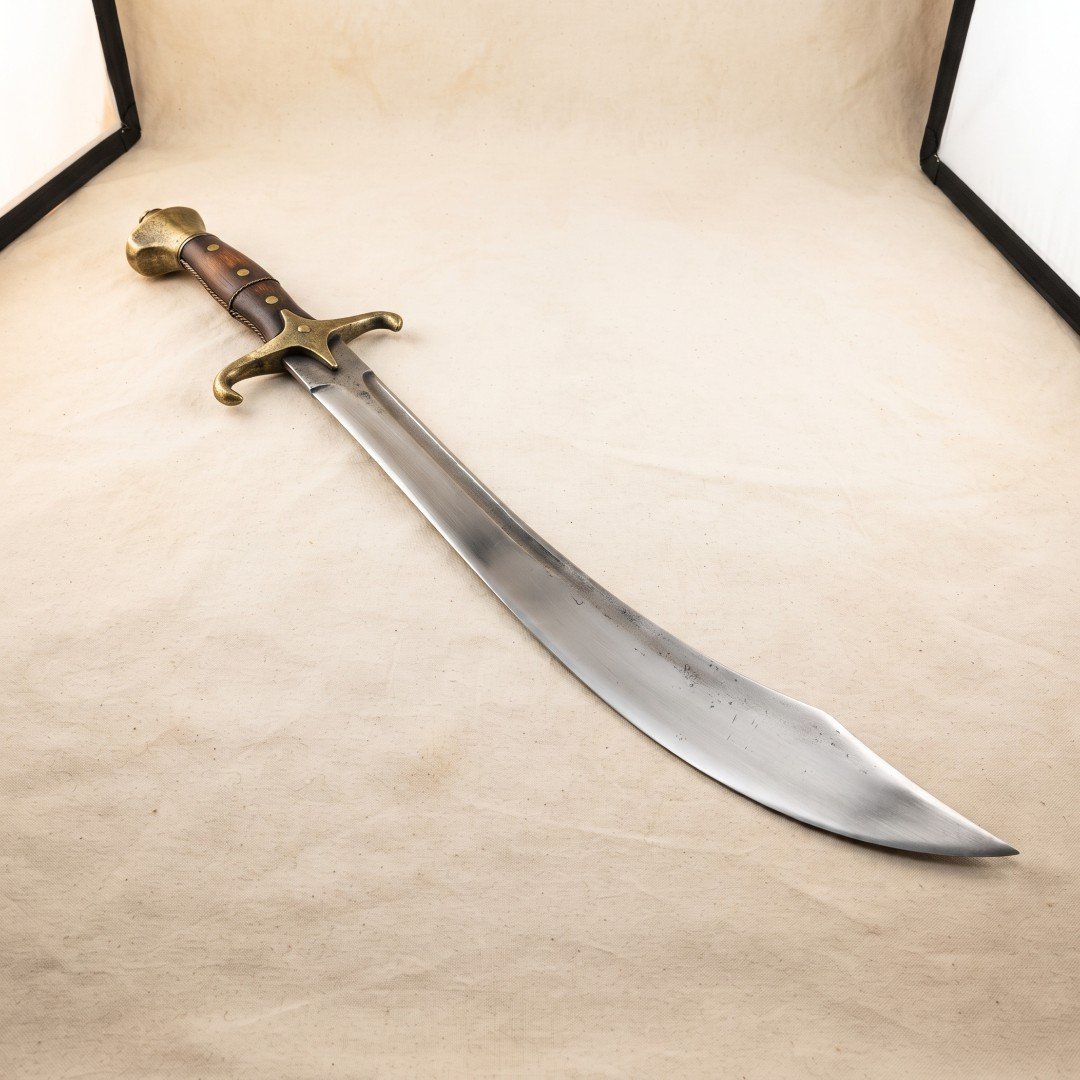
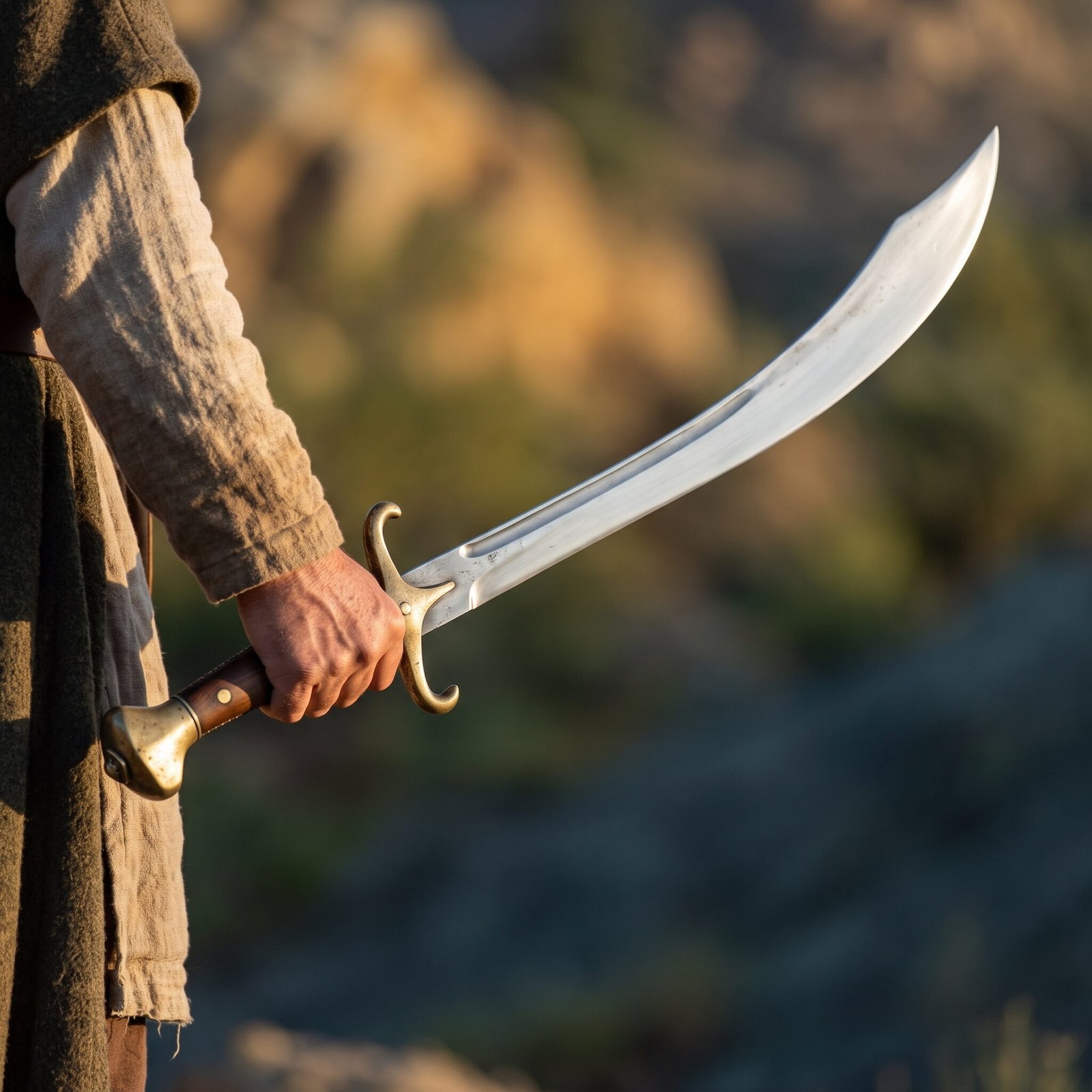
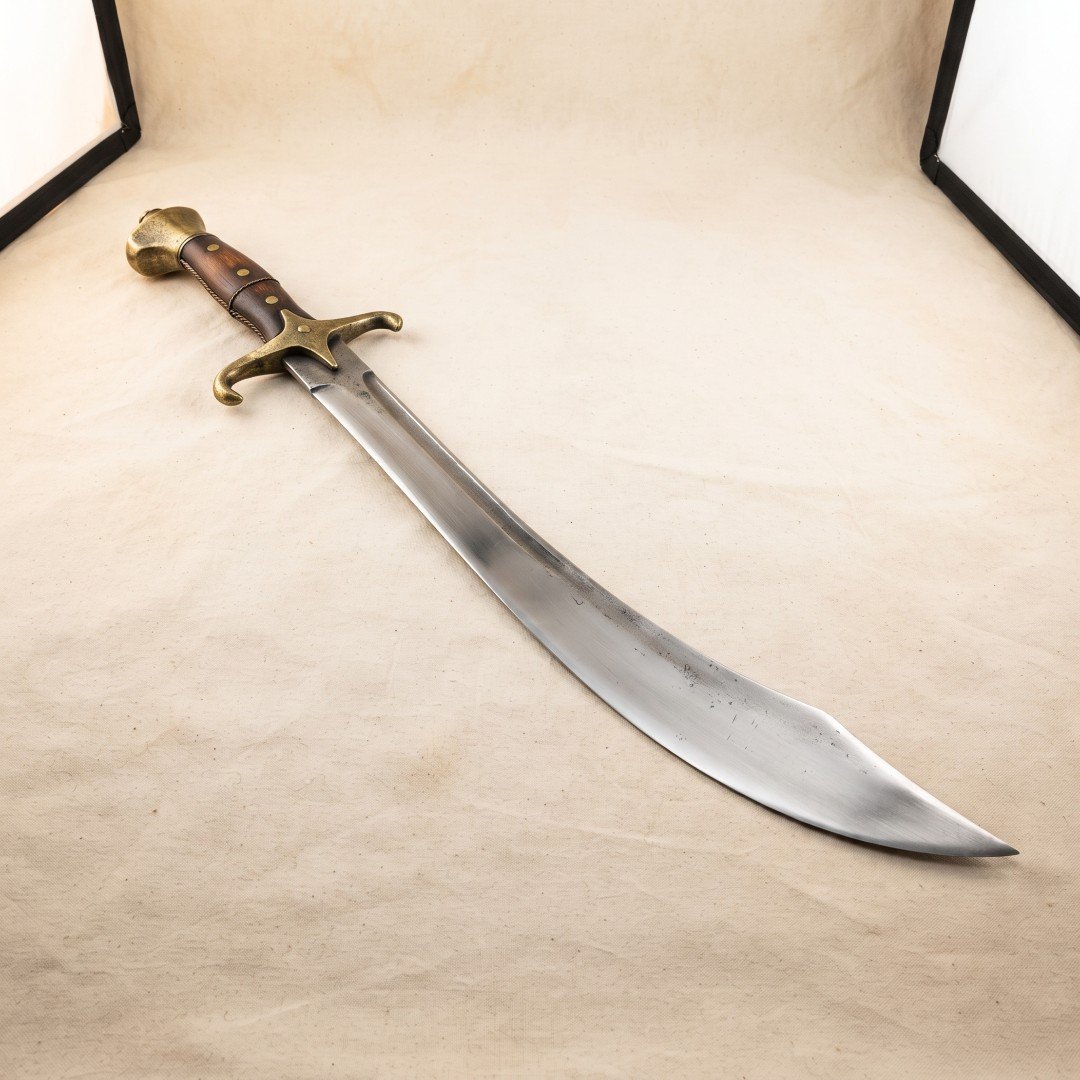
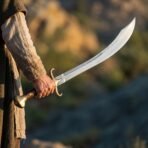
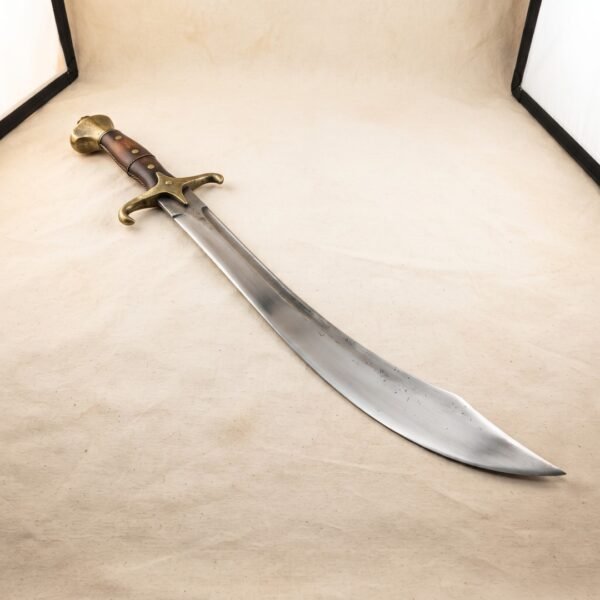
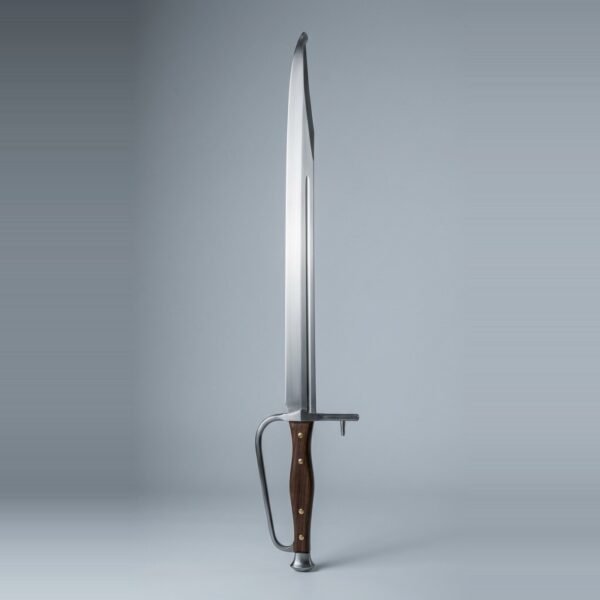
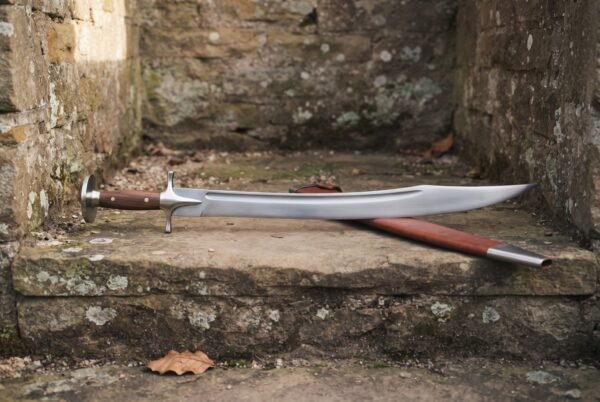
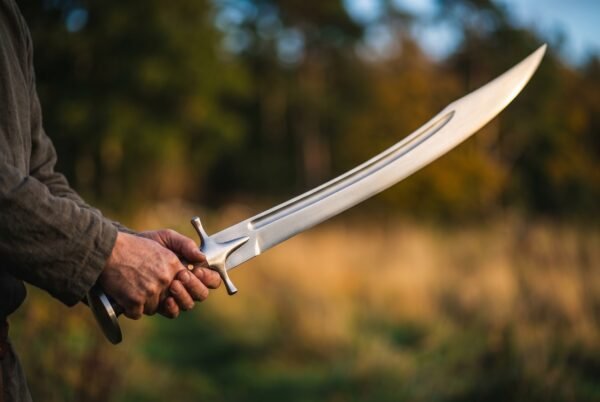
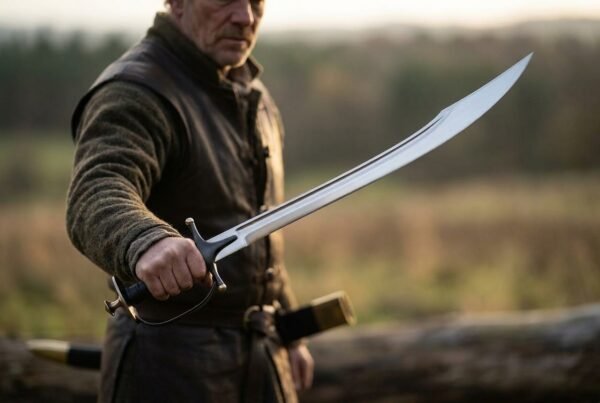
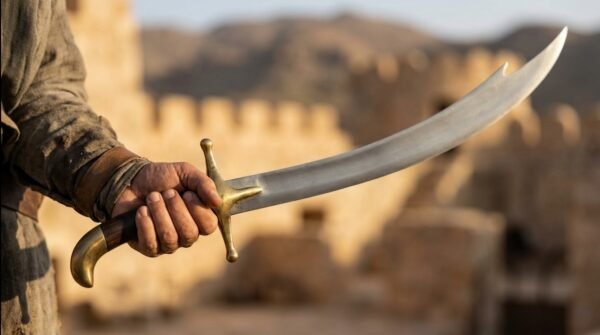
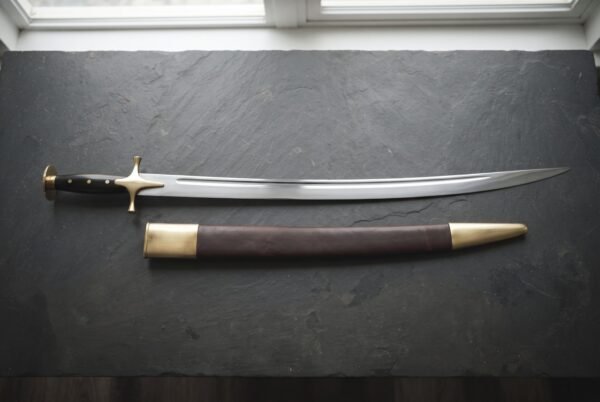
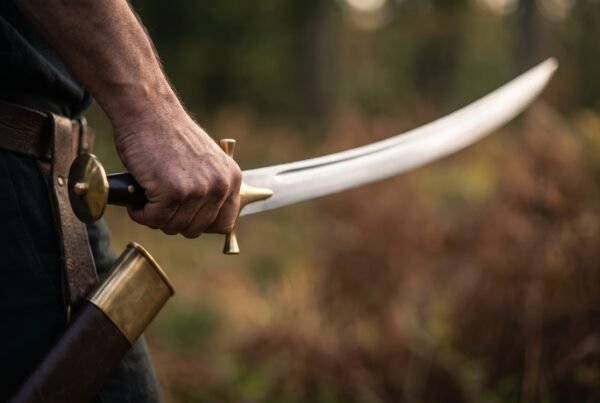
The Duneclaw is a scimitar cut to the old proportions, short in the hilt and enormous in the belly, the shape most people picture when they hear the word. What is worth knowing is that scimitar is not the name of a historical sword at all. It is a European word, borrowed into English in the sixteenth century from the Italian scimitarra, and Europeans used it as a catch all for every curved single edged sword they met coming out of Persia, Turkey, Arabia and North Africa. The Persians called their own sword a shamshir, the Turks a kilij, the Arabs a saif, and none of them would have recognised the term. What all those swords shared, and what this blade reproduces, is a forward weighted curve built to slice rather than thrust.
This one is forged and finished in the Czech Republic. The blade is 1095 high carbon steel taken to a hand sanded satin finish that leaves the forging marks visible along the flat rather than polishing away the evidence of how it was made. The hilt is a riveted hardwood grip between brass quillons and a heavy lobed brass pommel cap. It ships with a fitted leather blade sleeve, a care card and free shipping inside the United States.
Specifications
| Steel | 1095 high carbon steel |
|---|
| Hardness | 54 to 58 HRC |
|---|
| Overall length | 33 inches |
|---|
| Blade length | 27 inches |
|---|
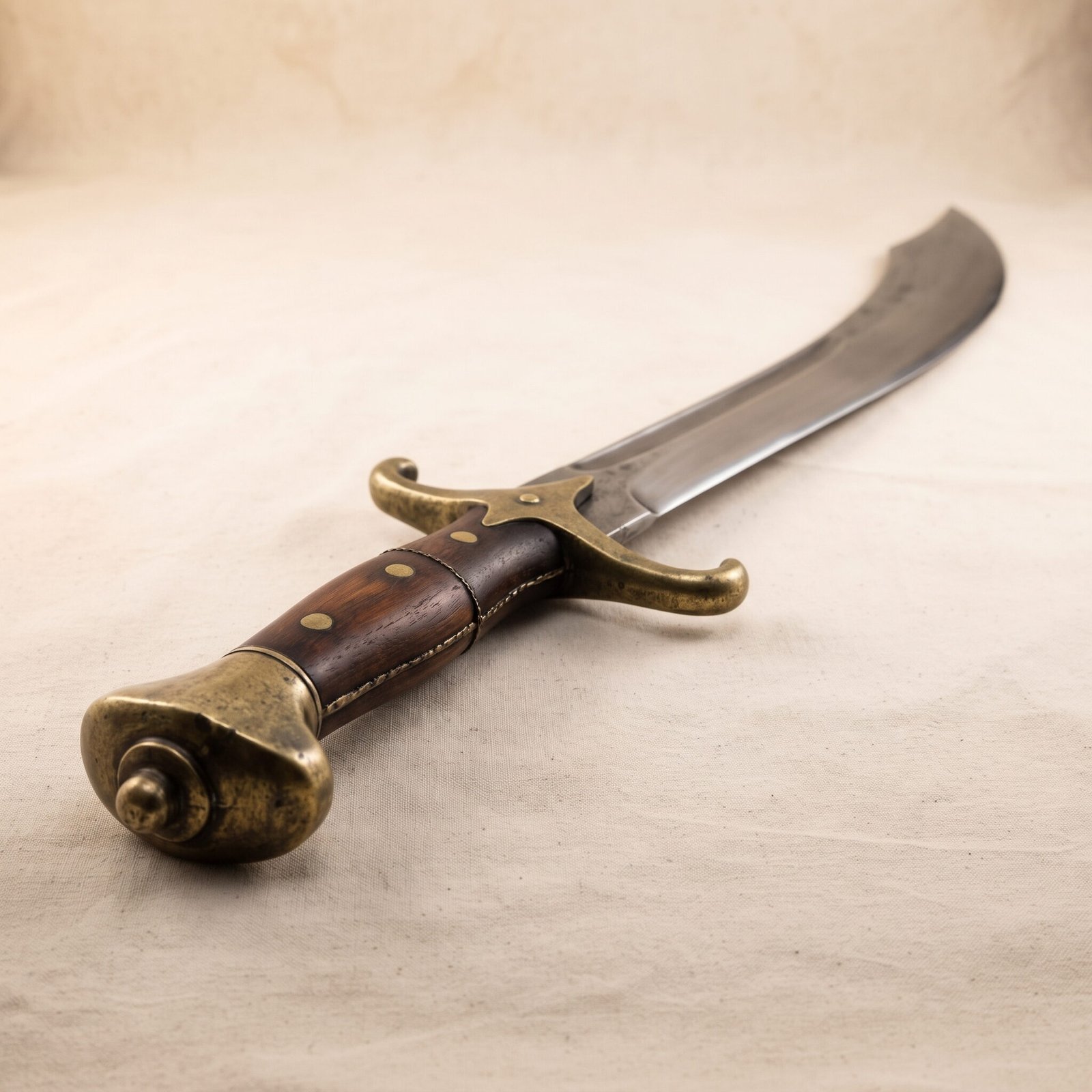
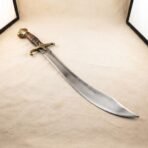
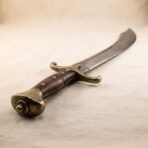
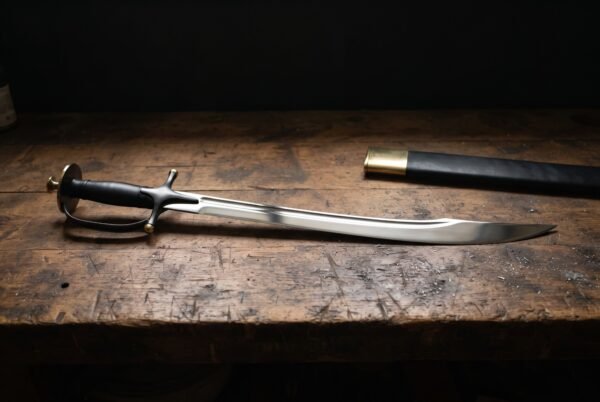
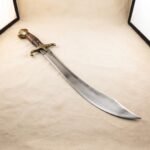
| Blade | Curved single edged blade with a wide flaring belly, clipped back edge near the point and a narrow fuller along the spine |
|---|
| Blade finish | Hand sanded satin, forge marks left visible |
|---|
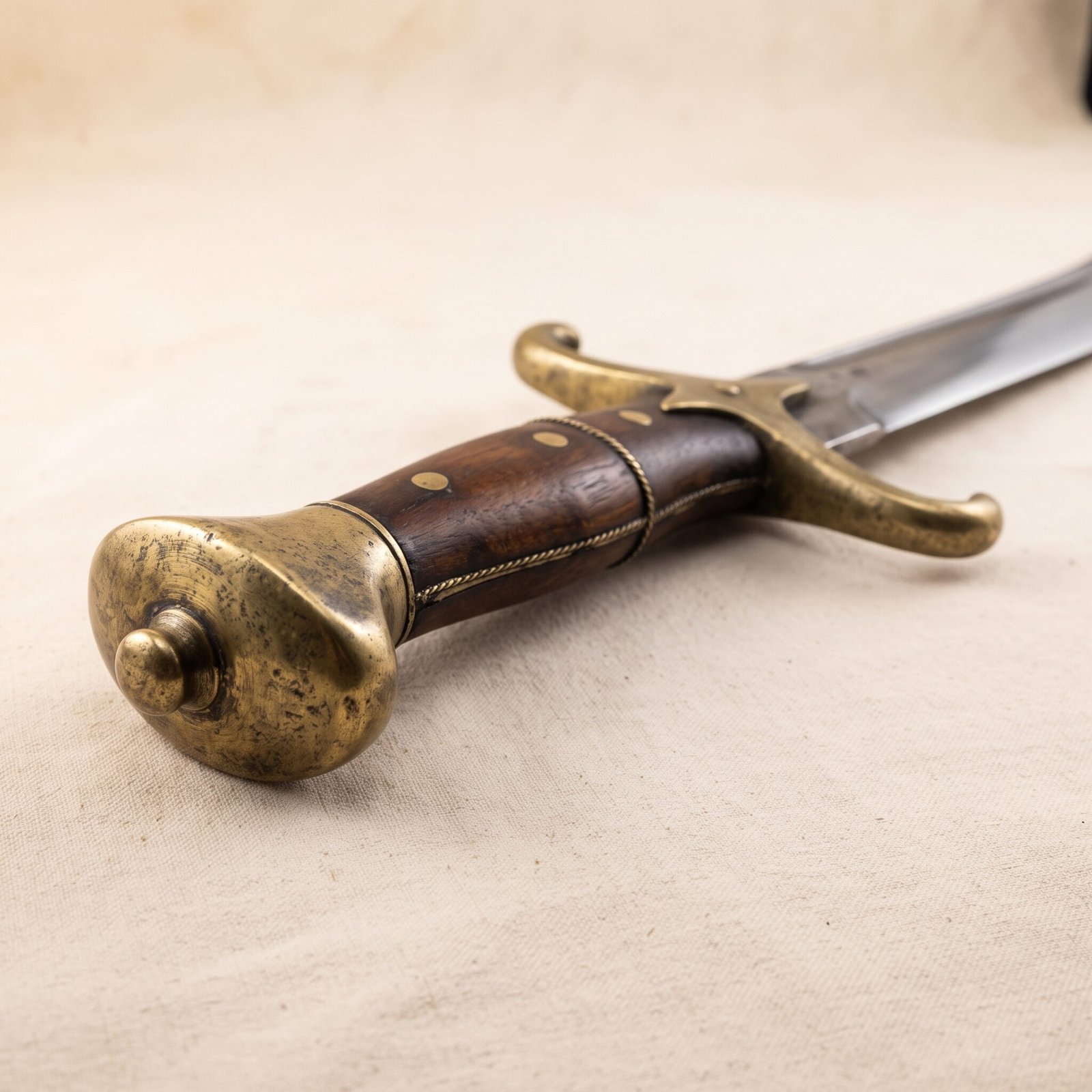
| Guard | Brass cross guard with downturned scrolled quillons |
|---|
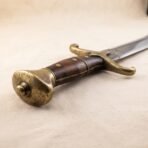
| Grip | Hardwood scales with brass rivets and twisted brass wire bands |
|---|
| Pommel | Lobed brass cap with a button finial |
|---|
| Sheath | Fitted leather blade sleeve |
|---|
| SKU | RK-1386 |
|---|
Why the belly is so wide
The widest part of this blade sits about two thirds of the way to the point, and that is not a stylistic choice. It is where the sword is designed to make contact. On any swinging blade there is a spot along its length where an impact produces no shock back into the hand, the point of percussion, and a maker sets the mass of the blade to put that spot where the cut is going to land. Widening the blade out there moves it forward and adds momentum exactly where it does work.
The cost of that decision is that the sword becomes tip heavy, which is why the scimitar family also shortened the blade and kept the hilt compact. You end up with a sword that is not especially long, that feels heavier than its weight suggests once it is moving, and that cuts far harder than a straight blade of the same mass. It also recovers slowly, which is why these swords were paired with a shield or used from horseback rather than fenced with. Understanding that trade tells you more about the sword than any amount of description of its finish.
Why 1095 high carbon steel and not stainless
1095 carries just under one percent carbon and almost nothing else. That plainness is what makes it good sword steel. It responds to heat treatment in a way a smith can read and control, it hardens through the full thickness of a blade this size, and its fine grain structure lets an edge come to a genuine apex rather than crumbling into carbides. On a broad chopping blade you want toughness first and edge holding second, and 1095 at 54 to 58 HRC gives you both without becoming glassy.
Stainless steel earns its corrosion resistance with chromium, and the chromium ties up carbon into hard particles. In a paring knife that is a sensible bargain. In a twenty seven inch blade that will be loaded across its whole length, those particles are places for a crack to start. The trade you accept with 1095 is that it will rust if you ignore it. That is a housekeeping problem, and a small one. We lay the whole comparison out on Damascus versus stainless.
The riveted hardwood grip
The grip is hardwood in two scales, pinned through the tang with brass rivets, with a brass ferrule at the guard and a lobed brass cap over the butt. This is full tang construction, meaning the steel runs the whole length of the handle at nearly its full width, which is the only sensible way to build a sword that is going to be swung hard. A rat tail tang glued into a hollow handle will fail, and it fails without warning.
Wood was chosen historically for the same reason it is chosen now. It is light, so it does not fight the forward balance the blade is trying to establish, it damps vibration better than metal, and it warms in the hand instead of drawing heat out of it. The brass rivets are peened rather than screwed, so there is nothing to work loose. Hardwood does want a little attention over the years, particularly if the sword hangs somewhere dry or in direct sun, and the routine for that is on wooden handle care.
Engraving, runes and your own design
Use the rune converter on this page to turn a name, a date or a short phrase into Elder Futhark and we will cut it into the steel or the handle. If you would rather have a Viking pattern than a rune line, choose your own design in the engraving option above the add to cart button and tell us whether it goes on the blade or the handle. Where a piece already carries an engraved design, your chosen engraving replaces it rather than sitting alongside it. On a satin finished blade like this one an engraved line reads particularly clearly, because the cut catches light against the brushed surface instead of disappearing into a mirror. See the engraving page for lettering sizes and what we can fit.
Care and sharpening
A satin finish is more forgiving than a mirror, but it is still carbon steel and it still wants oil. Wipe the blade after handling and put a thin film of light oil over it with a cloth every few weeks. If the sword lives on a wall in a heated room that is all it will ever need. If it lives in a garage, a basement or anywhere the temperature swings enough to condense moisture, oil it monthly and check it. Surface rust that has just started will come off with fine steel wool and oil without harming the finish. Our routine is set out on steel care.
To sharpen it, follow the curve rather than trying to hold the blade flat to the stone. Work a few inches at a time, keep the bevel angle steady, and sweep the blade through its arc so each section gets equal work. Finish on a fine stone and a strop. There is a full walkthrough on sharpening with a whetstone.
Made in the Czech Republic
The work behind this piece happens in a Czech Republic workshop that has kept to the old methods. Steel is forged and heat treated by hand, the grind is taken down by eye rather than by machine, and the handle, fittings and sheath are cut and finished one at a time. Because of that, every piece carries small marks of the hand that made it.
Ransack Viking is a United States company. We import direct, check each piece when it reaches us, and ship from our Chicago, Illinois warehouse. Engraving is added here in the United States after arrival, so the piece you receive is finished to your order.
A note on handmade variation
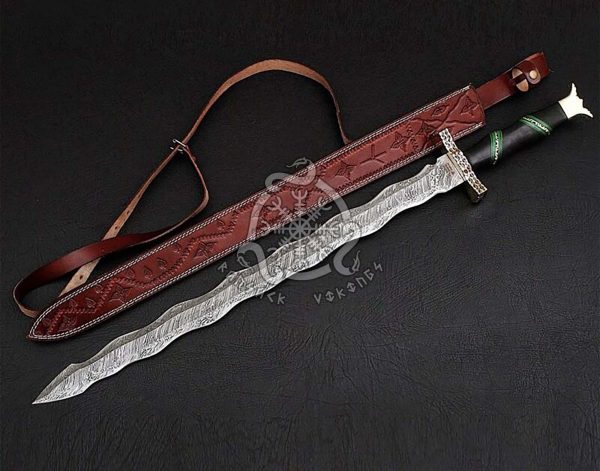
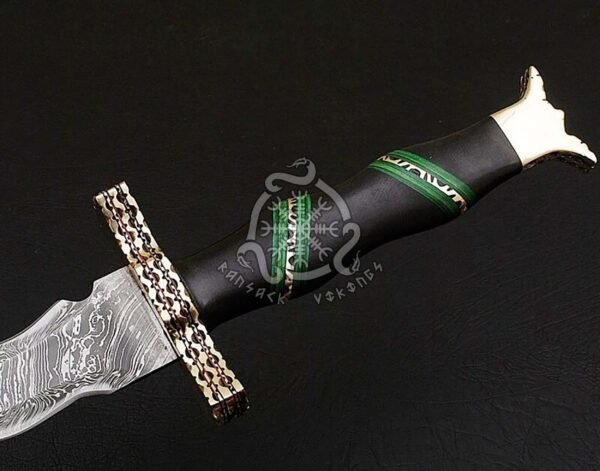
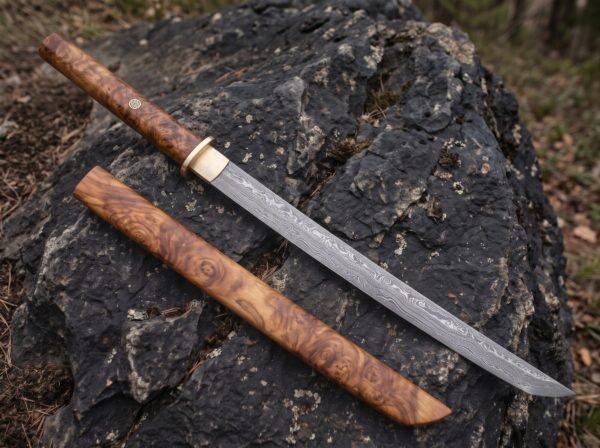
This scimitar is hand forged. It is not machine made and it is not bulk produced, so what arrives will not be a pixel for pixel copy of the photograph. The grain and colour of the hardwood, the tone of the brass, the pattern of forging marks left in the satin finish and the exact line of the curve all vary from one sword to the next, because each is worked by hand from natural materials. The dimensions, the steel and the build are the same every time. The character is not.
Frequently asked questions
Is it sharp when it arrives?
It comes with a real cutting edge at working sharpness. That is deliberate on a sword this size. Ask in the order notes if you want it taken further and we will do it before it ships.
Why does the blade have marks on it?
Those are forging marks, left in on purpose. The blade is hand sanded to a satin finish rather than buffed to a mirror, so the record of the hammer and the grinder stays visible. They are not flaws and they are not rust.
Can I hang it on a wall?
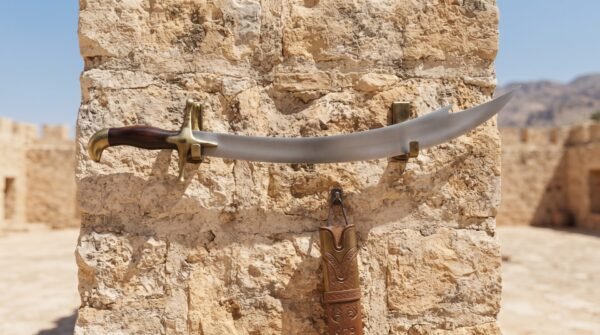
Yes, and most of these end up on one. Use a mount that supports the blade in two places rather than hanging it by the guard alone, and keep it out of direct sunlight and off exterior walls that get cold enough to sweat.
What is the difference between this and a talwar?
A talwar is Indian and is identified by its hilt, a disc shaped pommel with a short knuckle guard. This is a scimitar in the broader sense, with a cross guard and a capped pommel, and a much wider belly than most talwar blades.
Can I have runes engraved on it?
Yes. Use the rune converter for Elder Futhark or choose your own design in the engraving option, and tell us whether it goes on the blade or the handle. Allow an extra week.
How long does shipping take?
Free inside the United States. Stock swords leave within two to three business days. Engraved swords take two to three weeks before they ship.
What is in the box
- Duneclaw hand forged 1095 high carbon steel scimitar
- Fitted leather blade sleeve
- Care card with oiling and storage instructions
- Certificate of hand forging
- Forged and finished in the Czech Republic
Explore the range
Browse the other scimitars, the full swords range, the falchions and the sabres, or read the guides.
Compare it with these
Closest to this in the range is the Weavewind scimitar, 37 inches overall. If this one is not quite right, there is the Silkmoon scimitar, 38 inches overall. Also in this group is the Sandreaver scimitar, 36 inches overall.
If you are putting a set together, the Gravewind bastard sword sits alongside it. Pick the steel, the length and the fittings yourself on the design your own page.
If you want to spar rather than display, the Ostrevak steel dussack is the blunt trainer built for it, and our dussack guide is worth a look.

Knew this piece was special the second I opened the box.
Five stars isn’t even enough honestly. Exactly as described and clearly made with care. Packaging was excellent and it arrived in perfect condition. If you’re on the fence just get it. You won’t regret it.
Incredible craftsmanship on this one. Packaging was excellent and it arrived in perfect condition. The craftsmanship really shows in the small details. Feels way more premium in person than the listing photos. Already planning my next purchase from this shop.
This piece is a genuine work of art. Exactly as described and clearly made with care. The craftsmanship really shows in the small details. Can’t recommend this enough.
This piece is fine. Just didn’t wow me. Decent quality overall though not amazing. It’s fine for the price. Nothing that stood out. Wouldn’t say no to it but wouldn’t rave about it either.