Blog
What Is a Dussack? The Trainer With a Hole in It

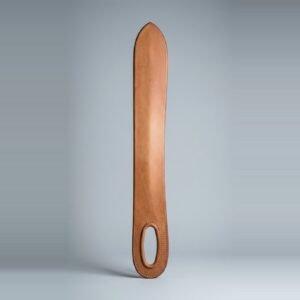
A dussack is a short, broad, single edged training sword with no pommel, no upper guard and no separate grip. The handle is a hole cut straight through the blade itself. You put your hand through it and fence. That is the entire design, and it has survived five hundred years because it is very hard to improve on.
It is also the cheapest serious thing you can buy in this sport, which makes it the piece that gets dismissed until somebody puts one in your hand. Then you discover it teaches cutting mechanics, edge alignment and measure at least as well as a steel sword does, with nothing to break and nobody going to hospital.
If you are new here, what HEMA actually is is the place to start, followed by how to choose your first HEMA sword. If you want the curved steel relative, that is the HEMA sabre guide, and the dussacks themselves sit in the HEMA sabres category.
What a dussack actually is
The practice dussack, which is the version people buy, has a blade of roughly 25 to 38 inches, historically made of wood. There is no crossguard above the hand and no pommel below it. Instead a hole is cut through the flat of the blade near the base, and the edges of that hole are the grip. Your fingers go through, your hand sits in the gap, and the piece becomes a single object with no fittings whatsoever.
That is not a simplification of a sword. It is a different solution to the same problem, and it is the reason the dussack is effectively indestructible. There is no tang to loosen, no pommel to work free, no rivet to shear and no guard to bend. There is one piece of material with a hole in it.
The sharp original that the practice piece derives from is a different object with an actual hilt, but the training form is the one that mattered to the fencing schools and it is the one that has come back into use.
Where it came from, which is more interesting than most sellers admit
The dussack came out of the Hussite Wars in the early 15th century, when the Czech tesak entered German usage. The name travelled with the object. By the late 16th century it was an established sidearm in German lands and across the Habsburg monarchy, and by then it had its own place in the German fencing schools as a training tool for single edged cutting.
That Czech origin is not a marketing flourish, it is the documented route the type took into German use. It does happen to sit neatly with the fact that these are made by hand in the Czech Republic, which is the kind of coincidence a seller is allowed to enjoy.
The hole through the blade
The grip is the part everybody asks about, so here is what it does.
Because your hand passes through the blade rather than gripping something attached to it, the sword and the hand are on the same axis. There is no offset between the line of the edge and the line of your forearm, which means edge alignment is almost automatic. On a sword with a conventional grip you learn alignment by feel over months. On a dussack the geometry does a lot of that teaching for you.
The hole also limits what you can do, deliberately. You cannot change grip mid movement, you cannot choke up or drop back on the handle, and you cannot rotate the piece in your hand. Everything has to come from the wrist, the elbow and the shoulder, which is exactly the point of a training tool.
The other thing it gives you is hand protection without a guard. The material around the hole stands proud of your knuckles, so the blade itself is doing the job a knuckle bow does elsewhere.
The four modern forms
Leather
Thick vegetable tanned leather, cut to shape. The softest option and the one clubs hand to beginners and to anyone running a session without full kit. It will not break, it will not break anyone else, and it is light enough that an hour of drills does not destroy your forearm.
Wood
The historical material and still a perfectly good one. Stiffer than leather, cheaper than steel, and it behaves honestly in a bind. The drawback is that wood eventually splits, especially at the hole, and a split dussack is finished rather than repairable.
Synthetic
Moulded nylon. Stiffer again, more durable than wood and consistent piece to piece in a way natural materials are not. The trade is that a synthetic dussack hits considerably harder than a leather one, so kit requirements go up. More on the whole synthetic question in synthetic versus steel trainers.
Steel
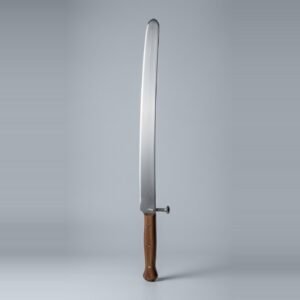
The full weight version, with the nagel peened through the blade and rivets holding the whole thing together. A steel dussack is a sparring tool for people in proper kit, not a beginner’s item, and it handles closest to the sabre it is preparing you for.
What a dussack teaches
Cutting mechanics, first and foremost. Because the grip is fixed and the piece is light, you cannot muscle a bad cut into looking acceptable. Either the edge arrives correctly or it does not, and you find out immediately.
After that, measure and tempo. Dussack work in the German schools is fast and close, and it runs at a pace that makes longsword look contemplative. Clubs use it for exactly that: a way to get people moving, cutting and reacting without the equipment burden that steel brings.
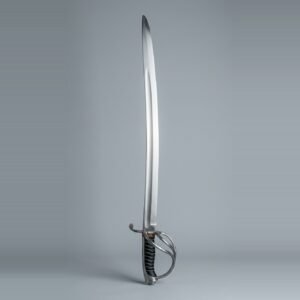
It also transfers. The movement pattern carries directly into sabre and, with some adjustment, into the messer material. If you want the German single edged tradition with a hilt on it, the messer guide is the next stop.
What it does not do
It does not teach you anything about handling a steel sword’s weight, and it does not prepare your hands for the shock of a hard steel bind. Anyone telling you a leather dussack is a substitute for a steel trainer is selling you a leather dussack.
It also does not come with a scabbard, which is a sentence that should be unnecessary and is not. Dussacks, feders, montantes and wasters never had one and nothing in this range ships with one.
And it is not a tournament sabre. If you are entering an event, read the ruleset, because tip and blade requirements are specific. Under the Berlin HEMA Cup gear requirements, for instance, rounded tips are not allowed on rapier and sabre and permitted tips are spatulated or rolled at a minimum of 1.5 cm across. HEMA tournament gear rules covers the general shape of it.
Buying one, and keeping it
Buy leather if you are starting out, running a beginners class, or want something you can throw in a bag and not think about. Buy wood if you want the historical experience and accept that it has a lifespan. Buy synthetic if you want durability and your club has the kit for it. Buy steel if you are already sparring in full protection and want the handling that matches a sabre.
Care is simple and mostly about moisture. Leather wants to be kept dry, out of direct sun and away from radiators, and it will take a light dressing occasionally if it starts to feel dry. Wood wants the same and nothing else. Steel wants a wipe and a thin film of oil like any other blade, and it should be stored horizontal rather than sealed somewhere damp.
Inspect the area around the hole on any material before every session. That is where the stress concentrates and that is where failures start. On leather and wood you are looking for tearing or splitting at the corners, and on steel you are checking that the rivets and the nagel have not moved.
For the wider question of flex and how it is sold, HEMA sword flex explained is the reference, and blunt versus sharp training swords covers why nothing in this family is sharp.
Where to see these
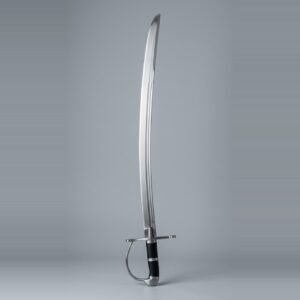
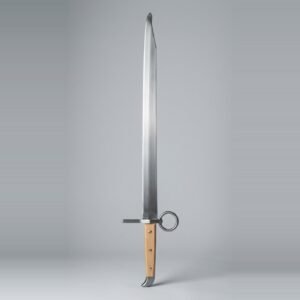
Start with the Reifholm leather dussack, which is one slab of thick vegetable tanned leather with the grip hole cut through it and twin stitch lines, and no steel anywhere on the piece. When you are ready for the steel it prepares you for, the Kaldrast hanger sabre is the closest match in handling, with a curved single edged blade and a D shaped knuckle bow. If the German single edged material pulls you toward a hilt instead, the Brenvald langes messer and the larger Skarnvald grosses messer are the two to look at. The Ostrevak steel dussack is the steel dussack itself, a nagel peened straight through the blade with no cross at all and a rounded blunt tip, and it is what the leather one trains you toward.
Everything here is made by hand in the Czech Republic, inspected at our North Babylon, New York warehouse and shipped from there. Engraving is done in the United States after arrival, with the options on the engraving page.
Questions people ask
What is a dussack?
A short single edged training sword with a blade of roughly 25 to 38 inches, no pommel and no upper guard, where the grip is a hole cut straight through the blade itself. Historically it was made of wood, and modern versions come in leather, wood, synthetic and steel.
Where does the dussack come from?
It came out of the Hussite Wars in the early 15th century, when the Czech tesak entered German usage. By the late 16th century it was an established sidearm in German lands and the Habsburg monarchy, with its own place in the German fencing schools.
Why is the handle a hole in the blade?
Because it removes every part that can fail and it puts your hand on the same axis as the edge. There is no tang, no pommel and no rivet to work loose, and the alignment between your forearm and the edge is built into the shape rather than something you have to learn.
Is a dussack a real sword or just a trainer?
The practice dussack is a trainer, and that is not a criticism. The sharp form it derives from was a genuine sidearm, but the version with a hole through the blade was made for fencing schools and it is the one that is useful today.
Which material should a beginner buy?
Leather, almost always. It is light, it will not break, it will not injure a partner who is not in full kit, and it costs less than anything else in the sport. Move up to synthetic or steel when your club’s kit requirements and your own protection allow it.
Can you spar with a dussack?
Yes, and that is largely what they are for, but the protection you need depends on the material. Leather against leather works with modest kit, while steel dussacks belong in the same protective gear you would wear for any steel sparring. Ask your club rather than assuming.
Does a dussack help with sabre?
Considerably. The cutting mechanics, the hand positions and the measure carry across almost directly, which is why so many sabre clubs run dussack drills. It is the cheapest way to build the movement before you spend money on steel.
How do I look after a leather dussack?
Keep it dry, out of direct sun and away from heat sources, and give it a light leather dressing if it starts to feel dry. Check the edges of the grip hole before each session, because that is where stress concentrates and where any tearing will start.
Keep reading
The rest of the HEMA writing lives in the guides section, and the full range is under HEMA swords.