Blog
Blunt vs Sharp Training Swords: How to Tell Them Apart

A blunt training sword and a sharp cutting sword look similar in a photograph and are not remotely the same purchase. One is built to be hit thousands of times by another person. The other is built to slice through a rolled tatami mat in one pass. Buy the wrong one and you either ruin a good blade or hurt somebody, and there is no version of that mistake that ends well.
The frustrating part is that the difference is often invisible at the resolution most sellers photograph at. The edge on a training blade is a flat land two or three millimetres wide. On a screen, from a metre away, that reads as a line. So does a sharp edge. You have to know what to look for.
This guide sets the two side by side: geometry, steel, heat treat, what each is used for and how to tell them apart on a listing. If you are still working out what any of this is for, read what HEMA is, and if you are buying rather than reading, the first sword guide covers the decision. Both types sit under HEMA swords.
The short version
A blunt is for hitting people who are wearing protective kit. A sharp is for cutting inanimate targets and is never used against a person, ever, under any circumstances, including slowly, including with a friend you trust, including once.
That rule is not negotiable and it is not a legal disclaimer written by somebody nervous. It is the single line that keeps this hobby from being a different hobby entirely.
The edge, which is the whole difference
What a blunt edge actually looks like
A properly made training blade has a flat land along the edge, roughly 2 to 3.5 mm wide, ground parallel and finished smooth. Hold it under a light and that land catches the light as a visible stripe running the length of the blade. That stripe is the thing to look for in a product photograph. If you can see a bright band along the edge rather than a fine dark line, you are looking at a blunt.
Width matters. Too narrow and the edge concentrates force into a small area on impact, which is how fingers get broken through gloves. Too wide and the blade stops behaving like a sword, because the mass moves outward and the bind feels wrong. Two to three and a half millimetres is the band the market has settled on for good reason.
What a sharp edge looks like
A converging grind that runs to an apex. No land, no stripe, no reflection along the edge because there is no flat surface left to reflect anything. In a photograph a sharp edge reads as a thin dark line where the blunt reads as a bright one. That single visual cue is more reliable than most product descriptions.
The tip, which is a separate system
A training blade has a widened blunt tip, rolled, folded back or flared into a knob. Tournament rules are specific: the Berlin HEMA Cup gear requirements permit spatulated or rolled tips at a minimum diameter of 1.5 cm across all four categories, and rounded tips are not allowed on rapier and sabre. Longsword blades must have a clearly distinguishable edge, back and flats. A cutting sword has an acute point because a point that spreads force is exactly what you do not want when the target is a mat. More rules detail in HEMA tournament gear rules.
Steel and heat treat, which run in opposite directions
This is the part that surprises people who come from knives, where harder is generally considered better.
Blunts run softer
Training blades are spring steel: 51CrV4, 6150, 9260 or 1095, hardened to roughly 49 to 52 HRC. That is deliberately soft. A training blade needs to bend under a hard bind and spring back straight rather than take a permanent set or snap. Hardness buys edge retention, and a blunt has no edge to retain, so it buys nothing here and costs a great deal in brittleness.
Sharps run harder
A cutting sword is 1095 high carbon at 54 to 58 HRC, because an edge that dulls after four cuts is a bad edge. The trade is that a harder blade is less forgiving of lateral load, which is what happens the moment the edge alignment is off in a cut or the moment somebody parries it.
Stainless is neither
Stainless steel appears on decorative wall swords because it never needs oiling and photographs brightly. It is harder and more brittle than either category above and it has no business in a piece that gets hit or used for cutting. A stainless training sword is a costume item wearing the wrong label. The steel glossary covers the alloys in detail.
What each one is actually for
Blunts
Paired drills, technique work, controlled sparring, free play, reenactment and, in the case of purpose built feders, tournament fencing. Everything you do with a partner happens with a blunt.
Worth knowing: a blunt longsword and a feder are not interchangeable for competition. Many longsword tournaments ban blunt longswords outright and allow only purpose built feders or sword shaped feders. Blunts remain excellent for drilling, pair work and reenactment, they are simply not what most longsword events accept. The distinction is set out in what a feder is.
Sharps
Test cutting against rolled tatami, water bottles, pool noodles and similar targets. It is a real discipline with its own skills, and it is the honest test of whether your edge alignment is as good as you think it is. It happens alone or with a spotter, against a target on a stand, at a safe distance from every other human being present.
Cutting also teaches things that sparring cannot. A blade that stops dead in a mat is telling you your edge was off by a few degrees. Nothing in paired drilling gives you feedback that unambiguous.
How to tell them apart on a listing
Sellers vary in how clearly they say it, so here is the checklist.
Look at the edge in the photograph for a bright stripe. Look at the tip for a widened shape against an acute point. Read the hardness figure, since roughly 49 to 52 HRC means training and 54 to 58 HRC means cutting. Read the steel, since 51CrV4 strongly implies a trainer and 1095 at a high hardness implies a sharp. And read the description for the word sparring, which a responsible seller will not put on a sharp blade.
If the listing gives none of that, treat the absence as the answer. A seller who does not know which one they are selling should not be selling either.
The photograph test nobody mentions
If the tip is cropped out of frame, walk away. The tip is the single most rules relevant part of a training blade and the part a careless photograph loses first. A seller who does not show it either does not own the piece or does not know why it matters.
Care, which differs more than you would expect
Both need the same basics: wipe down after use because sweat is what corrodes carbon steel, keep a thin film of oil on the blade, and check the hilt for movement regularly.
Beyond that they diverge. A blunt gets inspected for burrs after hard sparring, because a burr raised by a hard bind is a sharp edge nobody ordered, and it gets filed flat. It also gets checked for set bends and for cracks at the schilt shoulder and ricasso. A sharp gets its edge maintained and stored where nothing can brush against it. Neither ships with a scabbard in this line, so both want a bag or a rack. The care guide covers the routine.
One more: mark your own. Club racks full of identical blades create the exact confusion this guide is about, and a name or a date cut into the ricasso removes it. Engraving is done in the United States after arrival and is explained on the engraving page.
Where to see these
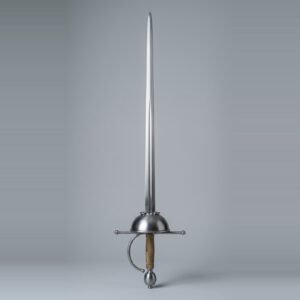
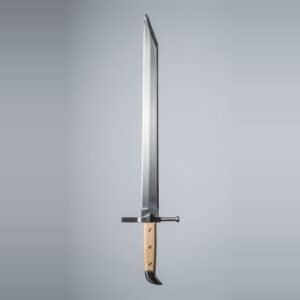
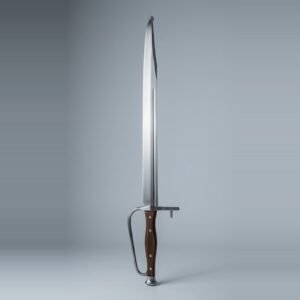
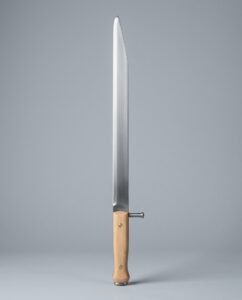
For the blunt side, the Drakvend blunt longsword has a flat diamond section and a wheel pommel, and the Draugmar arming sword shows the same blunting on a single handed blade with a wide fuller. The Brunhak langes messer carries a large ring nagel and a clipped point rounded off for training. For the fencing tool built from the ground up rather than blunted afterward, look at the Vindlaur feder. On the sharp side, the Velstrand cup hilt rapier and the Torvhaug langes messer are ground to a working edge for cutting practice and are not sparring tools. Ranges under HEMA longswords, HEMA arming swords and HEMA messers.
Blunt and sharp questions
Can a blunt training sword still hurt someone?
Yes, considerably. A blunt blade carries the same mass and speed as a sharp one and breaks fingers and ribs quite happily. Protective kit is mandatory for sparring precisely because blunt does not mean harmless.
Can I sharpen a blunt training sword?
You can physically remove the land, and you would be left with a sharp blade at a hardness intended for flexing rather than cutting. It would hold an edge poorly and it would never again be safe for sparring. Buy the right blade instead.
Can I blunt a sharp sword and spar with it?
No. Grinding a land onto a sharp blade does not change its heat treat, its distal taper or its point geometry. You would have a stiff hard blade with a narrow tip, which is the combination that causes injuries.
How wide should a blunt edge be?
Roughly 2 to 3.5 mm as a flat land. Narrower concentrates force on impact and wider changes how the blade handles. If you can see a bright stripe along the edge under a light, it is in the right region.
Is a sharp sword legal to own?
Rules vary by country, state and city, and blades are sold to adults aged 18 and over. Check your own jurisdiction before ordering, since this is one area where a general answer helps nobody.
Which should I buy first?
A blunt, almost always. Sparring and drilling with a partner is what a club night consists of, and cutting is a discipline you add later once your mechanics are worth testing. Cutting with poor edge alignment is just expensive mat destruction.
Do sharps and blunts handle the same?
Broadly similar in the hand, noticeably different in motion. A sharp is usually stiffer, often a little heavier through the blade, and it bites the air differently on a cut. A blunt flexes on contact in a way a cutting sword never should.
Why is stainless steel a warning sign on either type?
Because stainless is chosen for decorative swords that never get used. It is too hard and brittle for repeated impact and it is not what any serious maker in this field uses. Spring steel for trainers, high carbon for cutting, stainless for wall hangers.
If you want the flex side of the training blade story, that is in the flex guide, and the rest of what this shop has written is listed in guides.