Blog
What Is a Feder? The HEMA Longsword Trainer Explained

A feder is a training sword built for longsword fencing. It is not a blunt longsword with the edge taken off. It is its own thing, designed from the start to be fenced with, and the differences are structural rather than cosmetic. Get that distinction wrong in a HEMA club and somebody will correct you before you have finished the sentence.
The name comes from the German for feather, which sounds whimsical until you handle one and understand why. The blade is narrow and thin through most of its length, the base is widened into a flared section called the schilt, and the hilt carries enough mass to drag the balance point back toward the hand. The result feels like a sword in the bind while weighing and flexing like something far safer.
This guide covers the anatomy, the sub types, what the numbers on a spec sheet mean and how to pick one. If you are earlier in the process than that, read what HEMA is first, and if you are comparing a feder against the alternatives, choosing your first HEMA sword is the wider view. The range itself lives under feders.
What makes a feder a feder
Four features, and you need all four before the word applies.
The schilt
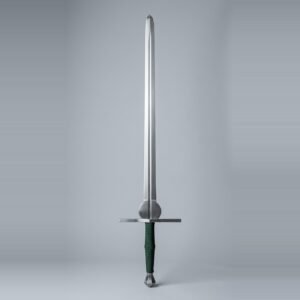
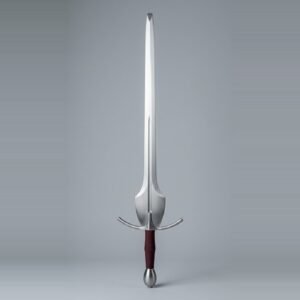
The schilt is the flared widening at the base of the blade, just above the cross. It does two jobs. It protects the hand when the other blade slides down into the bind, and it moves mass toward the hilt so the sword does not handle like a stick. Schilt shapes vary a lot: rounded, shield shaped, triangular, spiky, or on a Meyer feder a broad flat one running down a long ricasso. Some feders have no schilt at all and are sold as schiltless, which is an honest name at least.
The long ricasso
The unsharpened section between the cross and the start of the blade proper. It gives you somewhere safe to put a hand for half swording drills and it lengthens the lever arm without lengthening the striking part of the blade.
The narrow flexible blade
Thin in profile compared with a longsword blade of the same length, and thinner still as it runs to the point. This is where the safety comes from. The blade bends under a thrust instead of transmitting the whole force into a rib.
The widened tip
Rolled, folded back or flared into a knob, and always blunt. Tournament rules are specific about this, which is covered further down.
Feder against blunt longsword
The confusion is understandable, because from ten feet away they look similar. Up close they are built for different jobs.
A blunt longsword is a sword shaped piece with a real profile taper, usually a fuller, an unsharpened edge land of roughly 2 to 3.5 mm and a rounded widened tip. It handles like the historical original because it is shaped like one. That makes it excellent for drilling, pair work, reenactment and preparing for cutting practice.
A feder is a fencing tool. It handles like a longsword in the bind but it is thinner, more flexible and built to take thousands of hard exchanges without being dangerous. Here is the commercially important part: many longsword tournaments will not let a blunt longsword through the gear check at all and accept only purpose built feders or sword shaped feders. If competing is in your plan, that decides the purchase for you. The full comparison of edge geometry sits in blunt against sharp training swords, and HEMA longswords is where the blunts live.
The sub types you will meet
Once you start reading maker pages the vocabulary multiplies. The useful ones:
Standard feder
The default. Medium flex, medium schilt, suitable for general club training and most tournaments depending on the ruleset. If you have no strong opinion, this is the one.
Light or training feder
Softer flex and less mass, aimed at controlled sparring, coaching and drilling with beginners. Pleasant to use and generally not accepted for full contact competition.
Tournament or strong feder
Stiffer, heavier, built for full speed and full force. Stiffer is not better in the abstract. It is better for the specific job of not flexing so much in a hard tournament exchange that the fight becomes unreadable.
Meyer feder
Modelled on the 1570 proportions from Joachim Meyer, with a broad ricasso and a distinctive silhouette. Popular with people working that source directly.
Sword shaped feder
A compromise design with feder safety and flex but a profile much closer to a real longsword, with a subtle schilt rather than an obvious one. Some tournaments that ban blunts accept these, and again, name the ruleset before you assume.
Shorty and hand and a half feder
Shorter blade for smaller fencers, tight training halls and people with shoulder problems. No stigma attached.
Stiff feder for harnischfechten
Minimal flex, for armoured fencing where the blade is not going to be thrusting into an unarmoured target. A different job entirely and not a general purpose choice.
Reading a feder spec sheet
A proper HEMA listing publishes numbers. If it does not, that tells you something. As a reference point, the Regenyei Standard Feder is published with a blade of 100 cm from guard to tip, a weight of 1330 to 1460 g depending on blade strength, a point of balance about 7 cm from the crossguard, a grip of 32 cm including the pommel, a polished cross of 25 cm, a pear pommel and a back folded tip. It is listed from 250 euro excluding VAT with a stated production time of 3 to 5 months.
That last figure is the one to sit with. Three to five months is normal at the top of this market, and several other well known makers are longer or currently not producing. Stock on a shelf is worth a great deal in this category.
What each number is telling you
Blade length sets your measure. Total length and grip length decide whether the sword fits your body. Weight on its own means very little, because a heavy sword with the balance near the hand feels lighter in motion than a light sword with the balance far out. Point of balance is the number that actually predicts how it feels, and around 5 to 8 cm from the cross is the usual band for a longsword feder. Flex is a safety property and is graded in tiers rather than as a single figure.
Flex, very briefly
The market sells flex as named tiers. Light sits around 15 to 21 lb, medium around 25 to 29 lb, strong or tournament from 30 to 43 lb and up, and stiff or no flex is reserved for harnischfechten and buhurt. Those numbers describe the force needed to bend the blade a set amount, so a higher number means a stiffer blade, which is the opposite of what most people assume on first reading. The whole subject has its own guide at feder flex explained.
Tip rules, because they decide entry
Berlin HEMA Cup gear requirements permit spatulated or rolled tips with a minimum diameter of 1.5 cm across all four tournament categories. Rounded tips are explicitly not allowed on rapier and sabre. Longsword blades must have a clearly distinguishable edge, back and flats, which is a quiet way of saying the blade has to be sword shaped rather than a bar. Tip caps are supplied by the tournament and personal ones are not accepted.
That is one event’s rules and other events differ. The habit worth building is to read the gear document for the specific competition before buying anything on the strength of the word tournament. More of this in HEMA tournament gear rules.
Steel, and why it is softer than a cutting blade
Feders are spring steel. 51CrV4 is the common choice, with 6150, 9260 and 1095 also used, hardened to about 49 to 52 HRC. That is intentionally softer than a sharp cutting sword, which runs harder to hold an edge. A feder does not need an edge. It needs to bend hard and come back straight, thousands of times, and a harder heat treat would give you a blade that takes a set or snaps under a bind.
Stainless has no place here at all. It appears on decorative swords because it does not rust and looks bright on a wall, and it is too hard and brittle for anything that gets hit. A stainless training sword is a costume item mislabelled. There is more on steel selection in the steel glossary.
Care, which takes about a minute a week
Wipe the blade after training, because sweat and hand oil are what actually corrodes it. A thin film of oil on the blade and inside the cross is enough. Check the pommel and cross for movement every few sessions and get it tightened if there is any, because a loose hilt gets worse quickly and can fail mid bind. Inspect the edges for burrs after hard sparring and file them flat, since a burr is a sharp edge you did not order. Feders do not ship with a scabbard and never have one, so store yours in a bag or on a rack. General blade care is covered in the care guide.
Club racks full of identical feders are a real problem, and a short engraved line on the ricasso solves it permanently. Names, dates or Elder Futhark all work. That is cut in the United States after arrival and explained on the engraving page.
Where to see these
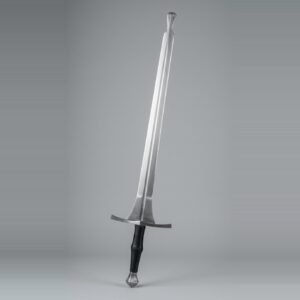
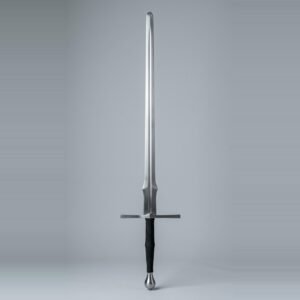
The Vindlaur feder is the plain standard form with a rounded schilt and a scent stopper pommel, which is the shape most clubs expect. The Brimhalt feder carries a shield shaped schilt and a curved cross for anyone who wants more coverage over the hand. For contrast, put either of them next to the Drakvend blunt longsword and the schilt and ricasso stop being abstract ideas. The Valkspire longsword sits between the two with a squared wide ricasso.
Feder questions
Is a feder a real sword?
It is a real training sword and a historical type in its own right, depicted in fencing sources from the sixteenth century onward. It was never a battlefield item. It was purpose built for fencing practice then, exactly as it is now.
Can I cut with a feder?
No, and you should not try. The edge is blunt, the blade is thin and flexible and the heat treat is soft. Cutting practice needs a sharp blade with a stiffer spine, which is a completely separate purchase.
What length feder should I buy?
Most standard feders sit around a 100 cm blade, and that suits most adults. Shorter fencers, low ceilings and shoulder injuries are all good reasons to go shorter. Ask your instructor, because club training space decides this more often than body height does.
Do feders come with a scabbard?
They do not. Neither do montantes, dussacks or wasters. Anyone selling you a feder scabbard is selling you something that has no historical or practical basis. A soft bag or a rack is the normal answer.
Why is the tip so wide?
Because it spreads the force of a thrust across a larger area. A narrow point concentrates everything into one spot on the mask or jacket. Tournament rules set a minimum diameter for exactly this reason, commonly 1.5 cm with a spatulated or rolled shape.
How long does a feder last?
Years with normal club use, and less if you fence hard against stiff blades every week. Blades take a set, develop burrs and eventually crack at the schilt or the ricasso shoulder. Inspect after every hard session and retire anything with a visible crack rather than hoping.
Is a heavier feder better?
No. Heavier feels more solid in the bind and more tiring over a two hour session, and the balance point matters far more than the total weight. A well balanced 1400 g sword handles better than a poorly balanced 1250 g one.
Can I use a feder for reenactment?
You can, but a blunt longsword usually looks and handles closer to the original, which is what reenactment is about. Feders look like what they are, which is fencing gear.
If you are still deciding between a feder, a blunt and something single edged, the comparison is laid out in the first sword guide, and the rest of the writing on this site is indexed in guides.