
A zweihander is a sword too long to be swung from one hand and too long to be drawn from a hip. The name is German and it means exactly what it says, two hander. These were the swords carried at the front of a Landsknecht formation in the sixteenth century, held across the body and worked with the arms rather than the wrist, and they were carried on the shoulder because no belt scabbard will accept a blade of that length.
Both pieces here are 1095 high carbon steel hardened to 54 to 58 HRC. One runs approximately 48 inches overall with a 36 inch stiff diamond section blade, paired steel parrying hooks below the ricasso and a swept crossbar with ring terminals at each end. The other runs 50 inches overall with a 39 inch blade about 5 inches across the flat, cut as a satin polished slab with two lines of Elder Futhark runes down it, and it is built as a display piece rather than a cutting sword. Both include a fitted black scabbard.
Measure your wall before you measure your reach, or take a longsword instead.
Free US shipping
On most pieces. Heavier and oversized ones carry a flat charge.
Hand Forged
Heated, hammered and ground by hand.
Engraving available
Names, dates or Norse runes on most pieces.
Ships from Chicago
Inspected and dispatched from our Chicago warehouse. No import duty, no customs delay on US orders.
Zweihanders
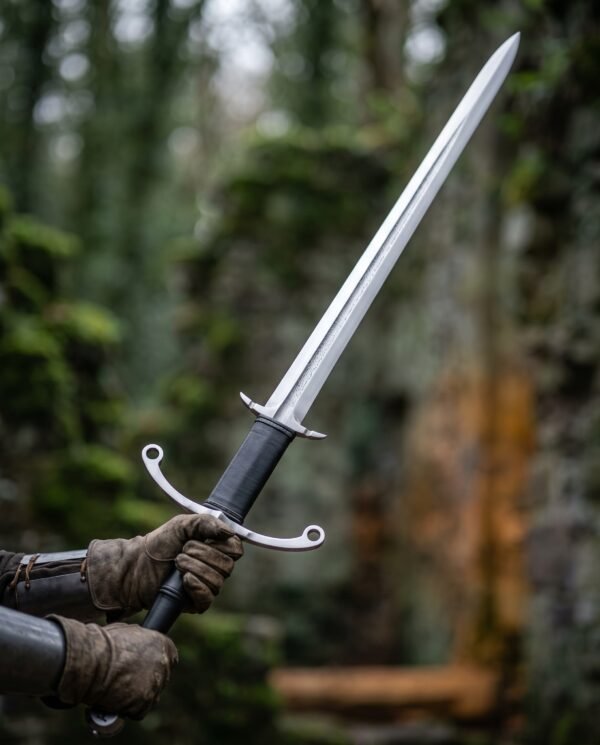
Grimhook Hand Forged Damascus Steel Two Handed Longsword with Parrying Hooks | 48 Inch Overall | Ring Terminal Crossguard and Black Leather Scabbard | Collector Gift | RK-1760
Original price was: $599.00.$509.15Current price is: $509.15.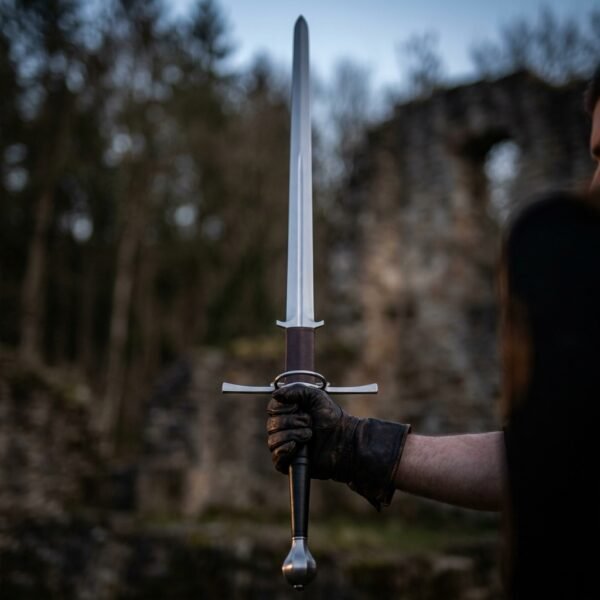
Rundholm Hand Forged 51CrV4 Montante Greatsword with Leather Wrapped Ricasso & Parierhaken | About 66 Inches Overall | Long Two Hand Grip and Free US Shipping | Club Gift | RK-3033
Original price was: $749.00.$636.65Current price is: $636.65.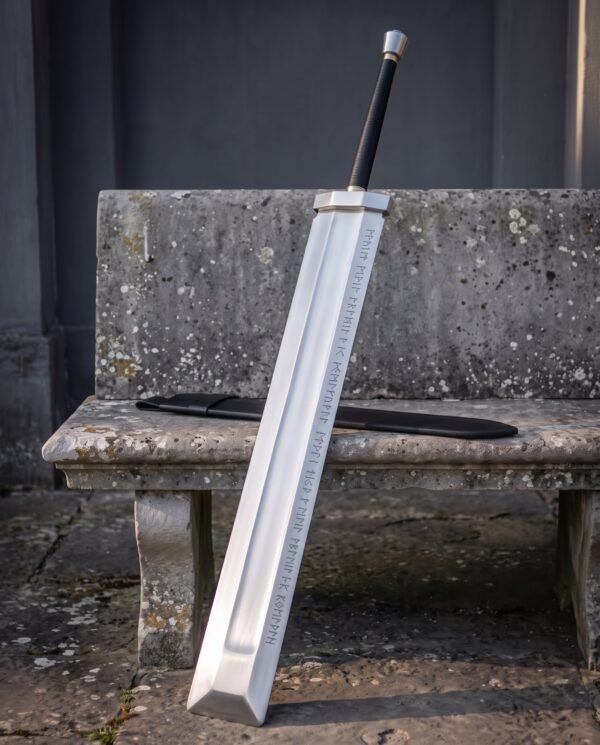
Broadkeel Hand Forged 1095 Steel Fantasy Greatsword | 50 Inch Overall | Slab Sided Blade and Rune Etched Panels with Black Leather Scabbard | Cosplay Display Gift | RK-1946
Original price was: $599.00.$509.15Current price is: $509.15.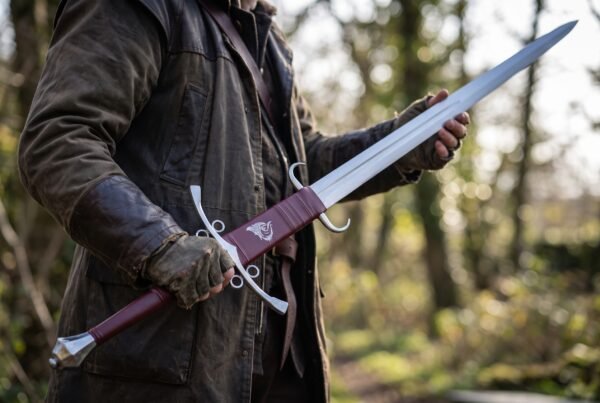
Crimsonring Hand Forged High Carbon Two Handed Side Ring Sword with Raven Stamped Burgundy Leather | Polished Steel Ring Guard and Parrying Hooks | Matching Leather Scabbard | Reenactor Gift | RK-2173
Original price was: $449.00.$381.65Current price is: $381.65.Why anybody built a sword this long
Somewhere past about 45 inches overall, a sword stops behaving like a sword and starts behaving like a short polearm. You cannot draw it from a belt. You cannot use it in a press of bodies. You cannot recover it quickly if the first movement misses. Every one of those is a real disadvantage, and the people who carried these knew it perfectly well, which raises the obvious question of why the things existed at all.
The answer is reach and leverage. A blade of 36 to 39 inches, hung on a grip of 9 or 10 inches, gives you a lever nearly four feet long that you drive with both arms and your hips rather than with a wrist. That produces a swing you cannot easily stop and cannot easily block, and it lets one person control a wide arc of space in front of them. Against a line of pole arms, where the whole point of the formation is that nobody gets close, a person who can sweep the shafts aside from outside the reach of a short sword is doing something nobody else in the field can do.
These were the swords of the Doppelsoldner, the German soldiers of the sixteenth century who drew double pay in exchange for standing at the front of a Landsknecht block. That is the practical context. The other context is ceremonial. A great many surviving examples of this size are parade pieces, carried upright at the front of a procession, never sharpened and never intended for anything but display. Both traditions produced the same silhouette.
The parts that only exist on a sword this size
Two features on this page do not appear on shorter swords, and both are worth understanding before you buy.
The first is the ricasso. On a long two hander the section of blade immediately in front of the guard is left unsharpened, and often left thicker, so that a hand can be placed directly on it. That is not a shortcut in the grinding. It is deliberate, and it effectively lengthens the grip by another handspan when you need to shorten your leverage in close.
The second is the pair of parrying hooks, the parierhaken, fitted as steel lugs a little way up the blade from the guard. They do two jobs. They stop an opposing blade sliding down the ricasso onto your hand, which is the whole reason a hand can safely be there at all, and they act as a second crossguard so the sword has a working guard at both grip positions. Grip the ricasso above the hooks and you are effectively holding a much shorter, much more controllable sword. That technique is halfswording, and the hooks are what make it survivable.
Neither feature is decoration. If you are looking at a long sword with hooks and wondering why they are there, that is the answer.
The swords in this collection
Two pieces, both in 1095 high carbon steel hardened to 54 to 58 HRC, both supplied with a fitted black scabbard. They are built for different purposes and the product pages say so.
The 48 inch two hander with parrying hooks
Approximately 48 inches overall with a blade of approximately 36 inches in a stiff diamond section. A diamond section is a blade with a raised central ridge running its length and the flats sloping away to the edges on both sides, and it is chosen when stiffness matters more than cutting depth. On a blade this long that stiffness is the difference between a sword and a spring.
The guard is a swept steel crossbar with ring terminals at both ends. Paired steel lugs sit below the ricasso as parrying hooks. The grip is approximately 10 inches of black leather over a wood core, sized for two hands with room to move between them. The pommel is a faceted scent stopper, peened over a full tang, which means the tang runs the whole length of the grip and the pommel is hammered over the end of it rather than screwed on.
It ships with a black scabbard fitted with a polished steel chape, built to this blade rather than to a generic size.
The 50 inch greatsword with runed panels
50 inches overall with a 39 inch blade about 5 inches across the flat. This is the wider and more theatrical of the two, and it is honest about that on the product page: it is built as a display and cosplay piece rather than as a cutting sword.
The blade is a satin polished slab with chamfered long edges and a squared bevelled tip, rather than a tapering diamond or a fullered section. Two lines of Elder Futhark runes are etched down the flat. Fittings are a short steel cross and a compact stepped pommel, which keeps the visual weight in the blade instead of balancing it out at the hilt. The grip is a black bound wrap over a timber core with a brass collar, about 9 inches. The scabbard is black leather over a timber core, fitted to the blade.
If you want a piece that photographs enormous and hangs on a wall, this is it. If you want something to take to a cutting stand, it is not.
Lengths, steel and fittings
Every figure below is taken from the specification panel of a piece on this page. These are forged and ground by hand, so read the numbers as what to expect rather than as a guarantee to the millimetre.
| Sword | Steel and hardness | Overall length | Blade | Grip and fittings | Scabbard |
|---|---|---|---|---|---|
| Two hander with parrying hooks | 1095 at 54 to 58 HRC, full tang | About 48 in | About 36 in, stiff diamond section, paired steel lugs below the ricasso | About 10 in black leather over wood, swept crossbar with ring terminals, faceted scent stopper pommel peened over the tang | Black with a polished steel chape |
| Greatsword with runed panels | 1095 at 54 to 58 HRC | 50 in | 39 in, about 5 in across the flat, satin polished slab with chamfered edges and a squared bevelled tip, two etched rune lines | About 9 in black bound wrap over timber with a brass collar, short steel cross, compact stepped pommel | Black leather over a timber core, fitted |
The column that matters most is the fourth one. A stiff diamond section and a wide slab profile are two different objects that happen to be the same length, and they are bought for two different reasons.
Sizing, reach and where it will actually live
Fifty inches is longer than most people picture. It is longer than the average kitchen worktop is deep by a factor of two, and it will not go in a wardrobe upright. Before ordering, measure the wall you intend to hang it on and allow at least six inches of clearance at each end for the mounts. A sword of this size hung on a wall that is too short reads as a mistake from across the room.
For handling, the number to think about is not the overall length but the grip. Ten inches of grip means your hands sit apart rather than together, and that separation is where the control comes from. Hold both hands tight against the guard and a sword this long becomes unmanageable. Slide the lower hand back towards the pommel and it settles.
Neither of these is a beginner's handling sword and neither is a sparring piece. If you are buying a first sword to actually move with, a longsword at around 45 inches or an arming sword is a far more sensible starting point.
Steel and hardness
Both blades are plain 1095 high carbon steel hardened to 54 to 58 HRC. That is the house spec for a sword and it is chosen on purpose. At that hardness the steel is hard enough to hold an edge and take a polish, and soft enough to bend and come back rather than snapping. On a blade of 36 to 39 inches that second property matters far more than the first, because a long blade flexes under its own weight and any hardness pushed much higher turns a flex into a fracture.
1095 is not stainless. It will rust if you leave it wet or fingerprinted, and it will develop a grey patina over years, which is stable and does no harm. The alternative in our range is Damascus of 1095 and 15N20, forge welded and acid etched, hardened to 58 to 60 HRC. That is a different look and slightly better edge retention, and you will find it on the Damascus swords page rather than here.
Both hilts here are assembled with a peened pommel over the tang rather than a threaded nut. Peening is permanent. It cannot loosen the way a threaded pommel can, and it cannot be taken apart for cleaning, which is a fair trade on a piece this size.
Care, rust and storage
Wipe the blade down after every handling session. Skin oil is mildly acidic and a fingerprint left on bare 1095 will etch itself into the polish within days, particularly on a satin finish where it shows. Use a clean cloth, then a light film of oil. Camellia, mineral or any food safe oil works.
Store the sword out of the scabbard if it is going to sit for months. Leather holds moisture against steel, and a blade left sheathed through a humid summer is the most common way a well kept sword ends up spotted. The scabbard is for carrying and for the shelf, not for long term storage.
If orange spotting does appear, it lifts with fine abrasive and oil. Grey patina should be left alone. Our care guide covers the method in detail and it applies to a sword blade exactly as it does to a knife.
Hang it properly. A blade this long needs two mounting points and both need to be into something structural, not into plasterboard alone. Our stands and display mounts page covers the hardware.
Engraving
The flats of both blades and the plain steel of the guards take engraving, done in the US after the sword arrives. Names, dates and Elder Futhark rune lines are the usual requests on a piece of this size, and a long flat is the one surface where a full line of text actually looks right. Text engraving is 19 dollars, a symbol is 39 dollars and a family crest is 49 dollars.
One of the two swords already carries two etched rune lines down the flat, so plan any addition around them. Elder Futhark is a phonetic alphabet rather than a cipher, so a name is transliterated by sound and not letter for letter, and there is no rune for the letter C. Read our guide to the runes first. Engraving is permanent and an engraved piece cannot be returned, so send the exact spelling and check it twice.
Where these come from and how they ship
Ransack Viking is a US company based in Chicago, Illinois. Both swords are forged, ground, fitted and finished by hand in the Czech Republic, then imported, inspected and shipped from Chicago. Engraving is done in the US after arrival.
Expect small differences in grind, polish and leather colour between two swords of the same name. A blade of this length is ground in several passes by a person moving along it, and no two passes are identical. Shipping a 50 inch object costs more than shipping a knife and takes a longer box, which is worth knowing before you compare a sword price against a folder.
How to choose
If what interests you is the historical form, the parrying hooks, the gripped ricasso and the way a Doppelsoldner actually held one of these, take the 48 inch piece with the diamond section blade and the ring terminal guard. It is the closer of the two to a documented sixteenth century type and it is the one that will reward reading about.
If what you want is scale and presence, a blade five inches across with runes down it and a silhouette that fills a wall, take the 50 inch greatsword and take it knowing it is a display piece. It says so on its own page and we would rather repeat it here than argue about it later.
If neither is quite right, the claymores and bastard swords pages sit either side of this one in length.
Browse related categories
- Swords, the full range
- Longswords, the two handed sword at a usable length
- Bastard swords, one hand or two
- Claymores, the Highland answer to the same problem
- Flamberges with wave profiled blades
- Fantasy and film swords
- Sword stands and wall mounts
- Scabbards and sheaths
- HEMA swords, including the montante and the two handed training forms
Guides worth reading first
- How to buy your first sword
- Display sword or battle ready, and what the terms mean
- How to display swords and axes safely
- Full tang and partial tang explained
- Steel and hardness: what an HRC number tells you
Frequently asked questions
What is a zweihander?
A German two handed sword of the sixteenth century, long enough that it has to be worked with both arms and carried on the shoulder rather than drawn from a belt. The name means two hander. They were carried by the Doppelsoldner, the soldiers who drew double pay for standing at the front of a formation.
What are the hooks on the blade for?
They are parrying hooks. They stop an opposing blade sliding down the unsharpened ricasso onto your hand, and they act as a second crossguard when you grip the blade above them. That grip is halfswording, and it turns a very long sword into a short controllable one in close.
Are these sharp?
Both are hand ground and finished. The 48 inch piece with the hooks is built as a functional sword in 1095 at 54 to 58 HRC. The 50 inch greatsword is built as a display and cosplay piece rather than a cutting sword, and its product page states that plainly.
How much wall do I need?
More than most people expect. Allow the full 48 or 50 inches plus at least six inches of clearance at each end for the mounts, and fix both mounting points into something structural rather than into plasterboard alone.
What is a diamond section blade?
A blade with a raised central ridge running its length and the flats sloping away to the edges on both sides. It is chosen for stiffness rather than cutting depth, and on a blade of 36 inches that stiffness is what keeps the sword from behaving like a spring.
Will these rust?
Yes, both are plain 1095 high carbon steel and neither is stainless. Wipe the blade after every handling session, leave a light film of oil on it, and store it out of the scabbard if it will sit for months. Grey patina is stable and harmless. Orange spotting lifts with fine abrasive and oil.
Can I get one engraved?
Yes, on the flats of the blade or the plain steel of the guard, done in the US after it arrives. Text is 19 dollars, a symbol is 39 dollars and a family crest is 49 dollars. Engraving is permanent and an engraved piece cannot be returned, so check the spelling first.
Where are these made?
Ransack Viking is a US company based in Chicago, Illinois. The swords are handmade in the Czech Republic, then imported, inspected and shipped from Chicago, with engraving added in the US after arrival.
Big swords at a HEMA event
A full zweihander is a lot of sword to bring to a sparring night, and most clubs will point you at a HEMA longsword trainer first. Before you enter anything, read the tournament gear rules so the kit check does not end your day early. If you still want the big one, the Rundholm montante greatsword is our 51CrV4 option.
Featured pieces
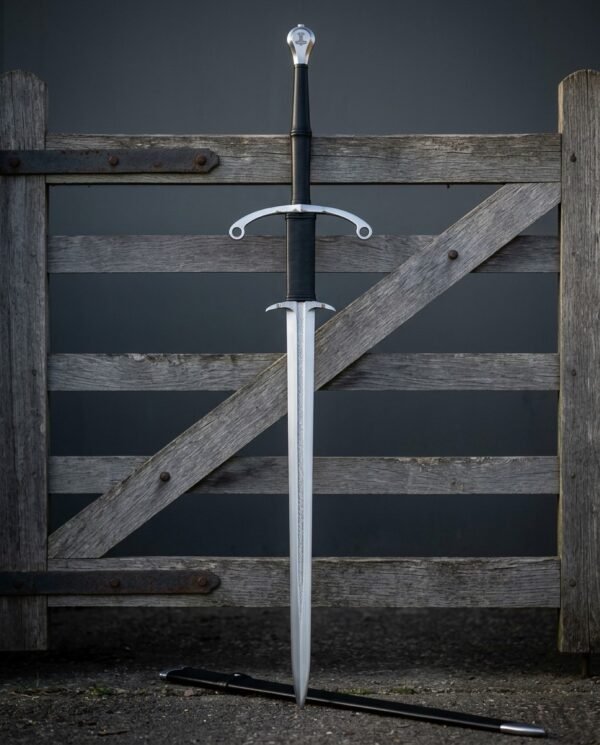 Grimhook Hand Forged Damascus Steel Two Handed Longsword with Parrying Hooks
Original price was: $599.00.$509.15Current price is: $509.15.
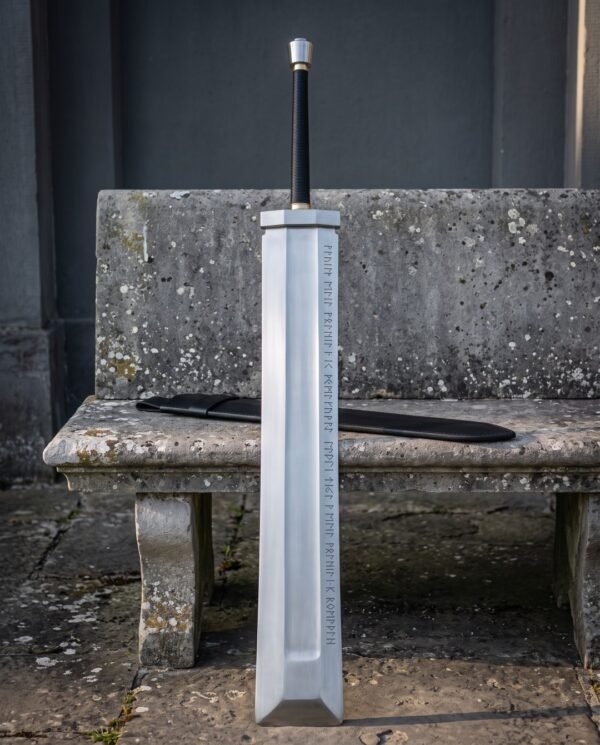 Broadkeel Hand Forged 1095 Steel Fantasy Greatsword
Original price was: $599.00.$509.15Current price is: $509.15.
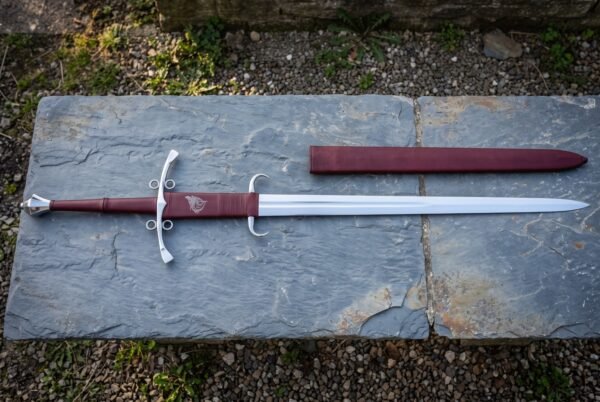 Crimsonring Hand Forged High Carbon Two Handed Side Ring Sword with Raven Stamped Burgundy Leather
Original price was: $449.00.$381.65Current price is: $381.65.
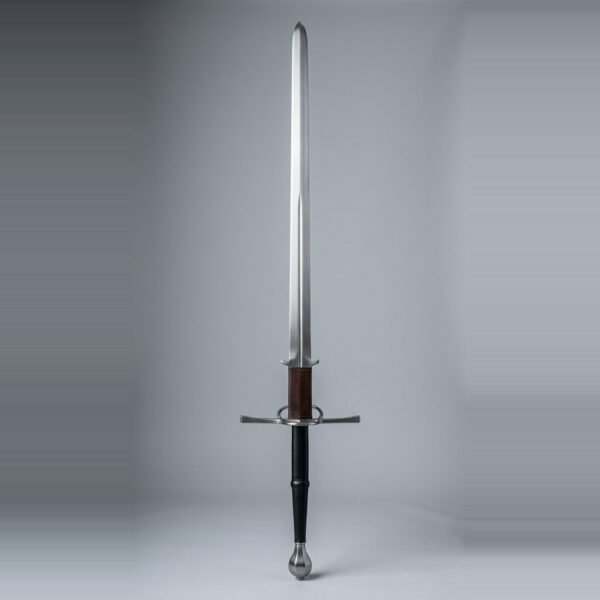 Rundholm Hand Forged 51CrV4 Montante Greatsword with Leather Wrapped Ricasso & Parierhaken
Original price was: $749.00.$636.65Current price is: $636.65.