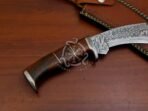
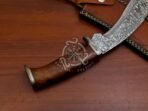
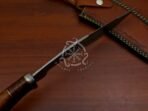
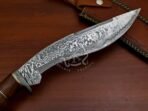
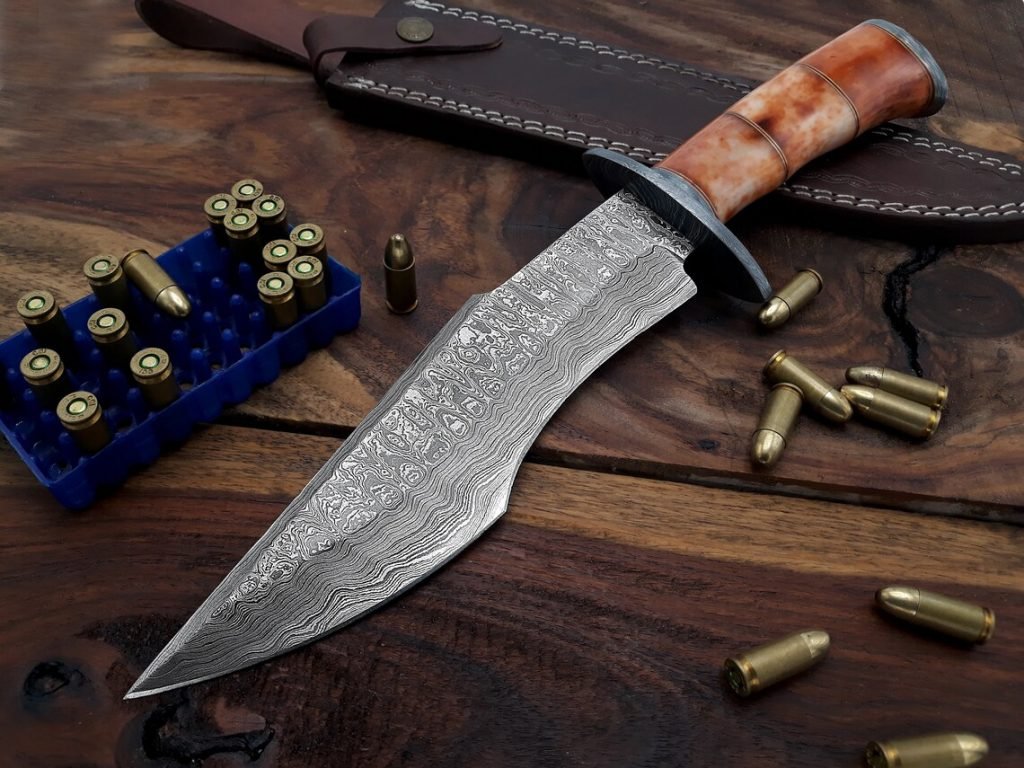
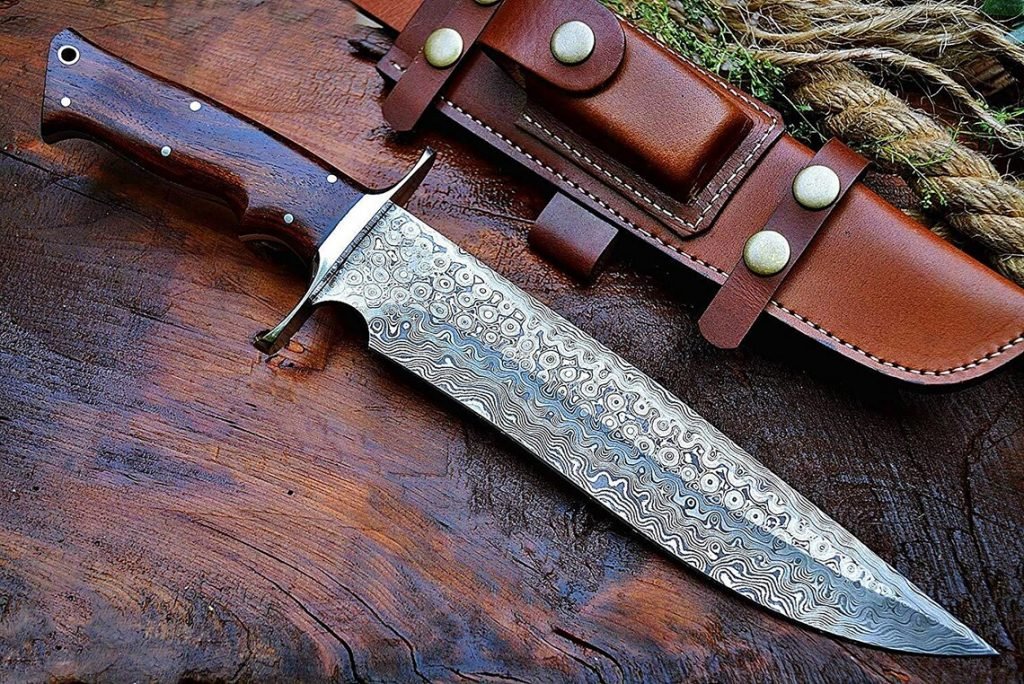
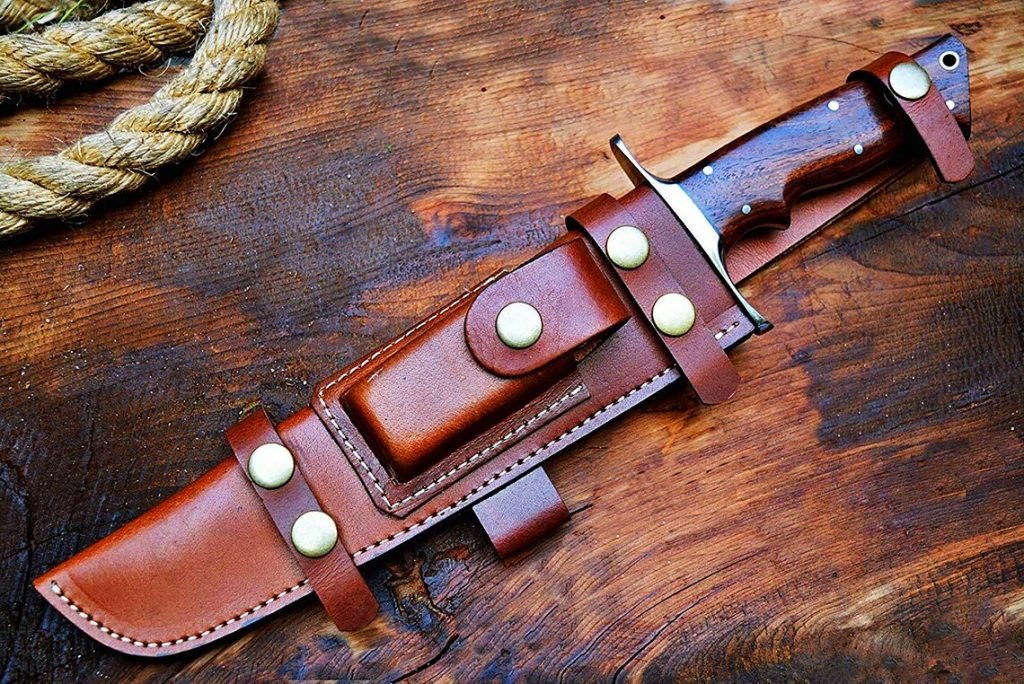
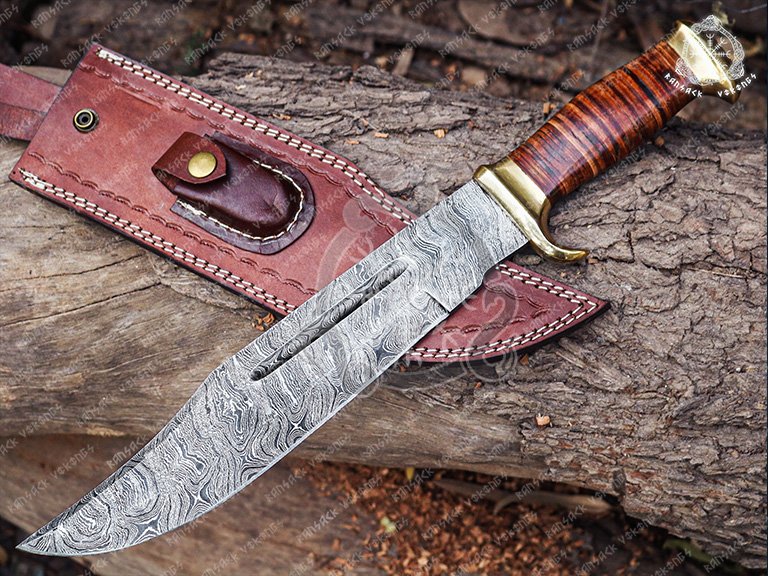
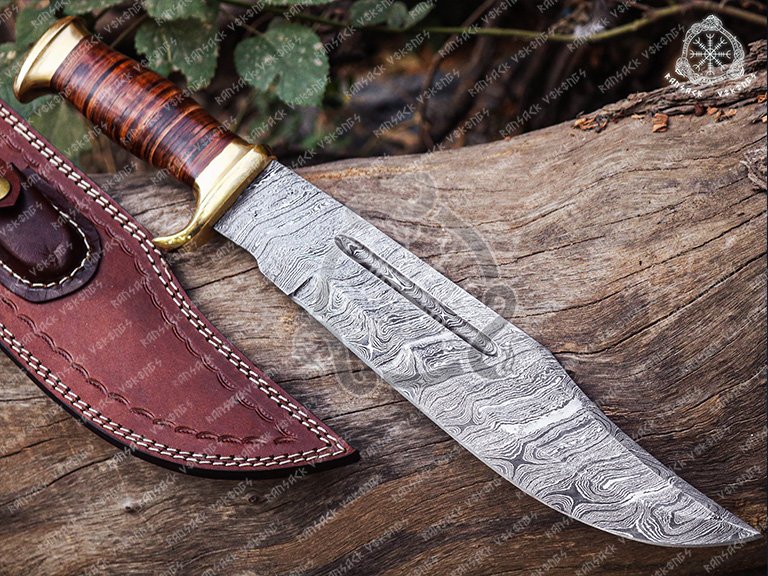
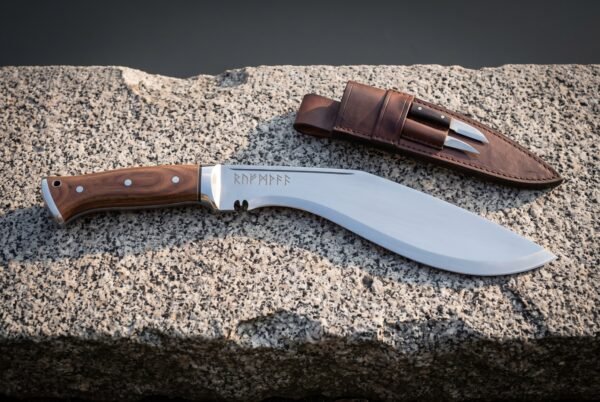
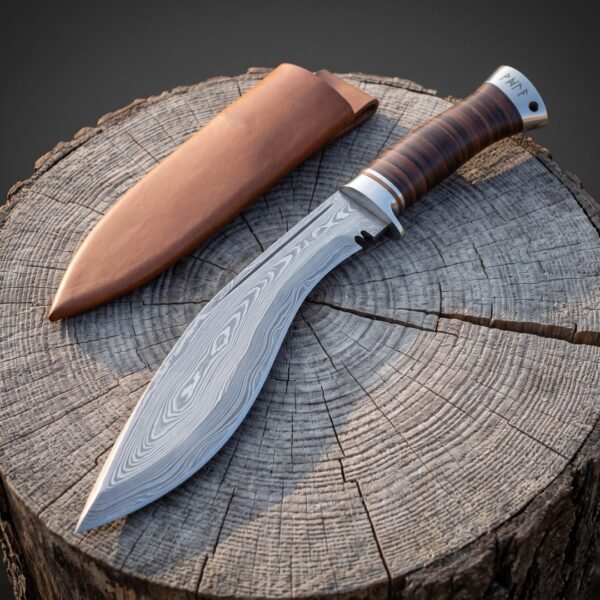
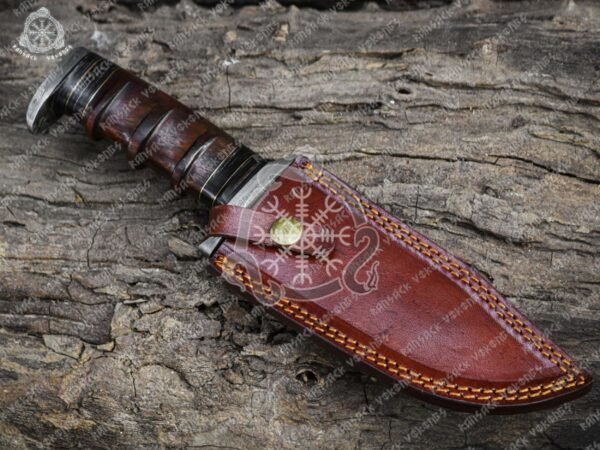
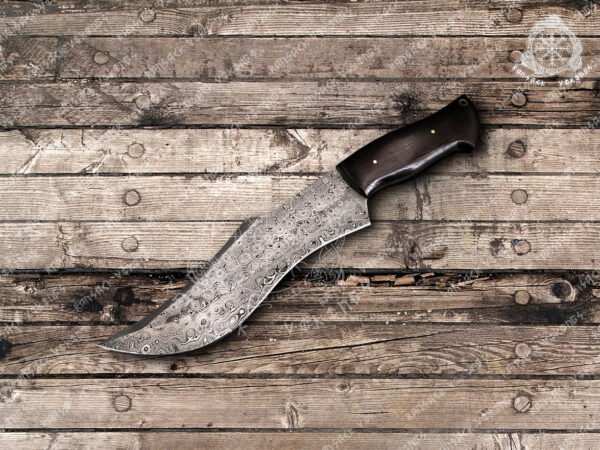
The Gurkhastag was forged, ground and fitted by one pair of hands. Damascus in the blade, stag horn and wood at the grip, hand forged Damascus guard and butt cap, and a kukri that comes out of the shop with the edge already set. It runs 15 inches overall with a 10 inch blade, a 5 inch handle and 4 mm of stock through the spine, which is heavy enough to chop and still light enough to carry. The forward angle is the whole point of the shape, as what a kukri is explains.
The kukri is one of the very few blade shapes still in official military service in more or less its original form. It has been carried by Gurkha regiments in the British and Indian armies for over two hundred years, and in Nepal it is a household tool long before it is a fighting knife: it splits kindling, clears brush, butchers and does the work a machete and a hatchet split between them elsewhere. Look near the base of the blade, just in front of the bolster, and you will find a small notch. That is the cho, and it is not decoration. It stops sap and fluid running back down onto the handle, it gives a stone somewhere to stop when you sharpen, and traditionally it is the mark that identifies a blade as a real khukuri rather than a copy.
Every Gurkhastag is forged and finished in the Czech Republic and ships in a fitted leather sheath, with free shipping inside the United States.
Specifications
| Steel | Hand forged Damascus, 1095 and 15N20 |
|---|
| Hardness | 58 to 60 HRC |
|---|
| Damascus layers | 393 layers |
|---|
| Blade shape | Forward curved kukri |
|---|
| Blade thickness | 4 mm |
|---|
| Overall length | 15 inches |
|---|
| Blade length | 10 inches |
|---|
| Handle length | 5 inches |
|---|
| Handle | Stag horn and wood, Damascus guard and butt cap |
|---|
| Sheath | Leather sheath |
|---|
| SKU | RK-561 |
|---|
Why the kukri is bent forward
The angle is the entire design. A straight knife puts the cutting edge on the same line as your forearm, so when you swing it the force passes straight through and most of the energy goes into moving the blade rather than into the target. Bend the blade forward and two things change at once.
First, the centre of mass moves out past the line of the handle. That is the same trick an axe uses, and it means the heavy part of the blade arrives at the wood travelling faster than your hand is, which is where chopping power actually comes from. Second, the edge now meets the target at an angle rather than square on, so it slices as it bites instead of wedging. Anyone who has used a kukri and a machete on the same green wood knows the difference immediately: the machete glances and the kukri sinks.
The forward bend also gives you three usable zones on one edge. The belly at the front, where the curve is deepest, is the chopping section. The straight section near the handle is the fine work section, where the edge is close to your fingers and you have real control for carving or preparing food. The tip is thinner and finer and is used for detail work and piercing. That is why the kukri survived as a household tool in Nepal rather than becoming purely military.
One honest note on what you are buying. A traditional Nepalese khukuri ships in a scabbard called a dap with two small companion blades tucked behind it, a small utility knife called the karda and an unhardened burnisher called the chakmak. The Gurkhastag is a Damascus interpretation of the pattern, and it ships with the blade and the leather sheath only. If those two companions matter to you, buy a village made Nepalese set instead of this one.
Why Damascus and not stainless
This is forge welded Damascus: 1095 high carbon and 15N20 nickel steel bonded at welding heat, folded, drawn down together and hardened to 58 to 60 HRC. On a chopping blade that hardness is doing real work. A soft stainless edge rolls the first time it hits a knot in seasoned wood, where this holds. 393 layers means the pattern is dense and fine rather than coarse, and because the layers run through the bar the figure follows the curve of the blade rather than sitting flat across it.
What stainless would give you is neglect tolerance, and that is a fair argument for a tool that gets left in a shed. This wants a wipe and a smear of oil instead. The honest comparison is in Damascus versus stainless, and is Damascus steel good answers the underlying question without the marketing.
Stag horn, wood and the Damascus fittings
The grip pairs stag horn with timber, shaped by hand so it fills the palm rather than sitting flat in it. On a chopping blade the handle has a harder job than on any other knife, because every strike sends shock back through the tang. Both stag horn and wood are natural materials with some give in them, and both damp that shock in a way steel and hard resin do not. Stag is also the best wet grip of any handle material we use, which matters when you are working in the rain and the piece weighs what this one does.
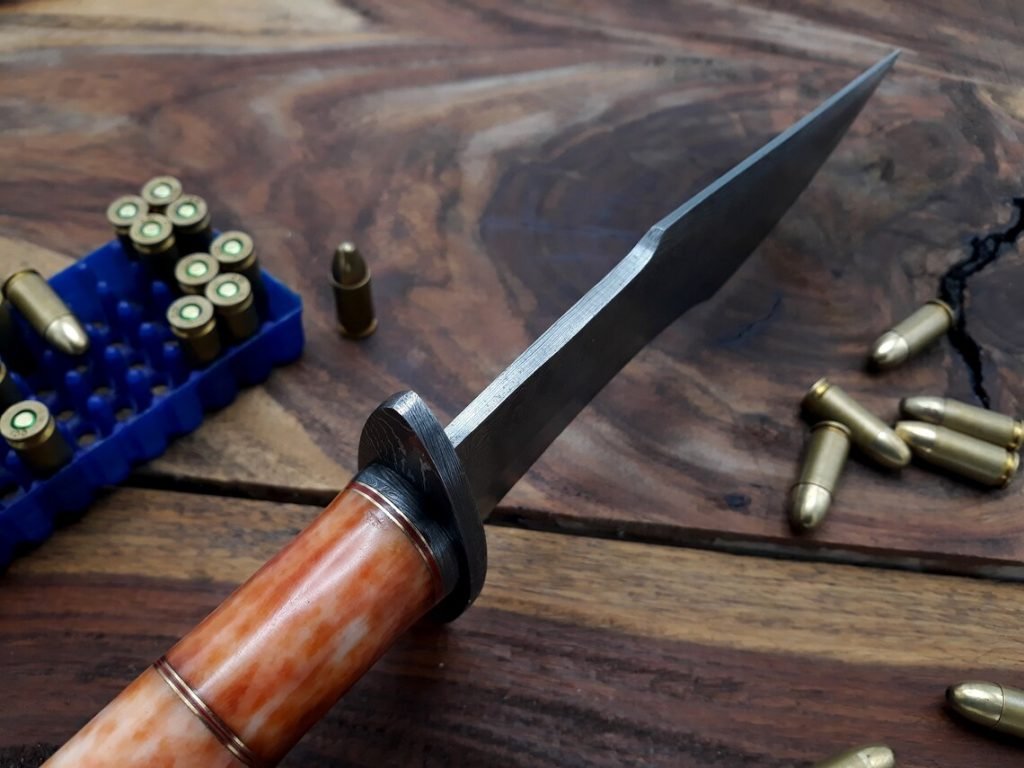
The guard and butt cap are cut from the same Damascus as the blade, so the pattern carries from tip to pommel. The butt cap is not decorative on a kukri: it caps the end of the tang so the handle cannot split off backwards under repeated impact. Care for the horn and the wood is the same routine, a light coat of oil once or twice a year, no long soaking and no radiators. The method is in wooden handle care.
Engraving, runes and your own design
Use the rune converter on this page to turn a name, a date or a short phrase into Elder Futhark and we will cut it into the steel or the handle. If you would rather have a Viking pattern than a rune line, choose your own design in the engraving option above the add to cart button and tell us whether it goes on the blade or the handle. Where a piece already carries an engraved design, your chosen engraving replaces it rather than sitting alongside it. The broad flat of a kukri is the largest single engraving surface in our knife range, so a full name and date sits there without crowding. See the engraving page.
Care and sharpening
Left wet it will spot. Dried and oiled it will look the same in twenty years. Store it out of the leather for long periods, since vegetable tanned leather holds moisture against steel.
Sharpening a kukri is different from sharpening a straight knife and this is where people struggle. You cannot lay the whole edge on a flat stone at once because the edge is curved in two planes. Work it in short sections, moving the blade across the stone as the curve changes, or use a rod or a small pocket stone and take the stone to the blade rather than the other way round. Give the chopping belly a slightly steeper angle than the straight section near the cho, because that is the part that takes impact. Method in steel care and sharpening with a whetstone.
Made in the Czech Republic
The work behind this piece happens in a Czech Republic workshop that has kept to the old methods. Steel is forged and heat treated by hand, the grind is taken down by eye rather than by machine, and the handle, fittings and sheath are cut and finished one at a time. Because of that, every piece carries small marks of the hand that made it.
Ransack Viking is a United States company. We import direct, check each piece when it reaches us, and ship from our Memphis, Tennessee warehouse. Engraving is added here in the United States after arrival, so the piece you receive is finished to your order.
A note on handmade variation
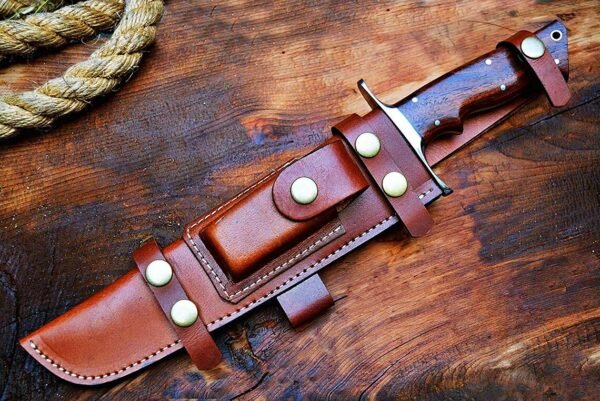
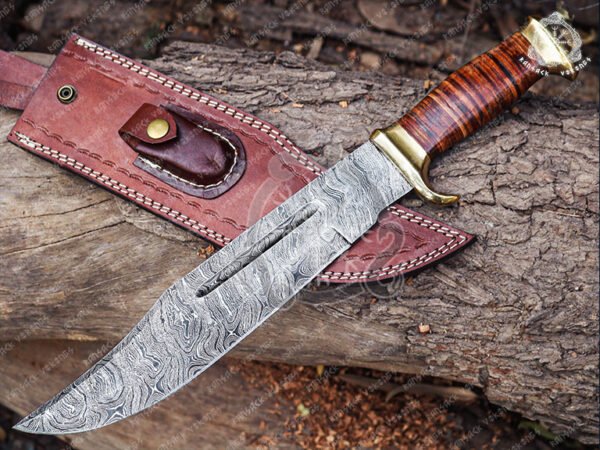
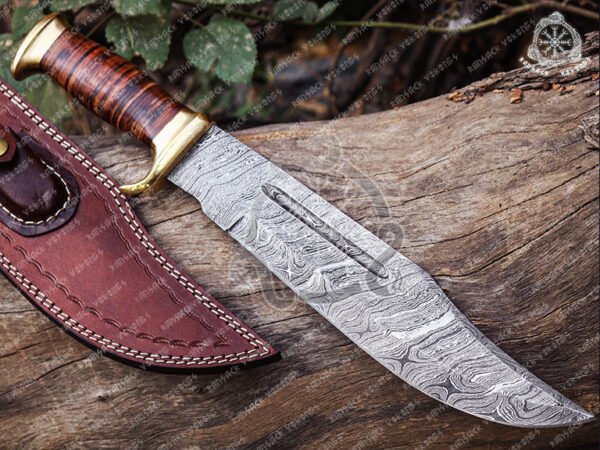
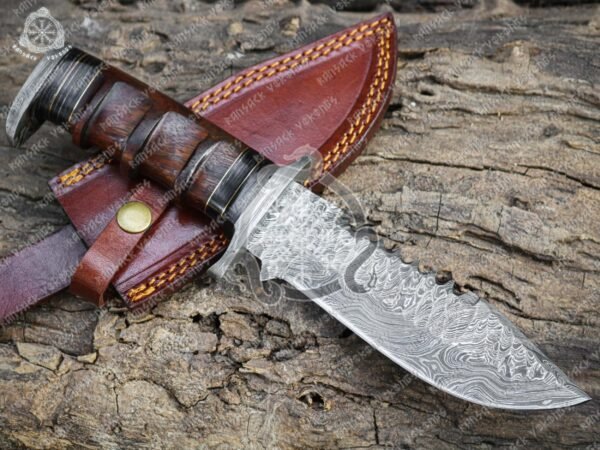
The Gurkhastag is hand forged. It is not machine made and it is not bulk produced, so what arrives will not be a pixel for pixel copy of the photograph. The Damascus figure is different on every blade, the stag horn is marked by the animal it came from, the timber grain belongs to its own tree, and the sweep of the curve shifts by fractions because a person forged and ground it. The dimensions, the steel and the build are the same every time. The character is not.
Frequently asked questions
What is the small notch near the handle for
That is the cho. It stops fluid running back onto the grip, it gives your stone a stopping point when sharpening, and on a traditional khukuri it is the maker mark that identifies a genuine blade.
Can I use it as a machete on green brush
Yes, and it will outperform a machete of the same length on anything thicker than a stem. On thin whippy growth a long machete is faster, because reach matters more than mass there.
Does it come with the two small companion knives
No. This ships as the blade and the fitted leather sheath. The karda and chakmak belong to traditional Nepalese sets and are not part of this piece.
Is 4 mm thick enough for chopping
Yes, because the curve and the forward mass do the work rather than sheer bulk. A thicker spine would add weight in the hand without adding much to the cut.
How do I sharpen a curved edge without a special stone
Move the blade across a bench stone in short overlapping sections so the contact point tracks the curve, or hold the blade still and run a small stone along it. Do not try to sweep the whole edge in one pass.
Is it safe to hand this to someone as a gift
It ships sharp and in its sheath. If it is a gift, say so in the order notes and we will pack it accordingly and cut any engraving before it goes out.
What is in the box
- One Gurkhastag Damascus kukri knife
- Fitted leather sheath
- Protective packaging
- Forged and finished in the Czech Republic
Explore the range
Compare it with the heavy blades in Bowie Knives, the field knives in Hunting Knives, the chopping tools in Camping Axes and Hatchets and the Norse pieces in Viking Knives. Background reading sits in the guides.

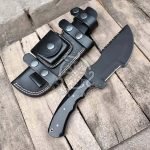
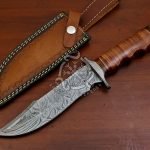


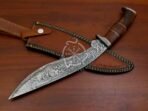

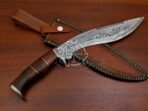






My whole family was impressed when I unboxed it. It’s handmade in the Czech Republic but ships from a US warehouse so it arrived quicker than I expected. Fit and finish is museum quality. You can tell real craftsmen made this by hand. Highly recommend this one.
This knife is well made. Just a couple small things kept it from 5 stars. Second time ordering from Ransack Viking and still happy overall.
Showed up right on time and looked even better than the photos. Leather sheath is thick and well stitched. Not the cheap stuff you usually get. Already telling my friends to check this out.
Solid knife. Glad I ordered it. Wood handle looks great though it’s a little smaller than I imagined. Still very happy with it and would recommend.
My whole family was impressed when I unboxed it. Highly recommend this one.