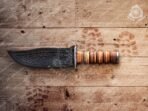
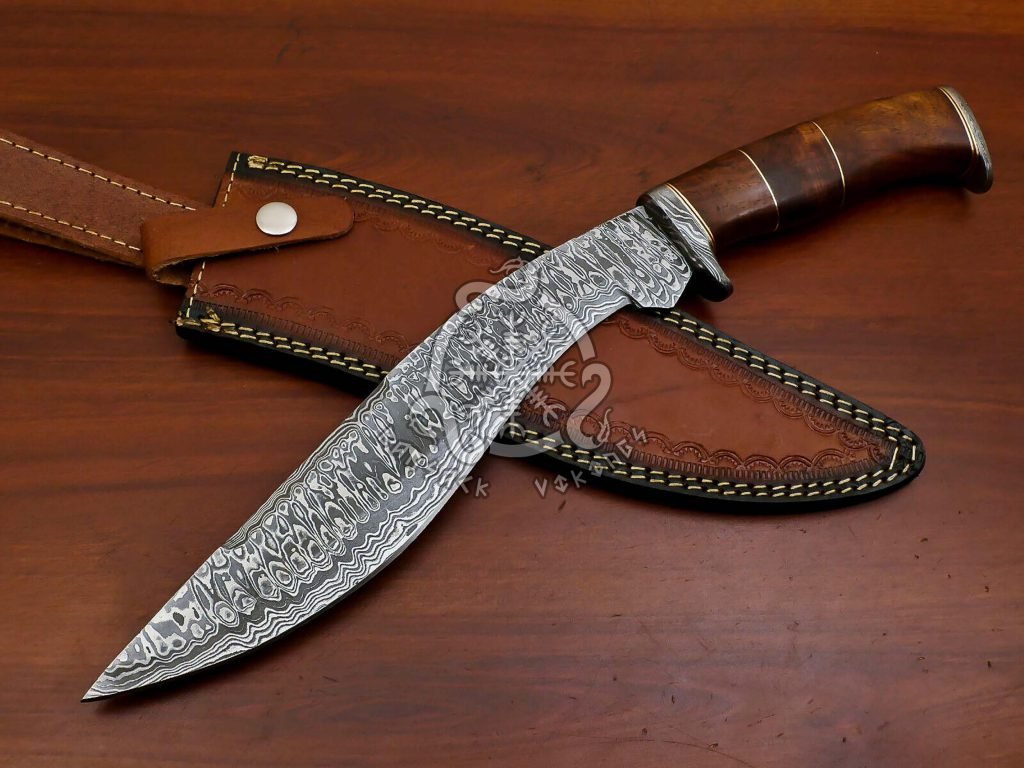
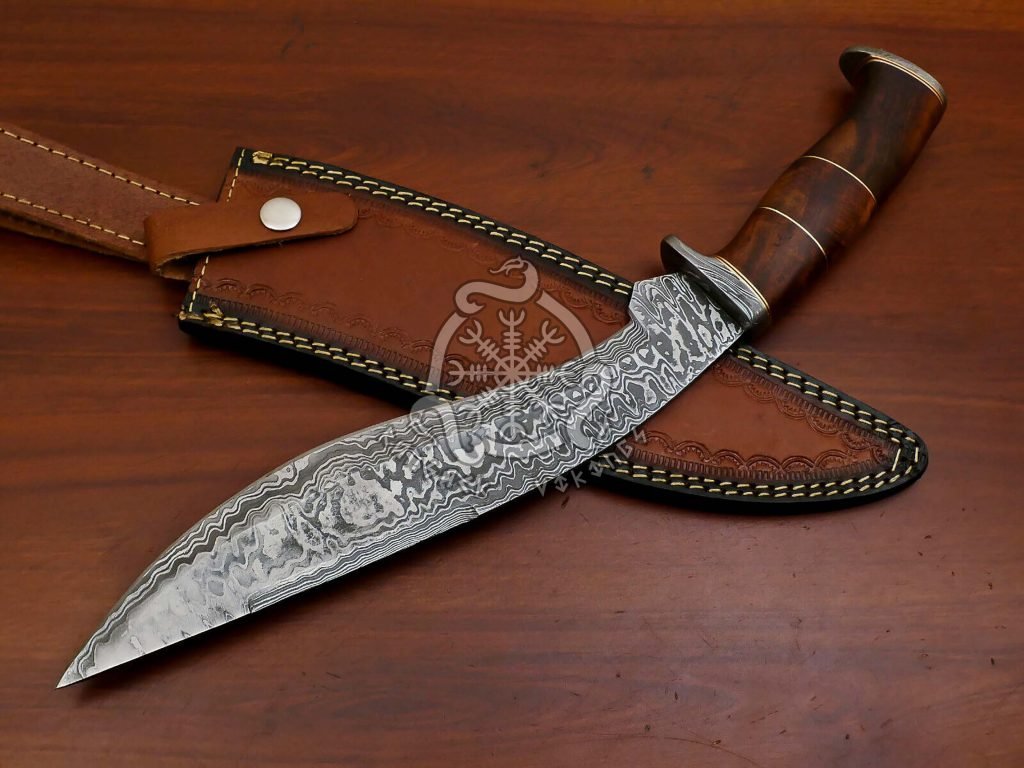
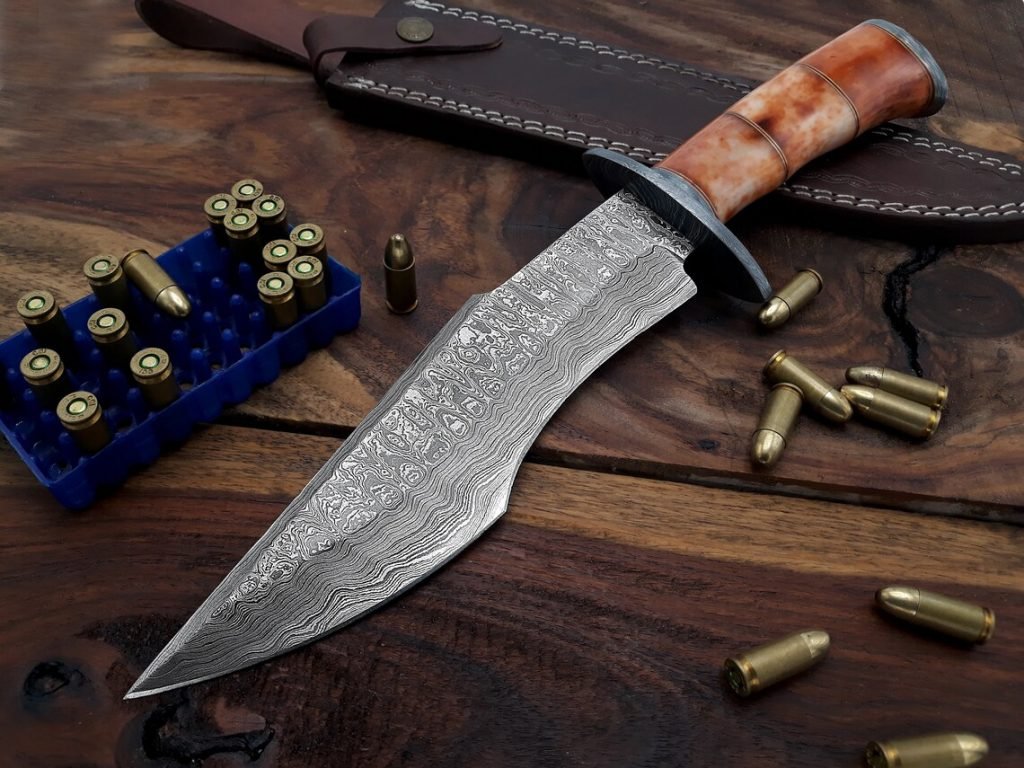
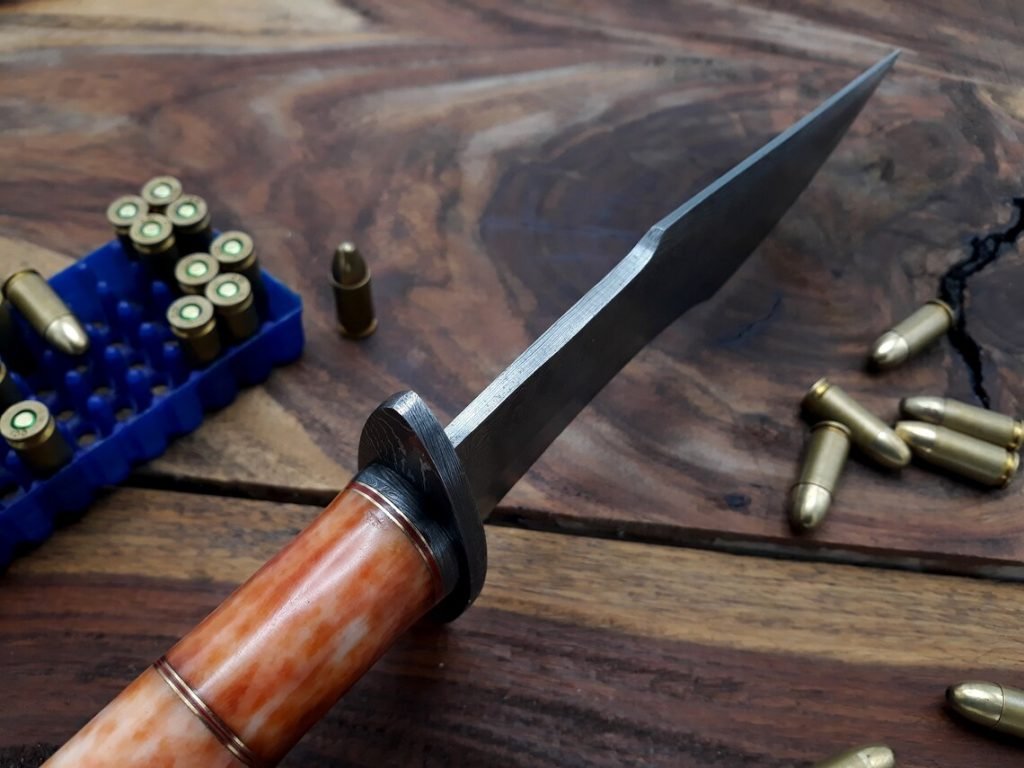
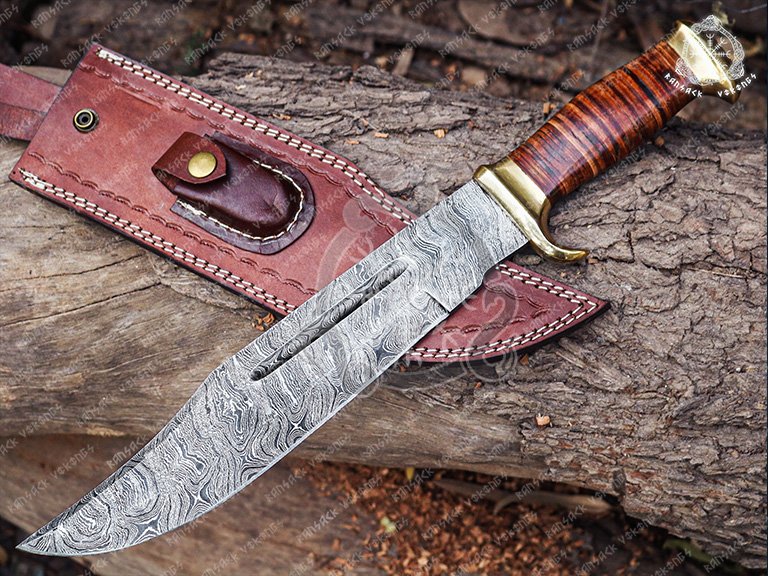
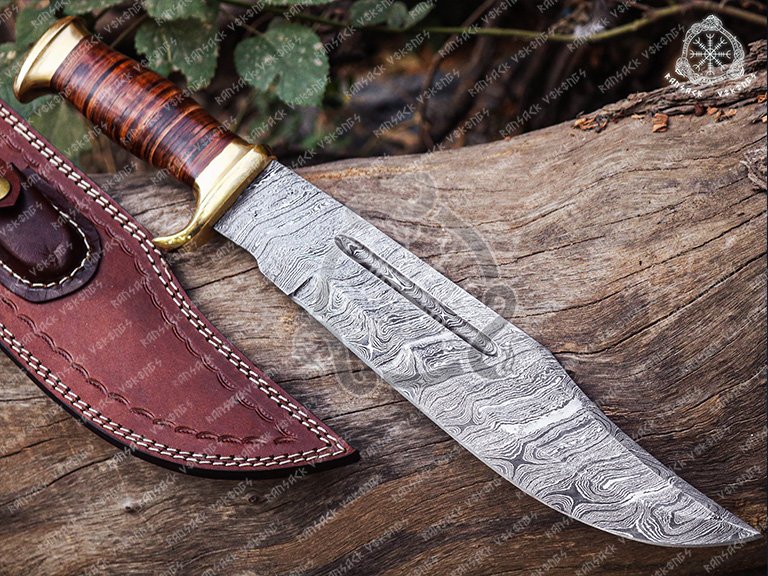
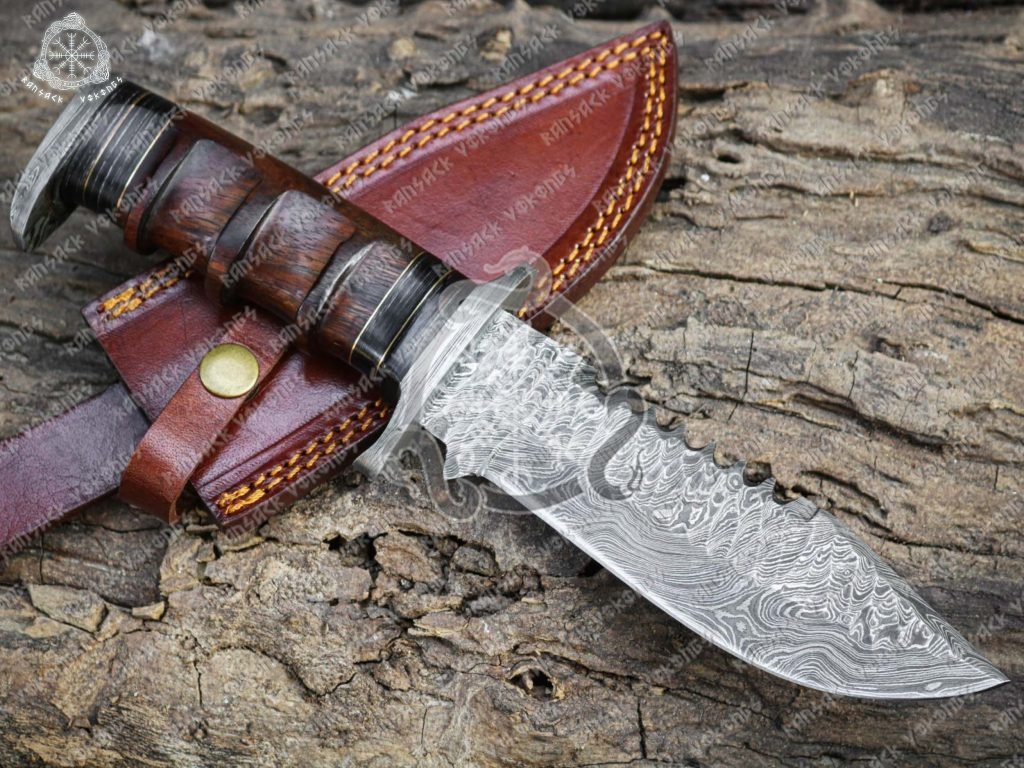
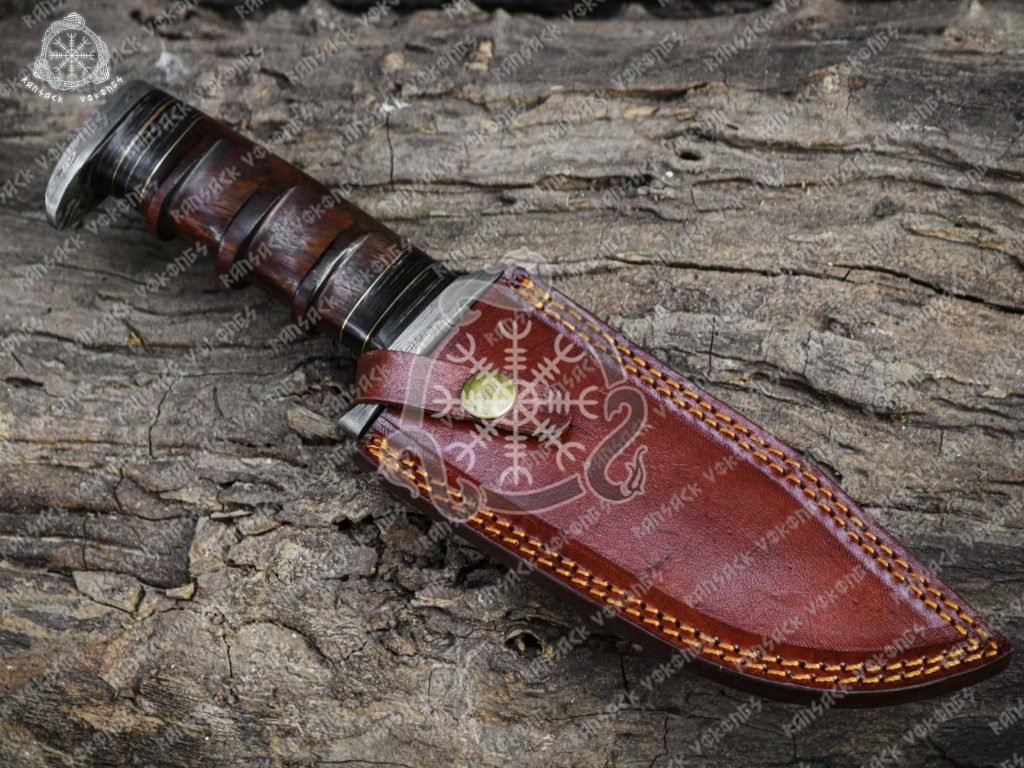
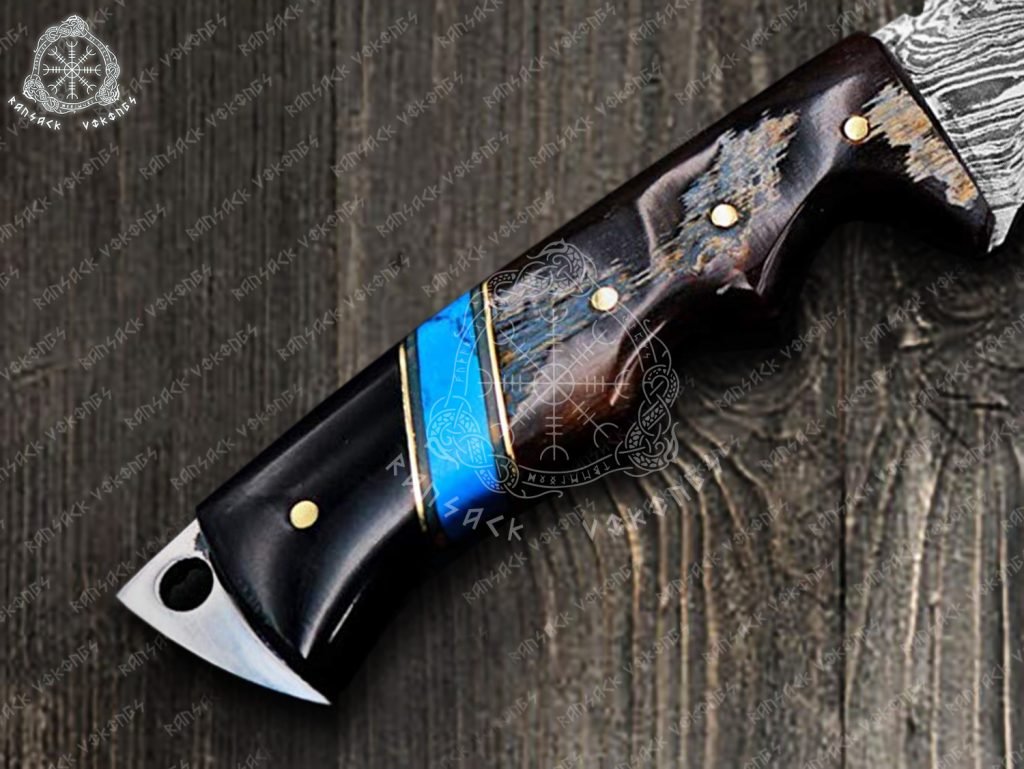
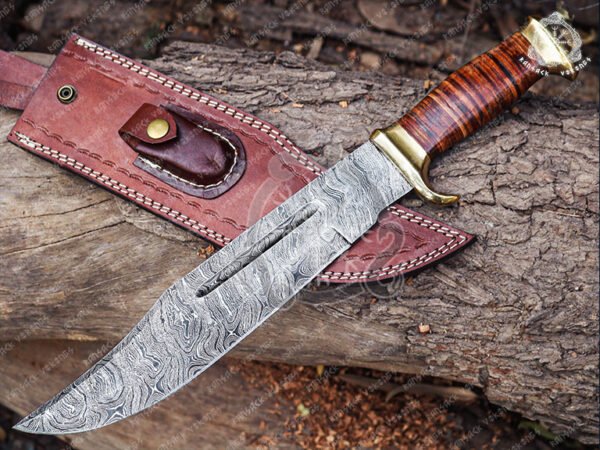
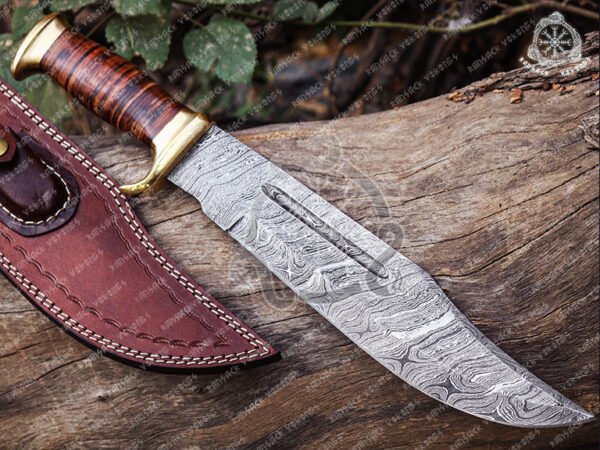
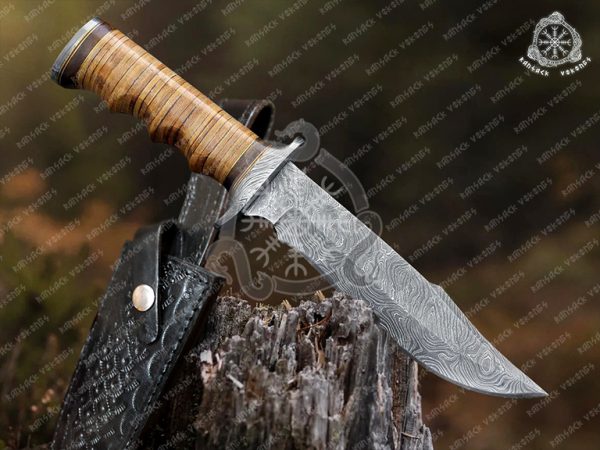
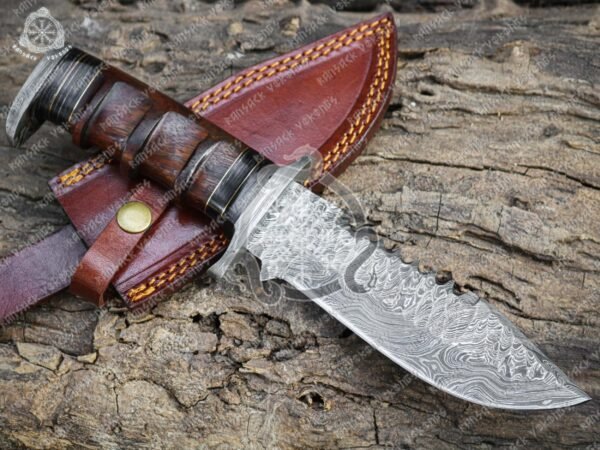
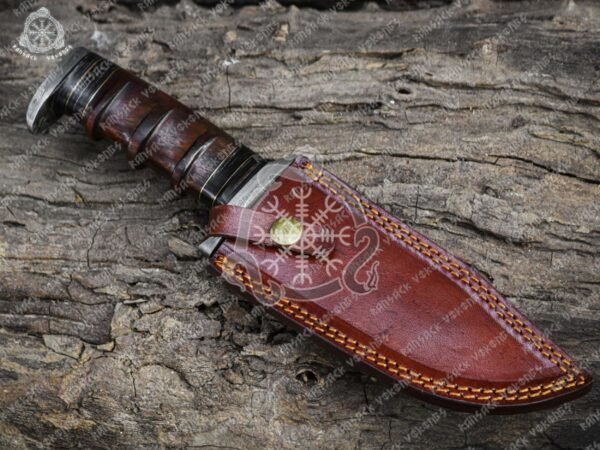
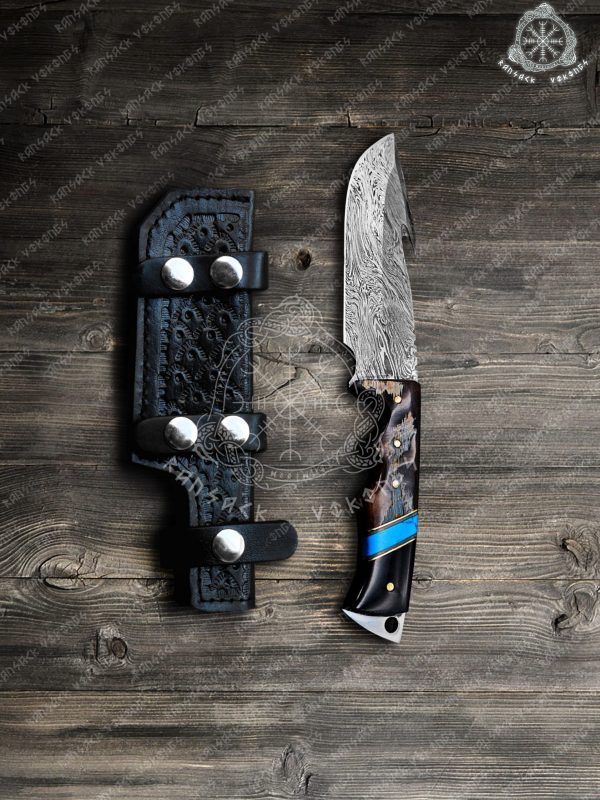
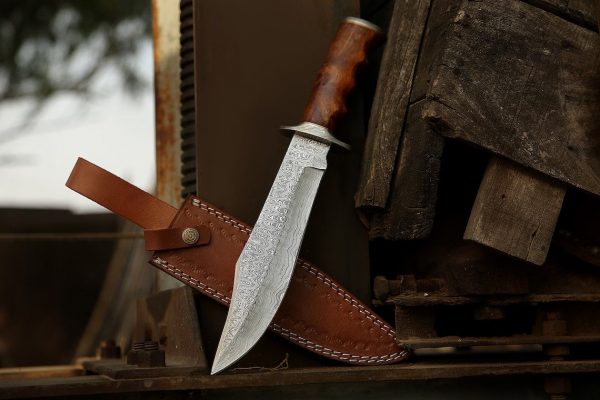
Gutwarden is a hand forged Damascus gut hook knife, 12 inches overall with a 7 inch blade and a 5 inch stacked leather handle. The billet is forge welded from 1095 and 15N20 and worked into a fire pattern, the hook is cut and sharpened on the inside curve, and the handle is built from roughly 150 to 200 separate leather washers stacked, bonded and then turned down to shape. If you have not used a gut hook before, what a gut hook is for explains what it is for.
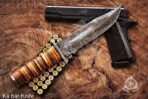
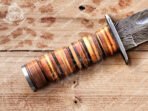
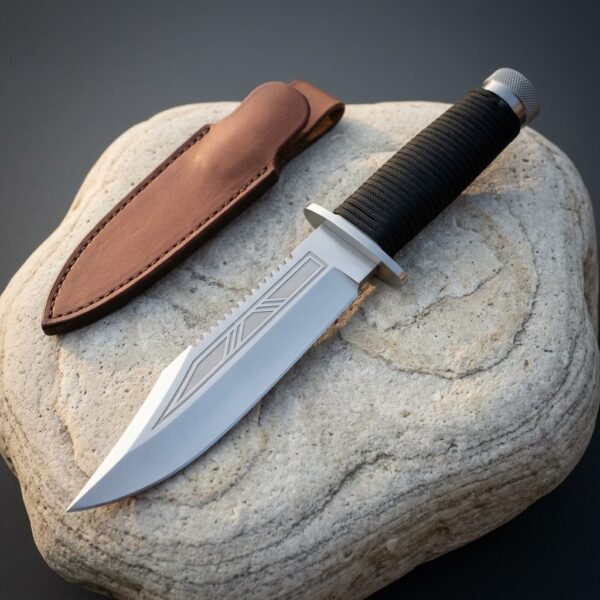
That stacked leather grip has a longer history than most people realise. It became the standard on American fighting and hunting knives in the 1940s, when the United States Marine Corps adopted a fighting utility knife built the same way, and it stuck because it does something no synthetic does. Leather compresses very slightly under the hand, which means the grip is quiet, warm in cold weather and does not turn slick when it gets wet with sweat or blood. It also takes an oil finish that darkens rather than peels. If you have been searching for a Damascus KA BAR knife and landing on this page, the handle is why.
The knife is forged, ground, handled and sheathed in the Czech Republic. It ships with a fitted cowhide leather sheath, free within the United States, with the edge already set and ready to work.
Specifications
| Steel | Hand forged Damascus, 1095 and 15N20 forge welded |
|---|
| Hardness | 58 to 60 HRC |
|---|
| Pattern | Fire pattern Damascus |
|---|
| Overall length | 12 inches |
|---|
| Blade length | 7 inches |
|---|
| Handle length | 5 inches |
|---|
| Weight | 13.5 oz |
|---|
| Handle | Stacked leather, 150 to 200 washers bonded and turned |
|---|
| Sheath | Cowhide leather sheath included |
|---|
| SKU | RK-365 |
|---|
What a gut hook knife is actually for
The small hook cut into the spine is the reason this knife exists, and it is widely misunderstood. It is not a second point and it is not for gutting in the sense of stabbing. The cutting edge sits on the inside of the curve, and the rounded outer nose of the hook is deliberately blunt. In use you make one short entry cut through the hide, slide the blunt nose of the hook under the skin so it rides against the underside of the hide, then pull towards you. The hide is cut from the inside outwards.
Two things follow from that. The first is that the paunch stays intact. A knife point pushed into an abdominal cavity finds the stomach and the intestine sooner or later, and once they are opened the meat is compromised and the job gets unpleasant. The blunt nose of a gut hook physically cannot do that, because it rides on the hide and pushes the viscera down and away. The second is that hair is not dragged into the cut. A straight blade run edge down through hide pulls hair in with it. A hook cutting outwards pushes it out.
The rest of the year the hook earns its keep on rope, twine, baling wire wraps, packaging strap and seat belts, all of which it cuts faster than the main edge because the material is drawn into the curve rather than being pushed away from a flat edge. The 7 inch main blade behind it is a full working length, so the knife is not a specialist you have to carry alongside something else.
Why Damascus and not stainless
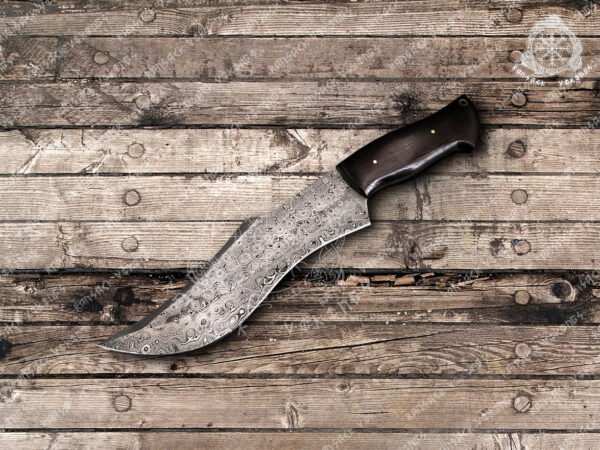
This blade is pattern welded from 1095 high carbon steel and 15N20, a nickel bearing steel, forge welded into a single billet and then folded and drawn out. The two steels are chosen because they harden compatibly and because they react differently to acid etching, which is what makes the light and dark bands you can see. The pattern runs through the full thickness of the steel. It is not printed, not laser marked and not a coating, and it cannot wear off with sharpening.
Run at 58 to 60 HRC this holds a working edge considerably longer than a soft stainless blade and takes a finer edge off the stone. The cost is that it is high carbon steel underneath the pattern and it will rust if you leave it wet, which is a fair trade for anyone who cleans a knife after using it and not a fair trade for anyone who will not. The full comparison, including where stainless genuinely wins, is in Damascus versus stainless. If you want the deeper background on the billet itself, read what Damascus steel is.
The stacked leather handle
Each washer is punched, threaded onto the tang, bonded to its neighbours and compressed, and only then is the whole stack turned, sanded and finished as one piece. That is why the grip has no seams to catch and no scale to work loose. Under the hand it warms in seconds and gives a small amount, which is what makes a leather stack comfortable through a long session where a hard handle raises a hot spot.
Care is simple and it is not the same as caring for wood. Keep it out of standing water, do not put it anywhere near a dishwasher or a radiator, and feed it two or three times a year with a leather conditioner or a light coat of neatsfoot or mineral oil, worked in with your fingers and buffed off. Dried out leather shrinks and crazes. Fed leather darkens and lasts decades. The same routine applies to the sheath, and that is covered in leather sheath care.
Engraving, runes and your own design
Use the rune converter on this page to turn a name, a date or a short phrase into Elder Futhark and we will cut it into the steel or the handle. If you would rather have a Viking pattern than a rune line, choose your own design in the engraving option above the add to cart button and tell us whether it goes on the blade or the handle. Where a piece already carries an engraved design, your chosen engraving replaces it rather than sitting alongside it. On this knife the flat behind the hook takes a short line cleanly, and the leather stack can be branded or cut with initials. Full detail on placement and lettering is on the engraving page.
Care and sharpening
The main edge sharpens like any carbon steel blade, on a stone with light pressure and a consistent angle. The hook is the part people get wrong. Do not attempt it on a flat stone. Use a round ceramic rod, a small round diamond file or a chainsaw file that fits the inside radius, work only on the inside curve, and leave the outer nose blunt. A few strokes is usually all it needs, because the hook cuts material that is drawn into it and dulls slowly.
After use, wash, dry properly and put a thin film of mineral or camellia oil on the blade. Do not store the knife in the sheath for months at a time, because leather holds moisture against steel. A grey patina will build up and that is a good thing. Orange rust is not, and it comes off with a soft abrasive and oil before it pits. Full method in steel care and the angle work in sharpening with a whetstone.
Made in the Czech Republic
This is a handmade piece from the Czech Republic, made in a workshop that still forges, grinds and finishes by hand instead of stamping parts out. The smiths there have kept the older way of working, and the wood, horn and leather are shaped and fitted by hand as well. Two pieces of the same design will never be identical, and that is part of what you are buying.
Ransack Viking is a United States company. We handle the import ourselves, look over every piece when it lands and ship from our warehouse in North Babylon, New York. Engraving is done in the United States after the piece arrives, so your design goes on before we send it out.
A note on handmade variation
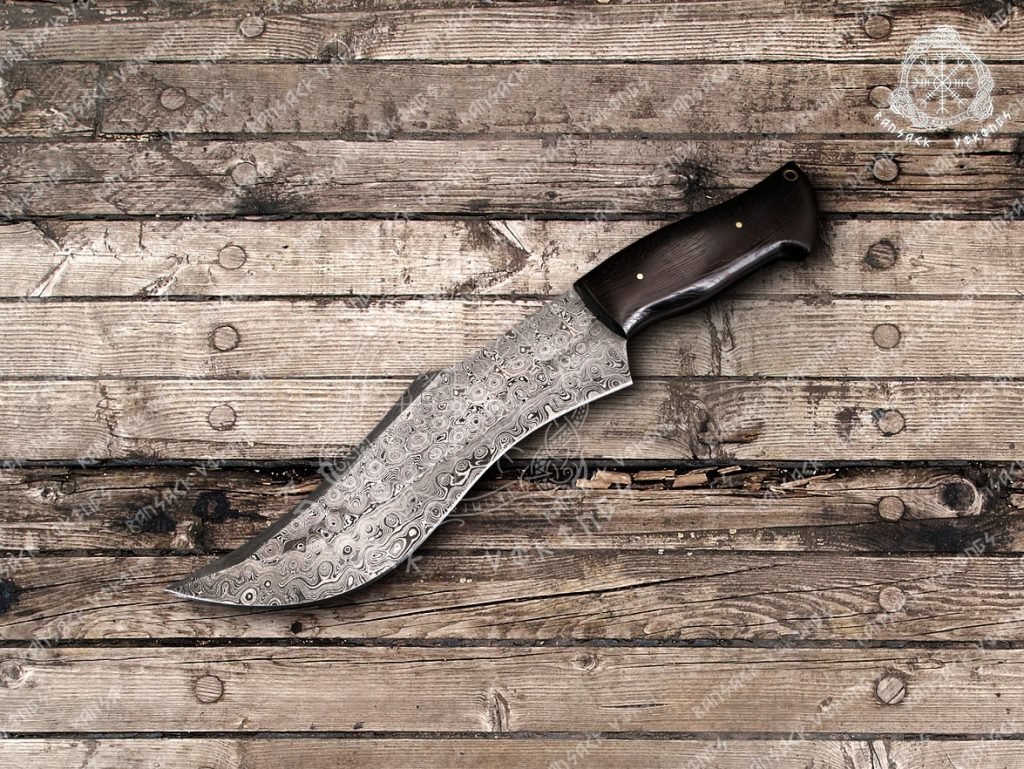
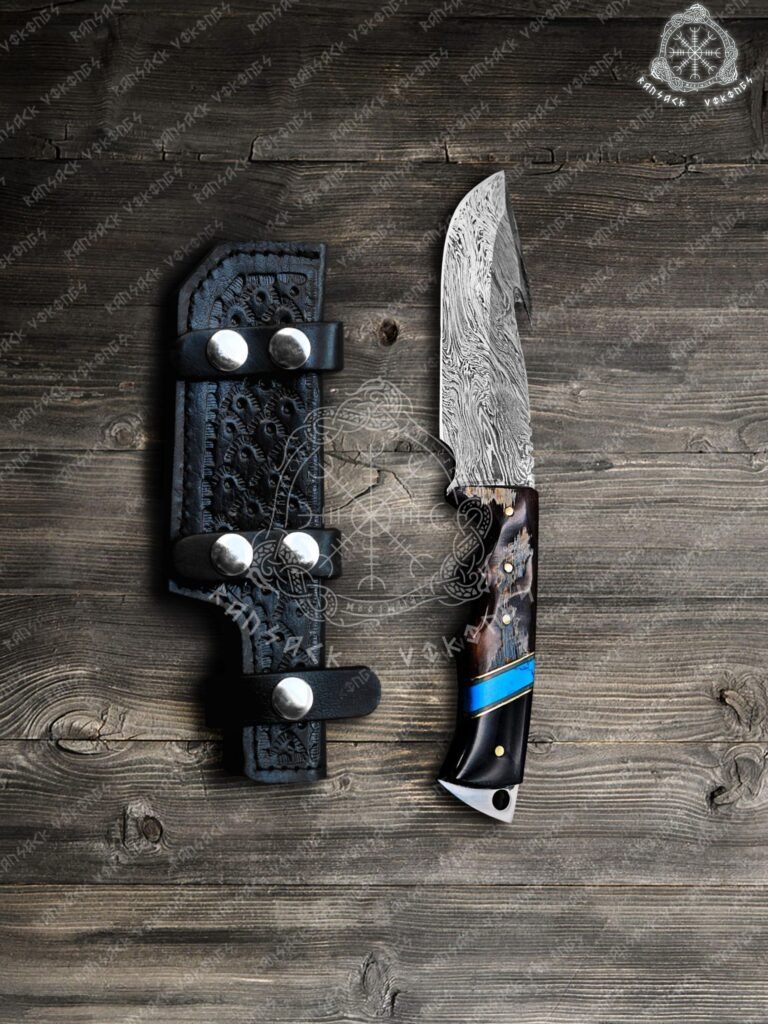
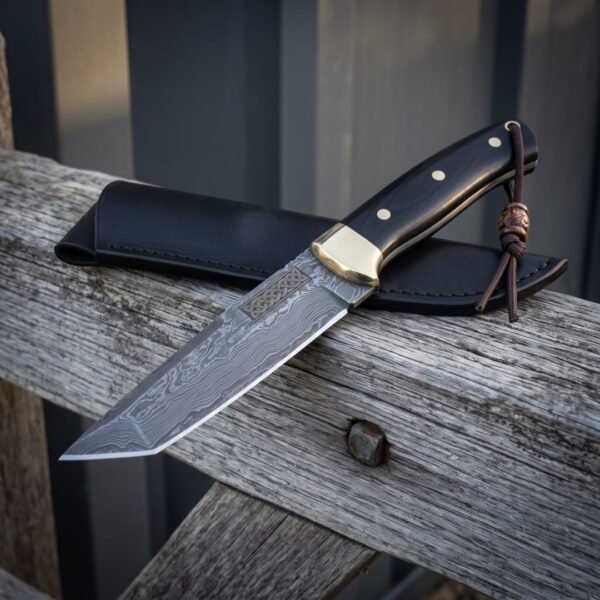
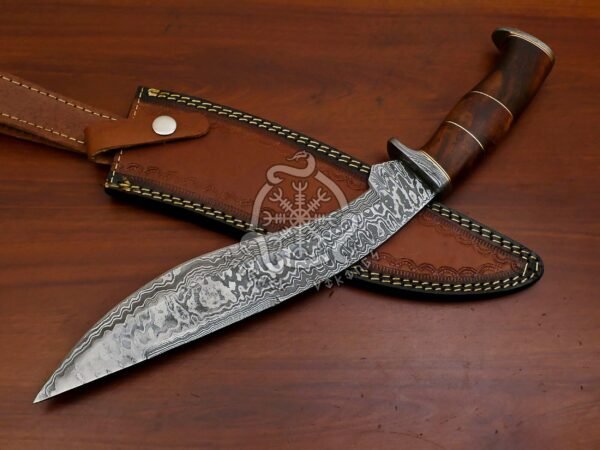
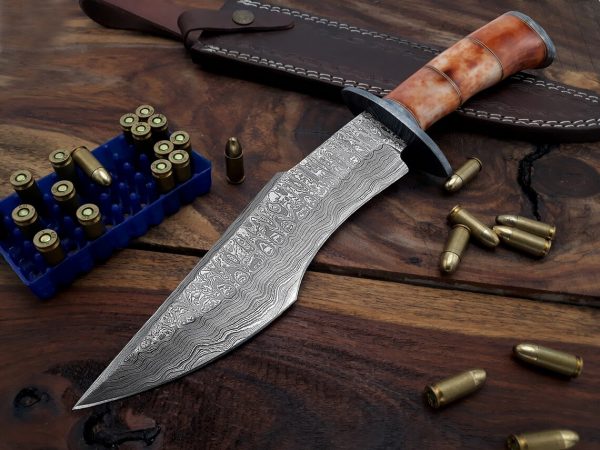
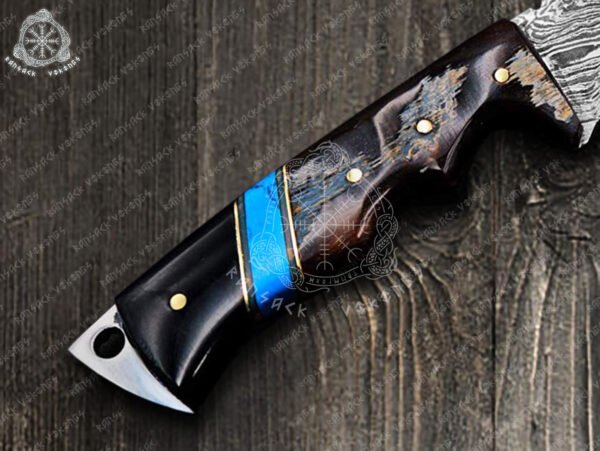
This is a hand forged knife, not a machine made or bulk produced one, so the knife that arrives will not be a pixel for pixel copy of the photograph. The fire pattern is drawn out of the billet by hand and no two billets move the same way, so the swirl and the density of the layers differ from one blade to the next. The leather washers come from a natural hide and take the finish at their own rate, so the colour of the stack can run from mid tan to a deep brown. The grind lines and the exact sweep of the hook shift by a fraction because they are cut by eye.
The dimensions are the same every time, the steel is the same every time and the build is the same every time. The character is the part that is not, and that is what you are buying when you buy from a forge.
Frequently asked questions
Is the knife sharp when it arrives?
Yes. The main edge and the inside of the hook are both sharpened before the knife is boxed, and it will field dress an animal the day it arrives.
How does this compare with a Damascus KA BAR knife?
The handle construction is the same idea, a stacked leather grip turned as one piece, and the blade length is in the same class. The differences are that this blade is forge welded Damascus rather than a single stainless or carbon bar, and that the spine carries a gut hook, so it is set up for field dressing rather than for general fighting utility work.
Is it full tang?
The tang runs the full length of the handle and the leather washers are stacked onto it, which is how a leather stacked handle is built. It is a through tang construction, not a short stub pinned into a block.
How do I sharpen the gut hook?
With a round file or a ceramic rod that matches the inside radius, working only on the inner curve. Never take a flat stone to it and never sharpen the outer nose, because the nose is meant to be blunt so it can ride under hide.
Will the Damascus pattern match the photograph?
No. The pattern is a property of the individual billet and it is different on every blade. Yours will be recognisably the same fire pattern and it will not be the same arrangement.
How long does shipping take?
Processing is one to two weeks in the shop, plus transit. Shipping is free inside the United States and returns are accepted within 7 days.
What is in the box
- One Gutwarden Damascus gut hook hunting knife, 12 inches overall
- Fitted cowhide leather sheath
- Protective packaging
- Forged and finished in the Czech Republic
Explore the range
Comparable pieces sit in Bowie knives, hunting knives, Damascus skinner knives and Viking knives. The steel, the heat treat and the leatherwork are all explained in the guides.
Also in this part of the catalogue
If this one is not quite right, there is the Hornreaver bowie knife, pattern welded Damascus. Also in this group is the Wengehook bowie knife, pattern welded Damascus. Sitting beside it in the catalogue is the Hornreach bowie knife, pattern welded Damascus.
From the same corner of the shop, there is the Cowhand bull cutter knife. Or start from a blank sheet on the custom Damascus knife page.







Overall a good buying experience. Would buy from this shop again.