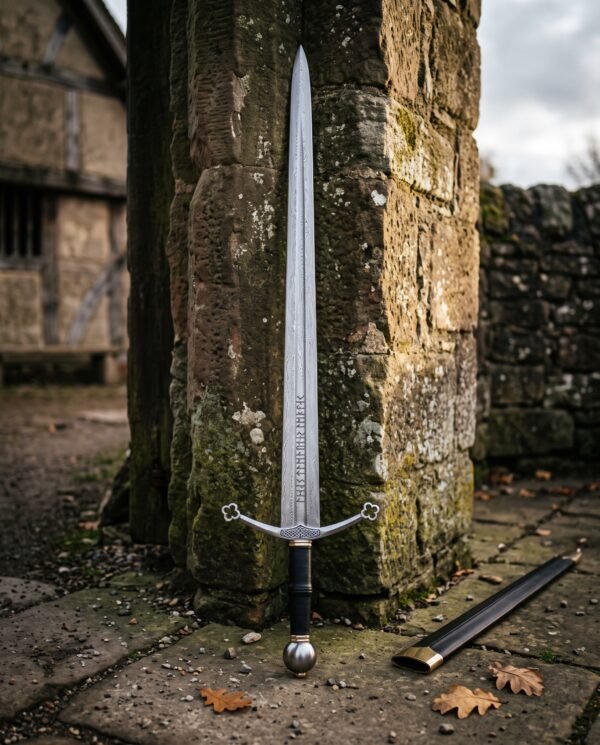
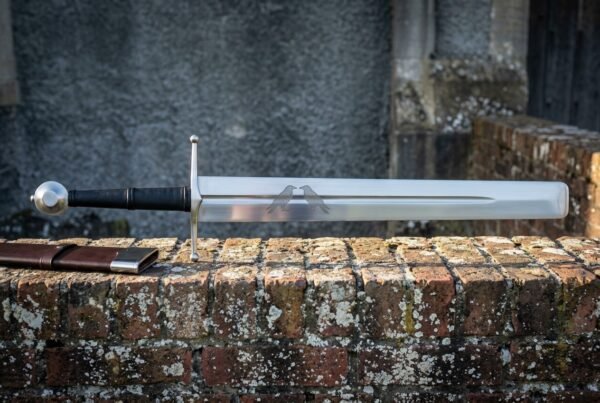
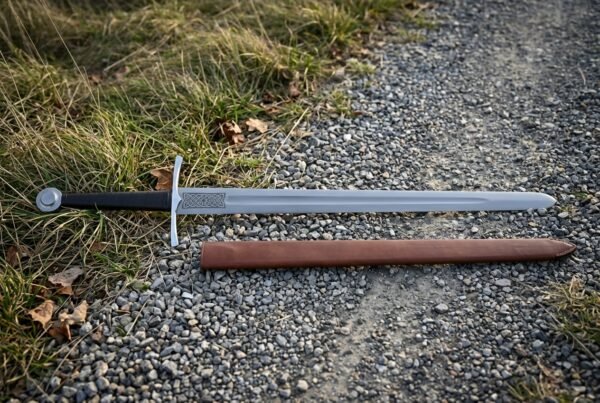
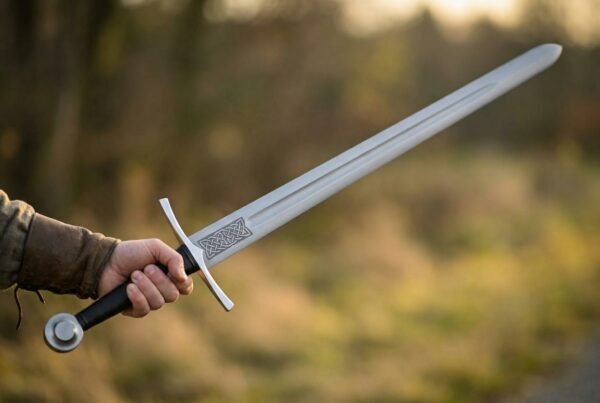
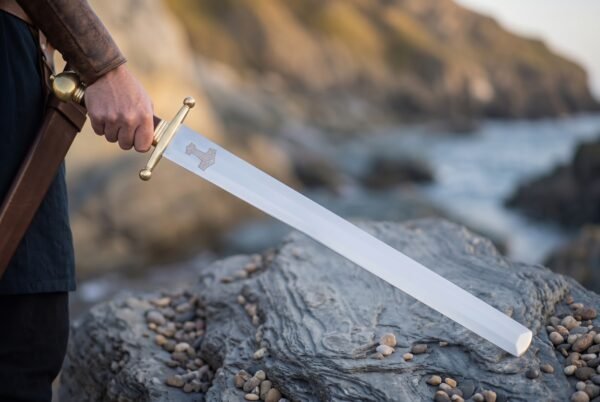
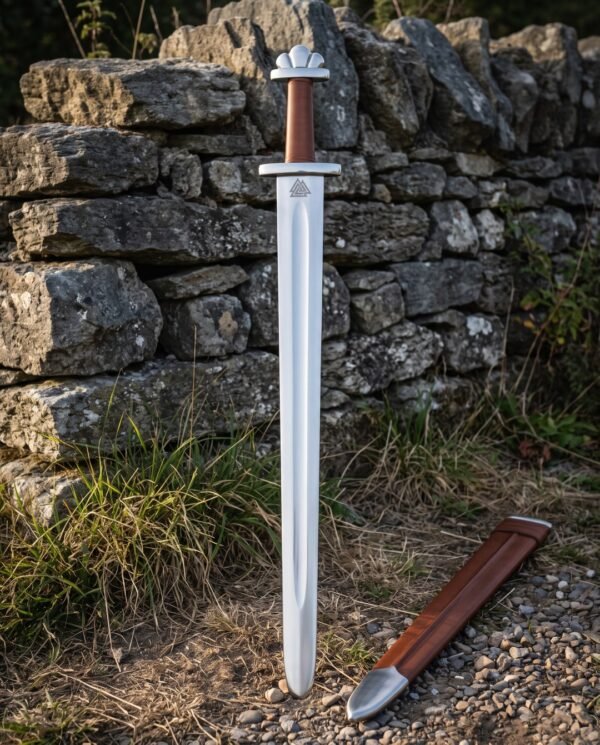
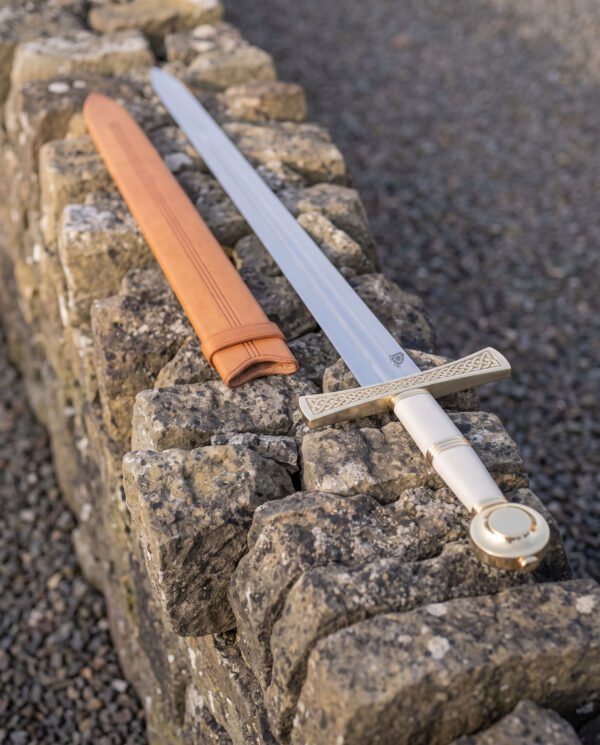
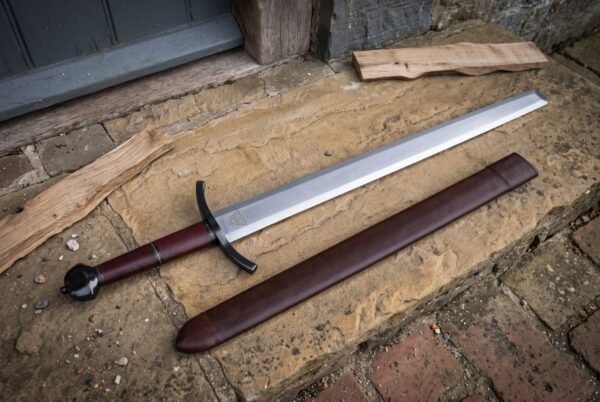
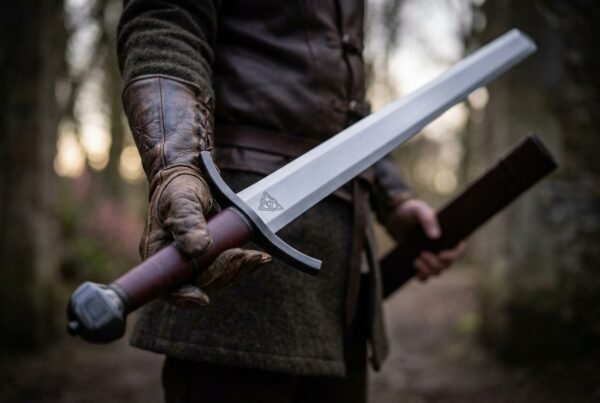
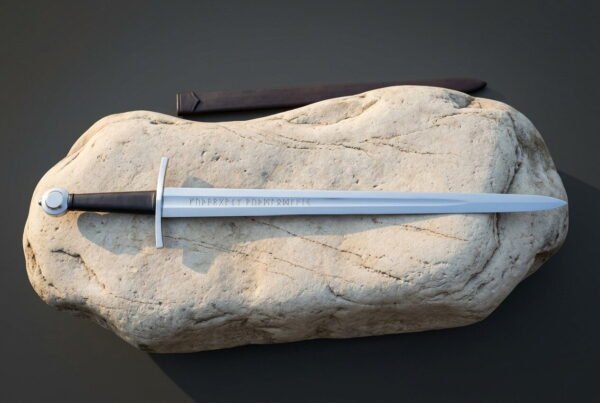
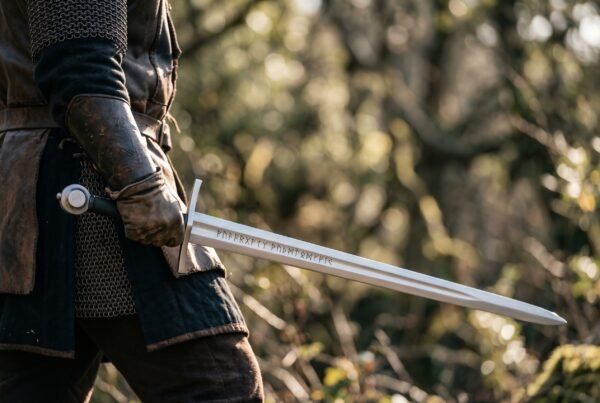
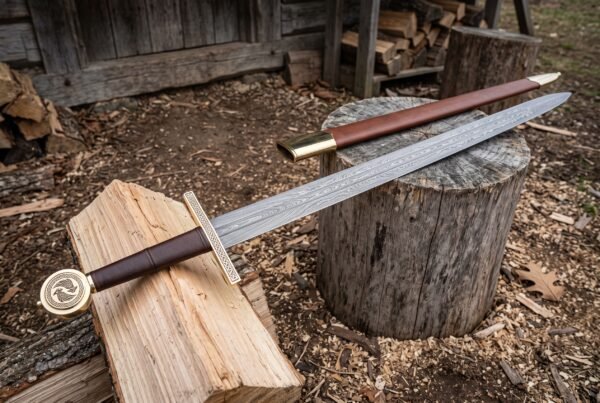
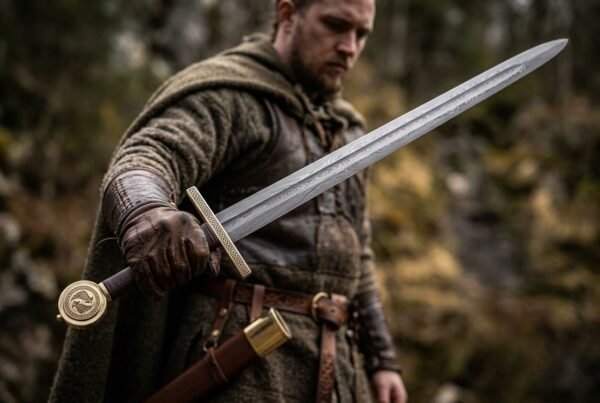
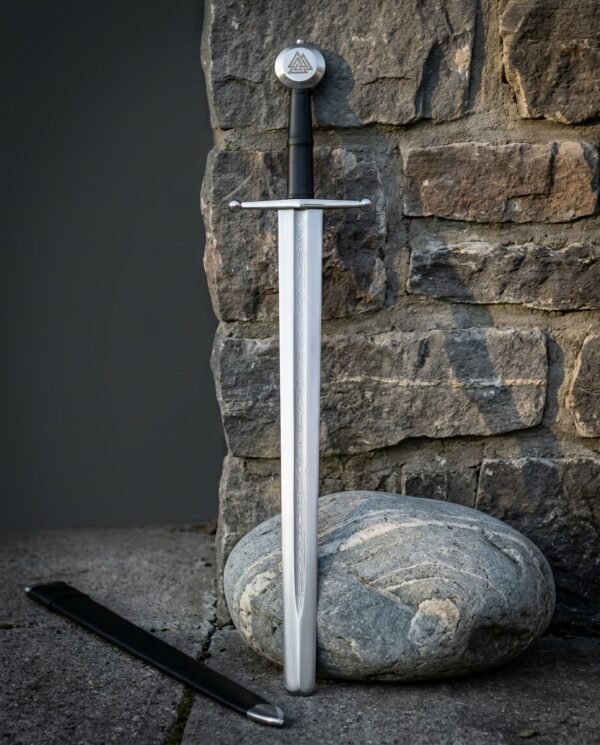
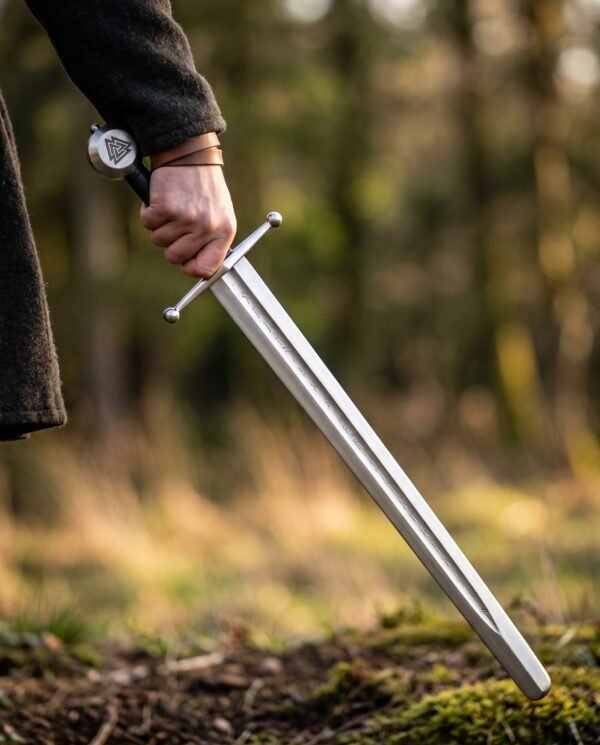
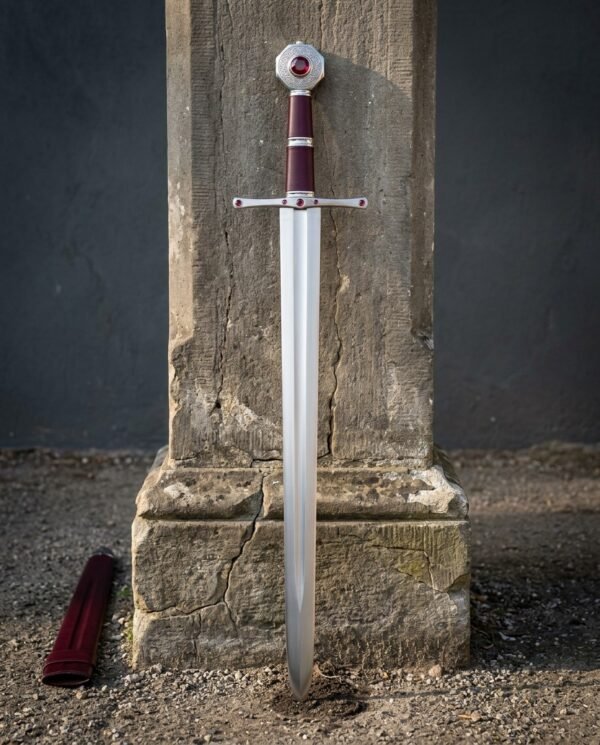
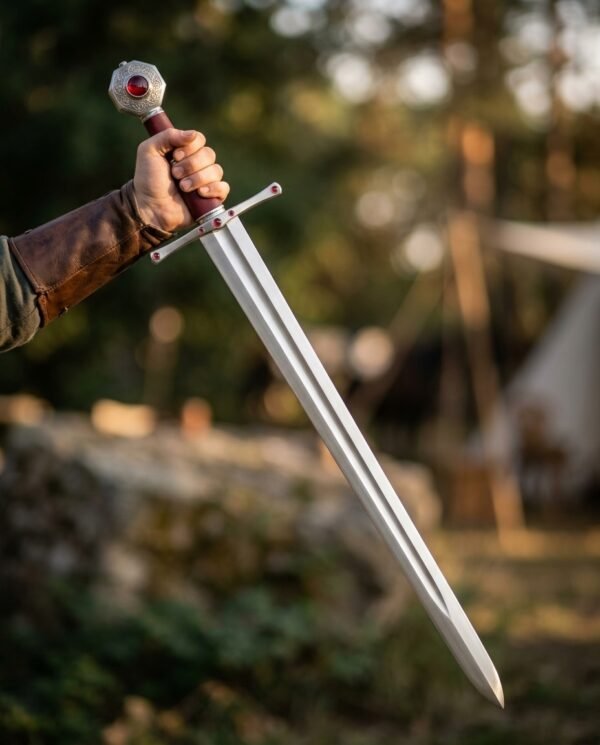
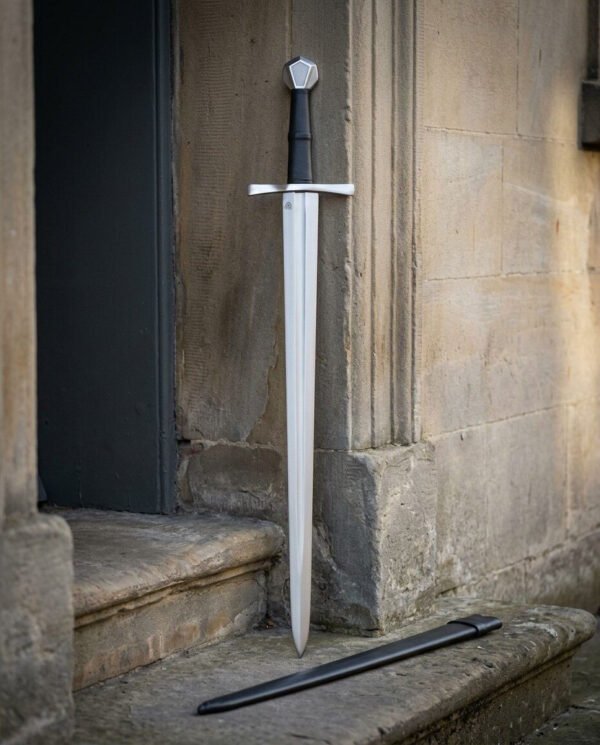
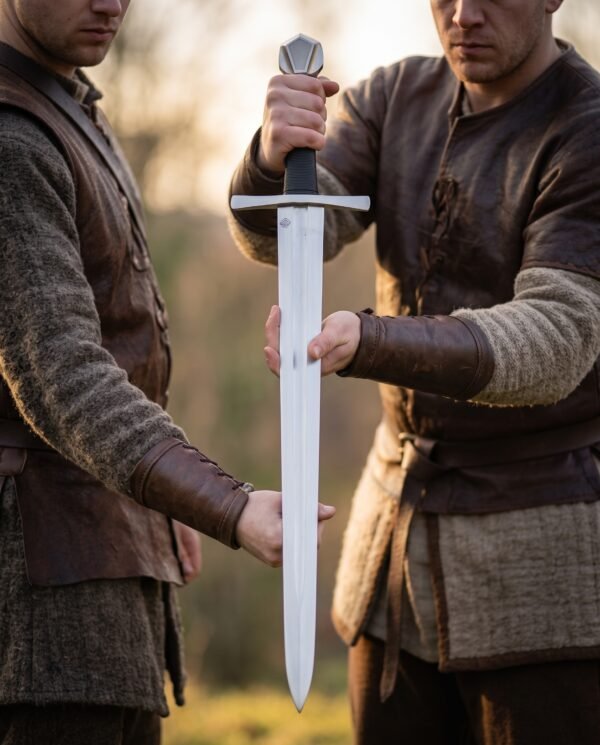
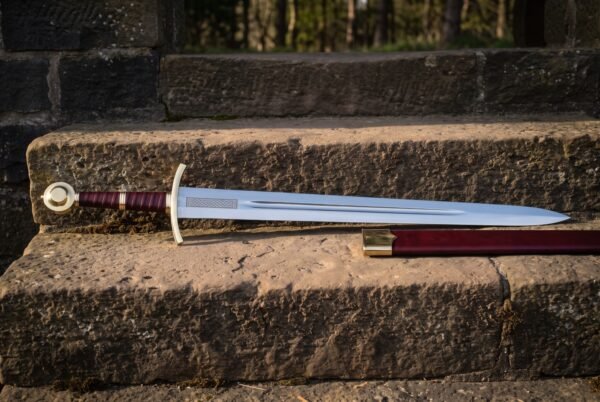
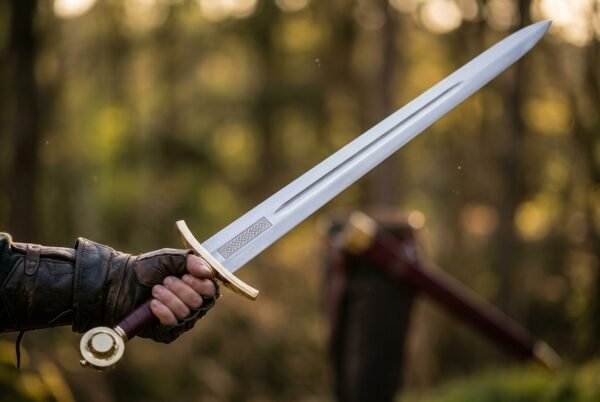
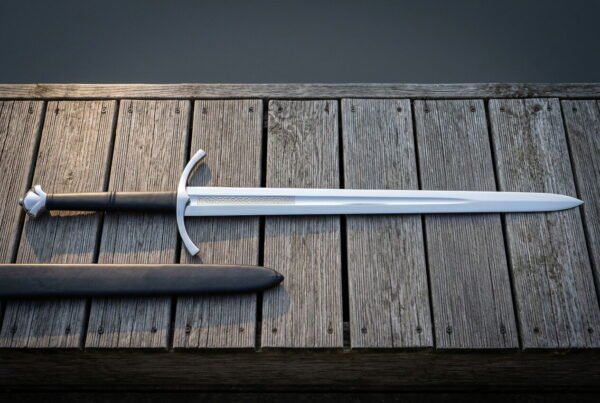
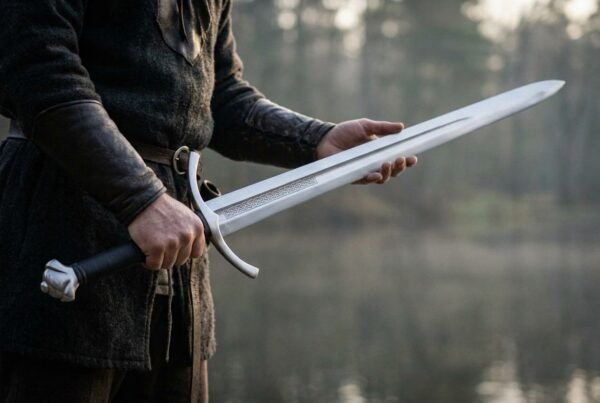
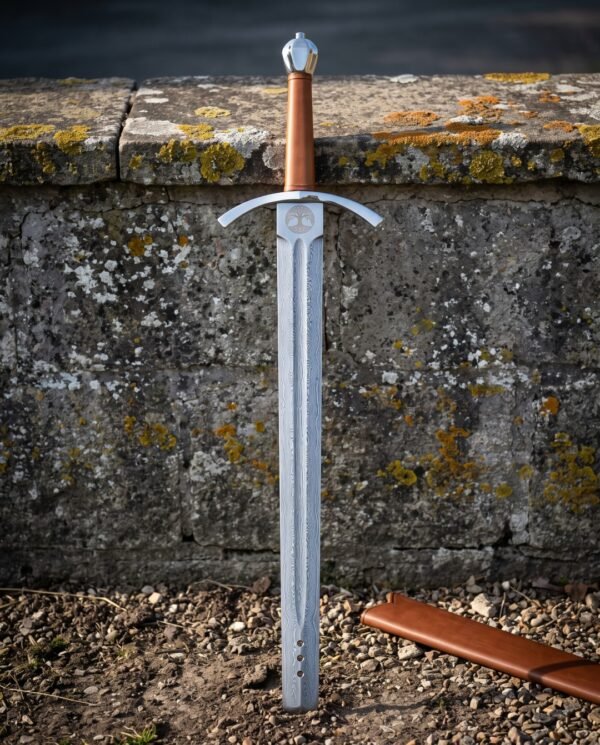
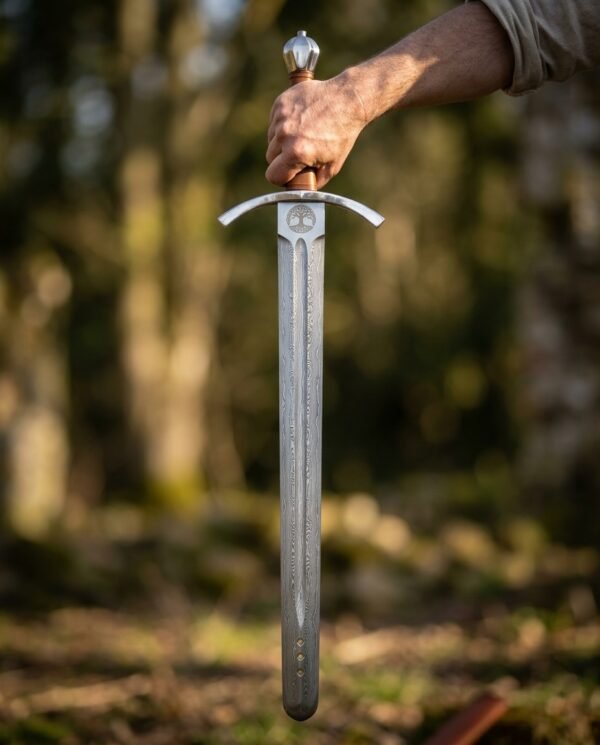
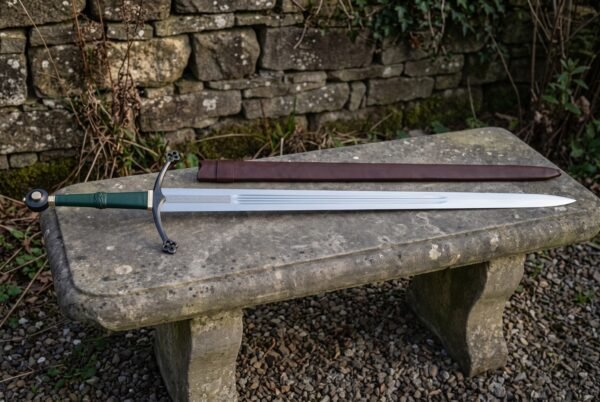
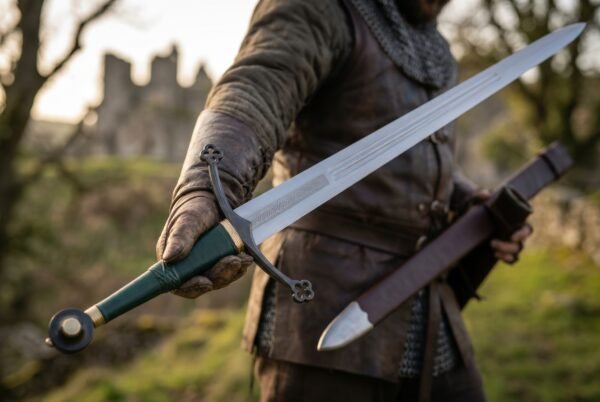
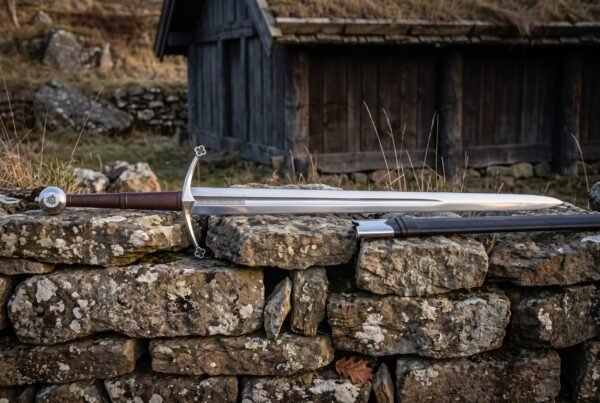
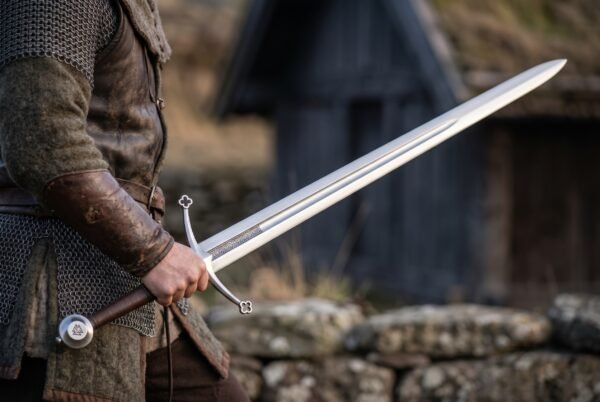
An arming sword is the single handed knightly sword of the high middle ages, the piece that followed the Viking sword and hung at the hip beside a shield before the longsword took over. Straight double edged blade, a cross of steel or brass at the hand, a short grip for one hand and a counterweighted pommel at the end. It is the shape most people picture when they picture a medieval sword.
The swords here run 31 to 40 inches overall with 24 to 32 inches of blade, and bare weights sit between about 2 lb 6 oz and 2 lb 14 oz. Most blades are 1095 high carbon hardened to 54 to 58 HRC. Around a dozen are 1095 and 15N20 Damascus at 58 to 60 HRC. Grips are leather over a shaped wooden core, fittings are steel or brass, and nearly every sword ships with a fitted leather scabbard.
Choose by pommel and guard first, since those are what place a sword in a century, then read the edge line on the product page, because some pieces are sharpened and some are ground as display edges.
Free US shipping
On most pieces. Heavier and oversized ones carry a flat charge.
Hand Forged
Heated, hammered and ground by hand.
Engraving available
Names, dates or Norse runes on most pieces.
Ships from Chicago
Inspected and dispatched from our Chicago warehouse. No import duty, no customs delay on US orders.
Arming Swords

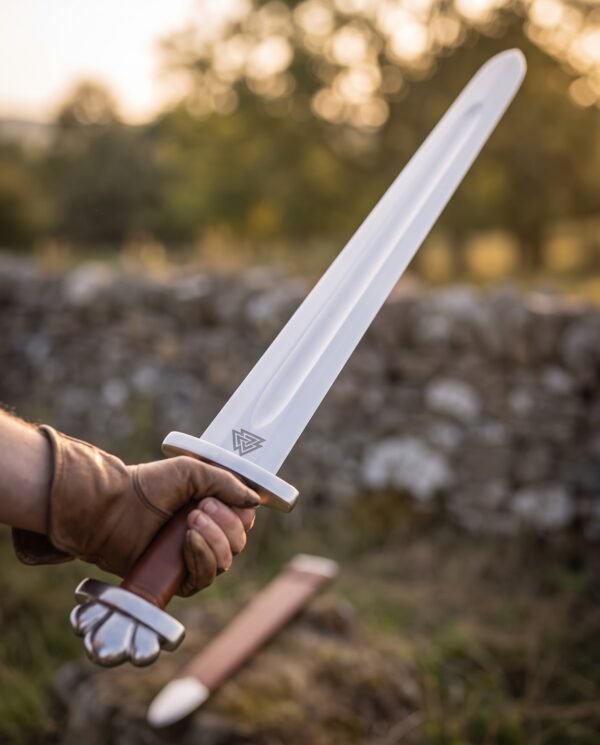
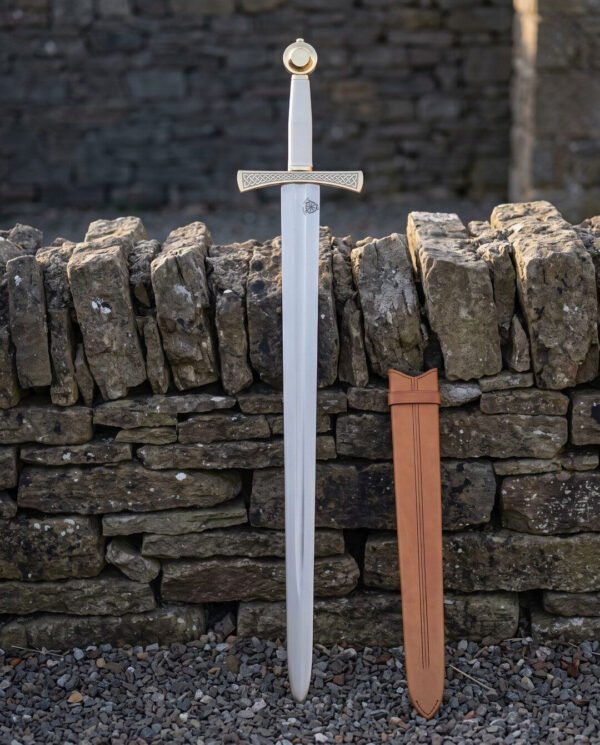

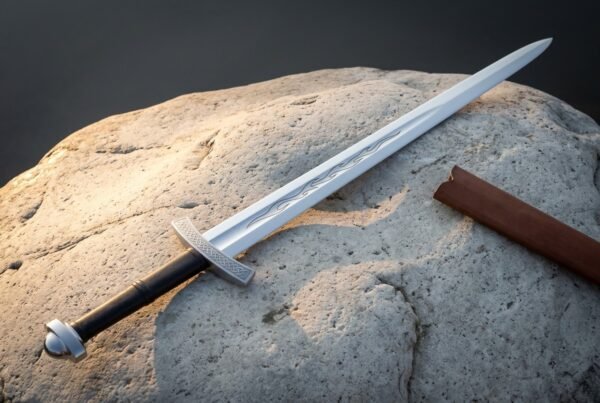
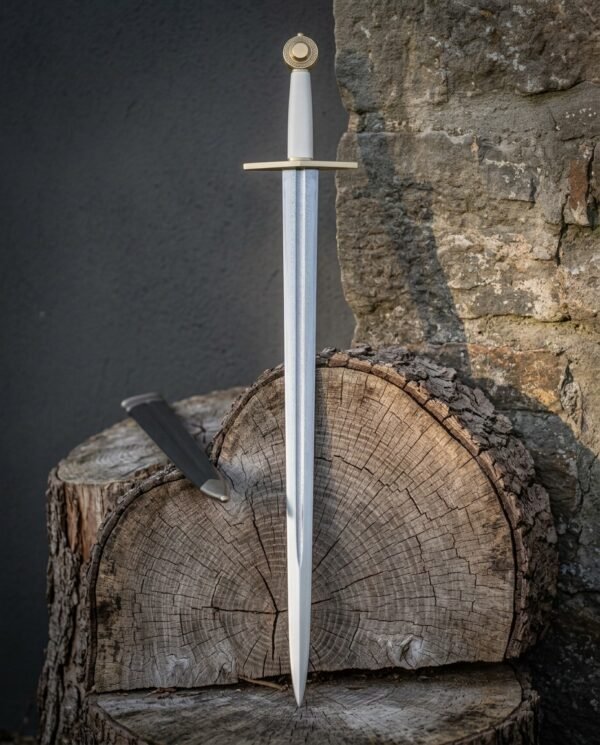
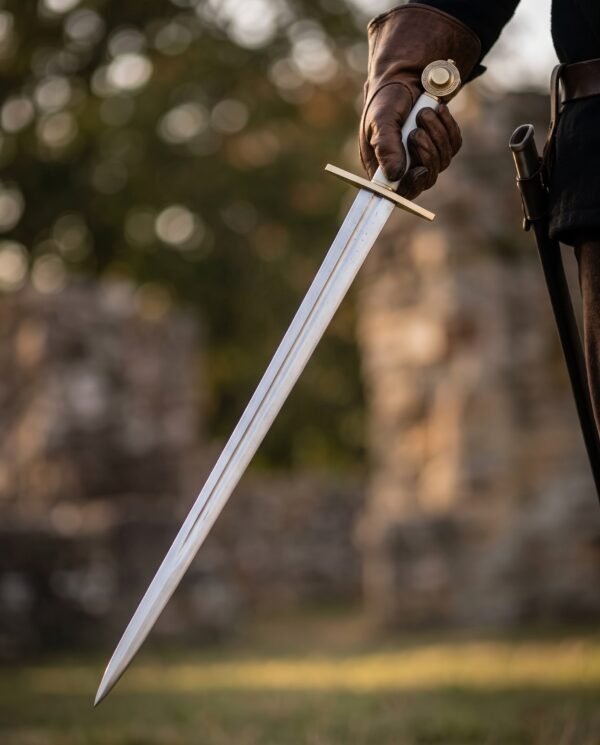
What an arming sword actually is
The name is period. Fifteenth century sources use it for the ordinary side sword a man of arms carried, the one worn at the hip as a matter of course rather than the specialist piece carried for a particular job. Modern collectors use it more narrowly, for a straight, double edged, single handed sword with a cruciform hilt, in use across Europe from roughly the eleventh century to the fifteenth.
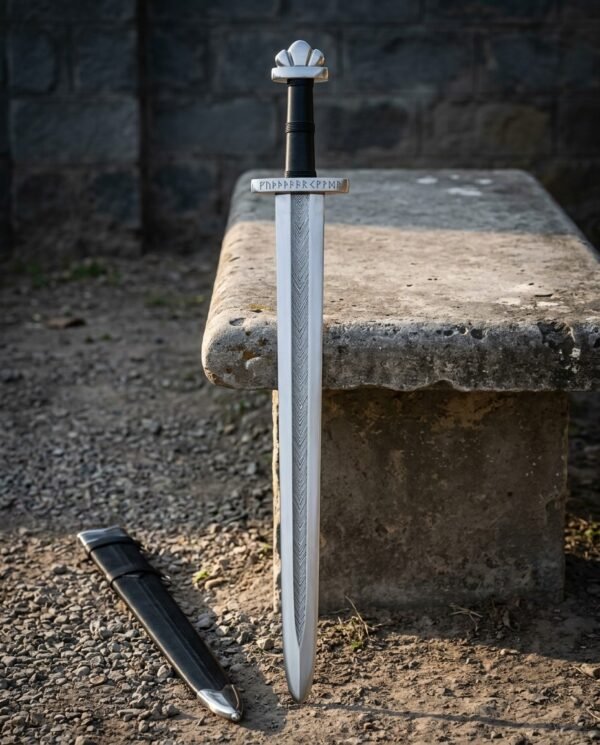
The shape is the direct descendant of the Viking sword. Take the broad Norse blade, lengthen the cross into a real crossguard, taper the blade a little harder towards the point, and you have an arming sword. That change happened because the things it met changed. Mail gave way to mail with plate reinforcement, and a broad cutting blade that worked well against a mailed opponent needed a stiffer, more acute point to be worth anything against a plate harness.
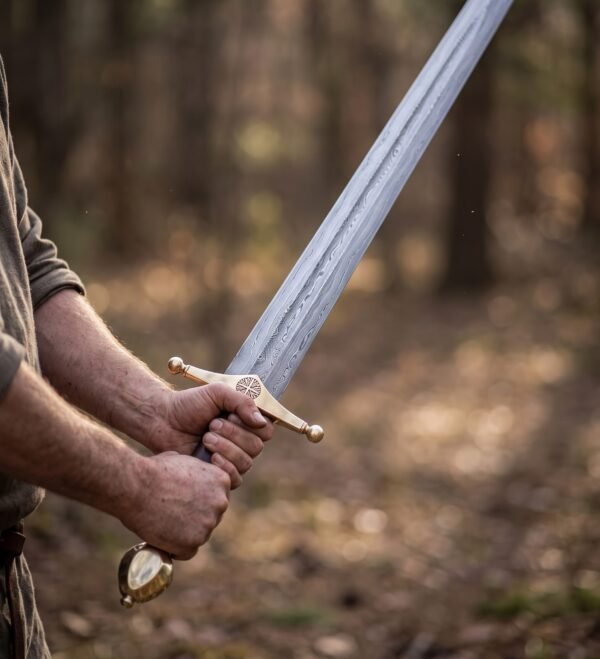
It was never carried alone in the field. The arming sword is half a system, and the other half is a shield, a buckler or a mailed left hand. That is why the grip is short and why the pommel is heavy. A sword you swing with one arm needs the mass behind your fist rather than out at the tip.
Knightly sword and single hand medieval sword are the same object under different names. If you have seen it called a Type XII or a Type XIV, that is Ewart Oakeshott's typology, which sorts medieval blades by profile, cross section and fuller rather than by date alone.
Where it sits between the Viking sword and the longsword
Three single handed and one and a half handed shapes cover most of the medieval sword range on this site, and picking between them is easier than it looks.
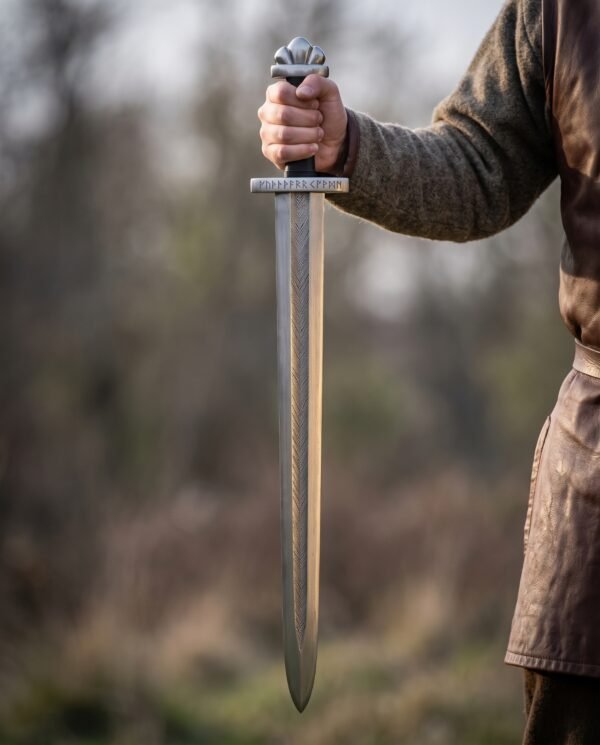
A Viking sword is broader, shorter in the taper and blunter in profile, with a stubby cross and a lobed or tea cosy pommel. It cuts. An arming sword is longer in the blade, more tapered, with a proper crossguard and a wheel or disc pommel. It cuts and thrusts. A longsword has a grip long enough for both hands and a blade to match, which changes everything about how it is used and how much wall it needs.
The arming swords here average around 36 to 37 inches overall. The longswords on this site run 44 to 46 inches. That is most of a foot of difference, and it is the difference between a sword that fits over a doorway and one that does not.
Reading the hilt
On a straight sword the blade tells you very little about the period. The hilt tells you almost everything, which is why collectors buy arming swords by the pommel.
Wheel pommel
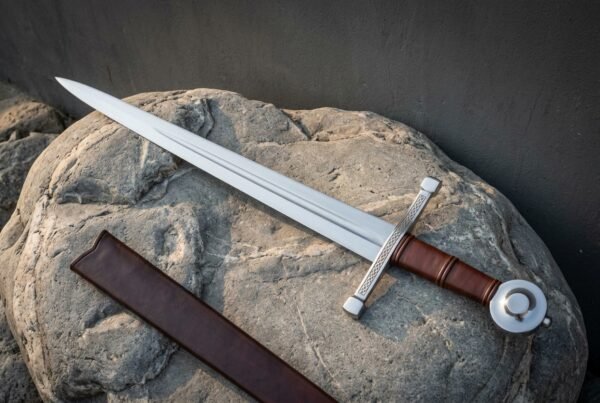
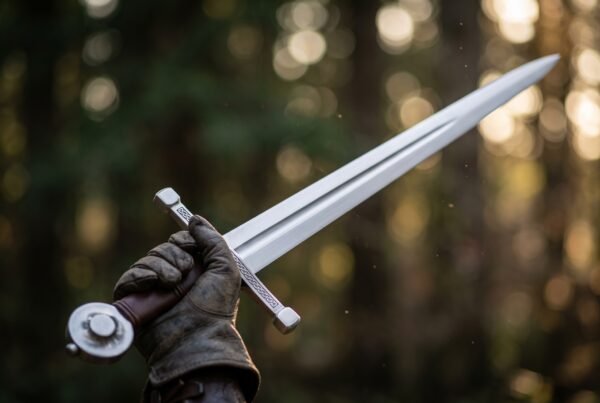
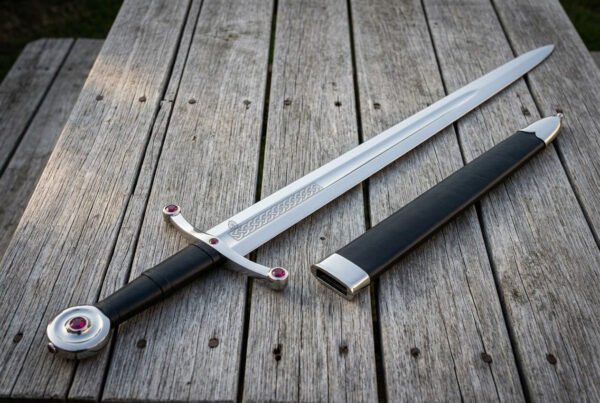
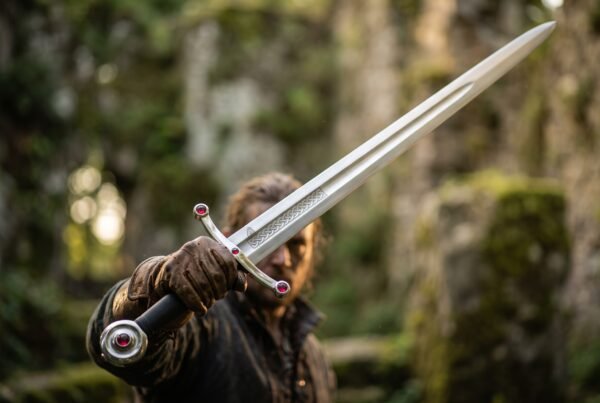
The commonest form here and the commonest form in the surviving record. A flat disc seen from the side, thick through the middle, often with a raised or recessed central boss, sometimes cut with knotwork or a cross. Swords with wheel pommels here run 31 to 38 inches overall with 24 to 32 inches of blade and weigh around 2 lb 10 oz to 2 lb 12 oz bare. If you want one arming sword and no strong opinion about the century, take a wheel.
Disc pommel
A broader, thinner plate than the wheel, sometimes with a raised central boss, sometimes cut through with a device. It sits flatter against the heel of the hand. The disc pommel swords here measure 31 to 38 inches overall with 26 to 31 inches of blade at about 2 lb 8 oz.
Brazil nut and acorn
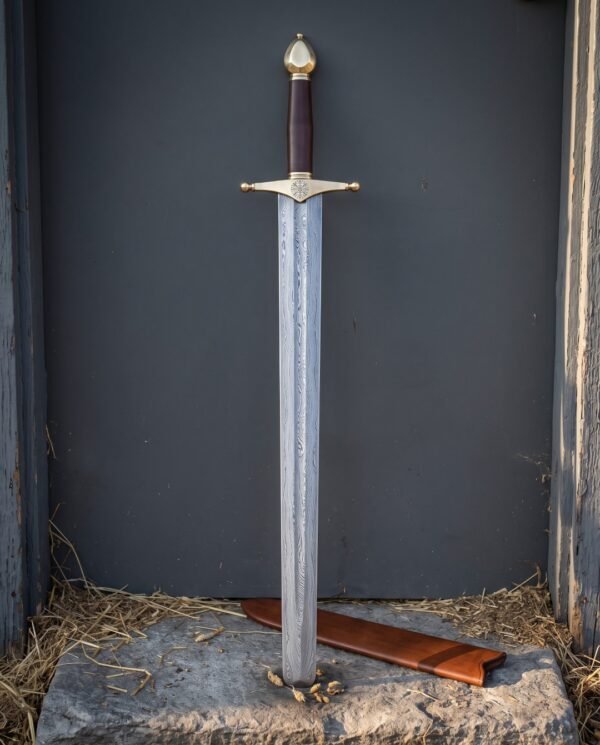
Earlier forms, carried over from the Norse and Norman end of the story. The brazil nut is a rounded triangular lump seen from the side, the acorn a tall tapered dome, often in brass. Both here sit at about 36 inches overall with 29 inches of blade. Choose one of these if the sword is going to stand next to Viking pieces rather than plate armour.
Scent stopper and tapering cone
Late forms, fourteenth and fifteenth century, shaped like the stopper of a decanter or a faceted cone. They belong on the longest and most acutely tapered blades, which is exactly where they appear here: 38 to 40 inches overall with 30 to 32 inches of blade on the scent stoppers, and 35 inches on the cone. These are the swords that read as armoured combat rather than as a mail and shield fight.
Faceted blocks and balls
Eight sided blocks, faceted spheres and plain polished balls, in steel or solid brass, peened over the tang. They run 32 to 37 inches overall with 25 to 31 inches of blade and about 2 lb 6 oz to 2 lb 8 oz. Faceting is a light catcher, and on a polished sword it does more work in a display case than a plain surface does.
Guards, side rings and finger rings
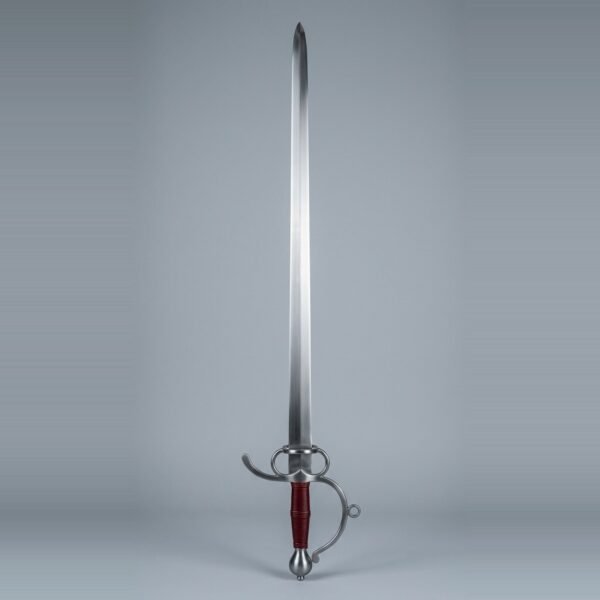
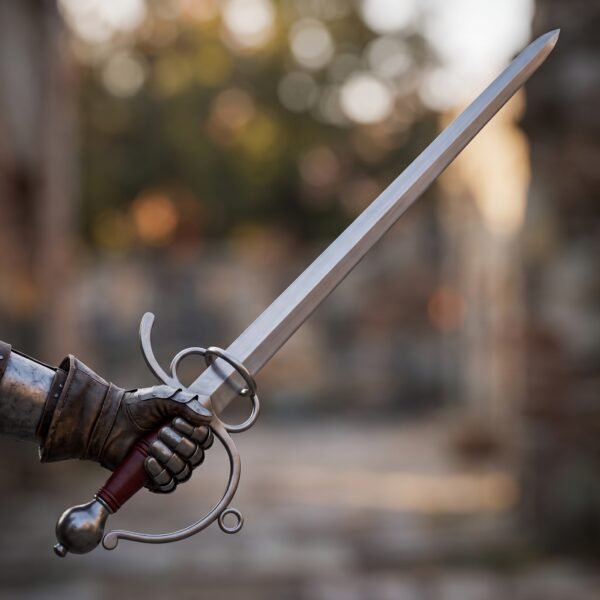
Most guards here are a straight steel cross of rectangular section with squared or spatulate terminals, some blued, some blackened, some in polished brass with ball or trefoil ends. A handful add a side ring set on one face of the cross. That ring is the first step towards the complex hilts of the sixteenth century, and it exists because fighters started hooking a finger over the cross for point control and wanted something to protect it. If a sword has a ring, it is telling you it sits late in the story.
Blades and fullers
Almost every blade here is double edged and straight, with a taper that runs from a broad base to a point. What varies is how hard that taper works and what runs down the middle.
A fuller is the groove forged or ground along the centre of the blade. It is not a blood groove, and it does not exist to let anything out. It is a stiffening rib in reverse: removing steel from the middle of the flat, where it does the least work, keeps the blade stiff against bending while dropping its weight. Broad shallow fullers running most of the blade appear on the cutting oriented pieces here. Narrow fullers, or none at all, appear on the stiffer tapering blades, where a diamond or raised central section does the same job.
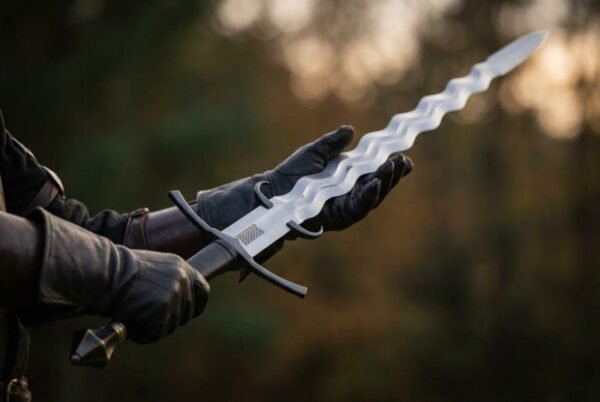
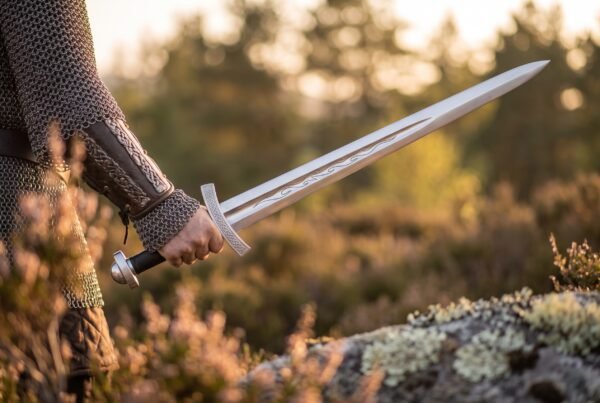
A few swords in this category carry an undulating flame profile with a bright polish and a leaf shaped point. Those are flamberge blades on an arming sword hilt, and they are bought for the look.
Sizes and weights across the range
Every figure below is taken from the specification panel of a sword in this category. These are hand forged pieces, so two swords of the same name will differ a little. Read the ranges as what to expect.
| Pommel form | Overall length | Blade length | Bare weight | Steel offered | Period feel |
|---|---|---|---|---|---|
| Wheel | 31 to 38 in | 24 to 32 in | 2 lb 10 oz to 2 lb 12 oz | 1095 at 54 to 58 HRC, some Damascus at 58 to 60 | Twelfth to fourteenth century |
| Disc | 31 to 38 in | 26 to 31 in | About 2 lb 8 oz | 1095 at 54 to 58 HRC, some Damascus at 58 to 60 | Thirteenth to fourteenth century |
| Faceted block or ball | 32 to 37 in | 25 to 31 in | 2 lb 6 oz to 2 lb 8 oz | 1095 at 54 to 58 HRC | Broad, hard to date by pommel alone |
| Scent stopper | 38 to 40 in | 30 to 32 in | Not listed | 1095 at 54 to 58 HRC, some Damascus at 58 to 60 | Fourteenth to fifteenth century |
| Brazil nut | About 36 in | About 29 in | Not listed | 1095 at 54 to 58 HRC, some Damascus at 58 to 60 | Eleventh to twelfth century |
| Brass acorn | About 36 in | About 29 in | Not listed | 1095 and 15N20 Damascus at 58 to 60 HRC | Norman and early medieval |
| Solid ball | About 37 in | About 31 in | Not listed | 1095 at 54 to 58 HRC | Late medieval |
| Tapering cone | About 35 in | About 28 in | Not listed | 1095 at 54 to 58 HRC | Fourteenth century |
Weight is the figure people misread most often. Two and a half to three pounds is what a real single handed medieval sword weighed, and the swords here sit in that band. The films that gave everyone the idea of a heavy sword were wrong, and a genuine arming sword is lighter in the hand than most people expect the first time they pick one up.
Steel, hardness and edge finish
Two steels run through this category. Most blades are plain 1095 high carbon hardened to 54 to 58 HRC, which is the house standard for a sword that has to take a knock without chipping. Around a dozen pieces are 1095 and 15N20 forge welded Damascus hardened to 58 to 60 HRC, where the two alloys are etched to show as light and dark layers. A small number of older listings state a different grade in their own specification table, and where they do, that table is the accurate answer for that sword.
Finishes run from satin through bright polish to blued and blackened. Blueing and blackening are surface treatments and they will wear at the high points with handling, which is normal and is how an old sword looks.
Edges are finished one of two ways, decided piece by piece. Some are sharpened and ready to use. Others carry an unsharpened display edge, occasionally with a rounded blunt end. The specification table on each product page says which, and that table is the answer for that sword. Nothing here is sold for contact against another blade.
Scabbards, mounting and care
Most swords in this category ship with a fitted leather scabbard, and several include a steel throat or a suspension belt. A new scabbard is tight and loosens slightly as the leather settles around the blade. Do not store a carbon steel sword in its scabbard for months at a time, because leather holds moisture against steel and that is the usual cause of rust on a sword that was otherwise cared for.
For wall display, support the sword at two points and hang it so the edge faces away from anyone walking past. A sword on a single hook will eventually rotate. Keep a light film of mineral oil on the blade and wipe fingerprints off after handling, since skin oil is mildly acidic and marks polished steel faster than most people expect.
Engraving and gifting
Most arming swords here can be engraved after they arrive in the United States. The usual placements are the ricasso, the flat above the ricasso and the face of the pommel, and the marks people ask for are a name, a date, an Elder Futhark line, a Valknut, a Vegvisir or a family crest. Elder Futhark is phonetic, so a name is transliterated by sound, and there is no rune for the letter C.
An engraved piece is permanent and cannot be returned, so send the exact spelling and check it twice before you order.
Where these swords are made
Every sword in this category is made by hand in the Czech Republic. Finished pieces are imported to the United States, inspected by Ransack Viking in Chicago, Illinois, and shipped from there, with engraving cut after arrival. Small differences in grind, polish, leather colour and pommel finish between two swords of the same name are expected, because two people made them on two different days.
Browse related sword categories
- Viking swords, the broader Norse ancestor of this shape
- Longswords with hand and a half grips
- Damascus swords in forge welded 1095 and 15N20
- Short swords for close quarters and shelf display
- Broadswords with wider cutting blades
- Bastard swords between one hand and two
- The full sword range across every type
- Kite shields and bucklers, the other half of the kit
- Sword stands and wall mounts
- Leather scabbards and replacement sheaths
- HEMA arming swords, blunted single handed trainers for club use
Guides worth reading first
- How to buy your first sword without wasting money
- Display sword vs battle ready: what the words actually mean
- How to display swords and axes on a wall safely
- Excalibur: the legend, the sources and what collectors buy
- The steel we use, and how hard it is
Frequently asked questions
What is an arming sword?
It is the ordinary single handed sword of the high middle ages: straight, double edged, with a cruciform hilt, a one hand grip and a counterweighted pommel. It was worn at the hip as a side arm and used with a shield or a buckler. Knightly sword and single hand medieval sword describe the same thing.
How long is an arming sword?
The swords in this category run 31 to 40 inches overall with 24 to 32 inches of blade, and most sit around 36 to 37 inches overall. Each product page lists the figures for that specific sword, since these are forged by hand and vary a little.
How much does an arming sword weigh?
Between about 2 lb 6 oz and 2 lb 14 oz bare for the pieces here that list a weight. That is close to the historical range, and it is lighter than most people expect. A sword feels heavier than a tool of the same weight because the mass sits forward of your hand.
What is the difference between an arming sword and a longsword?
Grip length, and everything that follows from it. An arming sword has a one hand grip and is meant to be used with a shield or buckler in the other hand. A longsword has a grip long enough for both hands and a longer blade to balance it. The longswords on this site run 44 to 46 inches overall against 31 to 40 for the arming swords.
What is the difference between an arming sword and a Viking sword?
The hilt, mostly. A Viking sword has a short stubby cross and a lobed, tea cosy or brazil nut pommel, with a broad blade that tapers gently. An arming sword has a longer crossguard, usually a wheel or disc pommel, and a blade that tapers harder towards the point. The arming sword is what the Viking sword turned into as armour improved.
Are these swords sharp?
It depends on the piece. Some are finished sharpened and ready to use, others carry an unsharpened display edge, sometimes with a rounded end. The specification table on the product page states which, and that table is the accurate answer for that sword.
What is the fuller for?
Stiffness and weight. Taking steel out of the centre of the flat, where it contributes least to resisting a bend, keeps the blade rigid while making it lighter and better balanced. It has nothing to do with blood, and a sword without one is not a lesser sword, it is a stiffer cross section doing the same job a different way.
Where are these swords made?
They are made by hand in the Czech Republic, then imported, inspected and shipped by Ransack Viking from Chicago, Illinois, with any engraving cut in the United States after arrival.
If you want to spar with one
If you want an arming sword to spar with rather than to own or display, look at our arming sword trainers, which are blunt 51CrV4 spring steel at 49 to 52 HRC. Synthetic versus steel trainers will help you choose between the two materials. The Haldvane blunt arming sword is a good first one.