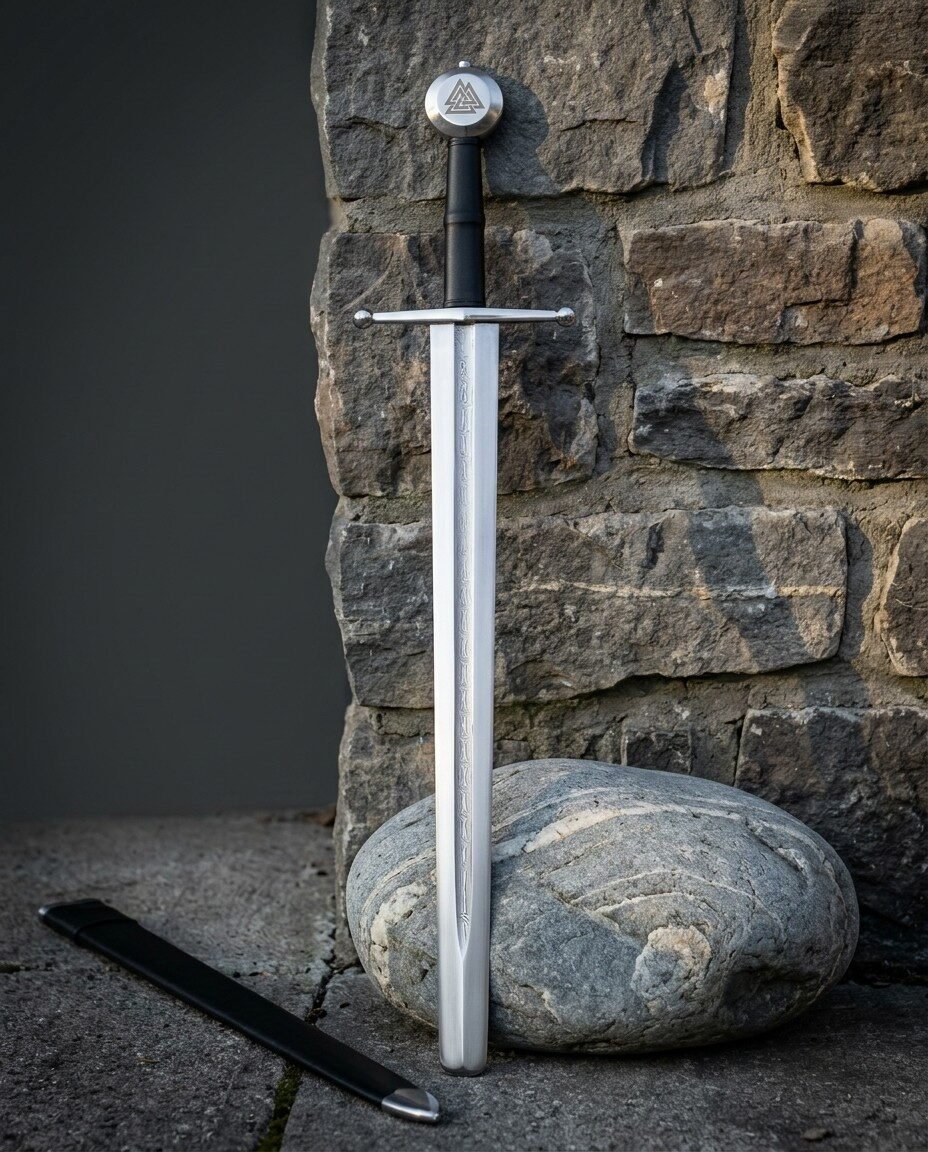
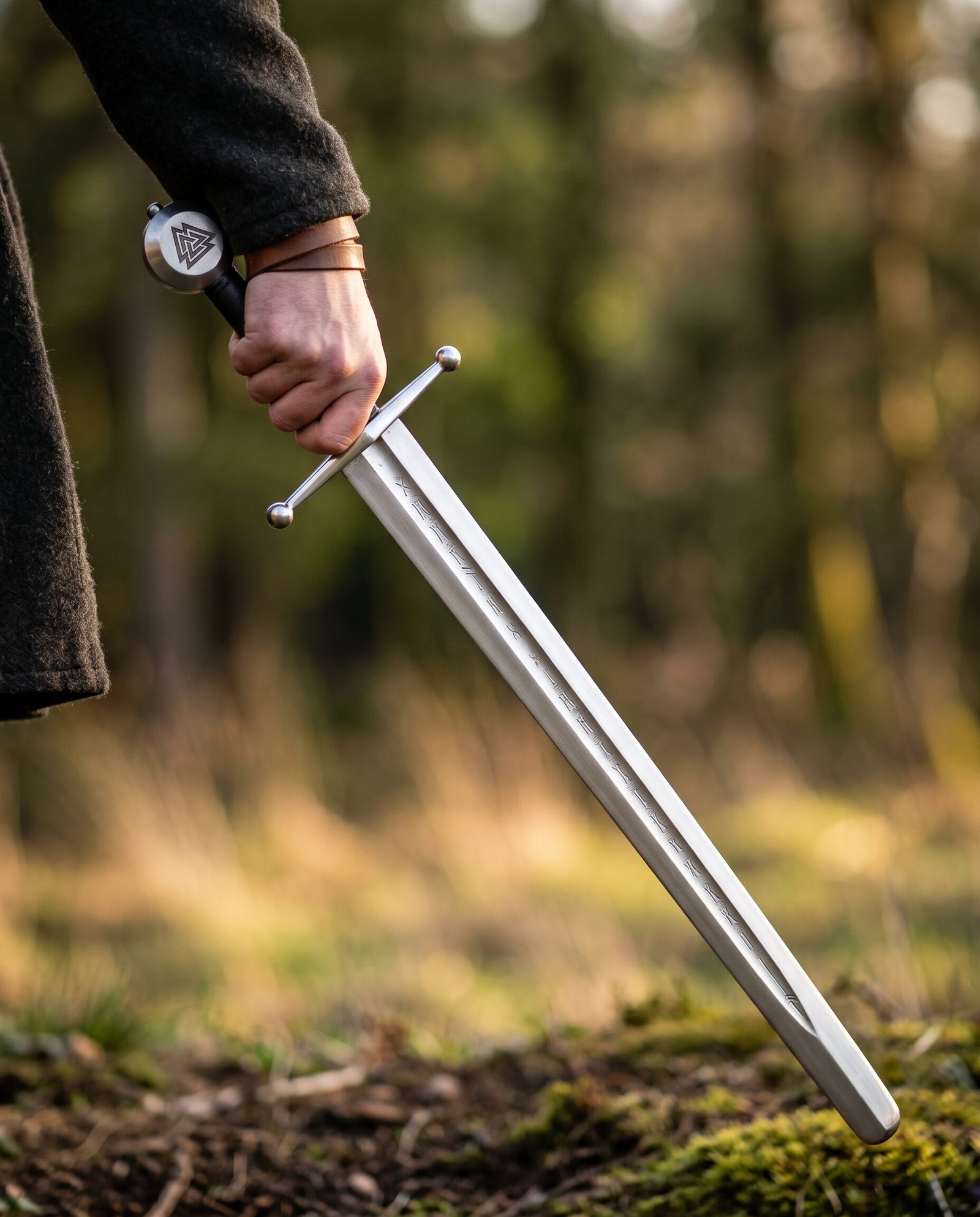
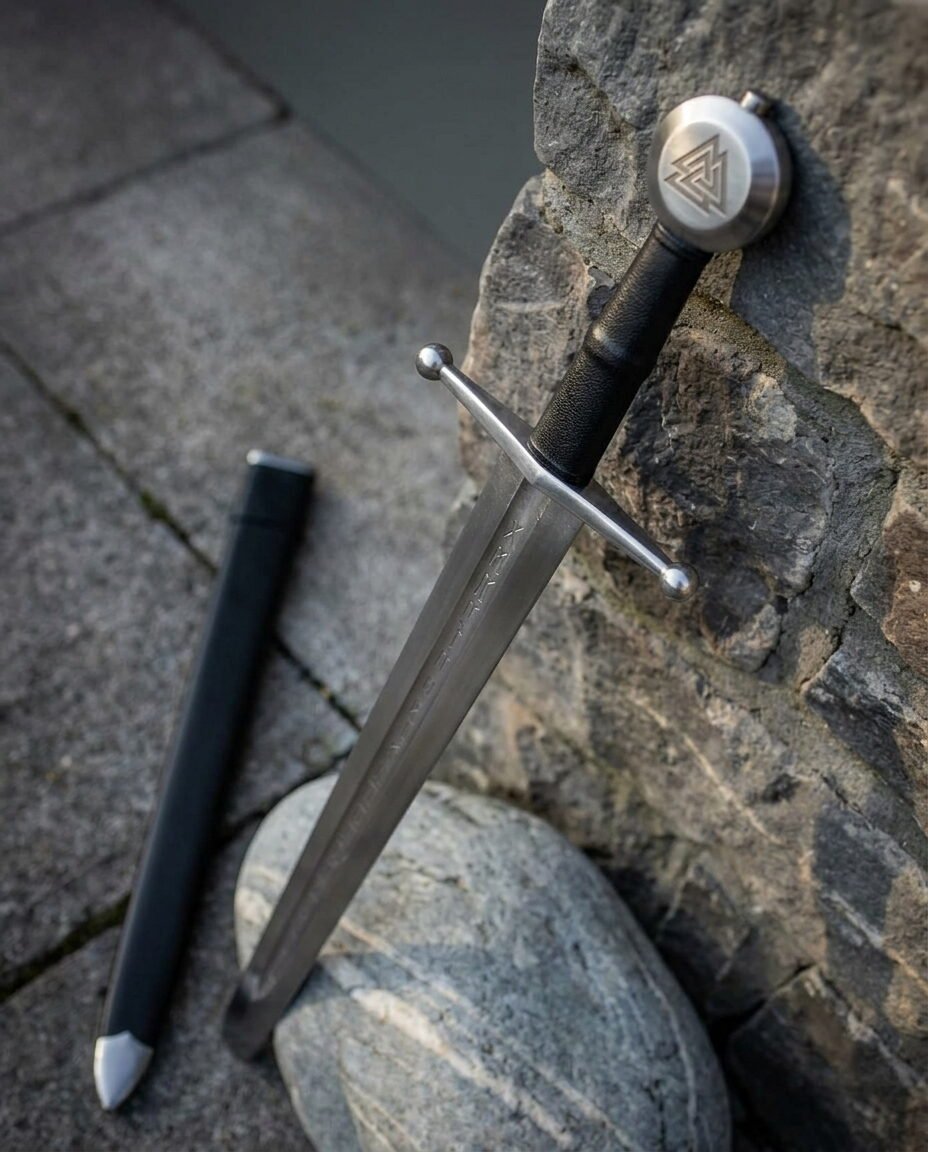
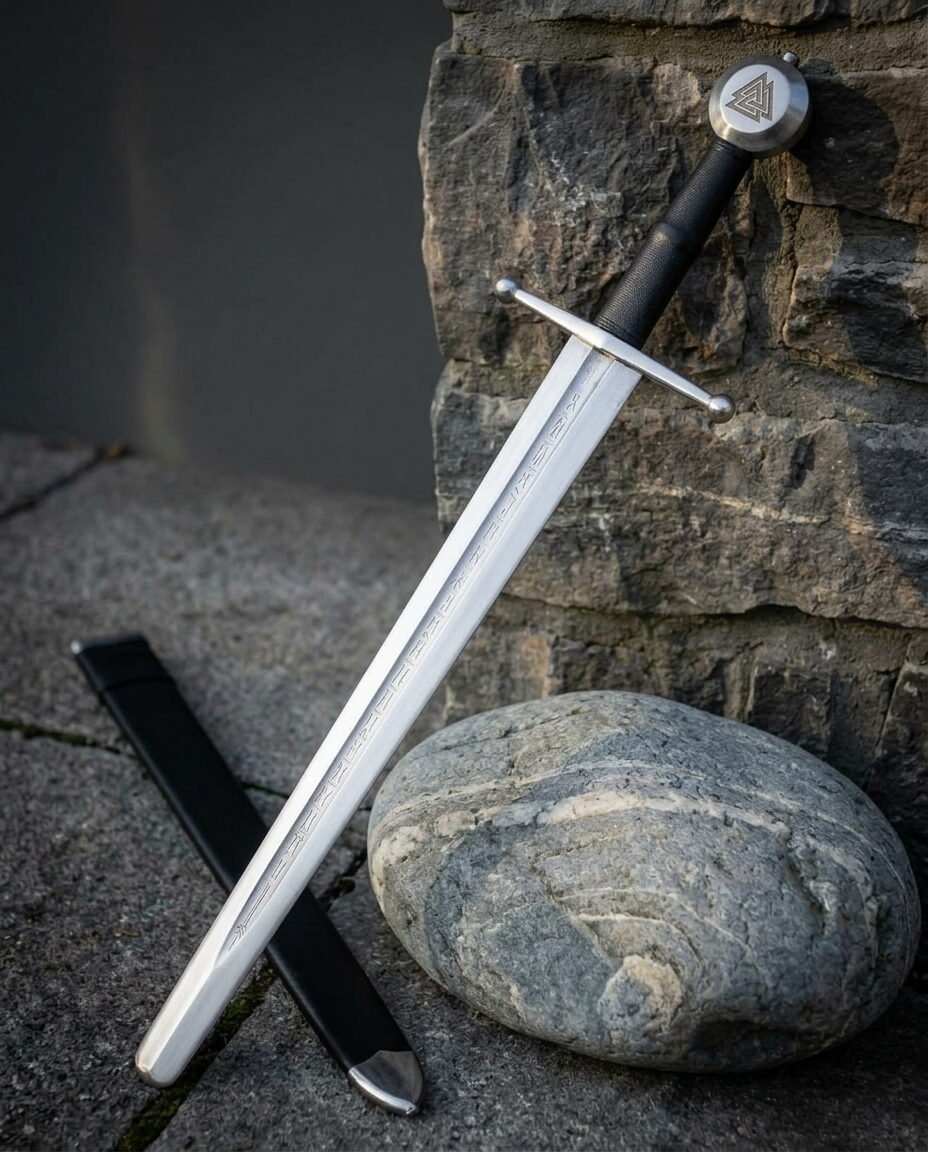
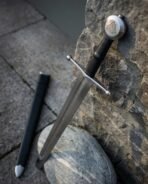
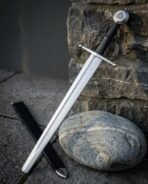
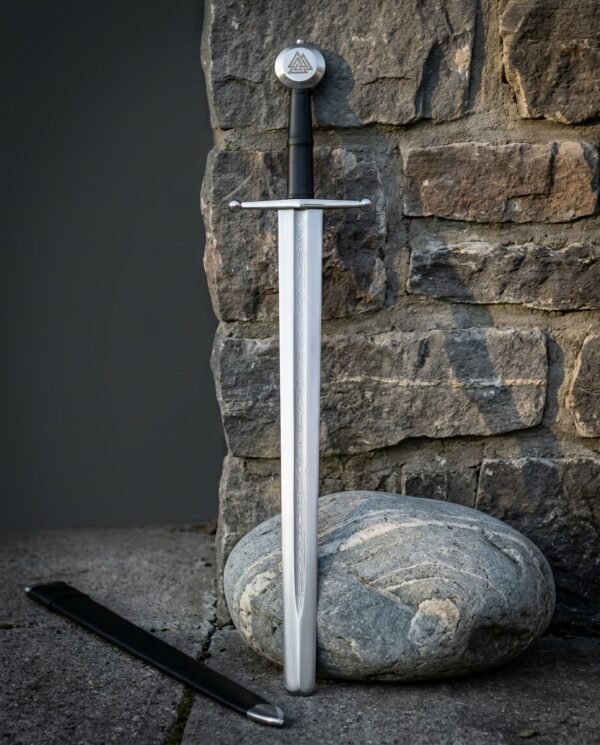
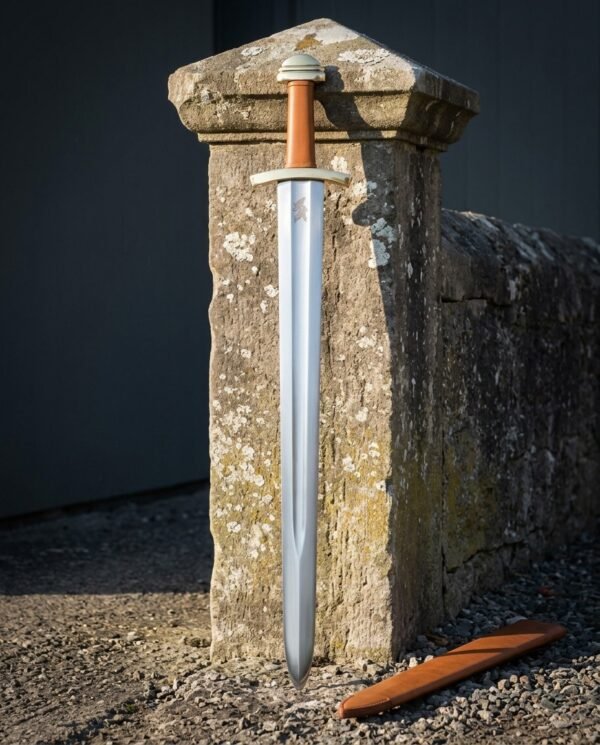
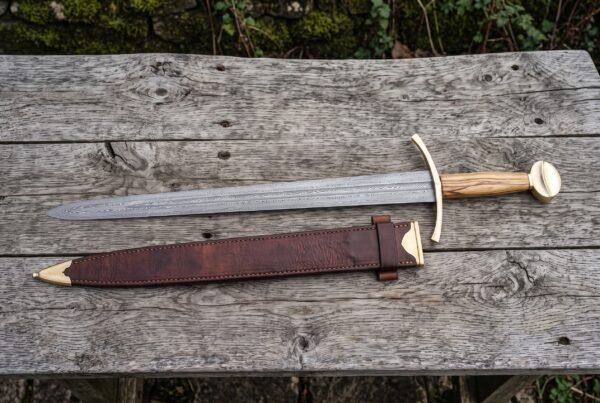
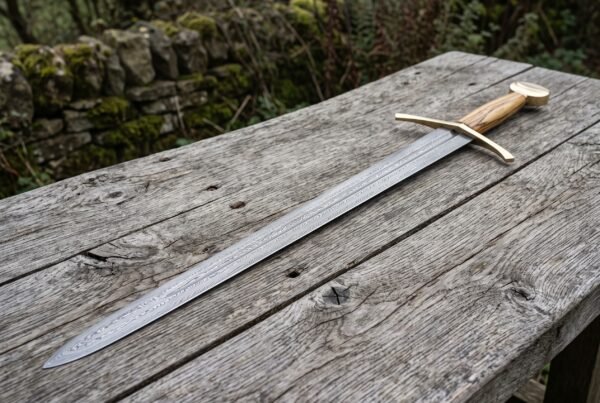
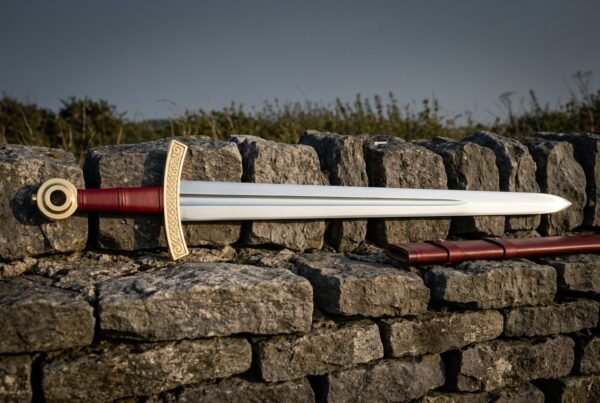
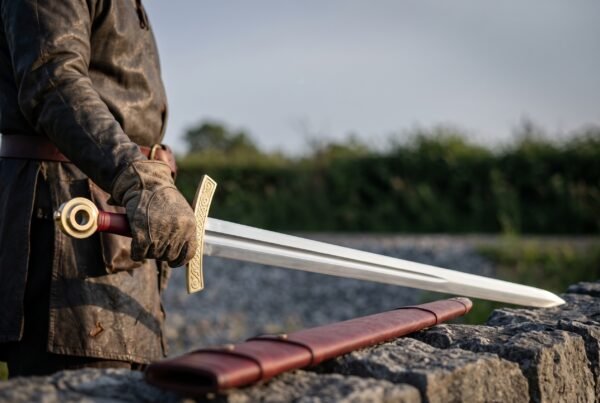
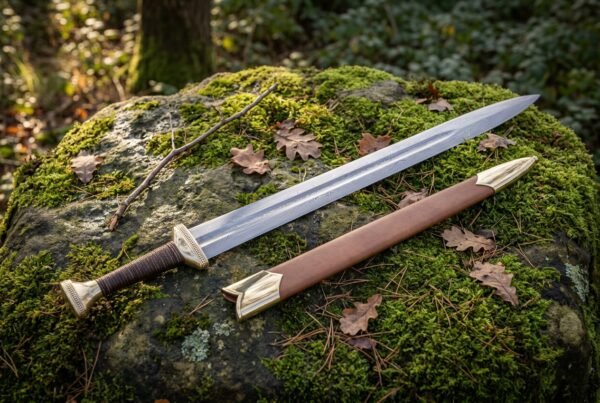
The Valkwarden is a single hand sword with a long column of Elder Futhark runes cut down the centre of the blade, a straight crossguard finished with small ball terminals, a black leather grip and a heavy steel disc pommel carrying a Valknut. It ships in a black leather scabbard with a steel chape at the tip.
The Valknut on the pommel is three triangles interlocked into a single closed figure, and it is one of the few Norse symbols we can actually point at in the archaeology rather than guessing about. It appears on the Stora Hammars picture stones on Gotland, on the Tangelgarda stone, and on a bedpost from the Oseberg ship burial, and in almost every case it sits next to a scene involving death, burial or Odin. Nobody knows what the Norse called it, because the modern name is a nineteenth century coinage from the Norwegian for knot of the slain. This sword is forged and finished in the Czech Republic. Kept with the Viking swords, and worth setting against the arming swords before you decide.
Specifications
| Material | 1095 high carbon steel blade, steel guard and pommel, leather over timber grip |
|---|
| Overall length | Approximately 37 in / 94 cm |
|---|
| Blade length | Approximately 30 in / 76 cm |
|---|
| Blade profile | Broad double edged blade with near parallel edges, a central fuller and a rounded point |
|---|
| Hardness | 54 to 58 HRC |
|---|
| Finish | Hand worked satin |
|---|
| Engraving | Vertical Elder Futhark rune column cut along the fuller, Valknut on the pommel |
|---|
| Guard | Straight steel crossguard with small ball terminals |
|---|
| Grip | Black leather over a shaped timber core with a raised riser at the middle |
|---|
| Pommel | Polished steel disc pommel, Valknut engraved, peened tang |
|---|
| Scabbard | Black leather with a polished steel chape |
|---|
| Included | Sword and fitted leather scabbard |
|---|
| SKU | RK-1678 |
|---|
What the Valknut actually is
Look at the pommel closely. Three triangles, each one passing over one neighbour and under the other, so no triangle is fully on top and no triangle is fully underneath. That is what makes it a genuine interlace rather than three shapes stacked on a page, and it is the same logic that runs through Norse and Insular knotwork generally. Follow any single band with a finger and it never terminates.
Two versions survive. The unicursal form, where one continuous line makes all three triangles, is the one on the Tangelgarda stone. The tricursal form, three separate closed triangles woven together, is the one on the Stora Hammars stone and the one shown here. Both turn up in contexts loaded with death and with Odin, which is why modern readings connect it to the fallen and to the passage between worlds. That connection is a reasonable inference from where it was carved, not a recorded Norse doctrine, and it is worth knowing the difference.
What it plainly is not is a rune. Runes are letters with sound values and the Valknut has none. It is a symbol, in the same family as the Helm of Awe and the Vegvisir, and a sword is exactly the sort of object the Norse would have marked. The rune column on the blade is separate work and does carry sound values.
The steel
The blade is 1095, a plain high carbon steel with about one percent carbon and almost nothing else in it. It is the steel a period smith would recognise in the hand. It forges predictably, holds a fine edge and takes heat treatment honestly, which is exactly what you want on a blade this long where consistency through the length matters more than exotic alloy content.
Normalised, quenched and tempered, it sits at 54 to 58 HRC. That is deliberately not the hardness we run on a small knife. A thirty inch blade has to be able to flex and come back, and pushing the hardness up on a piece this long trades toughness you need for edge retention you do not. The finish is a hand worked satin rather than a mirror, which suits an engraved blade because a mirror polish fights with cut lines and shows every fingerprint.
The rune column is cut into the flat rather than stamped or printed, so it has depth and it will still be there in fifty years. The guard and disc pommel are steel with the tang peened over the pommel, a mechanical lock rather than glue or a threaded nut, and the grip is leather over a shaped timber core. The scabbard is leather over a fitted core with a polished steel chape.
Engraving, runes and your own design
Use the rune converter on this page to turn a name, a date or a short phrase into Elder Futhark and we will cut it into the steel, the leather or the wood. If you would rather have a Viking pattern than a rune line, choose your own design in the engraving option above the add to cart button and tell us where it goes. Where a piece already carries an engraved design, your chosen engraving replaces it rather than sitting alongside it, so your line takes the place of the rune column on the blade or the Valknut on the pommel. Tell us which one you mean. Full details are on the engraving page.
Handling and balance
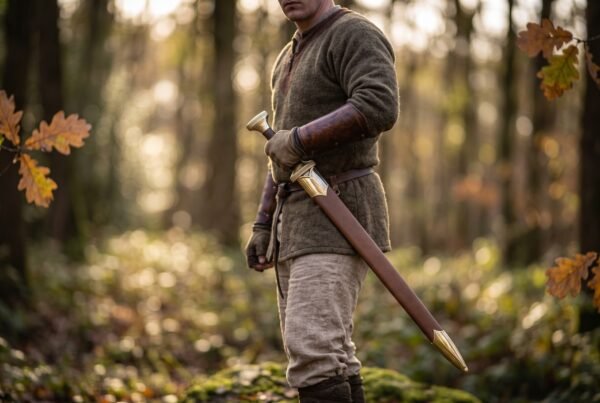
The disc pommel is heavy on purpose. It sits behind the hand and pulls the point of balance back toward the guard, so a broad blade like this one comes round faster than its width suggests and stops where you tell it to. Hold the sword with the heel of your hand under the pommel rather than choked up against the guard, which is how the fittings are laid out and how a period grip works.
The ball terminals on the crossguard give the thumb and forefinger something to index on, so you always know where the edge is without looking. The rounded point tells you what the profile was for. This is a cutting sword rather than an armour piercing one, built to open a target with the edge.
It arrives sharp and it is a display, collecting and light cutting sword. It is not built for edge to edge contact against another blade and we do not sell it for sparring or full contact reenactment.
Care
Wipe the blade after every handling session and put a thin film of oil on the steel before the sword goes away. Bare 1095 will grey where a fingerprint has sat for a week, and the rune column will hold dust and oil, so work the cloth along the column rather than across it. Do not store the sword sheathed for long periods in a damp room, because vegetable tanned leather holds moisture against steel.
Lift any rust spot with oil and a fine synthetic pad, working along the length, then re oil. Feed the leather grip and scabbard once or twice a year with a leather balm and keep both out of long direct sun. The steel chape and the pommel want nothing more than a dry cloth. Full guidance is in our steel care notes.
Made in the Czech Republic
This piece is made by hand in the Czech Republic, in a workshop that still works the old way. The steel is forged, ground, heat treated and finished by smiths who learned the trade from the people before them, and the wood, horn and leather are cut and fitted by hand rather than pressed out on a line. That is also why no two pieces come out exactly the same.
Ransack Viking is a United States company. We import these pieces ourselves, check every one when it lands and ship from our warehouse in Chicago, Illinois. Engraving is done here in the United States after the piece arrives, so your runes or your own design go on before it leaves for you.
A note on handmade variation
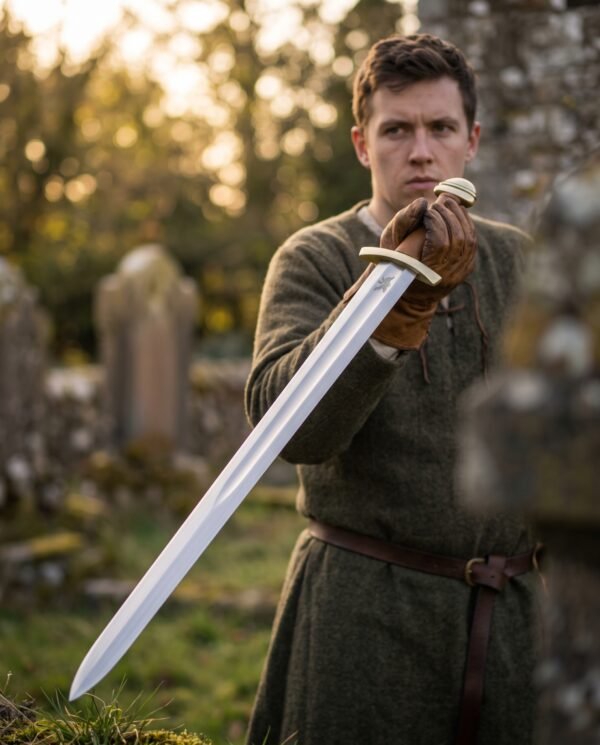
This sword is hand made rather than machine made or bulk produced, so what arrives will not be a pixel for pixel copy of the photograph. The satin finish takes its own direction under the abrasive, the rune column is cut by eye so its spacing shifts slightly, the Valknut on the pommel is engraved one at a time and the leather takes dye differently from hide to hide. The dimensions, the steel, the hardness and the build are the same every time. The character is not. We wrote up why a full tang matters separately, and there is a piece on buying a first sword as well.
Frequently asked questions
What does the symbol on the pommel mean
It is a Valknut, three interlocked triangles found on Gotland picture stones and the Oseberg burial, usually near scenes of death and Odin. The modern name is a nineteenth century coinage.
Is the sword sharp when it arrives
Yes, both edges arrive with a working edge. Store and handle it as a sharp sword.
Can the runes say my own name
Yes. Use the rune converter on this page and your line is cut in place of the column shown.
Can I use it for reenactment fighting
No. It is sharp and it is not built for edge to edge contact. It is a display, collecting and light cutting sword.
Is the blade Damascus
No. It is 1095 high carbon steel with a hand worked satin finish. A single steel has no contrast to etch, so it does not carry a pattern.
How long until it ships
One to two weeks of processing, then free shipping inside the United States. Engraved orders sit at the longer end.
What is in the box
- Valkwarden arming sword in 1095 high carbon steel at 54 to 58 HRC
- Engraved Elder Futhark rune column and Valknut disc pommel
- Fitted black leather scabbard with a polished steel chape
- Care card for high carbon steel and vegetable tanned leather
- Lifetime warranty against defects in forging, grind, heat treat and fittings
- Forged and finished in the Czech Republic
Explore the range
See more in arming swords, viking swords, swords and engraved and personalised, or read the guides.
Other pieces in this group
For a straight comparison, see the Braidfuller Viking sword, 36 inches overall. Worth putting side by side with this is the Keelbrand Viking sword, high carbon steel. In the same category sits the Valkbrand Viking sword, 37 inches overall.
From the same corner of the shop, there is the Northstave arming sword. Nothing here exactly right, build one to your own spec on the custom Viking sword page.
If you would rather train with a sword than hang one up, the Ashgrimm arming sword suits club work, and our HEMA arming swords covers the choices.

Showed up right on time and looked even better than the photos. I keep coming back to Ransack Viking because it’s always this good.