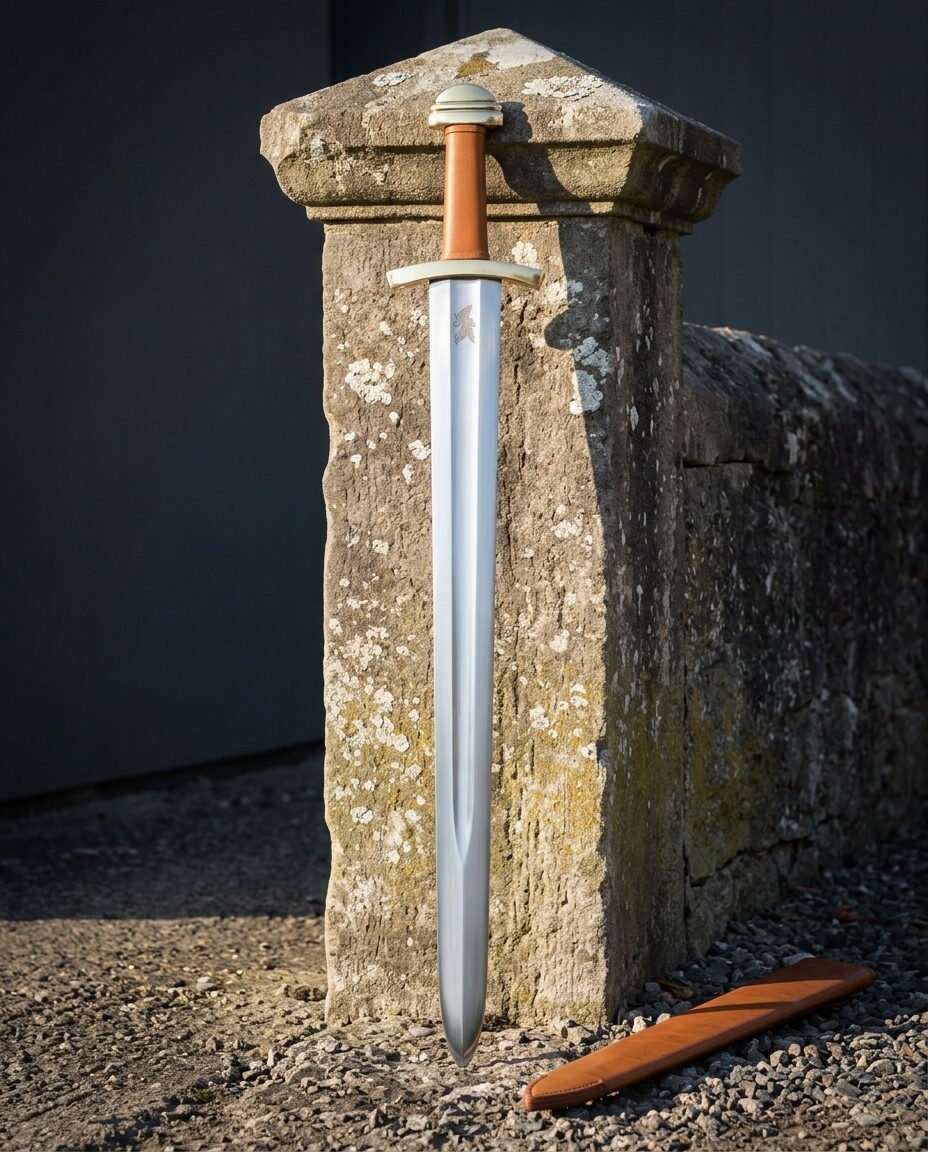
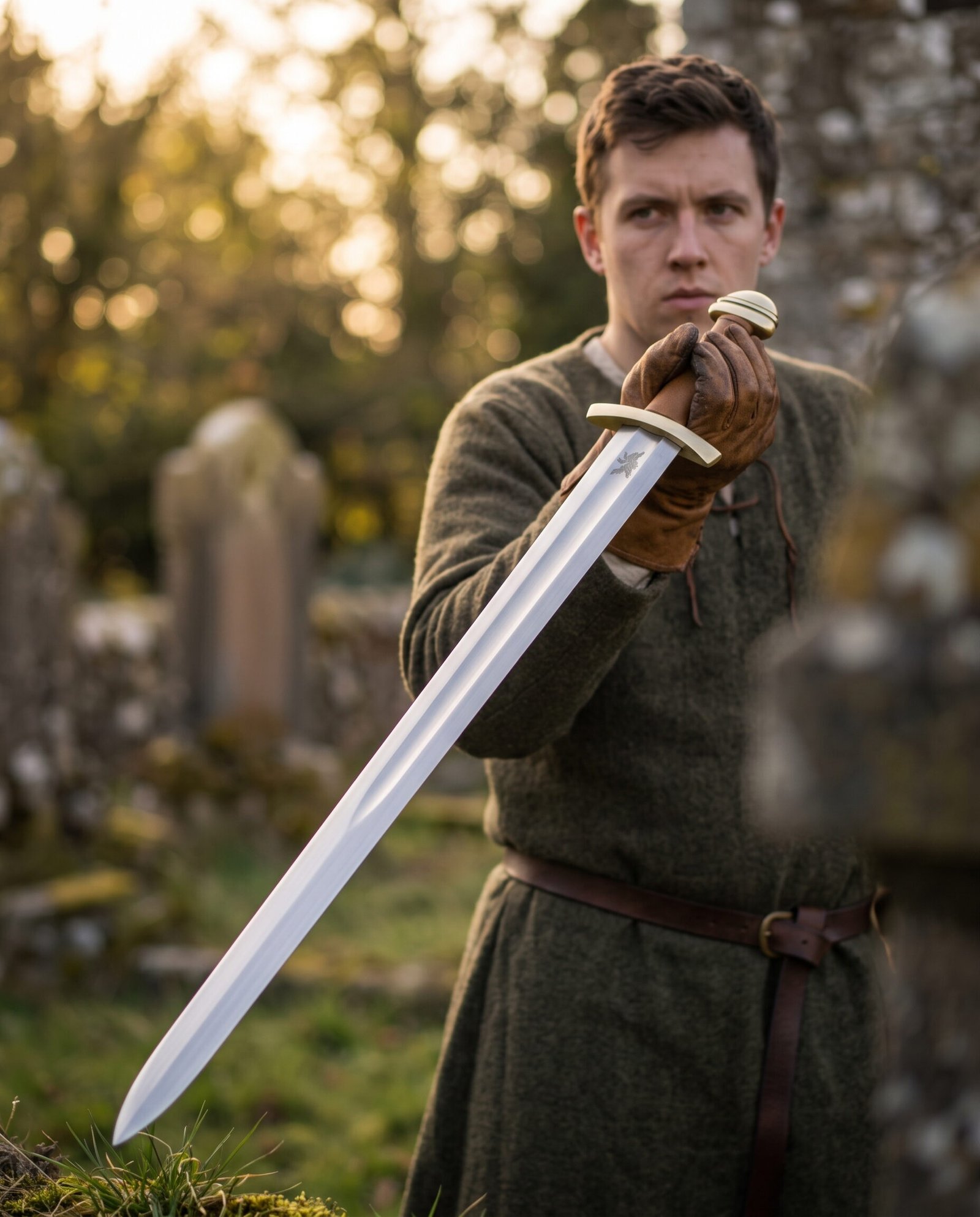
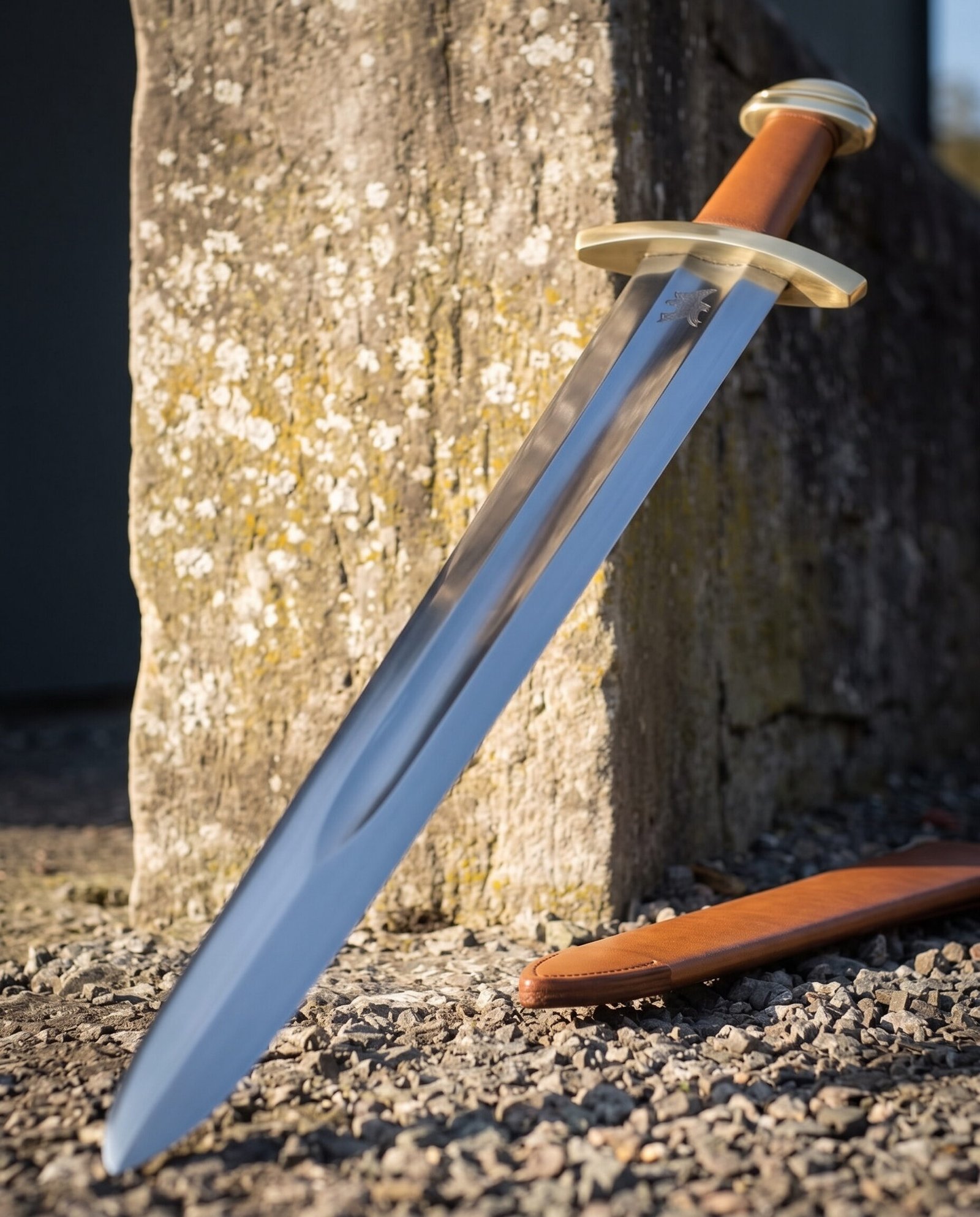
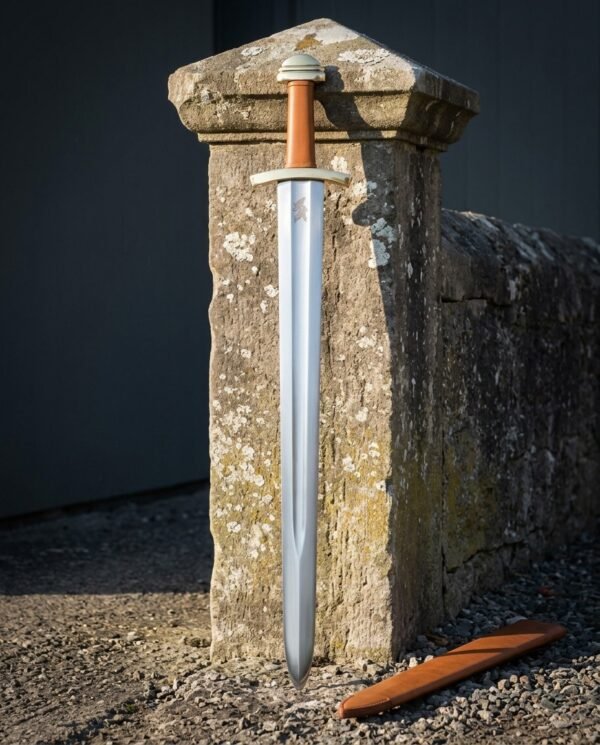
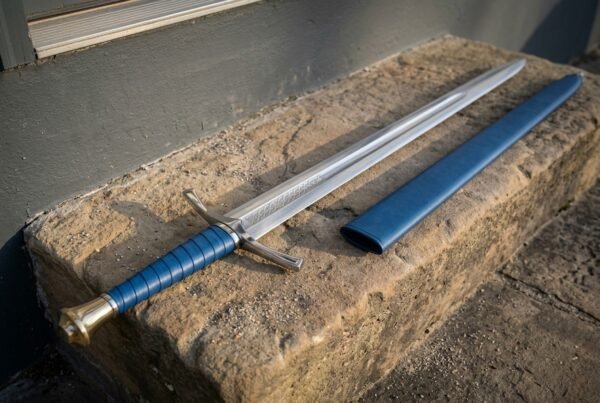
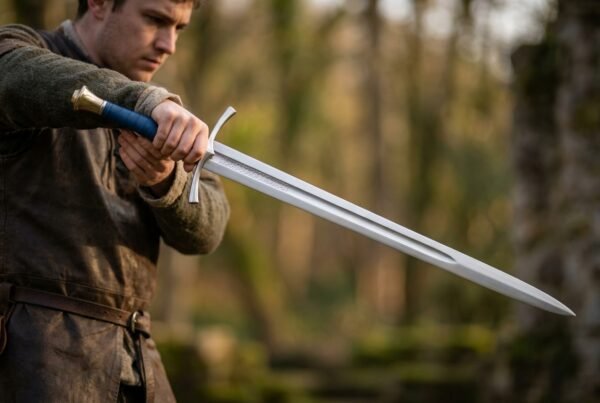
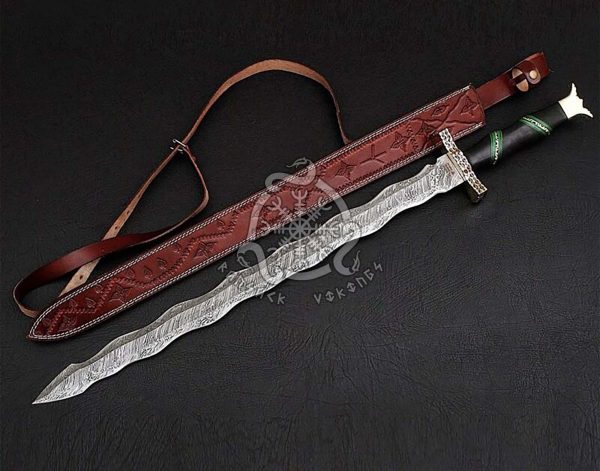
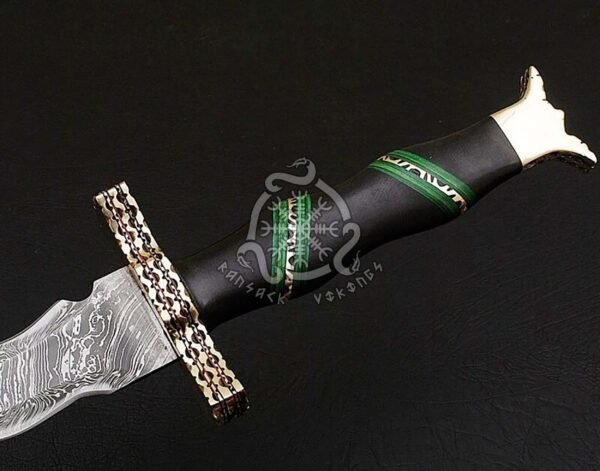
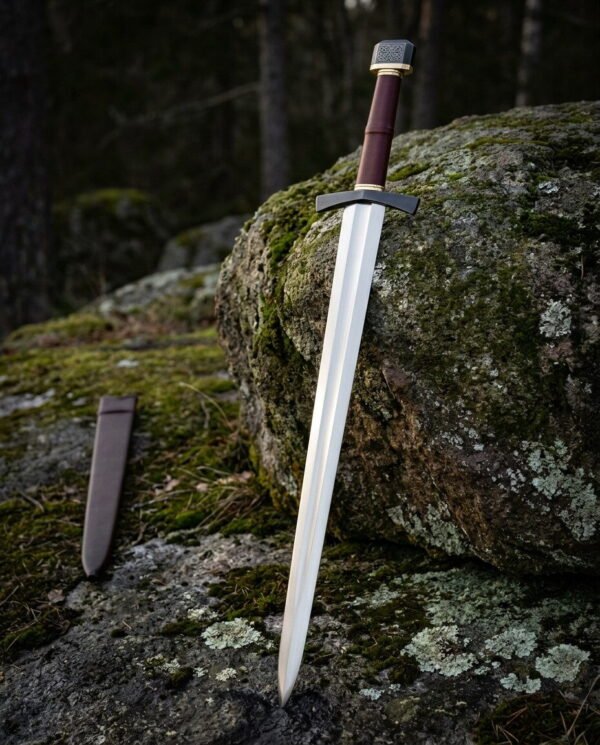
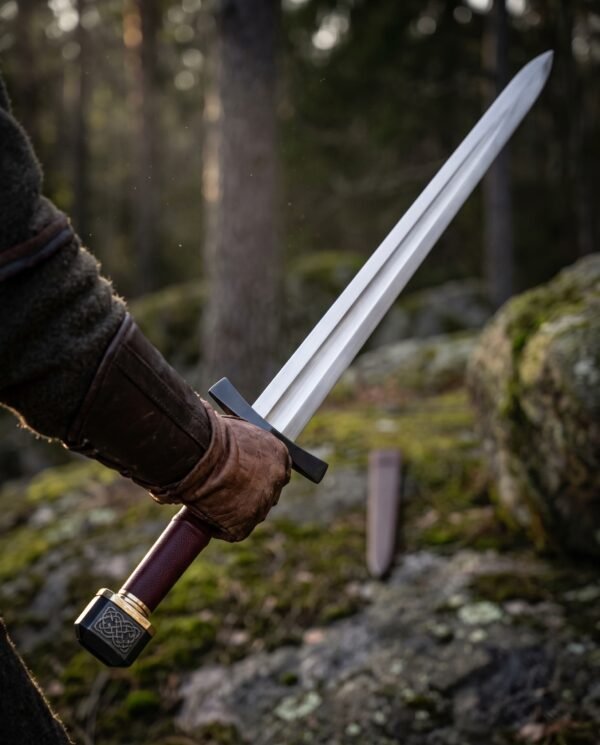
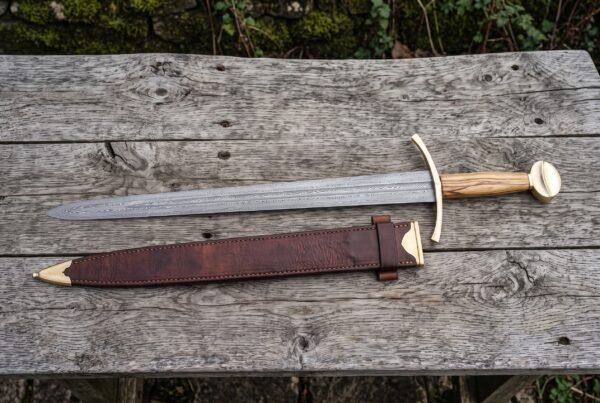
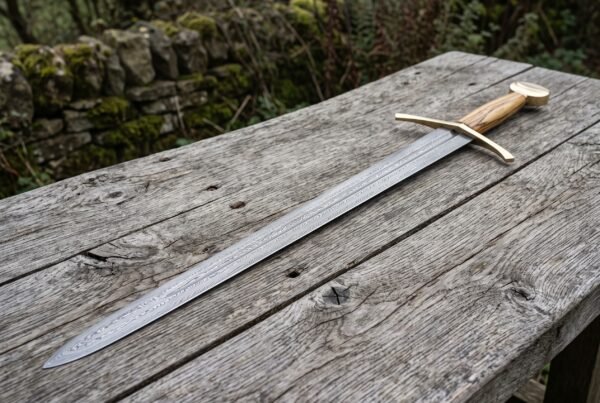
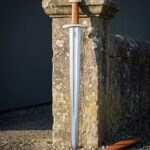
The Emberhilt is a single hand viking sword built on the tenth century pattern, with a broad fullered blade, a curved brass lower guard, a tan leather wrapped grip and a domed brass pommel cap seated on a stepped collar. A small raven is etched into the flat of the blade just above the guard. It ships with a fitted tan leather scabbard with a stitched seam and a leather chape.
The shape of a Norse sword is driven by one thing above all others, which is that it had to be light enough to carry all day on a shoulder or a hip and still cut hard enough to matter in the half second a shield wall gave you. That is why the blade is wide and thin rather than narrow and thick, why the fuller runs almost the whole length, and why so much brass sits behind the hand. Everything about it is a weight argument.
Forged, ground, heat treated, hilted and sharpened in the Czech Republic. It ships with the fitted leather scabbard and a care card. You will find it filed with the Viking swords, while the pattern welded alternatives sit in the Damascus swords.
Specifications
| Blade material | 1095 high carbon steel, hardened and tempered to 54 to 58 HRC |
|---|
| Blade length | Roughly 29 inches |
|---|
| Blade | Broad double edged profile, polished bright, with a wide central fuller running most of the length |
|---|
| Overall length | Roughly 35 inches including grip and pommel |
|---|
| Grip | Roughly 3.5 inches, tan leather over a shaped wooden core |
|---|
| Guard | Curved solid brass lower guard |
|---|
| Pommel | Domed solid brass cap on a stepped collar, peened over the tang |
|---|
| Etching | Single raven mark on the flat of the blade above the guard |
|---|
| Scabbard | Tan leather over a wooden core, hand stitched seam, leather chape |
|---|
| Included | Sword and fitted leather scabbard |
|---|
| SKU | RK-1715 |
|---|
Why the fuller runs down the middle of the blade
The groove down the centre of this blade is a fuller, and the old name for it, blood groove, describes something it never did. It is a stiffening and lightening feature and it works the same way an I beam works in a building. Steel resists bending mostly through the material furthest from the centre line of the section. Take material out of the middle, where it contributes least, and you lose weight much faster than you lose stiffness. On a viking blade a well cut fuller can remove a fifth of the mass while the blade stays essentially as rigid.
You can see the consequence in the surviving finds. Migration period and viking age blades from Norwegian and Danish river and grave finds are wide, often two inches at the shoulder, and remarkably light, frequently under two and a half pounds for a thirty inch blade. That combination is only possible with a deep fuller. It also changes how the sword feels. Mass removed from the middle of the blade lets the point come back under control quickly, which is what you want from a sword used above a shield rim rather than in open ground.
The steel and the brass
The blade is 1095 high carbon steel, forged, normalised, quenched and tempered to 54 to 58 HRC. For a blade this long that band is the right compromise. Harder steel holds an edge longer but a thin wide blade taken past the high fifties starts to behave like glass under lateral load. Softer than the mid fifties and the edge takes a set instead of springing back. Because 1095 carries no chromium it is bright, it sharpens easily on a stone, and it will spot with rust if you leave it wet or fingerprinted.
The guard and pommel are solid brass, filed, fitted and polished. Brass was a real Norse choice, not a modern shortcut. Copper alloy hilt furniture appears on plenty of excavated swords, sometimes inlaid with silver or twisted wire, because it is easy to work cold, does not rust and holds a shine. Here the tang runs through the guard, the wooden grip core and the pommel collar and is peened over the cap, which puts the whole hilt in compression. The grip is wrapped in tan leather and stitched on the underside.
Engraving, runes and your own design
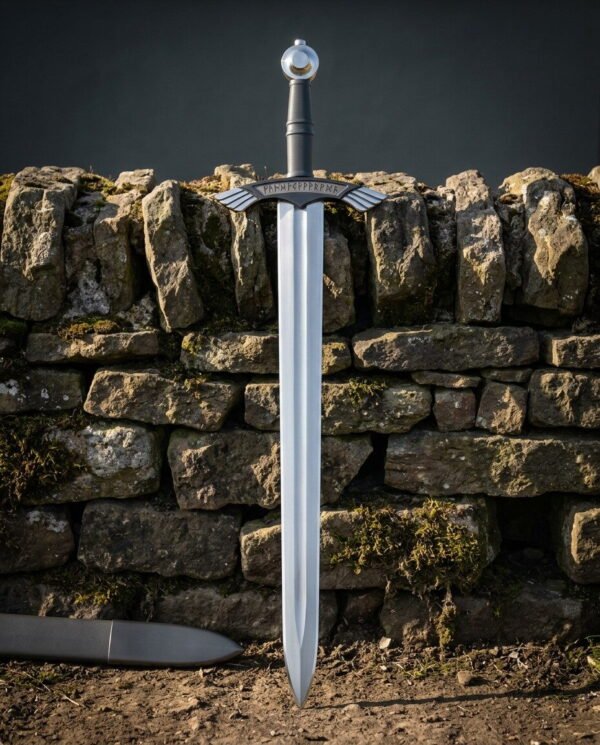
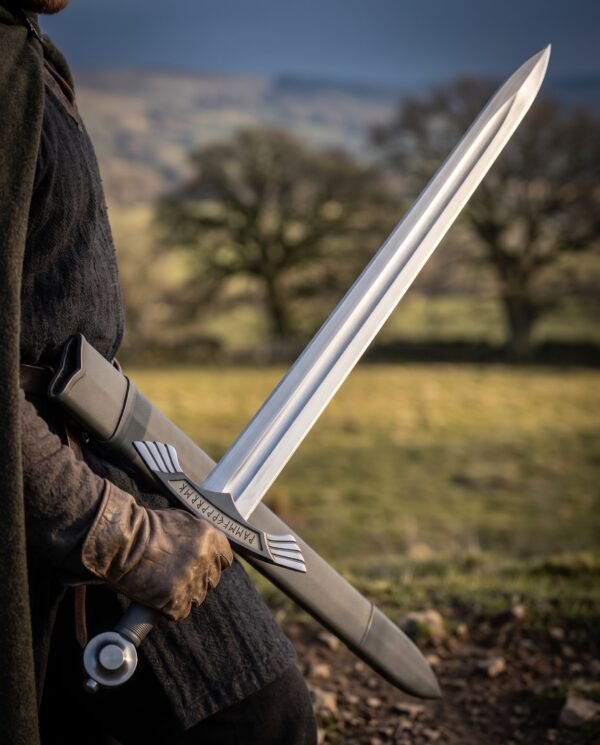
Use the rune converter on this page to turn a name, a date or a short phrase into Elder Futhark and we will cut it into the steel, the leather or the wood. If you would rather have a Viking pattern than a rune line, choose your own design in the engraving option above the add to cart button and tell us where it goes. Where a piece already carries an engraved design, your chosen engraving replaces it rather than sitting alongside it.
The fuller on this blade is the obvious home for a rune line and it will take a long one. The flat above the guard takes a short name, and the brass pommel cap takes a very short mark such as a single bindrune or a set of initials. The leather scabbard can also be stamped. Tell us which you want on the engraving page.
Handling and balance
The point of balance sits roughly four inches ahead of the guard. That is a little further forward than a later medieval arming sword and it is intentional, because a viking blade of this profile is a cutting sword rather than a thrusting one. It rewards a cut delivered from the elbow with the wrist locked, and it feels alive rather than dead when you move it in a figure of eight.
The grip is short, around three and a half inches, which is historically correct and surprises people the first time. A viking hilt is designed for the hand to be trapped between guard and pommel rather than to slide, so it should feel snug. Be clear about what this sword is. It is a sharpened collector, display and dress reenactment piece, hand made and hand balanced. It is not sold for full contact sparring or blade on blade work, and it should not be used against hard targets.
Care
Wipe the blade with an oiled cloth every time you handle it. 1095 has no corrosion resistance and skin oils are acidic enough to etch a print into a polished flat within a few days in a humid room. Light machine oil, camellia oil or a purpose made blade oil all work. There is more detail on steel care.
Do not store the sword in the scabbard for long periods. Leather is hygroscopic and it will hold damp against the steel. Store the blade oiled and out of the scabbard, and keep the scabbard fed twice a year with a neutral leather balm. The brass will dull to a warm patina, which most owners prefer. If you want it bright, use a brass polish on a cloth and keep it off the leather and off the blade.
Made in the Czech Republic
This piece is made by hand in the Czech Republic, in a workshop that still works the old way. The steel is forged, ground, heat treated and finished by smiths who learned the trade from the people before them, and the wood, horn and leather are cut and fitted by hand rather than pressed out on a line. That is also why no two pieces come out exactly the same.
Ransack Viking is a United States company. We import these pieces ourselves, check every one when it lands and ship from our warehouse in Chicago, Illinois. Engraving is done here in the United States after the piece arrives, so your runes or your own design go on before it leaves for you.
A note on handmade variation
This is hand made, not machine made and not bulk produced, so what arrives will not be a pixel for pixel copy of the photograph. The fuller is cut by hand and its width wanders very slightly along the blade. The satin from the final grind lies differently every time. Brass takes a polish at its own rate and no two pommels catch the light identically.
The tan leather is the most variable part. Vegetable tanned hide takes dye unevenly by nature, so the grip and scabbard can land anywhere from a light russet to a deeper amber, and the grain pattern is the record of the animal it came from. Blade length, overall length, steel, hardness and construction are the same on every one. More on the gap between a display sword and a battle ready one elsewhere on the site, along with how steel and hardness actually work.
Frequently asked questions
Is the blade sharp when it arrives
Yes. It comes with a keen working edge along its full length. It is sharp from the moment you open the box, so keep it scabbarded when it is not in your hand.
Is this suitable for reenactment combat
Not for contact. It is fine as a dress and display piece for a kit, and it is correct in profile and weight for that. It is not a blunt, it is not built for blade on blade work, and it should never be used in a bout.
Why is the grip so short
Because that is how viking hilts were made. The hand is meant to be held between the guard and the pommel rather than to move along the grip. Three and a half inches is normal on original finds.
Does it come with the scabbard
It does. The fitted tan leather scabbard over a wooden core, with its stitched seam and leather chape, ships with the sword and is made to that individual blade.
Will the brass tarnish
It will, slowly, to a warm gold brown patina. That is normal and most people leave it. If you prefer it bright, any brass polish restores it in a minute.
How long does shipping take
One to two weeks before it leaves the shop, because the blade is forged and the hilt fitted after you order. US shipping is free.
What is in the box
- One hand forged 1095 viking sword with brass guard and domed pommel
- One fitted tan leather scabbard over a wooden core with a leather chape
- Care card covering oiling, storage and leather feeding
- Lifetime warranty against defects in forging, grind, heat treat and fittings
- Forged and finished in the Czech Republic
Explore the range
See the rest of the viking swords, the wider swords, the Norse arms, and the guides for more on fullers, balance and blade care.
Close to this one
In the same category sits the Splitcrown Viking sword, forged from 1095. A near match for this one is the Bonecrest Viking sword, 36 inches overall. Closest to this in the range is the Knotreave Viking sword, 36 inches overall.
Fitting out further, the Talonsweep Damascus sword belongs with it. Nothing here exactly right, build one to your own spec on the custom Viking sword page.


Perfect gift. Perfect quality. No complaints. Leather sheath is thick and well stitched. Not the cheap stuff you usually get. Worth every penny.
Does the job but I wasn’t blown away.
Five stars isn’t even enough honestly. Weight and balance make it feel like a real functional piece not some cheap replica. 1095 Steel blade holds a razor edge right out of the box. 10/10 would buy again.
Knew this sword was special the second I opened the box. Shipping was fast and everything arrived well packaged.
Can’t stop showing this off to everyone who comes over. This will be a family heirloom for sure.