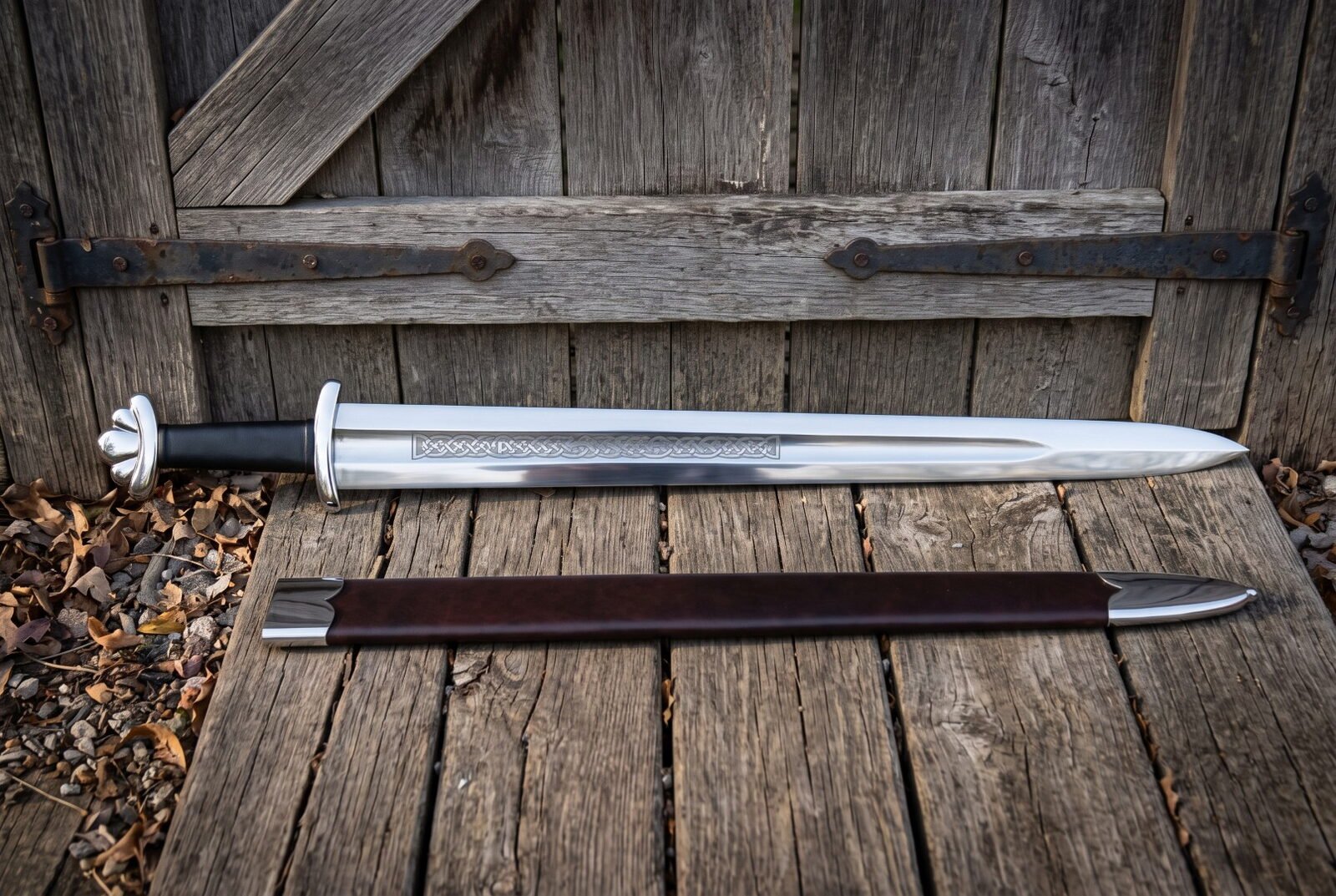
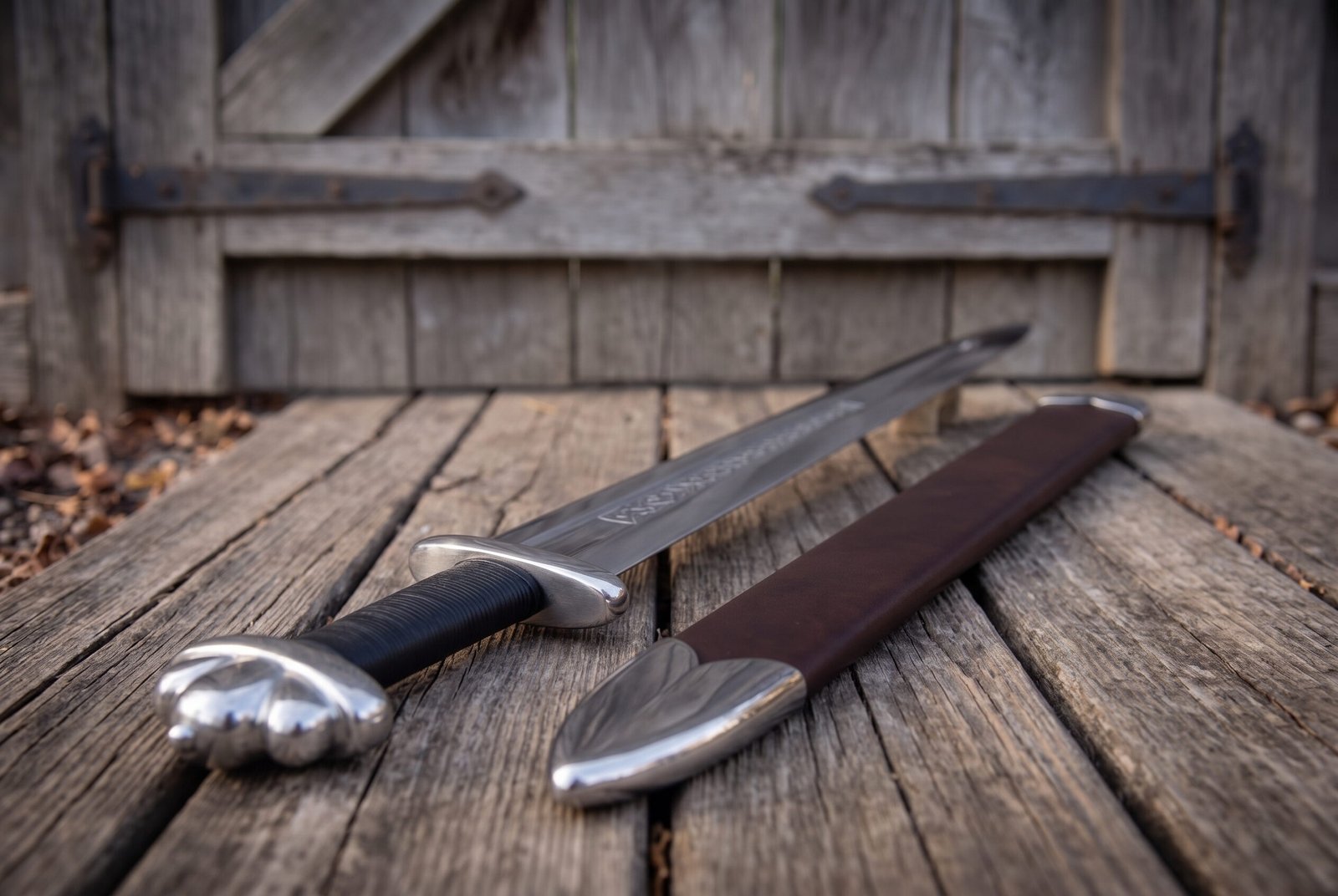
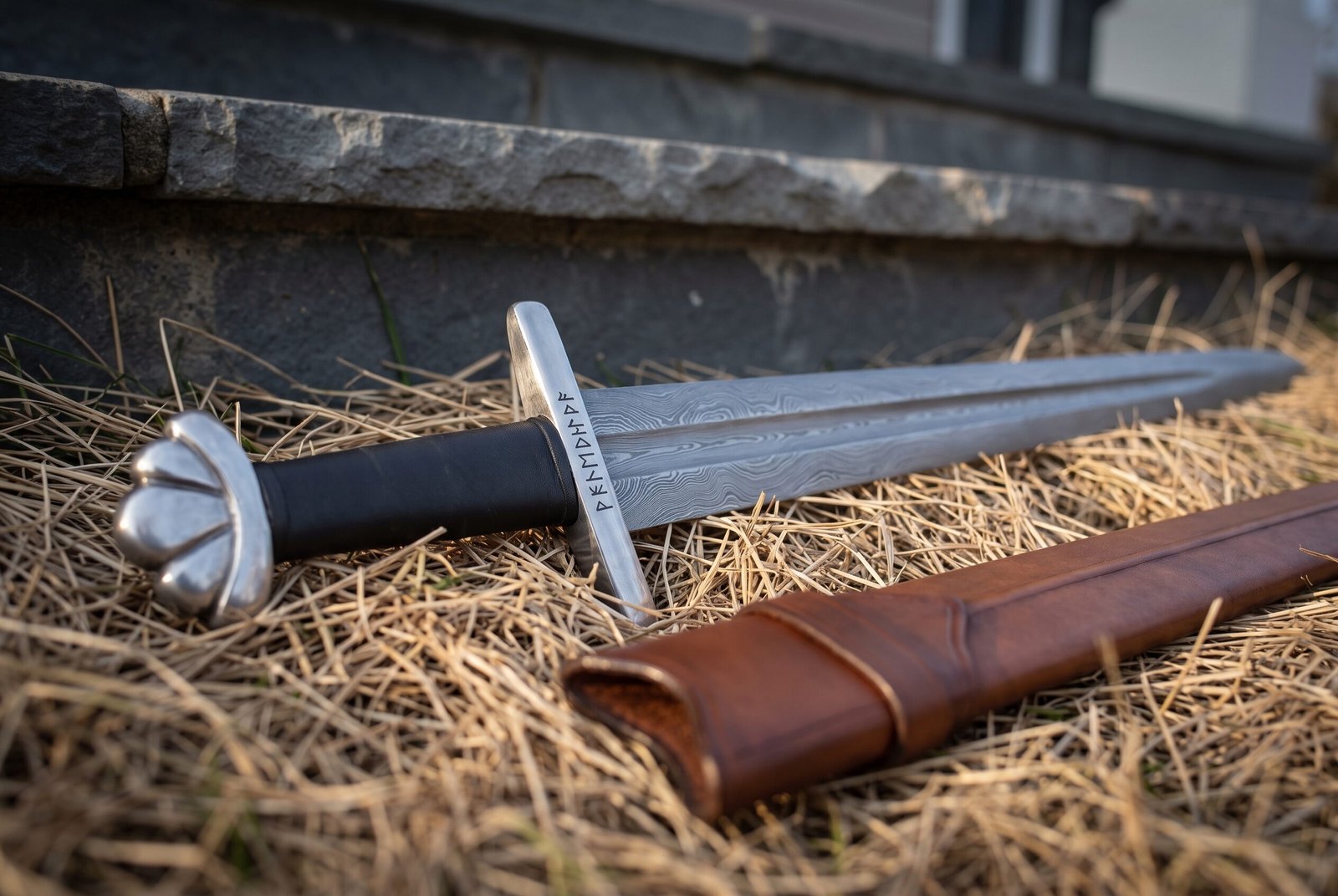
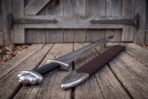
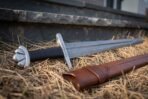
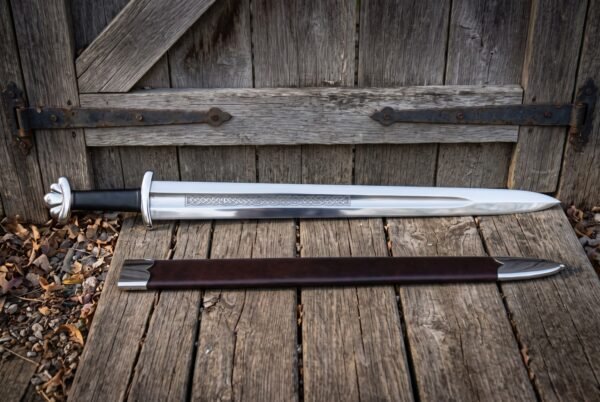
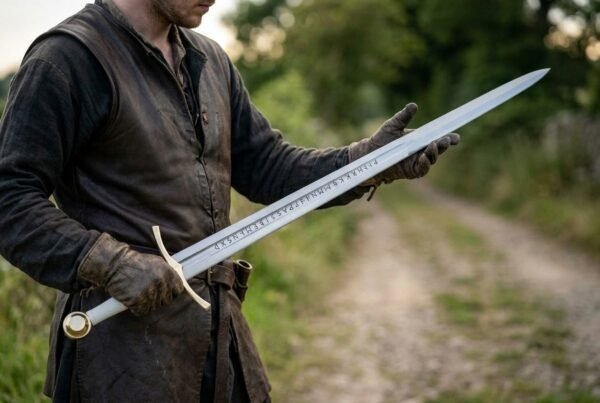
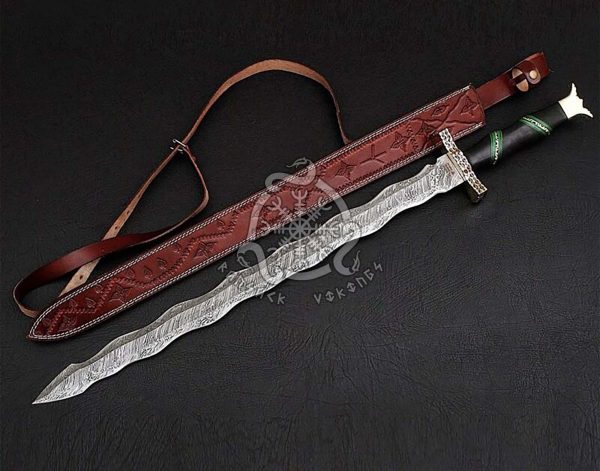
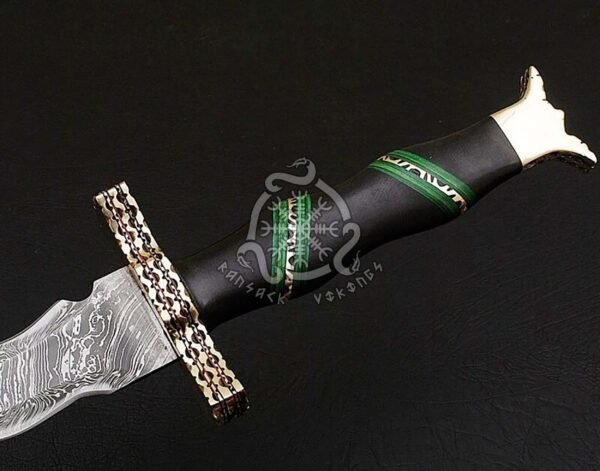
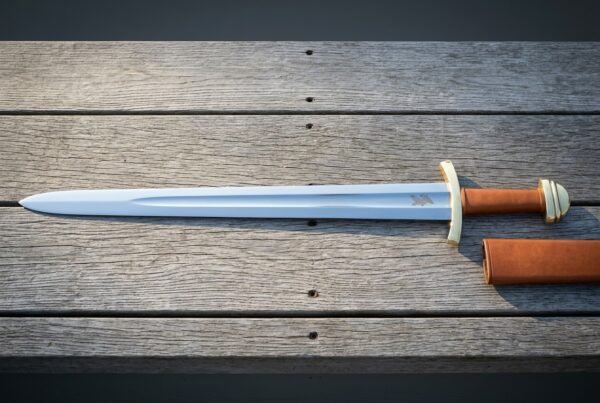
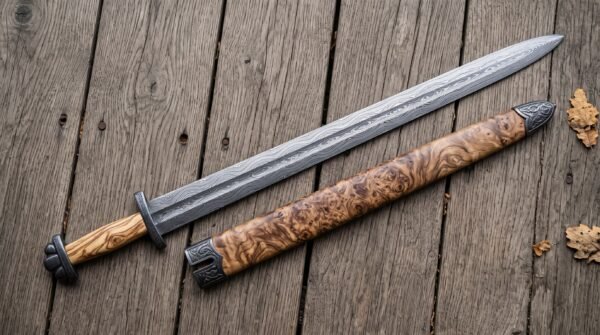
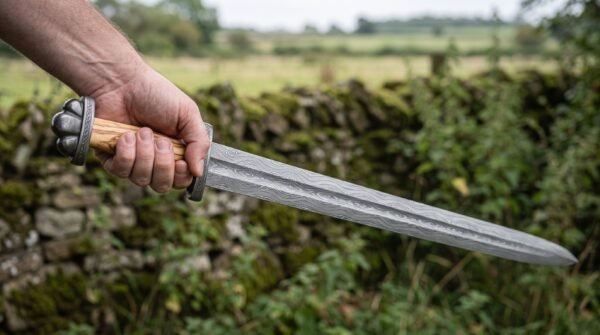
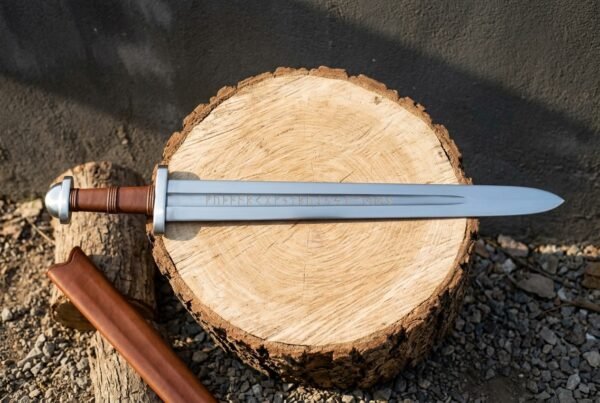
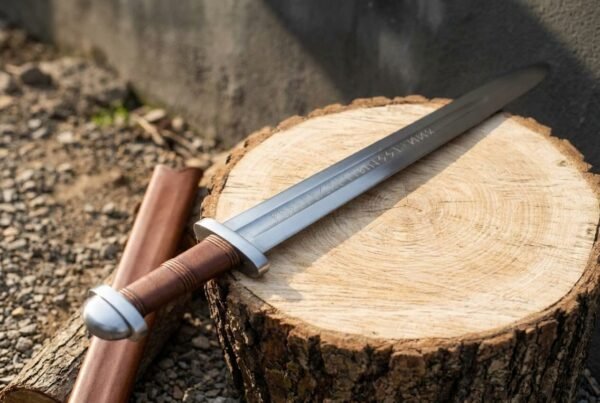
The Knotreave is a Viking age sword of the classic Norse pattern. The pommel is a five lobed cap sitting on a straight upper guard, the lower guard is a short thick bar, and the grip between them is wrapped in black leather. The blade is broad and almost parallel sided before it turns into a short rounded point, with a wide shallow fuller running most of its length and an etched panel of Norse interlace set into it. It comes with a dark brown leather scabbard mounted with a polished steel throat and a matching chape.
Norse swords of this shape have been sorted since 1919 by a typology worked out by the Norwegian archaeologist Jan Petersen, who examined about fifteen hundred sword finds and grouped them almost entirely by hilt form, because blades corrode and hilts survive. The lobed pommel types run through the ninth and tenth centuries and are among the most numerous he recorded. The lobes are not decoration for its own sake. They are the memory of an older way of building a hilt, in which separate panels of contrasting metal were riveted onto a plain pommel cap. When smiths began forging pommels in one piece they kept the divisions, because that was what a sword was supposed to look like. Knotreave is forged, ground, heat treated, etched and fitted by hand in the Czech Republic.
Screen Norse kit gets the sword wrong more often than it gets it right, and the screen arms rated for accuracy rates the ones you have seen. Knotwork carried meaning as often as it was pure decoration, and our note on Norse symbols works through the recurring shapes. A board from the round shields is what usually stands beside one.
Specifications
| Material | 1095 high carbon steel, hardened to 54 to 58 HRC |
|---|
| Overall length | Approximately 36 inches |
|---|
| Blade length | Approximately 29 inches, double edged, nearly parallel sided with a short rounded point |
|---|
| Fuller | Wide shallow fuller running most of the blade |
|---|
| Engraving | Etched Norse interlace panel in the fuller below the guard |
|---|
| Grip | Approximately 4 inches, black leather wrapped over a shaped core |
|---|
| Guard | Short straight lower guard in polished steel |
|---|
| Pommel | Five lobed polished steel cap on a straight upper guard, peened over the tang |
|---|
| Scabbard | Dark brown leather over a shaped core with polished steel throat and chape |
|---|
| Weight | Approximately 2 lb 12 oz bare |
|---|
| Included | Sword, fitted scabbard, care card |
|---|
| SKU | RK-1979 |
|---|
Why a Viking hilt looks nothing like a knightly one
Put this sword next to a medieval arming sword and the differences are all in the hilt. The Norse guard is short, barely wider than a hand, where the knightly cross is wide enough to shelter the wrist. The Norse grip is short too, often only just long enough for a fist, and the pommel is a heavy block rather than a flat wheel. None of that is primitive. It follows from the fact that a Viking age fighter carried a round shield, and the shield did the job that a long crossguard did three centuries later.
With the defence handled by the left arm, the sword could be optimised entirely for hitting things. A short grip locks your hand in one position between the two guards, so the blade cannot roll in the hand. A heavy pommel is the counterweight that keeps a broad blade from feeling nose heavy. And because the sword is not expected to bind and wind against another blade, the guard needs to be nothing more than a stop that keeps your fingers off the edge. The whole hilt is a compact, dense, purposeful lump of steel, and that is exactly how it feels when you pick it up.
The steel and the leather
The blade is 1095 high carbon steel taken to 54 to 58 HRC. Historic Viking blades were pattern welded, not because Norse smiths preferred the look but because they could not reliably get large quantities of good homogeneous steel and welding strips of different iron together was the practical way to build a long blade. Modern 1095 gives us in one bar what they had to construct, so we use it plain and put the ornament where they often put it too, into the fuller. If you want the pattern welded look, our Damascus swords are the ones to go to.
The grip core is shaped to an oval and wrapped in black vegetable tanned leather, dyed through rather than surface coated. The scabbard is the same hide, wet formed to this exact blade and dried hard so it holds its shape, then mounted with a polished steel throat and chape. Steel rather than brass is the correct choice for a Norse sword, since brass mounts belong more to the later medieval world.
Engraving, runes and your own design
Use the rune converter on this page to turn a name, a date or a short phrase into Elder Futhark and we will cut it into the steel, the leather or the wood. If you would rather have a Viking pattern than a rune line, choose your own design in the engraving option above the add to cart button and tell us where it goes. Where a piece already carries an engraved design, your chosen engraving replaces it rather than sitting alongside it. This blade already carries the interlace band in the fuller, so ordering runes for the fuller replaces it. If you want both, put the runes on the lower guard or on the leather of the scabbard. Norse smiths signed blades in the fuller, so a name there is the most authentic placement there is. See the engraving page.
Handling and balance
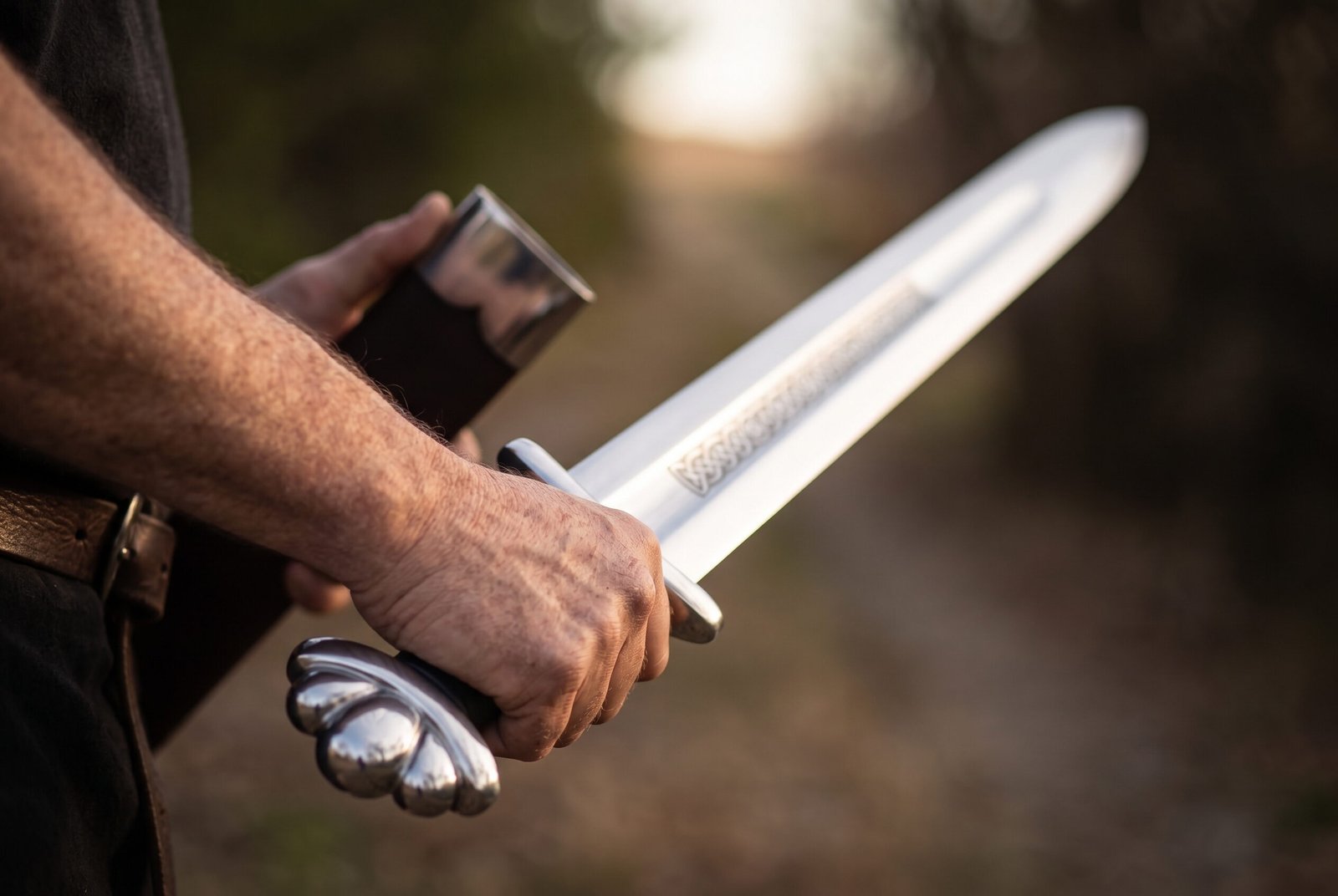
The balance point is around four inches forward of the guard. In the hand the sword feels dense and short coupled rather than long, which is what a Viking sword should feel like. The short grip means there is only one way to hold it and it locks your hand in place. Take it with the last three fingers and let the pommel sit into the heel of your palm.
The blade is a cutting profile with a rounded point, so it wants to be used in arcs rather than in thrusts, and it rewards letting the weight of the blade do the work rather than driving with the shoulder. This is a sharp functional sword suitable for display and for solo cutting on soft targets. It is not a sparring or reenactment combat sword, since those require blunt rebated blades, and it must never be brought into contact with another blade or another person.
Care
Carbon steel and skin salt do not get along. Wipe the blade every time you handle it and keep a light film of oil on it. Pay particular attention to the etched panel, which has more texture than the polished surfaces and will show rust first, and to the join where the lower guard meets the blade, which traps moisture.
Feed the leather grip and scabbard two or three times a year with a neutral cream, worked in and buffed off. Do not store the sword sheathed for long periods in a damp room, because vegetable tanned leather draws moisture and holds it against steel. The steel throat and chape want the same oiling as the blade. Full guidance is on our steel care page.
If it is going on a wall, hanging swords and axes safely covers mounts, fixings and what not to do.
Made in the Czech Republic
Every piece we sell is made by hand in the Czech Republic. The smiths there work the way the trade has been worked for a long time, heating and hammering the steel, taking the bevels down by eye, and fitting the handle and the leather one at a time. There is no automated line anywhere in it, so small differences from one piece to the next are normal and expected.
Ransack Viking is a United States company based in Chicago, Illinois. We bring the pieces in ourselves, inspect them on arrival and ship them from our own warehouse. If you add engraving, that is carried out here in the United States before your order goes out.
A note on handmade variation
This sword is hand made rather than machine made or bulk produced, so what arrives will not be a pixel for pixel copy of the photograph. The lobes on the pommel are cut and filed individually, so their exact profile and the depth of the divisions between them will be slightly its own. Hammer texture shows on the flats under raking light. The etched panel varies in contrast from one blade to the next, and leather takes dye differently across a hide so the scabbard may be a shade lighter or darker. The dimensions, the material and the build are the same every time. The character is not.
Frequently asked questions
Is it sharp on arrival
Yes, it ships with a hand finished cutting edge. Ask in the order notes for a blunt edge if it is going on a wall or into a house with children and we will do it at no extra cost.
Is the blade pattern welded
No. This one is plain 1095 high carbon steel with an etched interlace panel in the fuller. If you want a genuinely pattern welded Norse blade, look at our Damascus Viking swords.
Can I use it in a reenactment
Not for combat. Reenactment fighting requires blunt rebated blades that meet the rules of the society you fight with. This sword is fine as a display or costume piece as long as it stays sheathed.
Why is the grip so short
Because Viking hilts were short. The grip is meant to lock a single fist between the two guards so the blade cannot roll. If you have very large hands, tell us and we can add half an inch.
Does the scabbard come with a belt or baldric
Not as standard. It is a fitted scabbard with steel mounts. Message us before ordering if you want suspension rings or a baldric and we will quote for it.
How quickly does it ship
One to two weeks of processing, then free tracked shipping inside the US from Chicago.
What is in the box
- Knotreave Viking sword, sharpened unless you ask otherwise
- Fitted dark brown leather scabbard with steel throat and chape
- Care card and lifetime warranty note
- Forged and finished in the Czech Republic
Explore the range
See more in Viking swords, Norse arms, scabbards and sheaths and swords, or read the guides.
Others in the same line
If this one is not quite right, there is the Oathbright Viking sword, 30 inches overall. Also in this group is the Emberhilt Viking sword, forged from 1095. Sitting beside it in the catalogue is the Bonecrest Viking sword, 36 inches overall.
From the same corner of the shop, there is the Ashenroot arming sword. You can have this made your way instead on the custom Viking sword page.

Got this as a gift and now I want one for myself too. Edge retention has been great even after regular use. Highly recommend this one.
It’s a decent sword. Nothing extraordinary though. Blade edge needed some sharpening out of the box. It’s fine but I expected a little more for the price. Not bad, not amazing either.
Got this as a gift and now I want one for myself too. Edge retention has been great even after regular use. Worth every penny.