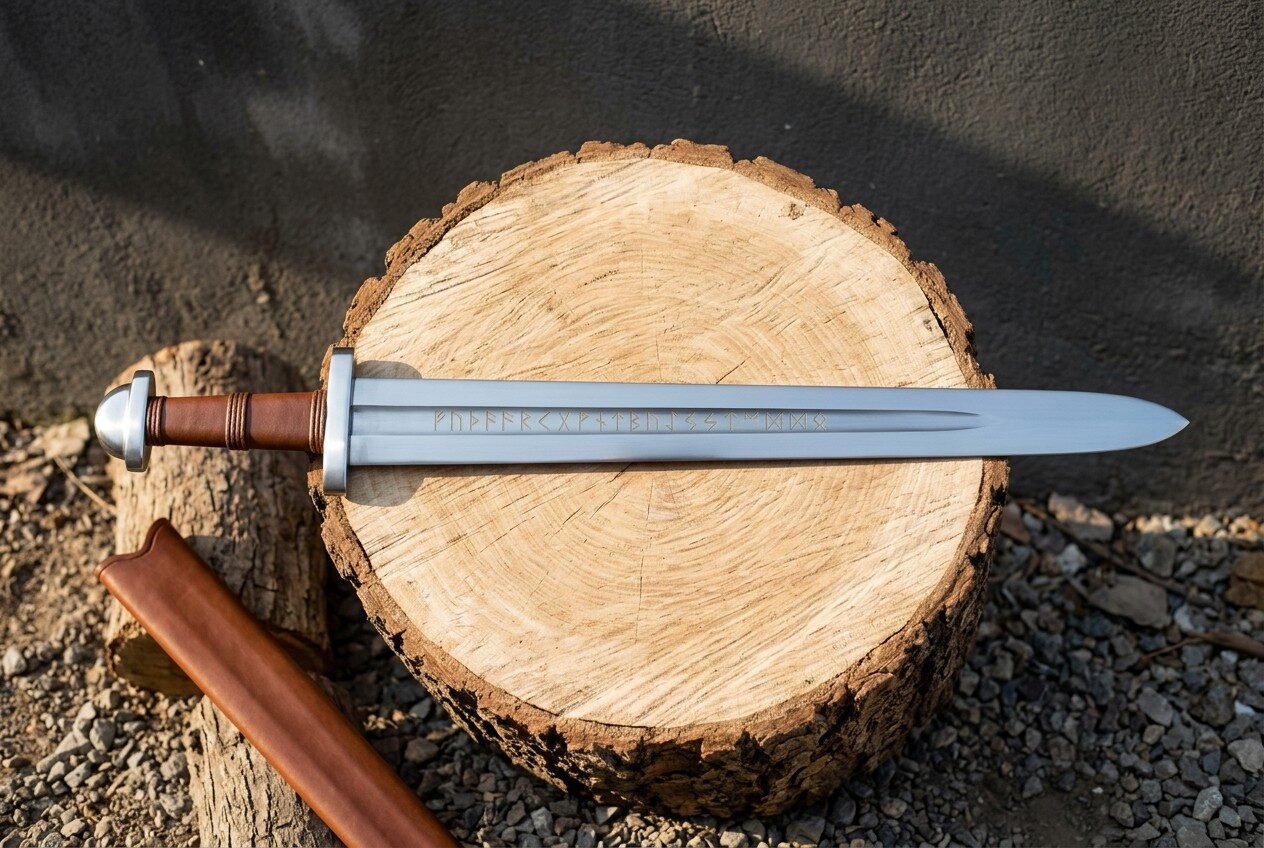
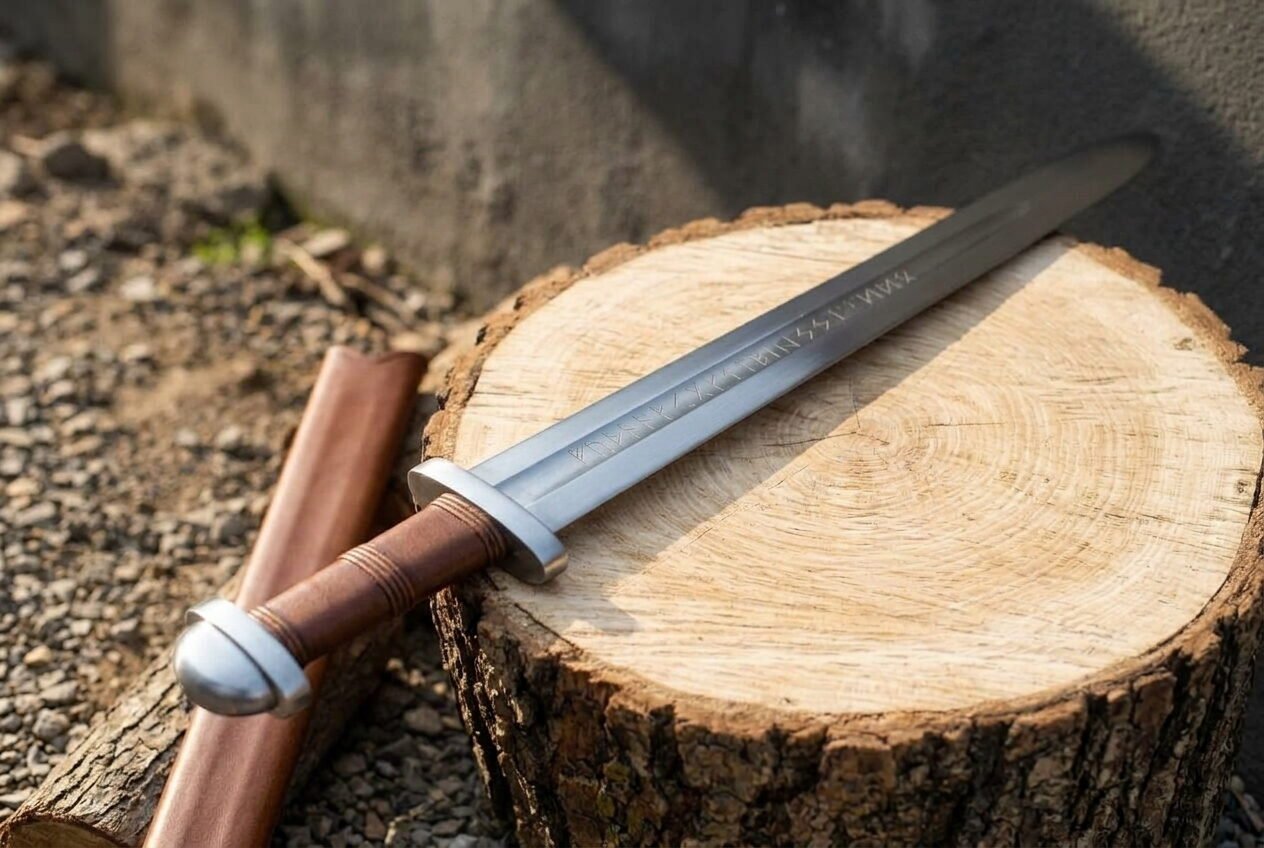
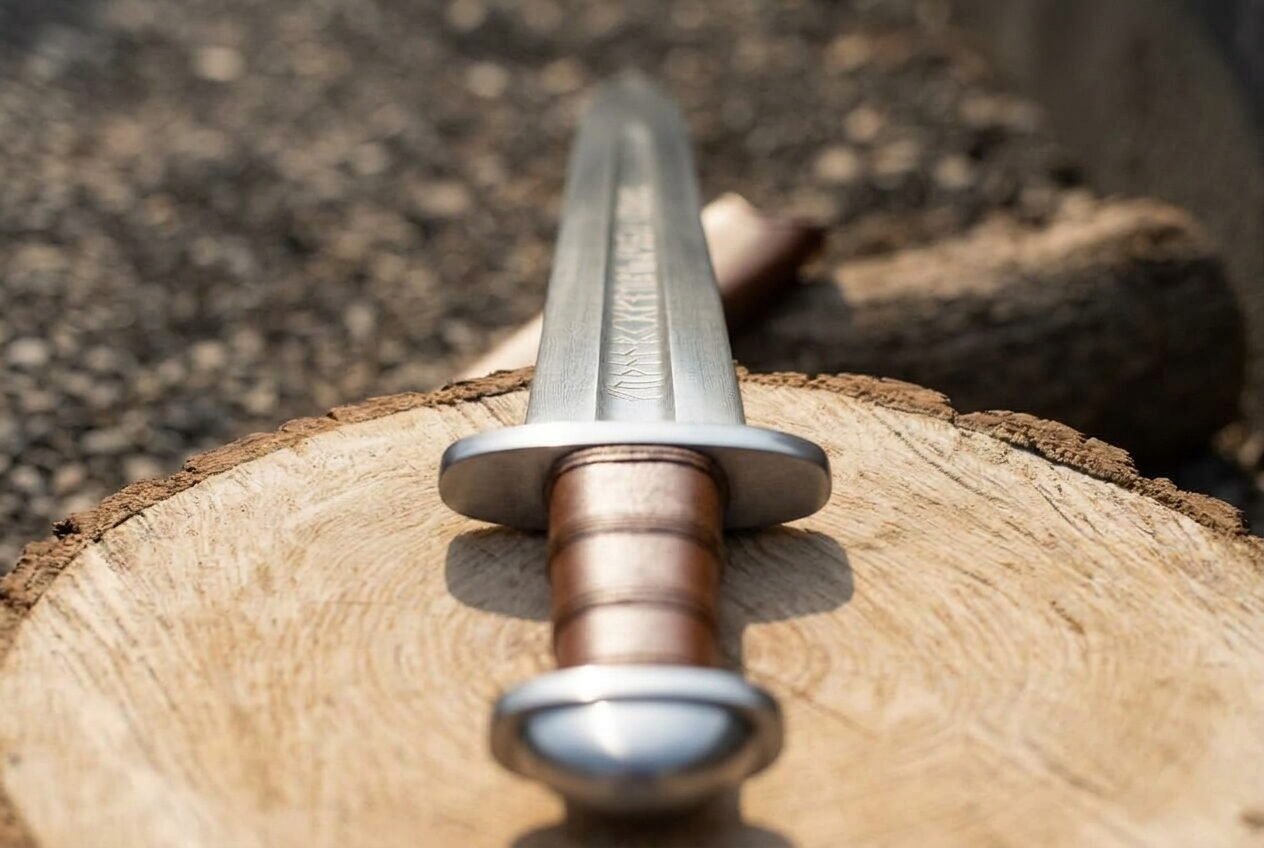
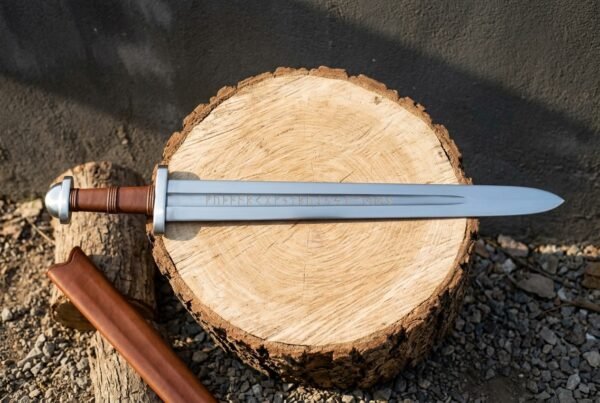
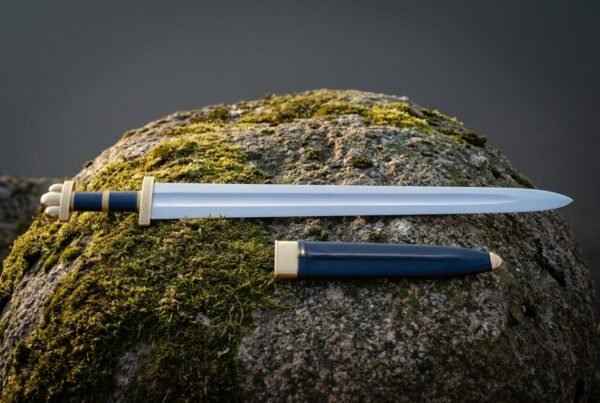
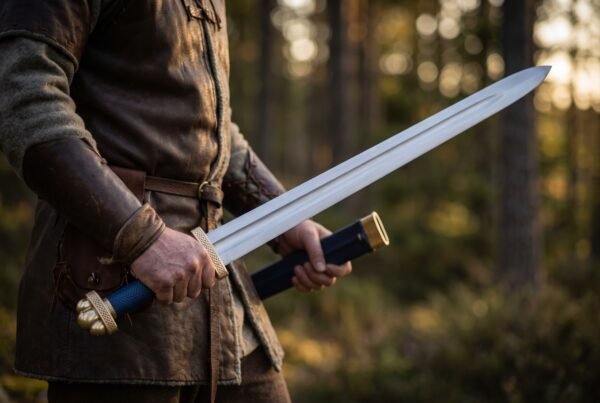
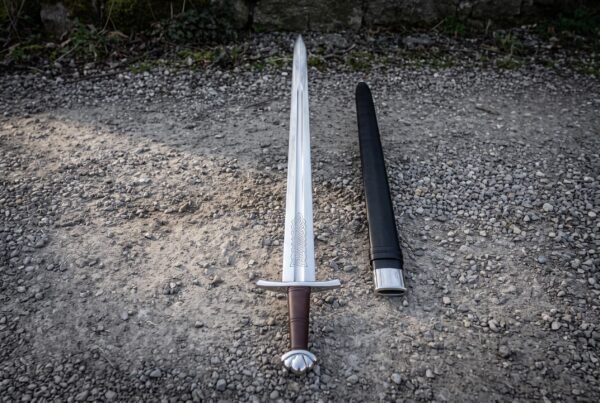
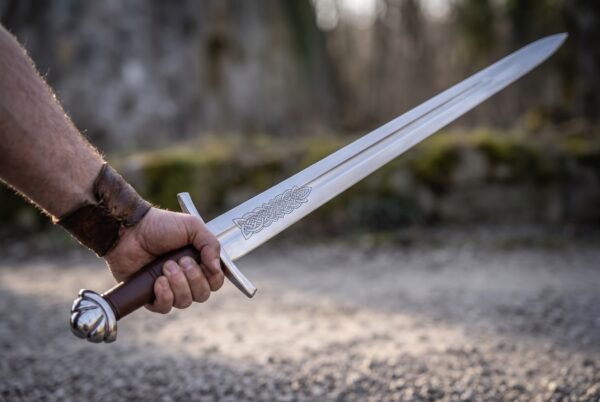
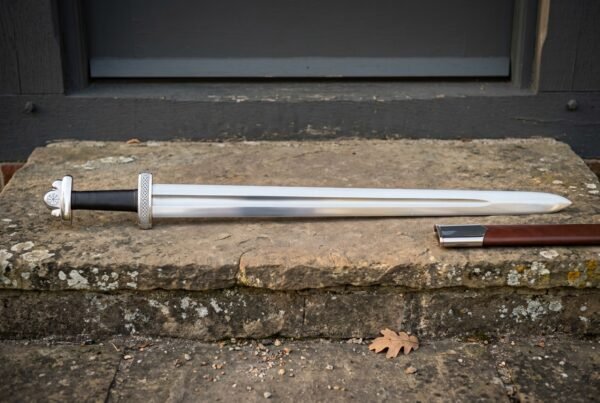
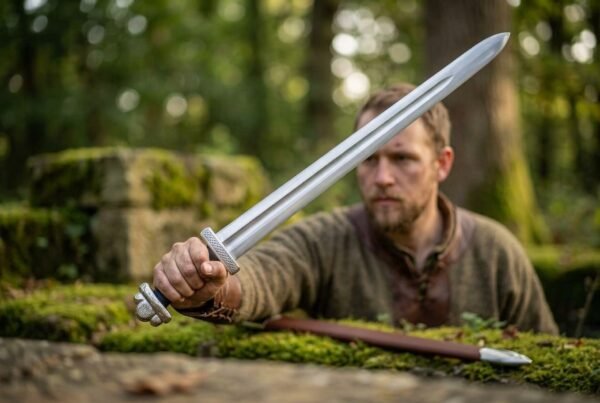
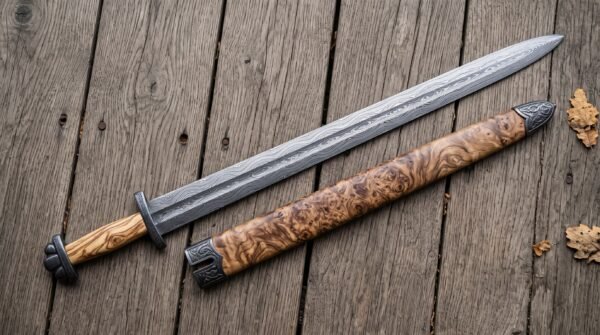
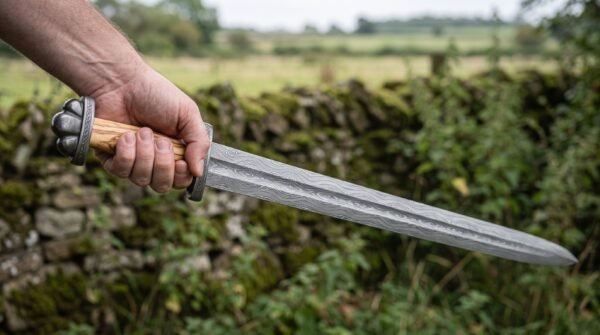
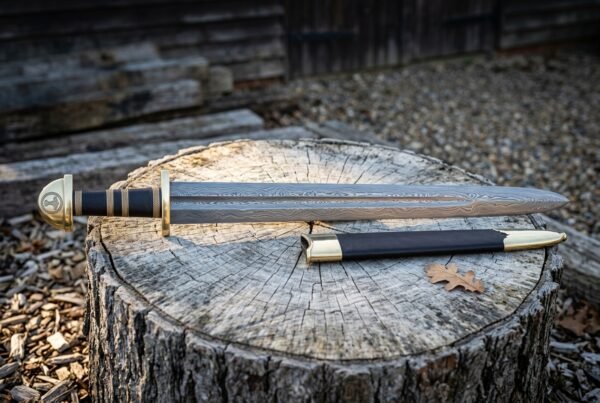
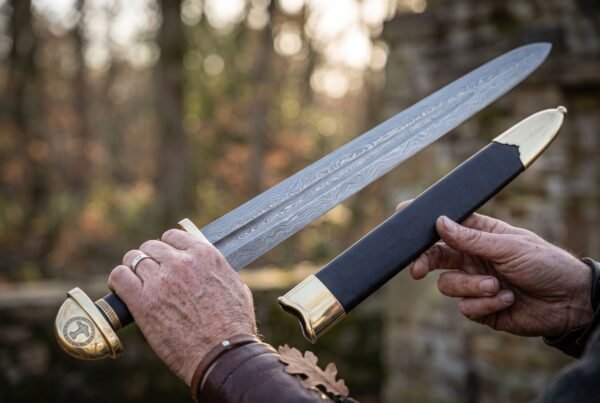
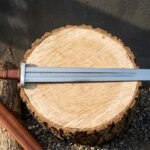
This is a single handed Viking sword with a broad double edged blade carrying a line of Elder Futhark runes cut into the fuller, a plain steel lower guard, a grip wrapped in russet leather with cord risers underneath, and a domed steel pommel peened over the tang. It comes with a fitted leather covered scabbard. It is hand forged from 1095 high carbon steel and finished satin bright.
Inscribed blades are not a modern invention dressed up as history. The most famous group of Viking age swords are the Ulfberht blades, more than a hundred and seventy of which have been found across northern Europe, all carrying the same name inlaid into the fuller in iron or steel letters. They were made over roughly two centuries, which means Ulfberht was not one man but something much more like a workshop mark or a brand. Metallurgical analysis has shown that the genuine ones are made of remarkably clean high carbon steel, while a large number of contemporary fakes carry a misplaced cross in the inscription and are made of ordinary bloomery iron. Someone in the tenth century was counterfeiting sword brands, and someone else was learning to spot it by reading the punctuation.
Each sword is forged, ground, heat treated, engraved, polished and hilted in a Czech Republic workshop, and the grip is risered and wrapped by hand. It ships in its scabbard with blade oil and a care card. It sits in the Viking swords. The arming swords cover the same ground from a different angle.
Specifications
| Blade material | 1095 high carbon steel, hardened and tempered to 54 to 58 HRC |
|---|
| Overall length | Approximately 35 inches |
|---|
| Blade length | Approximately 29 inches, double edged with a wide central fuller |
|---|
| Inscription | Elder Futhark rune line cut along the fuller on one face |
|---|
| Guard | Plain straight steel lower guard |
|---|
| Grip | Russet leather wrapped over cord risers on a shaped hardwood core, single hand |
|---|
| Pommel | Domed polished steel upper pommel, peened over the tang |
|---|
| Scabbard | Brown leather covered wooden scabbard, fitted to the blade |
|---|
| Finish | Satin polished blade and fittings, oiled leather |
|---|
| Weight | Approximately 2 lb 7 oz |
|---|
| Included | Sword, scabbard, blade oil, care card |
|---|
| SKU | RK-1702 |
|---|
Why the grip has ridges under the leather
Squeeze the grip and you can feel raised bands under the wrap. Those are risers, cord laid over the wooden core before the leather goes on, and they are one of the details that separate a sword built by someone who has held one from a sword built from a photograph. A smooth cylindrical grip has to be gripped hard to stop it rotating in the hand. Risers give the palm something to key against, so the sword can be held loosely and still stay oriented, and a loose grip is what lets a blade change direction quickly.
They also solve a subtler problem. Leather stretches. A wrap over a smooth core will loosen and start to creep within a season of handling. A wrap over risers is locked by the ridges and cannot slide along the grip even as it relaxes. Surviving grip cores from the period show exactly this construction, sometimes with cord and sometimes with carved ridges cut straight into the wood.
The pommel is peened, not threaded. The tang runs through it and is hammered over into a rivet head that spreads and locks the whole hilt under compression. There is no nut to work loose, which is the standard failure point on assembled swords.
The steel, the fuller and the engraving
The blade is 1095, a plain high carbon steel of just under one percent carbon, hardened and tempered to 54 to 58 HRC. That range is deliberate for a long blade. Harder steel holds an edge longer but becomes brittle, and a brittle sword fails suddenly and in pieces rather than bending and returning. Any maker claiming 60 plus on a twenty nine inch blade is describing a piece that must never flex.
The wide fuller is not a blood groove, whatever the internet says. It is a structural feature that removes metal from the centre of the flat where it does least for stiffness, leaving mass concentrated at the edges and spine. The blade ends up lighter without losing meaningful rigidity, which is the same principle as an I beam. It is also the flattest and most even part of the blade, which is exactly why inscriptions have always gone there.
The rune line is cut into the steel with gravers after polishing, so the strokes have crisp shoulders and catch the light from a distance. It is cut, not etched. An etched line is shallow and fades with polishing over decades. A cut line is still there in a hundred years.
Engraving, runes and your own design
Use the rune converter on this page to turn a name, a date or a short phrase into Elder Futhark and we will cut it into the steel, the leather or the wood. If you would rather have a Viking pattern than a rune line, choose your own design in the engraving option above the add to cart button and tell us where it goes. Where a piece already carries an engraved design, your chosen engraving replaces it rather than sitting alongside it.
That last point matters more on this sword than on most, because the fuller inscription is the defining feature of the piece. If you order a custom rune line it goes in the fuller in place of the standard one, not underneath it or beside it. If you want to keep the standard line and add something of your own, we can put a second line on the reverse face of the blade or on the scabbard. Say so in the order notes and see the engraving page.
Handling and balance
The balance point sits roughly four inches ahead of the guard, which is the right place for a broad single handed Viking sword. The type is a cutting sword. It has a rounded or gently pointed tip rather than a sharp thrusting point, and its mass is distributed to make the edge arrive with authority, which is why these swords feel so different in the hand from a later tapered arming sword.
This is a hand forged display, collection and reenactment piece. We do not sell it as a battle ready sparring sword and it should not be used for full contact bouts or edge on edge cutting against another blade. Swords for steel fighting are built blunt to a defined flex specification and are tested to it. This one is built to be a sword, looked at, held and understood.
Care
Wipe the blade and oil it after handling, every time. Bare 1095 turns a fingerprint into an etched mark within days in a humid room, and the engraved rune line will trap a smear of skin oil if you let it. A soft cloth and a few drops of mineral oil, gun oil or blade oil is all it takes. If rust appears, lift it with a rust eraser worked along the length of the blade rather than across it, and be gentle near the engraving so you do not soften the stroke shoulders. There is more in steel care.
Feed the leather grip and the scabbard with a neutral balm once or twice a year. Do not store the sword in the scabbard for years at a time, because wood and leather both hold moisture against steel. Draw it every few months, oil it and put it back.
Made in the Czech Republic
Every piece we sell is made by hand in the Czech Republic. The smiths there work the way the trade has been worked for a long time, heating and hammering the steel, taking the bevels down by eye, and fitting the handle and the leather one at a time. There is no automated line anywhere in it, so small differences from one piece to the next are normal and expected.
Ransack Viking is a United States company based in Chicago, Illinois. We bring the pieces in ourselves, inspect them on arrival and ship them from our own warehouse. If you add engraving, that is carried out here in the United States before your order goes out.
A note on handmade variation
Every sword here is hand made rather than machine made or bulk produced, so what arrives will not be a pixel for pixel copy of the photograph. The rune line is cut by hand with a graver, so stroke depth and spacing carry a human rhythm rather than the dead evenness of a laser. The fuller is ground by hand and its width and run out vary a little. The russet leather takes its dye differently across a hide and the riser cord sits where the hand puts it, so grip texture varies. The length, the steel, the heat treat and the build are the same every time. The character is not. We go further into it in why a full tang matters, and pick it up again in the Ulfberht blades.
Frequently asked questions
What does the rune line on the blade say?
The standard blade carries an Elder Futhark line in the fuller. If you want a specific word, name or phrase instead, use the rune converter on this page and it will be cut in place of the standard line.
Is it sharp out of the box?
It arrives with a finished cutting edge rather than a razor hone. Treat it as sharp. Ask in the order notes if you want it taken further before it ships.
Is the engraving etched or cut?
Cut with hand gravers after polishing. The strokes have real depth and square shoulders, which is why they catch light. An etched line is shallow and fades.
Is this battle ready for reenactment fighting?
No. It is a display, collection and kit piece. It is not built or sold for full contact bouts or edge on edge work against another blade.
Is the scabbard included?
Yes. A leather covered wooden scabbard ships with the sword and is fitted to that specific blade, which is why the two should stay together.
Will mine look exactly like the photograph?
Close, but the graver strokes, the fuller and the leather all carry the hand that made them. The length, the steel and the build do not vary.
What is in the box
- One hand forged 1095 carbon steel Viking sword with a cut Elder Futhark blade inscription
- Fitted leather covered wooden scabbard
- Bottle of blade oil
- Care card covering oiling, rust removal and leather feeding
- Lifetime warranty against defects in forging, grind, heat treat and fittings
- Forged and finished in the Czech Republic
Explore the range
Browse the rest of the Viking swords, the wider sword range and the engraved and personalised pieces, or read the guides for more on inscribed blades, fullers and grip construction.
Near neighbours in the shop
A near match for this one is the Runetooth Viking sword, 38 inches overall. Closest to this in the range is the Moorsweep Viking sword, 36 inches overall. If this one is not quite right, there is the Skaldbone Viking sword, 36 inches overall.
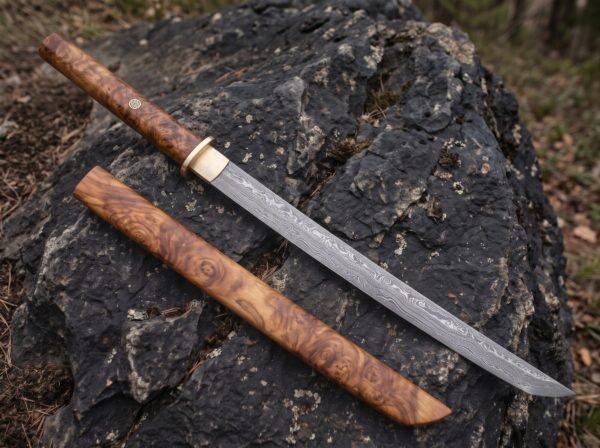
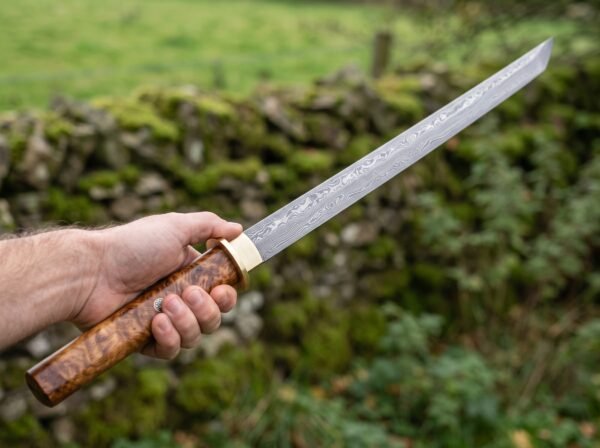
The Nightpath Japanese sword covers the other half of the same kit. You can have this made your way instead on the custom Viking sword page.

Was nervous ordering something like this online but so glad I did. Came in a nice gift box which made it feel even more special. Already telling my friends to check this out.