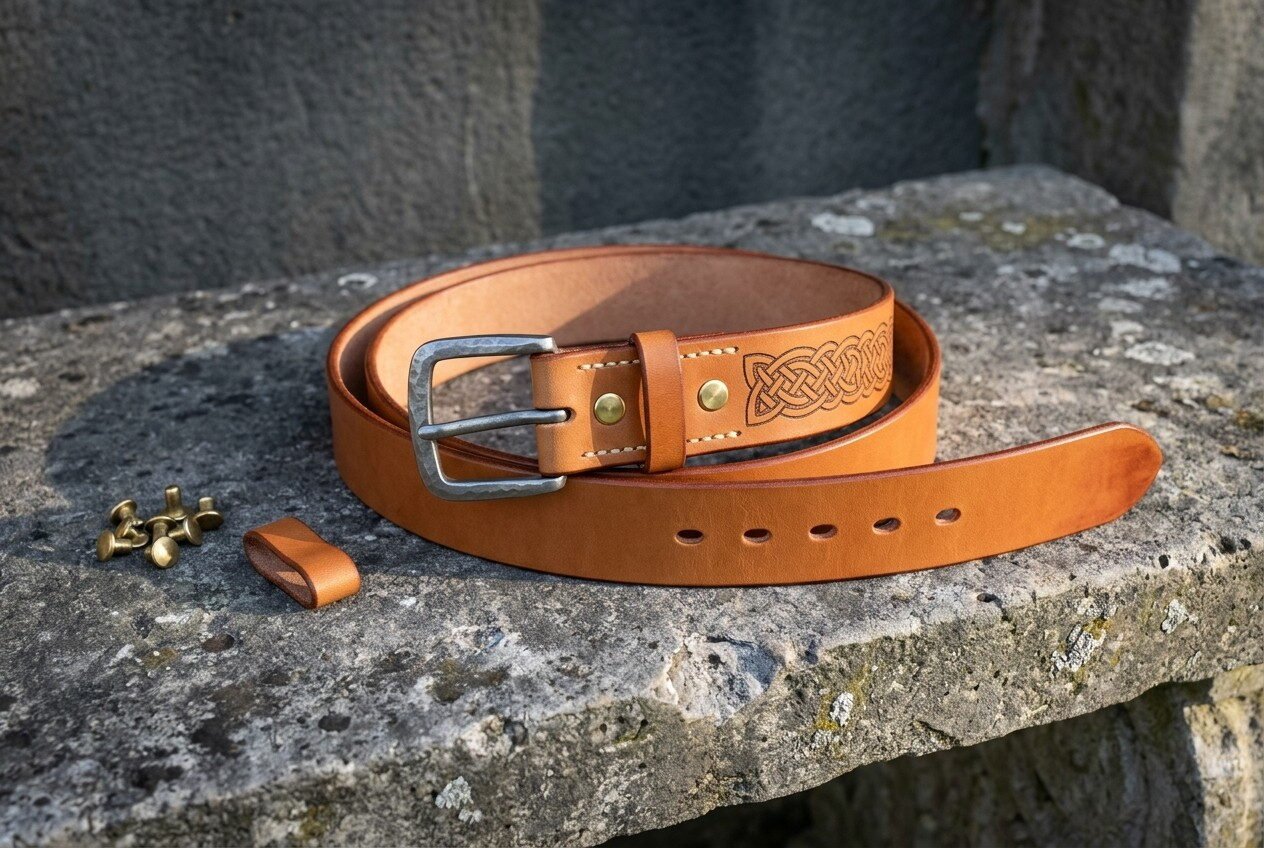
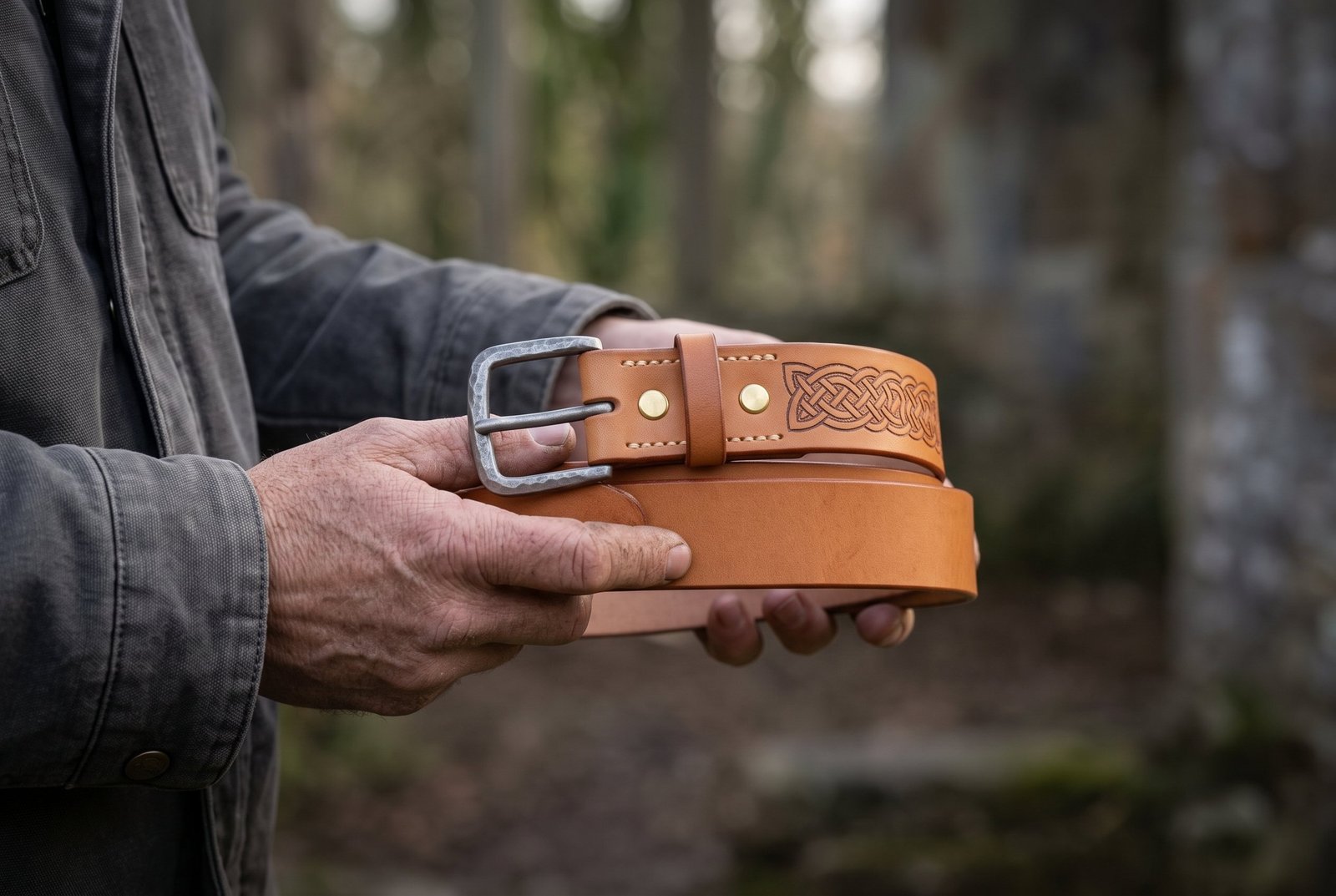
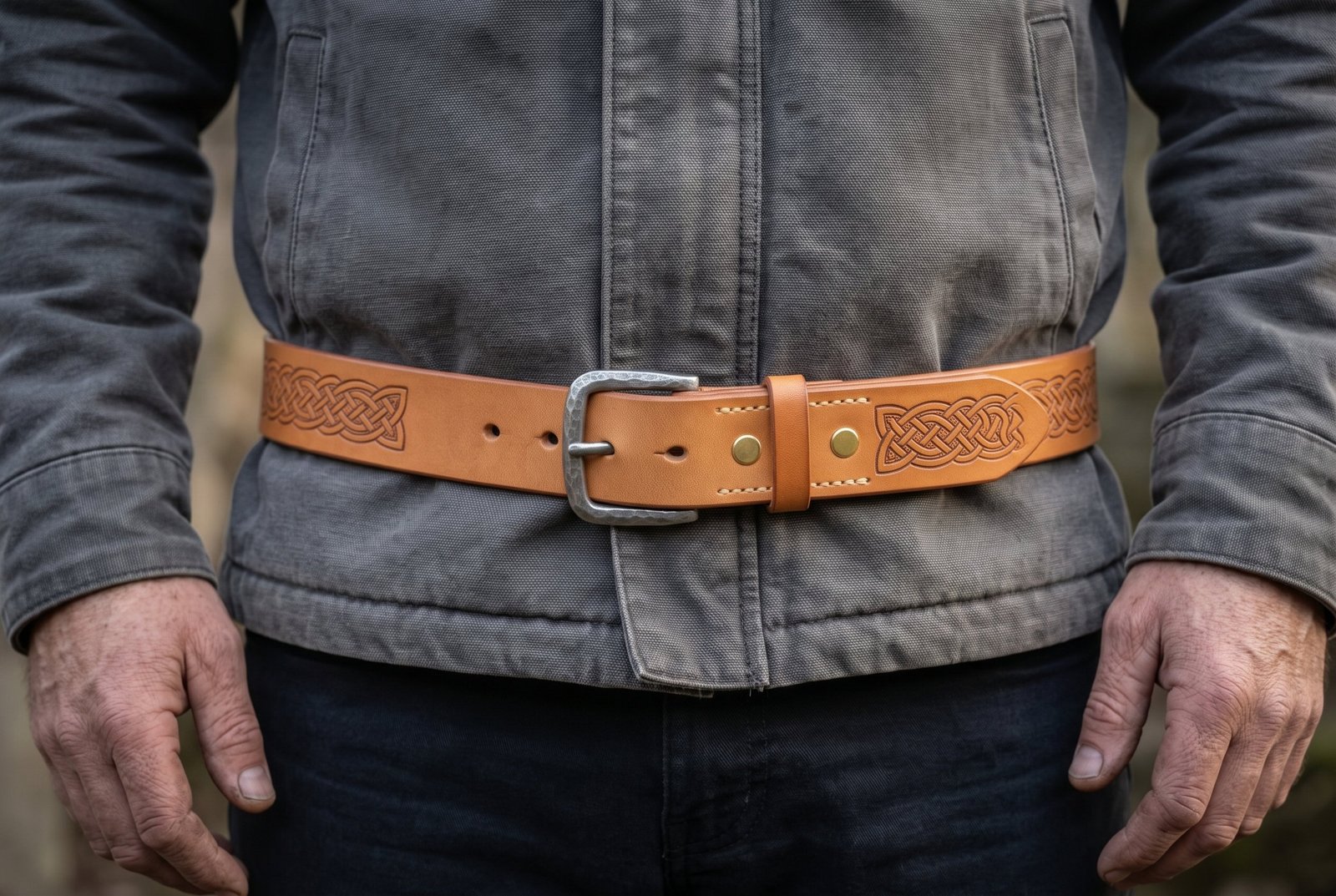
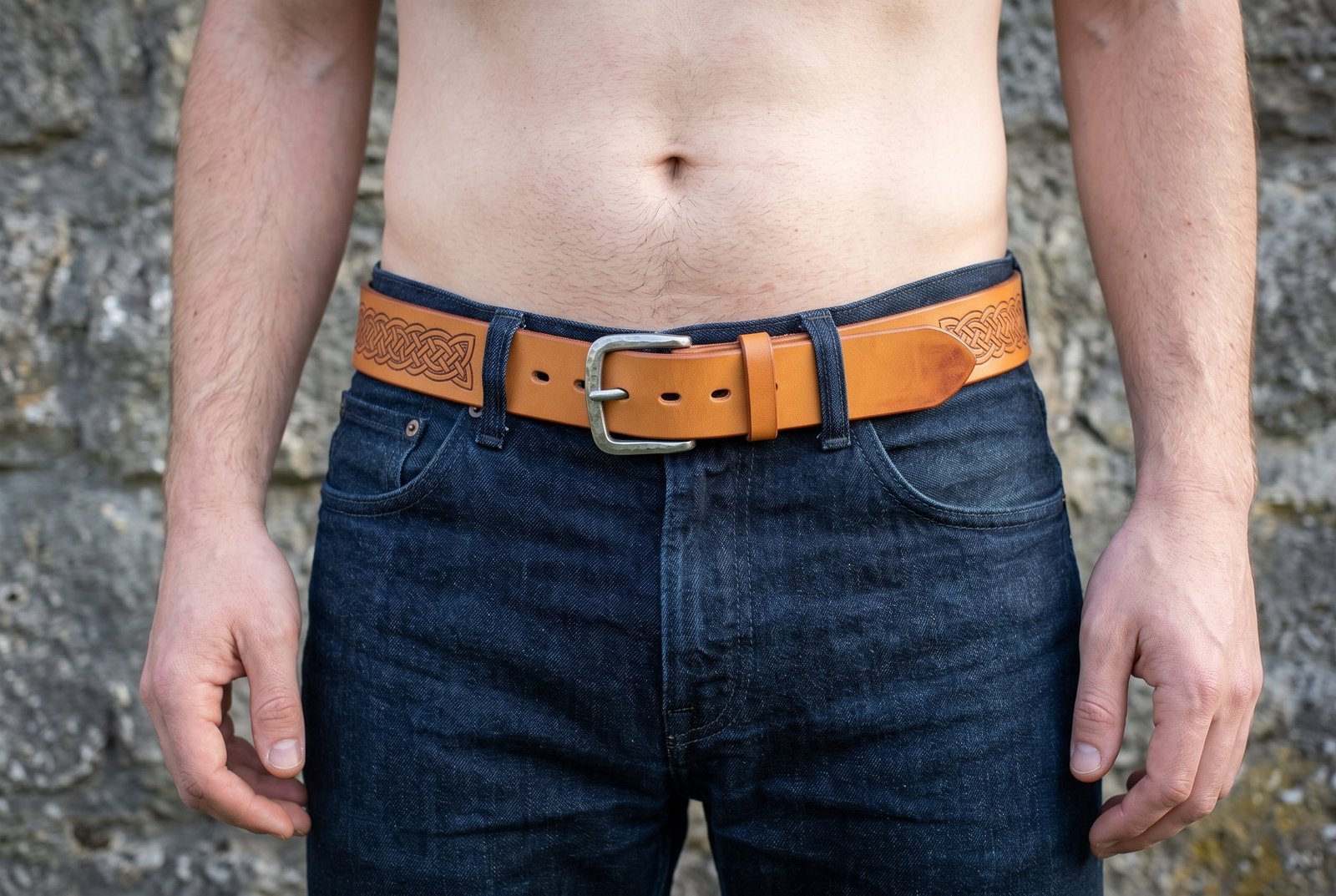
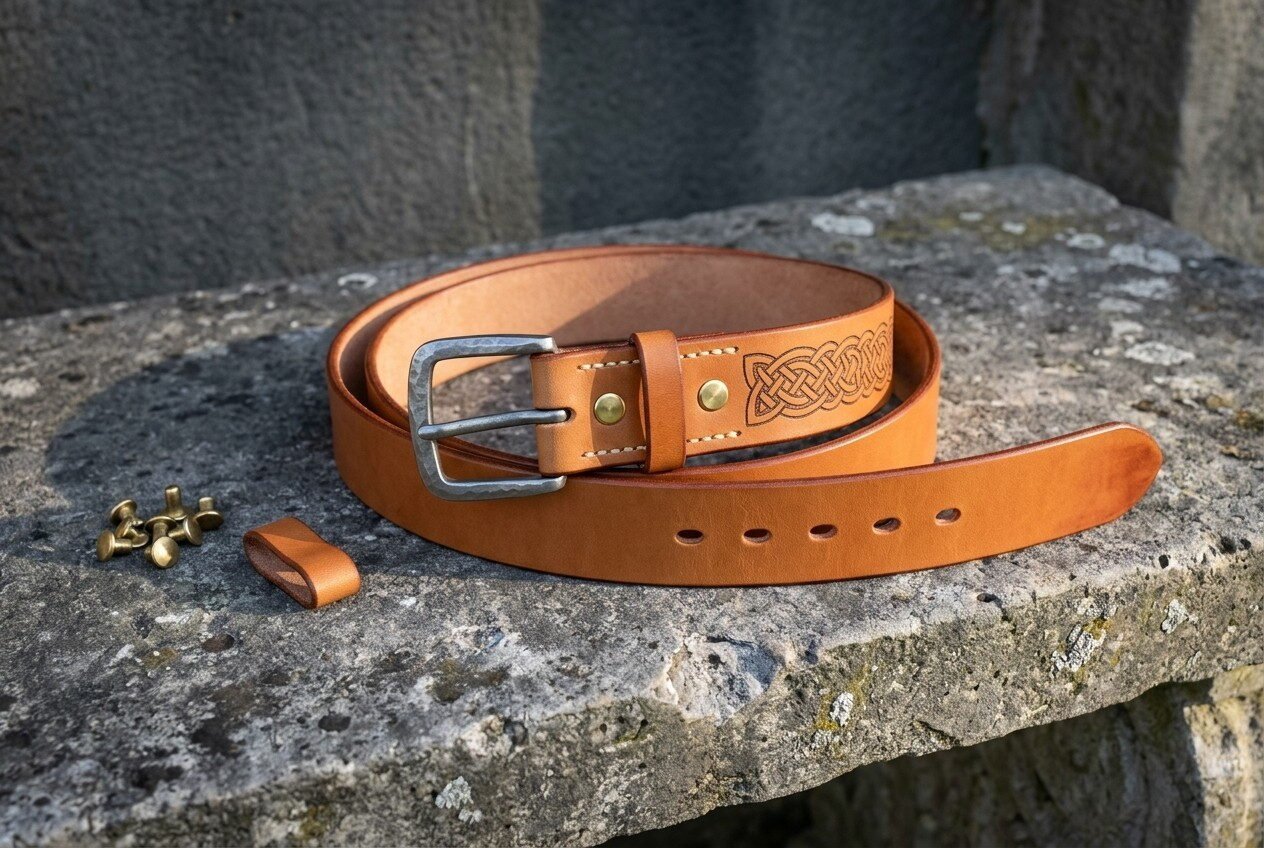
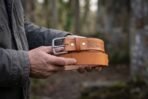
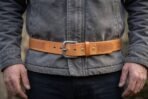
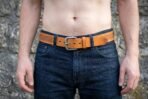
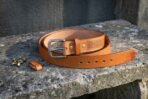
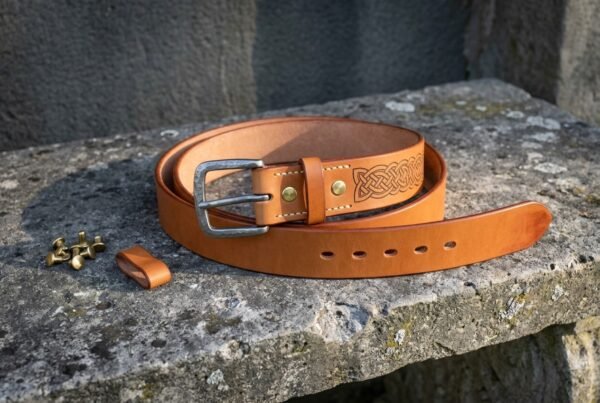
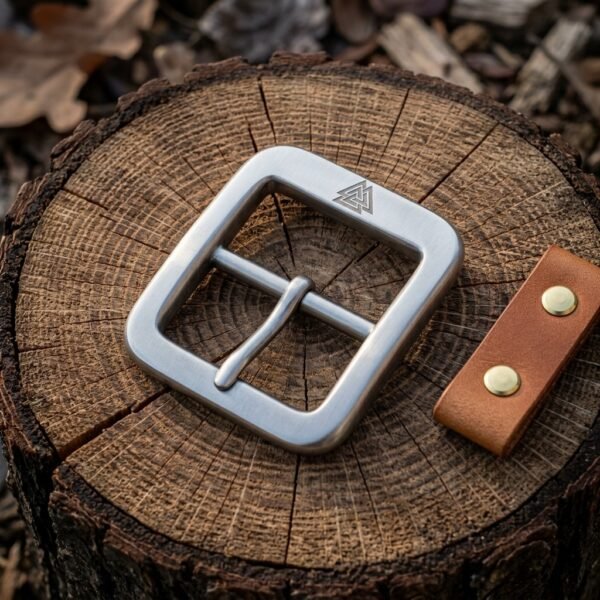
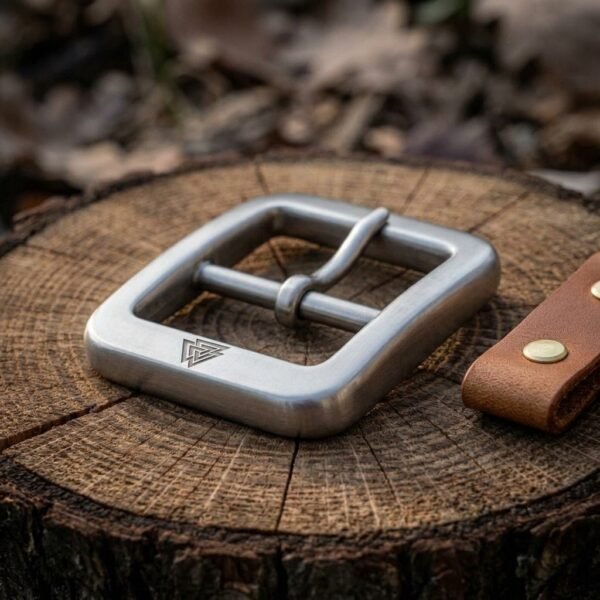
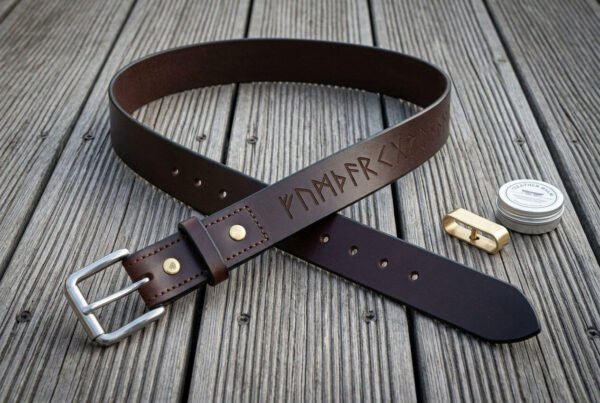
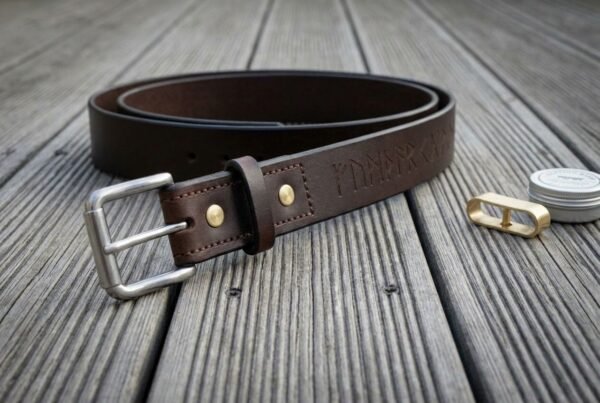
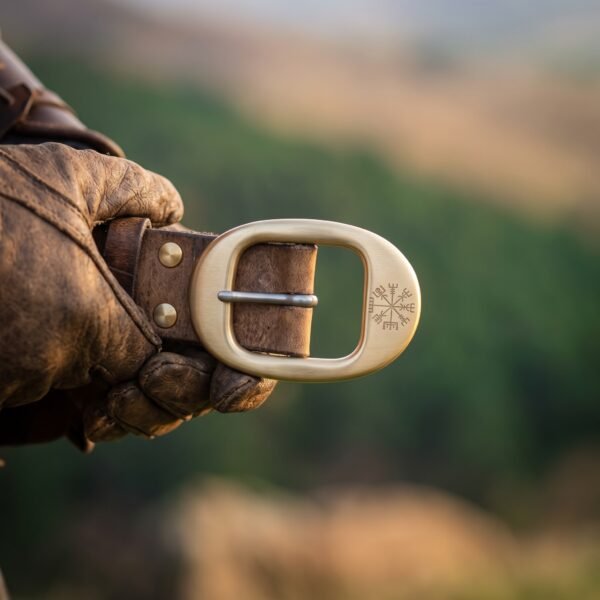
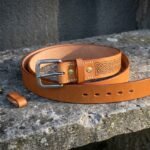
The Knotcinch is a hand made viking leather belt cut as one strip from a single hide, an inch and a half wide, in a warm tan that darkens with wear. A panel of four strand Celtic knotwork is stamped into the damp leather just behind the buckle, deep enough to hold its shape for the life of the belt, with a stitched border running around it. The buckle is a heavy hand hammered frame in an antiqued steel finish, held on by two solid brass rivets, and a matching leather keeper loop slides behind it. A spare keeper and a set of spare rivets are included.
The reason this belt is a single strip and not two layers glued together is worth explaining, because it is the difference between a belt that lasts twenty years and one that curls in two. A hide is not uniform. The firmest, densest leather in the whole animal runs along the spine, in the area a tanner calls the back or the bend, and that strip is where belts should come from. Cut from the belly and the fibres are loose and stretchy, and the belt will grow an inch in a year and start rolling at the edges. Two thin belly strips glued back to back hide that for a while and then delaminate. This one is cut from the back. It is made and finished in the Czech Republic. If the Viking belts and buckles brought you here, the Viking home decor pieces are the obvious next stop.
Specifications
| Material | Full grain vegetable tanned cowhide, approximately 9 to 10 ounce weight |
|---|
| Width | 1.5 inches, which fits standard belt loops on jeans and trousers |
|---|
| Sizes | Waist 30 to 46 inches, cut to order |
|---|
| Stamping | Four strand Celtic knotwork panel struck into damp leather, with cream stitched borders beside the buckle |
|---|
| Buckle | Heavy single prong frame buckle, hand hammered, antiqued steel finish |
|---|
| Fixings | Two solid brass rivets, removable so the buckle can be changed |
|---|
| Keeper | Matching leather keeper loop, fitted |
|---|
| Holes | Five holes at one inch spacing, punched and edge finished |
|---|
| Finish | Hand rubbed tan dye, burnished edges, light wax topcoat |
|---|
| Included | Belt, spare keeper loop, spare rivet set, care card |
|---|
| SKU | RK-1663 |
|---|
Full grain, and what the other words mean
Leather labelling is close to meaningless unless you know the four terms, so here they are. Full grain is the outer surface of the hide left exactly as it grew, with the tight fibre layer intact and any natural marks still visible. Top grain has had that outer surface sanded off to remove blemishes and then had a finish sprayed back on, which makes it look uniform and makes it weaker, because the sanding removes the densest fibres in the piece. Genuine leather is a legal term meaning only that some leather is present, and it is usually a split from the middle of the hide. Bonded leather is scrap ground up and glued to a backing, and it belongs in no belt at any price.
This belt is full grain. That means you may see a healed scar, a brand mark or an insect bite somewhere along its length. Those are not defects and we do not cut around them, because cutting around them means moving off the back of the hide and onto softer leather. A mark in the surface is the clearest evidence you have that nothing was sanded off.
The stamping and the buckle
The knotwork panel is struck rather than printed or embossed by machine. The leather is cased, meaning wetted and left until the moisture is even through the thickness, then the pattern is set with hand tools and the background is matted down so the strands stand proud. Casing is why the impression stays crisp. Stamping dry leather gives a shallow mark that relaxes back flat within a year.
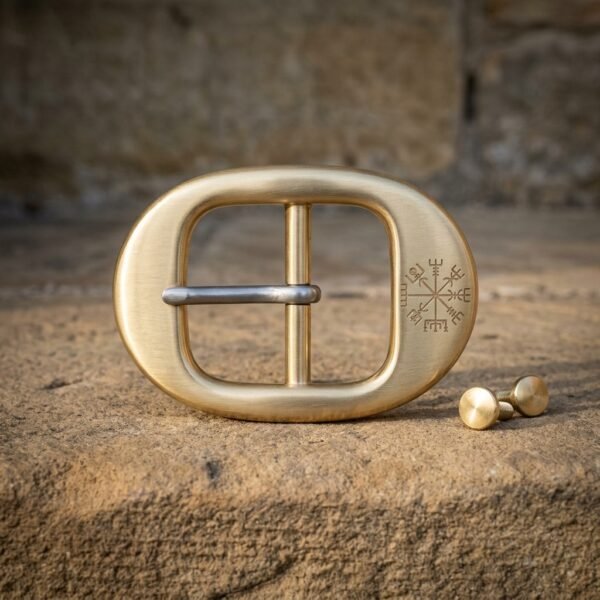
The buckle rivets are solid brass and they are removable rather than peened shut. That is a deliberate choice, because a good belt strap will outlast several buckles and there is no reason to throw away the leather when a buckle finish wears. Undo the two rivets, swap the frame, set the spares that come in the box, and carry on. The frame is hammered by hand, so the texture on yours will differ a little from the one photographed.
Engraving, runes and your own design
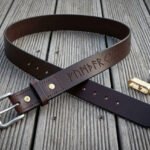
Use the rune converter on this page to turn a name, a date or a short phrase into Elder Futhark and we will cut it into the steel, the leather or the wood. If you would rather have a Viking pattern than a rune line, choose your own design in the engraving option above the add to cart button and tell us where it goes. Where a piece already carries an engraved design, your chosen engraving replaces it rather than sitting alongside it. On the Knotcinch that means a rune line is struck where the knotwork panel sits, in place of it. If you want runes as well as the knotwork, ask for them on the inside of the strap near the buckle, where they sit against you and not on show. See the engraving page.
Fit and sizing
Belt sizing catches almost everyone out, so measure rather than guess. The correct number is not your trouser waist size. Take a belt you already wear and measure from the fold at the buckle to the hole you actually use, in inches, and order that number. If you have no belt to hand, run a tape through the loops of trousers that fit and add nothing to the result.
Ordering by trouser size usually lands you two inches short, because trouser waist labels are measured on the garment and a belt sits over that garment plus a shirt tucked into it. This belt is punched with five holes at one inch spacing, so the size you order gives you two inches of adjustment either way, which covers a heavy meal, a winter jumper or a year of ordinary change. If you are between sizes, order the larger one, since a belt can be shortened and punched at home with a punch and a sharp knife but cannot be lengthened.
Care
Vegetable tanned leather wants feeding twice a year, more if you live somewhere dry. Use a neutral leather cream or a light dubbin, work a thin coat in with your fingers, leave it twenty minutes and buff off what has not soaked in. Do not use saddle soap as a conditioner, since it is a cleaner and it strips more than it puts back. Do not dry a soaked belt on a radiator or in front of a fire, because heat sets the fibres hard and they crack at the fold. Let it dry at room temperature and feed it while it is still slightly damp. Hang it from the buckle rather than rolling it, and expect the tan to deepen to a rich brown over the first year.
Made in the Czech Republic
The work behind this piece happens in a Czech Republic workshop that has kept to the old methods. Steel is forged and heat treated by hand, the grind is taken down by eye rather than by machine, and the handle, fittings and sheath are cut and finished one at a time. Because of that, every piece carries small marks of the hand that made it.
Ransack Viking is a United States company. We import direct, check each piece when it reaches us, and ship from our Chicago, Illinois warehouse. Engraving is added here in the United States after arrival, so the piece you receive is finished to your order.
A note on handmade variation
This belt is hand made, not machine made or bulk produced, so what arrives will not be a pixel for pixel copy of the photograph. Hide is a natural material and no two backs take dye at the same rate, so the tan will land lighter or darker and will carry its own grain and growth marks. The knotwork panel is struck by hand, so it sits a few millimetres nearer or further from the buckle. The width, the weight of leather, the fittings and the length you order are the same every time. The character is not. There is more on that in the Vegvisir, and in the Elder Futhark if you want the background.
Frequently asked questions
What size should I order
Measure an existing belt from the buckle fold to the hole you use, and order that number in inches. Do not order your trouser size.
Is this real leather all the way through
Yes. It is one strip of full grain vegetable tanned hide cut from the back of the animal, not two thin pieces glued together.
Can I change the buckle
Yes. The two brass rivets undo, so any buckle for a 1.5 inch strap will fit. A spare rivet set comes in the box.
Will the stamped knotwork flatten out
No. The leather was cased before it was struck, which is what makes an impression permanent rather than a mark that relaxes.
Can I have runes on it instead
Yes. A rune line replaces the knotwork panel, or it can go on the inside of the strap if you want both.
How long until it ships
One to two weeks while it is cut to length and stamped, then free shipping inside the United States.
What is in the box
- Knotcinch full grain leather belt with a stamped Celtic knotwork panel
- Antiqued hammered frame buckle on two removable brass rivets
- Matching leather keeper loop, fitted
- Spare keeper loop and a spare rivet set
- Care card for vegetable tanned leather
- Lifetime warranty against defects, no receipt needed
- Made and finished in the Czech Republic
Explore the range
Browse the other viking belts and flags, the scabbards and sheaths that hang from them, the wider accessories, and the guides for measuring a belt properly.
Compare it with these
For a straight comparison, see the Waymark Viking belt. Worth putting side by side with this is the Runestrap Viking belt. In the same category sits the Girdlock Viking belt.
From the same corner of the shop, there is the Runemead drinking horn. Pick the steel, the length and the fittings yourself on the design your own page.

Should have read more reviews before ordering. Even shipping from a US warehouse this took way longer to arrive than promised. Quality felt well below what was shown in the listing. Would not recommend based on my experience.