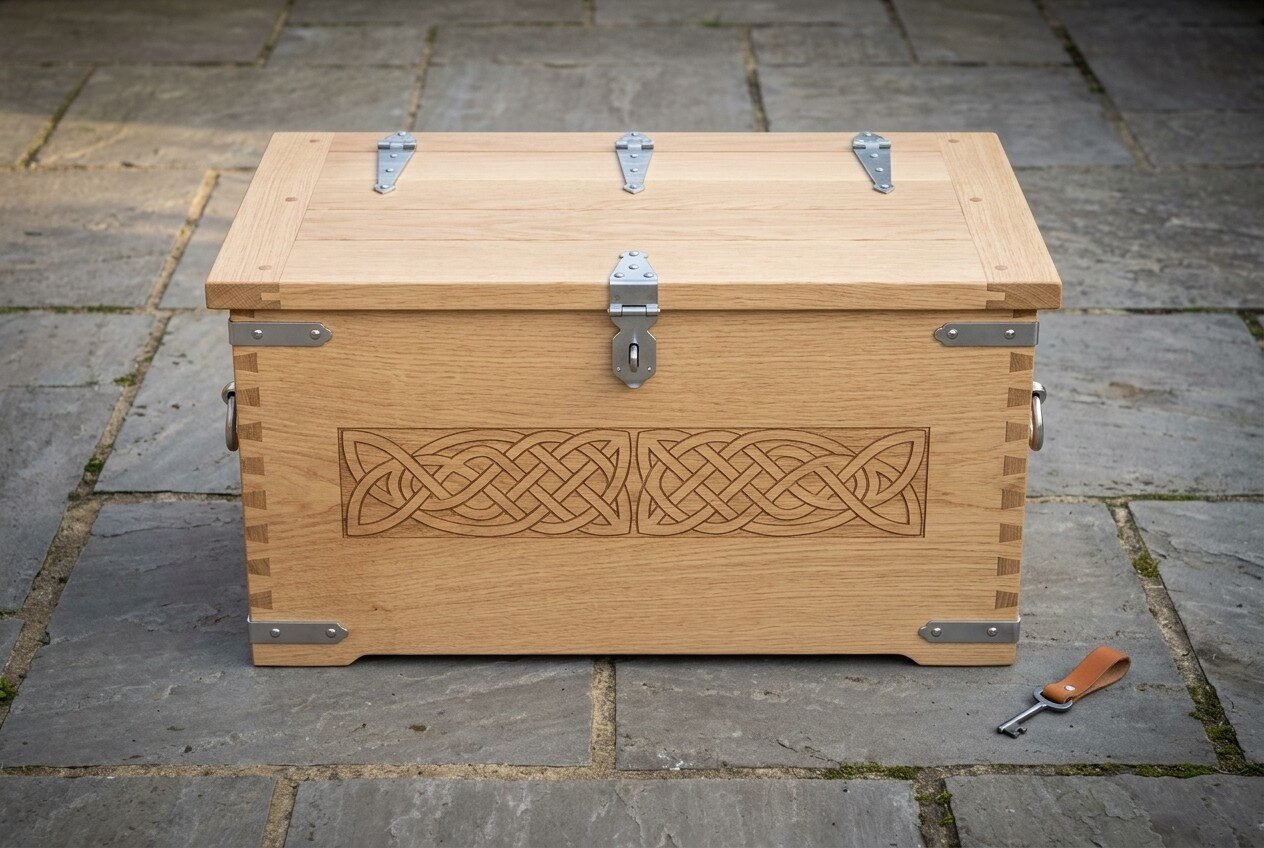
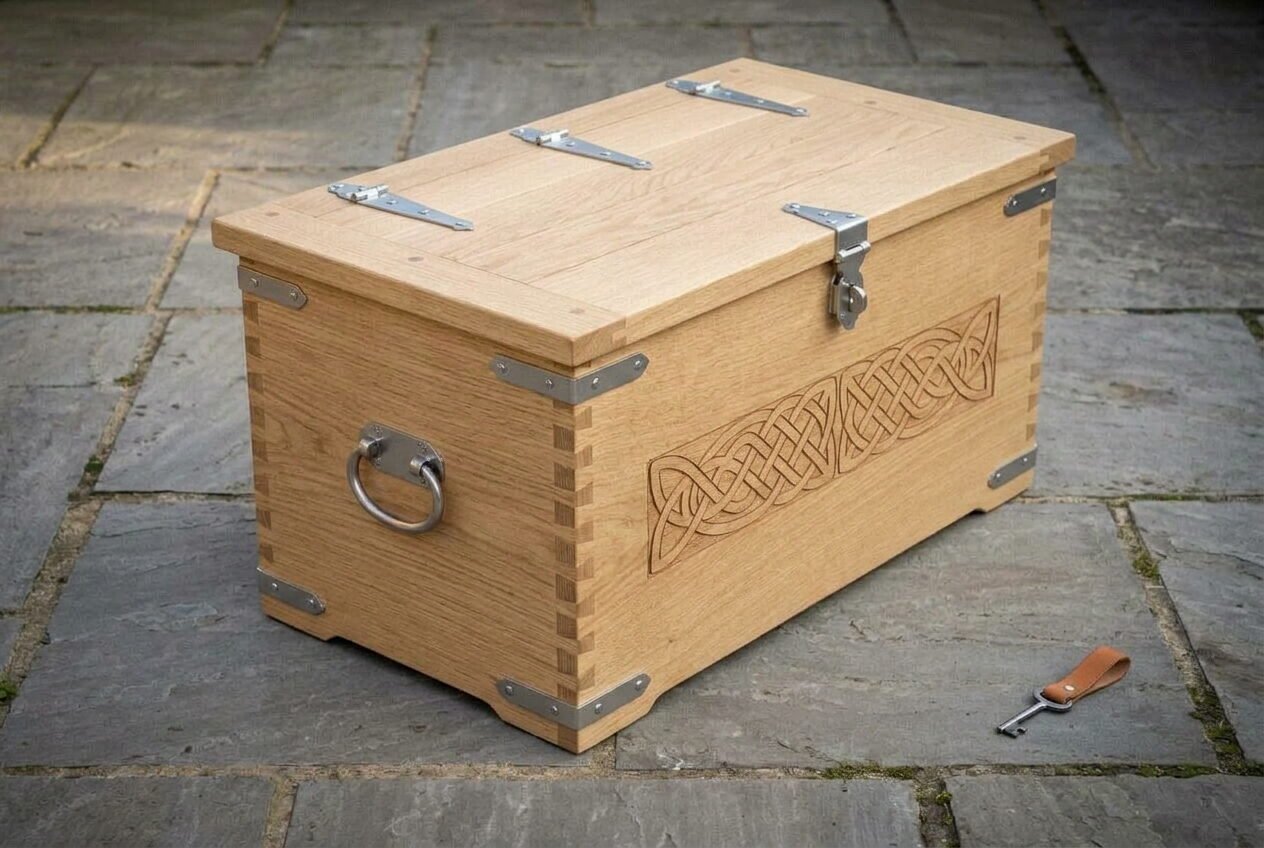
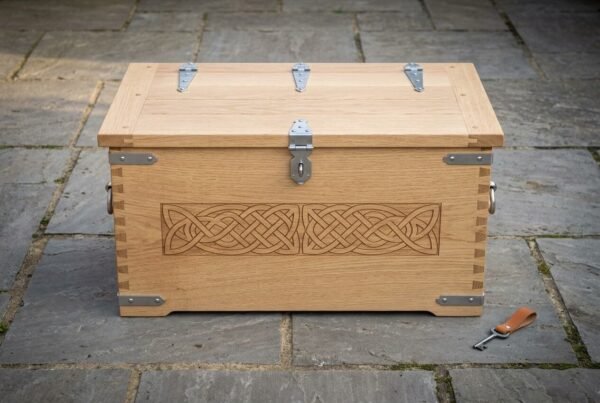
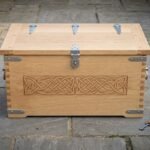
This is a solid oak storage chest built in the old northern manner, with through dovetailed corners, a flat lid on three long steel strap hinges, forged corner brackets, a ring handle on each end and a hasp and staple lock with a key on a leather fob. The front carries two panels of interlaced Norse knotwork cut into the surface rather than glued on, so the pattern is part of the board and will still be there after decades of polishing.
Chests like this were the main furniture of a Norse household. There were very few cupboards and almost no drawers, so a chest held clothes, tools, grain, silver and anything else worth keeping off a damp floor, and on a ship the same chest doubled as the rower’s bench and his sea locker. The best surviving example is the Mastermyr chest found in a bog on Gotland, which came up still packed with a smith’s tools and told archaeologists more about Viking age carpentry than any single find before it. This chest is built and finished in a Czech Republic workshop and ships assembled with the key already fitted to the lock. It belongs with the Viking home decor. If the shape is not quite right, the rune stones and rune sets run close to it.
Specifications
| Material | Solid oak boards, natural pale finish |
|---|
| Joinery | Through dovetailed corners, pegged lid frame |
|---|
| Carving | Two interlaced knotwork panels cut into the front board |
|---|
| Lid | Flat framed lid on three long steel strap hinges |
|---|
| Fittings | Steel corner brackets, hasp and staple lock, ring handle at each end |
|---|
| Lock | Keyed hasp lock, key supplied on a leather fob |
|---|
| Finish | Hand sanded and oiled, open grain |
|---|
| Included | Chest, fitted key on leather fob, care card |
|---|
| SKU | RK-1632 |
|---|
Why the corners are dovetailed and the lid is flat
Look at the corners and you will see a row of interlocking fingers running top to bottom. That is a through dovetail, and it is doing something a screwed butt joint cannot. Oak moves across the grain with the seasons, swelling in a damp summer and shrinking in a dry heated winter, and a dovetailed corner lets the two boards move together while the wedge shape of the pins locks the joint against being pulled apart. A chest built this way can be dragged by one end, loaded heavy and left in an unheated room for years without the sides letting go.
The lid is flat rather than domed for the same practical reason the old sea chests were flat. A flat lid is a seat, a work surface and a place to stack a second chest. Domed lids belong to a later fashion in travelling trunks, where the curve shed rain on a coach roof and stopped porters from piling anything on top. The three long strap hinges spread the load of the lid across the back board instead of concentrating it on two small butt hinges, which is what stops a heavy lid from tearing its fixings out over time.
The oak and the finish
Oak was the working timber of the Norse world for the same reasons we use it here. It is hard, it is stiff for its weight, it splits cleanly along the ray when you want it to and it contains enough tannin to resist rot and insect attack. The boards are planed, hand sanded through the grits and finished with a penetrating oil rather than a film lacquer, so the surface you touch is wood and not plastic. An oil finish scratches more easily than a lacquer but it repairs invisibly, which matters on a piece that is meant to be used rather than looked at.
The steel fittings are given a light protective finish and left bright. Over years they will pick up a soft grey patina where hands touch them, which is normal and is not a fault.
Engraving, runes and your own design
Use the rune converter on this page to turn a name, a date or a short phrase into Elder Futhark and we will cut it into the steel, the leather or the wood. If you would rather have a Viking pattern than a rune line, choose your own design in the engraving option above the add to cart button and tell us where it goes. Where a piece already carries an engraved design, your chosen engraving replaces it rather than sitting alongside it. On a chest the usual choices are a rune line across the lid, a name band under the knotwork or a date on the front edge. See the engraving page for placement and depth.
Placing and using the chest
A chest this size works at the foot of a bed, under a window, along a hallway wall or as a low table beside a sofa. Keep it off a damp concrete floor, and if it is going on a stone or tiled floor put small felt or cork pads under the corners so the base can breathe and so you do not scuff either surface when you slide it.
Do not stand it in front of a radiator or in the direct path of a heating vent. Solid wood dislikes rapid drying more than it dislikes cold, and a chest left with hot dry air blowing on one face will move unevenly. If you are storing textiles, line the inside with unbleached cotton or acid free tissue rather than plastic sheet, because plastic traps moisture against the wood and against whatever you have put inside.
Care
Dust with a dry cloth. Every six to twelve months, or whenever the surface starts to look thirsty, wipe on a thin coat of a hardening furniture oil or a wax and oil blend, leave it fifteen minutes and buff the excess off with a clean cloth. Do not use silicone polish or an all purpose spray cleaner, both of which sit on top of the finish and make future re oiling patchy. Wipe spills straight away. If a ring mark appears, a light sand with fine paper along the grain followed by fresh oil will take it out. Keep the steel fittings dry and put a spot of light oil on the hinge knuckles once a year so they stay quiet.
Made in the Czech Republic
Every piece we sell is made by hand in the Czech Republic. The smiths there work the way the trade has been worked for a long time, heating and hammering the steel, taking the bevels down by eye, and fitting the handle and the leather one at a time. There is no automated line anywhere in it, so small differences from one piece to the next are normal and expected.
Ransack Viking is a United States company based in Chicago, Illinois. We bring the pieces in ourselves, inspect them on arrival and ship them from our own warehouse. If you add engraving, that is carried out here in the United States before your order goes out.
A note on handmade variation
This chest is hand made, not machine made and not bulk produced, so what arrives will not be a pixel for pixel copy of the photograph. Oak is a natural material and every board reads differently. Grain, figure, ray fleck and colour vary from chest to chest, the dovetail pins are cut and pared by hand so their spacing varies by a fraction, the carved knotwork carries the small tool marks of a hand cut line, and the steel fittings show light hammer texture. The dimensions, the timber, the joinery and the fittings are the same every time. The character is not. If that is the part you care about, carry on with how to hang a blade on a wall, then gifts for reenactors.
Frequently asked questions
Is the knotwork carved or printed
Carved. The pattern is cut into the front board with a chisel and a v tool, so you can feel the depth with a fingertip and it cannot wear off.
Does it come with a key
Yes, one key on a leather fob, already fitted to the hasp lock. It is a light domestic lock meant to keep a lid shut and honest hands out. It is not a security safe and should not be treated as one.
Can I sit on it
Yes. The lid is framed and sits on three long strap hinges, and a flat chest lid was used as a bench for a thousand years. Sit on the middle rather than dropping onto one end.
Will it arrive assembled
Yes. It ships built, carved, finished and with the hinges, brackets, handles and lock already fitted. There is nothing to put together.
Can you cut a name into the lid
Yes. Add a rune line or your own design through the engraving option and tell us where you want it. A name band across the lid or under the front knotwork are the two most common requests.
How long does shipping take
Processing is one to two weeks in the shop, then free shipping inside the United States. A chest is a large parcel so allow a few more days in transit than a small item.
What is in the box
- Solid oak Viking storage chest with carved knotwork front
- Steel strap hinges, corner brackets and end ring handles fitted
- Hasp and staple lock with one key on a leather fob
- Care card for oiled solid wood
- Lifetime warranty against defects in the build and the fittings
- Made and finished in the Czech Republic
Explore the range
See more in Viking home decor, the rune stones and rune sets and the accessories, or read the guides on Norse woodwork and joinery.
Others in the same line
A near match for this one is the Wardhold Viking home decor. Closest to this in the range is the Hearthspire Viking home decor. If this one is not quite right, there is the Wickthorn Viking home decor.
The Braidhorn beard ring covers the other half of the same kit. You can have this made your way instead on the design your own page.

Got this as a gift and now I want one for myself too. Feels way more premium in person than the listing photos. Packaging was excellent and it arrived in perfect condition. This is going straight into my display case.