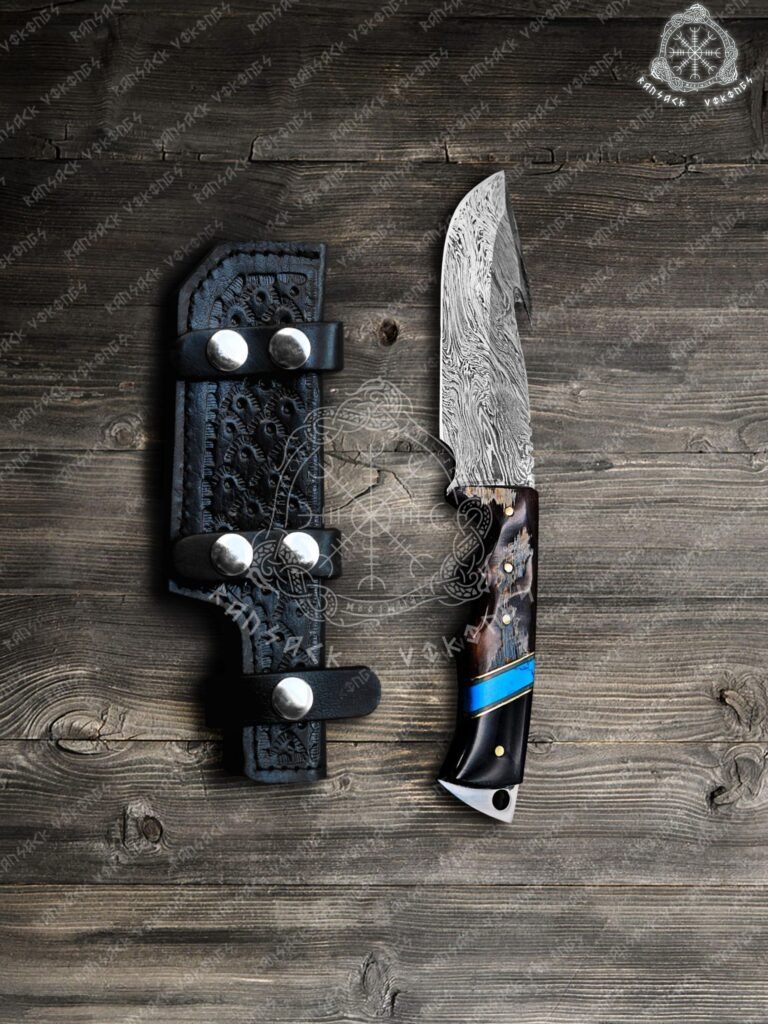
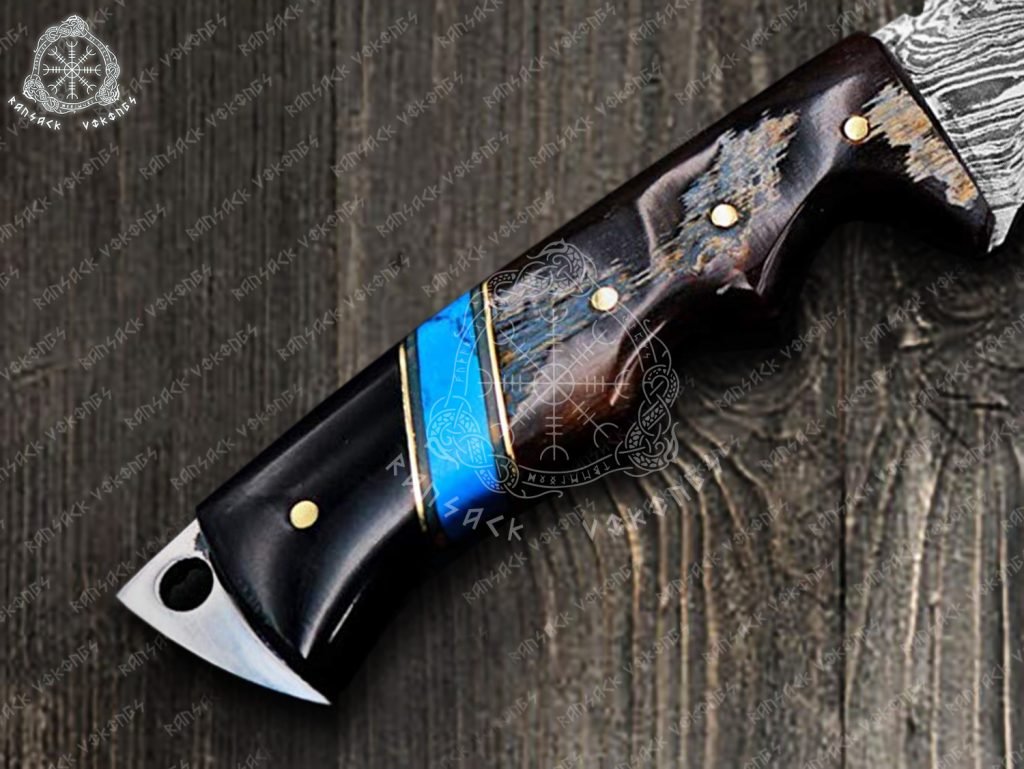
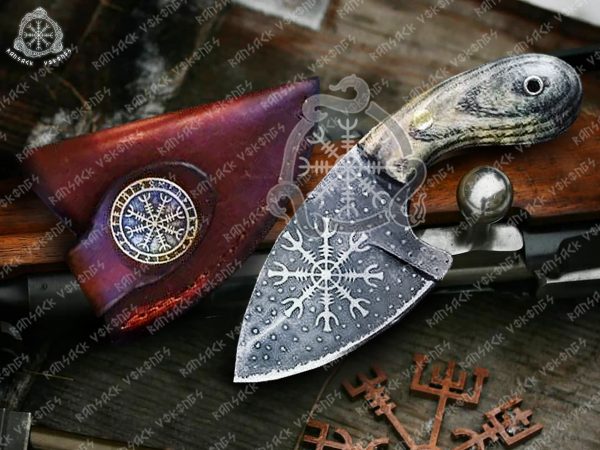
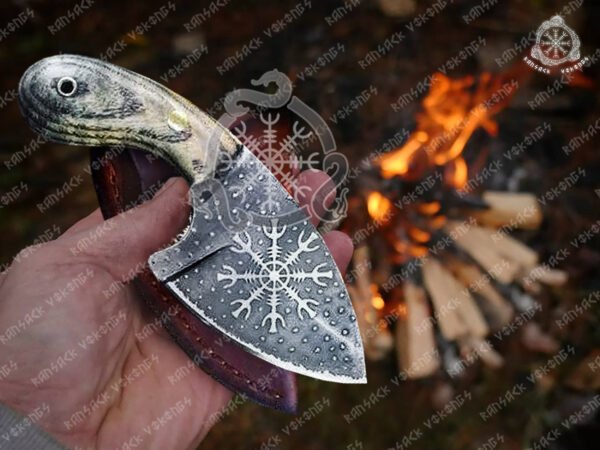
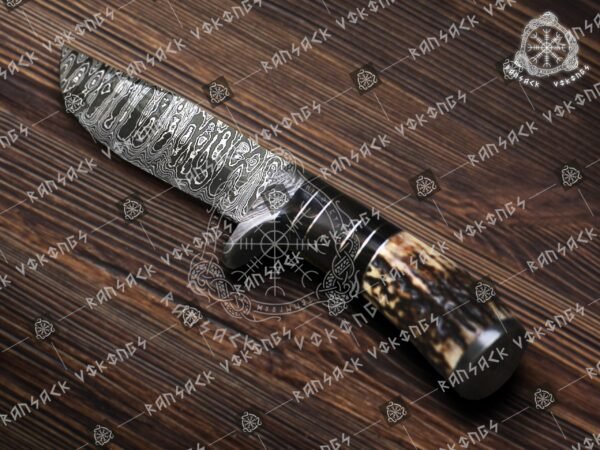
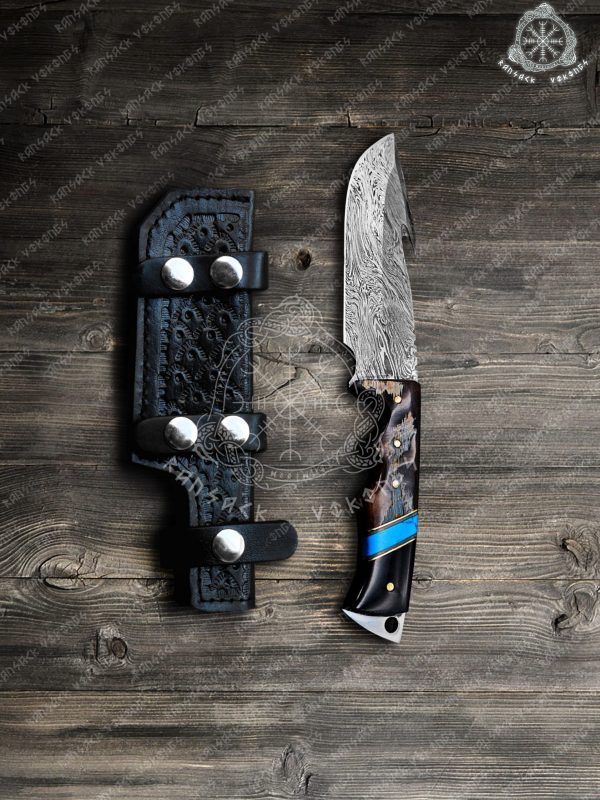
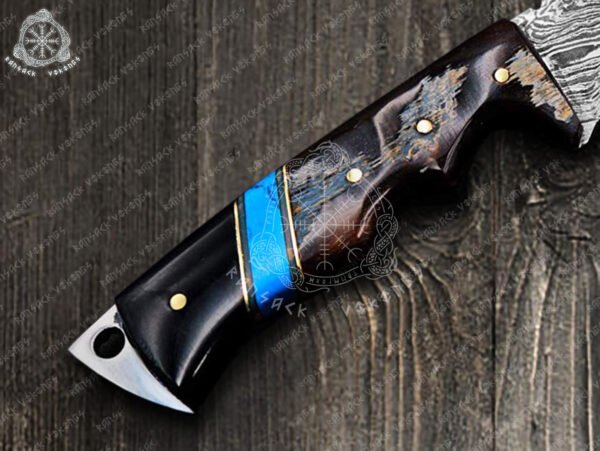
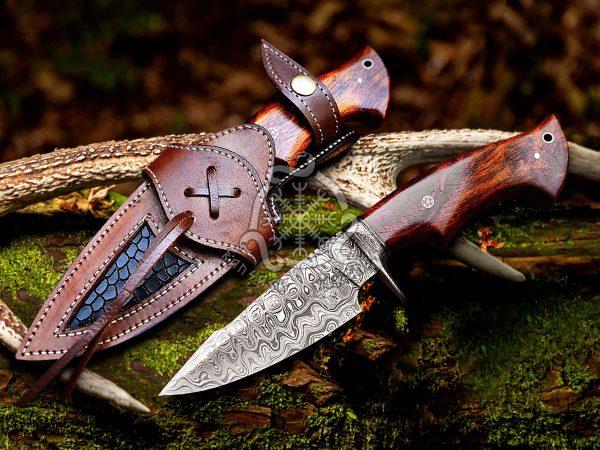
The Hornhook pairs a hand forged Damascus blade with a buffalo horn handle and a gut hook ground into the spine. It is a field dressing knife first and a collector piece second, and it feels heavier in the hand than it looks on a screen, which is exactly what you want when your hands are cold and wet. If you have not used a gut hook before, what a gut hook is for explains what it is for.
The gut hook is one of the few genuinely modern additions to knife design, and it exists to solve a very specific problem that has ruined a great deal of meat over the years. When you open an animal, the danger is not the hide. It is what sits directly underneath it. Puncture the stomach or the intestine and the contents spill into the body cavity, and at that point you are not field dressing any more, you are salvaging. A gut hook lets you cut the hide from the inside outward, so the sharp edge is always travelling away from the organs rather than toward them.
The Hornhook is forged and finished in the Czech Republic, and shipping inside the United States is free.
Specifications
| Steel | Hand forged Damascus, 1095 and 15N20 |
|---|
| Hardness | 58 to 60 HRC |
|---|
| Blade shape | Hunting blade with gut hook ground into the spine |
|---|
| Handle | Buffalo horn |
|---|
| SKU | RK-10493 |
|---|
What a gut hook is actually for, and how to use it
Look at the hook itself. It is a small crescent cut into the spine near the tip, sharpened on the inside curve only, with the outside of the curve left smooth and rounded. Every part of that is deliberate.
The technique is the opposite of what most people assume. You do not hook the hide from the outside and pull. You make a small opening with the point of the blade at the brisket, turn the knife over so the spine is facing down into the animal, slide the hook under the skin, and then draw the whole knife toward the tail. The sharpened inside curve cuts the hide from underneath as you pull, and the smooth rounded back of the hook rides along the abdominal wall pushing it out of the way. The hide unzips in one movement and the sharp part of the knife never gets near the paunch.
Done properly it is faster and far safer than the two finger method, where you drive the knife point up through the hide with two fingers of your other hand acting as a guide underneath. That works, and plenty of experienced hunters still do it, but it puts your fingers in front of a sharp edge in bad light and it is easy to go too deep.
The honest limitations of a gut hook are worth knowing before you buy one. It clogs with hair on a thick coated animal and needs clearing every few feet. It is awkward to sharpen because a flat stone cannot reach the inside of the curve, so you need a round ceramic rod, a small round file or a chainsaw file. And it is a single purpose feature: outside of opening an animal it does nothing except catch on your sheath. If you dress several animals a season it earns its place many times over. If you dress one, a plain hunting knife will do the job with more care taken.
Why Damascus and not stainless
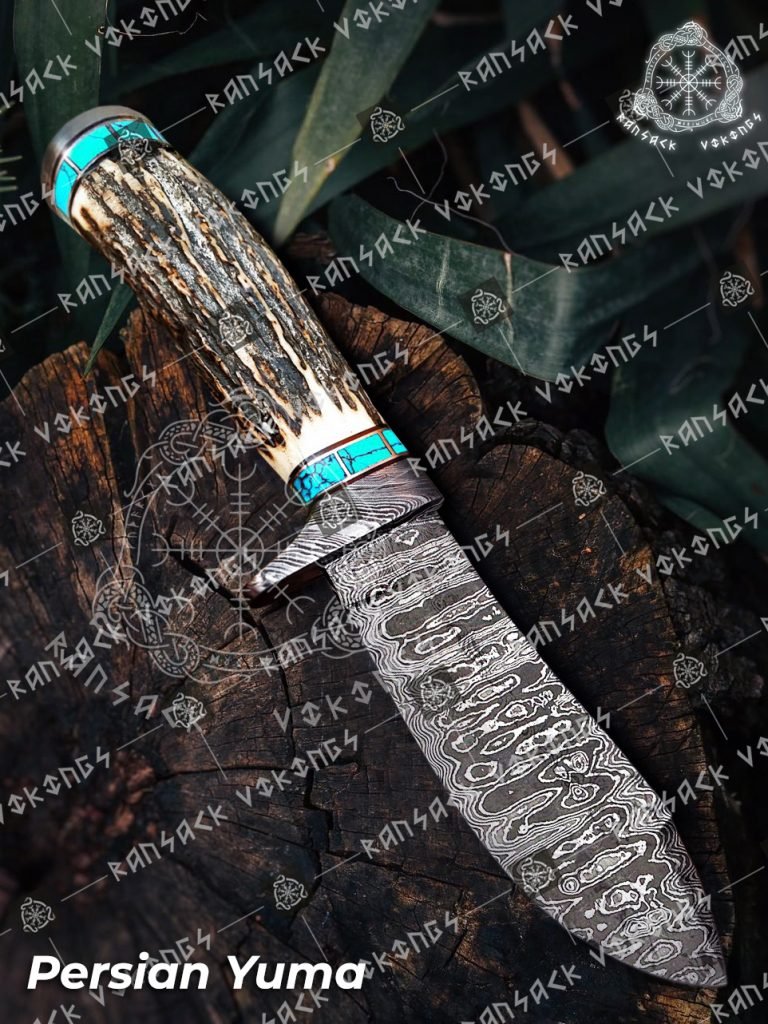
Forge welded from 1095 high carbon and 15N20 nickel steel, this blade carries a pattern that goes all the way through the steel and hardens to 58 to 60 HRC. Printed and laser etched blades look similar in a photograph and fall apart under a file. If you are buying Damascus anywhere, run through our five checks for real Damascus first, and look particularly at the inside of a gut hook, which is a surface a printed finish cannot reach.
Against stainless, the argument here is about how the edge behaves in hide. Hide and hair are abrasive, and a soft stainless edge dulls noticeably over a single animal. This steel is harder, takes a finer edge and holds it, which on a knife whose whole job happens in one concentrated hour of work is exactly what matters. What you give up is corrosion resistance, and field dressing is a wet, warm, biologically aggressive environment, so this is one of the few knives in the range where cleaning it promptly is not optional. Blood is mildly acidic and will mark carbon steel within hours. The comparison is set out in Damascus versus stainless.
The buffalo horn handle
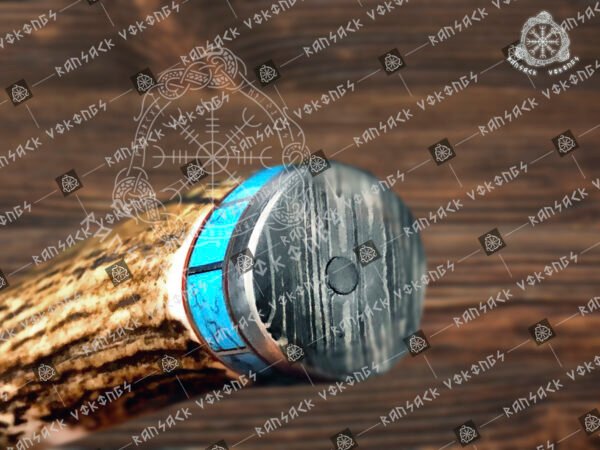
This handle is buffalo horn, cut, shaped and polished by hand. Because it came from an animal rather than a mould, expect the grain, the banding and the colour to be unique to your piece.
Horn is a good choice on a dressing knife for a practical reason rather than an aesthetic one. It is keratin, the same material as a fingernail, and it holds on to a wet hand far better than a polished timber or a smooth resin does. It also warms to the hand in seconds, which is not a small thing when you are working outdoors in November. Being slightly resilient rather than rigid, it takes the shock out of the knife when you are working against bone.
Care is the same as timber and takes two minutes. A light coat of oil once or twice a year, applied thin and wiped back, stops the horn drying out and shrinking away from the fittings. Keep it out of long soaking and away from direct heat, both of which will dry it and can open a crack. Wash it after use rather than leaving it, and dry it properly. The method is in wooden handle care and applies to horn and bone without change.
Engraving, runes and your own design
Use the rune converter on this page to turn a name, a date or a short phrase into Elder Futhark and we will cut it into the steel or the handle. If you would rather have a Viking pattern than a rune line, choose your own design in the engraving option above the add to cart button and tell us whether it goes on the blade or the handle. Where a piece already carries an engraved design, your chosen engraving replaces it rather than sitting alongside it. Buffalo horn is one of the best engraving surfaces we work with, because a cut line comes up pale against the dark surface and needs no inlay to read clearly. See the engraving page.
Care and sharpening
Two rules cover the steel. Dry it, and oil it. Do those and the pattern stays crisp and the edge comes back in minutes on a stone. After field use, wash the blade properly before you oil it, because dried blood and fat will hold moisture against the steel and mark it.
Sharpening is two separate jobs on this knife. The main edge is ordinary bench stone work at a consistent angle. The gut hook cannot be done on a flat stone at all, and this is the part people neglect until the hook stops cutting. Use a small round ceramic rod, a round needle file or a chainsaw file, work only the inside of the curve, and leave the smooth outer back of the hook alone because it is meant to be blunt. A few strokes each season is enough. Full method in steel care and sharpening with a whetstone.
Made in the Czech Republic
This piece is made by hand in the Czech Republic, in a workshop that still works the old way. The steel is forged, ground, heat treated and finished by smiths who learned the trade from the people before them, and the wood, horn and leather are cut and fitted by hand rather than pressed out on a line. That is also why no two pieces come out exactly the same.
Ransack Viking is a United States company. We import these pieces ourselves, check every one when it lands and ship from our warehouse in North Babylon, New York. Engraving is done here in the United States after the piece arrives, so your runes or your own design go on before it leaves for you.
A note on handmade variation
The Hornhook is hand forged. It is not machine made and it is not bulk produced, so what arrives will not be a pixel for pixel copy of the photograph. The Damascus pattern comes out of the billet differently on every blade, the buffalo horn carries the banding and tone of the animal it came from, and the sweep of the hook and the grind of the edge shift by fractions because a person cut them. The dimensions, the steel and the build are the same every time. The character is not.
Frequently asked questions
Do I have to use the gut hook, or can I dress an animal with the main edge
You can use the main edge. The hook is there to make the first opening cut safer and faster, and plenty of hunters use it only for that and then switch to the blade.
How do I sharpen the hook itself
With a round ceramic rod, a round needle file or a chainsaw file, worked on the inside of the curve only. A flat bench stone cannot reach it. Leave the smooth outer back of the hook blunt.
Does it come with a sheath
No. This model ships as the knife in protective packaging. If you want a sheath cut for it, message us before you order and we will quote for one.
Will the hook catch on things in a pack
It can, which is one of the trade offs of the feature. Carry it in a fitted sheath or a dedicated pocket rather than loose.
Is buffalo horn better than wood for a hunting knife
For wet hands, yes. Horn grips better when it is slick with water or blood and it warms up faster in cold weather. Timber is more tolerant of being left neglected for years.
How long does it take to arrive
One to two weeks of processing in the shop, then transit. Free inside the United States. If you need it before a season opens, tell us before you order.
What is in the box
- One Hornhook Damascus gut hook hunting knife
- Protective packaging
- Forged and finished in the Czech Republic
Explore the range
Compare it with the field blades in Hunting Knives, the curved edges in Damascus Skinner Knives, the rest of Accessories and the Norse pieces in Viking Knives. Field technique and steel background sit in the guides.
Other pieces in this group
Another in the same line is the Fletchbane accessory, pattern welded Damascus. Next along the rack is the Tinebraid accessory. For a straight comparison, see the Pocketforge accessory.
The Arrowward Damascus jewelry piece covers the other half of the same kit. Nothing here exactly right, build one to your own spec on the custom Damascus knife page.






Incredible craftsmanship on this one. Fit and finish is museum quality. You can tell real craftsmen made this by hand. Came in a nice gift box which made it feel even more special. Weight and balance make it feel like a real functional piece not some cheap replica. 10/10 would buy again.
Feels way more premium than the price suggests.
This knife beat every expectation I had. Leather sheath is thick and well stitched. Not the cheap stuff you usually get. 10/10 would buy again.
Best knife I’ve ever owned. Fit and finish is museum quality. You can tell real craftsmen made this by hand. This shop clearly takes pride in their work.
My whole family was impressed when I unboxed it. Weight and balance make it feel like a real functional piece not some cheap replica. Ransack Viking is quickly becoming my go to shop for anything Norse themed. If you’re on the fence just get it. You won’t regret it.