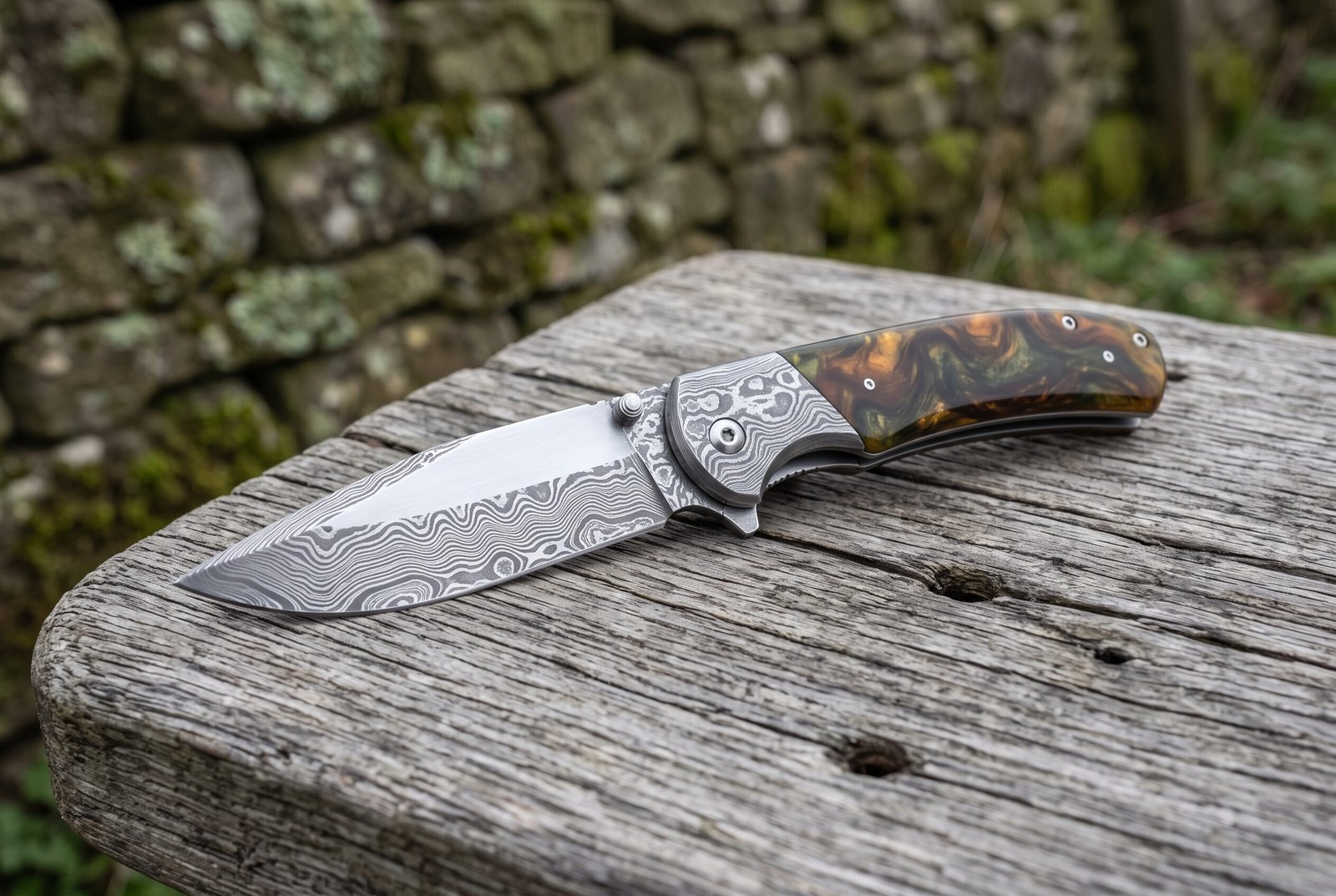
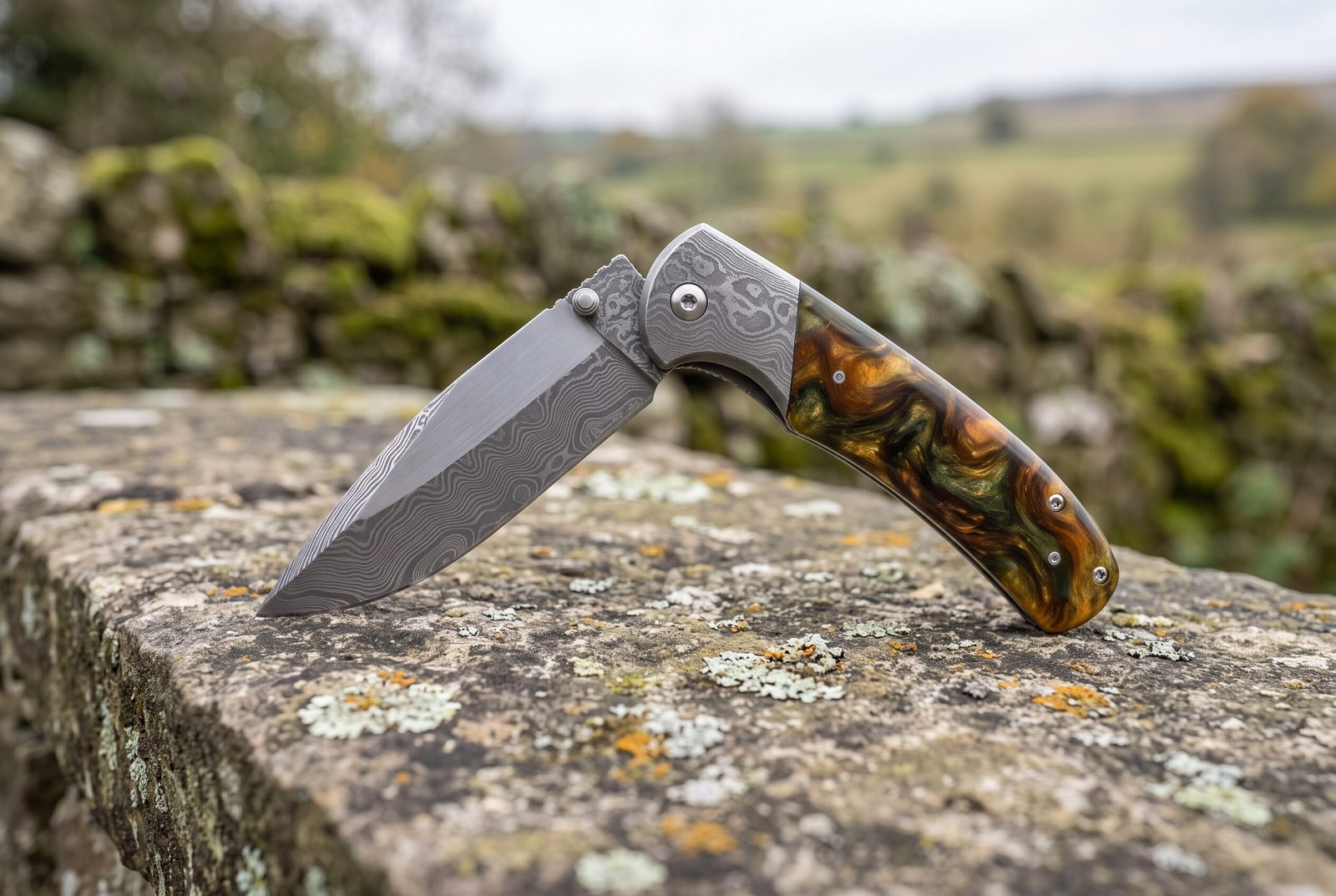
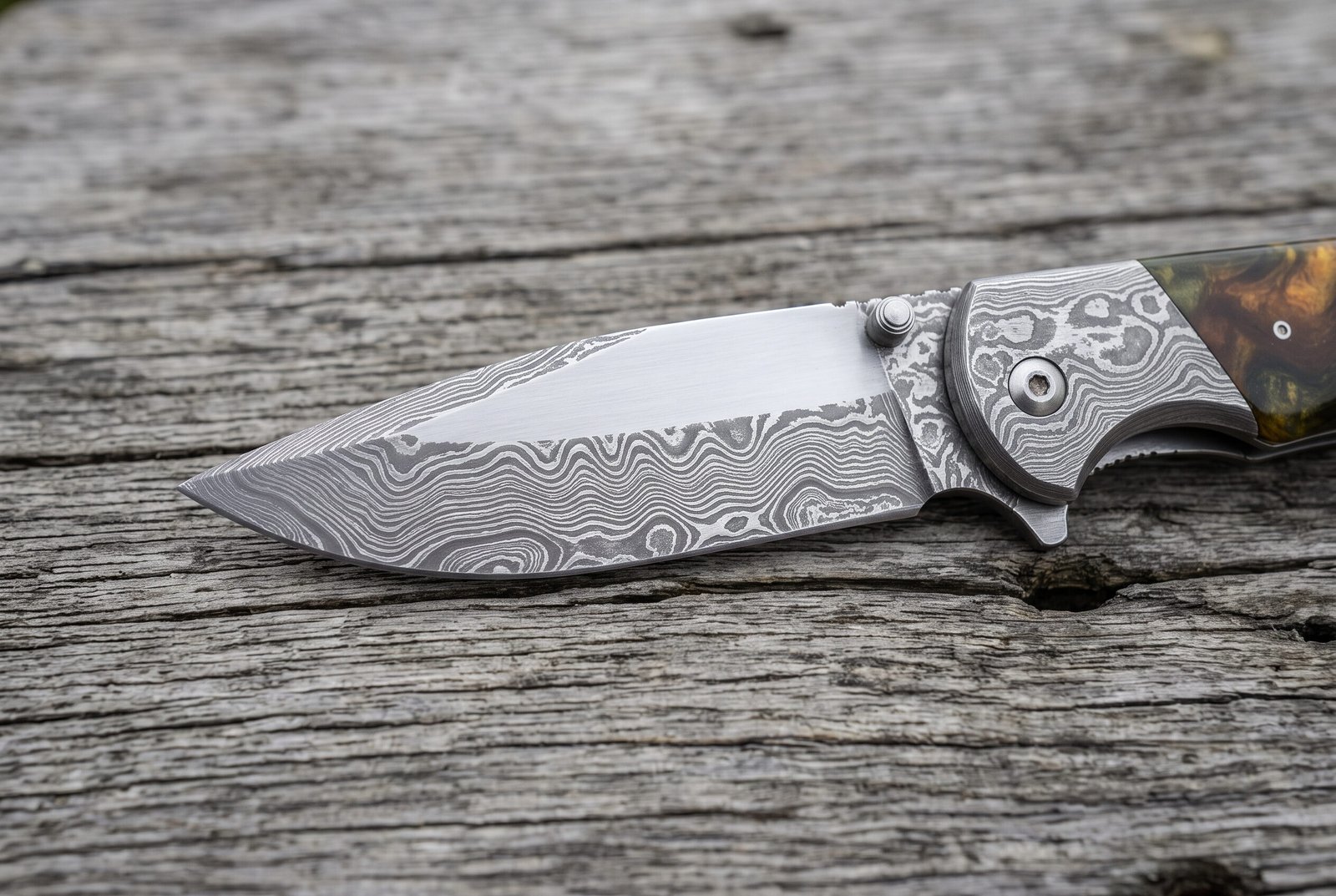
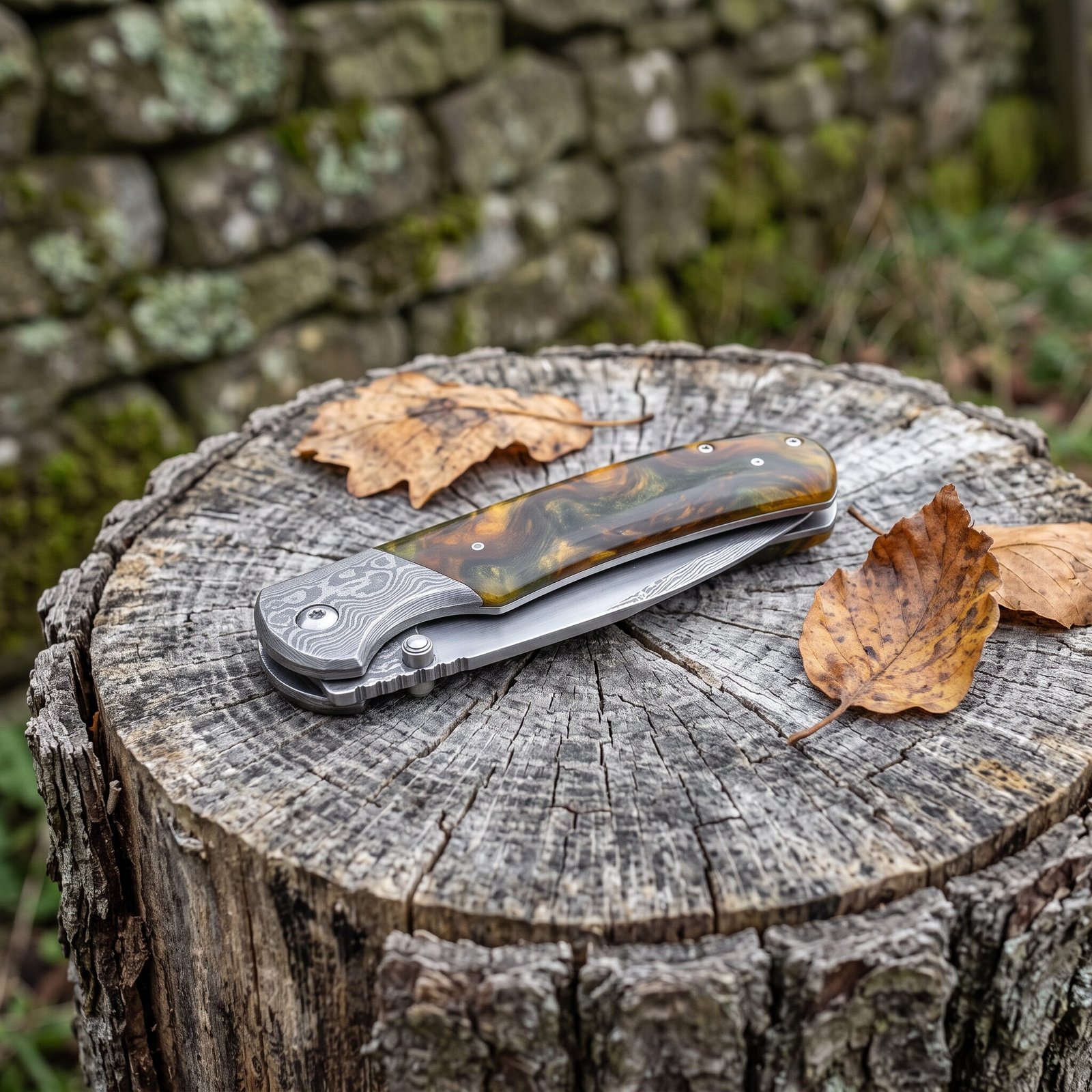
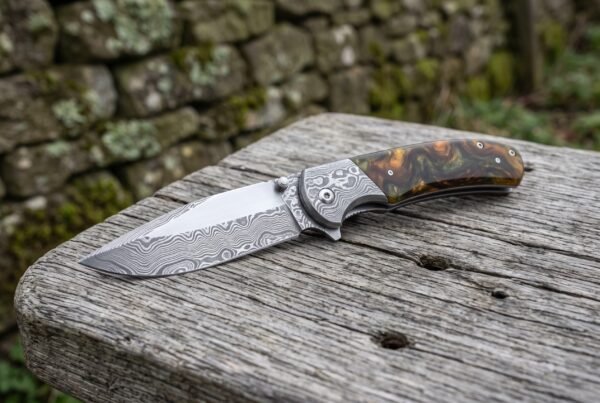
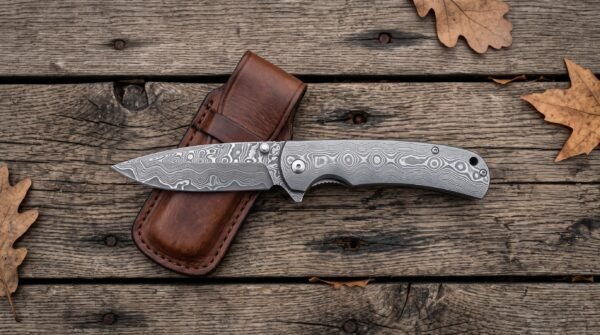
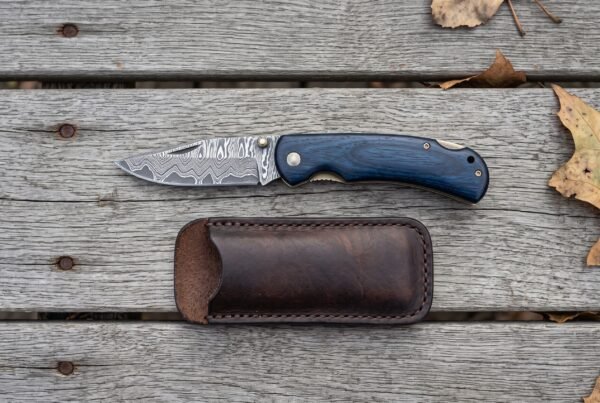
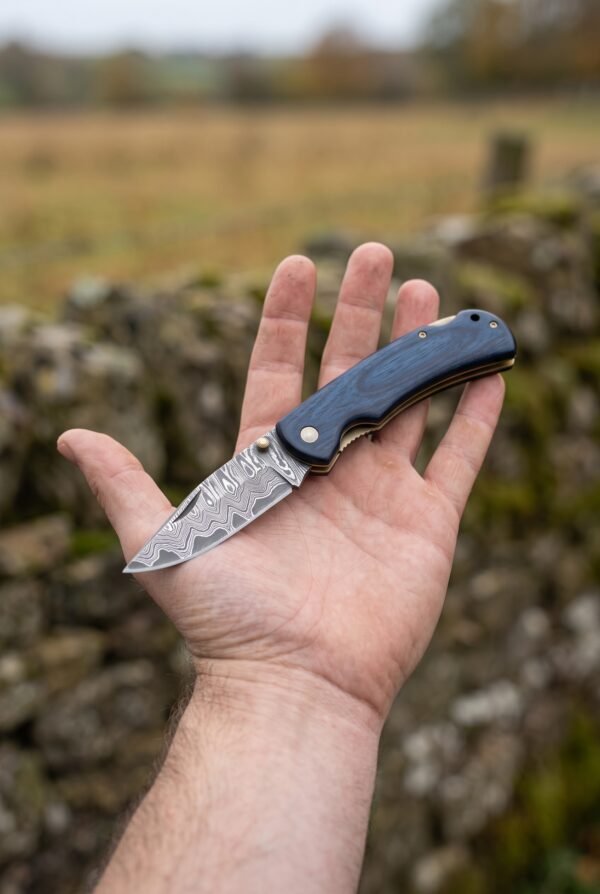
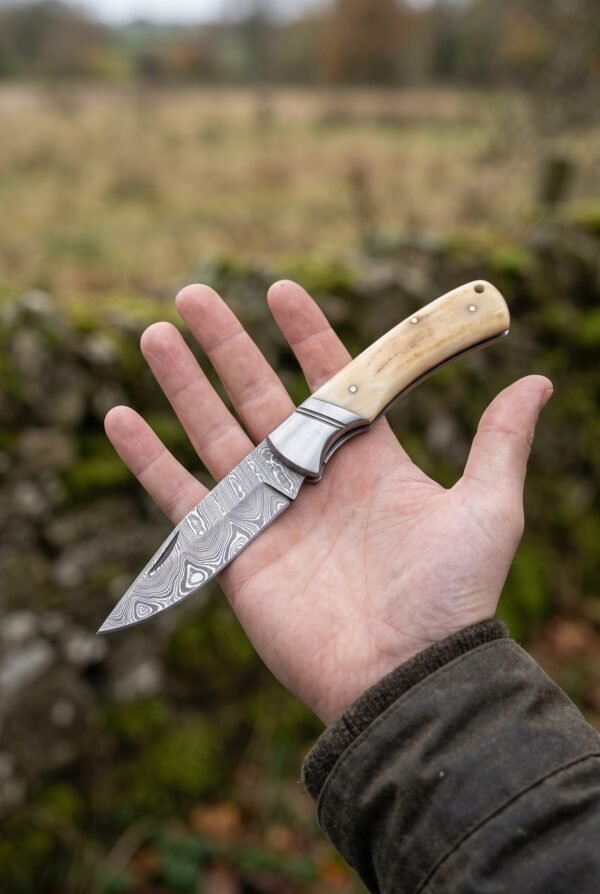
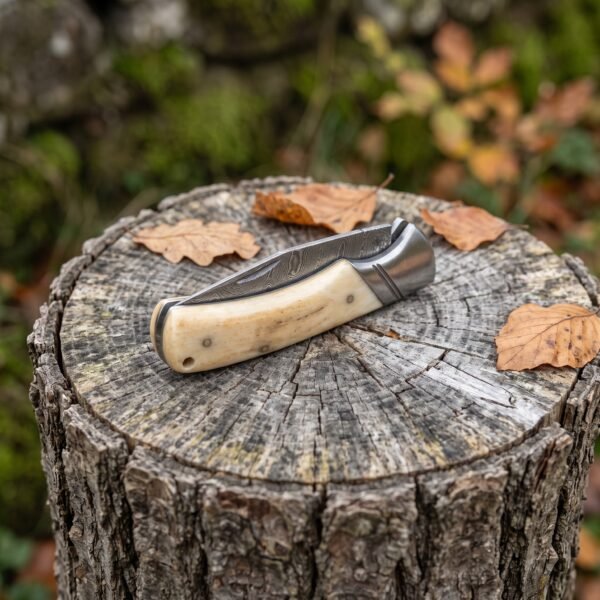
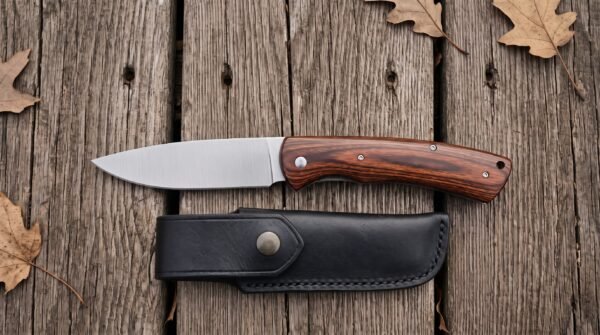
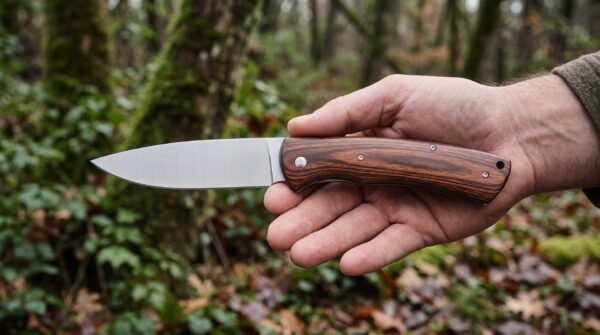
This Resincarry is a working folding pocket knife rather than a drawer piece. The blade is layered Damascus, the handle is cast resin, it measures 8.5 inches open, and it arrives with an edge that is ready to cut. The flat of the blade is left clear specifically so it can be engraved.
Folding knives are far older than most people assume. Roman sites across Europe have produced folding pocket knives from the first century onward, some with cast bronze handles shaped as hunting dogs, lions or gladiators, and they work exactly as you would expect: a blade on a pin that swings into a slot. What the Romans did not have was a spring. Their folders were friction folders, held open only by the pressure of the handle and the user’s thumb on the tang, which is why they never displaced the belt knife. The folding knife only became a genuinely popular object in the seventeenth century, once smiths worked out how to fit a backspring that held the blade both open and shut. That single addition is what turned a curiosity into the most carried tool in the world.
The Resincarry is forged and finished in the Czech Republic, and shipping inside the United States is free.
Specifications
| Steel | Hand forged Damascus, 1095 and 15N20 |
|---|
| Hardness | 58 to 60 HRC |
|---|
| Damascus layers | 352 layers |
|---|
| Type | Folding pocket knife with a flipper tab and a thumb stud |
|---|
| Overall length open | 8.5 inches |
|---|
| Blade | Drop point, Damascus with a plain satin band along the spine left clear for engraving |
|---|
| Bolsters | Two Damascus bolsters at the pivot end |
|---|
| Handle | Amber, green and black swirl resin scales over steel liners |
|---|
| Pins | Steel pins through the scales, screw pivot |
|---|
| Sheath | None, ships without a sheath |
|---|
| SKU | RK-10491 |
|---|
Why a folder is harder to build than a fixed blade
A fixed blade is one piece of steel with a handle on it. If the tang is sound and the grind is even, it works. A folder has to do the same job while also being a mechanism, and everything that makes it convenient also makes it difficult to make well.
The pivot is the whole knife. It has to be tight enough that the blade does not rattle sideways and loose enough that it swings without fighting you, and that tolerance is measured in fractions of a millimetre. Get it wrong in one direction and the blade wobbles. Get it wrong in the other and it binds. On a hand made folder the pivot is fitted and adjusted by feel rather than assembled from parts that were guaranteed to fit before anyone touched them.
Then there is centring. When the blade closes it has to sit exactly between the two handle sides without touching either one, because a blade that rubs will scar its own finish every time you shut it. That means the blade, the pivot, the spacers and both handle sides all have to agree with each other. And unlike a fixed blade, where force runs down a continuous tang, all the load on a folder passes through pins and a pivot, so the handle has to be built to carry it.
What you should look for when you handle any folder is simple. Open and close it slowly and feel for grit. Look down the closed knife to see whether the blade sits centred. Push the blade sideways when open and see whether it moves. Those three checks tell you more about how a folder was made than any specification list.
Why Damascus and not stainless
This is real pattern welded Damascus, not an etched print. Layers of 1095 high carbon and 15N20 nickel steel are forge welded, folded and drawn out, so the pattern runs through the blade rather than sitting on the surface, and hardening puts it at 58 to 60 HRC.
On a pocket knife that hardness earns its keep every day. An everyday carry blade does a hundred small cuts a week on tape, cord, cardboard and food, and edge retention is the difference between sharpening once a season and sharpening once a fortnight. This steel is harder than the stainless in a supermarket knife, takes a finer edge and keeps it longer.
The cost is corrosion, and on a folder that cost is slightly higher than on a fixed blade, because a pocket is a warm damp place and because moisture gets into a pivot and stays there. Dry the blade before you close it if it has been wet, and put a drop of light oil on the pivot occasionally. Done that way it is a non issue. We set the trade out in Damascus versus stainless, and if you are comparing Damascus folders anywhere, run them through our five checks for real Damascus first.
The resin handle
Resin was chosen for stability rather than for looks. A cast resin handle is a solid block with no grain direction, no moisture content and nothing in it that can move, so heat, cold, oil and water leave it unchanged. That matters more on a folder than on anything else in the range, because a handle that swells or shrinks even slightly will throw the blade off centre or bind the pivot, and a fixed blade would simply carry on working.
It is also the only handle material here that needs no maintenance at all. There is nothing to oil and nothing to feed. Wash it with soap and water, dry it, and put it away. Because resin is cast rather than cut from a natural material, the colour and the swirl are set as it cures, so the figure in yours will differ from the photograph even though the material is man made.
What resin gives up against horn or timber is warmth in the hand and the depth that natural material develops with years of handling. On a pocket knife that lives in a pocket and gets wet, we think stability is the better trade.
Engraving, runes and your own design
Use the rune converter on this page to turn a name, a date or a short phrase into Elder Futhark and we will cut it into the steel or the handle. If you would rather have a Viking pattern than a rune line, choose your own design in the engraving option above the add to cart button and tell us whether it goes on the blade or the handle. Where a piece already carries an engraved design, your chosen engraving replaces it rather than sitting alongside it. This model is built with the blade flat left clear for exactly this purpose, and a short rune line or a set of initials sits well on it. A pocket knife is the piece people actually carry every day, which is why it is the one most often ordered with a name on it. See the engraving page.
Care and sharpening
Damascus is high carbon at heart, so it will rust if you leave it wet, and a closed folder holds damp against the blade. Dry it before closing, wipe it with mineral or camellia oil now and then, and put a single drop of light machine oil on the pivot two or three times a year. Do not flood the pivot, because oil collects pocket lint.
Sharpening is ordinary stone work, and a folder is easier than a big fixed blade because the edge is short enough to do in one pass per side. Keep the blade open and locked or held firmly, work at a consistent angle, and finish with a few light strokes on a strop to bring the polish back. We cover both jobs in steel care and sharpening with a whetstone. More on choosing an everyday carry blade is in our EDC guide.
Made in the Czech Republic
This piece is made by hand in the Czech Republic, in a workshop that still works the old way. The steel is forged, ground, heat treated and finished by smiths who learned the trade from the people before them, and the wood, horn and leather are cut and fitted by hand rather than pressed out on a line. That is also why no two pieces come out exactly the same.
Ransack Viking is a United States company. We import these pieces ourselves, check every one when it lands and ship from our warehouse in Chicago, Illinois. Engraving is done here in the United States after the piece arrives, so your runes or your own design go on before it leaves for you.
A note on handmade variation
This knife is hand forged. It is not machine made and it is not bulk produced, so what arrives will not be a pixel for pixel copy of the photograph. The Damascus pattern comes out of the billet differently on every blade, the resin swirls as it cures and never sets the same way twice, and the grind and the pivot are set by hand. The dimensions, the steel and the build are the same every time. The character is not.
Frequently asked questions
Is it a locking knife or a slip joint
It opens with a flipper tab or the thumb stud. If the exact locking arrangement matters for where you intend to carry it, message us before ordering and we will confirm it on the piece you are buying.
Is it legal to carry in my pocket
Folding knives are the most widely permitted category, but blade length limits and rules on locking blades vary by state and by city in the United States and are stricter again in most of Europe. Check your local rule before you carry it.
Does it come with a sheath
No. This is a pocket knife and it folds into itself, so it ships in protective packaging without a sheath.
Will the pivot loosen with use
Not in normal carry. If it ever feels loose after years, the pivot can be adjusted rather than replaced, which is one of the advantages of a hand fitted folder.
Can the resin handle be engraved as well as the blade
The blade flat is the better surface and is left clear for it. Resin can be cut, but a line in steel reads more crisply and lasts better.
How sharp is it when it arrives
Sharpened and ready to work. Open it carefully the first time.
What is in the box
- One Resincarry Damascus folding pocket knife
- Protective packaging
- Forged and finished in the Czech Republic
Explore the range
Compare it with the rest of Folding Pocket Knives, the fixed blades in Hunting Knives, the personalised work in Engraved and Personalized and the Norse pieces in Viking Knives. Background reading is in the guides.
Close to this one
Closest to this in the range is the Campfold folding pocket knife, pattern welded Damascus. If this one is not quite right, there is the Ramfold folding pocket knife, pattern welded Damascus. Also in this group is the Stagcarry folding pocket knife, pattern welded Damascus.
If you are putting a set together, the Streamwood fish fillet knife sits alongside it. Nothing here exactly right, build one to your own spec on the custom Damascus knife page.

Knew this knife was special the second I opened the box. Weight and balance make it feel like a real functional piece not some cheap replica. Will definitely order again for another gift.