
Mjolnir is the hammer Thor carries, and the pendant is a small copy of it worn at the throat. The handle looks too short because it is too short. In the myth the dwarf Brokkr was forging it when Loki, in the shape of a fly, bit his eyelid and made him falter at the bellows, so the hammer came out stubby and Thor kept it anyway. The full size hammers do too. Close to a thousand hammer amulets have come out of Viking age graves, and almost all carry that same squat proportion.
Both pendants here are stainless steel rather than sterling, which is the honest answer and the practical one, because steel worn every day does not tarnish and will not mark skin. Each stands about 2 inches tall including the bail or crown. One is bright polished with a scrolled shaft and a knotwork banded bail on a heavy curb chain of roughly 24 inches. The other is a silver finish piece with deep cut interlace, a beaded border and a Vegvisir on the crown, on a box chain of roughly 24 inches.
Buy the one with the detail you would still want to look at in five years. The hammer is the most recognised Norse shape there is, and what the sources say about Thor explains why it was worn in the first place.
Free US shipping
On most pieces. Heavier and oversized ones carry a flat charge.
Hand Forged
Heated, hammered and ground by hand.
Engraving available
Names, dates or Norse runes on most pieces.
Ships from Chicago
Inspected and dispatched from our Chicago warehouse. No import duty, no customs delay on US orders.
Mjolnir Pendants
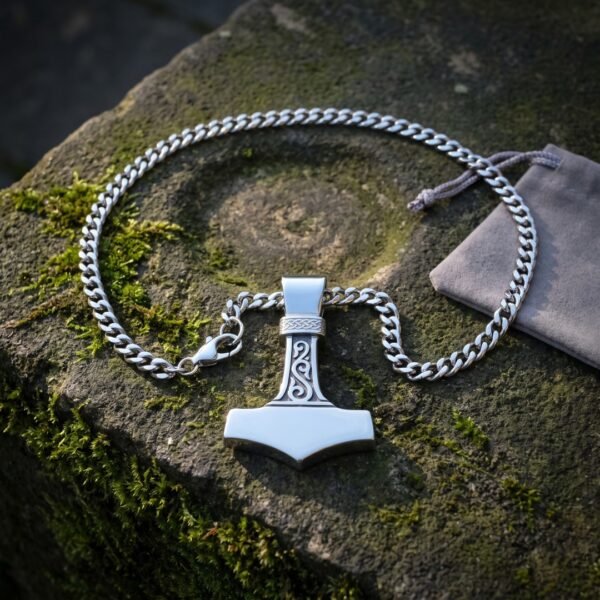
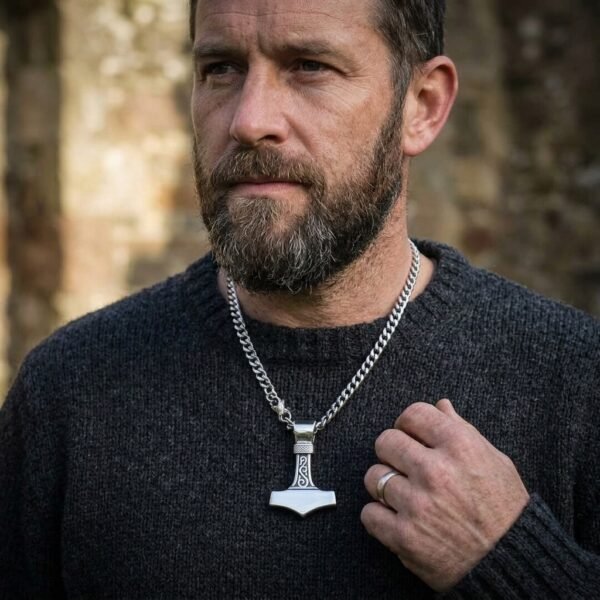
Thunderclasp Hand Made Stainless Steel Mjolnir Pendant with Knotwork Bail & Heavy Curb Chain | Norse Gift | RK-1734
Original price was: $159.00.$127.20Current price is: $127.20.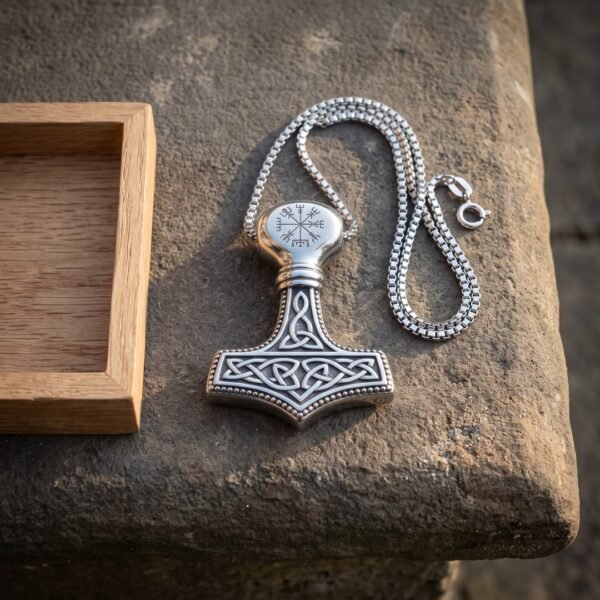
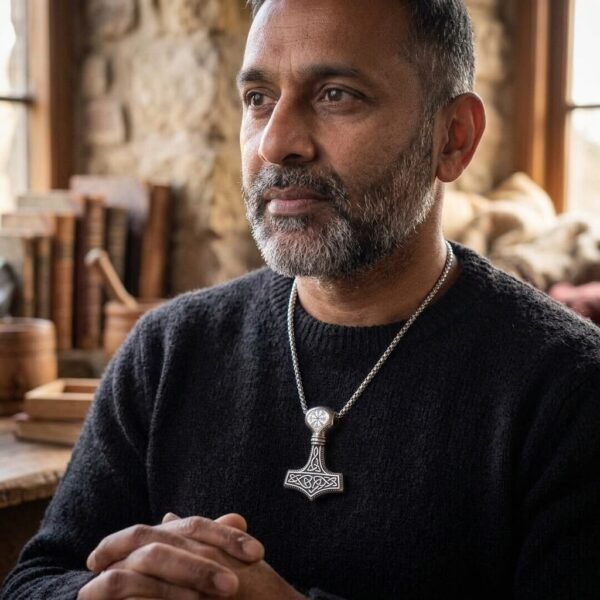
Thunderknot Hand Made Silver Finish Mjolnir Pendant with Celtic Knotwork & Vegvisir Crown | 24 Inch Box Chain | Norse Gift | RK-1754
Original price was: $159.00.$127.20Current price is: $127.20.Why the handle is too short
Every Mjolnir pendant you will ever see has a stumpy handle, and there is a story attached. Loki bet his head that the dwarf brothers Brokkr and Eitri could not match the treasures made by the sons of Ivaldi. While Brokkr worked the bellows, Loki turned himself into a fly and bit him on the eyelid. Brokkr let go of the bellows for a moment to swat it, the fire dropped, and the hammer came out of the forge with a handle shorter than it should have been. The dwarves won the bet anyway. Thor carried the hammer for the rest of Norse mythology and nobody mentions the handle again.
What makes that story interesting is that the archaeology agrees with it. There are close to a thousand hammer amulets from graves and hoards across Scandinavia, Iceland, England, the Baltic and the Rus trade routes, and the great majority share the same squat proportion, a broad flared head over a short shaft. The shape is not a modern jeweller taking liberties with a chain length. It is what people in the tenth century actually hung round their necks.
They cluster in that century for a reason worth knowing. Hammer pendants become common at precisely the point Christian cross pendants are spreading through the same regions, and a soapstone mould from Trendgaarden in Denmark casts a cross and a hammer side by side in the same block. Whoever owned that mould was covering both markets, or possibly both outcomes.
What the hammer meant to the people who wore it
Mjolnir in the sources is not simply something Thor hits giants with. It makes things binding. In the poem Thrymskvida the giant Thrym steals the hammer and demands the goddess Freyja as the price of giving it back. Thor goes in her place, veiled as the bride, and the trap springs at the moment the hammer is carried in and laid in the bride's lap to hallow the marriage. That single line tells us the object had a ceremonial job at weddings.
It appears again at Baldr's funeral, raised to hallow the pyre. Between those two scenes you get the working meaning of the symbol: protection, and the sealing of something that is meant to hold. This is also why hammer amulets turn up in women's graves as often as men's, which surprises people who assume the hammer was a fighting emblem and nothing else.
The pendants in this collection
Two pieces, both stainless steel, both roughly 2 inches tall, both supplied on a chain of about 24 inches. They differ in finish, in the detail cut into them, and in what they arrive in.
The polished steel hammer with a knotwork bail
Polished stainless steel, not plated and not sterling silver. The head is broad and flared, the shaft carries a pair of opposed scrolls, and the bail is banded with Celtic knotwork. It stands approximately 2 inches tall including the bail. The finish is a bright polish with the recessed scrollwork left darker, so the pattern reads as shadow against the shine rather than needing an applied coating to show up.
It hangs on a heavy curb link chain in matching stainless steel, approximately 24 inches, closed with a lobster clasp. It will not tarnish, will not turn skin green and is fine in the shower and in salt air. It arrives with the chain and a soft drawstring pouch.
The silver finish hammer with a Vegvisir crown
Polished silver finish stainless steel, again not solid sterling. This is the heavier looking of the two. A beaded border runs the whole outline, deep cut Norse interlace fills the head and the shaft, and the crown swells into a polished dome carrying an engraved Vegvisir, the eight spoked stave. It stands approximately 2 inches tall including that crown and measures approximately 1.8 inches across the hammer head.
The chain is a substantial box link of approximately 24 inches with a spring ring clasp. The finish is a bright polish on the raised surfaces with darkened recesses for contrast, which is what makes deep interlace legible at arm's length instead of turning into a grey blur. It arrives in a wooden gift box with a care card.
One honest note about the Vegvisir, because plenty of shops will not give you one. It is not a Viking age symbol. Its earliest appearance is in the Huld manuscript, written in Iceland in 1860, alongside related Icelandic grimoires of the seventeenth and eighteenth centuries. The text says the one who carries the sign will not lose his way in storms. It is a genuine piece of Icelandic magical tradition and it is about eight hundred years younger than Thor's hammer. Wear it because you like what it says, not because somebody told you a Viking wore one.
Sizes, chains and fittings
Every figure below is taken from the specification panel of a piece on this page. These are cut, filed and polished by hand, so read the measurements as what to expect rather than as a caliper reading.
| Pendant | Material and finish | Size | Chain and clasp | Cut work | In the box |
|---|---|---|---|---|---|
| Flared head with scrolled shaft | Polished stainless steel, not plated | About 2 in tall including the bail | Heavy curb link, about 24 in, lobster clasp | Celtic knotwork banded bail, opposed scrolls on the shaft | Pendant, chain, drawstring pouch |
| Broad head with a domed crown | Silver finish stainless steel, not sterling | About 2 in tall, about 1.8 in across the head | Box chain, about 24 in, spring ring clasp | Deep cut interlace, beaded border, engraved Vegvisir on the crown | Pendant, chain, wooden gift box |
The two clasps behave differently and it is worth knowing which you prefer. A lobster clasp opens with a sprung lever and is easier to work one handed behind your own neck. A spring ring is smaller, sits flatter and is fiddlier to open with cold fingers.
Sizing and how it will actually hang
A 24 inch chain sits at roughly mid chest on most adults, below the collarbone and below the neckline of an open collar. That is the length hammer pendants are usually worn at, because a 2 inch pendant on a short chain sits high on the throat and looks cramped. If you want it higher, a 20 inch chain is the usual alternative, and both pendants will move to one.
Chain style changes the look more than most people expect. A curb link lies flat and reads as a chain from across a room. A box chain is squarer in section, catches light along its whole length and looks heavier for the same actual weight. Neither is stronger in any way that matters at this size.
Weight matters more than length for comfort. Both of these are steel rather than hollow plate, so they have real mass and you will know they are there. That is generally what people want from a hammer and occasionally not what they want under a shirt for a twelve hour day. If it is a gift for someone who has never worn a pendant, the lighter polished piece is the safer bet.
Stainless steel, and why it is not silver
Neither of these is sterling and we would rather say so on the page than in the returns policy. Stainless steel is the better material for something worn daily. It does not tarnish, so it never needs polishing and never comes out of a drawer black. It does not contain the copper that turns skin green. It is hard enough to take a knock against a belt buckle or a car door without picking up a dent, and it is unbothered by sweat, chlorine, a shower or salt air.
Sterling silver is softer, warmer in colour and needs looking after. It will oxidise, it will scratch, and it will want a polishing cloth several times a year. The silver finish on the second pendant here gives you the colour without the maintenance, but it is a finish on steel and it should be treated as such rather than filed or aggressively polished.
Neither piece is Damascus. The forge welded 1095 and 15N20 that runs through our blades is a blade steel, and it is not what these pendants are made from.
Care and storage
There is not much to do. Warm water, a drop of washing up liquid and a soft cloth will take off skin oil and anything the day has added. Dry it properly, particularly around the bail and inside the links of the chain, because trapped water leaves marks even on steel that cannot rust in any meaningful way.
Keep the deep cut recesses clean with a soft toothbrush if the interlace starts to look flat. That flatness is dirt filling the shadow lines rather than wear. Avoid abrasive polish on the silver finish piece, and avoid dropping either onto a tiled floor, which is how most pendants pick up their first real mark.
If a chain does tangle, lay it flat on a hard surface, put a drop of oil on the knot and work it apart with two pins rather than pulling at both ends. Pulling is how a link opens.
Store it in the pouch or box it came in rather than loose in a drawer with keys and coins. A chain tangled in a drawer is the most common way a good pendant stops being worn.
Engraving
Both pendants have plain steel on the back of the head, which is where engraving goes. Names, dates, initials or a line of Elder Futhark runes all work at this size. Text engraving is 19 dollars, a symbol is 39 dollars and a family crest is 49 dollars, and it is done in the US after the piece arrives.
Elder Futhark is a phonetic alphabet rather than a cipher, so a name is transliterated by sound and not letter for letter, and there is no rune for the letter C. Our guide to the runes covers how that works. Engraving is permanent and an engraved piece cannot be returned, so send the exact spelling and read it twice before you order.
Where these come from and how they ship
Ransack Viking is a US company based in Chicago, Illinois. Both pendants are cut, filed, polished and finished by hand in the Czech Republic, then imported, inspected and shipped from Chicago. Engraving is done in the US after arrival.
Because the cut work is done by hand, expect very small differences in the depth of an interlace line or the darkness of a recess between two pendants of the same name. They are made by people, one at a time.
How to choose
If you want the plainer, brighter piece that reads as a hammer from across a room and will take daily wear without a thought, take the polished steel one with the curb chain. If you want something with more to look at close up, with interlace, a beaded border and a stave on the crown, and you want it to arrive in a wooden box for a gift, take the silver finish piece.
If neither shape is quite right, our Norse pendants page carries the Valknut, Vegvisir and Yggdrasil designs, and Thor's hammers covers the full sized pieces rather than the ones you wear.
Browse related categories
- Norse jewellery, the full range
- Norse pendants, Valknut, Vegvisir and Yggdrasil
- Viking rings and bracelets
- Arm rings and torcs
- Thor's hammers, the full sized pieces
- Engraved and personalised pieces
- Wedding and groomsmen gifts
Guides worth reading first
- Mjolnir, what the hammer actually meant
- The Vegvisir and where it really comes from
- Viking symbols and their meanings
- A guide to the Norse gods
- Elder Futhark runes and how names are written
- Thor in Norse myth, beyond the hammer
Frequently asked questions
Why is the handle on a Mjolnir so short?
Because it was short in the myth. Loki, as a fly, bit the dwarf Brokkr on the eyelid while he worked the bellows, the fire dropped, and the hammer came out with a stunted handle. Nearly every hammer amulet found in a Viking age grave shares that proportion.
Are these solid silver?
No. One is polished stainless steel and the other is a silver finish on stainless steel. Neither is sterling. Steel is the better material for something worn every day, because it does not tarnish, does not need polishing and will not turn skin green.
How big are the pendants?
Both stand approximately 2 inches tall, the first including its bail and the second including its domed crown. The second measures approximately 1.8 inches across the hammer head. Both come on chains of approximately 24 inches.
Can I wear it in the shower or the sea?
Yes. Stainless steel is unbothered by water, sweat, chlorine and salt air. Dry the chain properly afterwards, because trapped water leaves marks around the bail and between links even on steel that cannot meaningfully rust.
Is the Vegvisir a real Viking symbol?
Not a Viking age one. Its earliest appearance is the Huld manuscript of 1860 in Iceland, with relatives in Icelandic grimoires of the seventeenth and eighteenth centuries. It is a genuine piece of Icelandic magical tradition, about eight hundred years younger than the hammer beside it.
Were hammer pendants worn by men or women?
Both. Hammer amulets turn up in women's graves as often as in men's, which fits what the sources say about the object. The hammer hallowed a marriage and a funeral pyre as well as fighting giants.
Can I have one engraved?
Yes, on the plain steel at the back of the head. Names, dates, initials or a rune line all fit. Text is 19 dollars, a symbol is 39 dollars and a family crest is 49 dollars. Engraving is permanent, so check the spelling before you send it.
Where are these made?
Ransack Viking is a US company based in Chicago, Illinois. The pendants are handmade in the Czech Republic, then imported, inspected and shipped from Chicago, with engraving added in the US after arrival.