
Blog
Vegvisir: The Icelandic Stave and Why It Is Not Viking Age

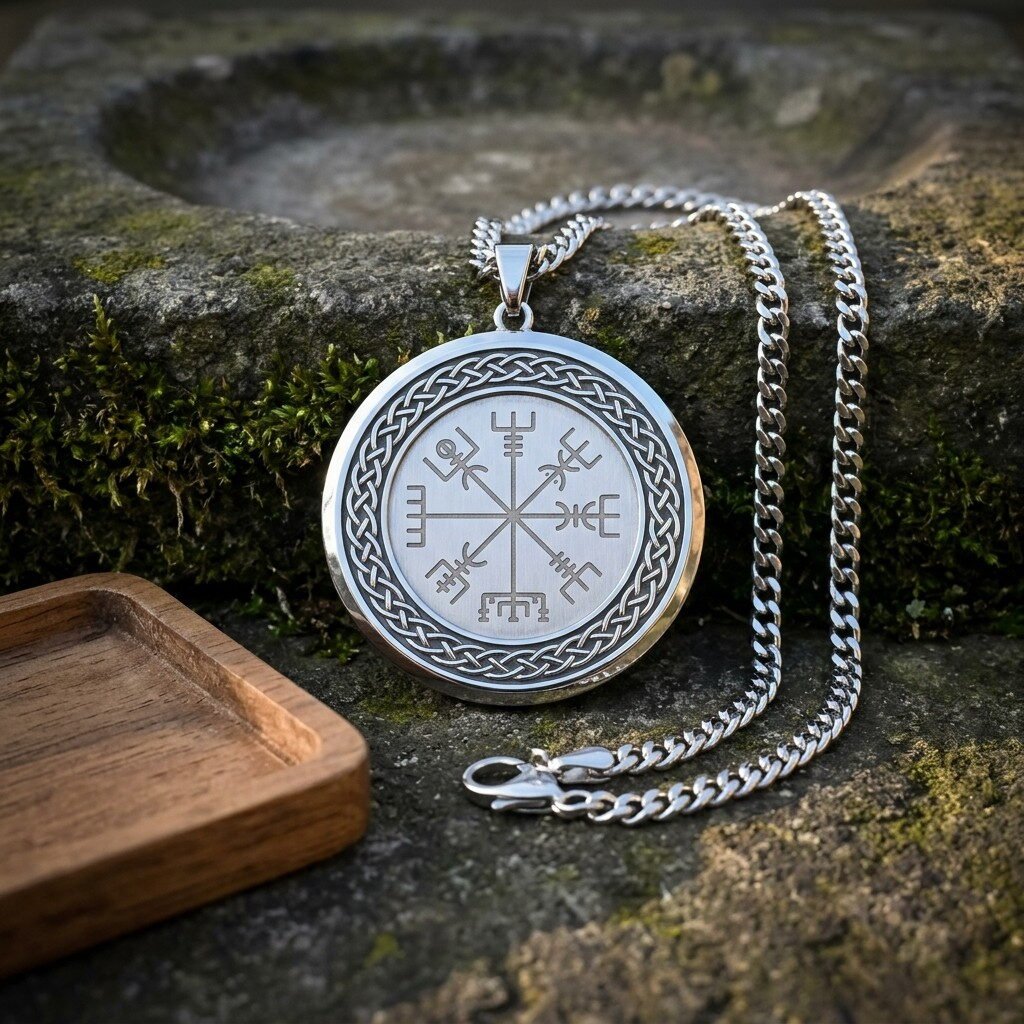
The Vegvisir is an Icelandic magical stave, eight branching arms around a centre, and it is not Viking Age. Its only early source is the Huld manuscript, compiled in Akureyri in 1860 by Geir Vigfusson, roughly eight centuries after the Viking Age ended. That puts it closer to the invention of the telephone than to any Viking, which has never slowed down a tattoo artist. No Viking Age object carries it and no medieval text mentions it. What the manuscript does say, and where the design came from, is below.
None of that makes it worthless. It makes it nineteenth century Icelandic folk magic instead of ninth century Norse religion, which is a real and interesting thing to be, and it does not need the upgrade. The problem is only with sellers and tattoo blogs that call it a Viking compass and leave the date out.
What the Huld manuscript says
The Huld manuscript, catalogued as IB 383 4to, is a small collection of Icelandic magical staves and lore written out by Geir Vigfusson in Akureyri in 1860. The Vegvisir sits in it with a short note. The usual translation runs close to this: if this sign is carried, a person will not lose their way in storms or bad weather, even when the way is unknown to them.
Read that carefully, because it is the whole documented claim. It is a charm against getting lost in bad weather, carried on the person. There is no mention of ships, no mention of the sea, no mention of the eight winds, no mention of the four cardinal directions, and no mention of Odin or any other god. Everything else that gets attached to the symbol has been added since, most of it by people with something to sell.
The name
Vegvisir is modern Icelandic and it is a plain word. Vegur is way or road, visir is a pointer or guide. Icelandic road signs use the same word. It means signpost, which is a good deal less mystical than the listings suggest. It does not mean compass, and the design has no needle, no bearings and no north.
Where the design actually comes from
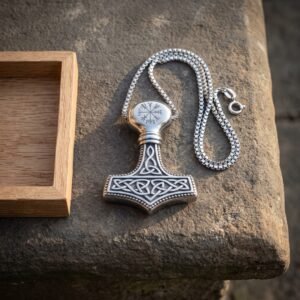 Thunderknot Hand Made Silver Finish Mjolnir Pendant with Celtic Knotwork & Vegvisir Crown | 24 Inch Box Chain | Norse Gift | RK-1754
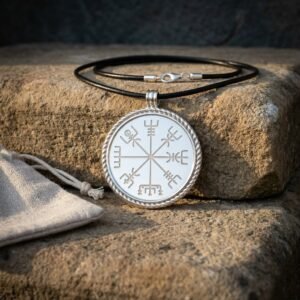 Wayfinder Hand Made Silver Tone Vegvisir Pendant with Twisted Rope Bezel & 20 Inch Black Leather Cord | Norse Runic Gift | RK-1600
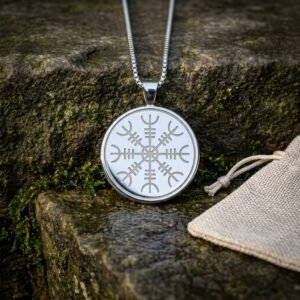 Wardstave Hand Made Helm of Awe Pendant with an Engraved Aegishjalmur Stave & Box Chain | Norse Protection Gift | RK-1665
Icelandic magical staves
The Vegvisir belongs to a body of Icelandic material called galdrastafir, magical staves. These are drawn signs, usually built from straight strokes with hooks, forks and crossbars at the ends, meant to be cut, drawn or carried for a specific purpose: to win a court case, to keep sheep from wandering, to stop a nosebleed, to find a thief. Hundreds of them survive in Icelandic manuscripts from the seventeenth century onward, and the tradition ran on into the nineteenth century, which is where Geir Vigfusson comes in.
The grimoires behind them
The older written collections are grimoires. The best known is the Galdrabok, an Icelandic manuscript compiled around 1600 by several hands. What is striking about that book, and awkward for anyone who wants a pure pagan lineage, is how mixed its sources are. It calls on Christian names of God alongside Thor and Odin, it uses Latin formulas, and it borrows from continental European magical books of the same period. This is post medieval folk magic in a Christian country, drawing on whatever it found useful. It is not a survival of Norse religion handed down intact.
Why the Viking Age claim fails
The dates do not work
The Viking Age is conventionally closed in 1066. The Huld manuscript is dated 1860. That is a gap of nearly eight hundred years, and it is not a gap you can bridge with an assumption that the design must be older. Historians want a chain of evidence rather than a strong feeling. For the Vegvisir there is nothing at all before the nineteenth century, and only a small number of Icelandic manuscripts of similar date carry it.
The archaeology is silent
Viking Age Scandinavia has produced a very large body of decorated material: picture stones, runestones, ship burials, brooches, sword fittings, carved wood, bone combs, coins. Symbols that were genuinely in use show up across that material repeatedly. Thor’s hammer is found as hundreds of pendants. The Valknut, which we covered in the piece on where the Valknut appears, is on picture stones and in the Oseberg burial. The Vegvisir appears on none of it. Not once.
It is not a navigation instrument
Even taken at face value the Vegvisir is a charm rather than a tool. A compass gives a bearing. This gives eight arms of equal length with no orientation, no scale and no moving part. Calling it a Viking compass confuses a protective sign with an instrument, and it also implies the Norse had a magnetic compass, which nobody thinks they did.
The Helm of Awe, the same problem with an extra wrinkle
The Helm of Awe is the closest comparison and it is more interesting, because here half the claim holds up. The Old Norse word aegishjalmr does appear in medieval literature. It is in Fafnismal in the Poetic Edda and in the Volsunga saga, where the dragon Fafnir speaks of wearing the aegishjalmr and terrifying everyone who came near his hoard. So the word is real and old.
The drawing is not. The eight armed figure that people tattoo and wear today comes from the same early modern Icelandic grimoire tradition as the Vegvisir, not from Norse antiquity. What the sagas describe sounds more like a quality, a power of terror that Fafnir possesses, than a picture anyone drew. So the accurate sentence is that the name is medieval and the symbol as drawn is early modern. Our broader guide to Viking symbols and their meanings works through the rest of the set the same way, and the piece on the meaning of Mjolnir is a useful contrast, because that is a symbol with both text and hundreds of surviving pendants behind it.
How the Norse actually found their way
The real navigation story is better than the charm. Norse sailors ran along latitudes, holding a course by the height of the sun at midday and the pole star at night, and by the coastal landmarks they had memorised. Landnamabok preserves a set of sailing directions for the route from Norway to Greenland that reads like a practical handbook, telling the sailor how far north to keep and what to look for on the way.
A wooden fragment found at Uunartoq in Greenland has been interpreted as part of a sun compass, a disc with a central gnomon whose shadow could be checked against scratched lines. That reading is disputed, and the object is a single find. Icelandic texts also mention a solarsteinn, a sunstone, and some researchers connect it to calcite crystals that can locate the sun through overcast sky by polarisation. No such stone has yet been found in a Viking Age ship burial, so that too sits in the maybe column. Seabird behaviour, the colour and temperature of the water, driftwood, cloud formations over unseen land: all of that was working knowledge. None of it needed a stave.
Buying a Vegvisir piece with the history attached
We sell plenty of pieces carrying this stave, and we would rather do it honestly than repeat the compass story. It appears across our Norse pendants, on carved and burned items in Viking home decor such as kuksa cups and lawn game sets, and alongside the rune material in our runestones and rune sets. If you want the stave combined with a name, a date or a line of Elder Futhark, that is handled through our engraved and personalised range, with the detail set out on the custom engraving page. Worth stating plainly: Ransack Viking is a US company in Chicago, Illinois, every piece is handmade in the Czech Republic the old way, then imported, inspected and shipped from Chicago, and engraving is done in the US after the piece arrives. On blades the steel is plain 1095 at 54 to 58 HRC, or Damascus of 1095 and 15N20 forge welded at 58 to 60 HRC, which is covered on our steel and hardness page.
Judging the drawing itself
A good Vegvisir has eight arms of equal length at equal angles, each terminating in its own distinct device. In the Huld drawing the eight ends are not identical to one another, and a lot of modern versions quietly simplify them into eight copies of the same fork, which loses the character of the original. Watch for the ring of runes that often surrounds the stave in tattoos and jewellery. That ring is a modern addition. It is not in the manuscript, and the runes in it are frequently either decorative nonsense or a transliterated English phrase, so read them before you commit them to your skin, where corrections are expensive.
The staves are often confused with the older writing system, which we separate out in runestones and what they say. For the cosmology the symbols sit inside, see the world tree.
Questions people ask
Is the Vegvisir a Viking symbol?
No. Its only early source is the Huld manuscript, written out in Akureyri, Iceland, by Geir Vigfusson in 1860. That is nearly eight hundred years after the Viking Age closed. No Viking Age carving, burial, runestone or piece of metalwork carries it, and no medieval text mentions it. It is genuine Icelandic folk magic of the nineteenth century, which is a different and later tradition, and interesting enough on its own terms without the borrowed antiquity.
What does the Huld manuscript actually claim for it?
Only this, in the usual translation: if this sign is carried, a person will not lose their way in storms or bad weather, even when the way is unknown to them. It is a charm against getting lost, carried on the body. The manuscript says nothing about ships, seafaring, the eight winds, the cardinal directions or any Norse god.
Is the Vegvisir a compass?
Not in any sense that would get you home in fog. The word vegvisir is modern Icelandic for signpost, from vegur, way, and visir, pointer. The design has no bearings, no scale, no orientation and no moving part. Calling it a Viking compass also implies the Norse had magnetic compasses, which no historian argues. They navigated by sun height, the pole star, landmarks and memorised sailing routes.
Is the Helm of Awe any older?
The name is, the picture is not. The Old Norse word aegishjalmr appears in Fafnismal in the Poetic Edda and in the Volsunga saga, where Fafnir wears it and terrifies all comers. The eight armed figure people wear today comes from early modern Icelandic grimoires, in the same tradition as the Vegvisir, rather than from Norse antiquity. Both halves of that are worth saying.
Should I avoid Vegvisir jewellery then?
Only if accuracy matters more to you than the design, which is a fair position. Plenty of customers want it knowing exactly what it is: a nineteenth century Icelandic protective stave with a clear written charm attached. The symbol carries real cultural history. The dishonest part is the marketing that backdates it by eight hundred years, not the object itself.
Are the runes drawn around a Vegvisir authentic?
Usually not. The ring of runes you see circling the stave in tattoos and modern jewellery is not in the Huld manuscript. It is a later decorative habit. In many designs the runes are either arbitrary or an English phrase transliterated letter by letter into Elder Futhark, which is not how the writing system worked. Check the wording before you have it cut rather than after.
If you are buying
Carried in the shop, the Wayrune Vegvisir pendant and the Northstave Vegvisir arming sword. The Northmark bearded axe and the Waymark canvas wall banner sit with them.
Shop the range
Thunderknot Hand Made Silver Finish Mjolnir Pendant with Celtic Knotwork & Vegvisir Crown | 24 Inch Box Chain | Norse Gift | RK-1754Wayfinder Hand Made Silver Tone Vegvisir Pendant with Twisted Rope Bezel & 20 Inch Black Leather Cord | Norse Runic Gift | RK-1600Wardstave Hand Made Helm of Awe Pendant with an Engraved Aegishjalmur Stave & Box Chain | Norse Protection Gift | RK-1665 Wayrune Hand Made Silver Finish Vegvisir Pendant with Knotwork Border & 24 Inch Curb Chain | Norse Wayfinder Gift | RK-1784
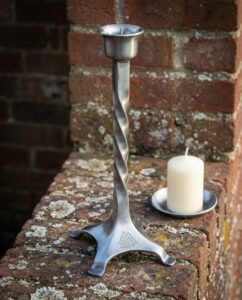 Wickthorn Hand Made Steel Viking Candle Holder with Hand Twisted Stem | 12 Inch Tall Tripod Base | Valknut Engraved Foot and Brushed Finish | Norse Table Gift | RK-1719
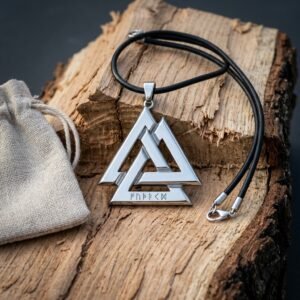 Thricebound Hand Made Polished Steel Valknut Pendant with Elder Futhark Rune Band & Black Leather Cord | Norse Gift | RK-1634