
A karambit is the hooked blade from the Malay archipelago, and the shape started in the fields rather than anywhere dramatic. It began as an agricultural tool for cutting roots and stripping husks, which is why the edge lives on the inside of the curve and the whole thing pulls toward you rather than pushing away. Add the finger ring at the butt and you have a knife that stays in the hand when a straight handle would not.
The four knives here run 8 to 11 inches overall including the ring, with 3 and a half to 6 inches of edge measured along the curve, and two of them list a weight near 6 ounces. Three are Damascus of 1095 and 15N20, forge welded and acid etched, hardened to 58 to 60 HRC. One is plain 1095 high carbon at 54 to 58 HRC with a mirror polish. All four are full tang with a steel finger ring, scales in micarta, rosewood or ebony, and a fitted leather sheath.
Put your finger through the ring before you decide the size is right.
Free US shipping
On most pieces. Heavier and oversized ones carry a flat charge.
Hand Forged
Heated, hammered and ground by hand.
Engraving available
Names, dates or Norse runes on most pieces.
Ships from Chicago
Inspected and dispatched from our Chicago warehouse. No import duty, no customs delay on US orders.
Karambit Knives
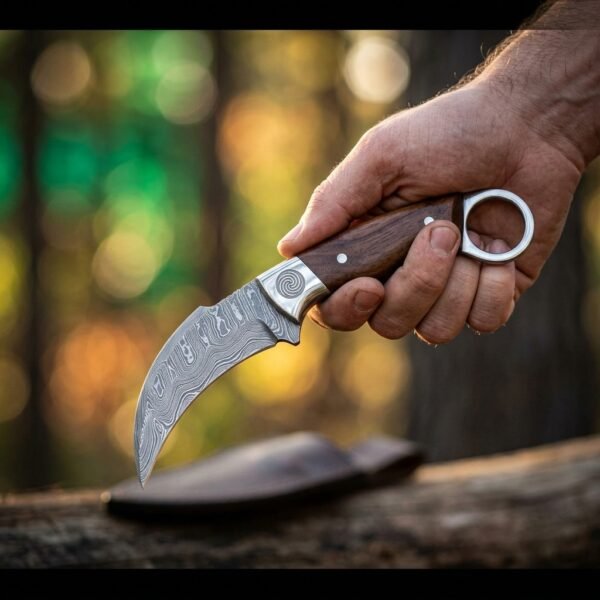
Clawfold Hand Forged Damascus Karambit Knife | 8 Inch Overall | Rosewood Scales and Spiral Engraved Bolster with Steel Finger Ring | EDC Collector Gift | RK-1902
Original price was: $289.00.$231.20Current price is: $231.20.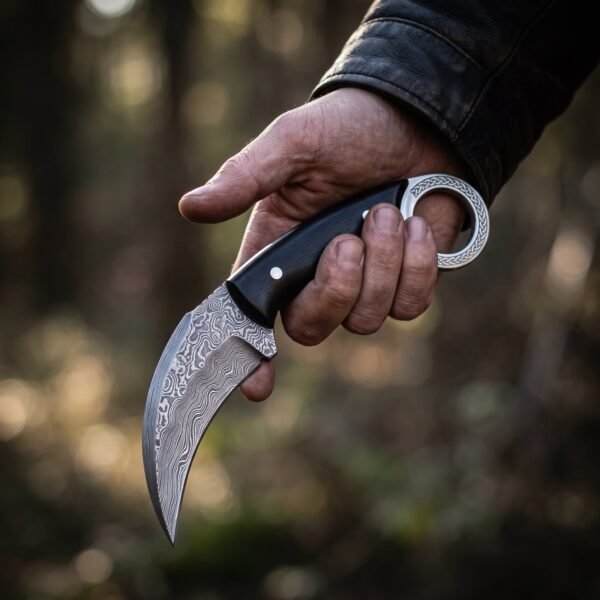
Clawshade Hand Forged 1095 and 15N20 Damascus Karambit Knife with Ebony Handle & Knotwork Engraved Finger Ring | Everyday Carry Gift | RK-1496
Original price was: $199.00.$159.20Current price is: $159.20.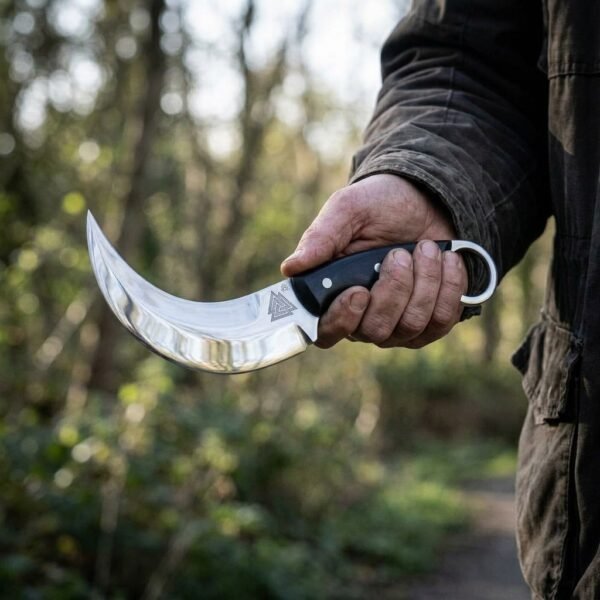
Talonvalk Hand Forged 1095 Steel Valknut Karambit Knife | 11 Inch Overall | Black Micarta Scales and Cowhide Leather Sheath | Norse Gift | RK-1851
Original price was: $229.00.$183.20Current price is: $183.20.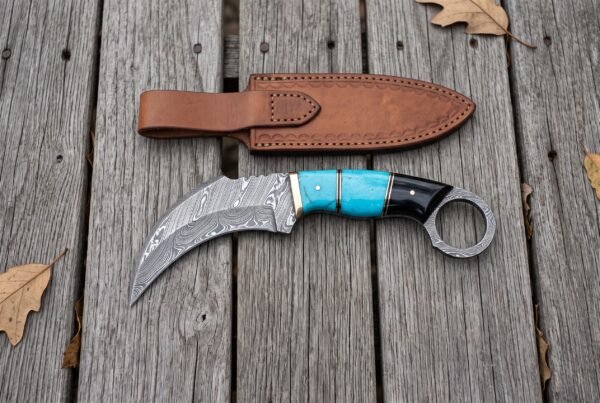
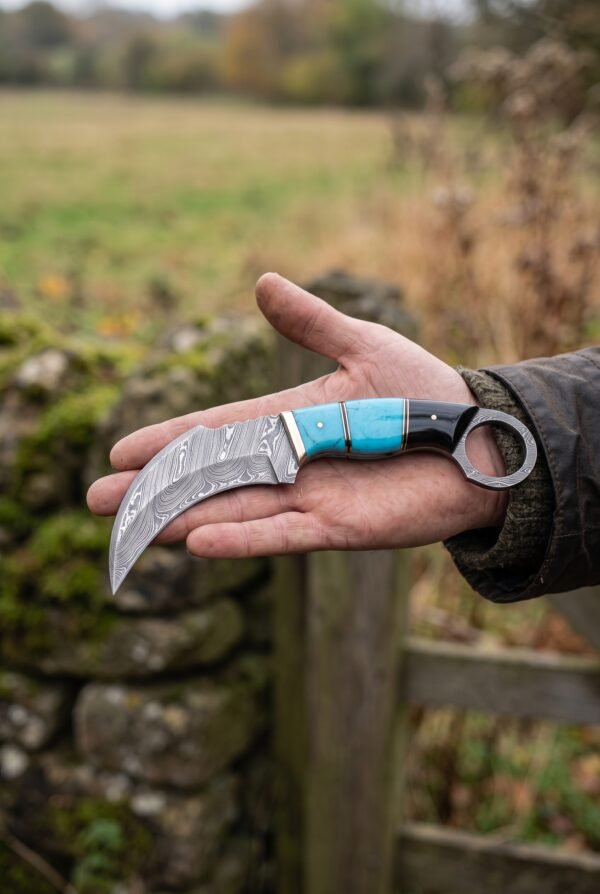
Turquoiseclaw Hand Forged Damascus Karambit Knife with Turquoise Bull Horn and Resin Handle and Damascus Finger Ring | Tactical Collector Gift | RK-1046
Original price was: $129.00.$103.20Current price is: $103.20.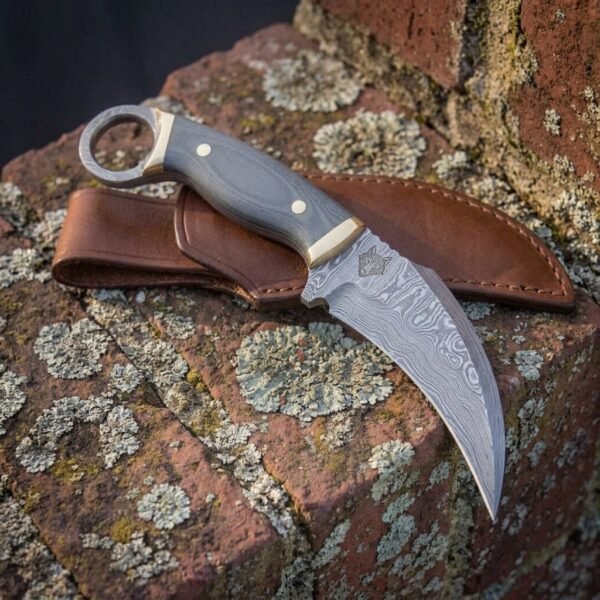
Talonveil Hand Forged Damascus Karambit Knife with Dark Grey Micarta Scales & Brass Bolsters | 9 Inch Overall | Steel Finger Ring and Leather Sheath | Collector Gift | RK-1701
Original price was: $269.00.$215.20Current price is: $215.20.Why the blade hooks and the edge faces inward
Start with what the shape does rather than where it came from. On a normal knife the edge faces away from you and the cut happens on a push or a slice across. On a karambit the edge sits inside a hooked blade, so the cut happens when the hand pulls back toward the body. That is the entire logic of the tool. A hook catches the thing you are cutting instead of sliding off it, and a pull is stronger and better controlled than a push because you are closing the arm rather than extending it.
The origin is agricultural. Farmers in the Malay archipelago used a small hooked blade to cut roots, strip fibre and open husks, and the ring at the butt kept the knife on the hand while the hand did other things. Everything the shape is now famous for came out of that job, not the other way round.
The curve also concentrates the cut. A straight edge spreads the contact along an inch or more of steel. A hook lands the load at a point that travels along the curve as the blade passes through, so the pressure stays high and the cut keeps going with far less force. That is why a small karambit works through cord and webbing that would stall a straight blade of the same size.
The cost of the shape is that a karambit is bad at everything a normal knife is good at. You cannot slice with it on a board, the point is awkward for detail work, and it does not baton or pry. It is a specialist and does not pretend otherwise.
The karambits in this collection
Four knives, two steels, and a real spread of size. The difference between the smallest and the largest here is three inches overall, which sounds minor and is not.
The small Damascus with ebony scales
Eight inches overall including the ring, with three and a half inches of edge measured along the curve, in 1095 and 15N20 Damascus hardened to 58 to 60 HRC. The figure is a flowing raindrop and ladder, etched to lift the contrast, and it runs through the bar rather than sitting on the surface. Ebony scales are twin pinned over a full tang, and the steel retention ring is engraved with Norse interlace, which puts the knotwork where your finger actually goes. It ships in a hand stitched black leather sheath, with no weight listed. At 199 dollars it is the least expensive knife on this page.
The small Damascus with rosewood scales
Eight inches overall with three and a half inches of edge measured along the curve, in 1095 and 15N20 Damascus hardened to 58 to 60 HRC. The pattern is a rolling wave, acid etched to bring the contrast up. Rosewood scales are pinned through with steel, the bolster is polished steel engraved with a spiral, and the finger ring is polished steel integral to the tang. It weighs about 6 ounces and ships with a brown leather sheath. Rosewood makes it the warmest of the four in the hand.
The mid sized Damascus with green micarta
Nine inches overall including the ring, with four inches of edge along the curve, again in 1095 and 15N20 at 58 to 60 HRC. Green micarta scales sit over a full tang on steel bolts with a brass bolster, and the blade is etched with a polished edge bevel so the working edge reads bright against the pattern. The steel ring at the butt is sized for an index finger. It weighs about 6 ounces and comes with a fitted leather sheath, blade oil and a care card.
The large 1095 with the Valknut
Eleven inches overall including the ring, with six inches of edge along the curve, which makes it half as long again as the small ones. Plain 1095 high carbon hardened to 54 to 58 HRC, mirror polished, with an etched Valknut at the ricasso. The blade is a deep hawkbill with a single plain edge, the scales are black canvas micarta over a full tang on polished steel pins, and the pommel is an integral steel retention ring. The sheath is black cowhide, wet formed and stitched to follow the curve of the blade. At 229 dollars it carries more edge per dollar than anything else here.
Sizes, steel and fittings across the range
Every figure below is taken from the specification panel of a knife on this page. These are forged and ground by hand, so treat them as what to expect rather than a guarantee to the millimetre.
| Knife | Steel and hardness | Overall length | Blade along the curve | Handle | Fittings | Listed weight | Price |
|---|---|---|---|---|---|---|---|
| Ebony Damascus | 1095 and 15N20 at 58 to 60 HRC | 8 in including the ring | 3 and a half in | Ebony scales, twin pinned over a full tang | Steel retention ring engraved with Norse interlace | Not listed | 199 dollars |
| Rosewood Damascus | 1095 and 15N20 at 58 to 60 HRC | 8 in | 3 and a half in | Rosewood scales pinned through with steel | Polished steel bolster engraved with a spiral, integral steel ring | About 6 oz | 289 dollars |
| Green micarta Damascus | 1095 and 15N20 at 58 to 60 HRC | 9 in including the ring | 4 in | Green micarta over a full tang on steel bolts | Brass bolster, integral steel ring sized for an index finger | About 6 oz | 269 dollars |
| Valknut 1095 | 1095 at 54 to 58 HRC | 11 in including the ring | 6 in | Black canvas micarta over a full tang on polished steel pins | Integral steel retention ring, etched Valknut at the ricasso | Not listed | 229 dollars |
One number needs care. Blade length on a hooked blade is measured along the curve, so a knife listed at 6 inches has less straight line reach than a straight 6 inch blade. If you are comparing a karambit against anything else on paper, allow for that first.
Sizing and fit
The ring decides the fit and nothing else does. Slide your index finger through it and the knife hangs off your hand rather than sitting in it, so you can open a door or take a knock without the knife going anywhere. A ring that is too tight is genuinely dangerous, because a knife you cannot get off your hand quickly is a problem. A ring that is too loose lets the blade rotate.
Overall length is the second decision. Eight inches sits in a pocket or a small sheath and disappears. Eleven inches is a substantial knife on the belt and the six inch hook makes it look larger still. If you have never used a karambit, the eight or nine inch pieces are far easier to live with.
Grip style splits opinion and both are correct. Edge inward, blade projecting from the bottom of the fist, is the traditional hold and the one the shape was designed around. Edge outward, blade rising from the top of the fist, gives you more reach and a usable point. Try both before you decide the knife is wrong for you.
Steel and hardness
Two steels run through this collection and there is no third. Plain blades are 1095 high carbon at 54 to 58 HRC. Damascus blades are 1095 and 15N20 forge welded and taken to 58 to 60 HRC. No proprietary grades and no mystery alloys.
1095 and 15N20 are paired because they weld to each other cleanly and take acid differently. In the etch the 1095 goes dark and the nickel bearing 15N20 stays bright, which is what makes the pattern visible. The nickel also toughens the billet, which is why the three pattern welded blades here are run two points harder than the plain one.
For a karambit the practical difference is this. The 1095 at 54 to 58 HRC comes back on a stone quickly and forgives being used on things it should not be. The Damascus at 58 to 60 HRC holds a working edge longer and takes more patience to bring back. Neither is stainless. Both will rust if you leave them wet. Our Damascus versus high carbon comparison covers the tradeoff properly, and the steel and hardness page explains what an HRC figure actually measures.
Handles, rings and fittings
All four are full tang, with the steel running the whole length and width of the handle. Three of them list the ring as integral to the tang rather than welded or screwed on, and the ebony piece carries a steel retention ring engraved with Norse interlace. That matters more on a karambit than on any other knife shape, because the ring is where all the force ends up. A ring hung on as a separate part is a failure waiting to happen.
Micarta is resin and canvas. It is effectively waterproof, it grips better wet than dry, and it will not shrink or crack. If the knife is going to be carried and used, take one of the micarta handled pieces. Rosewood is dense, oily and close grained, so it polishes up, resists moisture on its own and looks better after a few years. Ebony is denser still and close to black, and it wants the same treatment. Give either a wipe of oil once or twice a year and keep both out of dry heat.
Bolsters are brass on one knife and polished steel on another. Brass darkens over months and a metal polish on a cloth brings it back, or leave it and let it age. The steel pins and bolts are set flush so nothing sits proud against the palm.
Sharpening a hooked edge
A karambit cannot be sharpened flat on a bench stone. Push a hooked blade straight across a flat stone and you touch only the outside of the curve, which flattens the belly and destroys the geometry that makes the knife work. Two passes like that undo a lot.
Use a round or oval rod, or the edge of a stone, and let the contact point travel along the curve through the stroke. Match the angle already on the blade, work in short sections, and check for a burr along the whole edge before you switch sides. The tip of a hawkbill is where people go wrong, because it is easy to round it off by rolling the wrist at the end of a pass. Slow down there. 1095 restores on a 1000 grit stone in minutes and a 3000 grit polishes it. Damascus takes longer to move and holds the result longer. The method is on sharpening a curved blade.
Rust, sheaths and storage
Both steels here are carbon steel and both will rust. Wipe the blade dry after use, leave a light film of oil on it, and pay attention to the inside of the curve where a cloth does not reach. One of the knives ships with blade oil and a care card, and the routine is the same for all four.
Never take abrasive polish, wire wool or a rust eraser to an etched Damascus flat. The pattern lives in the top few thousandths of the surface and scrubbing removes it for good. Light orange spotting comes off with oil and a soft cloth. Grey patina is stable and does no harm.
The sheaths are stitched leather, one of them wet formed to the curve of the blade. Leather holds moisture against steel, so use the sheath for carry and store the knife out of it if it will sit for months. Our knife care guide covers blade, handle and sheath, and there are replacements in scabbards and sheaths.
Engraving
Any of these can be engraved after they arrive in the United States. The flat behind the ricasso and the bolster are the natural places on a knife this size. One piece already carries an etched Valknut at the ricasso, another a spiral cut into the bolster, and the ebony knife knotwork on the ring itself. Where a design is already there, your engraving replaces it rather than sitting beside it.
Text engraving is 19 dollars, a symbol is 39 dollars and a family crest is 49 dollars. Elder Futhark is a phonetic alphabet rather than a code, so a name is transliterated by sound and there is no rune for the letter C. Engraving is permanent and an engraved knife cannot be returned, so read the spelling twice before you order.
Where these come from and how they ship
Ransack Viking is a US company based in Chicago, Illinois. The pieces are handmade in the Czech Republic, then imported, inspected and shipped from Chicago. Engraving is done in the US after arrival.
Because these are forged by hand, two knives of the same model will differ slightly in etch figure, grind lines and the colour of the scales. Carry law is the other thing to check before you buy. A hooked fixed blade with a ring is treated differently from state to state and sometimes from city to city, so read our state by state summary and treat it as a summary rather than legal advice.
How to choose
If you want Damascus without spending close to three hundred dollars, take the ebony piece at 199 dollars. It is the cheapest pattern welded blade here, ebony is every bit as dense as rosewood, and the knotwork cut into the ring is the kind of detail that usually costs more.
If the knife is going to be carried and used, take the green micarta piece at 269 dollars. Nine inches is the size that most people get on with, micarta ignores water entirely, and it comes with the oil and the card to keep it right.
If you like a bigger blade, take the Valknut at 229 dollars. Six inches of hook along the curve is a lot of edge, plain 1095 is the easiest steel here to maintain, and the wet formed sheath is the best of the four.
If it is going in a collection or it is a gift, take the rosewood Damascus at 289 dollars. It is the most finished of the four, the rolling wave pattern reads clearly at that size, and the engraved spiral bolster does what a display piece has to do.
Browse related categories
- Damascus knives in forge welded 1095 and 15N20
- Folding and pocket knives for everyday carry
- Hunting knives for field dressing and skinning
- Kukri knives, the other blade that bends forward
- Viking knives, the single edged Norse working blades
Guides worth reading first
- What a karambit is and where the shape came from
- Damascus vs high carbon steel: which blade should you buy
- Knife laws by state, summarised
Frequently asked questions
What is the finger ring on a karambit for?
Retention. Your index finger goes through it and the knife stays attached to your hand, so you can grip something else or work with wet hands without losing the blade. It also lets you index the edge by feel, because the ring tells your hand which way the hook is pointing.
What was a karambit originally used for?
Farm work in the Malay archipelago. Cutting roots, stripping fibre and opening husks. The inward facing edge and the ring both came out of that job, and everything else followed from it.
Which size should I buy?
Eight or nine inches if this is your first one. Those sit in a pocket or a small sheath and are easy to live with. The eleven inch piece with a six inch hook is a belt knife and looks larger in the hand than the number suggests.
What is the cheapest karambit here?
The ebony handled Damascus at 199 dollars. Eight inches overall, three and a half inches of edge along the curve, pattern welded 1095 and 15N20 at 58 to 60 HRC, and a hand stitched black leather sheath. It is the only one here under two hundred dollars.
Do these arrive sharp?
Yes. Every blade is ground by hand and arrives with a working edge. They are not razors out of the box, because a very thin edge on a hooked blade rolls when it catches something hard. A few passes on a rod will take any of them further.
How do you sharpen a hooked blade?
Not on a flat stone laid down on a bench. Use a round or oval rod, or the edge of a stone, and let the contact point travel along the curve as you stroke. Match the existing angle, work in short sections and go carefully at the tip, where a hawkbill gets rounded off by accident.
Which is better here, 1095 or Damascus?
Take the 1095 if the knife will be used and sharpened often, because it comes back on a stone faster. Take Damascus for the pattern and slightly longer edge retention. Neither is stainless and both need oil.
Where are these knives made?
Ransack Viking is a US company based in Chicago, Illinois. The pieces are handmade in the Czech Republic, then imported, inspected and shipped from Chicago. Engraving is done in the US after arrival.
Featured pieces
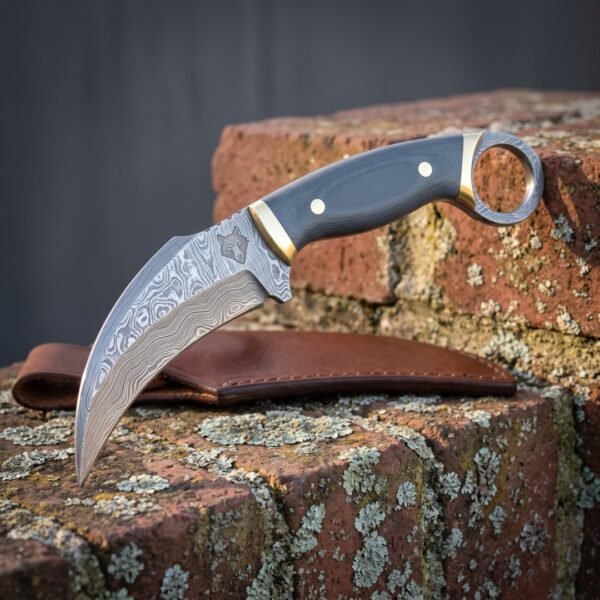 Talonveil Hand Forged Damascus Karambit Knife with Dark Grey Micarta Scales & Brass Bolsters
Original price was: $269.00.$215.20Current price is: $215.20.
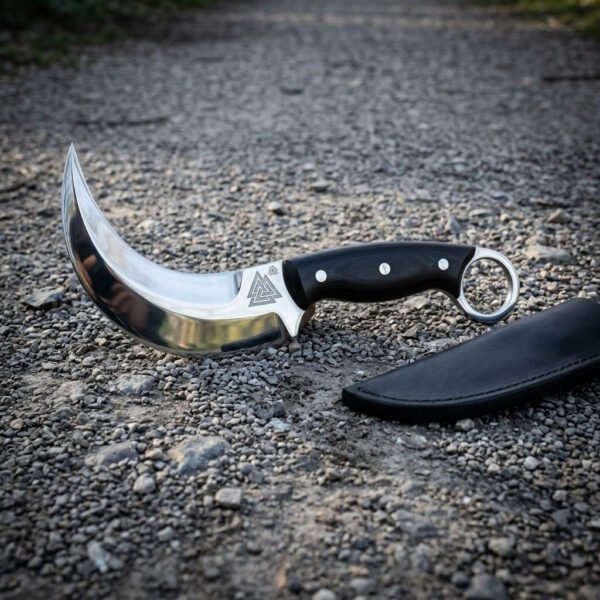 Talonvalk Hand Forged 1095 Steel Valknut Karambit Knife
Original price was: $229.00.$183.20Current price is: $183.20.
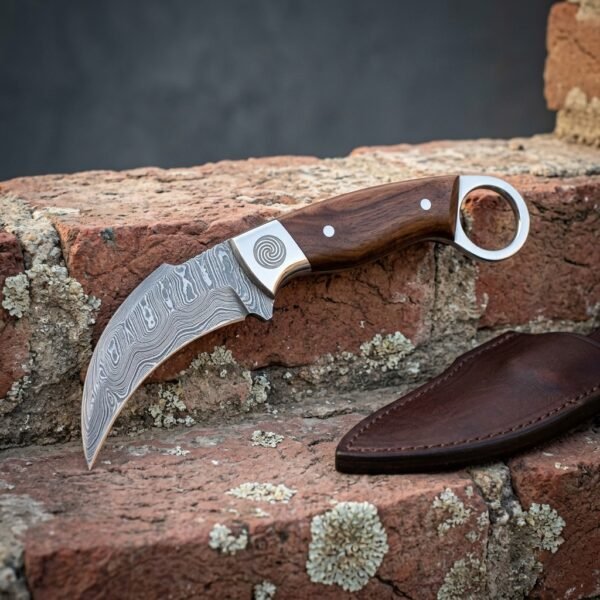 Clawfold Hand Forged Damascus Karambit Knife
Original price was: $289.00.$231.20Current price is: $231.20.
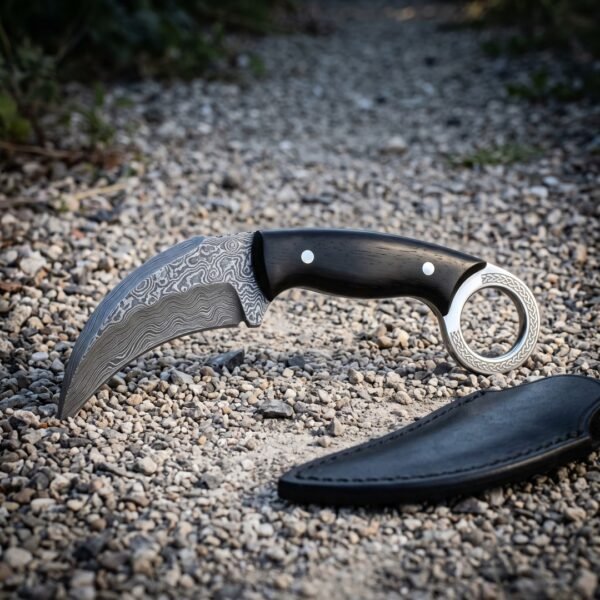 Clawshade Hand Forged 1095 and 15N20 Damascus Karambit Knife with Ebony Handle & Knotwork Engraved Finger Ring
Original price was: $199.00.$159.20Current price is: $159.20.