A Viking hammer is a blunt head on a short haft, and everything interesting about it follows from that. There is no edge to keep, no point to protect and nothing to sharpen. What it has instead is mass concentrated in a small block, so all of the force goes into a square inch of steel rather than being spread down a blade, the same argument the maces make. Mjolnir, the hammer Thor carried, is described in the Norse sources as short in the handle and never missing its mark, which is a fair account of how a heavy head on a short shaft actually behaves.
The hammers here run 15 to 24 inches overall, with heads in plain 1095 high carbon hardened to 54 to 58 HRC, in forge welded Damascus of 1095 and 15N20 at 58 to 60 HRC, and one large display head in stainless. Hafts are ash, walnut, rosewood or hardwood under a leather wrap, with steel collars, langets or brass bolsters where the head sits. Most carry cut Elder Futhark runes or a Mjolnir on the cheek, and most arrive with a shaped leather head cover.
Pick the weight first and the pattern second. If you want to know why the hammer carries the weight it does in Norse story, read what the sources say about Thor beyond the hammer.
Free US shipping
On most pieces. Heavier and oversized ones carry a flat charge.
Hand Forged
Heated, hammered and ground by hand.
Engraving available
Names, dates or Norse runes on most pieces.
Ships from Memphis
Inspected and dispatched from our Tennessee warehouse. No import duty, no customs delay on US orders.
Viking Hammers
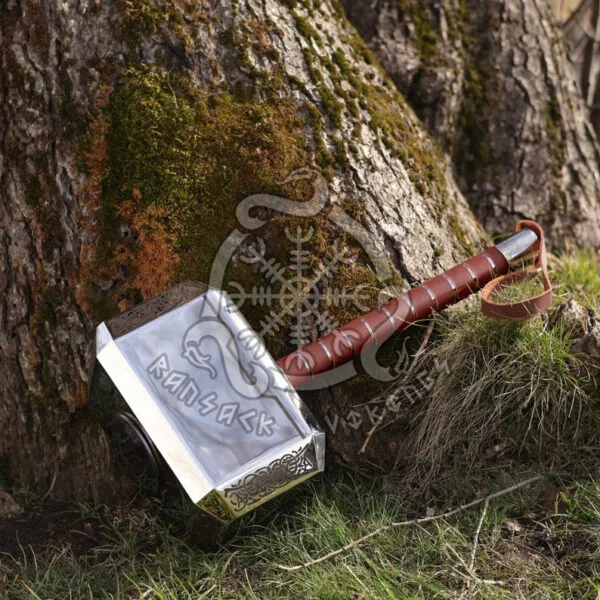
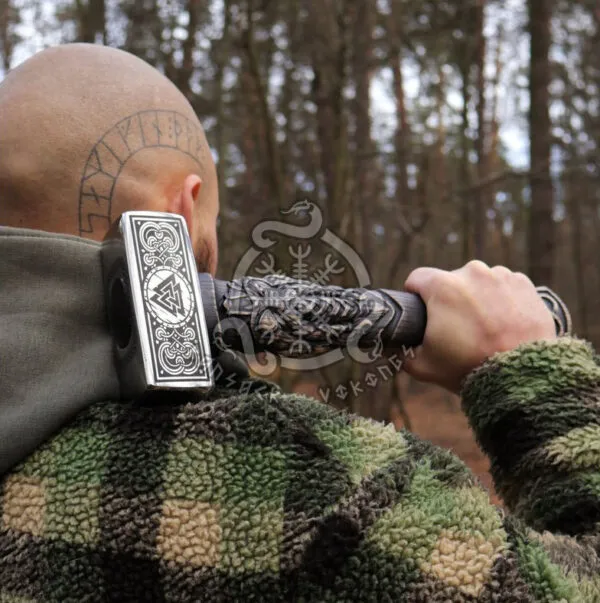
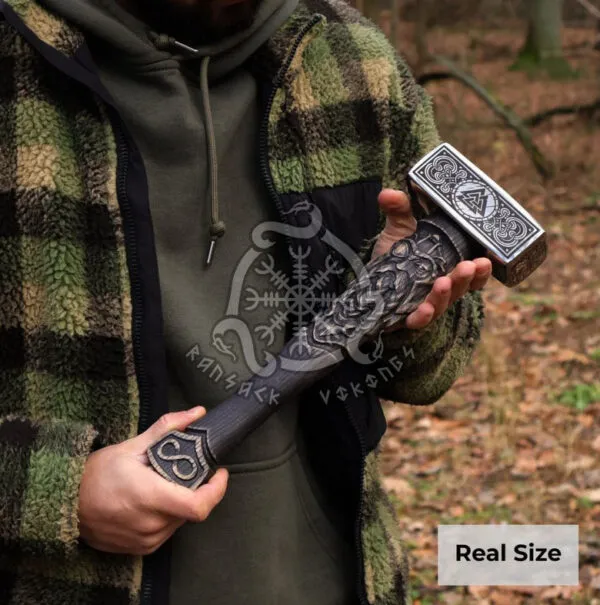
Why the head is blunt
An axe concentrates force along a line. A hammer concentrates it on a point, and that difference decides everything else about the object. An edge needs to be thin, which means hard, which means it can chip. A hammer face needs to be broad and tough, and it can be left softer on purpose because nothing about its job depends on holding a keen line. That is why a hammer head survives things that would ruin a blade.
Concentrating mass has a second consequence. A short haft with a heavy head puts almost all of the weight at the far end of a short lever, so the head accelerates late and arrives hard. You do not need a long swing. You need a loose grip, a short arc and a tight hand at the moment of contact. A hammer with a 15 inch haft and a solid block on the end will hit harder than most people expect the first time they pick one up.
Then there is Mjolnir. The Norse sources are unusually specific about it. Snorri Sturluson explains that the handle came out short because Loki, in the form of a fly, bit the dwarf working the bellows, and that the hammer would never miss its mark. Short handled, blunt, absurdly heavy for its size and impossible to lose. The block headed hammers on this page are built to that shape rather than to a modern tool shape, which is why they are square and chamfered rather than tapered and peened.
The hammers in this collection
Nine pieces, dividing by what the head is made of and what shape it has been forged into. The price spread is narrow enough that the choice comes down to weight and finish rather than budget.
Mjolnir block heads
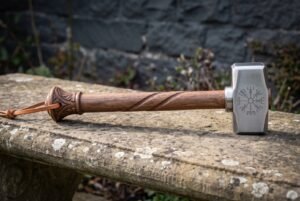
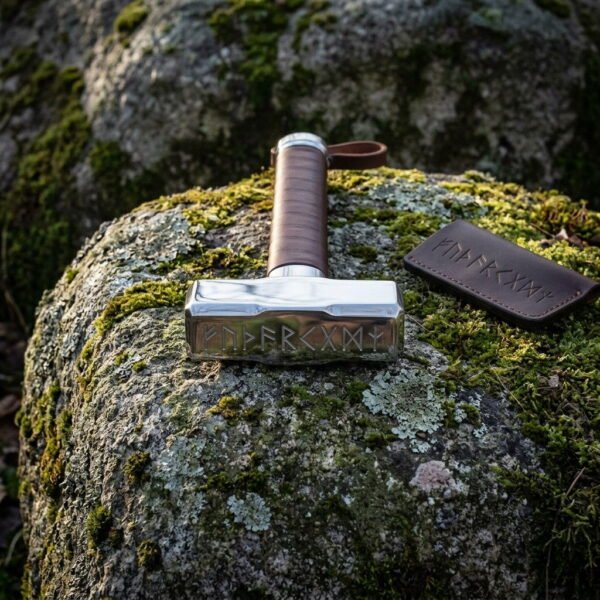
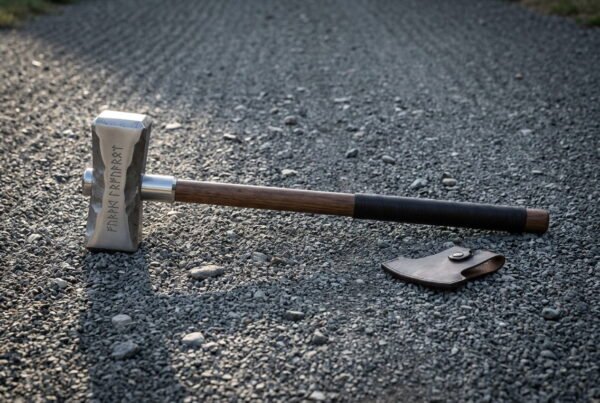
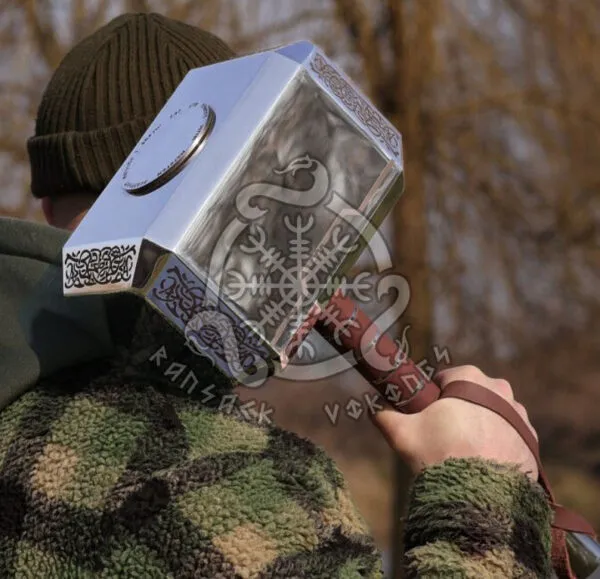
The squared block with chamfered corners and two flat striking faces is the core shape here. One is 1095 at 54 to 58 HRC on a 16 inch haft wrapped in tan leather over a hardwood core, with a steel butt cap, a leather wrist thong and a line of Elder Futhark runes cut across the face. Another runs the same head form at about 24 inches with a waisted, hammer textured body, a vertical line of runes cut into the face, a polished steel ferrule at the eye and a dark leather wrap over the lower third of a straight hardwood haft. Both come with a fitted leather head cover.
Rune cut steel heads
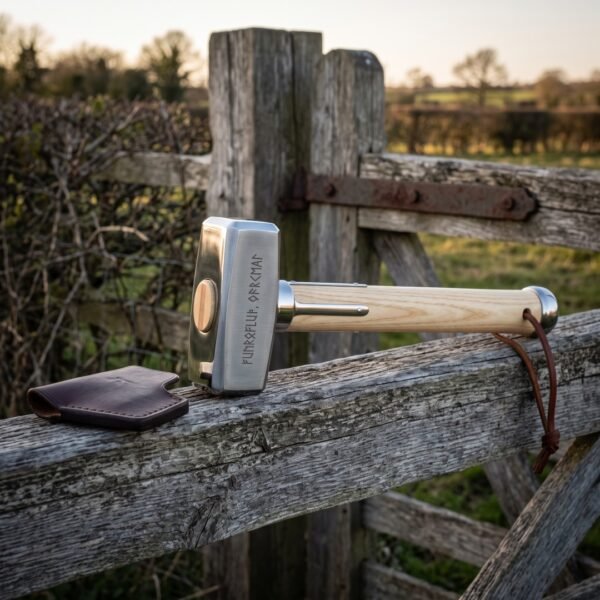
Two hammers put the lettering front and centre. The first carries two lines of Elder Futhark cut into a squared block head with chamfered faces and a round cheek boss, in polished 1095 at 54 to 58 HRC, on a straight ash haft with a steel collar at the throat, a steel butt ferrule and a leather thong knotted through the butt. The second cuts a Mjolnir into the cheek instead.
Damascus heads
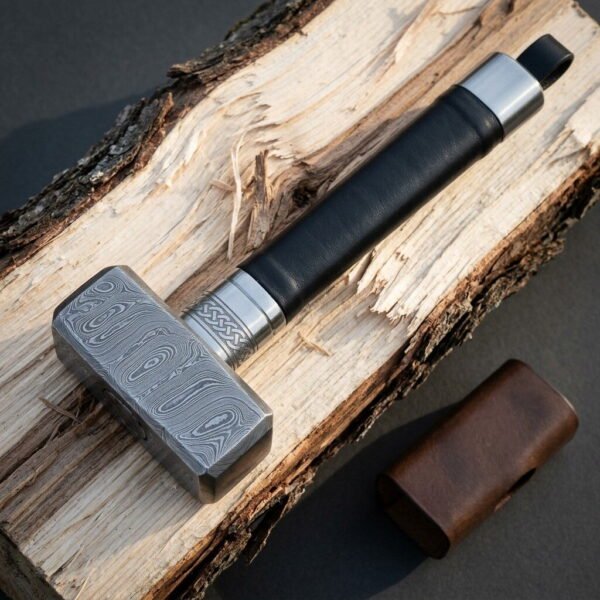
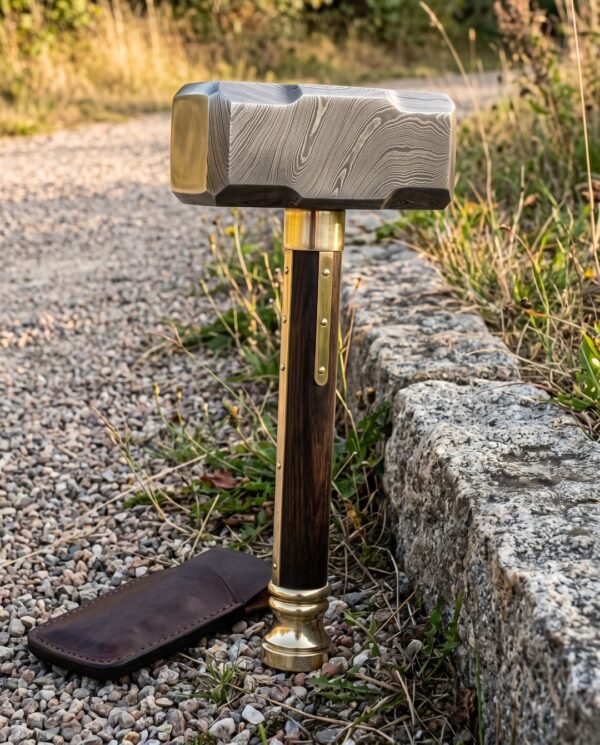
Two, both in forge welded 1095 and 15N20 hardened to 58 to 60 HRC and acid etched so the layers show. One is a twin faced head with waisted cheeks and polished chamfers on a rosewood haft in a straight taper, with brass strips pinned into both faces of the haft, a brass bolster under the head and a turned brass pommel at the base. The other carries a ladder and ring figure that runs through the full depth of the head rather than sitting on the surface, on a 15 inch black leather wrapped haft with a steel butt cap and a polished steel ferrule cut with interlaced knotwork. That second one is the piece to buy if you want the pattern to be the point.
The beaked and double faced hammers
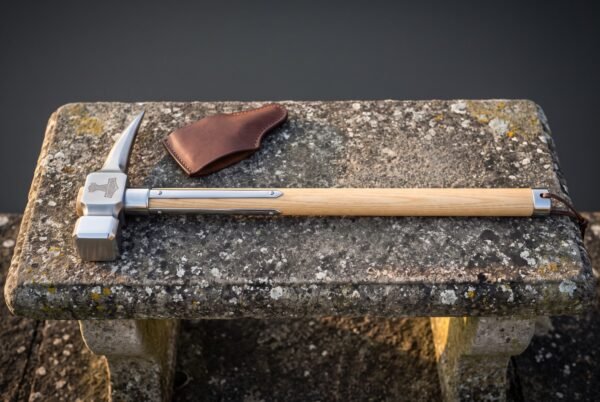
The beaked hammer is about 20 inches overall, a square textured face on one side and a long curved beak opposite, forged in high carbon steel hardened to 54 to 58 HRC at the face and the beak, on a pale oiled ash haft with riveted steel langets running down both sides and a leather lanyard through a drilled butt. The langets are the detail that matters. They are steel straps that carry the shock down the sides of the timber instead of letting it all sit in the eye.
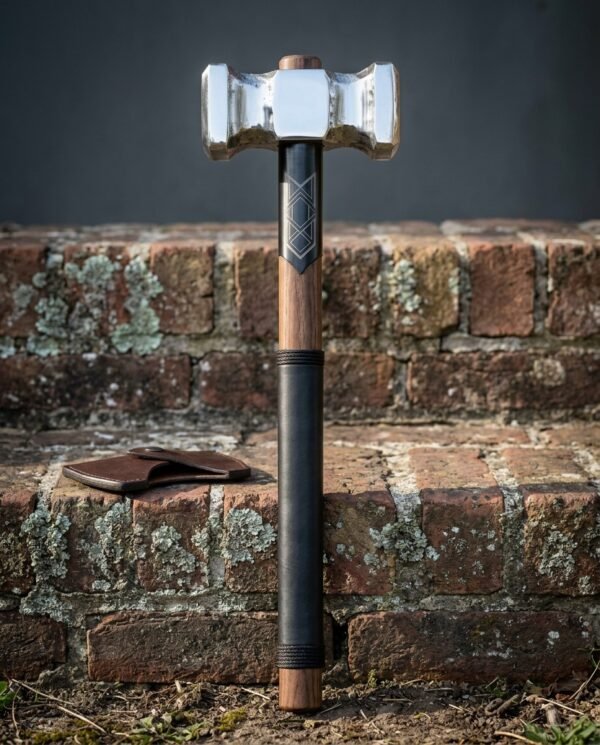
The double faced hammer is 19 inches on a walnut haft wedged from the top through the eye, the head about 6 inches across both faces and waisted through the middle, with a blackened steel collar engraved in interlaced lozenge knotwork and a black leather wrap whipped with cord at both ends. It ships with a brown leather belt hanger, the only piece here you can carry on a belt.
The stainless display hammer
One outlier, and it is enormous. A cast stainless head, hand dressed and finished, measuring 8.66 by 5.51 by 5.51 inches, on an overall length of 17.71 inches, weighing 11.24 lbs. That is over five kilos in a piece under a foot and a half long. It is a display and collector piece, it is not built to be swung, and it will need a stand or a bracket that means it.
Sizes, steel and weights across the range
Every figure below is taken from the specification panel of a piece on this page. These are forged and finished by hand, so read them as what to expect rather than as a guarantee to the millimetre.
| Head form | Head steel and hardness | Overall length | Haft | Collar or fittings | Listed weight | Price |
|---|---|---|---|---|---|---|
| Mjolnir block, runes across the face | 1095 at 54 to 58 HRC | About 16 in | Tan leather over hardwood | Steel butt cap and wrist loop | Not listed | 279 dollars |
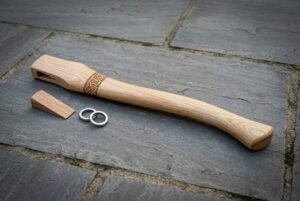
| Forged head, ash handled | High carbon at 48 to 52 HRC | 13.3 in handle | Ash | Head 4.7 by 1.6 by 1.6 in | 3.96 lbs | 279 dollars |
| Squared block, two rune lines | 1095 at 54 to 58 HRC | Not listed | Straight ash | Steel throat collar and butt ferrule | Not listed | 289 dollars |
| Square face with a curved beak | High carbon at 54 to 58 HRC | About 20 in | Pale oiled ash | Riveted steel langets both sides | Not listed | 299 dollars |
| Squared block, waisted and textured | 1095 at 54 to 58 HRC | About 24 in | Hardwood, leather wrapped lower third | Polished steel ferrule | Not listed | 299 dollars |
| Double faced, waisted through the eye | Forged steel, hardness not listed | About 19 in | Walnut, wedged through the eye | Blackened engraved collar | Not listed | 359 dollars |
| Mjolnir block, ladder pattern | Damascus at 58 to 60 HRC | About 15 in | Black leather over hardwood | Knotwork cut steel ferrule | Not listed | 369 dollars |
| Twin flat faces, waisted cheeks | Damascus at 58 to 60 HRC | Not listed | Rosewood with brass strips | Brass bolster and brass pommel | Not listed | 389 dollars |
| Large display head | Stainless, cast and hand dressed | 17.71 in | Not listed | Head 8.66 by 5.51 by 5.51 in | 11.24 lbs | 449 dollars |
Two listings state a weight and they mark the two ends of the page. Just under 4 lbs is a hammer you can pick up and swing without thinking about it. Over 11 lbs is a piece you lift with intent and put back down again, and it is sold as a display object for exactly that reason.
Weight, balance and how one swings
Length and weight work against each other. A 15 or 16 inch hammer is quick and easy to hold out at arm's length for a photograph. A 24 inch haft gives far more leverage and a much harder hit, and wants two hands or a very committed one.
The balance point on all of these sits close to the head, which is normal and correct. Hold one near the butt and it feels heavy and slow. Slide your hand up toward the collar and it comes alive. That is how a hammer is meant to be used, choking up for control and dropping back down the haft for power.
None of these are tools and none of them should be used as one. Driving a stake or splitting a log with a polished hammer will mark the face, spread the edges of the chamfers and eventually loosen the head in the eye. They are built for display, collection and ceremonial use, and the listings say so plainly.
Steel and hardness
Two house steels run through this page. Plain 1095 high carbon is hardened to 54 to 58 HRC. Damascus of 1095 and 15N20 is forge welded, folded and acid etched, hardened to 58 to 60 HRC, which brings up the pattern and holds a crisper chamfer.
One head sits lower, at 48 to 52 HRC, and that is a deliberate choice rather than an oversight. A softer hammer face deforms slightly rather than cracking when it meets something harder than itself. Blacksmiths have hardened striking faces down in that range for centuries for the same reason. If you have wondered why a hammer is not simply made as hard as possible, that is the answer.
The stainless display head is cast rather than forged, then dressed and finished by hand. Cast stainless will not rust and will not take the fine forged texture the carbon steel heads carry, which is a fair trade on a piece that exists to sit on a shelf.
Hafts, collars and how the head stays on
Ash is the traditional haft timber and it is here for a reason. It is springy along the grain, so it takes shock without putting all of it into your wrist, and it splinters slowly rather than snapping clean. Walnut is denser and darker and holds a wedge well. Rosewood is oily and close grained and needs almost no maintenance. Where a haft is leather wrapped, the core underneath is hardwood.
The joint between head and haft is the part that fails on cheap hammers, and there are three approaches here. A wedge driven from the top through the eye spreads the timber inside the head, which is the standard and the strongest. A steel collar or ferrule at the throat squeezes the timber and stops it splitting where the stress is highest. Langets, the steel straps riveted down both sides of the haft, carry the shock past the eye entirely.
Brass is used decoratively on the Damascus piece, as a bolster under the head, as pinned strips let into both faces of the rosewood and as a turned pommel at the base. Brass darkens over months and comes back with metal polish on a cloth, or leave it and let it age.
Grips, covers and hangers
Leather wraps run over the lower third of a haft or over the whole of it. The wrapped ones grip better with damp palms, and the whipped cord at each end of the walnut hammer is what stops the wrap creeping. Bare ash and walnut show the grain, which is the trade.
Most of these ship with a shaped leather head cover. It is not packaging. It keeps a polished or etched face off a shelf and away from fingers, and it is the easiest way to keep a carbon steel head clean. One is rune tooled to match its head.
Wrist lanyards appear on three of these, a leather thong through a drilled butt, knotted or looped. On a display piece it is a period detail. If you do handle a heavy hammer, it is also the thing that stops it leaving your hand.
Care and storage
Carbon steel rusts. Wipe the head dry, keep a light film of mineral or camellia oil on it, and put the cover back on when it goes on the shelf. Fingerprints do more damage than weather, because a salty print on a polished face etches in over a few weeks. Grey patina is stable. Orange spotting lifts with a fine abrasive and oil before it pits.
Etched Damascus needs a lighter touch. Hard polishing flattens the contrast between the two steels and the pattern fades, so oil it and leave it alone. The stainless head needs nothing beyond a wipe.
Timber hafts want a wipe of oil once or twice a year and no more. Keep them out of dry heat, because a haft that shrinks in a hot room loosens in the eye, and check the wedge occasionally on the wedged hammer. Leather wraps and covers take leather conditioner sparingly. Store a hammer flat or hung by the head rather than standing on its butt for years.
Engraving
Several of these already carry cut work, from rune lines to a Mjolnir on the cheek and interlaced knotwork on a collar. Further engraving is done in the United States after the piece arrives, and a hammer has more usable flat than almost anything else in the catalogue. The cheek takes a symbol well and the haft or collar takes a name or a date. On the large display hammer the listing states that engraving is available on the head or the shaft.
Text engraving is 19 dollars, a symbol is 39 dollars and a family crest is 49 dollars. Elder Futhark is a phonetic alphabet rather than a code, so a name is transliterated by sound and there is no rune for the letter C. Engraving is permanent and an engraved piece cannot be returned, so send the exact spelling and read it twice.
Where these come from and how they ship
Ransack Viking is a US company based in Memphis, Tennessee. The pieces are handmade in the Czech Republic, then imported, inspected and shipped from Memphis. Engraving is done in the US after arrival.
Hammers ship boxed with the head cover or belt hanger where one is supplied. Two hammers of the same name will differ slightly in forge texture, etch figure and haft colour, because two people made them on two different days.
How to choose
Buying a first one? Take a 1095 Mjolnir block at 16 inches. It is the shape everybody recognises, it is light enough to hold up and hand round, and the rune cut face is the detail people ask about.
Buying for a display case or a mantel? Go to the Damascus. The ladder figure runs through the full depth of the head, so it reads from any angle, and the knotwork collar finishes it.
Buying for somebody who wants presence over everything? The stainless display piece at 11.24 lbs. Nobody who picks that up puts it down without saying something.
Related collections
- Thor's hammers across the range
- Maces, the other blunt Norse head
- Viking axes for chopping rather than striking
- Bearded axes
- Battle axes
- Mjolnir pendants to match
- Stands and display fittings
- Engraved and personalised pieces
Guides worth reading first
- Mjolnir: the meaning of Thor's hammer
- The war hammer and the mace
- Mace, war hammer and flail compared
- Elder Futhark runes explained
- Steel and hardness: what HRC numbers mean
- How to display swords, axes and hammers
- Thor in Norse myth, beyond the hammer
Frequently asked questions
What is a Viking hammer?
A short hafted hammer with a blunt block head, built to the shape the Norse associated with Mjolnir rather than to a modern tool shape. The heads here are squared with chamfered corners and two flat faces, and most carry cut runes or a Mjolnir on the cheek.
How heavy are these?
Two listings give a weight. One forged head on a 13.3 inch ash handle comes in at 3.96 lbs. The large stainless display head is 11.24 lbs at 17.71 inches overall. The rest sit between those two, closer to the lighter end.
Why is one head softer than the others?
Because a hammer face is not a blade. One head is listed at 48 to 52 HRC, and a face in that range deforms slightly rather than cracking when it hits something hard. The blade steels here run harder, at 54 to 58 HRC for 1095 and 58 to 60 HRC for Damascus.
Can I actually use one of these?
They are sold for display, collection and ceremonial use, and that is what the listings say. Driving stakes or splitting wood with a polished head will mark the faces and eventually loosen the head in the eye. If you want a tool, buy a tool.
What are the steel straps down the sides of the haft?
Langets. They are riveted to both sides of the timber below the head and they carry the shock of a strike down past the eye instead of leaving it all in the joint. One hammer here uses them, along with a drilled butt and a leather lanyard.
Will the head come loose?
Not if it is looked after. The wedged head is spread inside the eye from the top, and the others use a steel collar or ferrule at the throat. Keep the haft out of dry heat, because timber that shrinks in a hot room is the usual reason a head starts to move.
Can these be engraved?
Yes, in the United States after arrival. The cheek of the head takes a symbol and the haft or collar takes a name or a date. Text is 19 dollars, a symbol is 39 dollars and a family crest is 49 dollars. Engraved pieces cannot be returned.
Where are these made?
Ransack Viking is a US company based in Memphis, Tennessee. The pieces are handmade in the Czech Republic, then imported, inspected and shipped from Memphis, with engraving added in the US after arrival.