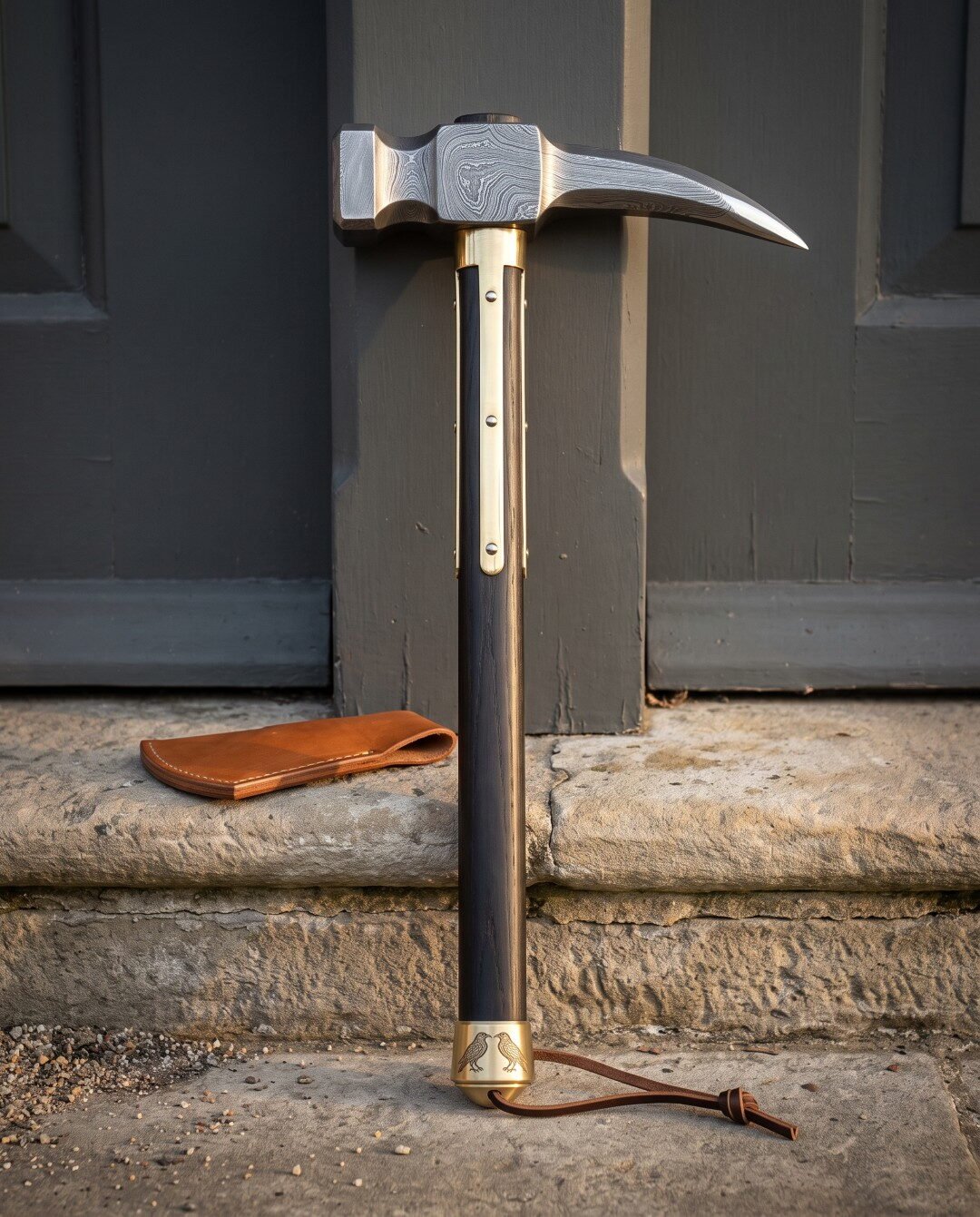
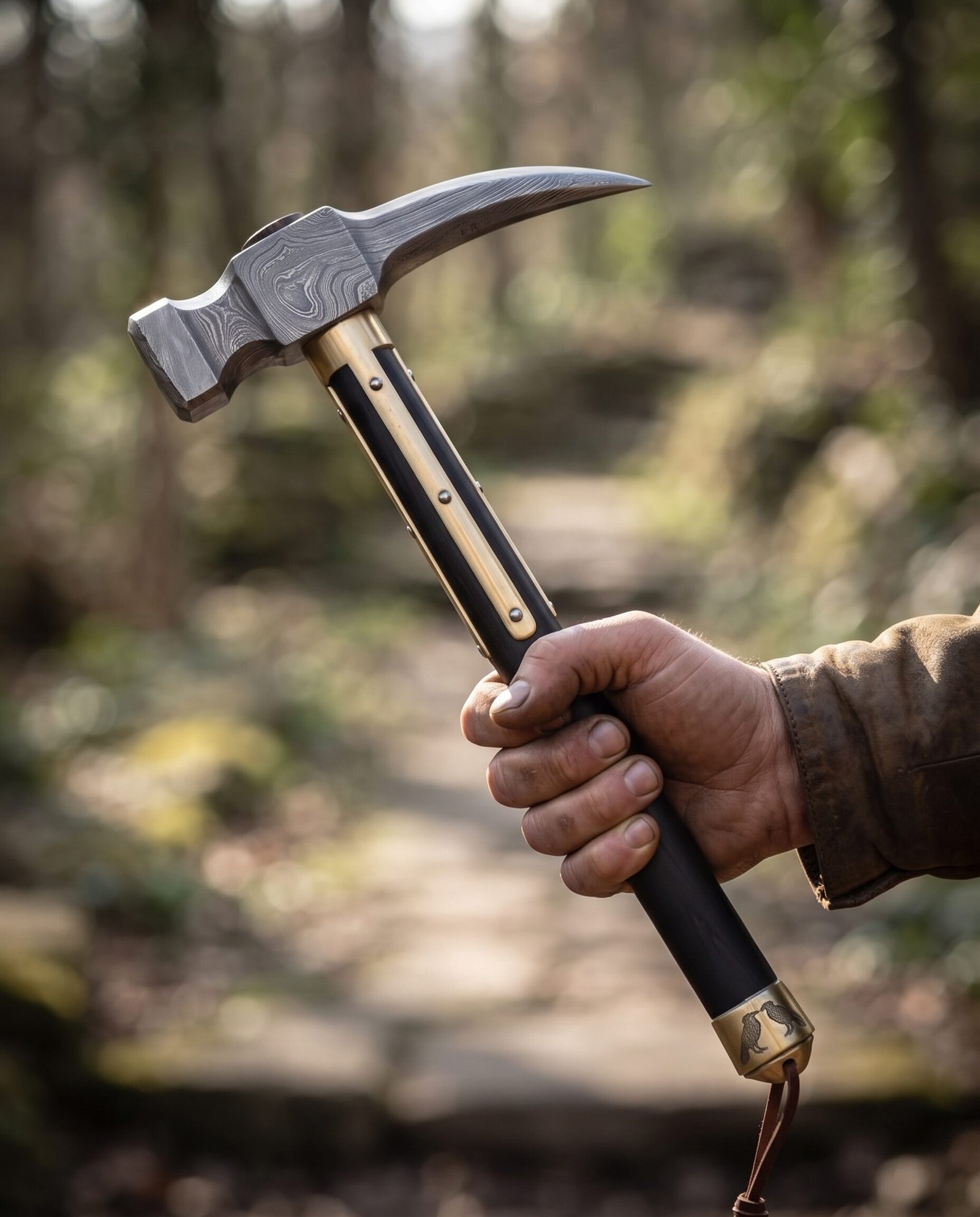
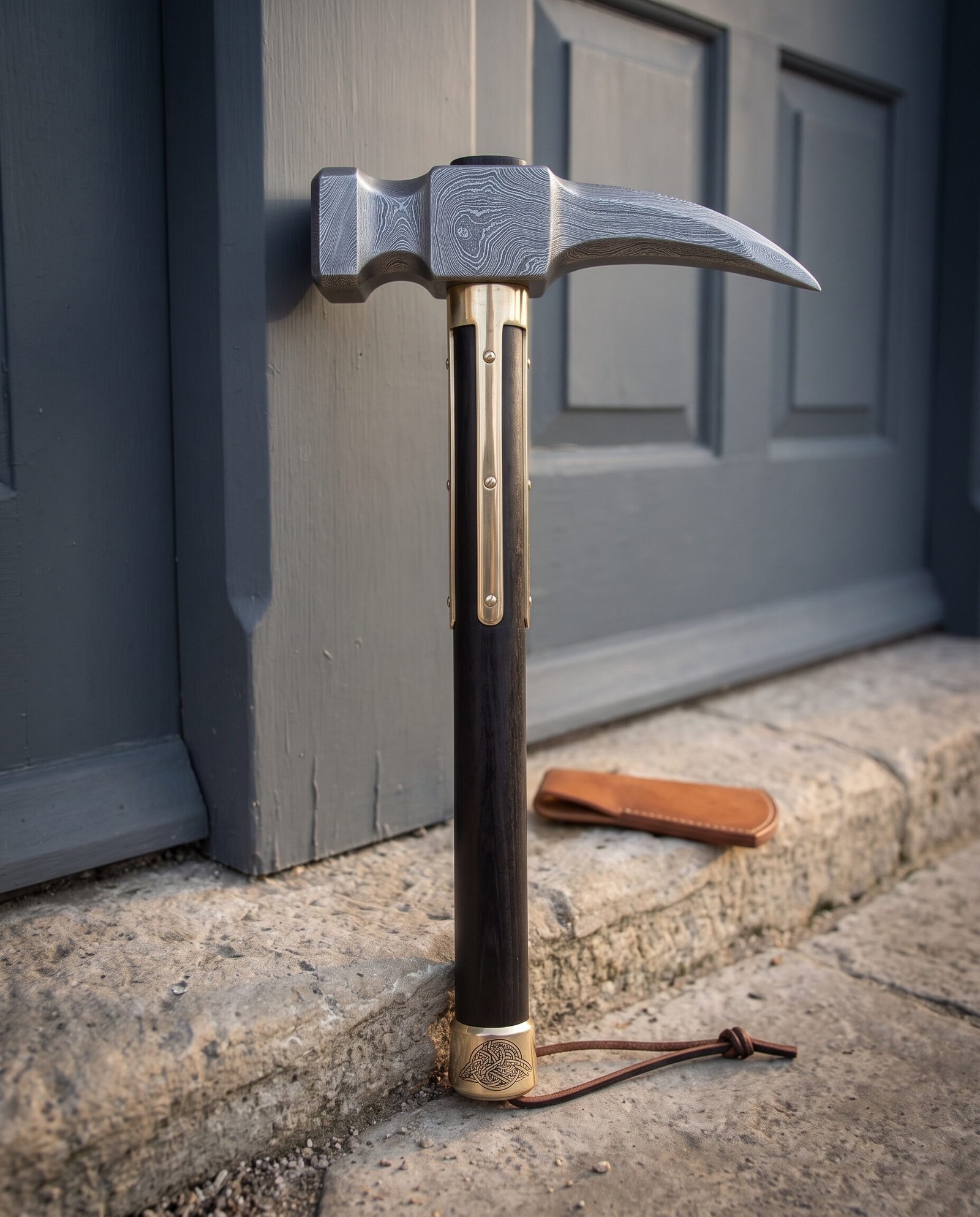
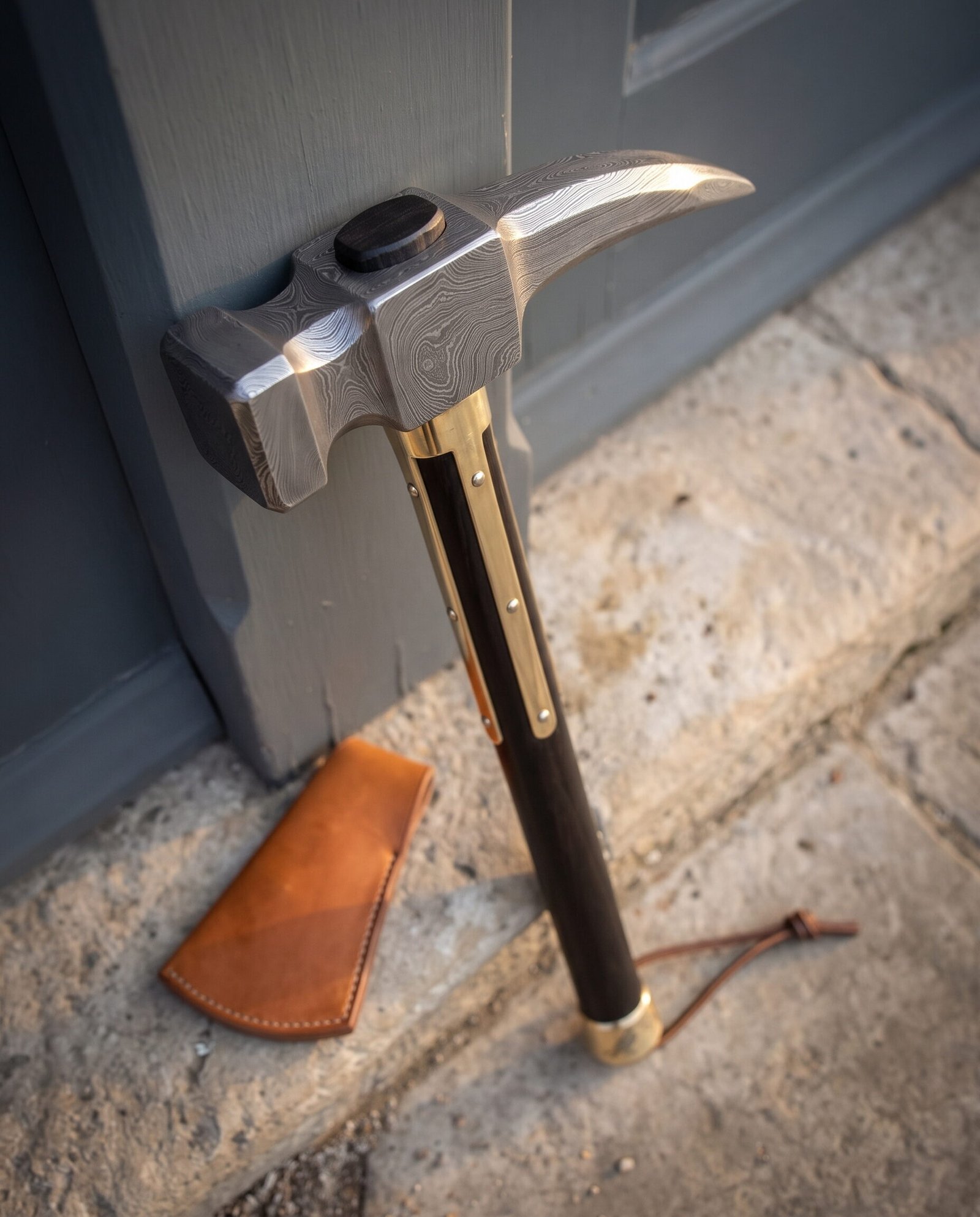
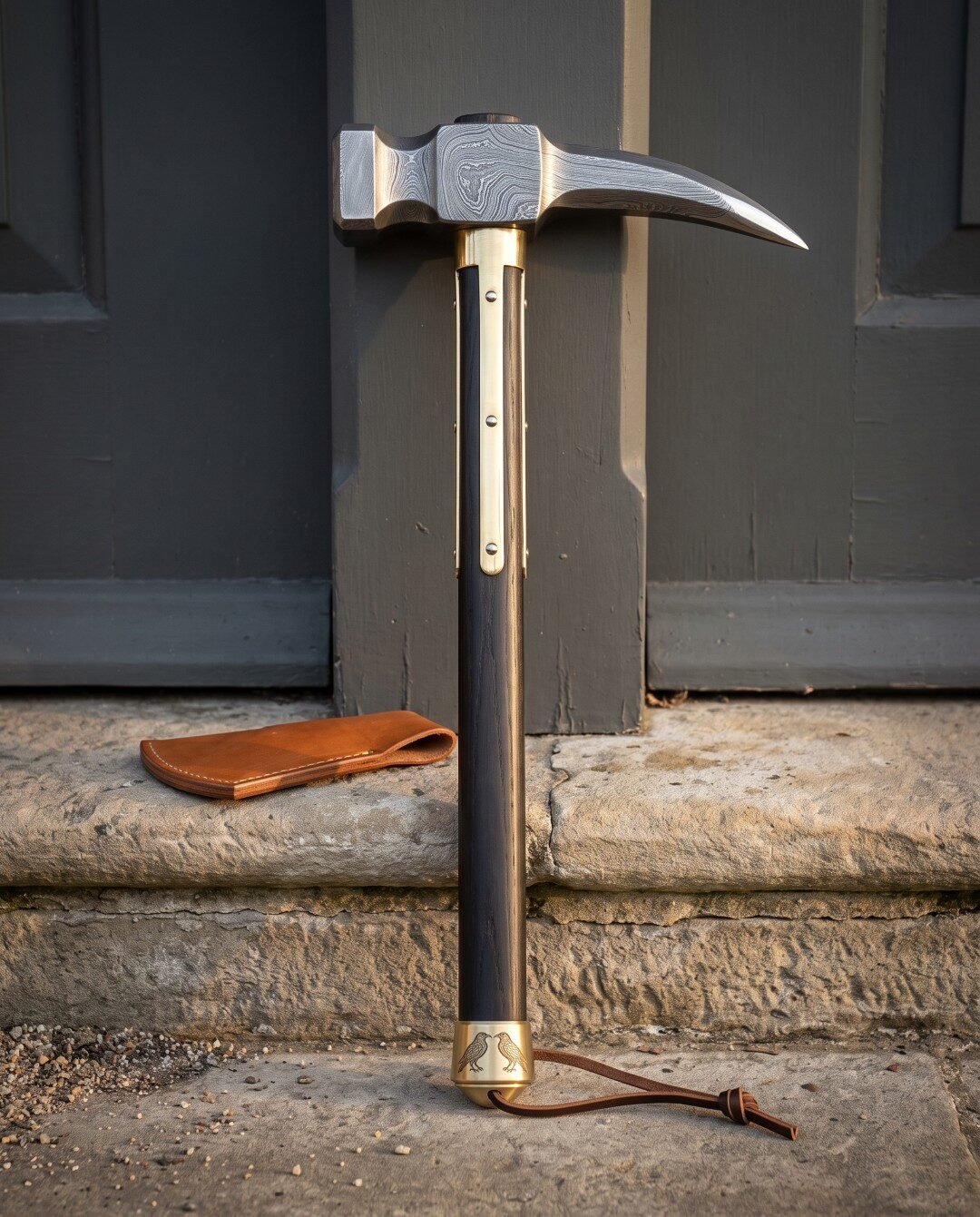
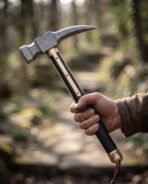
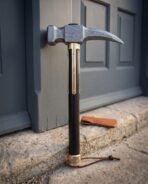
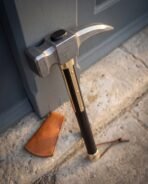
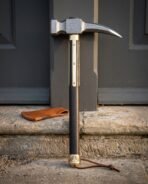
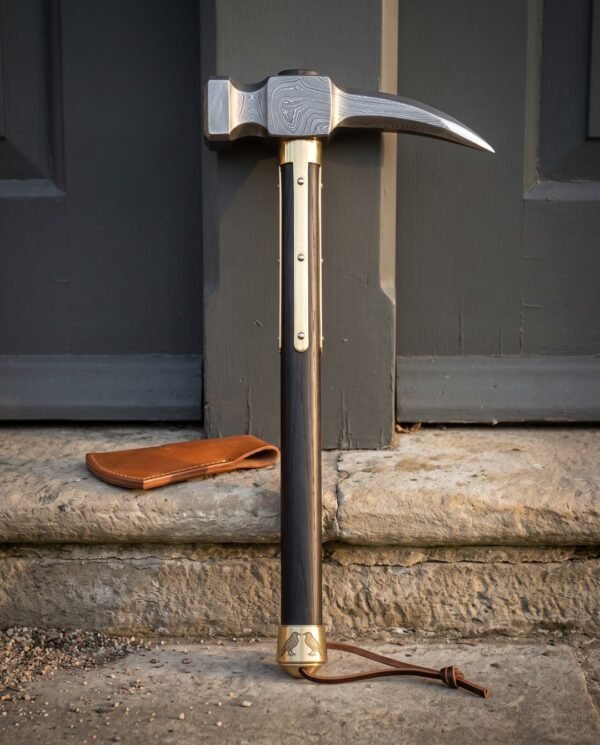
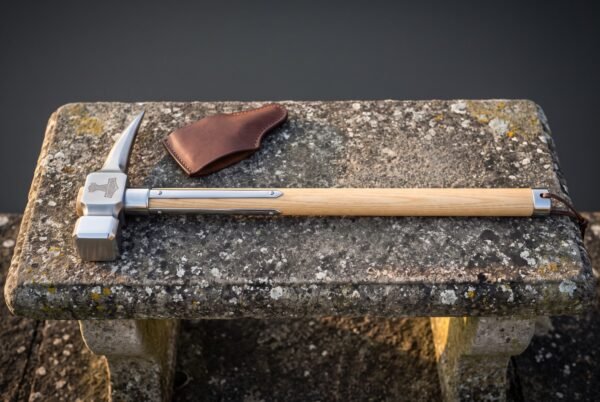
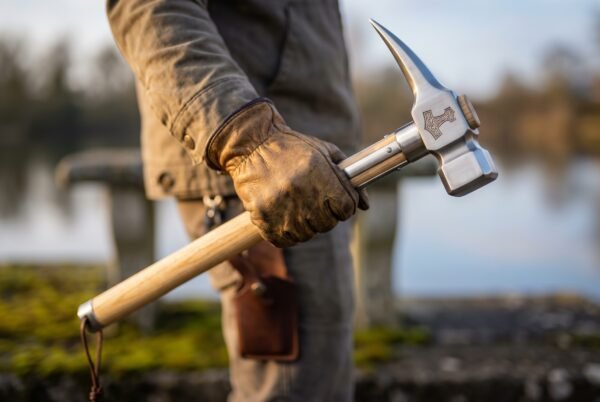
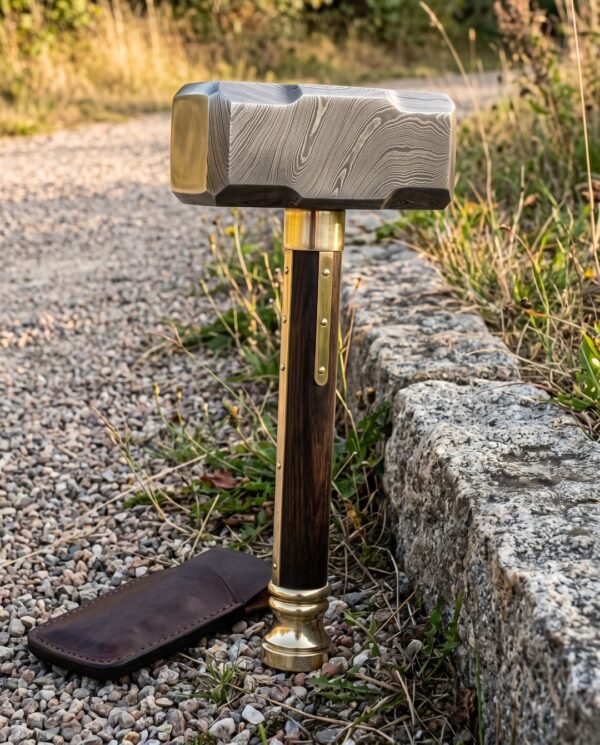
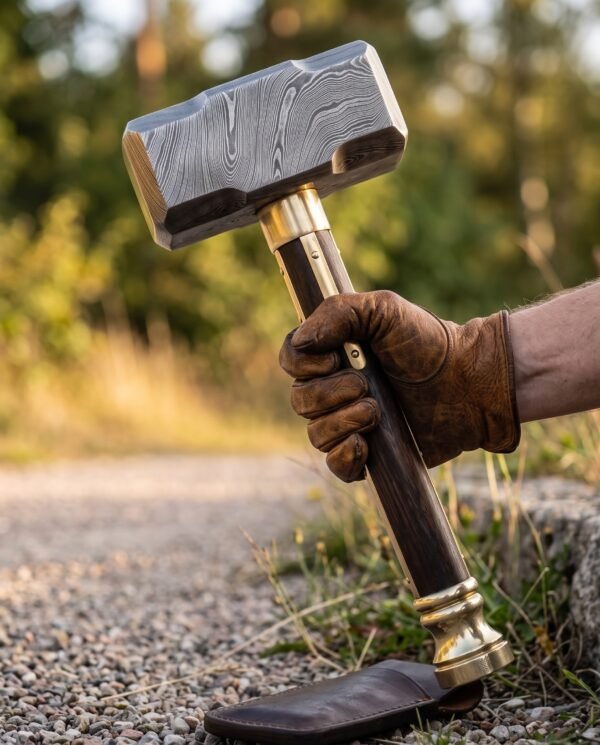
This is a hand forged war hammer with a flat striking face on one side and a long down curved beak on the other, forged from layered 1095 and 15N20 Damascus so the pattern runs through the whole head rather than sitting on the surface. The head is wedged and pinned onto a dark hardwood haft, held by two brass langets that run down the sides and riveted through, with a heavy brass collar under the head and a brass butt cap engraved with two ravens, carrying a leather wrist thong.
The beak is the interesting half. By the fourteenth century mail and then plate had made the cutting edge much less useful, and the answer across Europe was a head that put all of its force through a very small area. A hammer face concussed through armour without cutting it, and the beak, called a bec de corbin or crow beak, was designed to punch through or catch a plate edge and drag. The two ends of the same head answered two different problems, and the brass langets exist for a reason that has nothing to do with looks. They stop a haft being cut through behind the head, which is the single most common way a hafted head fails.
Each hammer is forged, ground, etched, heat treated and fitted in a Czech Republic workshop, then the haft is shaped and the brass work is cut and set by hand. It ships with the leather thong fitted and a small leather head cover. It is part of the battle axes, and the war axes are put together the same way.
Specifications
| Head material | 1095 and 15N20 Damascus, hand forged and acid etched, 58 to 60 HRC |
|---|
| Head | Square flat striking face on one side, long down curved crow beak on the other |
|---|
| Overall length | Approximately 16 inches |
|---|
| Head length | Approximately 8 inches from face to beak tip |
|---|
| Haft | Dark hardwood, oval section, oiled |
|---|
| Langets | Two solid brass langets down the sides of the haft, riveted through |
|---|
| Collar | Brass collar under the head |
|---|
| Butt cap | Brass butt cap engraved with two ravens, leather wrist thong through it |
|---|
| Finish | Etched Damascus head with polished bevels, oiled haft, polished brass |
|---|
| Weight | Approximately 2 lb 6 oz |
|---|
| Included | War hammer, tan leather head cover, care card |
|---|
| SKU | RK-1692 |
|---|
What the langets do and why the head is hung this way
Look at the two brass strips running down the sides of the haft under the head. Those are langets, and they are the part of a hafted head most people ignore and most cheap reproductions leave off. A hammer or an axe delivers its energy at the head, but the failure happens six inches below it, where an incoming edge or a badly aimed blow bites into the wood. Langets sheathe that zone in metal. On surviving fifteenth century war hammers the langets are often the most carefully made part of the whole hammer, riveted right through the haft so that they carry load rather than sitting on as trim.
The head itself is hung on a tapered slot and drawn down onto a shoulder in the haft, then pinned. That means the working load pushes the head onto the wood rather than away from it, which is the correct direction for any struck tool. A head that is simply glued or friction fitted will start to move within a season of handling, and once it moves it will keep moving.
The steel and the pattern
The head is forged from alternating layers of 1095 high carbon steel and 15N20 nickel alloy steel, folded and drawn out and then forged to shape. The two steels harden together but etch differently, so an acid etch leaves the 1095 dark and the 15N20 bright, and the light and dark bands you can see are the actual layer boundaries inside the metal. Grind into the face and the same pattern appears again, because it goes all the way through. This is why a Damascus piece is more expensive than a plain steel one. The billet is welded, cut, restacked and welded again, and every one of those cycles is a chance to lose the whole thing.
The head is hardened and tempered to 58 to 60 HRC, which is hard enough to hold the beak point and resist deformation on the face without being so hard that the corners chip. The haft is a straight grained hardwood with the grain running along the length, oiled rather than lacquered so it can be re fed as it dries. A lacquered haft looks better in a photograph and is worse in the hand, because it goes slippery the moment your palms are damp.
Engraving, runes and your own design
Use the rune converter on this page to turn a name, a date or a short phrase into Elder Futhark and we will cut it into the steel, the leather or the wood. If you would rather have a Viking pattern than a rune line, choose your own design in the engraving option above the add to cart button and tell us where it goes. Where a piece already carries an engraved design, your chosen engraving replaces it rather than sitting alongside it.
On this hammer the usual placements are the flat cheek of the head beside the eye, or a line running down the brass langet where it reads clearly against the polish. Cutting into an etched Damascus surface is possible and looks striking, though the pattern competes with the lettering, so most people choose the brass. There is more on placement and lead time on the engraving page.
Handling and balance
At around 16 inches this is a one handed hammer, in the family of the horseman pick rather than the two handed poleaxe. The balance sits well forward, roughly a hand span below the head, which is what gives a hammer its authority and also what makes it tiring to wave about. It wants short controlled arcs from the elbow and the wrist, not long swings from the shoulder.
This is a hand forged display and collection piece and a reenactment prop. It is not sold for full contact sparring and it should not be used in bouts against another person or against armour. The beak is a point and it behaves like one. Hang it, carry it in kit, take it to an event, and keep it away from anything you would not want a hole in.
Care
Wipe the head down and put a thin film of oil on it after handling, because an etched Damascus surface shows fingerprints as rust spots faster than a plain polished one does. Mineral oil, gun oil or a purpose made blade oil all work. If a spot of surface rust appears, lift it with a brass brush or a rust eraser and re oil rather than sanding, because sanding will cut through the etch and leave a bright patch in the pattern. There is more detail in steel care.
Feed the haft with boiled linseed or a hard wax oil once or twice a year, especially if it lives somewhere dry and heated, because a shrinking haft is what loosens a head. Polish the brass with a wadding polish when you want it bright, or leave it and let it darken to an honest patina.
Made in the Czech Republic
This is a handmade piece from the Czech Republic, made in a workshop that still forges, grinds and finishes by hand instead of stamping parts out. The smiths there have kept the older way of working, and the wood, horn and leather are shaped and fitted by hand as well. Two pieces of the same design will never be identical, and that is part of what you are buying.
Ransack Viking is a United States company. We handle the import ourselves, look over every piece when it lands and ship from our warehouse in Chicago, Illinois. Engraving is done in the United States after the piece arrives, so your design goes on before we send it out.
A note on handmade variation
Every hammer is hand made rather than machine made or bulk produced, so what arrives will not be a pixel for pixel copy of the photograph. Damascus pattern is the clearest example. No two billets etch the same way, so the swirls and bands across your head will run differently from the one shown, and that is the honest signature of a forged billet rather than a flaw. Hammer texture on the flats, the exact curve of the beak, the grain and tone of the hardwood haft and the way the brass takes a polish all vary. The dimensions, the steel, the heat treat and the build are the same every time. The character is not. The long form of that is the war hammer and the mace, with the Norse gods next to it.
Frequently asked questions
Is the beak sharp?
It is a point, not a cutting edge, and it arrives with the tip finished but not needle sharpened. Treat it as you would any spike. It will go through a boot.
Is this real Damascus or an etched pattern on plain steel?
Real forge welded Damascus. The layers are 1095 and 15N20 and the pattern continues through the thickness of the head, which is why the bands are visible on the bevels as well as the flats.
Can I use it for full contact reenactment fighting?
No. It is a display and collection piece and a costume or kit item. we do not sell it for sparring and it should not be swung at another person or at armour.
Will the head loosen over time?
It is hung on a tapered seat and pinned, so working load drives it on rather than off. Keep the haft oiled and it will stay tight. If it ever does move, the warranty covers it.
Can I have runes cut into it?
Yes. Use the rune converter on this page and tell us whether you want the line on the head cheek or on the brass langet. Brass gives the crisper read.
How long does shipping take?
Making time is one to two weeks and United States shipping is free. Custom engraving adds a few days because it is cut after the piece is finished.
What is in the box
- One hand forged Damascus war hammer with crow beak and hardwood haft
- Leather head cover
- Leather wrist thong fitted at the butt
- Care card covering oiling of steel, brass and haft
- Lifetime warranty against defects in forging, grind, heat treat and fittings
- Forged and finished in the Czech Republic
Explore the range
Browse the battle axes, the war axes and the wider Norse arms, or read the guides for more on hafting, langets and Damascus pattern.
Worth a look beside this
Sitting beside it in the catalogue is the Stormbeak war axe, 20 inches overall. Another in the same line is the Anvilwake Thor hammer, forged from 1095. Next along the rack is the Anvilcrown Thor hammer.
Fitting out further, the Birchskeg bearded axe belongs with it. Or start from a blank sheet on the custom Viking axe page.

No regrets on this purchase at all. So worth it.
Was nervous ordering something like this online but so glad I did. Ordered from Ransack Viking before and the quality stays consistent every time. You can tell it’s real Czech blacksmith work and shipping from the States made delivery painless. So worth it.
Knew this war hammer was special the second I opened the box. Came in solid packaging and arrived in perfect condition. Haft feels sturdy and well balanced for the size of the head. Already telling my friends to check this out.