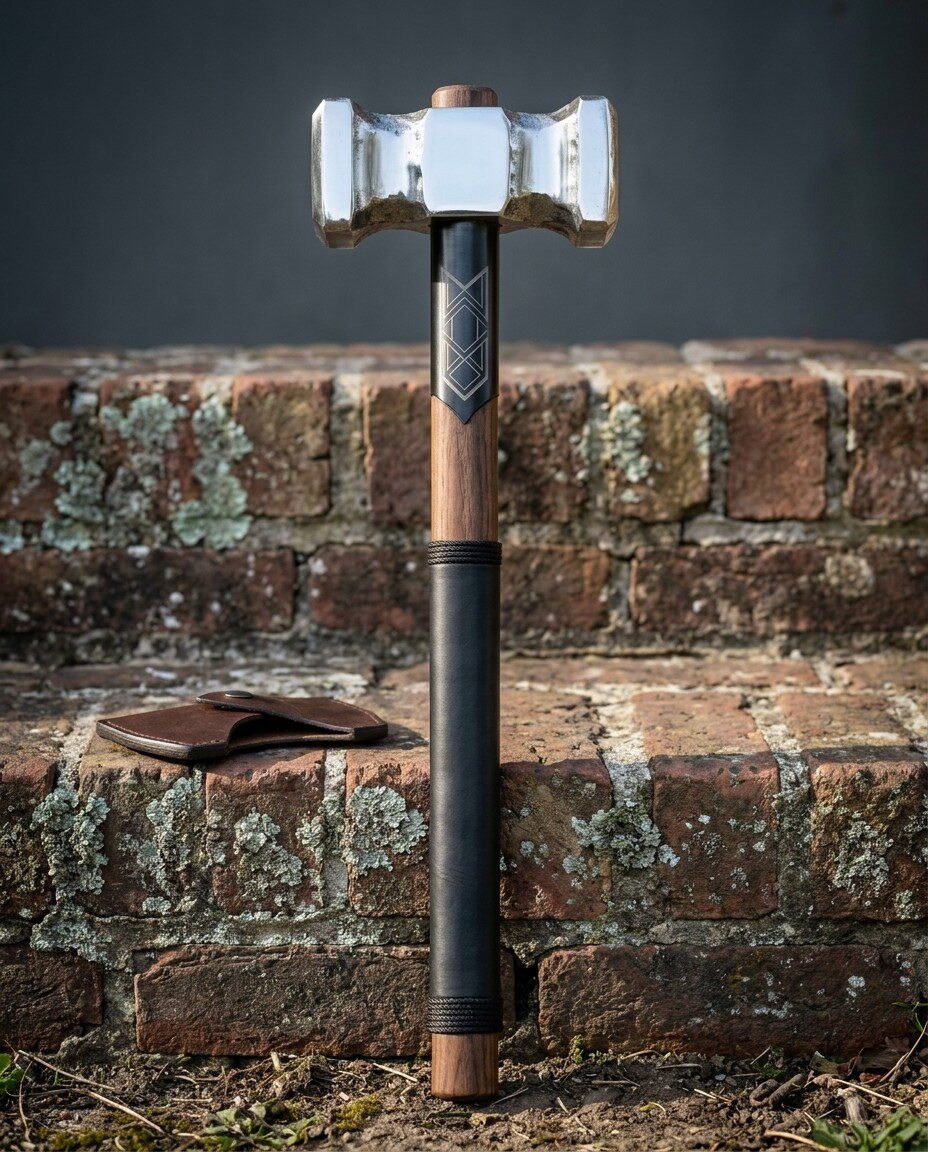
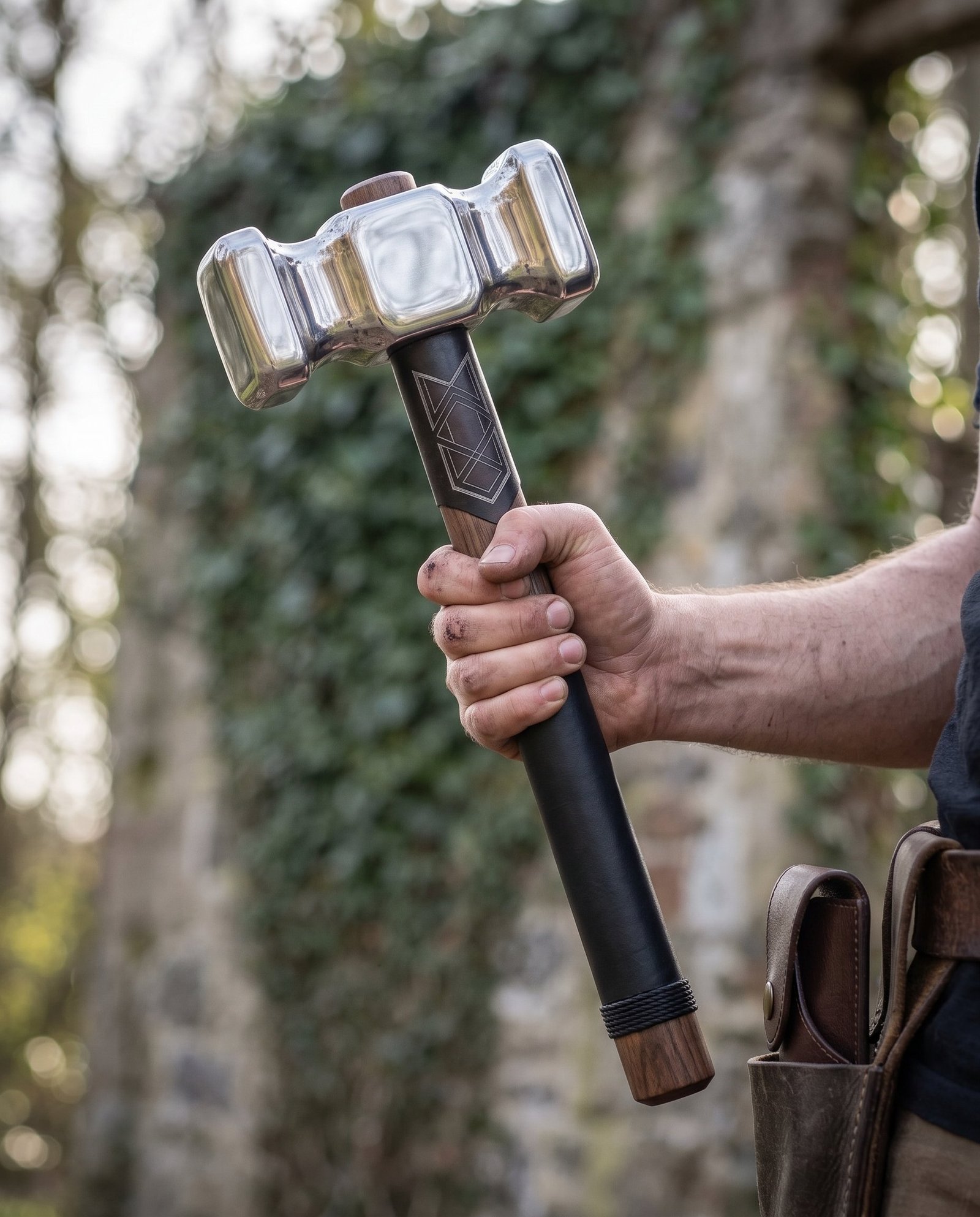
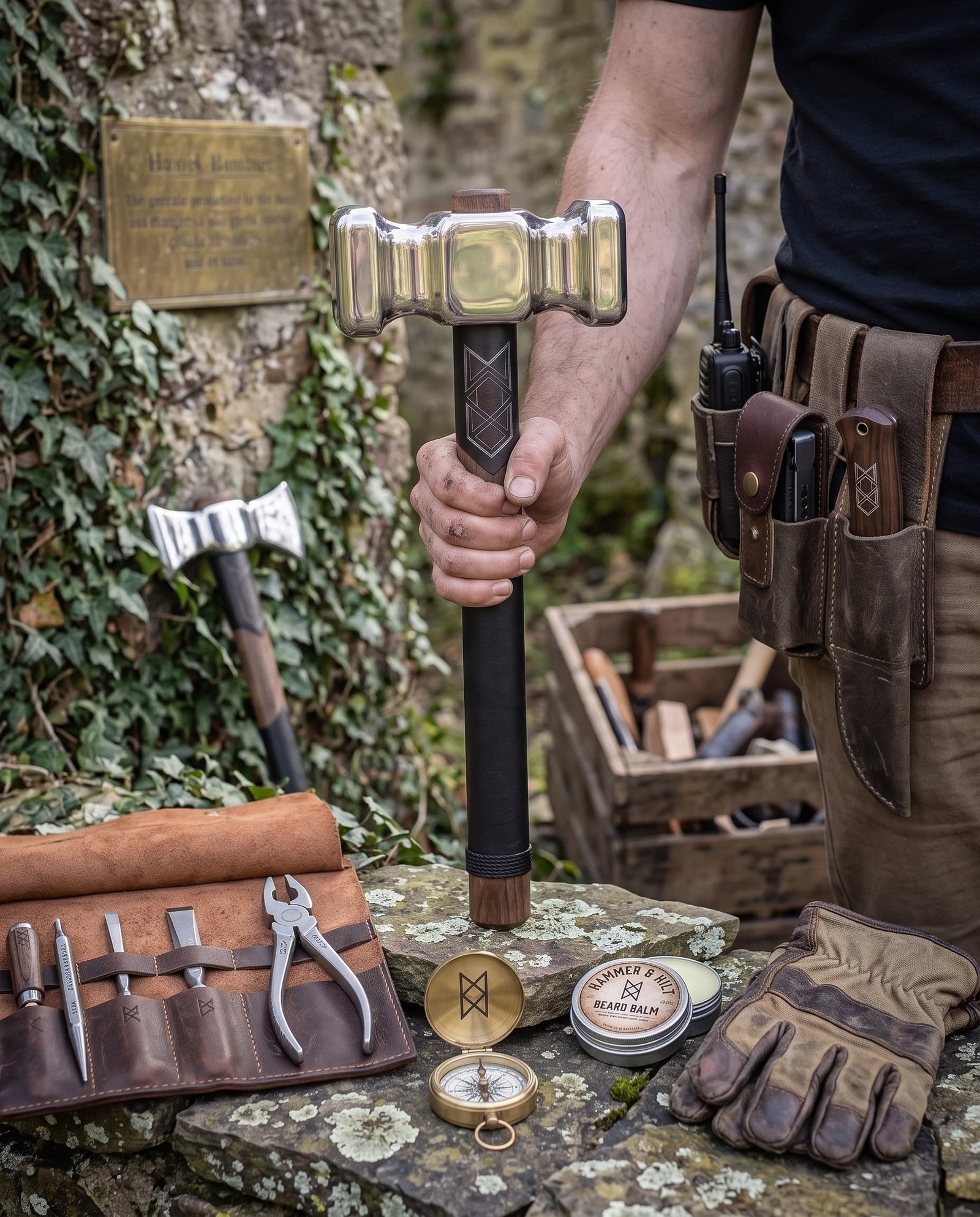
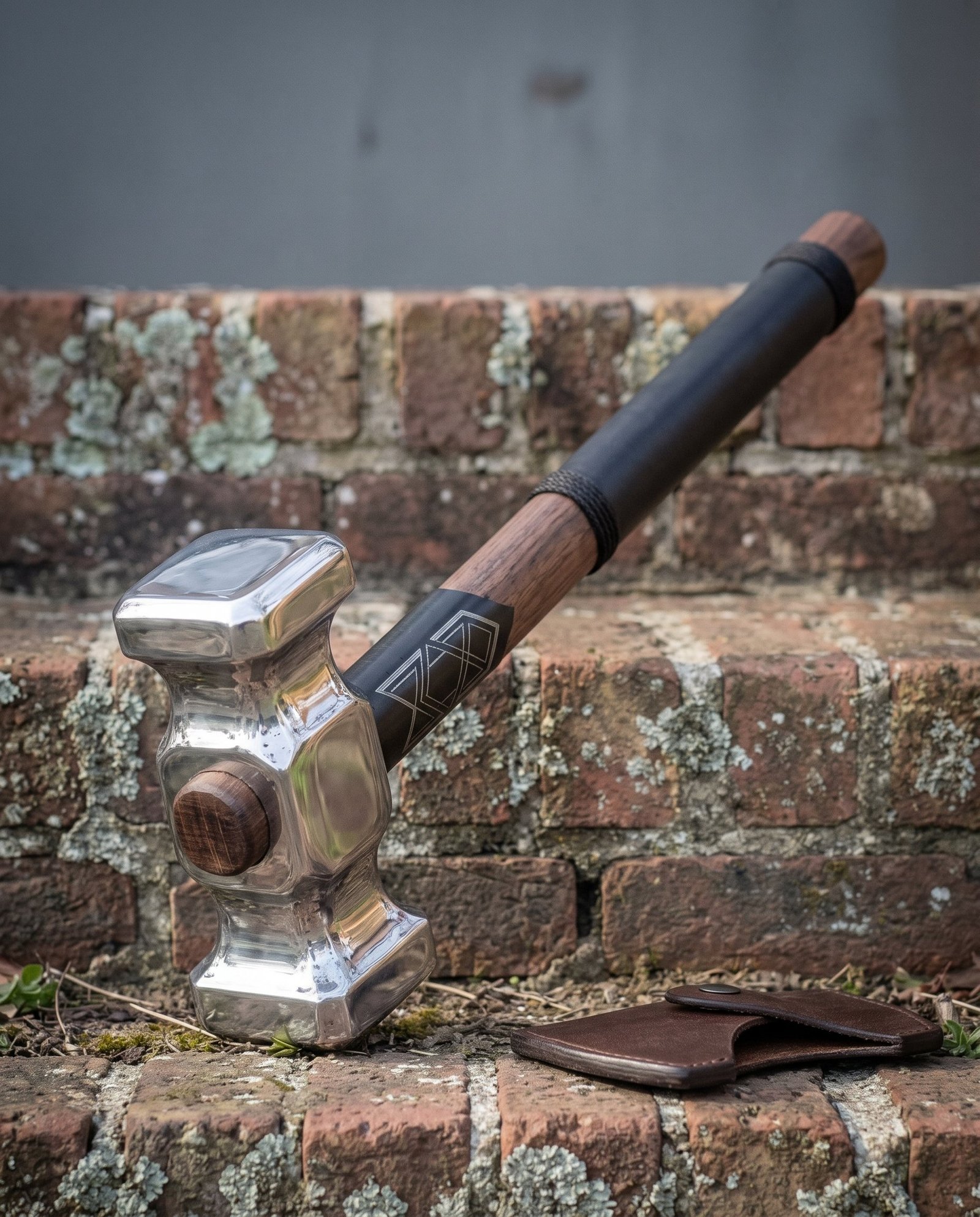
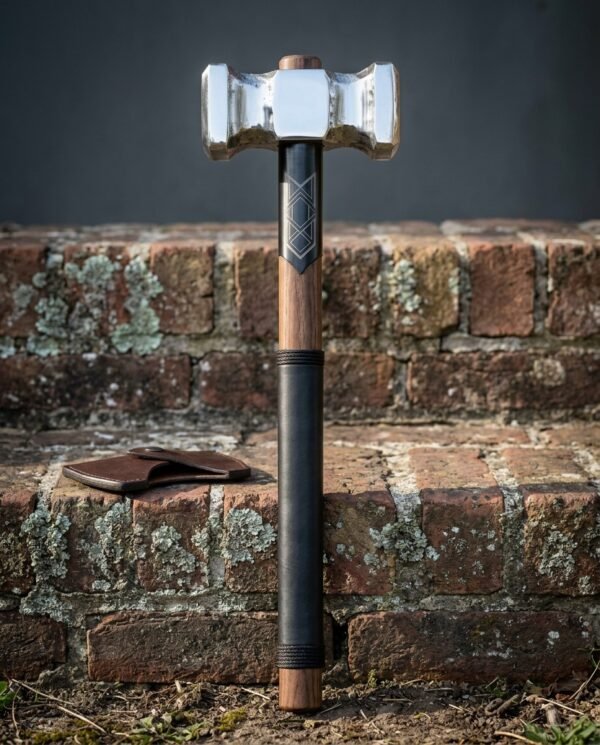
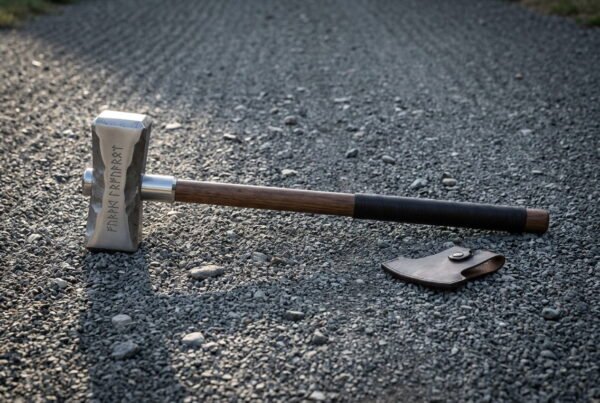
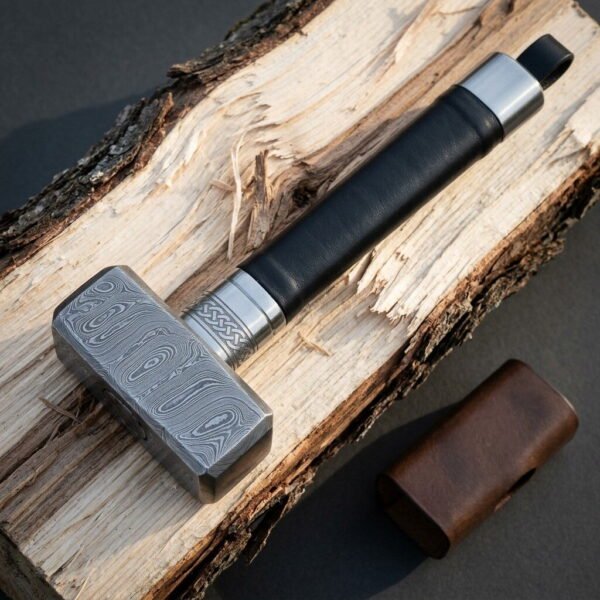
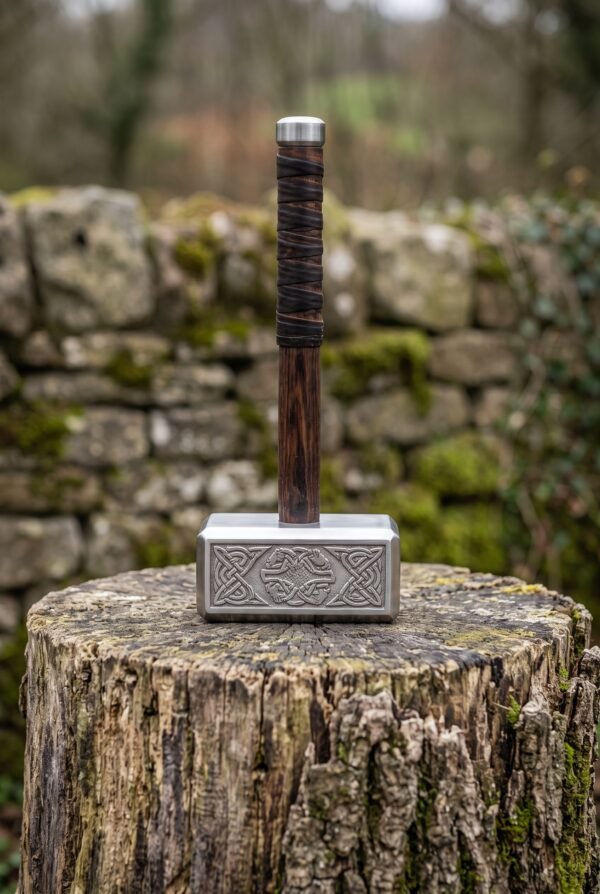
The Anvilcrown is a one hand war hammer with a heavy double faced head, forged from 1095 high carbon steel and polished to a mirror finish all over. Both faces are flat and square, the head is waisted through the middle where the eye passes through it, and the walnut haft is wedged from the top so the wedge shows in the eye. Below the head sits a blackened steel collar engraved with a stack of interlaced lozenge knots, and the lower two thirds of the haft carry a black leather grip wrap whipped at each end with cord. A brown leather belt hanger with a snap stud is included.
The most famous hammer in Norse myth has a design fault, and the story of it is worth knowing. In Snorri Sturluson’s Skaldskaparmal, Loki bets his head that the dwarf brothers Brokkr and Eitri cannot match the treasures of the sons of Ivaldi. While Brokkr works the bellows, Loki turns himself into a fly and bites him on the eyelid until the blood runs into his eye and he pauses to wipe it. That pause is why Mjolnir came out of the forge with a handle too short. The gods judged it the finest treasure anyway, because it never missed and always returned. There is a real point buried in that story: a hammer is defined by its head, not its handle. This one is forged and finished in the Czech Republic.
A hammer does its work through armour rather than around it, which how blunt heads beat armour explains. For where 1095 sits on the hardness scale and what that buys you, see the steel and hardness page. Blunt heads of the same period sit with the maces.
Specifications
| Steel | Hand forged 1095 high carbon steel |
|---|
| Hardness | 54 to 58 HRC |
|---|
| Head | Double faced, stepped down and waisted through the eye, squared faces with rounded edges |
|---|
| Head width | Approximately 6 inches across both faces |
|---|
| Overall length | Approximately 19 inches |
|---|
| Haft | Walnut, wedged from the top through the eye, bare wood showing above and below the grip |
|---|
| Collar | Blackened steel engraved with interlaced lozenge knotwork |
|---|
| Grip | Black leather wrap whipped with black cord at both ends |
|---|
| Finish | Mirror polished head all over |
|---|
| Included | Hammer and brown leather belt hanger with a snap stud |
|---|
| SKU | RK-1881 |
|---|
Why the war hammer beat the sword against armour
By the fourteenth century a well equipped man at arms was wearing plate over mail over padding, and that combination beats a sword. An edge needs to part material to work, and it cannot part hardened plate. Every serious cutting blade in Europe ran into this wall at the same time, and the answer was to stop trying to cut and start transmitting shock instead.
That is what a war hammer does. The whole energy of the swing arrives on a face the size of a large coin, and the plate spreads that force into the body underneath rather than stopping it. Armour that shrugs off a sword cut will still let through enough of a hammer blow to break a collarbone or stun a man long enough to end the fight. The double faced form here, with two flat striking faces instead of a face and a beak, is the older and simpler pattern and the one closest to the smith’s hammer it grew out of. It also happens to be the shape Mjolnir is usually given in Viking age pendants, which are short, squat and blunt at both ends.
Steel, walnut and the collar
The head is hand forged from 1095 high carbon steel, hardened and tempered to 54 to 58 HRC, then ground and polished to a mirror finish across the faces, the shoulders and the waist alike.
The haft is walnut. It is the traditional gunstock wood for good reason: dense enough to be stiff, stable enough not to move much with humidity, and good at damping vibration, which matters on anything you strike with. It is wedged from the top, which is the correct way to hang a head, because the wedge spreads the wood inside the eye so the head cannot travel down the haft. The collar below the head is blackened steel with the knotwork cut into it, and it does a job as well as looking good: it reinforces the haft at the point immediately below the eye, which is where a mis strike lands and where a wooden handle breaks.
Engraving, runes and your own design
Use the rune converter on this page to turn a name, a date or a short phrase into Elder Futhark and we will cut it into the steel, the leather or the wood. If you would rather have a Viking pattern than a rune line, choose your own design in the engraving option above the add to cart button and tell us where it goes. Where a piece already carries an engraved design, your chosen engraving replaces it rather than sitting alongside it. On this hammer that means a rune line on the collar takes the place of the lozenge knotwork. The flat faces of the head and the leather belt hanger are both alternatives if you want the collar left as it is. See the engraving page.
Handling and balance
The balance on a hammer is entirely in the head, and that is the point. Held near the butt this is a heavy, committed swing with a lot of energy at the end of it. Choked up under the collar it becomes controllable enough for close work. The leather wrap gives grip without the slipperiness of bare finished wood, and the cord whipping at each end stops the wrap creeping under use.
Check the head seating before you swing it, every time, the same as you would with an axe. Wooden hafts move with the seasons, and a loose head on a heavy hammer is genuinely dangerous. We sell this as a display and collector piece and it is not certified for contact sparring, reenactment combat or any use against another person.
Care
The faces are bare steel, so wipe them and put a light film of oil on them, particularly if the hammer lives somewhere with damp air. Leave the blackened collar alone apart from dusting: it is a surface finish and abrasive polish will cut through it and take the contrast out of the engraving. Oil the exposed walnut once or twice a year with a hardwood oil, worked in and wiped back, which keeps it from drying out and shrinking away from the eye. Feed the leather grip wrap and the belt hanger with a leather balm at the same time. Our steel care page covers dealing with rust spots on bare steel.
If it is going on a wall, hanging swords and axes safely covers mounts, fixings and what not to do.
Made in the Czech Republic
This is a handmade piece from the Czech Republic, made in a workshop that still forges, grinds and finishes by hand instead of stamping parts out. The smiths there have kept the older way of working, and the wood, horn and leather are shaped and fitted by hand as well. Two pieces of the same design will never be identical, and that is part of what you are buying.
Ransack Viking is a United States company. We handle the import ourselves, look over every piece when it lands and ship from our warehouse in Chicago, Illinois. Engraving is done in the United States after the piece arrives, so your design goes on before we send it out.
A note on handmade variation
This is hand made, not machine made or bulk produced, so what arrives will not be a pixel for pixel copy of the photograph. The head is shaped and polished by hand, so the line of each shoulder and the depth of the waist shift a little from one piece to the next. Walnut varies enormously in colour and figure from board to board, so one haft may be pale and straight grained and the next darker and more figured. The leather and the engraving depth vary too. The dimensions, the material and the build are the same every time. The character is not.
Frequently asked questions
Is this a working hammer or a display piece
The head is genuinely forged and the haft is properly hung, so it is a real hammer. We sell it as a display and collector piece, and we do not certify it for reenactment combat, sparring or any contact use against a person.
How heavy is it
Heavy. A double faced head of this size on a nineteen inch haft has serious mass and you will feel it in the wrist. That weight is the entire point of the design.
Is the leather belt hanger included
Yes, it comes with the hammer. It is a folded leather loop with a snap stud that goes over a belt and closes around the haft below the head.
Will the walnut haft loosen over time
It can, like any wooden hafted tool, because wood moves with humidity. Check it before each use. Keeping the wood oiled and out of a hot dry attic is the best prevention.
Can I have runes on the head
Yes. The flat faces will take a short rune line, or you can have the collar engraved instead, in which case your line replaces the lozenge knotwork that is there now.
How long before it ships
One to two weeks of processing, then free shipping in the US. If you are buying it for a date, tell us in the order notes before ordering.
What is in the box
- Anvilcrown forged steel war hammer on a walnut haft
- Brown leather belt hanger with a snap stud
- Care card for bare steel, walnut and leather
- Lifetime warranty against defects in forging, grind, heat treat and fittings
- Forged and finished in the Czech Republic
Explore the range
See more in Thors hammers, Norse arms and Viking axes, or read the guides on hanging a head and caring for a hardwood haft.
Worth a look beside this
Next along the rack is the Ladderpeen Thor hammer, 15 inches overall. For a straight comparison, see the Emberkey Thor hammer, pattern welded Damascus. Worth putting side by side with this is the Anvilwake Thor hammer, forged from 1095.
If you are putting a set together, the Rookbeak poleaxe sits alongside it. Or start from a blank sheet on the custom Norse arms page.
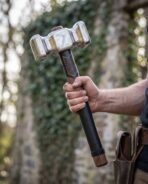
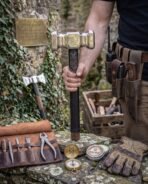
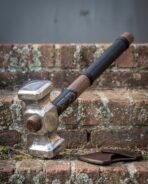
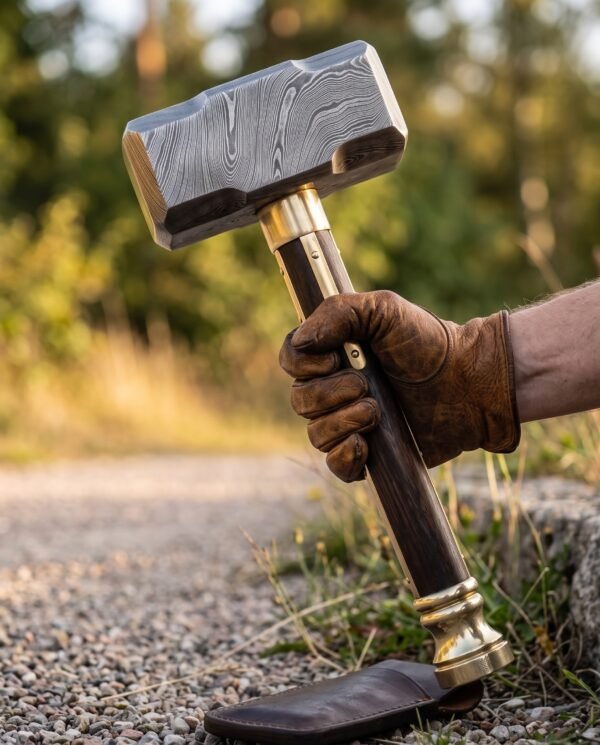
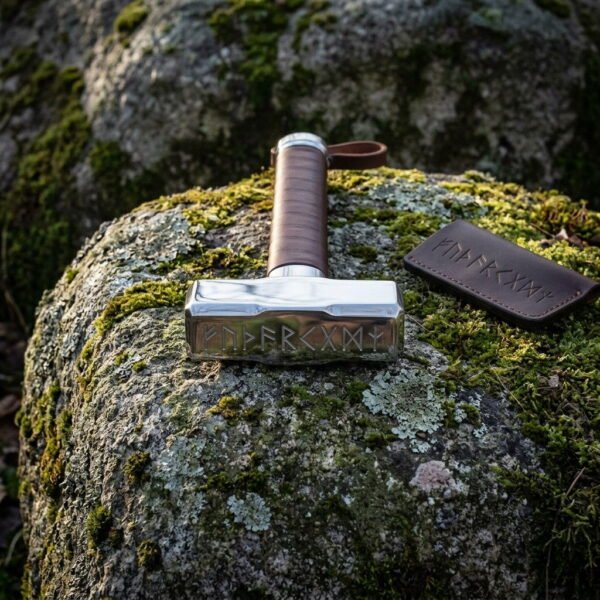
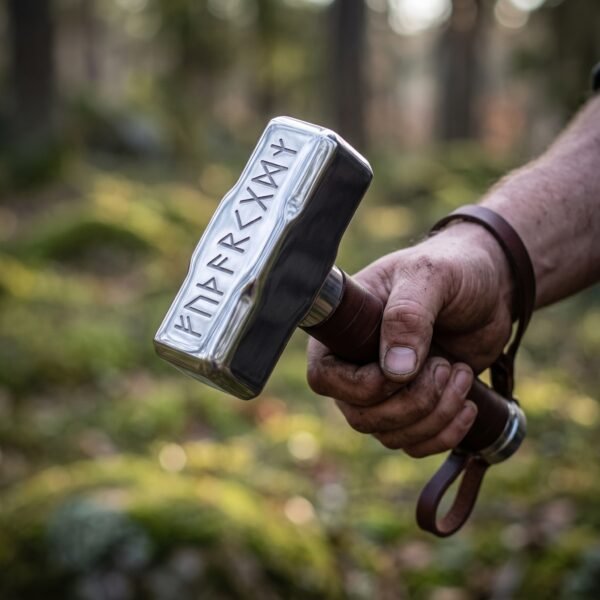
So happy I finally pulled the trigger on this one. Steel head is heavy in a good way. You can tell it’s not hollow. Haft feels sturdy and well balanced for the size of the head. Finish on the metal is even and clearly hand forged. Couldn’t be happier with this.