A throwing knife is built around one fact. Once it leaves your hand it rotates, and everything about the design exists to make that rotation predictable. That means no bolsters, no thick scales and no weight sitting off to one side. The blade is symmetrical, the tang is flat or skeletonised, the balance sits close to the middle, and the edge is deliberately not razor sharp because a fine edge chips the moment it hits wood.
All three sets here are 1095 high carbon at 54 to 58 HRC, sold as three matched knives with a stitched leather roll. Each knife is about 11 inches overall with roughly 6 inches of blade and a listed weight near 7 to 8 ounces. Points are symmetrical spear points, grips are cord or paracord wrapped over the tang, and finishes run from a matte black coating to hand rubbed satin. Two carry an etched Norse symbol on the flat.
Buy the set, not one knife. The throwing axes work the same way. Consistency between the three is most of the skill.
Free US shipping
On most pieces. Heavier and oversized ones carry a flat charge.
Hand Forged
Heated, hammered and ground by hand.
Engraving available
Names, dates or Norse runes on most pieces.
Ships from Chicago
Inspected and dispatched from our Chicago warehouse. No import duty, no customs delay on US orders.
Throwing Knives
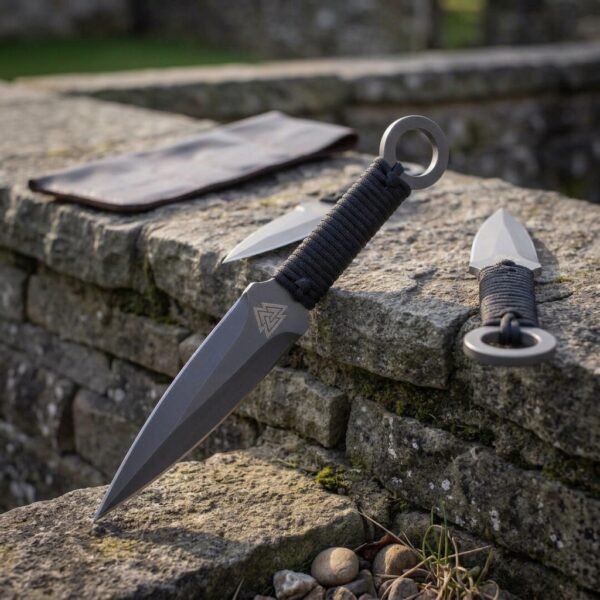
Stormknot Hand Forged 1095 Throwing Knife Set | Three 11 Inch Satin Blades with Etched Valknut | Paracord Grips and Leather Roll | Norse Target Gift | RK-1599
Original price was: $229.00.$183.20Current price is: $183.20.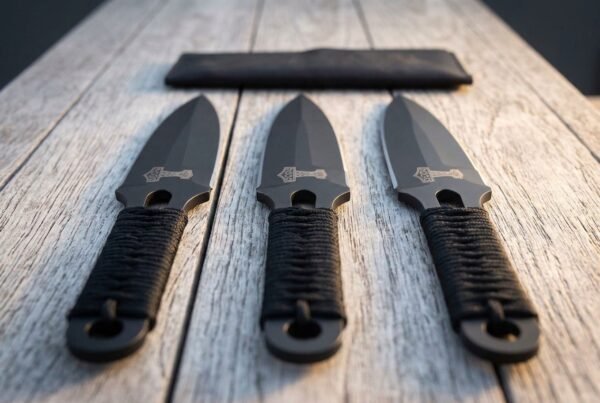
Thornflight Hand Forged 1095 Steel Viking Throwing Knife Set of Three with Cord Wrapped Handles & Leather Roll Sheath | Target Sport Gift | RK-1554
Original price was: $189.00.$151.20Current price is: $151.20.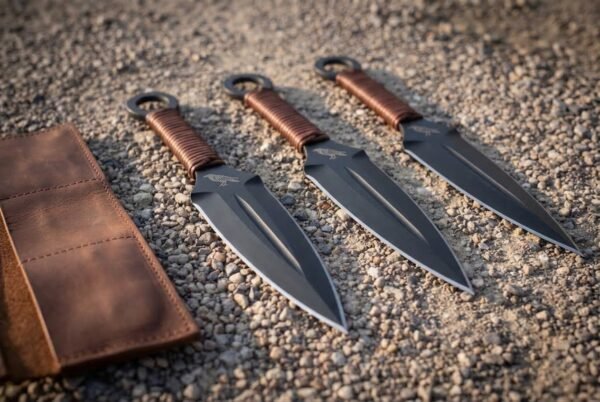
Nightraven Hand Forged 1095 Throwing Knives | Set of Three 11 Inch Blades | Black Coated Steel and Paracord Grips | Leather Roll Included | Target Gift | RK-1598
Original price was: $199.00.$159.20Current price is: $159.20.Rotation is the whole problem
Throwing is a distance problem before it is a technique problem, and the sooner you accept that the faster you get good at it. A knife thrown with rotation turns roughly one full revolution every foot and a half to two feet of travel, depending on how hard you release and where you hold it. That means there are specific distances from the target at which the point is facing forward when the knife arrives, and specific distances at which the handle is facing forward instead. Standing between them produces a knife on the floor and a dent in the wood.
Nothing about that is a flaw to be engineered out. It is the mechanic you learn. Find the distance where a full rotation puts the point in first, mark the floor, and throw from that mark until the throw is boring. Then learn the half rotation distance closer in and the two rotation distance further back. Everything after that is refinement.
Because rotation is the point, the design constraints follow directly. Weight has to sit close to the middle so the knife turns around a predictable axis rather than wobbling. There can be no bolster, no thick handle slab and no pommel lump on one side, because anything that puts mass off the centre line makes the spin inconsistent. The profile has to be symmetrical so that the knife behaves the same whether you throw it by the blade or by the handle. And the steel has to be tough rather than hard, because a throwing knife spends its life hitting wood at speed and occasionally hitting the frame, the floor or another knife.
That last point is where most cheap throwing knives fail. Hardened to knife hardness they chip and snap. Run soft they bend and stay bent. The 54 to 58 HRC band on this page is the compromise, and one of the sets sits deliberately at the tough end of it.
The sets in this collection
Three sets, three knives in each, all in 1095 high carbon and all supplied in a stitched leather roll. They differ in grip, finish and how much protection the steel has been given.
The cord wrapped set with the Thor hammer
Three matched knives at about 11 inches each and roughly 7 ounces, the lightest set here. The steel is 1095 at 54 to 56 HRC, which the listing states is at the tough end of the range on purpose. The grind is a symmetrical spear point, described as utility sharp rather than razor sharp, and that is not a shortcut. The tang is skeletonised and wrapped in black cord with a lanyard hole at the pommel, and the finish is a matte black coating with bright satin edge bevels and an etched Thor hammer. A rolled leather carrier holds all three. At 189 dollars this is the entry to the page.
Skeletonising the tang is what keeps a knife this size at 7 ounces. Cutting material out of the middle of the handle takes weight from where it does the least for the balance and leaves it distributed along the length, which is exactly what a thrower wants.
The paracord set with the raven
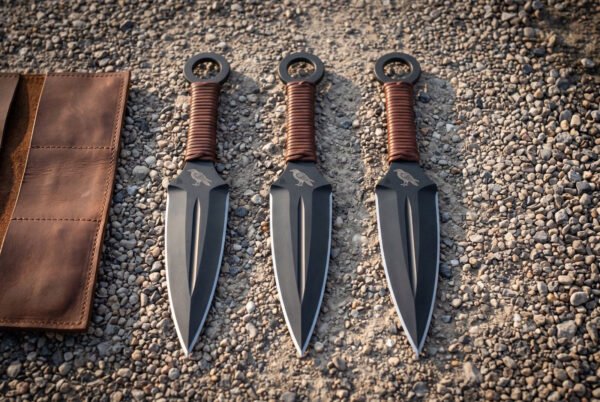
Three knives at about 11 inches overall with roughly 6 inches of blade and about 8 ounces each, in 1095 at 54 to 58 HRC. The profile is a symmetrical spear point with twin cut outs, the grip is brown paracord wrapped over a flat tang, and the pommel is an open steel ring. The finish is a black protective coating with bright ground edges, and a raven is cut into the flat above the wrap. A stitched leather knife roll is included. At 199 dollars this is the middle option and the most practical of the three.
The cut outs in the blade do the same job as the skeletonised tang on the first set. They remove metal from a part of the blade that contributes little and pull the balance back toward the centre. The open ring pommel gives you somewhere to hook a finger or a lanyard and, more usefully, a way to hang all three on a peg.
The satin set with the Valknut
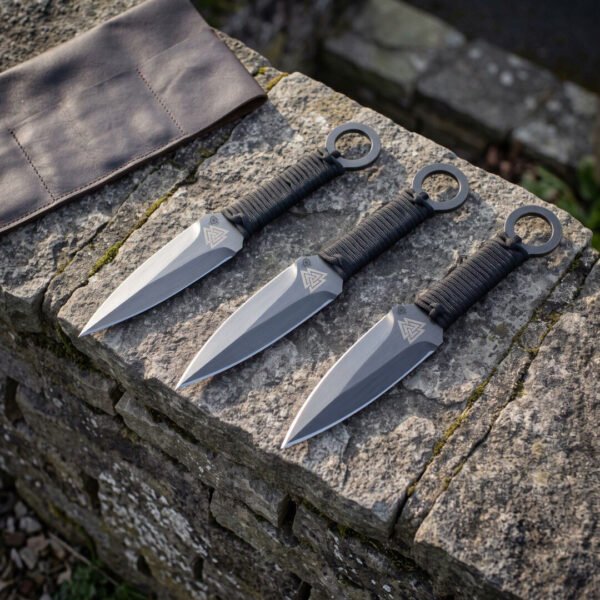
Three knives at about 11 inches with roughly 6 inches of blade and about 8 ounces each, matched across the set, in 1095 at 54 to 58 HRC. The profile is a symmetrical spear point with a raised central ridge, the grip is black paracord over a flat tang, and the pommel is an open steel ring. The finish is hand rubbed satin with no coating at all, and a Valknut is cut into the flat above the wrap. At 229 dollars it is the most expensive set here and the most attractive.
The raised central ridge is a stiffening spine. On a knife that is going to hit wood point first several hundred times, a flat blade will eventually take a set and bend. A ridge down the centre resists that in the same way a fold in a sheet of paper resists it, and it costs almost nothing in weight.
Sizes, steel and finishes across the range
Every figure below is taken from the specification panel of a set on this page. These are forged and ground by hand, so treat them as what to expect rather than as a guarantee.
| Set | Steel and hardness | Overall length | Blade length | Weight each | Grip and pommel | Finish and etching | Price |
|---|---|---|---|---|---|---|---|
| Cord wrapped, Thor hammer | 1095 at 54 to 56 HRC | About 11 in | Not listed | About 7 oz | Skeletonised tang in black cord, lanyard hole at the pommel | Matte black coating, bright satin edge bevels, etched Thor hammer | 189 dollars |
| Paracord, raven | 1095 at 54 to 58 HRC | About 11 in | About 6 in | About 8 oz | Brown paracord over a flat tang, open steel ring pommel | Black protective coating, bright ground edges, raven etched on the flat | 199 dollars |
| Satin, Valknut | 1095 at 54 to 58 HRC | About 11 in | About 6 in | About 8 oz, matched across the set | Black paracord over a flat tang, open steel ring pommel | Hand rubbed satin, no coating, Valknut etched on the flat | 229 dollars |
All three come as three matched knives in a stitched leather roll. Matched matters more than any single figure in the table. Three knives that behave identically let you correct your distance after the first throw, and three that do not will teach you nothing at all.
Sizing and fit
Eleven inches and seven to eight ounces is the standard mid size for target throwing, and it is the right place to start. Shorter knives rotate faster and need finer distance control. Heavier knives carry through wind and into hard targets better but tire the arm sooner. This size sits where most people learn fastest.
If you are buying for someone with small hands, the cord wrapped set at about 7 ounces is the easier one to release cleanly. If you are buying for someone who already throws, the extra ounce on the other two is welcome.
Steel and hardness
Everything here is plain 1095 high carbon. That is one of the two house steels, hardened for blades to 54 to 58 HRC, and it is the correct choice for throwing by a wide margin. The other house steel, forge welded Damascus of 1095 and 15N20 at 58 to 60 HRC, is harder and holds an edge longer, and neither of those things is what you want in a knife that is going to be driven into an oak round at speed.
Hardness on a throwing knife is a toughness decision, not an edge retention decision. Too hard and the point chips or the blade snaps at the tang on a bad landing. Too soft and it bends. The set listed at 54 to 56 HRC is sitting at the tough end of the band on purpose, and that is a reasonable choice rather than a corner cut.
None of it is stainless. The two coated sets have a black protective finish that slows corrosion down and will wear bright at the edges and anywhere that rubs, which is normal. The satin set has no coating at all and needs the most attention. The steel and hardness page explains what an HRC figure measures.
Edges, points and why these are not razors
Two of these are ground with a working edge rather than a fine one, and one is described as utility sharp on purpose. That is correct and it is worth understanding before you take a stone to them.
A thrown knife lands on its point and the edge behind it. A razor edge is a very thin section of steel with almost no material behind it, and it chips the first time it meets a knot or a nail or the steel of another knife already in the target. A blunter edge takes the same impact and rolls slightly, and a roll comes back with a few passes on a stone.
Keep the point sharp and leave the edges alone. If the point does blunt from repeated impacts, restore it with a file or a coarse stone and keep the original profile rather than making it finer. What you want is a point that sticks, not a point that shaves.
Targets, safety and looking after them
Throw into end grain. A round of soft wood standing on end with the grain running toward you will take a point and close up around it. Plywood, pallets and boards thrown at across the grain will splinter, deflect knives and destroy points. Cottonwood, poplar and pine rounds are all cheap and all work.
Never throw at anything with a hard backstop directly behind it and never throw where anyone can walk in from the side. Collect knives one thrower at a time. A knife that bounces off a frame comes back faster than you expect. Read axe throwing for beginners before you build a target, because the setup rules are identical and the article covers distance marking and backstops properly.
After a session, wipe the steel dry and put a light film of oil on it, paying attention to the point and to any bright ground bevels where the coating does not reach. Grass and damp soil are the fastest route to a rusty set, because a knife that misses spends the next ten minutes lying in wet ground. The satin set with no coating needs this most.
Leather rolls hold moisture against steel, so use the roll for carrying and store the knives out of it if they are going to sit for months. Our knife care guide covers the routine for blade, wrap and roll, and there are replacements in sheaths and rolls.
Engraving
These can be engraved after they arrive in the United States. The flat above the wrap is the natural place and two of the sets already carry a cut design there, a raven on one and a Valknut on the other. Where a piece already carries an engraved design, your chosen engraving replaces it rather than sitting beside it.
Text engraving is 19 dollars, a symbol is 39 dollars and a family crest is 49 dollars. Elder Futhark is a phonetic alphabet rather than a code, so a name is transliterated by sound and there is no rune for the letter C. Engraving is permanent and an engraved set cannot be returned, so read the spelling twice before you send it. Bear in mind that a coated blade will show a cut line bright against the black, which usually looks better than people expect.
Where these come from and how they ship
Ransack Viking is a US company based in Chicago, Illinois. The pieces are handmade in the Czech Republic, then imported, inspected and shipped from Chicago. Engraving is done in the US after arrival.
Because these are forged and ground by hand, small differences between the three knives in a set are normal, and the sets are matched on weight rather than made identical to the gram. Carry law is worth checking before you take a set anywhere. Throwing knives are treated differently from state to state and sometimes from city to city, so read our state by state summary and treat it as a summary rather than legal advice.
How to choose
If you are starting out, take the cord wrapped set at 189 dollars. Seven ounces is the easiest of the three to release cleanly, the skeletonised tang keeps the balance where a beginner wants it, and the black coating means an afternoon in wet grass is not a disaster.
If you want the most practical set for regular throwing, take the paracord and raven set at 199 dollars. Eight ounces carries better into a target, the cut outs keep the balance central, the coating protects the steel, and the open ring pommel makes them easy to hang up and easy to count at the end of a session.
If you want the best looking set and you do not mind maintaining it, take the satin Valknut set at 229 dollars. Hand rubbed satin with no coating, a raised central ridge for stiffness and a genuine Norse symbol cut into the flat. It is the one to give as a gift, and the one that will punish you if you leave it out in the rain.
Browse related categories
- Throwing axes for the same target and the same rules
- Tomahawks, which throw better than they look
- Viking knives, the single edged Norse working blades
- Daggers and symmetrical double edged shapes
- Damascus knives in forge welded 1095 and 15N20
- Hunting knives for field work rather than targets
- Leather sheaths, rolls and replacements
- The full Norse arms collection
Guides worth reading first
- Throwing for beginners: distance, rotation and targets
- The Valknut: what the three triangles actually mean
- Viking symbols and their meanings
- Knife laws by state, summarised
- The complete knife care guide: blade, wrap and roll
Frequently asked questions
How far from the target should I stand?
Far enough that one full rotation puts the point in first, which for a knife this size is usually somewhere between about twelve and sixteen feet from a standing throw. The exact figure depends on your release, so start in that range, adjust by a foot at a time, and mark the floor once it works.
Why are the edges not razor sharp?
Because a thin edge chips on impact. A throwing knife lands point first into wood and sometimes into the frame or another knife, and a fine edge is the first thing to break. A working edge takes the same hit and rolls instead, which comes back with a few passes on a stone.
Why buy a set of three rather than one knife?
Because consistency is most of the skill. Three matched knives let you throw, watch, correct your distance and throw again without walking to the target between each one. Three knives that behave differently teach you nothing.
What should I throw into?
End grain. A round of soft wood standing on end with the grain facing you will take a point and close around it. Never throw at plywood, pallets or boards presented across the grain, because they splinter, deflect knives and wreck points.
What steel are they and will they rust?
All three sets are 1095 high carbon at 54 to 58 HRC, which is a toughness choice rather than an edge retention one. None of it is stainless. Two sets have a black protective coating and one is bare satin, and all of them want wiping dry and a light film of oil after a session.
Can I sharpen the point when it dulls?
Yes, and you should. Use a file or a coarse stone, keep the original profile and resist making it finer. What you want is a point that sticks in wood, not one that shaves. Leave the edges behind the point mostly alone.
Do they come with a sheath?
Yes. Each set includes a stitched leather roll that holds all three. Use it for carrying rather than for long storage, because leather holds moisture against steel and a set put away damp will spot.
Where are these made?
Ransack Viking is a US company based in Chicago, Illinois. The pieces are handmade in the Czech Republic, then imported, inspected and shipped from Chicago. Engraving is done in the US after arrival.
Featured pieces
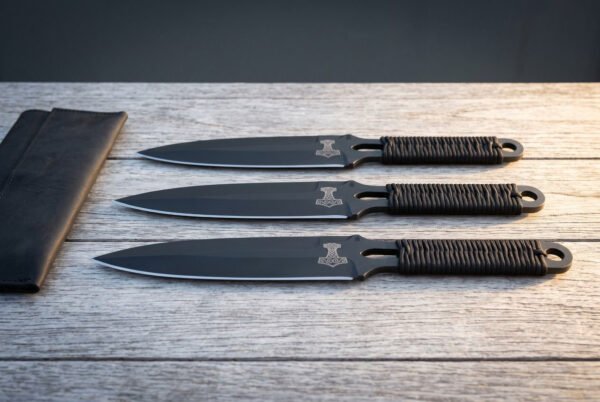 Thornflight Hand Forged 1095 Steel Viking Throwing Knife Set of Three with Cord Wrapped Handles & Leather Roll Sheath
Original price was: $189.00.$151.20Current price is: $151.20.
 Nightraven Hand Forged 1095 Throwing Knives
Original price was: $199.00.$159.20Current price is: $159.20.
 Stormknot Hand Forged 1095 Throwing Knife Set
Original price was: $229.00.$183.20Current price is: $183.20.