
A round shield is a disc you hold in the middle. Behind the boss, the raised dome at the centre, there is a hole cut through the board and a bar across it, so your fist sits inside the shield rather than strapped to your forearm. That single fact drives everything else. A centre grip lets you punch, rotate and cover in any direction, and it also means the shield hangs off your knuckles, so weight matters more here than on almost anything else we sell.
Thirteen pieces here, from 20 to 32 inches across and 7 to 16 pounds. Five are planked Viking boards of glued timber about 12 mm thick, with a steel or brass boss riveted through and a rawhide bound rim. Three are Greek hoplons, dished bowls of laminated hardwood faced in bronze or steel. Two are carved hardwood display pieces, two are formed steel, and one is a boss and fitting kit for building your own.
None of these is rated for full contact combat. The listings say so plainly. For an event rather than a wall, the renaissance faire and reenactment kit guide covers what to bring with a shield and what most sites expect.
Free US shipping
On most pieces. Heavier and oversized ones carry a flat charge.
Hand Forged
Heated, hammered and ground by hand.
Engraving available
Names, dates or Norse runes on most pieces.
Ships from Chicago
Inspected and dispatched from our Chicago warehouse. No import duty, no customs delay on US orders.
Round Shields
Why the round shield kept coming back
The round shield is the oldest and most stubborn shape in armour. It appears in the Aegean, across northern Europe, in the steppe and along the Mediterranean, and it survives centuries after other forms have come and gone. That is not tradition. It is geometry. A circle gives you the largest covered area for the least material and the least weight, and because it is symmetrical it does not care which way you turn it.
The Viking board is the plainest version. Planks of light timber glued edge to edge into a flat disc, a hole cut in the centre, a bar across the hole for your fist, and an iron dome riveted over the top to keep your hand from being broken. Around 12 mm of wood, which sounds thin until you understand that a shield is meant to fail. A board that splits and traps a blade has done its job. A board that stops everything without moving is heavy enough to be useless after a minute of holding it up.
The Greek hoplon works from the opposite direction. It is a dished bowl of laminated hardwood, faced in bronze or steel, with a rolled and riveted rim, and it is carried on the forearm through a band at the centre and a grip at the rim. That arrangement lets a man rest the upper edge on his shoulder and hold the thing up for hours, which is what a phalanx requires. It is also why a hoplon covers half your neighbour and only half of you.
The rim is the part people forget. A wooden board without an edge binding splits from the outside in the first time it takes a serious hit. Rawhide shrinks as it dries, so a wet strip stitched or nailed around the circumference pulls the planks together and stays tight. Bronze or steel rolled over the edge does the same job on the dished shields, at a cost in weight.
The shields in this collection
Thirteen pieces, and they are not variations on one thing. They come from three separate traditions plus a group built purely for display.
Planked Viking boards
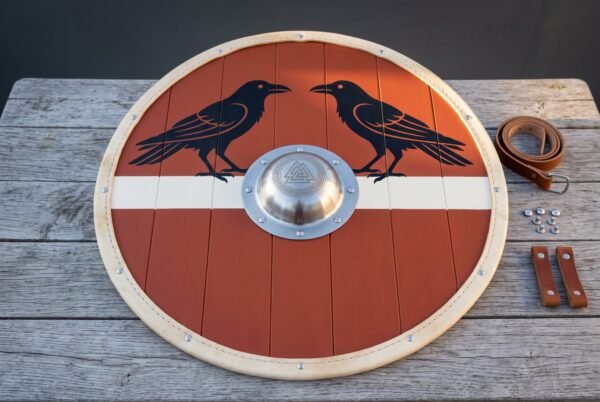
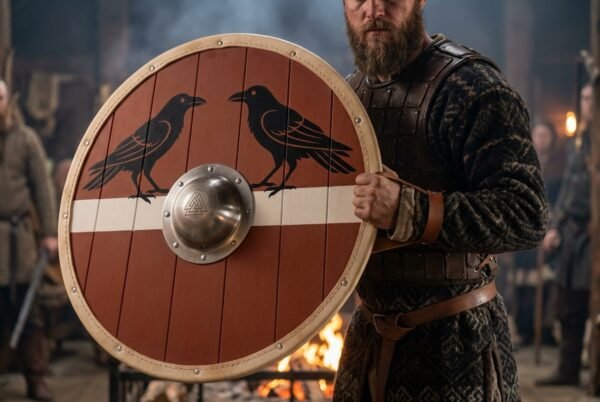
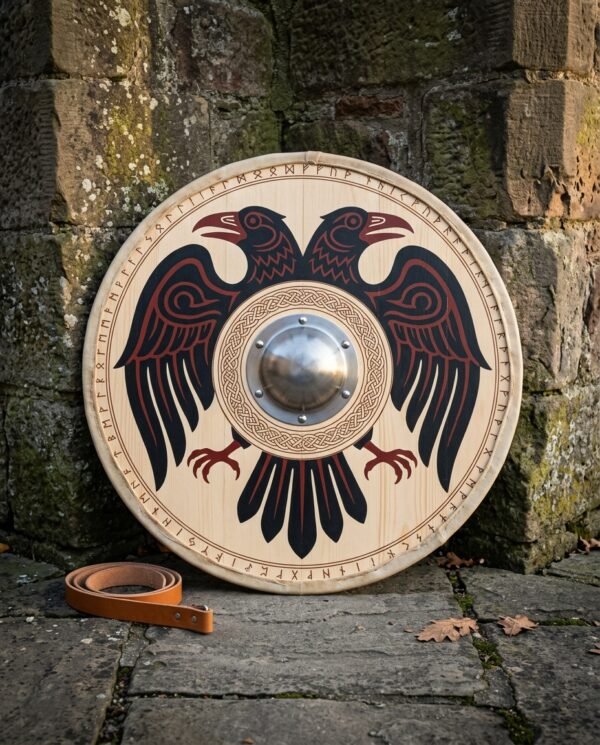
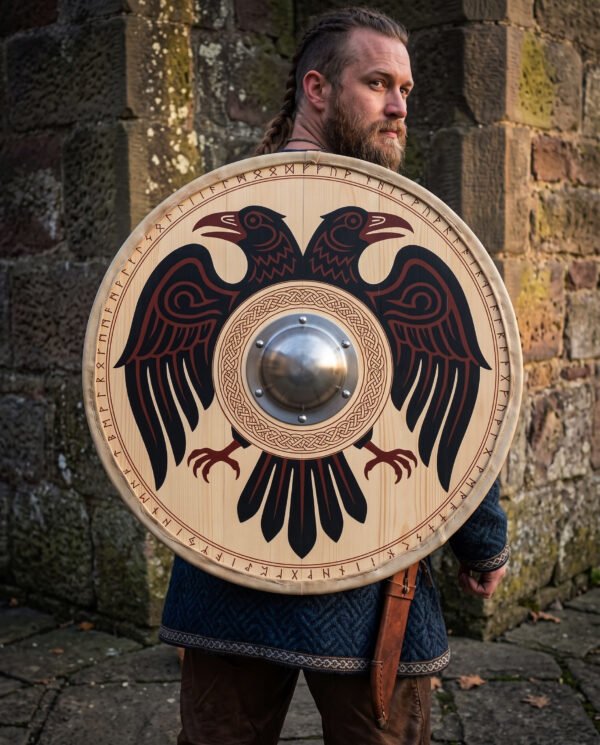
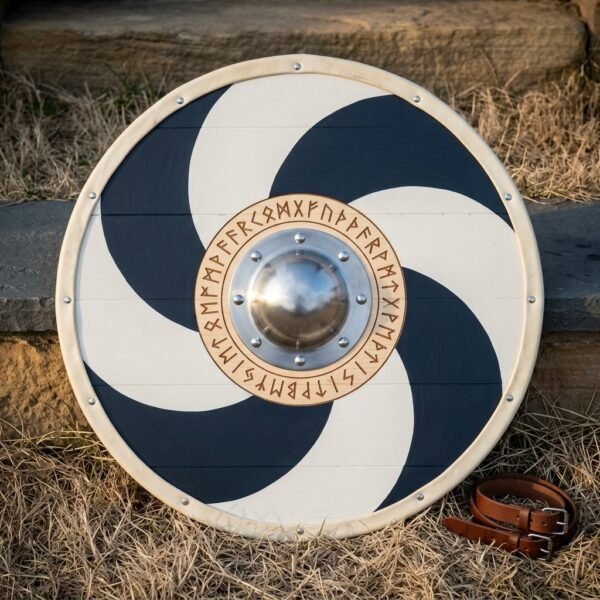
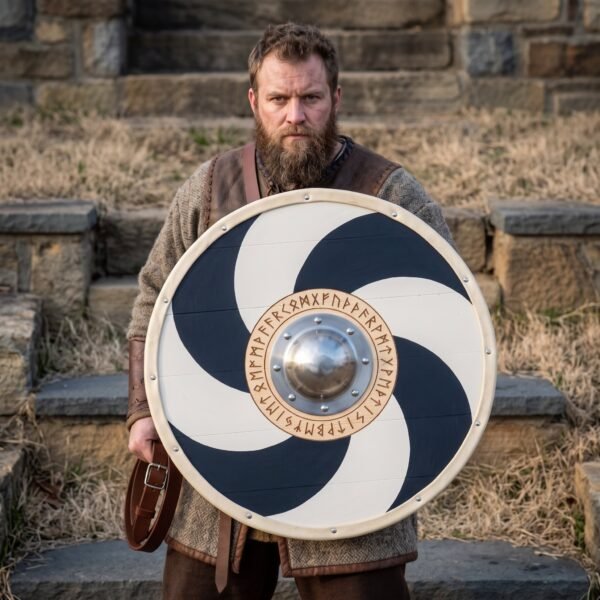
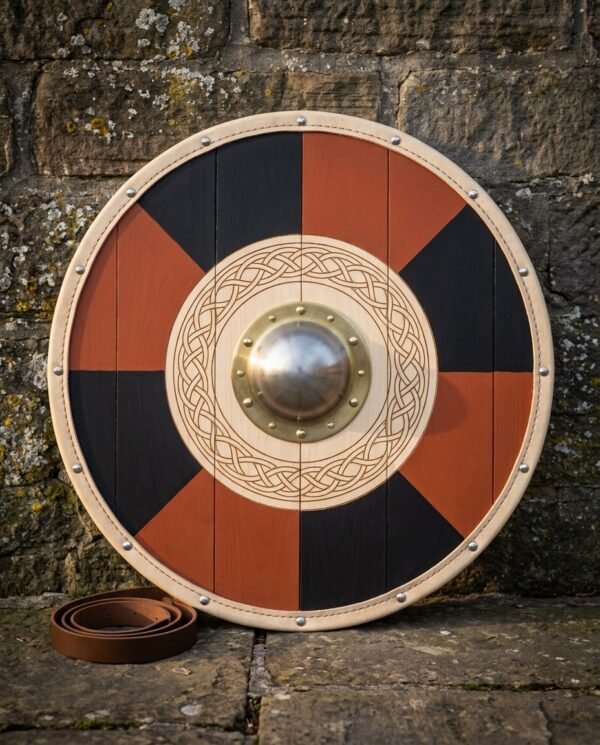
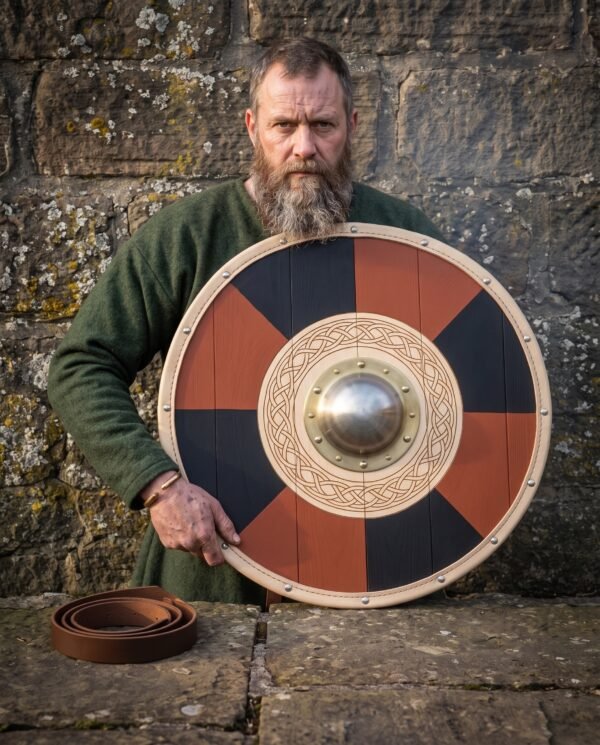
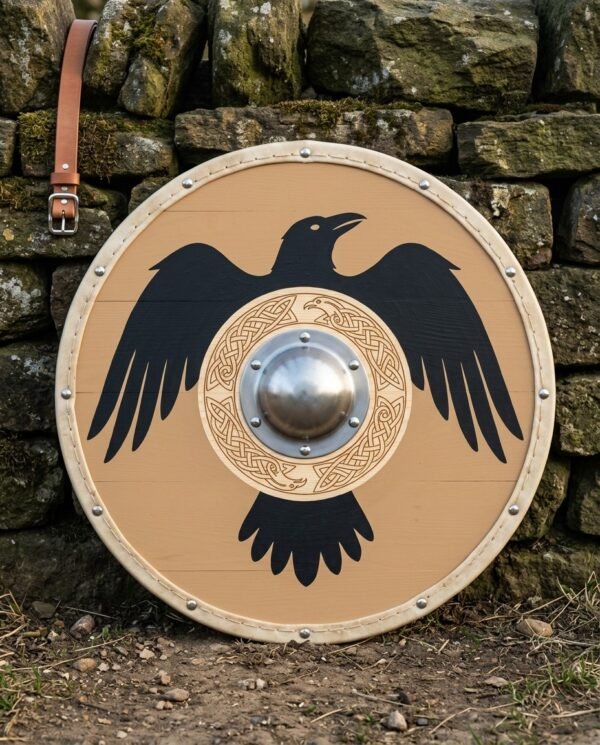
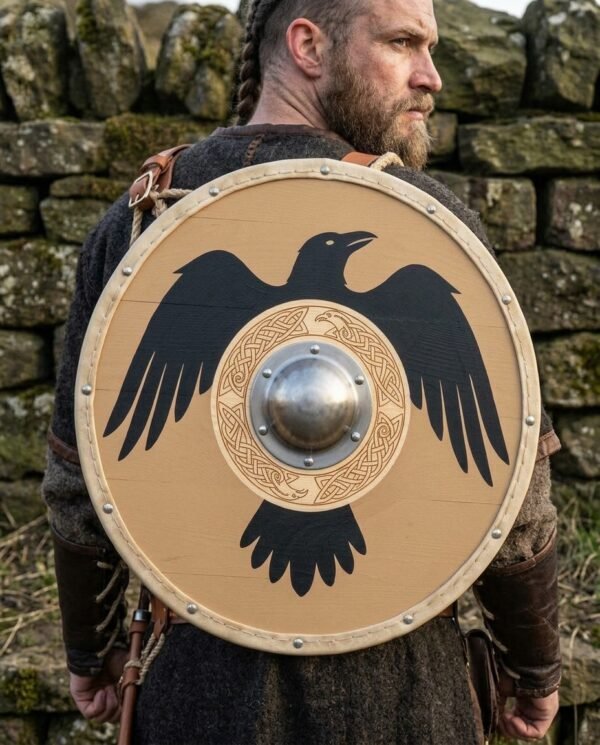
Five shields, three at 24 inches and two at 30, all built the same way. Timber planks glued edge to edge into a flat disc around 12 mm thick, a hand hole cut at the centre with a grip bar across it, a domed boss of mild steel or brass riveted through with six rivets, and a rawhide edge binding nailed or riveted around the full circumference. Weights run about 7 to 12 pounds. Faces are hand painted or carved: twin ravens in black on a red field with a white cross band, a raven device on natural timber with a knotwork roundel engraved at the centre, a navy and off white pinwheel with an Elder Futhark rune ring around the boss, and one quartered in oxide red and charcoal black with a carved interlaced knotwork ring cut around the boss.
Greek hoplons
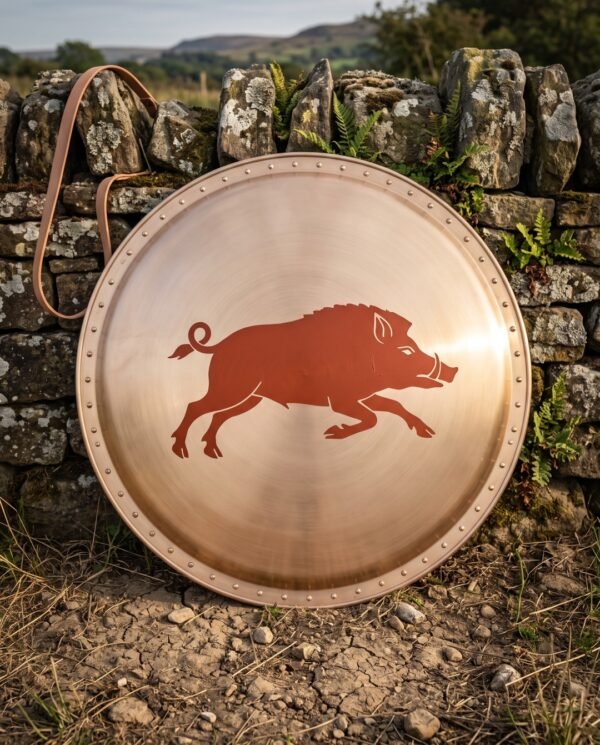
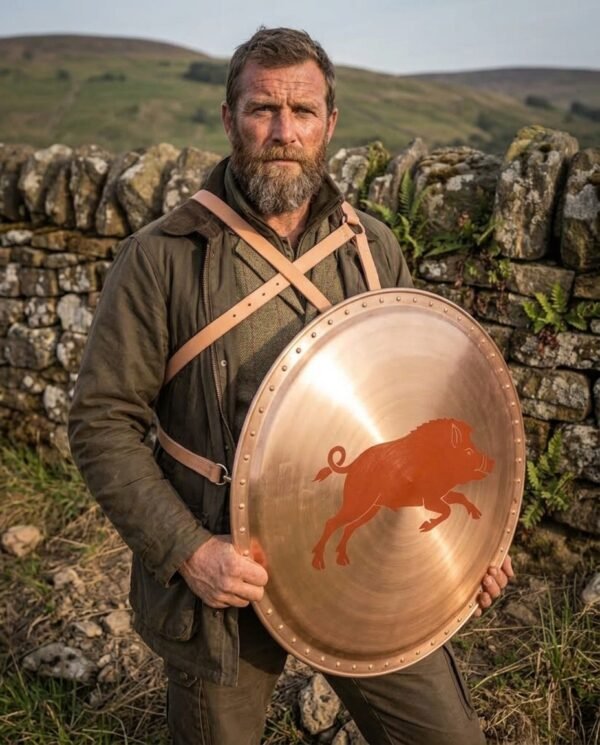
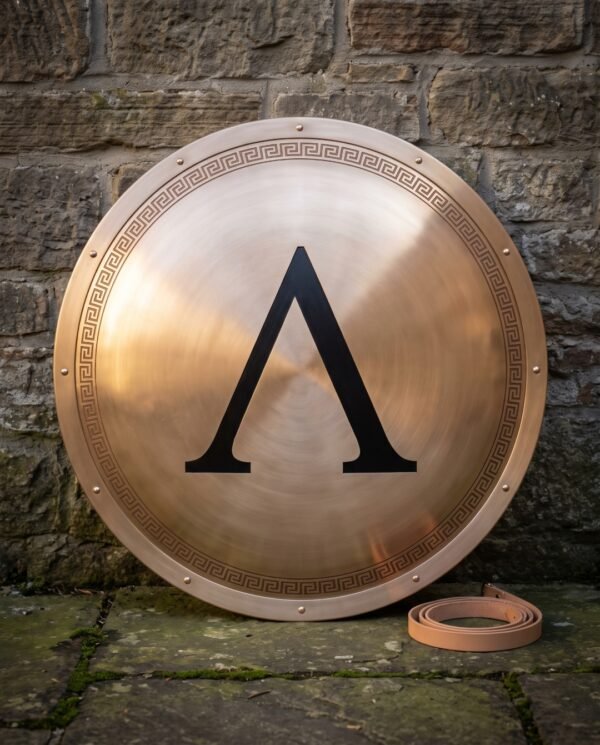
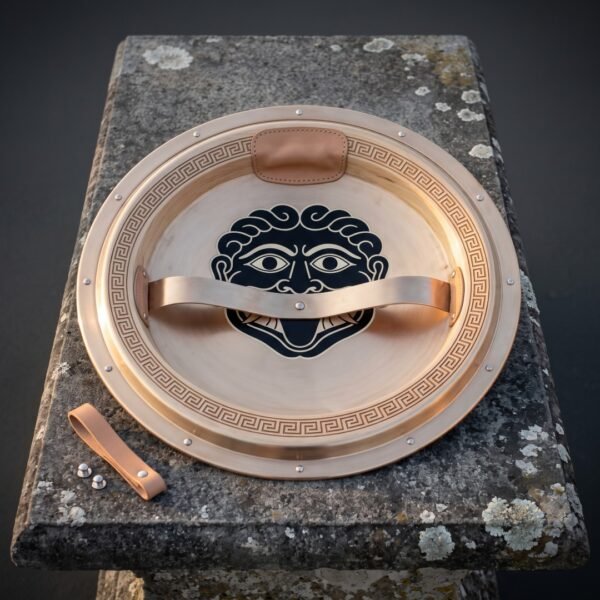
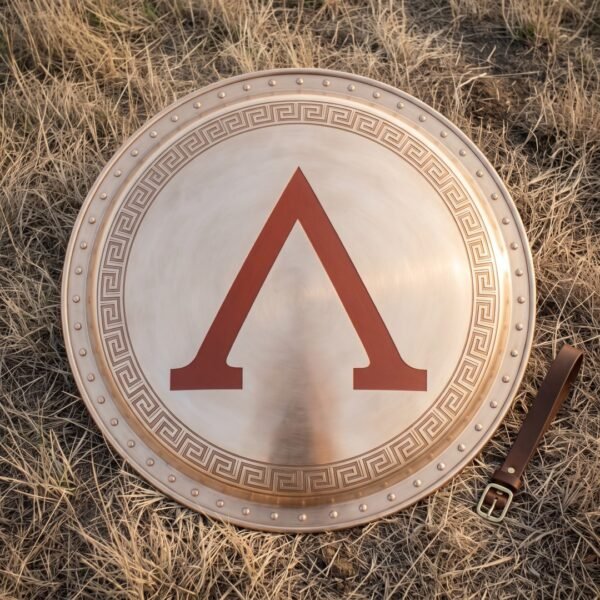
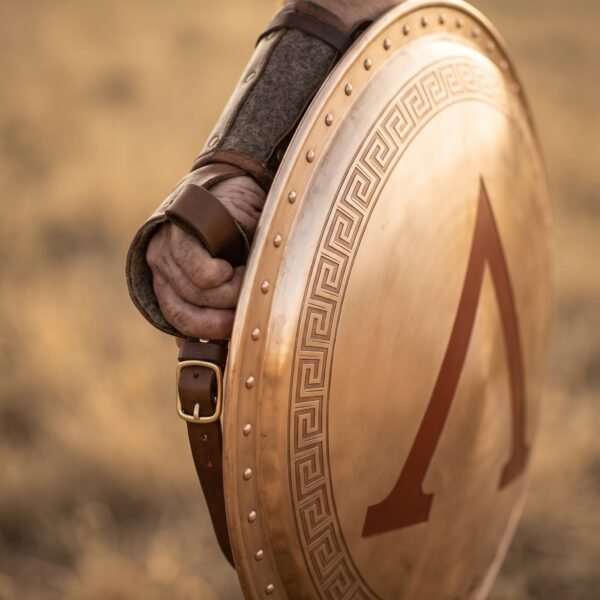
Three shields, 30 to 32 inches across and the heaviest things on this page at 12 to 16 pounds. All three are laminated hardwood dished to a shallow bowl with a metal facing spun over the front and a rolled rim riveted through the body. Two are bronze toned, one bright steel with a bronze finished flange engraved with a meander border. Devices are a running boar in oxide red, a black lambda with an engraved meander, and a crimson lambda for Lakedaimon. One carries a hand painted Gorgoneion on the inside face and a leather shoulder pad at the upper rim, which is the detail that tells you someone was paying attention.
Steel and carved display shields
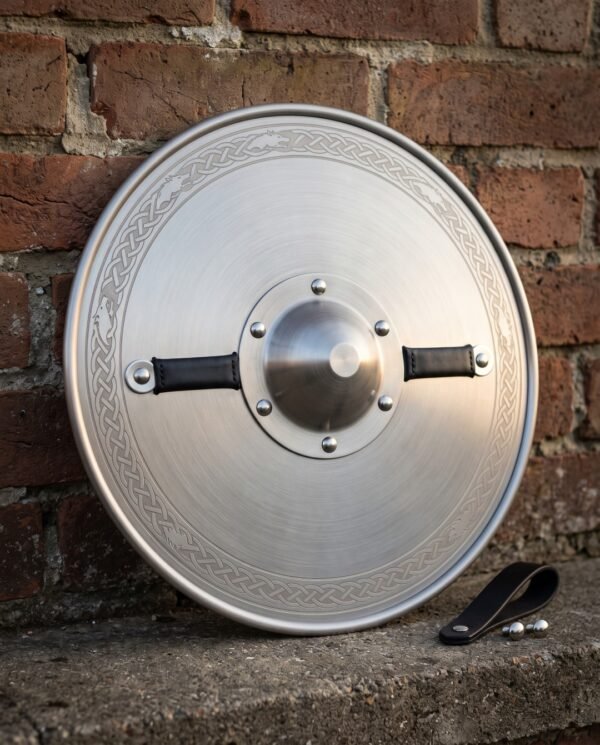
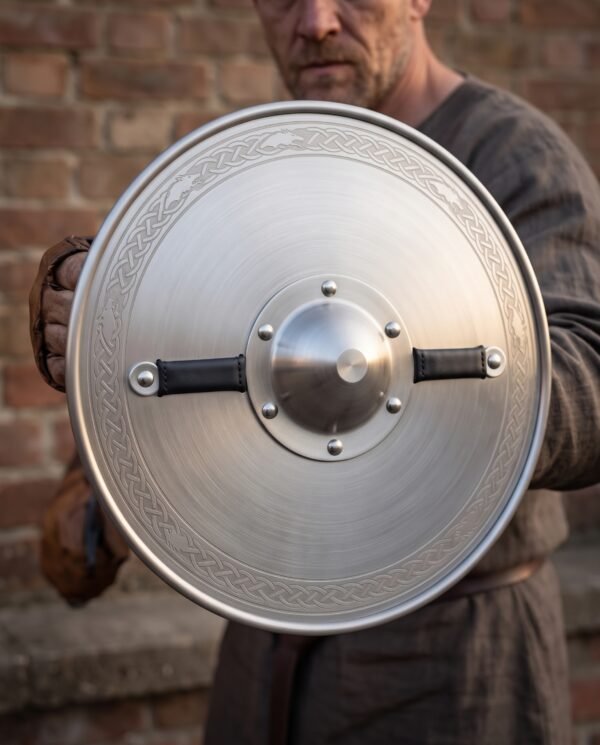
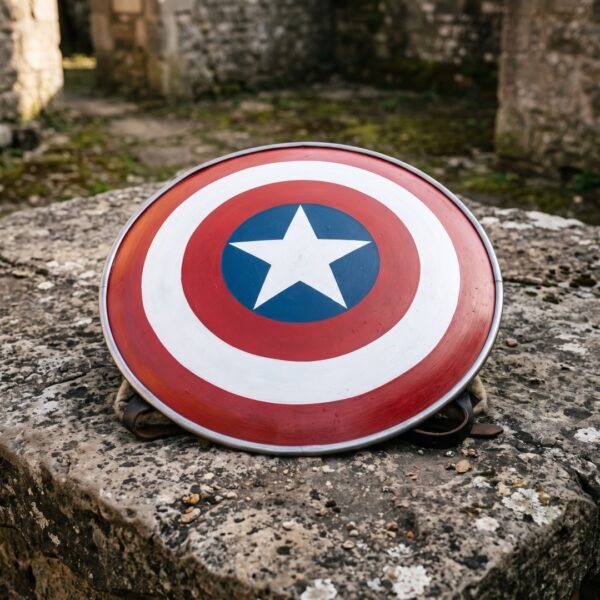
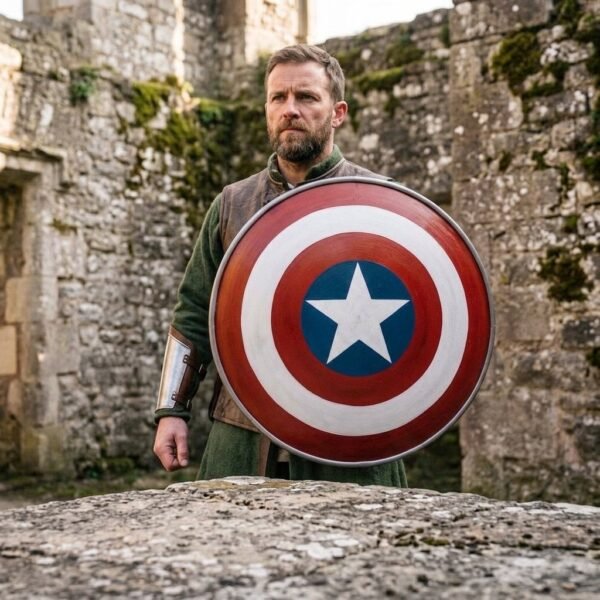
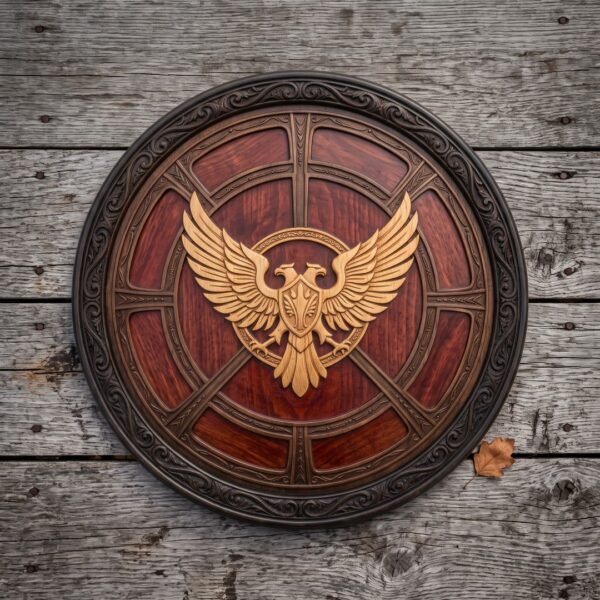
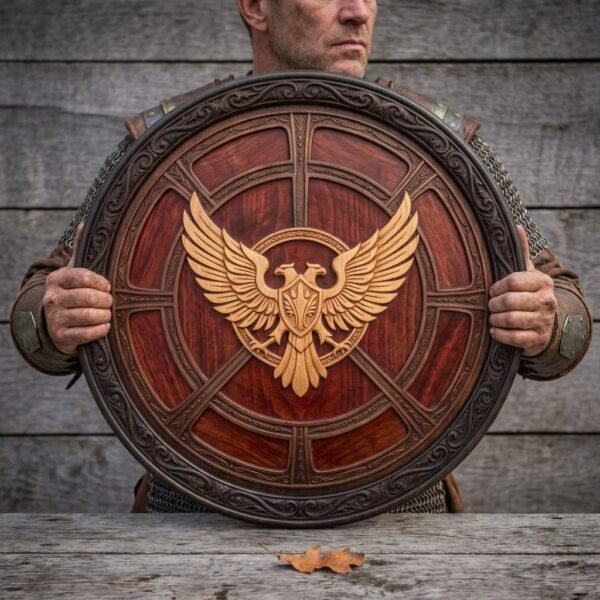
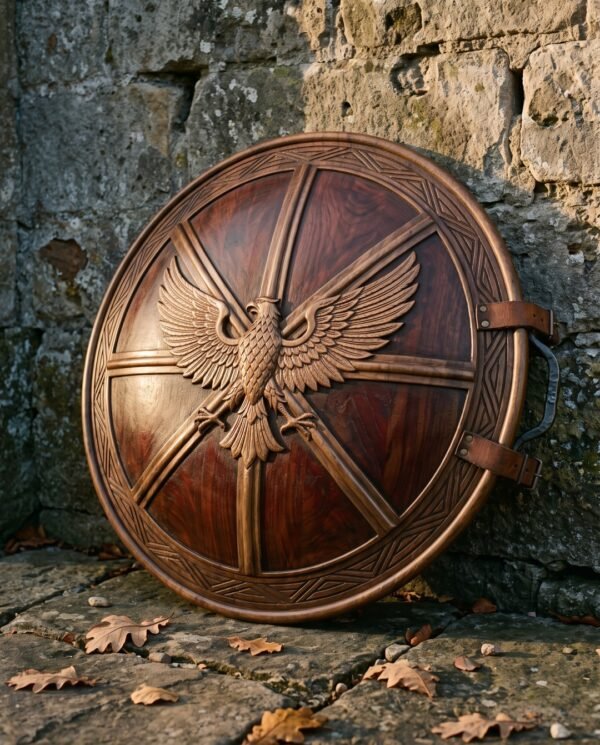
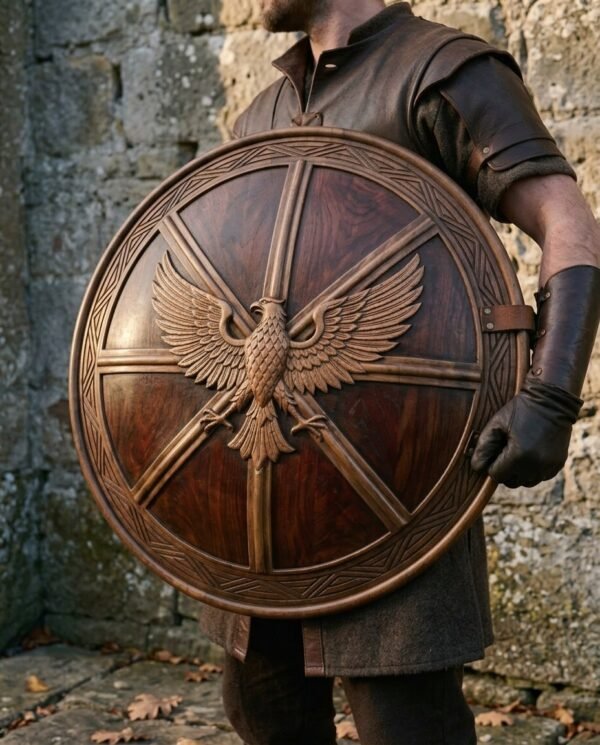
Four pieces made to be looked at. A 20 inch steel disc, dished from a single sheet in 16 gauge with a rolled edge, etched with an interlaced knotwork band ending in beast head terminals, with a raised dome on a flanged base plate riveted through the face. A 24 inch formed steel shield with a shallow convex dome, hand painted in concentric red and white bands with a white five pointed star on a blue centre disc, sealed and lightly worn back. And two carved hardwood shields at 24 inches, both stained deep red brown with a six spoke frame worked in relief, one carrying a double headed eagle with an escutcheon on the chest under a blackened steel rim, the other a single eagle with wings displayed under a bronze toned rim cut with a chevron band.
The boss and fitting kit
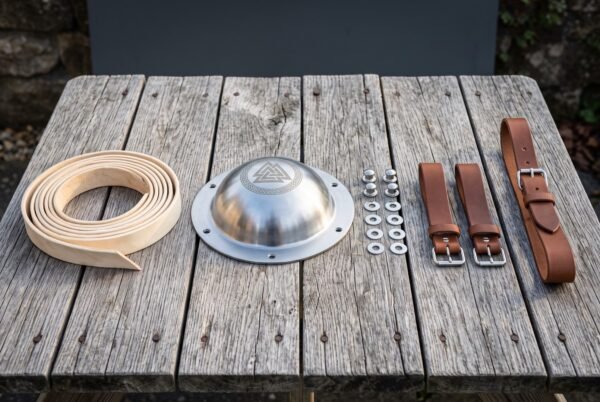
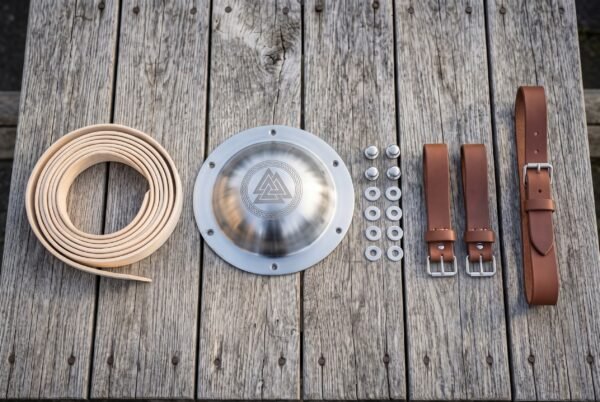
One item here is not a shield. It is everything except the board: a hand raised mild steel boss in 16 gauge, a deep hemispherical dome on a flat flange with six rivet holes and a Valknut cut inside a knotwork ring, six rivets with washers, a coil of undyed veg tan leather for the rim, two short buckled arm straps and a long buckled carry strap. If you can glue up planks and cut a hole, this is the cheapest way to a shield you actually built.
Sizes, construction and weights across the range
Every figure comes from the specification panel of a piece on this page. These are made by hand, so several are given as ranges rather than single numbers.
| Type | Diameter | Body | Boss or centre | Rim | Weight |
|---|---|---|---|---|---|
| Steel round shield | 20 in | Mild steel dished from a single disc, 16 gauge | Raised dome on a flanged base plate, riveted | Rolled edge, etched knotwork band | 9 to 11 lb |
| Viking planked board | 24 in | Edge glued solid wood planks, about 12 mm | Hand forged steel boss, riveted | Rawhide, hand stitched | About 7 lb |
| Viking planked board | 24 in | Planked wood, painted face | Spun steel dome engraved with a Valknut | Rawhide, riveted at intervals | Not listed |
| Viking planked board | 24 in | Glued plank softwood, about 12 mm at the centre | Domed mild steel, riveted through | Rawhide, riveted full circumference | About 8 lb |
| Carved hardwood | 24 in | Carved hardwood face, stained and waxed | Carved double headed eagle with escutcheon | Blackened steel with knotwork band | Not listed |
| Carved hardwood | 24 in | Carved hardwood face, stained and waxed | Carved single eagle, wings displayed | Bronze toned steel, chevron band | Not listed |
| Painted steel | 24 in | Formed steel, shallow convex dome | Blue centre disc with a five pointed star | Bare polished steel rim band | Not listed |
| Viking planked board | 30 in | Butted timber planks, flat disc, about 12 mm | Raised mild steel dome, six rivets | Rawhide and leather, nailed | 10 to 12 lb |
| Viking planked board | 30 in | Linden planks glued edge to edge, about 12 mm | Domed brass boss, carved knotwork ring around it | Rawhide, pinned with studs | 9 to 11 lb |
| Greek hoplon | 30 in | Laminated timber core, bronze toned sheet facing | Running boar device in oxide red | Rolled and riveted, domed rivets | About 12 lb |
| Greek hoplon | 30 in | Laminated hardwood, bright steel facing | Crimson lambda for Lakedaimon | Bronze finished flange, engraved meander | 13 to 15 lb |
| Greek hoplon | 32 in | Laminated hardwood, spun bronze facing | Black lambda, painted Gorgoneion inside | Rolled and riveted at intervals | 14 to 16 lb |
| Boss and fitting kit | Board not included | Hand raised mild steel boss, 16 gauge | Valknut in a knotwork ring, cut into the dome | Undyed veg tan leather strip, coiled | Not listed |
Note the boss kit row. It is fittings only. You supply the board.
Sizing and how a shield hangs
Diameter is the number people compare and weight is the number that decides whether you enjoy owning it. A 24 inch board at 7 or 8 pounds can be held out at arm's length and moved around. A 32 inch hoplon at 16 pounds cannot, not by most people, and it was never meant to be. It sat on a shoulder and in a line.
For a wall, diameter is about the space. A 24 inch shield reads as an object on a normal wall. A 30 inch shield dominates one. Measure before you order, and remember the fittings on the back mean the shield stands a little proud of the plaster rather than sitting flat against it.
For costume and light reenactment, take the 24 inch boards. They are the right size for a person to carry for a few hours, they clear a doorway, and they do not clout everyone you walk past. The 30 inch boards are more historically generous and considerably more tiring.
Boards, bosses and rims
The timber shields here are built the way the originals were. Planks glued edge to edge rather than plywood, because plank grain running one way lets a board flex and split along the grain instead of shattering, and 12 mm is close to the range archaeology gives for Viking age boards. Linden is named on one of them, which is the traditional timber and light for its stiffness.
Bosses are mild steel or brass, domed over the cut hand hole and riveted through the board, usually with six rivets. The boss is structural. It is the only thing standing between a strike on the centre of the board and the back of your hand, and it is why a shield without one is only ever a wall decoration. The kit here uses a deep hemisphere on a flat flange, which is the strongest arrangement of the two common shapes.
Rims are rawhide, leather, or rolled metal. Rawhide is the interesting one. It goes on damp, shrinks as it dries and pulls the whole board into compression, so the planks are held together by the rim as much as by the glue. If you buy a rawhide bound shield and store it somewhere very dry for years, that binding will keep shrinking and eventually crack. Somewhere with normal household humidity is fine.
Grips, straps and how you hold it
Two systems are on this page and they are not interchangeable.
The Viking boards use a centre grip. A bar or a leather strap crosses the hand hole behind the boss and you hold it in your fist. The shield can rotate freely, you can punch with the boss, and you can cover high or low by moving your hand a few inches. It also means the entire weight is on your fingers, which is the reason those boards are built light. Several here also come with an arm strap and a longer carry strap so you can sling the shield on your back.
The hoplons use a porpax and antilabe. A bronze or leather band at the centre takes your forearm and a grip at the rim takes your hand, so the load spreads across the whole arm. That is what makes a 16 pound shield carryable, and it is why a hoplon cannot rotate or punch. One of these adds a leather shoulder pad at the upper rim, because in practice the shield rested there.
Care and storage
Timber shields want stable humidity more than anything else. Very dry air shrinks the planks and can open a glue line, and very damp air swells them and loosens the rawhide. A normal room is fine. Do not hang one over a radiator or in direct sun, because the paint will fade and the board will move.
Steel bosses and steel faced shields need the same treatment as any bare steel. A wipe after handling and a light film of oil or wax once or twice a year. Bronze toned finishes are sealed, so leave them alone and dust with a dry cloth rather than a metal polish, which will cut straight through the finish. Leather straps take a conditioner occasionally. Painted faces are sealed but not armoured, so do not scrub them.
Engraving and painted work
Several of these already carry cut or etched work: a Valknut on the boss, an Elder Futhark rune ring around the centre, an engraved knotwork roundel, a meander border rolled into a hoplon rim. Steel bosses and steel rims can be engraved after they arrive in the United States.
Text engraving is 19 dollars, a symbol is 39 dollars and a family crest is 49 dollars. Elder Futhark is a phonetic alphabet rather than a code, so a name is transliterated by sound, and there is no rune for the letter C. Engraving is permanent and an engraved piece cannot be returned, so check the spelling before you order rather than after.
Where these come from and how they ship
Ransack Viking is a US company based in Chicago, Illinois. The pieces are handmade in the Czech Republic, then imported, inspected and shipped from Chicago. Engraving is done in the US after arrival.
Every face on this page is painted or carved by hand, so the device on your shield will not be a pixel copy of the photograph. Brush edges, stain depth and the grain under the paint all vary. Shields ship flat in a large box and they are bulky rather than heavy for their size, so check that someone can take delivery.
How to choose
Start with what it is for. If you want to hold it, buy a 24 inch planked board with a centre grip and accept that it will not stop a truck. If you want it on a wall, buy for the face, because at three feet away nobody is looking at the boss. If you are building a Greek kit, the hoplons are the only shields here that will look right, and you should be honest with yourself about the weight.
Then check the fittings. Some of these ship with straps and a grip already fitted, some ship with the fittings loose in the box for you to rivet where you want them, and one ships as fittings alone. The specification panel on each product page lists exactly what is included. Prices run from 169 dollars for the boss kit to 479 dollars for the largest bronze faced hoplon.
Browse related categories
- Kite shields and bucklers
- Shield bosses and shield fittings
- Roman and Greek shields
- All Viking shields
- Medieval helmets to go with the board
- Leather armour and body protection
Guides worth reading first
- Viking shields explained: construction, size and use
- Round shield versus kite shield
- Choosing a shield for display
- What Viking helmets actually looked like
- Renaissance faire and reenactment kit, what to actually bring
Frequently asked questions
How big were real Viking round shields?
Surviving boards and grave finds cluster between roughly 30 and 37 inches across, with the Gokstad ship shields at about 37 inches. The 30 inch boards here sit at the small end of that range and the 24 inch boards are smaller than the archaeology, which makes them easier to carry and easier to hang.
Are these strong enough for combat reenactment?
No. Every listing that mentions it says display, film and light contact only, and none of them is rated for full contact. Combat groups have their own construction standards and usually their own approved suppliers. Buy these for display, costume, stage or light living history.
Why is the wood only 12 mm thick?
Because that is what the originals were. A shield is a consumable. Thin planks flex, absorb a strike and can trap a blade, and a board light enough to hold up for ten minutes beats a board that stops everything and exhausts you in one. Thickness is also usually greatest at the centre and tapers toward the rim.
What is the boss for?
Your hand. The hand hole is cut straight through the board and your fist sits inside it, so the iron dome riveted over the front is the only thing protecting your knuckles. It also stiffens the centre of the board and gives you something to punch with.
What is the difference between a centre grip and an arm strap?
A centre grip puts the shield on your fist, which lets it rotate and punch but hangs all the weight from your fingers. An arm strap system spreads the load across the forearm, which carries far more weight but locks the shield to one orientation. The Viking boards here use the first, the Greek hoplons use the second.
Can I hang one on the wall without damaging it?
Yes. Use a bracket that supports the rim at two points at the bottom rather than hanging the shield from a single hook through the fittings, and fix into a stud. A 30 inch hoplon at 15 pounds will pull a plasterboard anchor out of the wall in its own time.
What is the leather and rawhide edging actually doing?
Holding the board together. Rawhide is applied damp and shrinks as it dries, which compresses the planks toward the centre and stops the outer edges splitting. It is structure disguised as trim, and it is why the rim on a planked shield is nailed or stitched all the way round rather than just glued.
Does the boss and fitting kit include the board?
No. It is the boss, six rivets and washers, a coil of undyed veg tan leather for the rim, two short buckled arm straps and one long carry strap. You supply the timber and cut the hand hole yourself.