
Everything on this page is a hafted head built to hit rather than to cut, and the reason the category exists is armour. An edge works on cloth, leather and skin. Against mail and plate it stops being the point, because a blade that cannot part the rings still has to do its damage through them. A concentrated blunt strike does that, as a mace does. A beak on the far side of the head concentrates it further, into a point small enough to punch through what a broad face only dents.
The three pieces here run about 20 to 26 inches overall with heads around 8 inches from face to beak, and the one listed weight is about 2 pounds 6 ounces. Two carry forge welded Damascus heads of 1095 and 15N20 at 58 to 60 HRC. One is plain high carbon at 54 to 58 HRC with a Mjolnir cut into the cheek. Hafts are ash, rosewood or dark hardwood with riveted brass or steel langets, and each comes with a shaped leather head cover.
Check the length against the wall before you order the 26 inch one.
Free US shipping
On most pieces. Heavier and oversized ones carry a flat charge.
Hand Forged
Heated, hammered and ground by hand.
Engraving available
Names, dates or Norse runes on most pieces.
Ships from Chicago
Inspected and dispatched from our Chicago warehouse. No import duty, no customs delay on US orders.
War Axes
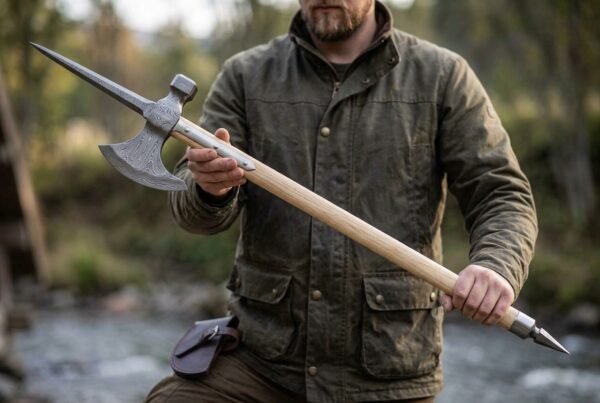
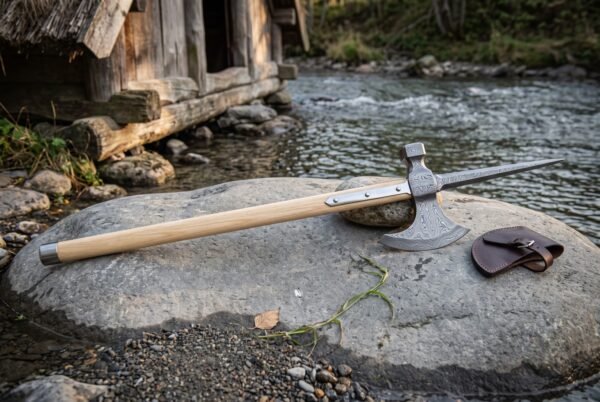
Stormpoll Hand Forged Damascus Steel War Axe | 36 Inch Overall with a 6 Inch Cutting Edge | Reenactment Display Gift | RK-1362
Original price was: $595.00.$476.00Current price is: $476.00.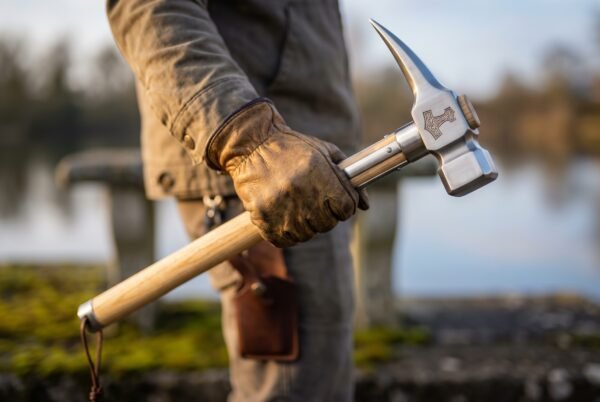
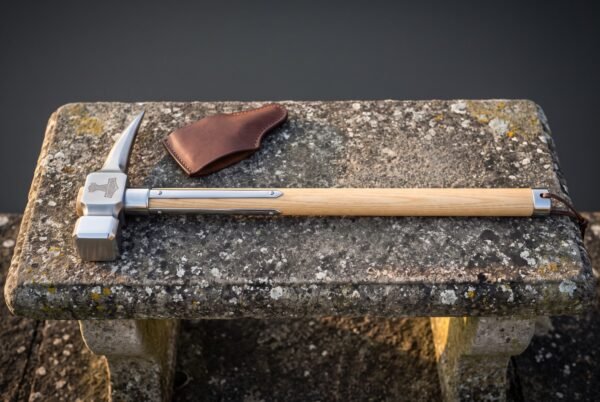
Stormbeak Hand Forged Viking War Hammer | 20 Inch Overall Length | Mjolnir Engraved Head and Steel Langets with Ash Haft | Norse Collector Gift | RK-1680
Original price was: $299.00.$239.20Current price is: $239.20.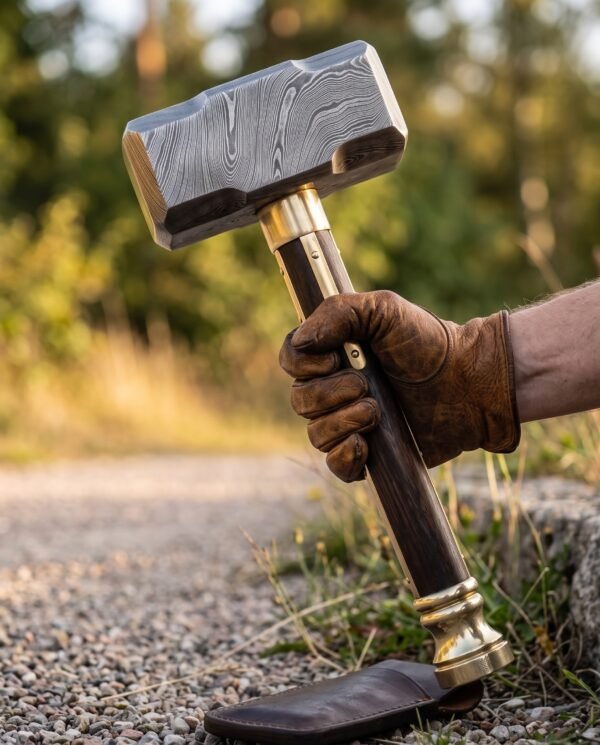
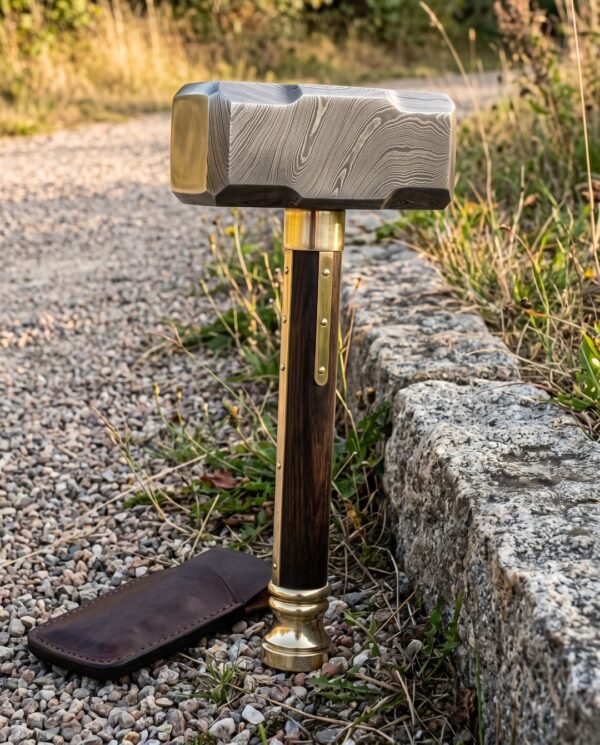
Thunderclad Hand Forged Damascus Viking War Hammer | Flat Faced Damascus Head | Rosewood Haft with Brass Bolsters and Turned Brass Pommel | Norse Gift | RK-1633
Original price was: $389.00.$311.20Current price is: $311.20.Why a blunt head exists at all
An axe is a better tool than a hammer for almost everything, right up until the target is wearing armour. Then the argument reverses, and it reverses for a reason worth understanding properly rather than repeating.
A cutting edge works by putting the whole force of a swing through a very thin line of steel. That is efficient against anything soft. Against mail it fails in a specific way. The rings spread the load sideways across the fabric of the shirt, the edge cannot get between them, and what arrives on the other side is a broad shove rather than a cut. The person inside is bruised, not opened. Against plate it is worse, because the surface is curved and hard and an edge tends to skid off it entirely.
A blunt head does not care. It was never trying to part anything. It arrives as a lump of moving mass, the armour transmits the force rather than absorbing it, and the damage happens underneath. A flat face spreads that across a few square inches. A beak, sometimes called a crow beak or a bec de corbin, concentrates the same energy into a point a fraction of that size, which is what lets it punch through a plate that a broad face would only dish.
The other thing the hammer form gets right is control. Because the head is compact and the mass sits close to the line of the haft, it does not want to twist in the hand the way a broad axe head does. You can stop a swing, redirect it, and land the same face twice in a row. That matters more than raw power on anything moving.
The historical note is that this shape is later than most people assume. Through the Viking age the axe did the work, because the armour it met was mail over padding and an axe still had something to bite. The specialised hammer with a beak belongs to the period when plate became common, which is exactly when an edge stopped being the answer.
The pieces in this collection
Three hammers, two in Damascus and one in plain high carbon. They differ in what the far side of the head does, which is the decision that matters most.
The Damascus crow beak
Twenty six inches overall, with a head about 8 inches from the striking face to the tip of the beak, in forge welded 1095 and 15N20 hardened to 58 to 60 HRC and acid etched with polished bevels. The haft is dark hardwood in an oval section with a brass ferrule, riveted brass langets, brass rivets and a leather wrist thong. It weighs about 2 pounds 6 ounces and ships with a leather head cover and a care card. At 379 dollars this is the piece that best shows what the form was actually for, because the beak is long enough to read as a working point rather than a decoration.
The oval haft section matters. A round haft can rotate in the hand and leave you landing the beak when you meant to land the face. An oval tells your palm which way the head is pointing without you having to look.
The twin faced Damascus
Layered 1095 and 15N20 at 58 to 60 HRC, acid etched, with twin flat striking faces, waisted cheeks and polished chamfers. There is no beak on this one. The haft is rosewood with a straight taper, brass strips pinned into both faces, a brass bolster under the head and a turned brass pommel at the base. A shaped leather head cover is included. The listing is explicit that this is intended for display, collection and as a ceremonial gift, and at 389 dollars it is the most finished object here.
Waisting the cheeks is what keeps a twin faced head from being a brick. Cutting material out of the middle of the head takes weight from where it does nothing and leaves it at the two faces where it does everything, so the balance stays forward without the whole thing getting heavy.
The Mjolnir hammer in high carbon
Twenty inches overall, roughly 51 cm, with a hand forged high carbon head hardened to 54 to 58 HRC at both the face and the beak. One side is a square textured striking face, the other a long curved beak, and a Mjolnir is cut into the cheek. The haft is pale oiled ash with riveted steel langets down both sides, and the butt is drilled and fitted with a leather lanyard. The head is brushed steel rather than polished and a shaped leather head cover is included. At 299 dollars it is the shortest and the most obviously Norse of the three.
The texture on the face is functional. A smooth face skids off a curved surface, and a cross hatched one grips it, which is the same reason a machinist's hammer is not polished flat.
Heads, hafts and fittings across the range
Every figure below is taken from the specification panel of a piece on this page. These are forged and fitted by hand, so treat them as what to expect rather than as a guarantee.
| Piece | Head steel and hardness | Overall length | Head form | Haft | Fittings | Weight | Price |
|---|---|---|---|---|---|---|---|
| Damascus crow beak | 1095 and 15N20 at 58 to 60 HRC | About 26 in | Striking face with a long beak, about 8 in face to tip | Dark hardwood, oval section | Brass ferrule, riveted brass langets, brass rivets, leather wrist thong | About 2 lb 6 oz | 379 dollars |
| Twin faced Damascus | 1095 and 15N20 at 58 to 60 HRC | Not listed | Twin flat faces, waisted cheeks, polished chamfers | Rosewood, straight taper, brass strips pinned into both faces | Brass bolster under the head, turned brass pommel | Not listed | 389 dollars |
| Mjolnir high carbon | High carbon at 54 to 58 HRC at the face and beak | About 20 in | Square textured face with a long curved beak, Mjolnir cut into the cheek | Pale ash, oiled | Riveted steel langets both sides, drilled butt with a leather lanyard | Not listed | 299 dollars |
All three include a shaped leather head cover. On a piece with a beak that is not optional. A hardened point at the end of a two foot lever finds shins and door frames on its own, and the cover is what makes the thing safe to keep in a room with other people in it.
Sizing and fit
Length changes the character of these more than the head does. At 26 inches the crow beak is a real two handed swing if you want it to be, and the extra lever multiplies whatever the head weighs. At 20 inches the Mjolnir piece is a one handed object that you can use in a confined space and hang on an ordinary wall without rearranging the room.
Weight is the number people misjudge. Two pounds six ounces sounds trivial next to an axe until you remember that all of it is concentrated at the far end of a 26 inch stick. Held at the butt it feels considerably heavier than the figure suggests, and a few minutes of swinging will tell you why nobody carried one of these all day when they had a choice.
For display, measure before you order. A 26 inch haft plus a mount needs about three feet of clear wall and two fixings, ideally into studs. A leather thong or lanyard at the butt is useful for hanging but is not a mounting system.
Steel and hardness
Two steels run through everything here and there is no third. Plain heads are 1095 high carbon hardened to 54 to 58 HRC. Damascus heads are 1095 and 15N20 forge welded and taken to 58 to 60 HRC.
The two are paired for the Damascus because they weld to each other cleanly and react differently to acid. The 1095 goes dark in the etch, the nickel bearing 15N20 stays bright, and that contrast is the only reason the layers are visible. The nickel also toughens the billet, which is why a pattern welded head runs harder than a plain one without becoming brittle.
Hardness on a striking head is a compromise rather than a target. Too soft and a face mushrooms over time. Too hard and a beak tip can chip instead of denting. The figures here sit where a percussion head belongs, which is a good deal softer than a knife blade of the same steel would be. Our steel and hardness page explains what an HRC number measures, and Damascus versus high carbon covers the tradeoff between the two.
Hafts, langets and brass
Look at the metal strips running down from the head on two of these. Those are langets, and they are the single most important detail on any hafted head. The wood immediately under a head is the weakest part of the assembly and the first thing to fail when a strike lands on the shaft instead of the head. Langets take that hit. They also spread the head fixing over several inches of timber rather than concentrating it at one point, which is what stops a head working loose over years.
Three timbers are used across the three pieces. Ash has long straight fibres that flex and return rather than splintering, and it damps shock well. Rosewood is dense, oily and close grained, which makes it the best looking and the least forgiving of the three. The dark hardwood on the crow beak is cut in an oval section for orientation.
Give any of them a wipe of timber oil once or twice a year and keep them out of dry heat and direct sun. A shrunken haft is how a head starts to move, and a head that moves should be re seated rather than swung. Replacement hafts and blanks are in axe handles and hafts.
Brass darkens over months into a warm brown. A metal polish on a cloth brings it back if you prefer it bright, and leaving it alone is equally valid. The steel langets on the ash hafted piece want the same light oil the head gets.
Care and storage
Wipe the head after handling and keep a light film of oil on the steel. Fingerprints are acidic and will etch themselves into a polished surface within weeks if you leave them there, which is most obvious on the two Damascus heads.
Never use abrasive polish, wire wool or a rust eraser on an etched Damascus head. The pattern lives in the top few thousandths of the surface and scrubbing removes it for good. Light orange spotting comes away with oil, a soft cloth and patience. Grey patina is stable and does no harm.
Store with the head cover off if the piece is going to sit for months, because leather holds moisture against steel. Somewhere with steady humidity is worth more than any particular oil. Our care guide for hafted heads covers the routine, and removing rust deals with the case where it has already gone wrong.
Engraving
Any of these can be engraved after they arrive in the United States. The cheek of the head is the natural place and one piece already carries a cut Mjolnir there. Where a piece already carries an engraved design, your chosen engraving replaces it rather than sitting beside it. On the Damascus heads a fresh cut reads bright against the etched pattern, which is worth knowing if you want the line to stand out.
Text engraving is 19 dollars, a symbol is 39 dollars and a family crest is 49 dollars. Elder Futhark is a phonetic alphabet rather than a code, so a name is transliterated by sound and there is no rune for the letter C. Engraving is permanent and an engraved piece cannot be returned, so read the spelling twice before you send it.
Where these come from and how they ship
Ransack Viking is a US company based in Chicago, Illinois. The pieces are handmade in the Czech Republic, then imported, inspected and shipped from Chicago. Engraving is done in the US after arrival.
Because heads are forged and hafts are shaped by hand, two pieces of the same model will differ slightly in etch figure, chamfer and timber colour. Long pieces ship in a long box, so allow somewhere to open it and a spare pair of hands if you are hanging the 26 inch one.
How to choose
If you want the piece that best explains what a war hammer was for, take the Damascus crow beak at 379 dollars. It is the only one here where the beak is long enough to look like the working part it was, the oval haft and brass langets are correct, and it is the heaviest and most satisfying of the three to pick up.
If it is going in a cabinet or being given as a gift, take the twin faced Damascus at 389 dollars. Twin flat faces, waisted cheeks, a rosewood haft and a turned brass pommel make it the most finished object on the page, and the listing is honest that display and ceremony are what it is for.
If you want Norse rather than late medieval, and you want it to fit a normal wall, take the Mjolnir hammer at 299 dollars. Twenty inches, ash and steel rather than rosewood and brass, brushed rather than polished, with the symbol cut into the cheek. It is the least expensive and the easiest of the three to live with.
Browse related categories
- Viking hammers across the full range
- Maces, the other answer to armour
- Thor's hammers and Mjolnir pieces
- Battle axes for anyone who wants an edge instead
- Medieval axes and poleaxe heads
- Bearded axes with the dropped beard on the edge
- Viking axes, the whole Norse axe collection
- Axe handles and replacement hafts
Guides worth reading first
- War hammer and mace: what each one was actually for
- Mace, war hammer or flail: how blunt heads differ
- Mail, plate or lamellar, and why armour changed the answer
- Mjolnir: the meaning behind the hammer
- Care for hafted heads: steel, haft and storage
Frequently asked questions
Why use a hammer instead of an axe?
Armour. An edge works on cloth and leather and fails against mail and plate, because the rings spread the load and a curved plate makes an edge skid. A blunt head transmits force straight through the armour into whatever is underneath, and a beak concentrates that force into a point small enough to punch through.
What is the beak on the back of the head for?
Concentration. The same swing delivered through a point a fraction of the size of the flat face produces many times the pressure at the contact, which is what gets through a plate that a broad face only dishes. It is sometimes called a crow beak.
Are these actually usable or are they display pieces?
The twin faced Damascus is listed for display, collection and ceremonial gifting, and should be treated that way. The other two are properly hafted with langets and are built to be handled. None of them are certified for full contact combat, and reenactment groups have their own rules you should buy to.
What are the metal strips down the sides of the haft?
Langets. The wood directly under a head is the weakest part of the assembly and the first thing to break when a strike lands on the shaft. Langets take that hit and spread the head fixing over several inches of timber rather than one point.
What steel are the heads made from?
Two of them are 1095 and 15N20 forge welded Damascus, acid etched and hardened to 58 to 60 HRC. The third is plain high carbon at 54 to 58 HRC at the face and beak. Neither steel is stainless, so both want a light film of oil.
How heavy are they?
The crow beak is listed at about 2 pounds 6 ounces and the other two do not carry a listed weight. Bear in mind that a compact head at the end of a 26 inch haft feels heavier in the hand than the same weight held close in.
Does a head cover come with them?
Yes. All three include a shaped leather head cover, and on a piece with a beak it is worth keeping on whenever the hammer is being moved or stored short term. Take it off for long storage so the leather is not trapping damp against the steel.
Where are these made?
Ransack Viking is a US company based in Chicago, Illinois. The pieces are handmade in the Czech Republic, then imported, inspected and shipped from Chicago. Engraving is done in the US after arrival.
Featured pieces
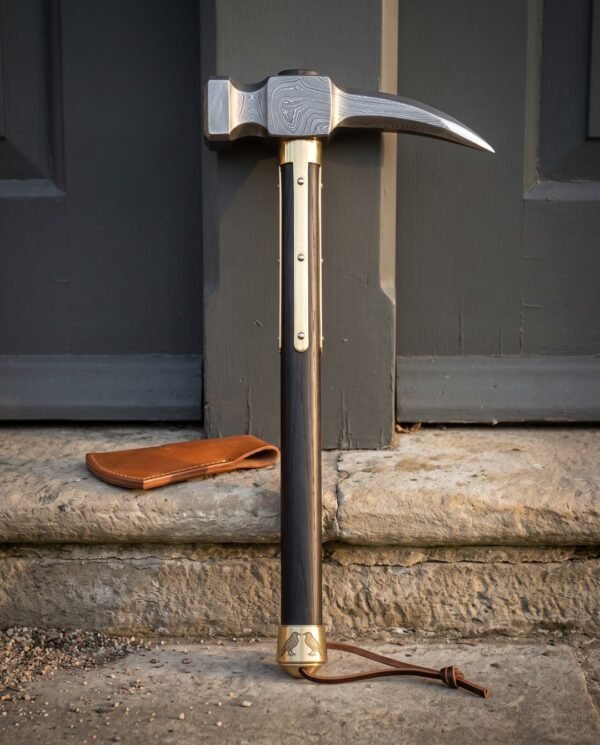 Crowfell Hand Forged Damascus War Hammer with Crow Beak Pick
Original price was: $379.00.$303.20Current price is: $303.20.
 Thunderclad Hand Forged Damascus Viking War Hammer
Original price was: $389.00.$311.20Current price is: $311.20.
 Stormbeak Hand Forged Viking War Hammer
Original price was: $299.00.$239.20Current price is: $239.20.
 Stormpoll Hand Forged Damascus Steel War Axe
Original price was: $595.00.$476.00Current price is: $476.00.