
Blog
Mjölnir: The Meaning of Thor’s Hammer

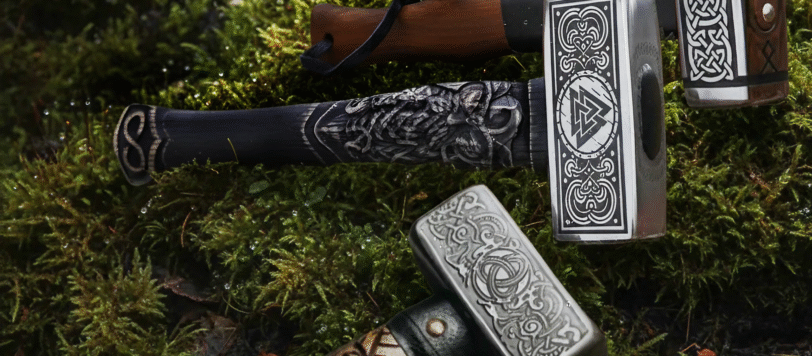
Mjölnir is the hammer of Thor, the Norse god of thunder, and the name most likely means “grinder” or “crusher,” from the same root as Old Norse words for grinding. That is the short answer, and it is a good deal less mystical than the merchandise implies. In the myths the hammer is what defends gods and humans against the forces of chaos, and in Viking Age life it was a symbol worn, carved, and invoked for protection and blessing. Some scholars connect the name instead to words for lightning. Either way, the idea is the same: Mjölnir is the thunderbolt made into a tool, and it became the most widely worn religious symbol of the Norse world.
What Does the Name Mjölnir Mean?
The etymology is genuinely debated, which is worth saying plainly because many websites present one theory as fact. The leading candidates:
“The grinder” or “the crusher”
Linking Mjölnir to Old Norse mala (to grind) and related words, the hammer as the thing that pulverizes whatever it strikes. This is the most commonly favored reading.
“Lightning”
Connecting the name to Slavic and Baltic words for lightning (such as Russian molniya), which fits Thor’s role as thunder god: the hammer blow is the lightning strike itself.
“Shining” or “white”
A minority view ties it to words for whiteness or gleaming, evoking the flash of the storm. It has the fewest supporters of the three, which is worth knowing before you meet it quoted as settled fact.
These readings are not really rivals, a thunder god’s hammer can grind, flash, and strike at once. What matters is that the name encodes overwhelming, elemental force.
The Myth: How Mjölnir Was Made
Our fullest account comes from the Prose Edda, written down in 13th-century Iceland by Snorri Sturluson, two centuries after the Viking Age ended, a caveat that applies to most Norse mythology. In the story, Loki wagers his own head with the dwarf brothers Brokkr and Sindri (Eitri) that they cannot forge treasures finer than those of rival craftsmen, which tells you most of what you need to know about Loki’s judgement. As Sindri works, Loki becomes a biting fly to sabotage him. The result of the interrupted forging is Mjölnir: a hammer of immense power with one flaw, a handle shorter than intended.
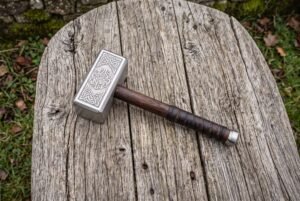 Mjolnir Hand Forged Stainless Steel Viking Hammer | 17.71 Inch Overall and 11.24 lb Weight | Thor Norse Mythology Collector and Display Gift | RK-625
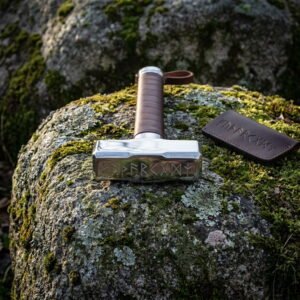 Thunderhide Hand Forged 1095 Steel Mjolnir War Hammer | 10 Inch Overall | Rune Cut Head with Brown Leather Haft and Wrist Loop | Norse Thor Gift | RK-1838
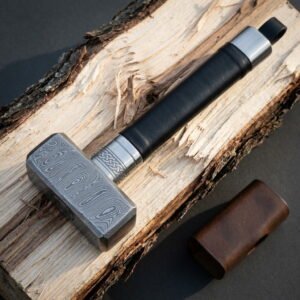 Ladderpeen Hand Forged Damascus Mjolnir Hammer | 10 Inch Overall | Ladder Pattern Head with Black Leather Haft and Knotwork Collar | Thor Gift | RK-1843
Even flawed, the gods judge it the greatest of all the treasures, because it means Asgard can be defended. The hammer never misses its target, returns to Thor’s hand when thrown, and can be concealed inside his shirt. Thor also wields it with iron gloves (Járngreipr) and a strength-doubling belt (Megingjörð).
More Than a War Hammer: What Mjölnir Did in the Myths
The surprising thing about Mjölnir in the sources is how often it appears in ceremonies rather than battles. It is a war hammer against the giants, certainly. It is also, and about as often, an instrument of blessing:
| Function | Example in the Sources |
|---|---|
| Defense of gods and humans | Thor’s constant campaigns against the jötnar (giants), the forces of chaos |
| Hallowing marriage | In the poem Þrymskviða, a hammer is laid in the bride’s lap to bless the wedding, the plot hinges on it |
| Resurrection and renewal | Thor blesses the bones of his goats with the hammer to restore them to life each morning |
| Funerary consecration | The hammer hallows Baldr’s funeral pyre |
| Cosmic endurance | After Ragnarök, Thor’s sons Móði and Magni inherit Mjölnir, carrying it into the renewed world |
That range, battle, marriage, birth, death, rebirth, is why scholars describe Mjölnir as a consecrating instrument: it marks whatever it touches as protected and set apart.
Thor and the Hammer in Everyday Belief
Odin gets the poetry and the pop culture, but the evidence suggests Thor was the god ordinary people actually turned to. He is the one who keeps the giants out, brings the rain, and stands between the farm and whatever is beyond the fence. That is a god you pray to about weather and safe passage rather than wisdom and war-glory, and it shows up in the ordinary record: Thor’s name is embedded in personal names across the Norse world, in place names from Scandinavia to England, and in the day of the week that English still calls Thursday.
The hammer moved with him from myth into practice. In Heimskringla, Snorri tells the story of King Hákon the Good, a Christian ruling a heathen kingdom, who made the sign of the cross over his cup at a sacrificial feast and had it explained away to the assembly as the sign of the hammer, which suggests a hammer sign made over drink was familiar enough that the excuse would pass. That is a thirteenth century account of a tenth century scene, so read it as tradition rather than reportage, but it fits everything else: the hammer as the gesture and object you reach for when something needs protecting or blessing.
What Archaeology Shows: Hammer Pendants
This is the point where mythology gives way to things you can hold. Hundreds of small hammer-shaped pendants of silver, iron, and bronze have been excavated across Scandinavia, the British Isles, Iceland, and the Baltic, mostly dating from the 9th to 11th centuries. For a long time scholars could only infer these were Thor’s hammers. Then in 2014 a small cast pendant found at Købelev in Denmark settled it: the runic inscription on it reads, charmingly, “this is a hammer.”
The timing of the pendants is the interesting part. They become most common exactly when Christianity was advancing through Scandinavia, and some jewelry molds have been found that could cast both crosses and hammers, one workshop serving both faiths. Many researchers read the hammer pendant partly as a quiet declaration of loyalty to the old gods during the conversion centuries, worn the same way a cross was worn. Mjölnir, in other words, had become the badge of an entire worldview under pressure.
What the Pendants Actually Look Like
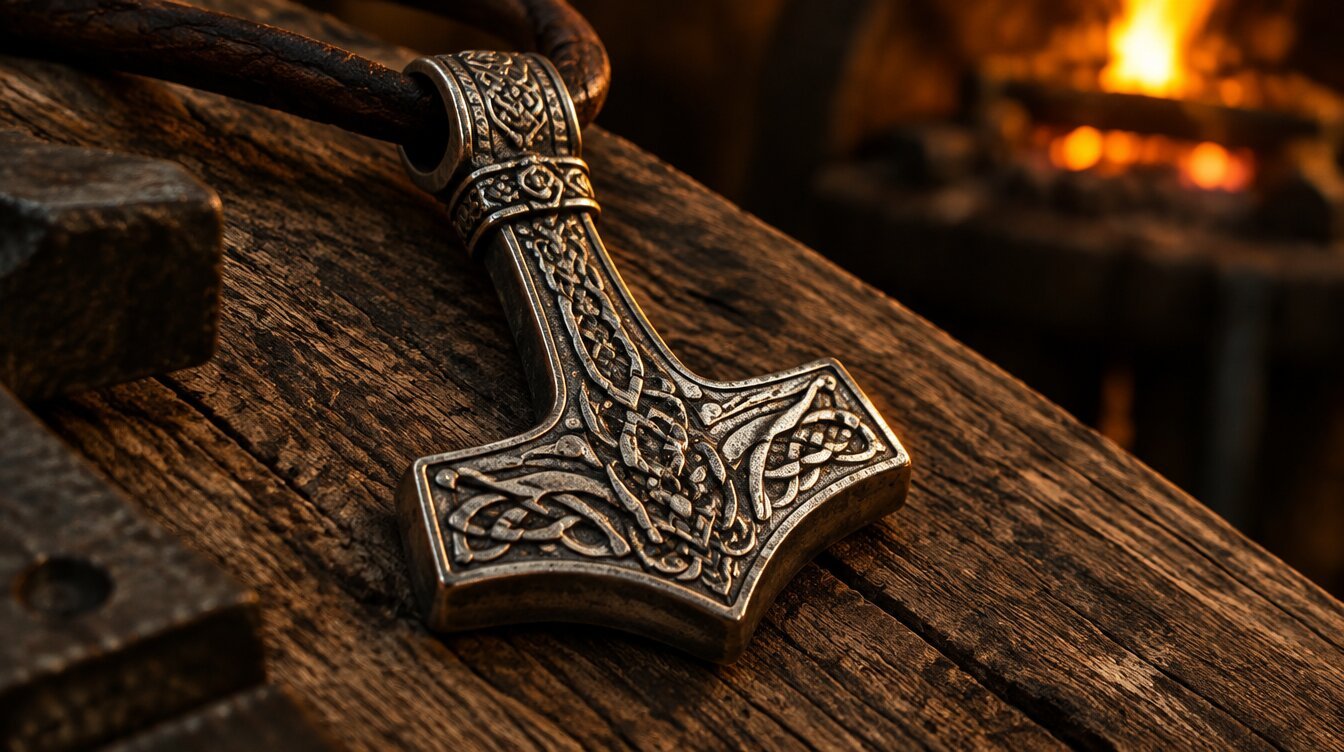
Say hammer pendant and most people picture one shape, but the finds are more varied than that. Most are small, often only two to four centimetres tall, which is worth knowing if you are shopping: the historical originals were discreet, not chest-sized. The basic form is a short shaft with a broad head, usually hung upside down from a loop at the shaft end, so the head sits low against the chest.
Materials run from plain iron up to fine silver. At the simple end are iron and bronze pendants that were clearly cheap to make and widely owned. At the other end are silver examples worked with filigree and granulation, tiny beaded wires and applied grains forming knotwork and animal ornament across the head, the sort of thing that took a skilled jeweller days. Amber, bone and lead examples turn up too. Some pendants carry a stamped or punched pattern of dots and rings rather than applied decoration, and a few are shaped so the head reads as a stylized animal or bird.
How they were worn varies as well. Many hung singly on a cord or chain. In parts of central Sweden a different arrangement appears in graves: an iron neck ring with several small hammers strung on it, sometimes along with other iron pendants, which turns the symbol into something closer to a collar than a necklace. Hammers also show up in silver hoards alongside coins and hacksilver, where they were probably as much bullion as belief by the time they were buried.
The date range matters too. These pendants are concentrated in the ninth to eleventh centuries, which is not the whole Viking Age but the later part of it. Before that, Thor was worshipped without anyone apparently feeling the need to wear his hammer around their neck. That timing is the strongest hint we have about what the pendants meant.
Mjölnir Today
The hammer remains a living symbol. It is worn by modern Heathens and Asatru practitioners as a religious emblem, by people of Scandinavian descent as a heritage marker, and by fans of Norse history and pop culture everywhere in between. In 2013 the United States Department of Veterans Affairs added the Hammer of Thor to its list of emblems available for veterans’ headstones. It must also be said honestly: a handful of extremist groups have misused Norse symbols including the hammer, but the symbol’s mainstream meaning, protection, strength, heritage, faith, long predates and outweighs that misuse, and the overwhelming majority of people who wear it do so for exactly those reasons.
The same protective symbolism is why the hammer shape endures on functional pieces. Our hand-forged Viking hammer collection carries the Mjölnir tradition into working steel, and the Thor’s hammers range covers the pieces made specifically in that shape. For something worn rather than swung, the Damascus steel jewelry takes the layered pattern of a forge welded blade down to pendant scale, so the piece around your neck is made the same way the blades are. The Mjolnir pendants carry the hammer shape at that same scale, and the wider Norse pendants collection holds pieces drawn from the rest of the mythology. Alongside those sit Viking axes and knives decorated with the same knotwork and runic motifs the pendant-makers used a thousand years ago, and for display a Viking helmet rounds out the set.
How to Wear a Mjölnir
There is no rule, and anyone who tells you otherwise is inventing tradition. But a few things make the difference between a piece you wear daily and one that lives in a drawer.
Size. Go smaller than you think. Historical pendants were mostly two to four centimetres and there is a reason: a heavy pendant swings, catches on collars and eventually breaks its own bail. A hammer that sits flat against the sternum and disappears under a shirt is one you will actually keep on. Save the large pieces for wearing over a jumper or on a leather cord outside the clothes.
Orientation. Hammers hang head down. That is how the loops are set on the originals and it is how the shape reads. It is not a superstition, it is just the geometry of a short shaft with a heavy head.
Cord or chain. A leather thong is the plainest and the most historically ordinary, and it is quiet against the skin. A chain looks sharper and lasts longer, but match the metal to the pendant or the mismatch is all you will see. Whatever you choose, check that the bail hole is smooth; a rough cast edge will saw through a cord over a year of wear.
Metal and skin. Silver darkens and that is fine, since the recesses of knotwork look better with the contrast. Steel and Damascus pendants need the same care as a blade: keep them dry, wipe them after a sweaty day, and give them a wipe of oil now and then. A Damascus piece has an etched surface, so avoid polishing compounds, which will lift the pattern right off.
Meaning. Wear it for what it means to you. For some people it is faith, for others heritage, for plenty of others it is simply a shape they like that comes with a thousand years of history behind it. All three are ordinary reasons and none of them requires justifying to anyone.
Where Thor sits among the rest of the pantheon is set out in our guide to the Norse gods, and the tree that holds their nine worlds together is covered in Yggdrasil. The hammer as a fighting head, rather than a symbol, is compared with the mace in mace, war hammer and flail. The hammer as a battlefield head is set out in the war hammer against the mace.
Questions people ask
What does Mjölnir literally mean?
The most widely accepted reading is “grinder” or “crusher,” from a Germanic root meaning to grind. A competing scholarly view connects the name to Slavic and Baltic words for lightning, fitting Thor’s storm-god role. The etymology is genuinely uncertain, and both readings point to the same idea of overwhelming striking power.
Did Vikings actually wear Thor’s hammer pendants?
Yes, this is among the best-documented facts of Norse religion. Hundreds of hammer pendants in silver, bronze, iron, and amber have been excavated across the Viking world, and a pendant found at Købelev, Denmark in 2014 carries a runic inscription reading “this is a hammer,” confirming what the shape represents.
How big were real Thor’s hammer pendants?
Small. Most are roughly two to four centimetres tall, hung head down from a loop at the end of the shaft. The chest-sized hammers sold today are a modern preference and nothing more. If you want something close to what was actually worn, and something you will still have on in a month rather than in a dish by the door, go smaller.
Is the Mjölnir symbol religious?
It can be. In the Viking Age, hammer pendants appear to have marked devotion to Thor, especially as Christianity spread, and today Mjölnir is a recognized religious symbol for modern Heathen and Asatru practitioners, including on US veterans’ headstones since 2013. Many others wear it simply as a heritage or history symbol, and both uses are common.
Why does Mjölnir have a short handle?
In the Prose Edda’s forging story, Loki, in the form of a fly, bites the dwarf smith Brokkr on the eyelid at a critical moment, interrupting the bellows work. The hammer emerges flawless in power but with a shorter handle than intended, which is why Thor wields it one-handed.
Could anyone lift Mjölnir in Norse mythology?
The “only the worthy may lift it” rule comes from Marvel comics and films. It is absent from the Norse sources. In the myths the giant Þrymr steals and hides the hammer with no apparent difficulty, and Thor’s sons inherit it after Ragnarök. The real requirements in the sources are Thor’s iron gloves and enormous strength, not moral worthiness.
How do I care for a steel or Damascus hammer pendant?
Treat it like a small blade, because that is what it is. Keep it dry, wipe it down after a hot day, and give it a light film of oil occasionally. Do not use polishing compound or abrasive cloth on a Damascus piece, because the pattern is an etched surface and polishing takes it off for good. Silver can be cleaned normally, though a little darkening in the recesses of knotwork usually looks better than a mirror finish.
Pieces in the catalogue
Pieces in the catalogue that fit, the Mjolnir Viking hammer and the Thunderclasp Mjolnir pendant. So are the Thunderhide Mjolnir war hammer and the Hammerpoll Viking axe.
Shop the range
Mjolnir Hand Forged Stainless Steel Viking Hammer | 17.71 Inch Overall and 11.24 lb Weight | Thor Norse Mythology Collector and Display Gift | RK-625Thunderhide Hand Forged 1095 Steel Mjolnir War Hammer | 10 Inch Overall | Rune Cut Head with Brown Leather Haft and Wrist Loop | Norse Thor Gift | RK-1838Ladderpeen Hand Forged Damascus Mjolnir Hammer | 10 Inch Overall | Ladder Pattern Head with Black Leather Haft and Knotwork Collar | Thor Gift | RK-1843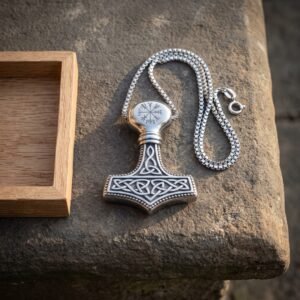 Thunderknot Hand Made Silver Finish Mjolnir Pendant with Celtic Knotwork & Vegvisir Crown | 24 Inch Box Chain | Norse Gift | RK-1754
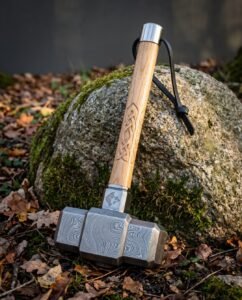 Thundergrain Hand Forged Damascus Mjolnir Style Hammer with Carved Ash Handle & Norse Knotwork Panel | Norse Display Gift | RK-1572
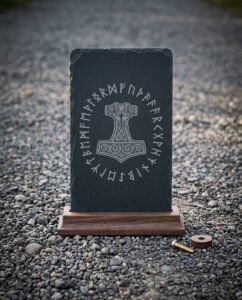 Thundermark Hand Made Engraved Slate Rune Plaque with Mjolnir and Full Elder Futhark Ring | 10 by 7 Inch Riven Slate | Solid Walnut Display Base | Norse Home Gift | RK-1714

One thought on “Mjölnir: The Meaning of Thor’s Hammer”
Comments are closed.