Blog
Valkyries in Norse Mythology: The Choosers of the Slain

What the Word Valkyrie Actually Means
The Old Norse word is valkyrja. It translates to “chooser of the slain,” from valr (the battle dead) and kjosa (to choose). That is the job description in two syllables: a valkyrie decided who died in battle and who did not. She was not a cheerleader for the winning side. She was the mechanism by which some men fell and others walked away, and the Norse understood that difference as a decision, not an accident.
The sources treat valkyries as female figures who serve Odin, the god of war, death, poetry, and wisdom. They carry the chosen dead from the battlefield to Valhalla, Odin’s hall, where those warriors feast and fight until Ragnarok. That much is consistent across the Eddas, the sagas, and the skaldic poetry. Everything else about them, including how many there were, what they looked like, and whether they had any say in who they chose, varies depending on which source you read.
The Darker Version the Eddas Describe
Modern depictions of valkyries lean toward noble, armoured women on winged horses, handing golden mead to grateful heroes. The original sources are not that polished.
The Darradarljod, a poem preserved in Njal’s Saga, describes twelve valkyries weaving on a loom of war. The warp is made from human intestines. The weights are severed heads. The shuttle is an arrow. The beater is a sword. They sing as they work, choosing which warriors will die and which will live, and the tone is not gentle. They are deciding the outcome of the Battle of Clontarf (1014 CE), and they are doing it with craft and violence, literally threading fate from the bodies of the fallen.
That image sits a long way from Wagner’s opera. The valkyries of the original mythology are closer to war spirits than angelic escorts. The Prose Edda describes them as Odin’s handmaidens who “serve in Valhalla, bring drink and look after the tableware and drinking vessels,” but that domestic detail coexists with descriptions of them riding over battlefields deciding who dies. Both roles belong to the same figures, and the Norse did not seem to find the combination contradictory.
Named Valkyries in the Sources
The Prose Edda and the Poetic Edda list valkyrie names, though the lists do not always agree. The Grimnismal names thirteen: Hrist, Mist, Skeggjold, Skogul, Hild, Thrud, Hlokk, Herfjotur, Goll, Geirahod, Randgrid, Radgrid, and Reginleif. Several of these names translate to something violent: Hild means “battle,” Goll means “tumult,” Skogul means “shaker,” and Hrist means “the quaking one.”
Brynhild is the most famous individual valkyrie, and her story runs through the Volsunga Saga and the Nibelungenlied. She defies Odin by choosing the wrong warrior to die in battle. Odin punishes her by pricking her with a sleep thorn and placing her in a ring of fire, from which only the bravest hero can wake her. Sigurd (Siegfried in the German version) rides through the flames, wakes her, and the two fall in love. It ends badly for everyone involved, which is standard for Norse love stories.
Sigrun appears in the Helgakvida Hundingsbana poems. She is a valkyrie who falls in love with the hero Helgi and marries him. When Helgi is killed, she visits his burial mound and spends a night with him among the dead before he rides to Valhalla. The poem treats this as both romantic and horrifying, and does not resolve the tension between those two readings.
Valkyries and the Battlefield
The practical question the mythology raises is: what did a valkyrie actually do on a battlefield? The sources give two answers that operate at different scales.
At the cosmic level, valkyries execute Odin’s will. He needs warriors in Valhalla for the final battle at Ragnarok, and valkyries select the best fighters from every human conflict and bring them to his hall. This is strategic. Odin is building an army, and valkyries are his recruiters. Every hero who falls in battle is a draft pick for the end of the world.
At the personal level, valkyries appear to individual warriors before or during battle. Sometimes they are visible, sometimes not. The Helgakvida poems describe them riding through the air in armour, with light flashing from their spear points. The imagery connects valkyries to the Northern Lights (aurora borealis), and some scholars have suggested that the Norse may have interpreted the aurora as valkyries riding across the sky. The connection is speculative but persistent.
The berserkers fought for Odin on the field. The valkyries decided which of Odin’s fighters came home and which went to Valhalla. Both roles serve the same god, and both involve a kind of violence that the mythology frames as sacred rather than cruel.
Valkyries in Comparison: The Irish Morrigan
The Norse were not the only culture with battlefield spirits who chose the dead. The Irish Morrigan (or Morrigu) performs a similar role: she appears on battlefields, sometimes as a crow, sometimes as a woman, and her presence signals death. The Badb, another Irish war figure, washes the armour of those about to die.
The parallels are close enough that some scholars have argued for a shared Indo European origin. Both traditions feature female supernatural figures associated with battle, death, and fate. Both grant these figures a degree of autonomy that the mortal women in the same cultures often did not have. The valkyrie and the Morrigan operate outside normal social rules, and that positioning may be part of the point: the forces that decide life and death on a battlefield do not follow the rules that govern a farm or a hall.
Valkyries in Viking Age Art
Small silver pendants from the Viking Age, found across Scandinavia, depict women holding drinking horns or carrying shields. These are generally interpreted as valkyrie figures, and they show up in graves of both men and women. The Tjangvide image stone from Gotland shows a rider on an eight legged horse (Sleipnir, Odin’s mount) being greeted by a woman holding a horn, which is the standard welcome to Valhalla scene.
The imagery is consistent: valkyrie as greeter, as cup bearer, as the figure who meets the dead warrior and leads him into the hall. This version emphasises the hospitable side of the role and leaves out the battlefield violence, which suggests that the Norse thought about valkyries differently depending on context. On the field, she kills you. In the hall, she pours your drink. The duality is not a contradiction; it is the whole point.
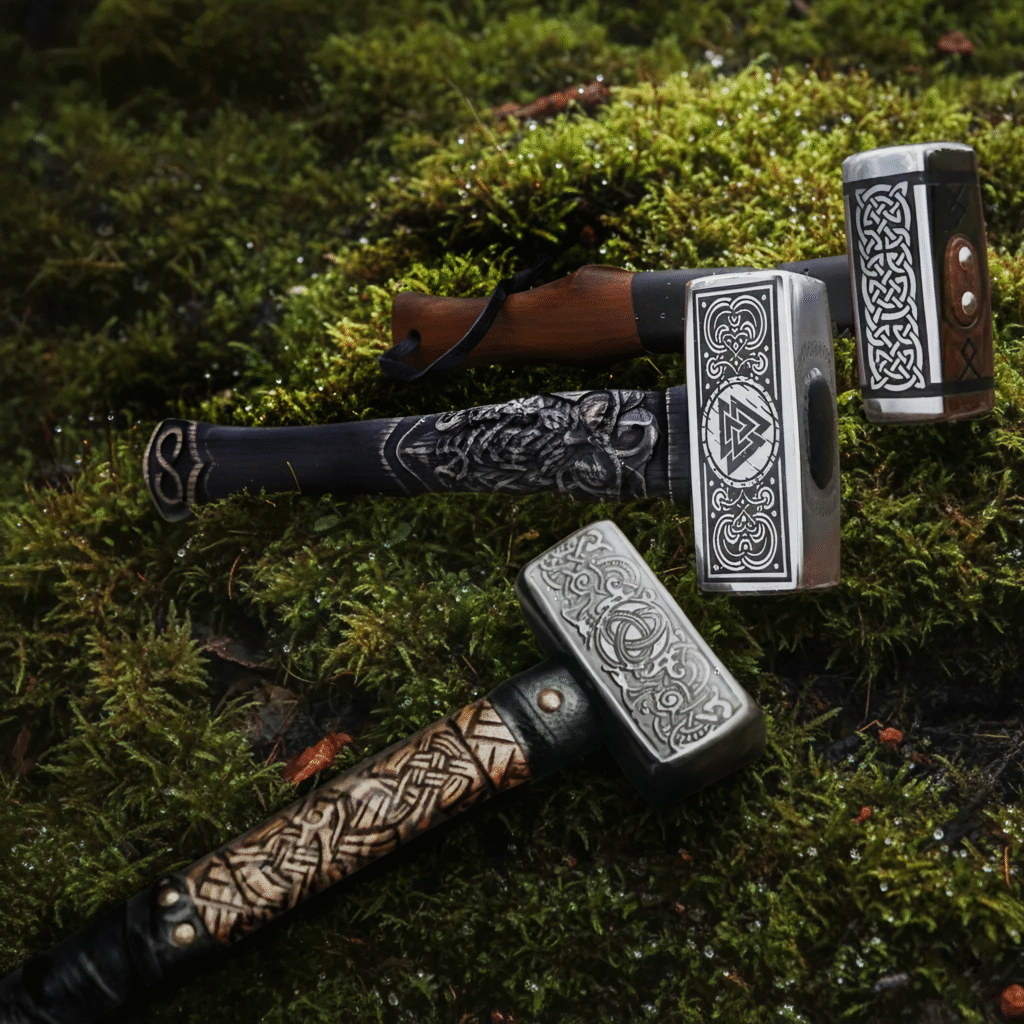
Norse metalwork and carving traditions carried these motifs forward. A Damascus sword with knotwork on the guard or a hand forged axe with a raven head both come from the same artistic tradition that produced the valkyrie pendants: a culture that decorated its tools with the figures it believed shaped its fate.
What Happened to the Valkyries After Conversion
When Scandinavia converted to Christianity between roughly 960 and 1100 CE, the valkyries did not vanish immediately. They survived in literature, particularly in the Icelandic sagas, which were written down by Christian authors working from older oral traditions. The Volsunga Saga, which contains Brynhild’s story, was recorded in the 13th century. The valkyries in these later texts are more human, more romantic, and less terrifying than their Eddic predecessors.
The shift mirrors what happened to the mythology as a whole. Odin became more of a literary character and less of a god. Loki became more devil shaped. And the valkyries became more like fairy tale princesses, which is the version that Wagner picked up in the 19th century and that pop culture has been repeating ever since. The original version, the one with the loom of intestines, is the one worth knowing.
For more on the world the valkyries inhabited, read our guides on Valhalla, the meaning of Mjolnir, the famous Vikings, and Elder Futhark runes.
Frequently Asked Questions
How many valkyries were there?
The number varies by source. The Grimnismal names thirteen. Other poems and sagas mention different names and different counts. There is no single canonical list. The Norse treated valkyries as a category of being rather than a fixed roster.
Were valkyries goddesses?
Not exactly. The sources describe them as supernatural female figures who serve Odin, but they are not worshipped independently. Some named valkyries (like Thrud, who is Thor’s daughter) have divine parentage, but the category as a whole sits between gods and mortals.
Did Vikings pray to valkyries?
There is no evidence of a dedicated valkyrie cult. However, valkyrie pendants found in Viking Age graves suggest they held personal or protective significance. The pendants appear in both male and female burials.
What is the connection between valkyries and the Northern Lights?
Some scholars have proposed that the Norse interpreted the aurora borealis as the reflections of valkyries’ armour or shields as they rode across the sky. The connection appears in later Scandinavian folklore but is not explicit in the Eddas.
Who was the most famous valkyrie?
Brynhild (Brunhilde in German tradition) is the most widely known. She defied Odin, was put to sleep in a ring of fire, and was woken by the hero Sigurd. Her story appears in the Volsunga Saga, the Nibelungenlied, and Wagner’s Ring Cycle.
What the shop carries
On the shelf in the same spirit, the Silverward round shield and the Dawnleaf Viking spear. Next to those, the Grainhilt grip Viking sword and the Ashwarden Viking battle axe.