
Blog
Valhalla, What the Sources Actually Say

Valhalla is not heaven, it is not the reward for being good, and it was never where all dead Norse fighters went. It is a barracks with very good catering, run by a god who is recruiting for a battle he already knows he will lose. Once you read the poems in that light, most of what gets said about it falls apart.
What follows is what the surviving texts describe, where they contradict each other, and which parts look old and which look like a thirteenth century Icelandic author tidying up. That last distinction matters more here than almost anywhere else in Norse mythology.
The Name
Valhall, in Old Norse, from val, the slain on a battlefield, and holl, a hall. Hall of the slain. The English form with the extra syllable comes through later scholarship and German opera. Some scholars have suggested that an older idea underneath it was valholl, the rock of the slain, an entrance to the underworld rather than a building, which would fit a scatter of place names and folk beliefs about hills that open. It is an argument, not a conclusion.
Where the Descriptions Come From
Almost everything specific comes from one poem. Grimnismal, in the Poetic Edda, is a recital delivered by Odin in disguise while being tortured between two fires, and it contains the roof, the doors, the food, the drink and the numbers. Vafthrudnismal adds the daily routine. Snorri Sturluson’s Prose Edda, written around 1220 by a Christian Icelander, gathers all of it into a coherent account, and coherence is exactly the thing to be suspicious of.
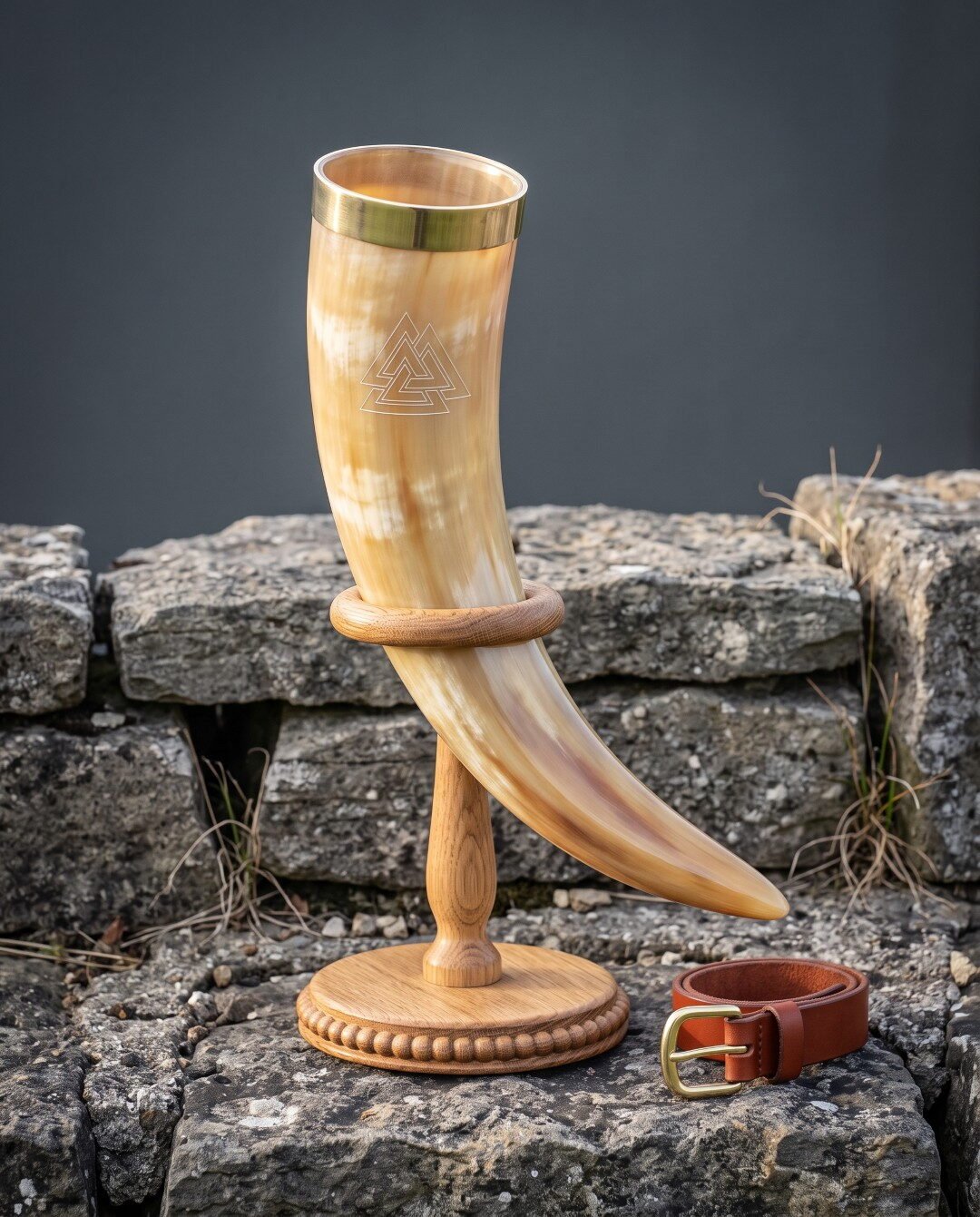
 Amberdraught Hand Made Valknut Drinking Horn and Oak Stand | Pale Natural Ox Horn | Solid Brass Rim Band with Tan Leather Belt | Norse Wedding Gift | RK-1685
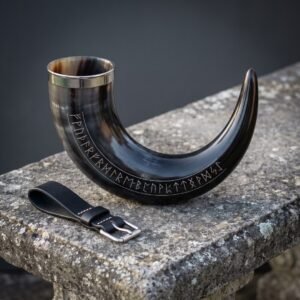 Runemead Hand Made Rune Drinking Horn | Full Elder Futhark Row | Dark Natural Ox Horn and Polished Steel Rim with Black Leather Belt Loop | Norse Mead Gift | RK-1675
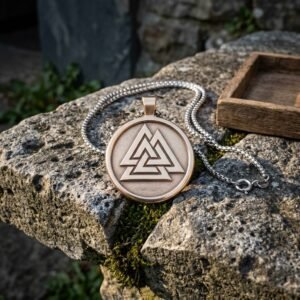 Kinbound Hand Made Bronze Tone Valknut Pendant with Raised Triple Triangle & 22 Inch Box Chain | Norse Memorial Gift | RK-1601
Everything was written down two centuries or more after conversion. That does not make it worthless. It makes it a literary tradition preserving older material, which is a different kind of source from an eyewitness.
What the Hall Looks Like
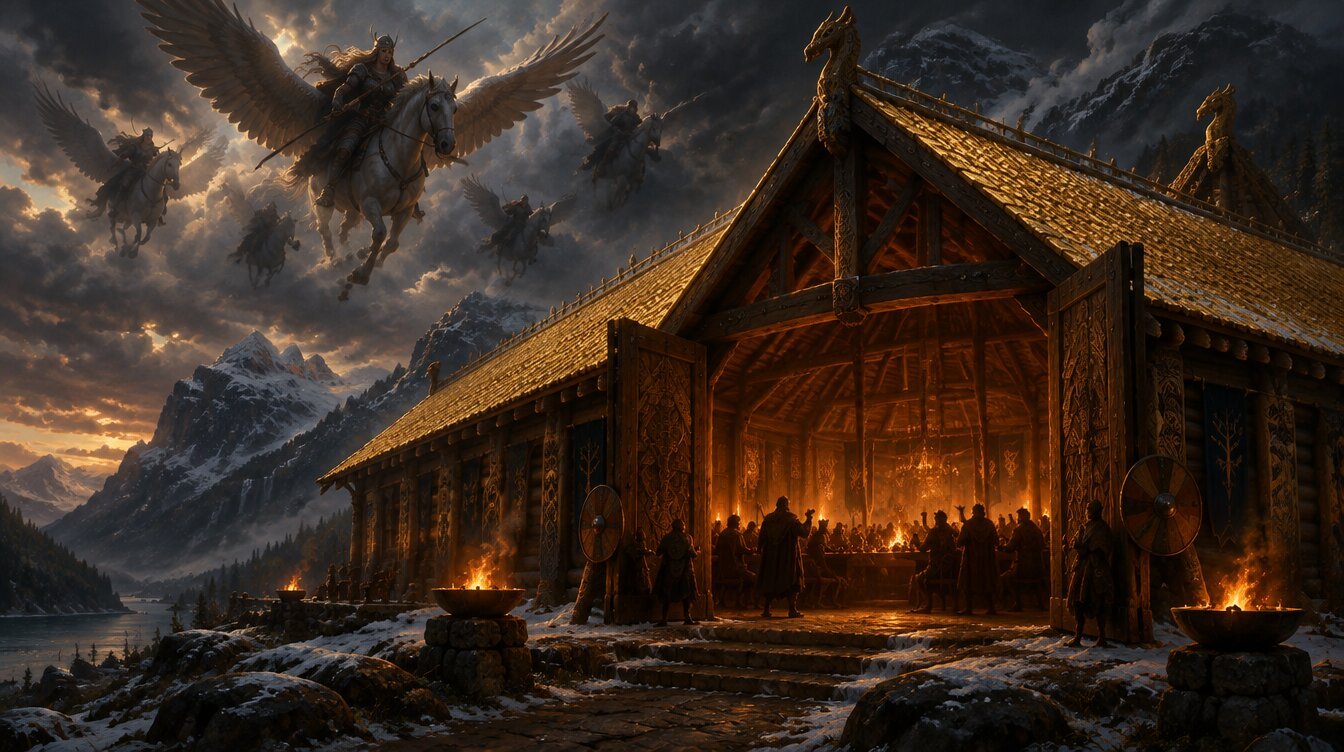
Grimnismal builds it out of war gear. The rafters are spear shafts. The roof is thatched with shields. Mail coats are strewn across the benches. A wolf hangs before the western door and an eagle hovers above it. The gate is called Valgrind, and the poem says few can work out how it is fastened.
Then the famous line: five hundred doors and forty more, and from each of them eight hundred fighters will go out at once when they march against the wolf. Multiply it and the arithmetic is absurd, which is probably the point. It is worth knowing that Old Norse hundrad often meant the long hundred of a hundred and twenty, so the figure may be six hundred and forty rather than five hundred and forty. Translators differ, and nobody should be quoting a precise number as though it were a census.
The Daily Routine
The einherjar, the single fighters or fighters belonging to one host, arm themselves each morning, go out into the yard, and cut each other to pieces. At evening they are whole again and they ride back to drink. Snorri says this plainly, and Vafthrudnismal has it in the older poetry as well.
The catering is unlimited by design. A boar named Saehrimnir is cooked every day by the cook Andhrimnir in a cauldron called Eldhrimnir, and is whole again by evening. A goat named Heidrun stands on the roof of the hall, browsing on the branches of a tree, and fills a vat with clear mead each day, which is what the einherjar drink. Odin, according to the same poem, drinks wine and eats nothing, throwing his food to the two wolves at his feet. A stag named Eikthyrnir stands on the roof beside the goat, and the water dripping from its antlers feeds the rivers of the worlds.
Who Actually Gets In
This is where the popular version is simply wrong. Grimnismal says that Freyja chooses half of the slain each day at her own field, Folkvangr, and that Odin has the other half. Half. The poem states it without argument and Snorri repeats it.
Beyond that, the sea goddess Ran was said to take the drowned in her net, and Egil Skallagrimsson’s lament for his drowned son works from exactly that belief. Snorri says those who die of sickness and old age go to Hel. Various sagas talk about the dead living on inside the burial mound or inside a nearby hill, which has nothing to do with any hall at all.
The accurate summary is that the Norse did not have one afterlife. They had several overlapping ones, recorded at different times by different people, and Valhalla is the one that got the best publicity.
The Valkyries
Valkyrja means chooser of the slain. In the eddic poems they serve ale in the hall and carry the drink to the einherjar, and Grimnismal gives a list of names that reads like a roll call of battle abstractions: Hrist, Mist, Skogul, Hild, Thrud, Hlokk, Herfjotur and more.
There is a much darker version underneath. Njals saga preserves a poem in which a man watching through a window sees twelve figures at a loom warped with human entrails, weighted with heads, working the outcome of a battle in Ireland. That is not a shield maiden with a horn of ale. It is closer to a fate goddess deciding who dies, and it is probably the older idea.
What the Hall Is Actually For
Odin is not collecting the dead out of generosity. He is building an army for the last battle, and the poems are explicit that he knows how it ends. The einherjar march out through the doors, the gods fight, and most of them die. Odin is swallowed by Fenrir. The world burns and then comes back green. The full sequence, and how much of it Snorri shaped, is in Ragnarok explained, and the wolf’s story is in the children of Loki.
A hall of the honoured dead who will lose anyway is a strange promise by the standards of most religions. It is also the most characteristic thing about the Norse material, and about Odin in particular.
What the Graves Say
Burial practice in the Viking Age is not one thing. Cremation and inhumation both occur, sometimes in the same cemetery. Some people are buried in ships or in stone settings shaped like ships, some in plain graves, some in chambers with furniture and animals. Grave goods range from nothing to a wagon.
Ibn Fadlan, an Arab envoy who watched a Rus funeral on the Volga in the early tenth century, describes a slave girl who says she can see her dead master in a green and beautiful place, and who is then killed and burned with him. That is a first hand account of what someone said they believed, which is rarer and more valuable than any amount of Icelandic poetry, and it does not mention a hall.
Put the two bodies of evidence side by side and the sensible position is that Valhalla was one strand of belief among several, probably strongest among the professional fighting classes who followed a lord, and that ordinary people expected something else or nothing in particular.
What Is Probably Late
The tidy architecture of nine worlds with named halls in each is largely Snorri’s arrangement of scattered older material. The idea of a single afterlife judged by how you died fits a Christian frame better than it fits the messy evidence. Some scholars have pointed at Roman ideas of an eternal feast, or at the influence of Christian heaven, as shaping the description. None of that is proven, and none of it means Valhalla was invented in the thirteenth century, since the word and the einherjar appear in older skaldic verse. It means the picture we have is a late one of an old thing.
Using the Word Now
Valhalla has become general shorthand for a glorious end, which is a long way from a recruiting hall for a losing side. If you want a symbol that genuinely connects to Odin and the dead, the Valknut is the strongest candidate, and what can honestly be claimed for it is in the Valknut. Wider symbol claims are sorted in Viking symbols and their meanings, and the people who actually left records of themselves are in famous Vikings.
For the drinking side of the hall, the drinking horns range covers the sealed and stand mounted pieces, with buying advice in buying a drinking horn. Pendants are in Norse pendants, and Viking home decor covers the wall pieces.
Ransack Viking is a US company in Chicago, Illinois. Everything is made by hand in the Czech Republic and imported, inspected and shipped from Chicago, where engraving is cut after arrival. US orders ship free and tracked with no duty, and the lifetime warranty against defects has no expiry. The rest of the writing is in the guides.
Questions people ask
What is Valhalla?
Odin’s hall of the slain, described in the Poetic Edda as roofed with shields and raftered with spear shafts, where chosen dead fighters called the einherjar train each day and feast each night until Ragnarok. It is a mustering hall for the last battle rather than a reward or a paradise.
Do all Vikings who die in battle go to Valhalla?
No. Grimnismal states that Freyja chooses half of the slain each day for her field Folkvangr and Odin takes the other half. Beyond that, the drowned were said to go to Ran, the sick and the old to Hel, and many people simply expected to remain in or near the grave.
What does the name Valhalla mean?
Hall of the slain, from Old Norse val, the battlefield dead, and holl, a hall. An older sense of a rock or hill of the slain has been proposed and would fit folk beliefs about hills that open for the dead, but it remains a suggestion rather than an established reading.
How many doors does Valhalla have?
Grimnismal says five hundred and forty, with eight hundred fighters marching out of each when the einherjar go against the wolf. Old Norse often counted in hundreds of a hundred and twenty, so the true figure may be six hundred and forty. The number is rhetorical either way.
What did the einherjar eat and drink?
A boar called Saehrimnir, cooked daily by Andhrimnir and whole again each evening, and mead from a goat named Heidrun who stands on the hall roof and fills a vat every day. Odin himself is said to eat nothing and drink only wine.
Are the valkyries the same as shield maidens?
No. Valkyries are supernatural choosers of the slain who serve in Odin’s hall, and in the oldest material they look more like fate figures weaving the outcome of battles than like fighters. Shield maiden is a saga term for a human woman who fights, and the two get merged constantly in modern retellings.
Is Valhalla mentioned in real Viking Age evidence, or only in later books?
The word and the einherjar appear in skaldic poetry that is older than the manuscripts, so the idea is genuinely of the period. The detailed description we have, though, was written down in Christian Iceland in the thirteenth century, and the tidiness of that account is the work of its author.
What happens to Valhalla at Ragnarok?
Its army marches out and largely dies. Odin is swallowed by Fenrir and avenged by his son Vidar, the world burns, and a new green earth rises with a small number of survivors. Valhalla exists to supply that battle, and the poems never pretend the battle is winnable.
Pieces in the catalogue
Pieces in the catalogue that fit, the Hornmoot ox horn tankard and the Emberward Viking round shield. So are the Ashfang Viking spear and the Thornhelm Viking sword.
Shop the range
Amberdraught Hand Made Valknut Drinking Horn and Oak Stand | Pale Natural Ox Horn | Solid Brass Rim Band with Tan Leather Belt | Norse Wedding Gift | RK-1685Runemead Hand Made Rune Drinking Horn | Full Elder Futhark Row | Dark Natural Ox Horn and Polished Steel Rim with Black Leather Belt Loop | Norse Mead Gift | RK-1675Kinbound Hand Made Bronze Tone Valknut Pendant with Raised Triple Triangle & 22 Inch Box Chain | Norse Memorial Gift | RK-1601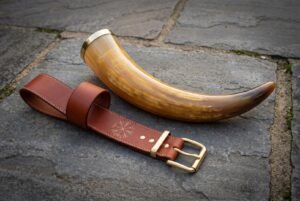 Hornmead Hand Made Viking Drinking Horn with Polished Brass Rim | Roughly 14 to 16 Inches Along the Curve | Vegvisir Stamped Leather Belt Hanger | Norse Mead Gift | RK-1711
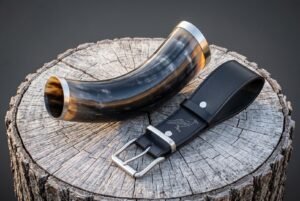 Draughtraven Hand Made Viking Drinking Horn and Leather Belt Hanger | Natural Ox Horn | Polished Steel Rim and Tip Band with Engraved Raven Strap | Norse Feast Gift | RK-1672
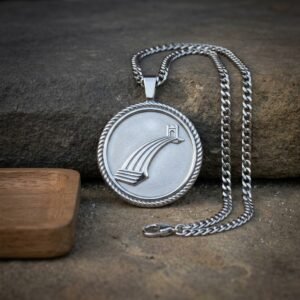 Skybridge Hand Made Silver Tone Bifrost Pendant with a Rope Twist Border & Heavy Curb Chain | Norse Necklace Gift | RK-1664