
Blog
Ragnarok: What the Sources Actually Say About the End

Ragnarok is the end of the world as Old Norse poetry tells it: a winter that will not break, a battle in which most of the gods are killed, the sun swallowed, the earth sinking under the sea, and then a green world rising again with a few survivors on it. Two medieval sources carry the bulk of the account, and they do not agree on everything, which is the first thing most retellings quietly skip.
What follows is what those sources actually say, where they differ, and which parts of the popular picture were added long after the Viking Age ended.
Where the account comes from
Almost everything we know sits in two places, which is rather fewer than the confidence of most retellings suggests. The first is the Poetic Edda, a collection of anonymous mythological and heroic poems preserved in the Icelandic manuscript Codex Regius, written down in the thirteenth century. The poems themselves are older than the manuscript, though how much older is argued about. The central one is Voluspa, the Seeress’s Prophecy, in which a volva speaks to Odin and lays out the world from its making to its burning. Vafthrudnismal and Grimnismal add details in passing.
The second is the Prose Edda, written by the Icelandic chieftain and lawspeaker Snorri Sturluson around 1220. Snorri was a Christian writing a handbook to teach young poets the old imagery so they could still understand skaldic verse. In the section called Gylfaginning he retells the myths in order, quoting the poems as he goes. He is the reason the story reads as a clean sequence. The poems are far more broken and allusive than he makes them sound. He is also a Christian antiquarian tidying up someone else’s religion, which is worth remembering before anyone builds a belief system on it.
There is a third kind of evidence that is easy to overlook. Carved stone from the Viking Age itself shows scenes that look like this story. The Gosforth Cross in Cumbria, a tall red sandstone cross from around the tenth century, carries figures that scholars read as a bound Loki, a woman holding a bowl, and a rider thrusting a spear into a beast’s jaws. A fragment of Thorwald’s Cross on the Isle of Man shows a man with a spear, a bird at his shoulder, and a wolf at his foot. Neither carving comes with a caption, so the readings are interpretations, but they suggest the story was in circulation centuries before anyone wrote it in a book.
What the name means
The Old Norse form in the poems is ragnarok, usually rendered as the fate or doom of the ruling powers. A closely related form, ragnarokkr, means the twilight of those powers, and it is the one Snorri leans on. Richard Wagner took the second reading and gave the last opera of his cycle the German title Gotterdammerung, twilight of the gods, which is how the phrase reached English. Which form is original is still argued. It matters more than it sounds, because doom and twilight carry different weight, and the choice colours every translation you will read.
 Wolfrune Hand Forged Damascus Steel Ulfberht Style Viking Sword | 36 Inch Overall with 30 Inch Blade | Norse Collector Gift | RK-1231
 Emberkeel Hand Forged Damascus Steel Norse Sword | 37 Inch Overall with 31 Inch Blade | Norse Collector Gift | RK-1233
 Barrowlight Hand Forged High Carbon Steel Norse Sword | 35 Inch Overall with 29 Inch Blade | Norse Collector Gift | RK-1235
The signs before the end
Fimbulvetr
The great winter comes first. Vafthrudnismal and Snorri describe three winters running together with no summer between them, snow driving from every direction, hard frost and biting wind. Before that, according to Voluspa, comes the moral collapse: brothers kill each other, kin break faith with kin, no man spares another. The poem calls it an axe age and a sword age, shields cloven, a wind age and a wolf age before the world falls.
The sun and the moon
Grimnismal names two wolves, Skoll and Hati, running after the sun and the moon. Snorri makes them kin of Fenrir and has them finally catch what they chase. Stars fall from the sky. The rooster Fjalar crows in the gallows wood, a soot red rooster crows in the halls of Hel, and Gullinkambi wakes the fighters in Valhalla.
The bonds break
Yggdrasil, the world tree, shakes and groans. The chained things come loose. Fenrir slips his fetter. Jormungandr, the serpent lying in the sea around Midgard, thrashes ashore and the water floods the land. Naglfar, a ship built from the untrimmed nails of the dead, floats free. Voluspa gives the frost giant Hrym the steering; Snorri hands it to Loki. Heimdall lifts the Gjallarhorn and blows it hard, and Odin rides to Mimir’s well for one last piece of counsel.
The battle
The sons of Muspell ride out under Surtr, whose sword shines brighter than the sun. They cross Bifrost and it breaks under them. Everything gathers on a plain called Vigrid, a hundred leagues on every side in Snorri’s telling. Then the pairings.
Odin and Fenrir
Odin, whose place among the Aesir and the Vanir is set out separately, goes against the wolf and the wolf swallows him. This is the fixed point of the whole account, repeated in poem and prose without variation. His son Vidar avenges him at once. Snorri gives the famous detail: Vidar wears a shoe made from all the scraps of leather that people have ever trimmed from their own shoes and cast aside, sets that foot on the wolf’s lower jaw, takes the upper jaw in his hand and tears the mouth apart. Voluspa says more simply that he drives a blade into the wolf’s heart, which is either a different tradition or a poet with less time.
Thor and Jormungandr
Thor kills the serpent. He does not survive it. Voluspa has him walk nine paces from the place where it lies and fall, killed by the venom it breathed on him. The two of them had met before, in the fishing trip where Thor baited a hook with an ox head and hauled the serpent to the gunwale, a scene carved on the Altuna stone in Sweden and on the Gosforth fishing slab.
Freyr, Tyr and Heimdall
Freyr faces Surtr and dies. The poems make the reason explicit, and it is a slow burning piece of storytelling: Freyr gave away his sword in Skirnismal to win the giantess Gerd, and he has nothing left to fight with when it finally matters. Tyr meets the hound Garmr, loosed from the cave Gnipahellir, and they kill each other. Heimdall and Loki, watchman and troublemaker, do the same. Snorri arranges these as a set of duels. The poems are less tidy, and in places you get one line and are expected to manage.
Then Surtr flings fire over the whole earth and the world burns. The sun goes black, land sinks into the sea, steam roars up, flame licks the sky itself.
What comes after
The story does not stop at the fire, and this is the part most retellings shorten. Voluspa has the earth rise a second time out of the water, green, with waterfalls and an eagle hunting fish above the cliffs. The surviving gods meet on the field of Ida and find the golden gaming pieces they had owned in the beginning lying in the grass. Vidar and Vali live. Thor’s sons Modi and Magni carry Mjolnir. Baldr and his brother Hodr come back from Hel and settle in the ruins. Fields grow unsown.
Two humans survive by hiding in a wood called Hoddmimis holt, Lif and Lifthrasir, and they live on the morning dew and repeople the world. The sun had borne a daughter before the wolf took her, and that daughter runs her mother’s road.
One stanza divides scholars sharply. In the Hauksbok version of Voluspa a mighty one comes from above to the judgement place, powerful, ruling over everything. Some read a Christian hand at work, since the poem was written down more than two centuries after Iceland formally converted in the year 1000. Others argue the ending fits Norse ideas of cyclical time without any borrowing. There is no settled answer, and anybody who tells you there is has picked a side.
What people get wrong
Ragnarok was not a dated prediction. Nothing in the sources sets a year or lets you count down to one, whatever the internet announces every few years. It sits outside ordinary time in the way the making of the world does.
It is also not simply an ending. The gods lose, and then the world starts again with their children in it. Reading it as pure destruction throws away half the poem.
And the tidy version of the sequence is Snorri’s editorial work as much as it is old tradition. He had fragments, he was a good writer, and he joined them up. Where he adds detail that no surviving poem supports, such as Vidar’s shoe, honest translations flag it. Treat Voluspa as the older voice and the Prose Edda as an informed commentary on it, and the differences stop being annoying and start being useful.
Carrying the story
Most people who read this myth end up wanting something from it on a wall or a belt. Our Viking swords follow the shapes that turn up in Scandinavian graves and river finds, with plain 1095 carbon steel run at 54 to 58 HRC, or Damascus of 1095 and 15N20 forge welded and finished at 58 to 60 HRC. The Viking axes cover the bearded and Dane patterns, and the Viking helmets are riveted spangenhelms with nasal or spectacle guards rather than anything with horns on it, a picture invented long after the Viking Age. Ransack Viking is a US company in Chicago, Illinois. Every piece is handmade in the Czech Republic the old way, then imported, inspected and shipped from Chicago. Engraving is done in the US after arrival, at 19 dollars for text and 39 for a symbol, so if you want a line of Voluspa or a row of Elder Futhark staves cut into a blade or a haft, that work happens here once the piece has landed and passed inspection. If you are picking a shape rather than a story, the background in our history of the Viking axe and the notes in the steel glossary will tell you more than a product page can.
The three who bring it about are covered in Loki’s children, and the tree that survives it is explained in the world ash.
Questions people ask
Does everyone die at Ragnarok?
No. Odin, Thor, Freyr, Tyr, Heimdall and Loki all die, but Vidar and Vali survive, Thor’s sons Modi and Magni inherit Mjolnir, and Baldr and Hodr return from Hel. Two humans, Lif and Lifthrasir, hide in a wood and live to repopulate the earth. Voluspa ends with a green world, not an empty one.
Which source should I read first?
Voluspa in a good translation of the Poetic Edda. It is the oldest surviving account and the one everything else builds on. Read Snorri Sturluson’s Prose Edda second, written around 1220, and treat it as an informed retelling by a Christian Icelander who was joining fragments into a single narrative and doing it well enough that most readers never notice.
Did Vikings expect Ragnarok on a set date?
There is no evidence for that. No source gives a year, a season or a countdown. The myth describes a fate rather than a scheduled event. Modern claims of a specific Ragnarok date are inventions, usually promotional, and the medieval texts support not one of them.
Is the story influenced by Christianity?
Scholars disagree. The manuscripts were written two to three centuries after Iceland converted in the year 1000, and the closing stanza in the Hauksbok text about a mighty one coming from above reads to some as Christian. Others see a native cycle of destruction and renewal. Both positions are held by serious specialists.
What does Ragnarok actually mean?
The older form means roughly the fate or doom of the ruling powers. A related form means their twilight, and Snorri prefers that sense. Wagner turned the second reading into the German title Gotterdammerung, which is why English speakers usually say twilight of the gods. Which form came first is still argued.
Is there Viking Age art showing Ragnarok?
Probably. The Gosforth Cross in Cumbria and a fragment of Thorwald’s Cross on the Isle of Man carry scenes widely read as Loki bound and Odin fighting the wolf. Carved stone comes without captions, so these are interpretations rather than proof, but they point to the story circulating well before it was written down.
Where to see these
If you want a piece that carries this, the shop has the Grainbeard bearded axe and the Wyrmhewn Viking bearded axe. The Ashenroot Yggdrasil sword and the Stormbeak Viking war hammer are in the same corner.
Shop the range
Wolfrune Hand Forged Damascus Steel Ulfberht Style Viking Sword | 36 Inch Overall with 30 Inch Blade | Norse Collector Gift | RK-1231Emberkeel Hand Forged Damascus Steel Norse Sword | 37 Inch Overall with 31 Inch Blade | Norse Collector Gift | RK-1233Barrowlight Hand Forged High Carbon Steel Norse Sword | 35 Inch Overall with 29 Inch Blade | Norse Collector Gift | RK-1235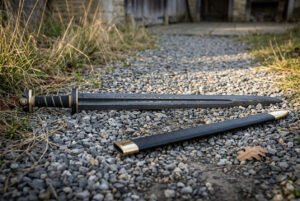 Nightfell Hand Forged Damascus Steel Viking Warrior Sword | 36 Inch Overall with 30 Inch Blade | Norse Collector Gift | RK-1237
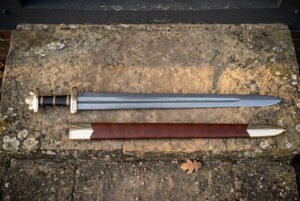 Sunwake Hand Forged High Carbon Steel Viking Sword | 35 Inch Overall with 29 Inch Blade | Norse Collector Gift | RK-1239
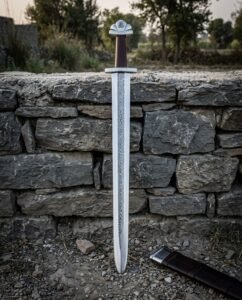 Wyrmfall Hand Forged Damascus Viking Sword | 37 Inch Overall | Valknut Inlaid Lobed Pommel with Serpentine Core and Brown Leather Scabbard | Norse Collector Gift | RK-1654