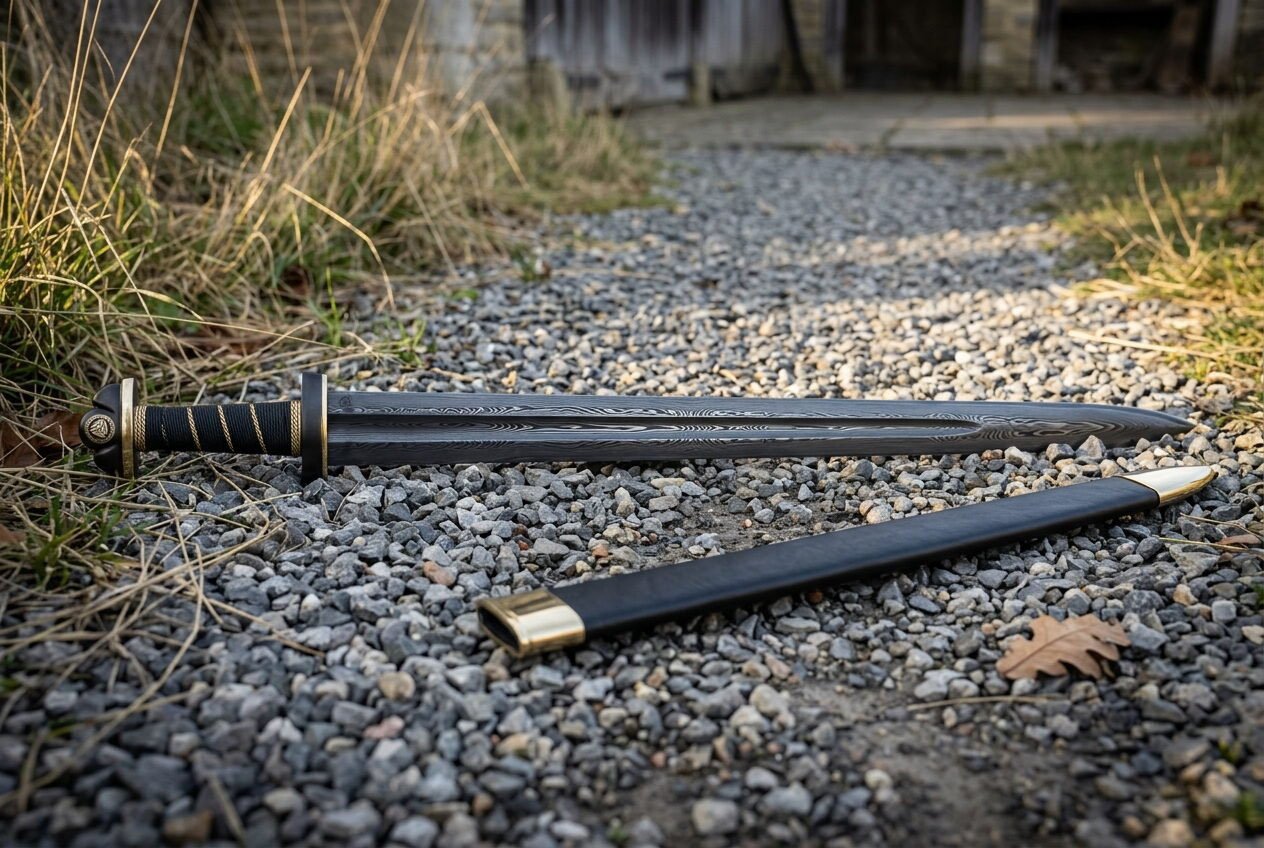
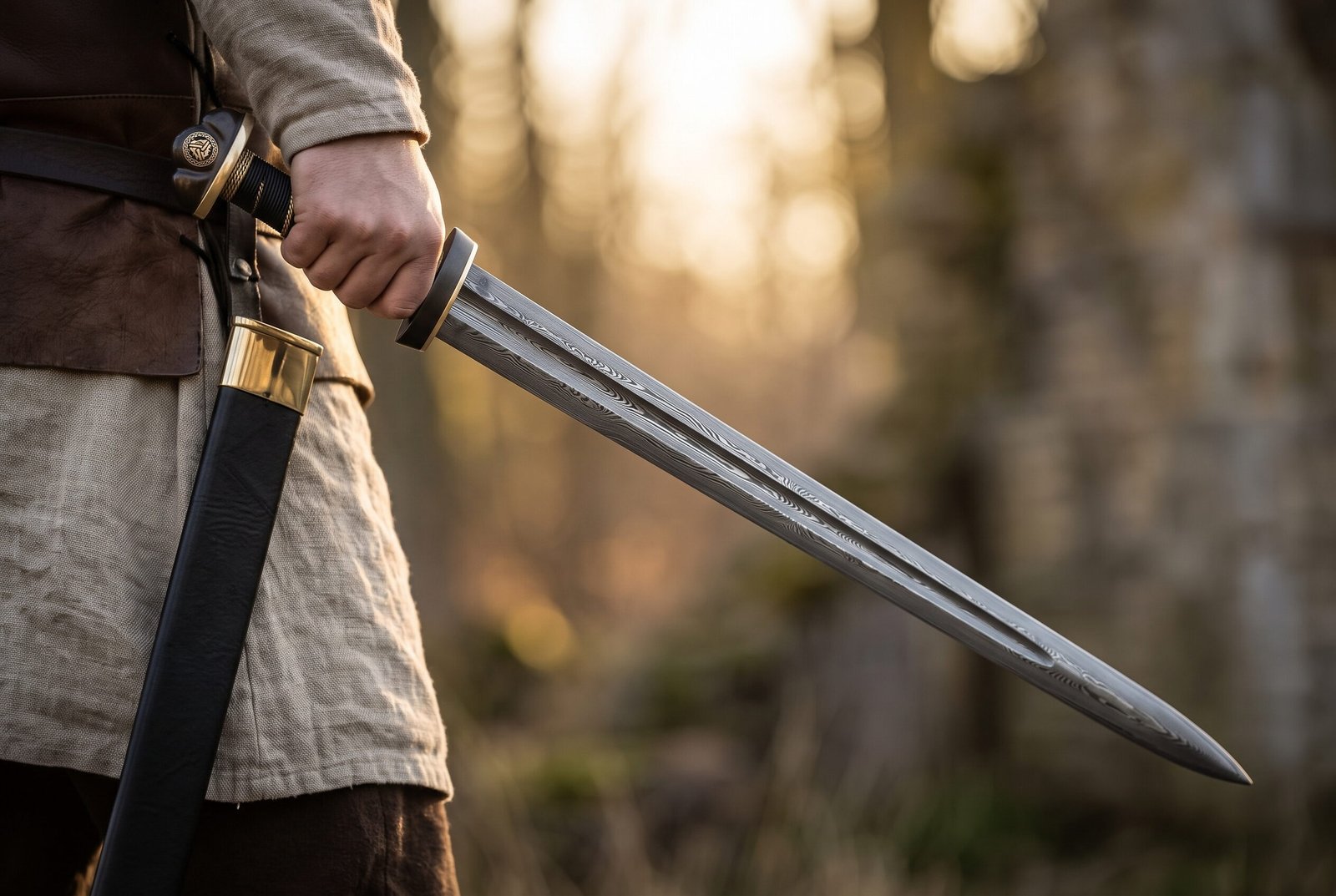
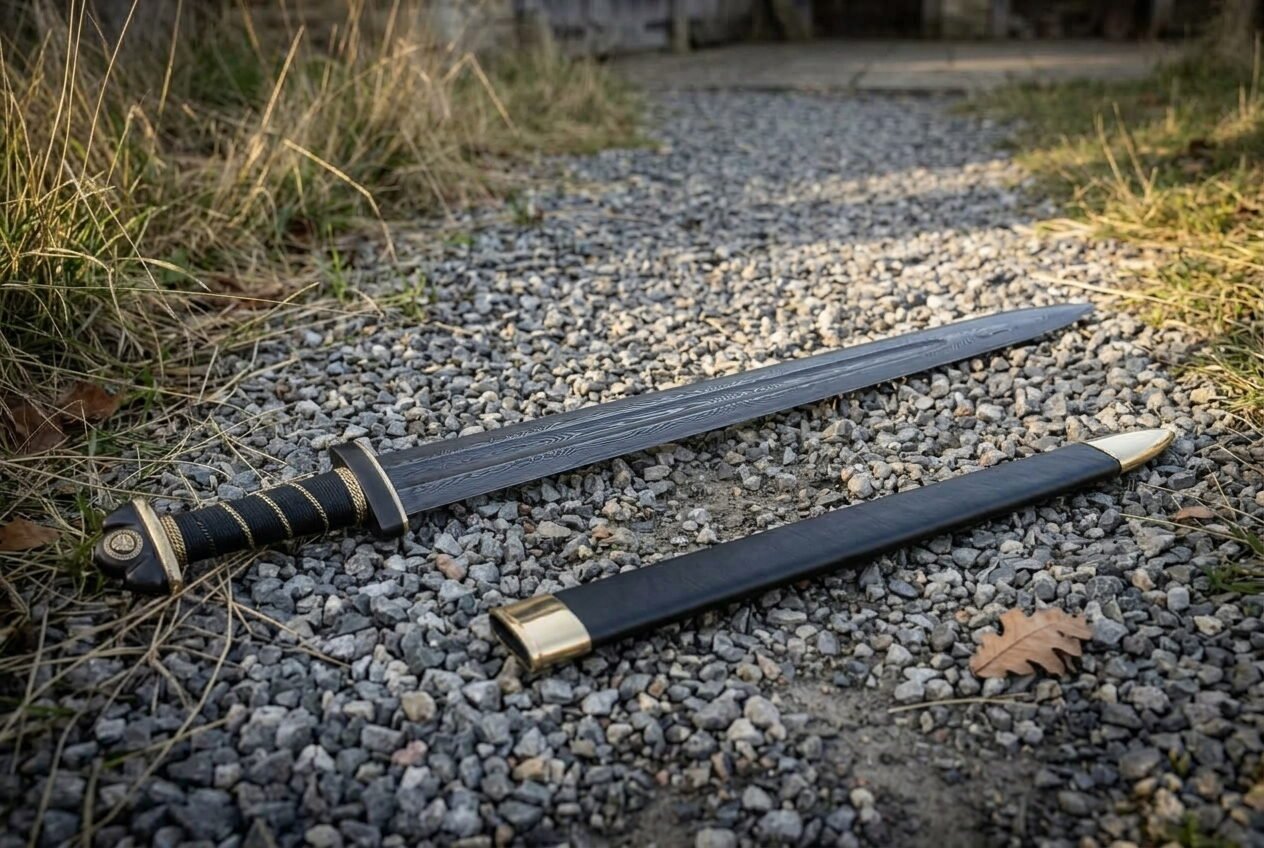
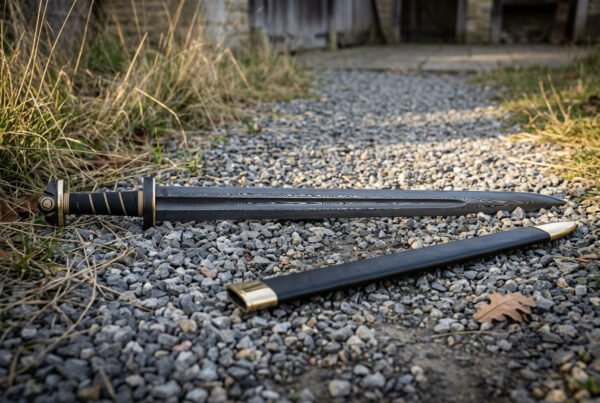
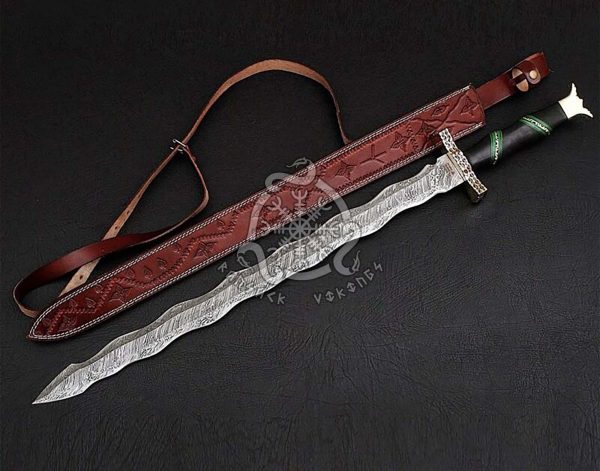
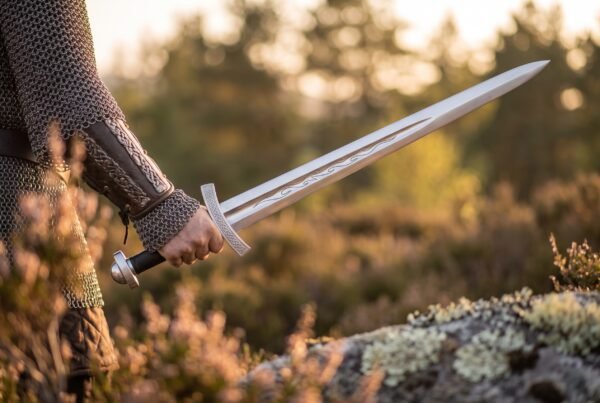
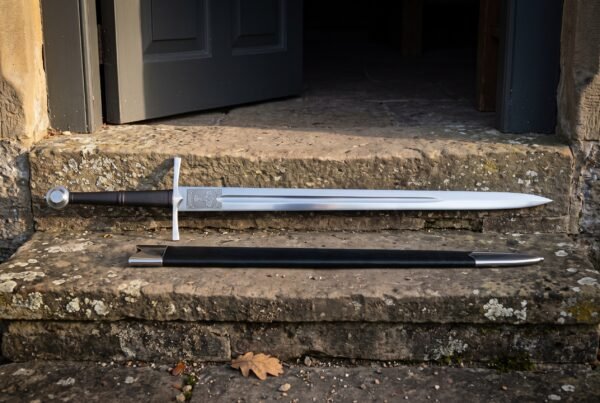
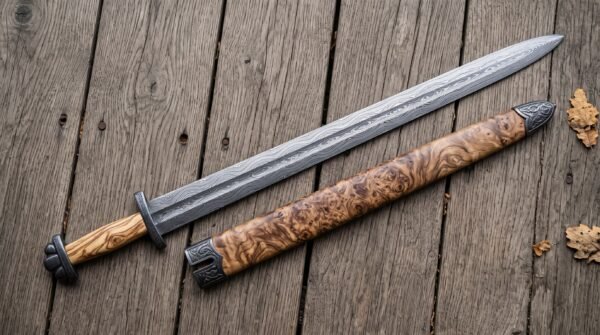
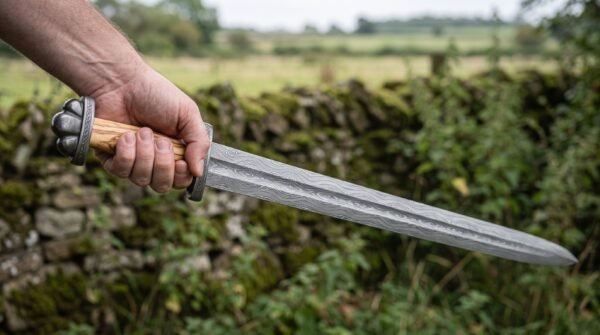
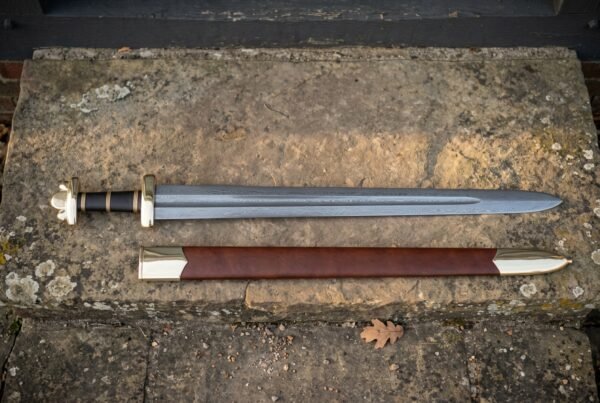
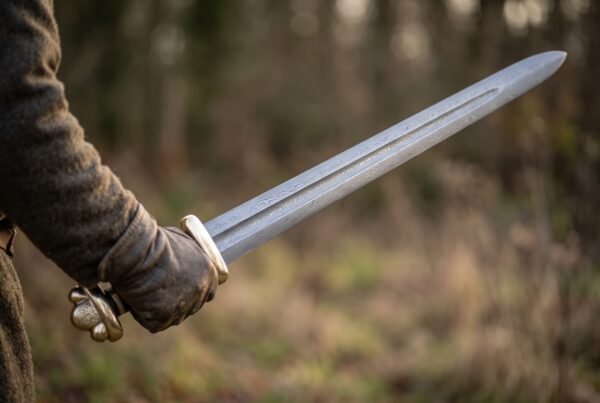
The Nightfell is a Damascus Viking warrior sword, 36 inches overall with a 30 inch fullered blade, hung in a black leather scabbard with brass fittings. The blade is forge welded from 1095 and 15N20 and etched, so the layers show as a flowing light and dark pattern along its full length. For the difference between a display piece and a cutting one, read the display and battle ready split.
This sword is forged and finished by hand in the Czech Republic. The blade is drawn out, ground, hardened, tempered and etched there. The guard is trimmed in brass, the dark pommel carries a brass collar and a brass medallion, the tang is peened over the pommel, and the sword ships in a fitted black leather scabbard over a wooden core with a belt hanger, blade oil and a care card. Shipping inside the United States is free, and the engraving option above the add to cart button is available on every sword in the range.
Specifications
| Item type | Viking sword, double edged, single handed |
|---|
| Steel | Damascus, 1095 and 15N20 forge welded, hand forged, oil quenched, tempered and etched |
|---|
| Hardness | 58 to 60 HRC |
|---|
| Overall length | 36 inches |
|---|
| Blade length | 30 inches |
|---|
| Blade width at guard | 2 inches, tapering to the point, bright polished cutting edge |
|---|
| Fuller | Central fuller, hand ground |
|---|
| Guard | Dark steel guard with brass trim on both faces |
|---|
| Handle | Black leather wrapped grip over a hardwood core, bound with twisted brass wire |
|---|
| Pommel | Dark lobed pommel with a brass collar and a brass medallion on the face, peened tang |
|---|
| Scabbard | Black leather over a wooden core with brass throat and chape, belt hanger |
|---|
| Weight | Approximately 2 lb 12 oz |
|---|
| SKU | RK-1237 |
|---|
What the Damascus pattern is
The blade is forge welded from alternating layers of 1095 and 15N20, drawn out, ground to shape and etched. The 15N20 carries nickel and stays bright in the etch while the 1095 darkens, which is what puts the flowing pattern down the blade. The pattern runs through the steel rather than sitting on the surface, so sharpening and light polishing do not remove it.
Why Damascus and not stainless
Both steels in the billet are carbon steels, and at 58 to 60 HRC the blade holds an edge and comes back from flex rather than taking a set. Stainless gets its rust resistance from a heavy chromium content, and in a section as long as a sword blade that tends toward coarse carbides and brittle failure. Our Damascus versus stainless page compares the two in more detail.
The grip and the fittings
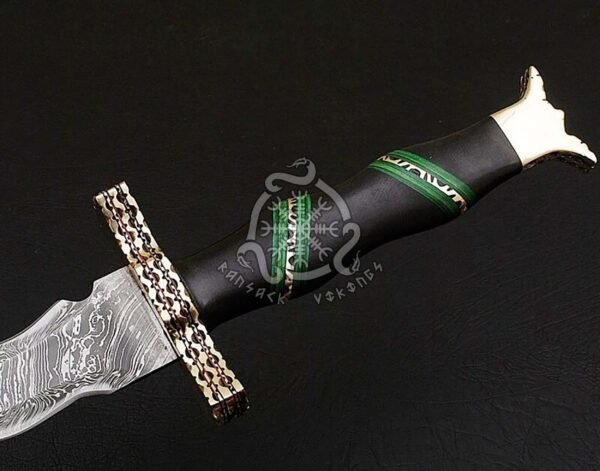
The grip core is shaped hardwood, waisted so the hand indexes the edge without looking, with black leather wet fitted over it so it dries tight to the core, and twisted brass wire wound over the leather in a spiral so the fingers find positive stops. The guard is trimmed in brass and the dark pommel carries a brass collar and a brass medallion, filed and fitted by hand, with the tang peened over the pommel so the assembly is mechanically locked. Nothing structural is held with adhesive.
Because the core under that wrap is wood, treat it as wood: no soaking, no hot cars, no drying with heat. Wipe it, dry it and let it come back to room temperature on its own. Our note on wooden handle care covers this exact material, and a light dressing on the black leather once or twice a year stops it drying out and cracking under the wire.
Engraving, runes and your own design
Use the rune converter on this page to turn a name, a date or a short phrase into Elder Futhark and we will cut it into the steel or the handle. If you would rather have a Viking pattern than a rune line, choose your own design in the engraving option above the add to cart button and tell us whether it goes on the blade or the handle. Where a piece already carries an engraved design, your chosen engraving replaces it rather than sitting alongside it. See the engraving page for placements and line lengths.
Care and sharpening
Damascus is carbon steel and it will rust if neglected. Wipe it after handling and keep a light film of oil on it, paying particular attention to the cutting edge, which is the first place a spot will show. Do not store the sword inside the scabbard for months, since leather holds moisture and tanning salts. Keep it on a rack with the scabbard beside it. Our steel care guide covers storage and how to lift early corrosion.
Sharpening is standard high carbon work over more length. Work the edge in overlapping sections along a coarse stone and then a fine one at a consistent angle, and finish on a strop. Keep the flats off the stone, because dragging an etched face across abrasive will wear the pattern flat in a streak. The angle control method in our guide to sharpening with a whetstone is what we use on the bench and it scales straight up to a sword.
Made in the Czech Republic
Every piece we sell is made by hand in the Czech Republic. The smiths there work the way the trade has been worked for a long time, heating and hammering the steel, taking the bevels down by eye, and fitting the handle and the leather one at a time. There is no automated line anywhere in it, so small differences from one piece to the next are normal and expected.
Ransack Viking is a United States company based in Chicago, Illinois. We bring the pieces in ourselves, inspect them on arrival and ship them from our own warehouse. If you add engraving, that is carried out here in the United States before your order goes out.
A note on handmade variation
This sword is hand forged. It is not machine made and it is not bulk produced, so what arrives will not be a pixel for pixel copy of the photograph on this page. The Damascus pattern in particular varies, because the layers land differently in every billet and the etch reads a little lighter or darker from one blade to the next. Add to that the grain of the wood under the grip, the tone of the leather and the file finish on the guard, and every sword comes out with its own character. The specification does not move: steel, heat treatment, dimensions, construction and finish standard are the same each time.
Frequently asked questions
Is the pattern printed on, and will it wear off?
No. The pattern comes from the layers of 1095 and 15N20 forge welded together, and the etch only brings out the contrast. It runs through the steel, so it will not chip or peel.
Is the sword sharp?
Yes. It arrives with a hand honed working edge. If you want it blunted for display or stage use, put a note on the order and we will finish it with a rounded edge at no extra cost.
Will a Damascus blade rust?
It can. Both steels in the billet are carbon steels, so keep a light film of oil on the blade and never store it wet.
Can I have runes engraved on a Damascus blade?
Yes. Use the rune converter on this page and choose the engraving option above the add to cart button.
How long does shipping take?
Free inside the United States with tracking. In stock swords leave within two business days. Forged to order, allow two to three weeks, plus a few days more for custom engraving.
What is in the box
- One Nightfell Damascus Viking warrior sword, 36 inches overall with a 30 inch blade
- Fitted black leather scabbard over a wooden core with brass throat and chape
- Leather belt hanger with buckle
- Blade oil and a lint free cloth for first storage
- Care card
- Forged and finished in the Czech Republic
Explore the range
Browse the full Viking swords range, the Norse arms we carry to go with them, the wider swords collection and our engraved and personalised pieces. Finishes, steel and care are explained in the guides.
Near neighbours in the shop
Next along the rack is the Duskfuller Viking sword, 36 inches overall. For a straight comparison, see the Grainhilt Viking sword, 35 inches overall. Worth putting side by side with this is the Runetooth Viking sword, 38 inches overall.
If you are putting a set together, the Riverstone wakizashi sits alongside it. You can have this made your way instead on the custom Viking sword page.

Photos don’t do this sword justice at all. The wood handle feels amazing and the balance is perfect. Fit and finish is museum quality. You can tell real craftsmen made this by hand. Came in a nice gift box which made it feel even more special. Can’t recommend this enough.
Perfect gift. Perfect quality. No complaints. Leather sheath is thick and well stitched. Not the cheap stuff you usually get. I keep coming back to Ransack Viking because it’s always this good. Shipping was fast and everything arrived well packaged.
Good quality sword for the price. Ransack Viking usually delivers solid quality and this was no exception.