
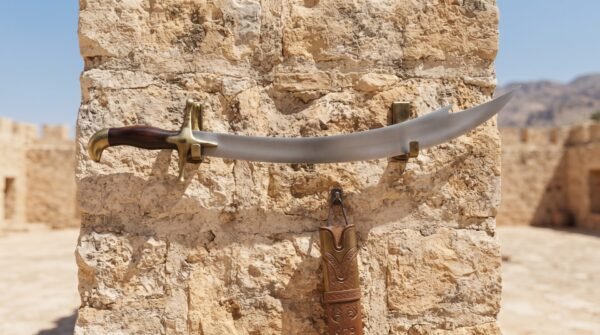
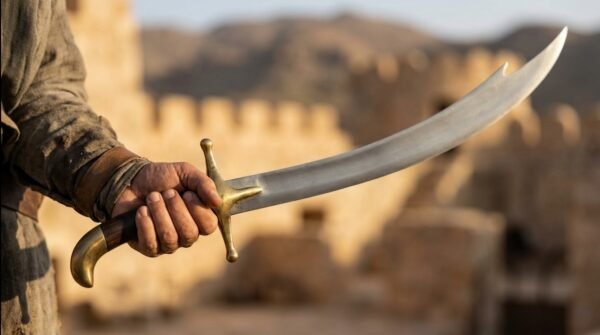
A scimitar is a single edged curved sword built to cut on the draw. The edge is on the outside of the curve, so as the blade travels it also slides, and a slicing cut does more with the same effort than a straight chop does. That is the whole argument for the shape, and it is why almost every cavalry tradition from Persia to India ended up with a curved blade.
Thirteen pieces here, covering three related forms. The broad bellied Arabian scimitar, the Indian talwar with its disc pommel and often a knuckle guard, and the Persian shamshir, which is the narrowest and most deeply curved of the group. Overall lengths run 33 to 39 inches with blades of 27 to 33 inches. Every blade is 1095 high carbon steel hardened to 54 to 58 HRC, finished in mirror polish, brushed satin or hand sanded satin with the forge marks left visible. Grips are rosewood, walnut, blackwood or plain hardwood, and fittings are brass or steel.
If you want one that cuts, buy the widest belly you can find.
Free US shipping
On most pieces. Heavier and oversized ones carry a flat charge.
Hand Forged
Heated, hammered and ground by hand.
Engraving available
Names, dates or Norse runes on most pieces.
Ships from Chicago
Inspected and dispatched from our Chicago warehouse. No import duty, no customs delay on US orders.
Scimitars
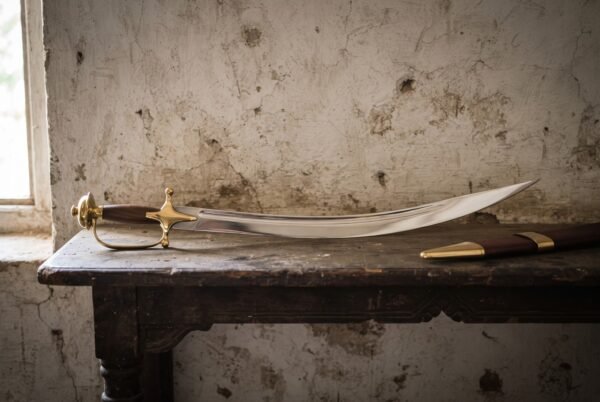
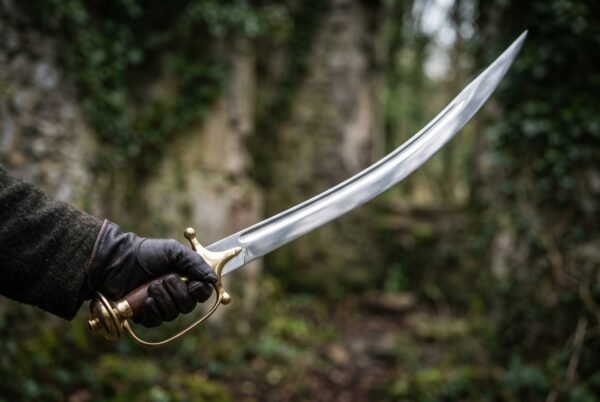
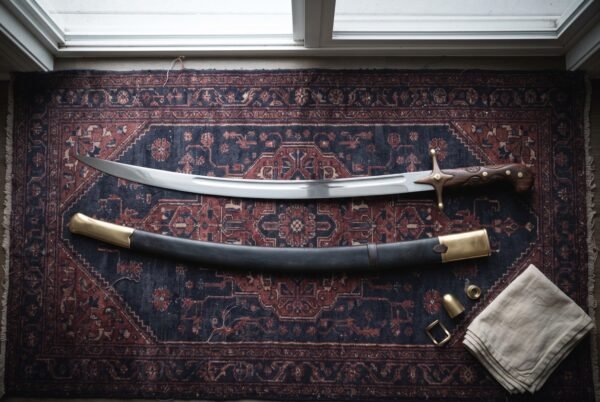
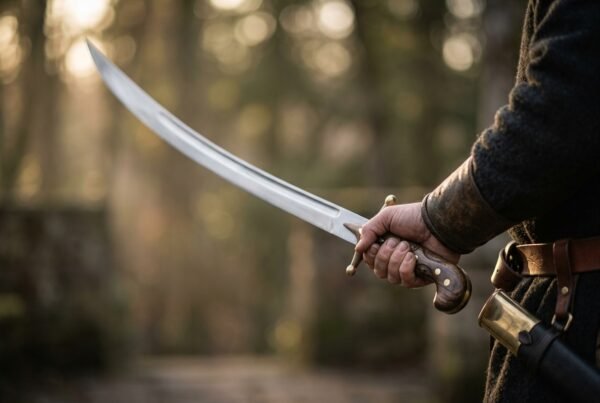
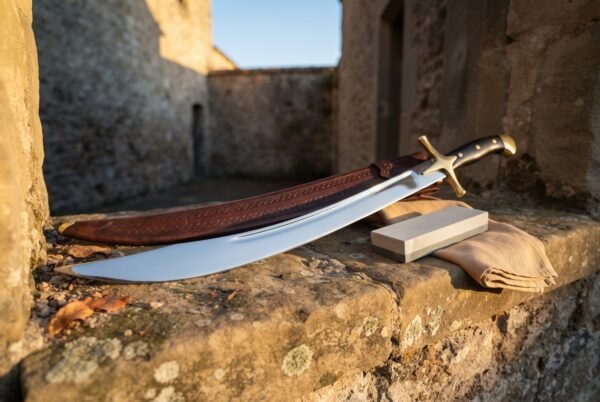
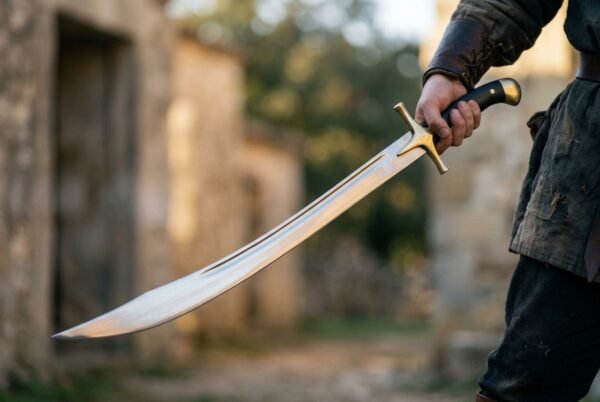
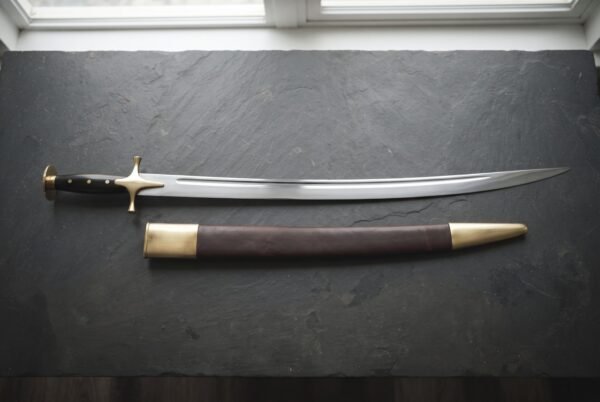
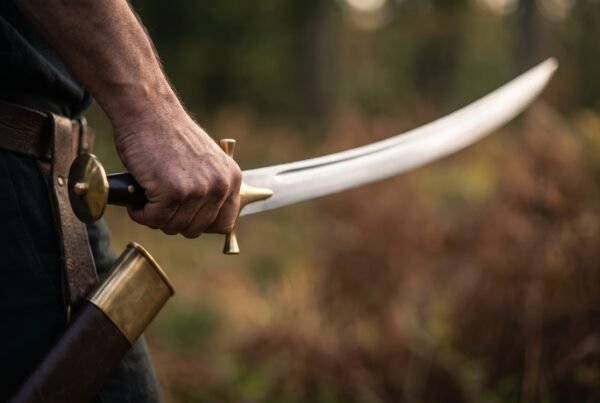
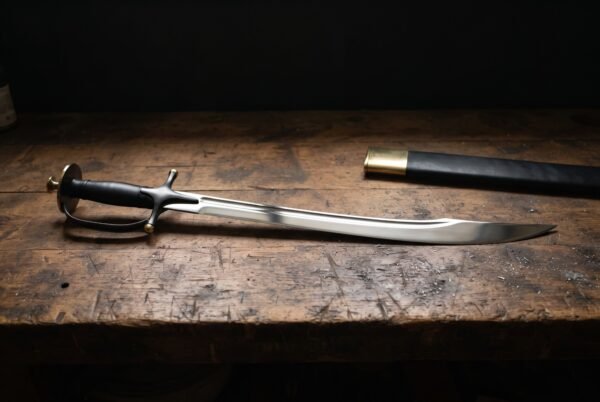
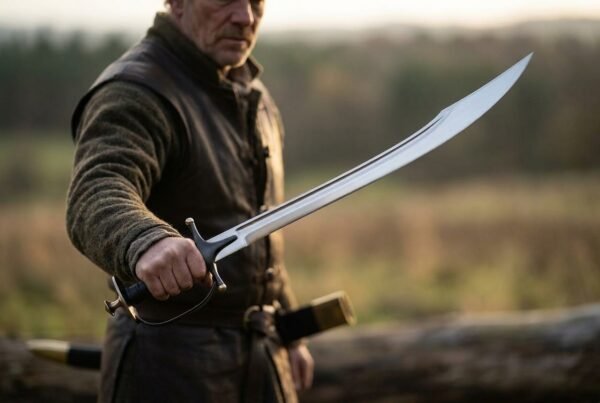
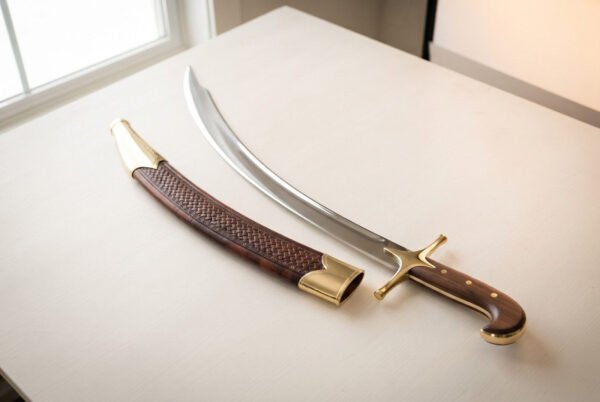
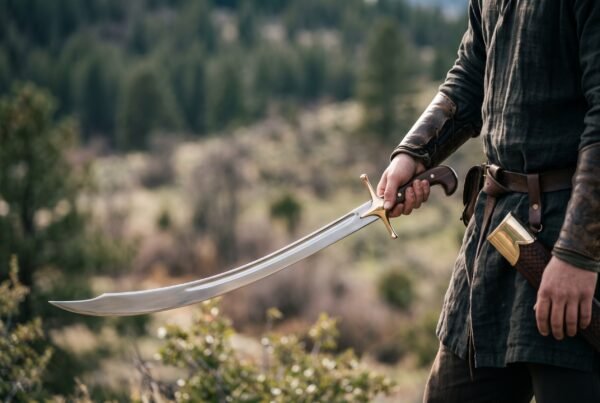
Why the blade curves
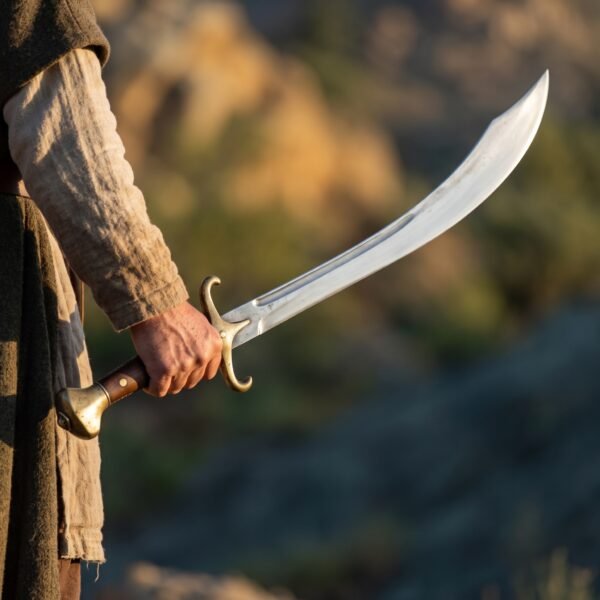
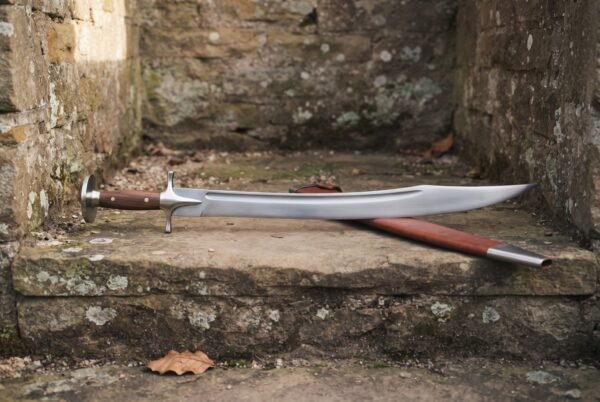
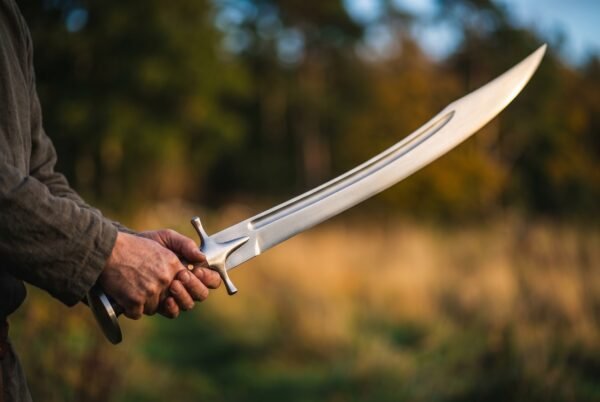
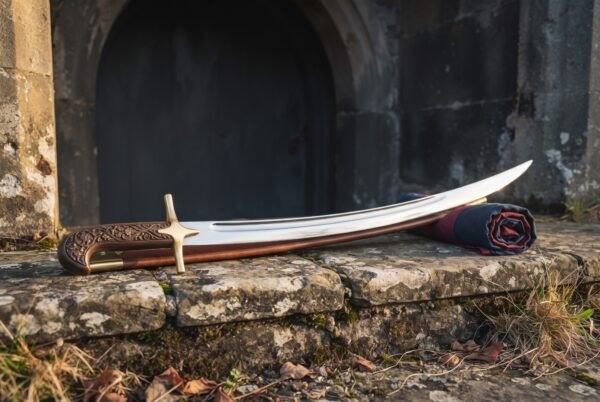
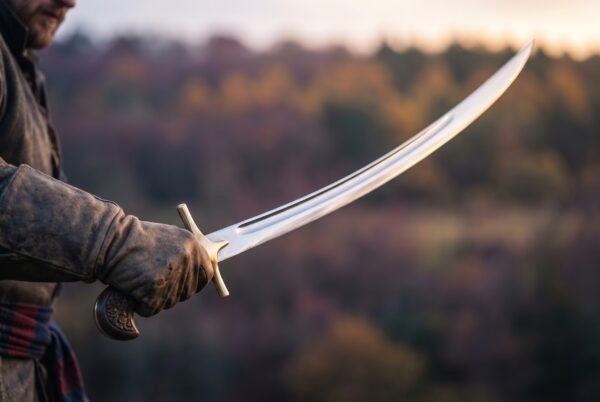
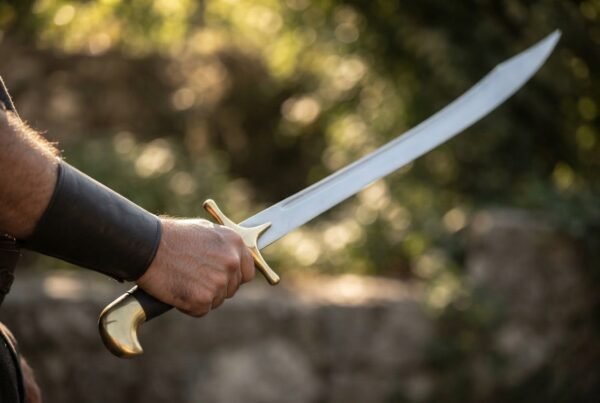
Put an edge on the outside of a curve and something useful happens. As the blade moves through a target, the point of contact slides along the edge instead of staying in one place. You get a slice rather than a chop, and a slice cuts deeper for the same energy because the edge is doing a longer stroke through the material than your arm is doing through the air.
That is worth most on horseback, which is where these swords come from. A rider cannot stop and set his feet. He passes a target at speed, and a curved edge trailing behind his hand carries the cut through without the blade wedging and pulling his shoulder out of the saddle. A straight blade in the same situation buries itself and stops. Every mounted tradition from Persia across to northern India worked this out, which is why the same curve shows up under three different names.
The curve costs something too. A curved blade thrusts badly, because the point is off the line of your arm and any push tends to slide off rather than drive in. Several of these carry a clipped or false edge at the tip to claw some of that back, and the shamshirs simply accept it. They were never intended to be pointed at anyone.
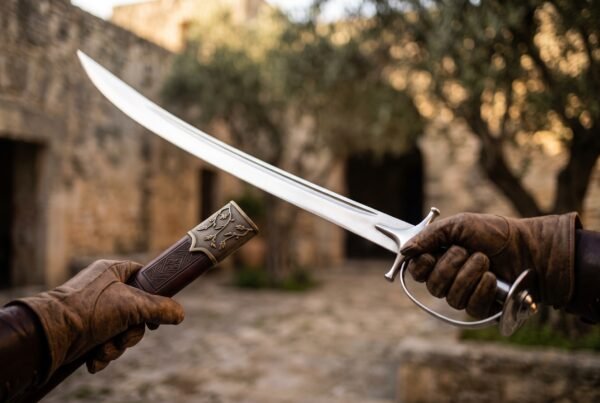
Where the width sits along the blade matters as much as the curve. A blade that flares out toward the last third puts mass where the cut lands, which is what the Arabian and talwar forms do. A narrow crescent of even width, like the shamshir, gives up that mass and gets speed and reach instead. Both are on this page and they feel completely different in the hand.
The scimitars in this collection
Thirteen pieces in three families, all in the same steel at the same hardness. What separates them is profile, hilt and how the weight is distributed.
Arabian scimitars
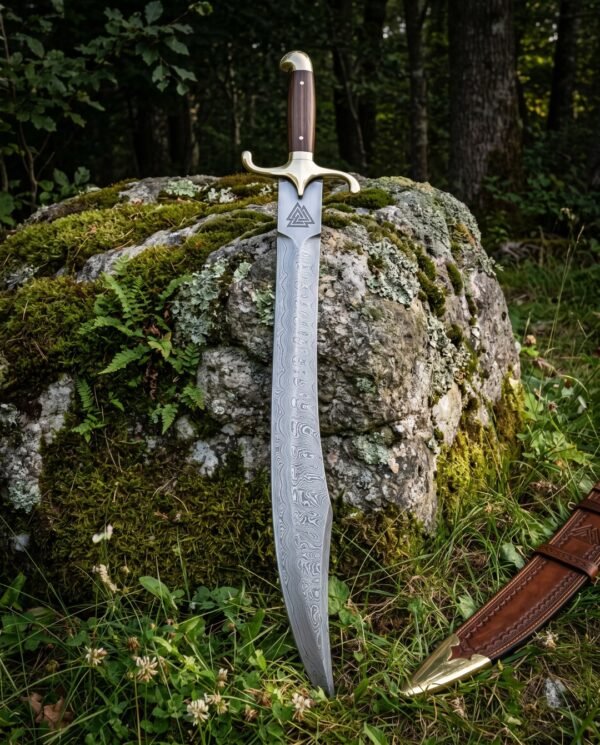
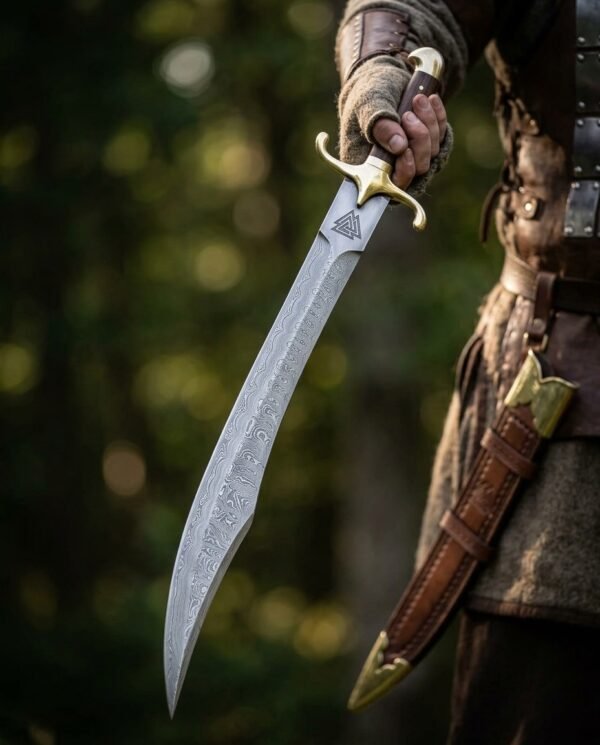
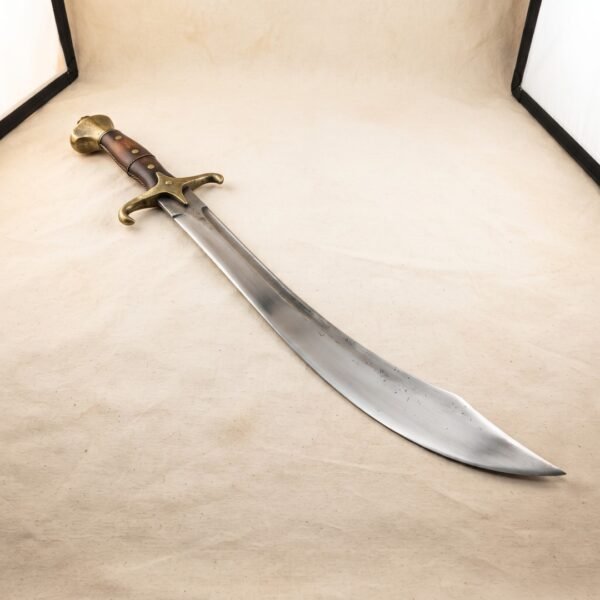
Four swords, 33 to 37 inches overall with 27 to 31 inch blades. These are the broad ones. The bellies flare through the last third and finish in a clipped or upswept point, and the fittings are brass with cross guards and either a hooked or a domed pommel. One is left in hand sanded satin with the forge marks still visible on the flat, which is the only piece here that shows its own making. Two carry long fullers under the spine. Grips are hardwood or rosewood, riveted through with brass.
Talwars
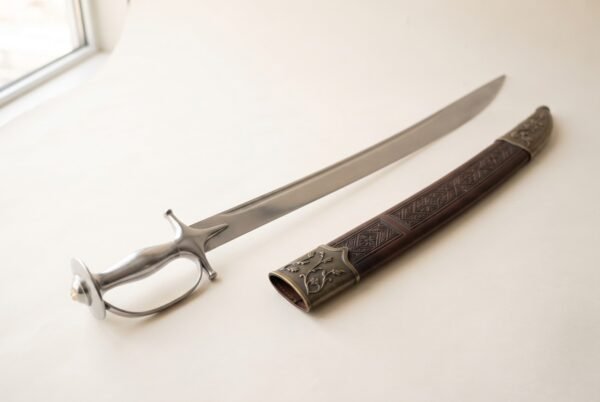
Five swords, 34 to 38 inches overall with 28 to 32 inch blades. The talwar is the Indian answer, and the tell is the pommel. Instead of a cap or a hook, the grip ends in a flat disc that faces back toward your forearm. That disc stops the hand sliding off under a hard draw cut, and it also means the grip is short and you hold it firmly rather than loosely. Three of the five carry a knuckle guard running from the quillon block to the pommel. One is an all steel Indo Persian hilt with a domed disc pommel and a chased brass throat on the scabbard. The rest run rosewood or blackwood grips with brass quillons.
Shamshirs
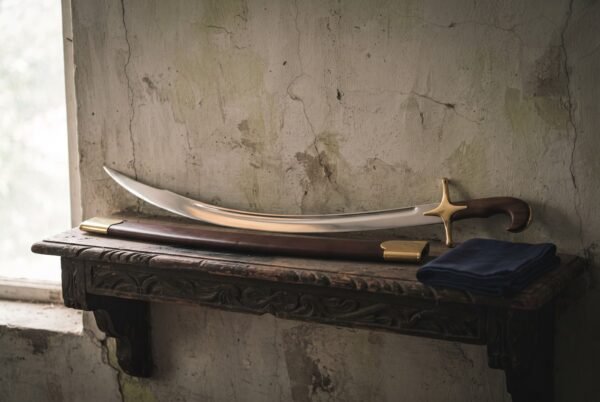
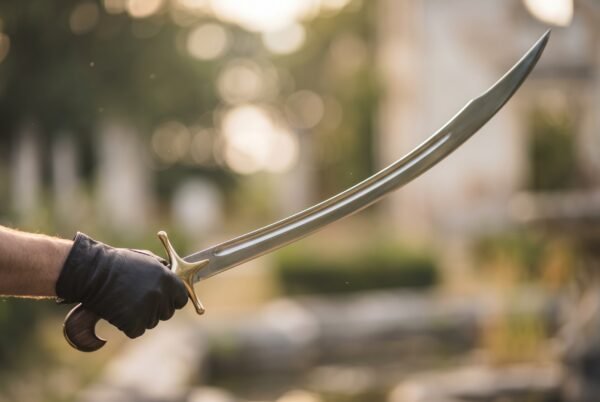
Four swords, 36 to 39 inches overall with 30 to 33 inch blades. The Persian form and the most extreme curve on this page. The blade is narrow, of even width from ricasso to point, and it bends in a single continuous arc so that the tip sits well off the line of the grip. There is no belly and no clipped point. Quillons droop forward, pommels hook back, and the grips are a single piece of rosewood, walnut or carved hardwood. One is cut with a vine scroll by hand. These are the fastest swords here and the least useful for anything except a drawn cut.
Hilts, knuckle guards and scabbards
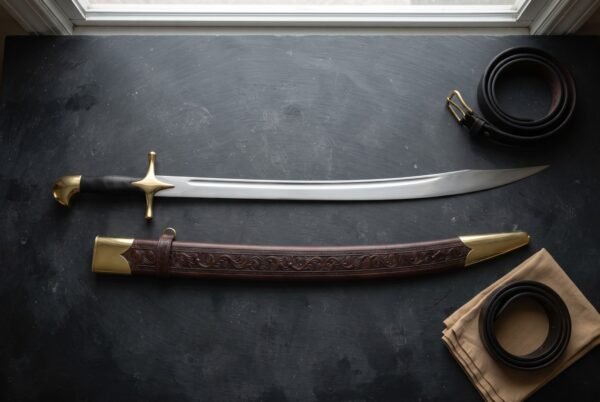
Brass dominates. Cross guards, quillons, pommel caps, scabbard throats and chapes are mostly brass, with three pieces in steel instead. Knuckle guards appear on three talwars and nowhere else. Scabbards run from a plain fitted leather blade sleeve on the cheapest piece up to basketweave tooled leather with brass throat and chape, tooled leather over wood, and one wooden scabbard with brass fittings at both ends.
Lengths, hilts and scabbards across the range
Every figure comes from the specification panel of a piece on this page. These are forged and ground by hand, so read them as what to expect rather than a guarantee to the millimetre.
| Form | Overall length | Blade length | Blade finish | Hilt | Scabbard |
|---|---|---|---|---|---|
| Arabian scimitar | 33 in | 27 in | Hand sanded satin, forge marks visible | Hardwood grip, brass quillons, lobed brass pommel | Fitted leather blade sleeve |
| Arabian scimitar | 35 in | 29 in | Polished, even curve with upswept flared point | Rosewood grip, brass cross guard with drooping quillons, hooked pommel | Tooled leather with brass fittings |
| Arabian scimitar | 36 in | 30 in | Mirror polished, flaring belly with clipped point | Leather wrapped grip, brass cross guard, hooked pommel | Tooled leather with brass throat and chape |
| Arabian scimitar | 37 in | 31 in | Mirror polished, long fuller, broad cutting belly | Dark hardwood grip with brass pins, brass cross guard, domed pommel cap | Hand tooled leather |
| Talwar | 34 in | 28 in | Polished, moderate curve with clipped false edge | All steel Indo Persian hilt, knuckle guard, domed disc pommel | Tooled leather over wood, chased brass throat and locket |
| Talwar | 35 in | 29 in | Mirror polished, deep curve with broad cutting belly | Blackwood grip, knuckle guard, brass ball quillons, disc pommel | Black leather with brass throat |
| Talwar | 36 in | 30 in | Mirror polished, even curve widening to an upswept point | Dark hardwood grip with brass pins, brass cross guard, brass disc pommel | Leather covered with brass throat and chape |
| Talwar | 36 in | 30 in | Brushed satin, flared belly with long forged fuller | Rosewood grip with brass rivets, steel quillons, steel disc pommel | Russet leather covered with steel chape |
| Talwar | 38 in | 32 in | Polished, deep curve with flared belly, long forged fuller | Rosewood grip, solid brass knuckle guard, quillons and disc pommel | Wooden with brass throat and chape |
| Shamshir | 36 in | 30 in | Polished, narrow blade with even Persian curve | One piece rosewood grip, brass cross guard with drooping quillons, hooked pommel | Leather covered with brass throat and chape |
| Shamshir | 37 in | 31 in | Mirror polished, narrow blade with deep even curve | Rosewood scales with brass rivets, brass cross guard, hooked pommel | Basketweave tooled leather with brass throat and chape |
| Shamshir | 38 in | 32 in | Mirror polished, narrow crescent with even deep curve | Walnut grip with brass rivets, drooping brass quillons, hooked ball pommel | Dark leather with brass throat, mid band and chape |
| Shamshir | 39 in | 33 in | Mirror polished, deep curve with fuller under the spine | Hand carved vine scroll hardwood grip, brass quillons, hooked pommel | Leather covered with brass throat and chape |
Every blade in the table is 1095 high carbon steel hardened to 54 to 58 HRC. There is no second steel on this page, so the choice is entirely about shape, fittings and finish.
Sizing and how they handle
Blade length here spans six inches, which does not sound like much until you hold both ends of the range. A 27 inch blade on a 33 inch sword is quick and close, easy to move indoors and easy to hang anywhere. A 33 inch shamshir on a 39 inch overall length has real reach and needs room behind you before you draw it.
Balance matters more than length on a curved sword. The broad bellied pieces carry their mass forward, which makes them feel heavier at rest and hit harder when they move. The narrow shamshirs sit closer to neutral and change direction faster. Neither is better. They were solving different problems for people on different horses.
Grips on the talwars are noticeably short, because the disc pommel is meant to trap the base of your hand rather than let it wander. If you have large hands, expect the talwar grip to feel tight and the shamshir grip to feel more natural. That is how they were made, not a fault.
Steel and hardness
Every blade here is plain 1095 high carbon, hardened and tempered to 54 to 58 HRC. On a long curved blade that is the sensible range. It is hard enough to hold an edge through real cutting and soft enough to bend and come back rather than crack, which matters when the geometry means a cut can land off the true line and load the blade sideways.
1095 is not stainless. It has no chromium and it will rust if you leave it wet or leave your fingerprints on it. That is the price of a steel that sharpens easily and takes a keen edge. If you want the full picture, read steel and hardness, and Damascus versus high carbon steel if you are wondering why nothing on this page is pattern welded.
Fullers, finishes and forge marks
Five of these carry a fuller, a long hollow ground or forged under the spine. It is not there to let blood out. It removes steel from the middle of the blade where it contributes least to stiffness, so the sword gets lighter without getting floppy. On a curved blade the fuller has to follow the arc, which is harder to do cleanly than on a straight one.
Finishes split three ways. Mirror polish shows every line of the curve and every fingerprint you leave on it. Brushed satin hides both and is the easiest to live with. Hand sanded satin with the forge marks left visible is the honest one, and on the piece here that carries it you can see the hammer work in the flat under raking light. None of these is better than the others. They are just different amounts of maintenance.
Sharpening a curved edge
Do not put a curved blade flat on a bench stone and push. You will grind the middle of the curve, miss the ends, and end up with a blade that has three different edge angles along its length.
Work the sword instead of the stone. Hold the blade steady and run a small stone or a rod along the edge in short sections, rolling your wrist to keep the stone square to the edge as the curve changes. Follow the arc. Fifteen strokes on a section, then move along and overlap the last few. It takes longer than a straight blade and there is no shortcut. The guide on sharpening a curved blade covers the wrist movement in more detail.
Care and storage
Wipe the blade after every handling, and pay attention to the inside of the curve where a cloth run straight down the blade will skip. Then a thin film of mineral oil, applied and wiped almost dry. A blade that looks wet is holding dust, and dust holds water.
Do not leave the sword in its scabbard for months. Leather stays slightly acidic after tanning and it holds humidity against the steel, so a snug scabbard through a damp season will hand you back a spotted blade. Hang the sword and stand the scabbard beside it. The wooden scabbard on the 38 inch talwar is a little kinder in that respect, but the rule still applies. The knife care guide covers oiling and rust removal properly.
Engraving
Most pieces here can be engraved after they arrive in the United States. On a curved sword the flat above the ricasso and the pommel are the usable surfaces, since a name laid along a curve rarely reads well. Names, dates and short rune lines all work.
Text engraving is 19 dollars, a symbol is 39 dollars and a family crest is 49 dollars. Elder Futhark is a phonetic alphabet rather than a cipher, so names are transliterated by sound and there is no rune for the letter C. Engraving is permanent and an engraved piece cannot be returned, so read the spelling back to yourself before you order.
Where these come from and how they ship
Ransack Viking is a US company based in Chicago, Illinois. The pieces are handmade in the Czech Republic, then imported, inspected and shipped from Chicago. Engraving is done in the US after arrival.
Because the curve is forged rather than cut from a pattern, no two are exactly alike. The arc varies a little, the fuller wanders slightly, grain in a rosewood or walnut grip is never repeated and tooled leather is worked by hand. These ship in a long box that someone needs to be there to take in.
How to choose
Pick the family first. If you want the sword that looks like the word scimitar, take a broad bellied Arabian piece. If you want the one that cuts hardest, take a talwar with a flared belly and a knuckle guard. If you want the one that looks best on a wall, take a shamshir, because a narrow crescent 33 inches long is a shape nothing else on this site matches.
Then look at the scabbard, because it is half of what you are buying and the difference between a plain leather sleeve and a basketweave tooled scabbard with brass at both ends is most of the price gap. Prices here run from 385 to 615 dollars. Finish comes last, and brushed satin is the easy answer if you do not want to be polishing something every week.
Browse related categories
- Sabres, the European curved cavalry blade
- Cutlasses, short and heavy at the belly
- Falchions, the medieval single edged chopper
- Arming swords for the straight bladed alternative
- Scabbards and replacement sheaths
- Sword stands and display mounts
Guides worth reading first
- What is a scimitar and where the name comes from
- How to sharpen a curved blade
- How to buy your first sword
- Display sword versus battle ready
Frequently asked questions
What is the difference between a scimitar, a talwar and a shamshir?
They are three regional versions of the same idea. The Arabian scimitar is broad through the belly with a flared or clipped point. The Indian talwar has a flat disc pommel facing back at your wrist and often a knuckle guard. The Persian shamshir is a narrow crescent of even width with the deepest curve of the three. All of them are on this page.
Why is scimitar not a real historical name?
Because it is a European catch all. The word arrived in English through Italian and French in the sixteenth century and was applied to any curved eastern sword the writer did not have a proper name for. The people who made and carried these called them shamshir, talwar, kilij or saif depending on where they were standing.
Are these sharp?
Yes. They are hand ground blades in hardened 1095 with working edges, and a curved edge is more likely to catch you than a straight one because it slides as it touches. Treat every piece here as sharp from the moment the box is open.
Which one cuts best?
A broad bellied piece with a long fuller and mass forward, which on this page means the 37 inch scimitar or the 38 inch talwar. The narrow shamshirs are faster but they carry less weight into the target.
What is the disc on the end of a talwar grip for?
It stops your hand sliding off the back of the grip during a draw cut, and it lets you brace the base of your palm against it to control the edge. It also makes the grip short. That is intentional, not a manufacturing shortcut.
Can I thrust with a scimitar?
Badly. The point sits off the line of your arm, so a thrust tends to slide rather than drive. The pieces with a clipped false edge at the tip do a little better than the rest. If thrusting matters to you, buy a straight sword.
Do they all come with a scabbard?
All thirteen ship with something, but it ranges from a plain fitted leather blade sleeve to a tooled leather scabbard over wood with chased brass at the throat. The specification panel on each product page says exactly what is included.
How do I hang one on a wall?
Curved swords sit best on a two point horizontal bracket with the edge up, so the curve looks deliberate rather than droopy. Fix into a stud, not into plasterboard, and support the blade near both ends rather than hanging the whole sword off the grip.
Curved blades on the club floor
Curved swords are still fenced today through the sabre, and our HEMA sabre trainers are the blunt versions made for it. The HEMA sabre guide is the place to start reading. The Sturvang sabre trainer has a three bar guard and a rolled safety tip.