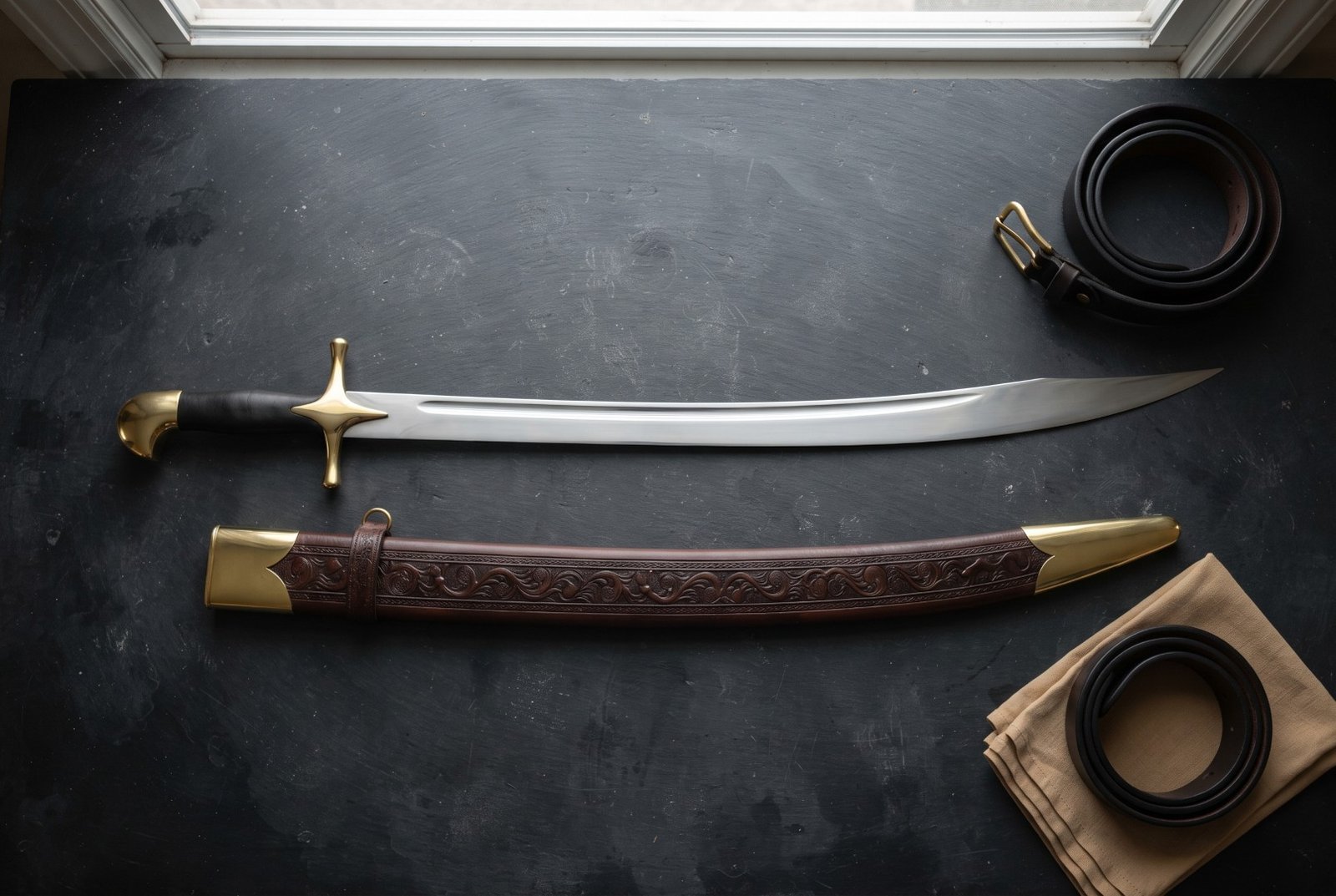
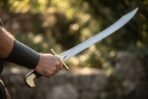
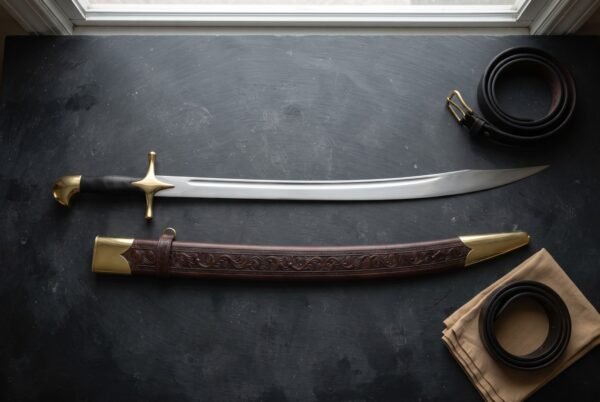
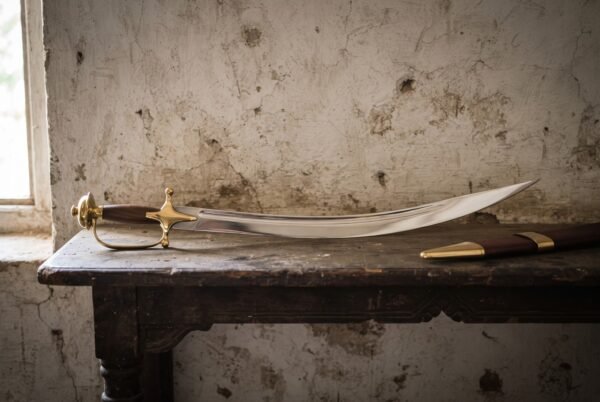
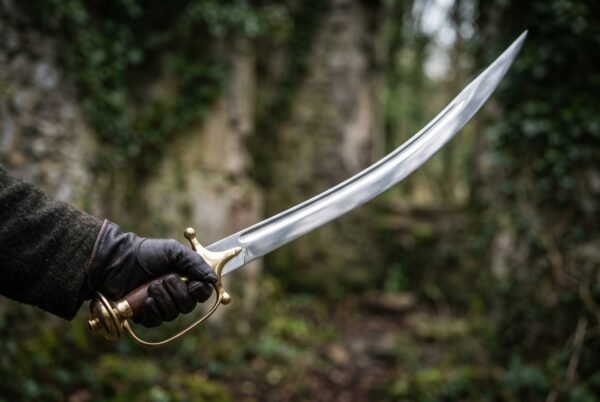
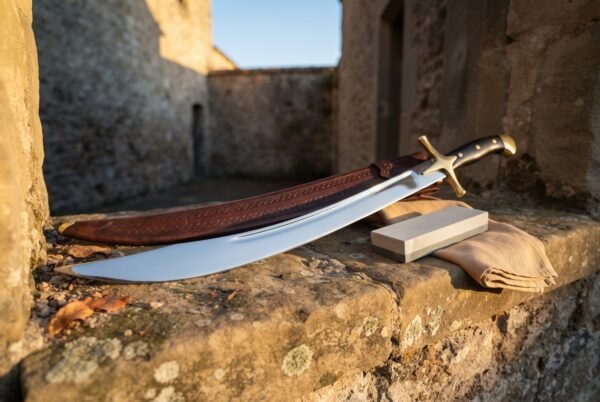
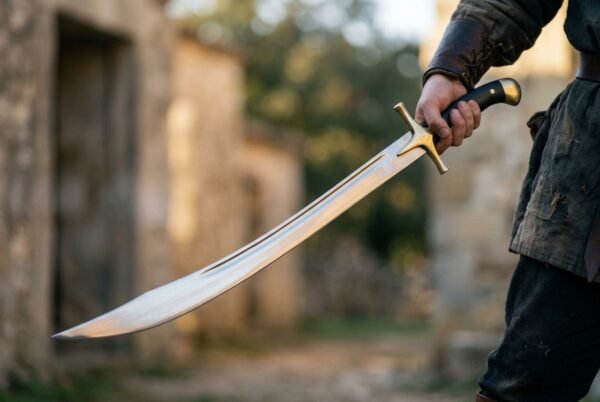
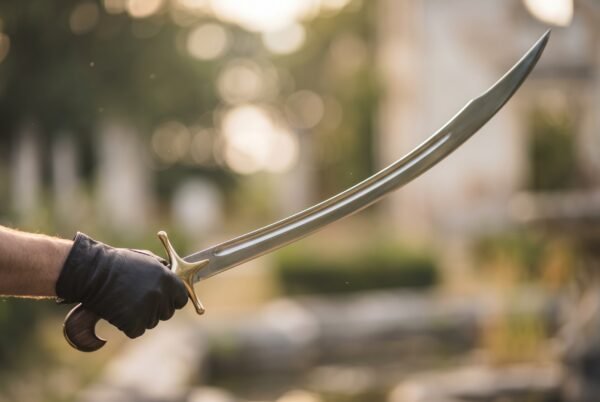
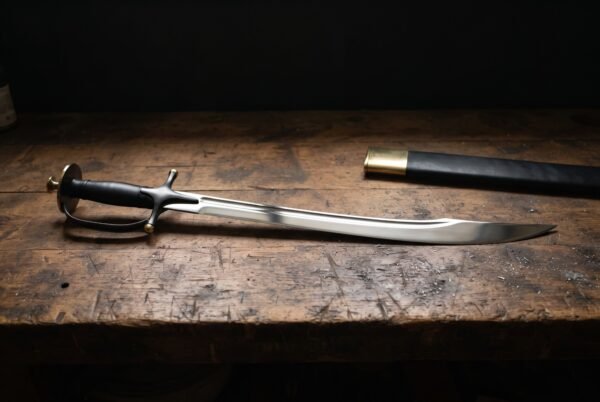
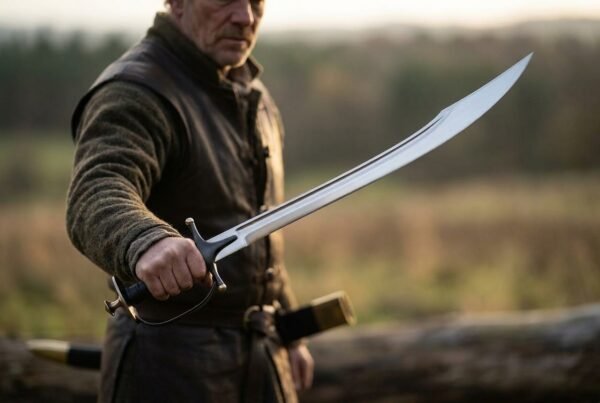
The Sandreaver is a scimitar in the Turkish kilij tradition, a curved single edged sword that carries most of its weight low and forward. The detail that separates a blade like this from an ordinary sabre is the belly. Look at where the curve widens roughly two thirds of the way to the point and you are looking at the yelman, a broadened section of the forward edge that shifts the centre of percussion outward. Ottoman smiths worked this feature deliberately because a wider distal section turns a light sword into a heavy cutter without adding weight at the hand, which is why period accounts describe these swords as feeling quick in the grip and brutal at the far end. The clipped point at the very tip is the other half of that idea, keeping the mass in the cutting zone rather than trailing off into a needle.
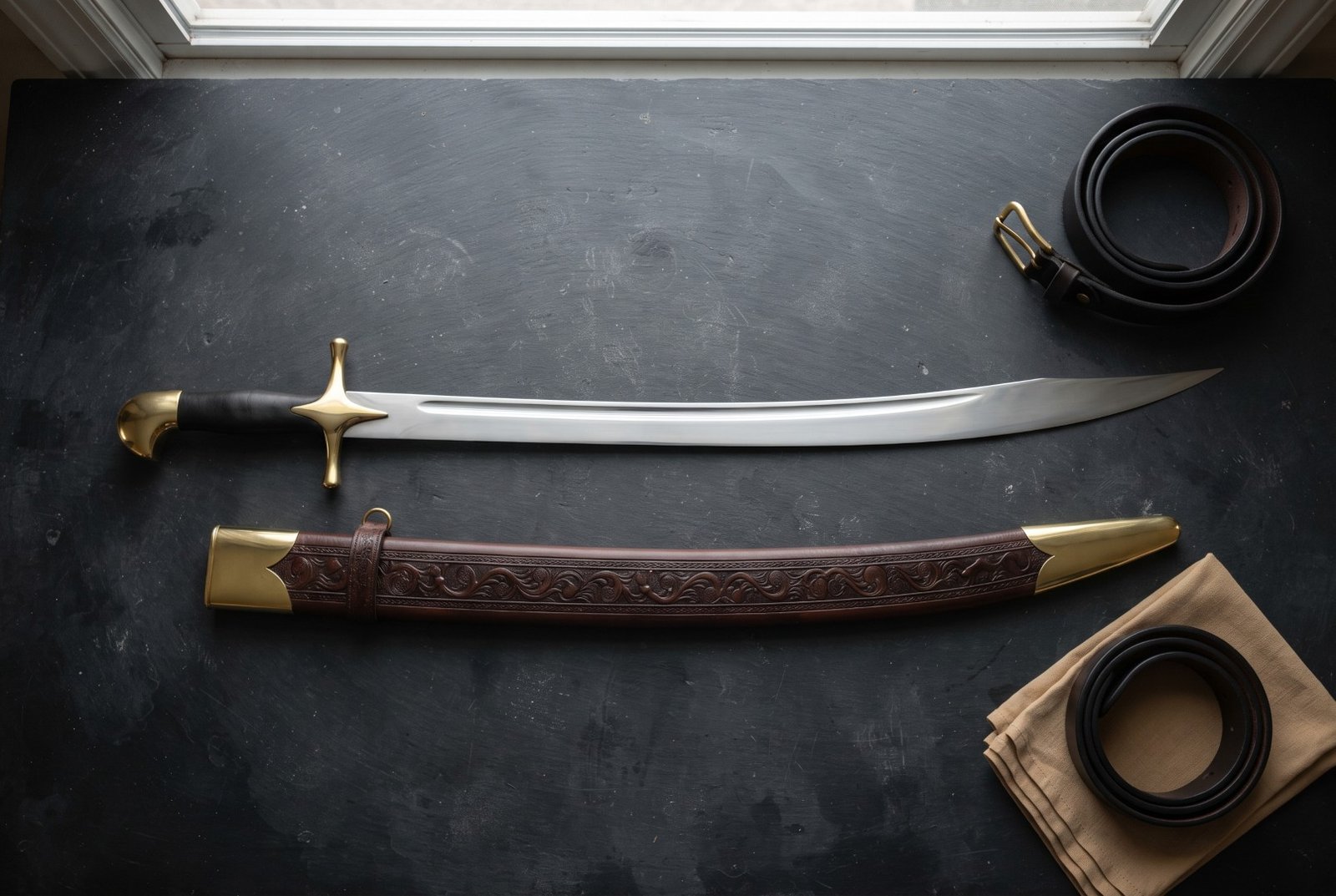
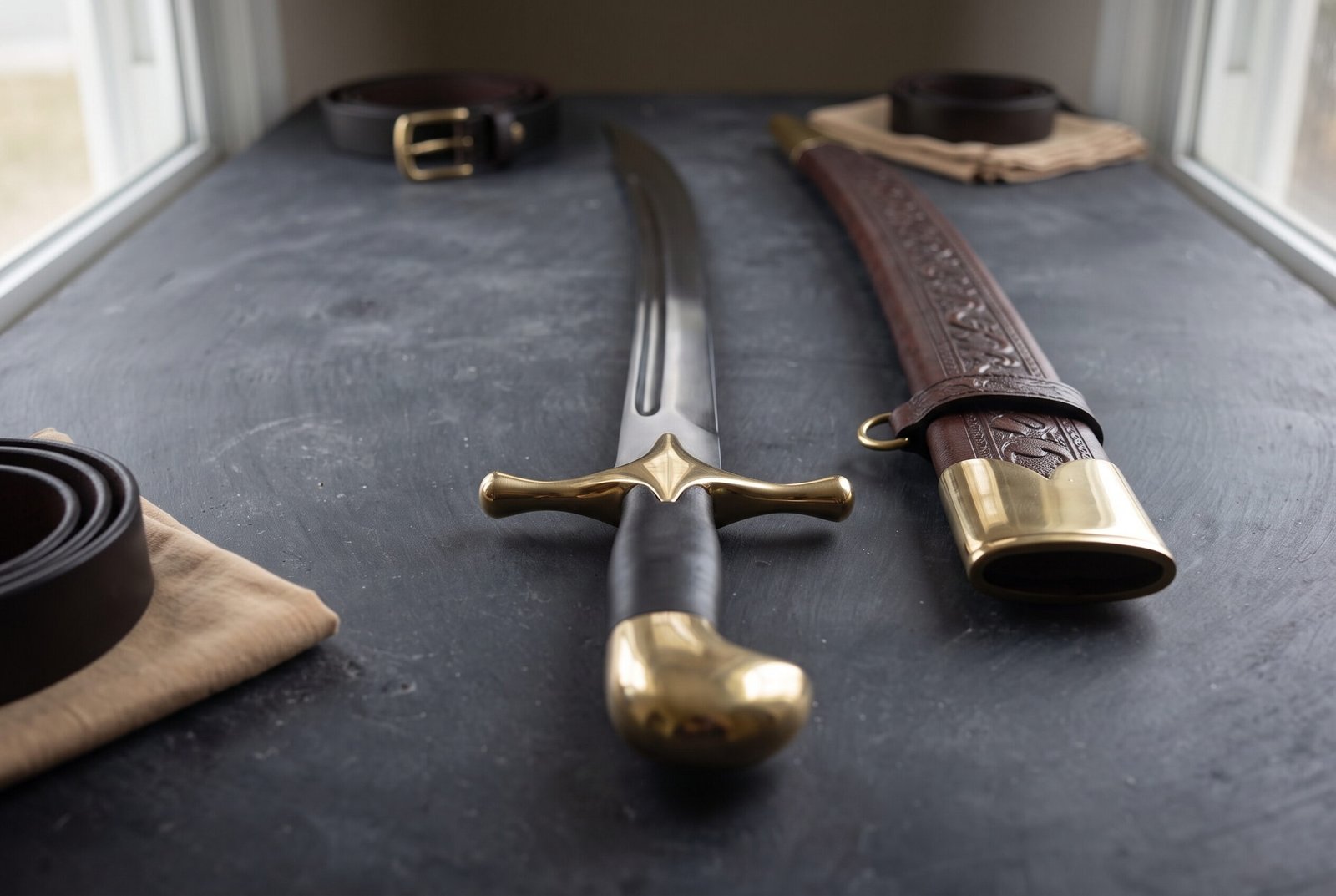
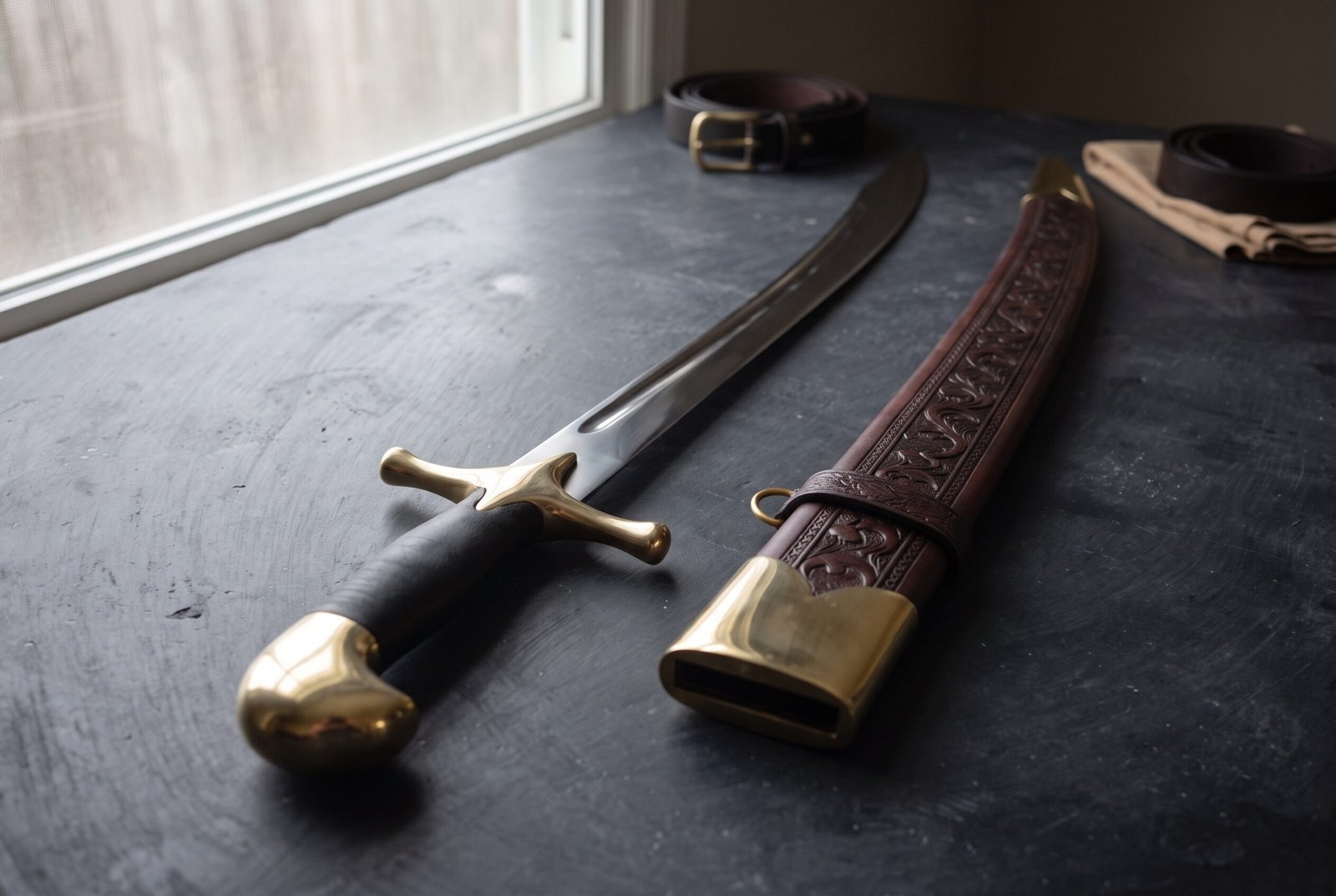
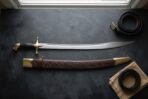
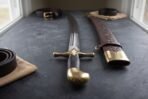
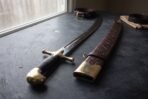
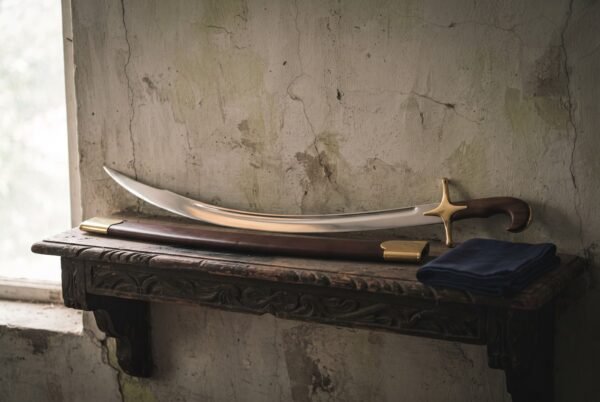
This one is forged and finished in the Czech Republic. The blade is 1095 high carbon steel, hand ground, heat treated and taken to a mirror polish, and the hilt is brass with a leather wrapped grip and a hooked pommel cap that locks the hand in place through a cut. It ships in its own tooled leather scabbard with a brass throat and chape, together with a care card and free shipping inside the United States.
Specifications
| Steel | 1095 high carbon steel |
|---|
| Hardness | 54 to 58 HRC |
|---|
| Overall length | 36 inches |
|---|
| Blade length | 30 inches |
|---|
| Blade | Curved single edged blade with a long fuller and a flared belly (yelman) with a clipped back near the point |
|---|
| Blade finish | Mirror polished |
|---|
| Guard | Solid brass cross guard with ball ended quillons and short diamond shaped langets |
|---|
| Handle | Black leather wrapped grip |
|---|
| Pommel | Hooked brass pommel cap |
|---|
| Scabbard | Dark brown tooled leather with brass throat, brass chape and a suspension ring |
|---|
| SKU | RK-1385 |
|---|
What makes a scimitar cut the way it does
A straight sword cuts by pressing an edge into a target. A curved sword cuts by drawing that edge across it. The curve means that at the moment of contact only a short section of edge is actually touching, so the whole force of the swing is concentrated into a small area, and as the sword continues through its arc that contact point travels along the edge and slices rather than chops. This is the whole reason curved swords spread across Persia, Anatolia, India and the steppe: from horseback you are not swinging down into a target, you are passing it, and a curved edge does the work of drawing itself through as the horse carries you on.
The Sandreaver follows that logic in its geometry. The spine stays thick well past the middle of the blade before it tapers, which keeps the sword stiff where a broad blade would otherwise flex. The flare of the belly puts real mass out where the edge is doing the work, and the clipped point keeps that mass from being wasted. Pick it up and the balance sits a few inches ahead of the guard, close enough to the hand to feel controllable, far enough forward that the sword wants to keep moving once you start it.
Why 1095 high carbon steel and not stainless
1095 is a simple carbon steel with just under one percent carbon and very little else. That simplicity is the point. It takes a heat treatment cleanly and predictably, it hardens deep, and it holds a fine edge because there are no large carbides in the structure to crumble away at the apex. On a blade this long that matters more than it does on a pocket knife, because a sword edge has to survive being loaded along thirty inches at once.
Stainless steels buy corrosion resistance by adding chromium, and above about thirteen percent that chromium locks up carbon in hard carbides. In a short kitchen blade that is a fair trade. In a long sword blade it is not, because those carbides make the steel more brittle in exactly the sizes and geometries where you need toughness. Every serious maker of long blades works in carbon steel for that reason. The cost is that 1095 will rust if you neglect it, which is a maintenance question rather than a quality question. If you want the longer version of that argument, we set it out on Damascus versus stainless.
The leather grip and brass furniture
The grip is a full length wrap of leather over the tang, drawn tight and finished so it firms up rather than slipping when your hand warms it. Leather was the standard grip covering on curved swords across the Islamic world and the Ottoman empire for a practical reason: it grips back. A polished wood or horn grip looks handsome on a table and becomes slick the moment a hand sweats on it. Leather does the opposite.
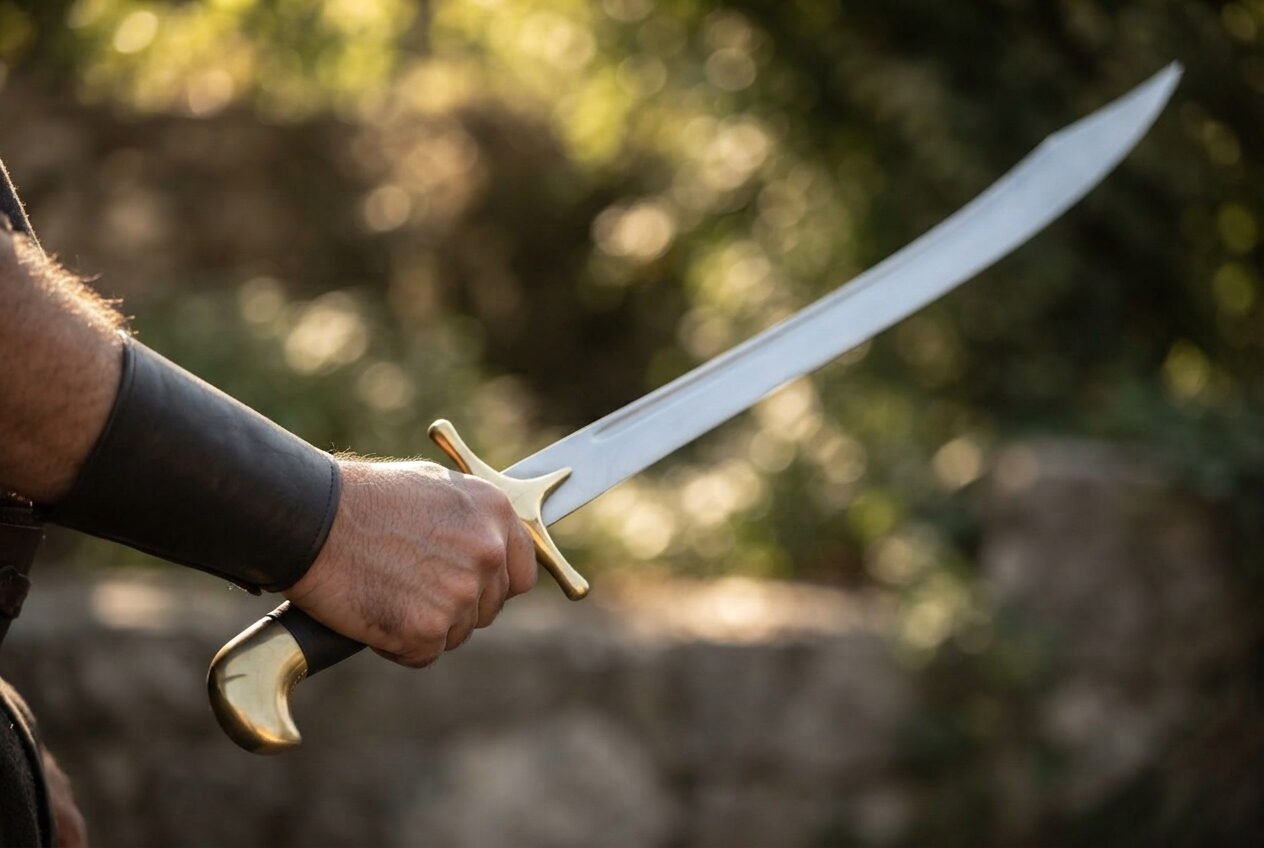
The brass cross guard ends in rounded ball tips and carries short diamond shaped langets on the blade and the grip, which help keep a hilt of this type from working loose over time. The hooked brass pommel curls back over the heel of the hand. That hook is not decoration. On a drawing cut the sword tries to rotate out of the grip and the hook is what stops it, so you can hold the sword lightly and still keep it. Brass was chosen historically because it casts cleanly into these shapes, does not rust, and takes a polish that stays bright against a leather grip.
Engraving, runes and your own design
Use the rune converter on this page to turn a name, a date or a short phrase into Elder Futhark and we will cut it into the steel or the handle. If you would rather have a Viking pattern than a rune line, choose your own design in the engraving option above the add to cart button and tell us whether it goes on the blade or the handle. Where a piece already carries an engraved design, your chosen engraving replaces it rather than sitting alongside it. A short line along the flat of the blade near the guard sits well on a scimitar because the eye follows the curve to it. Full details of what we can and cannot cut are on the engraving page.
Care and sharpening
Carbon steel needs a thin film of oil on it and very little else. Wipe the blade down after handling, because fingerprints are slightly acidic and will etch a grey mark into a mirror polish within a week if you leave them. A light machine oil or a dedicated blade oil, applied with a cloth once a month, is enough for a piece that lives on a wall in a normal room. If the sword is going to sit in its scabbard for long periods, oil it more often, because leather holds moisture and tanning residues against steel. Our full routine is on steel care.
Sharpening a curved edge is a matter of following the curve rather than fighting it. Work in short sections, keep the angle constant and let the blade travel across the stone in an arc so that the whole edge gets the same treatment. A coarse stone will bring back a neglected edge, a fine one will polish it, and a few passes on a strop will finish it. There is a step by step guide on sharpening with a whetstone.
Made in the Czech Republic
Every piece we sell is made by hand in the Czech Republic. The smiths there work the way the trade has been worked for a long time, heating and hammering the steel, taking the bevels down by eye, and fitting the handle and the leather one at a time. There is no automated line anywhere in it, so small differences from one piece to the next are normal and expected.
Ransack Viking is a United States company based in Chicago, Illinois. We bring the pieces in ourselves, inspect them on arrival and ship them from our own warehouse. If you add engraving, that is carried out here in the United States before your order goes out.
A note on handmade variation
This scimitar is hand forged. It is not machine made and it is not bulk produced, so what arrives will not be a pixel for pixel copy of the photograph on this page. The grain of the leather, the exact tone of the brass, the way the polish catches light along the belly and the precise line of the curve all vary from piece to piece, because every one is worked by hand from natural materials by a person making judgement calls at the anvil and the grinder. The dimensions, the steel, the heat treatment and the build are the same every time. The character is not, and that is the point of buying something forged rather than stamped.
Frequently asked questions
Does it arrive sharp?
It arrives with a clean cutting edge, taken to a working sharpness rather than a razor. That is the right state for a display sword of this size. If you want it keener, say so in the order notes and we will take it further before it ships.
Can I actually cut with it?
Yes. The blade is properly heat treated 1095 through its full length and it will handle tatami mats, water bottles and light test cutting. It is not a sparring sword and should never be used against another blade or against hard targets such as wood or bone.
What is the difference between this and a shamshir?
A shamshir is Persian, narrow, and curved evenly from guard to tip so that it is almost a section of a circle. This scimitar is broader, with a belly that widens toward the point. The shamshir is built to draw cut, this is built to chop as well as slice.
Can I have runes engraved on it?
Yes. Use the rune converter on this page for Elder Futhark, or pick your own design from the engraving option. Tell us whether you want it on the blade or the handle and expect an extra week or so on the lead time.
Will mine look exactly like the photograph?
No, and it is not meant to. The steel, the size and the build are identical. The leather grain, brass tone and polish will differ slightly because a person made it rather than a machine.
How long does shipping take?
Shipping inside the United States is free. Stock pieces leave in two to three business days and usually arrive within a week. Engraved pieces take two to three weeks before they ship.
What is in the box
- Sandreaver hand forged 1095 high carbon steel scimitar
- Tooled leather scabbard with brass throat and chape
- Care card with oiling and storage instructions
- Certificate of hand forging
- Forged and finished in the Czech Republic
Explore the range
See the rest of the scimitars, the wider swords collection, the sabres and the cutlasses, or read the guides for how to choose and care for a curved blade.
Near neighbours in the shop
Sitting beside it in the catalogue is the Emberledge scimitar, 37 inches overall. Another in the same line is the Duneclaw scimitar, 33 inches overall. Next along the rack is the Sandspire scimitar, 35 inches overall.
Fitting out further, the Brinehook cutlass belongs with it. You can have this made your way instead on the design your own page.
Our HEMA line includes the Orlunde spadroon for drills and sparring, and our smallsword guide is the place to look next.

Absolutely blown away by this piece. Feels way more premium in person than the listing photos. The craftsmanship really shows in the small details. Beyond happy with how this turned out.