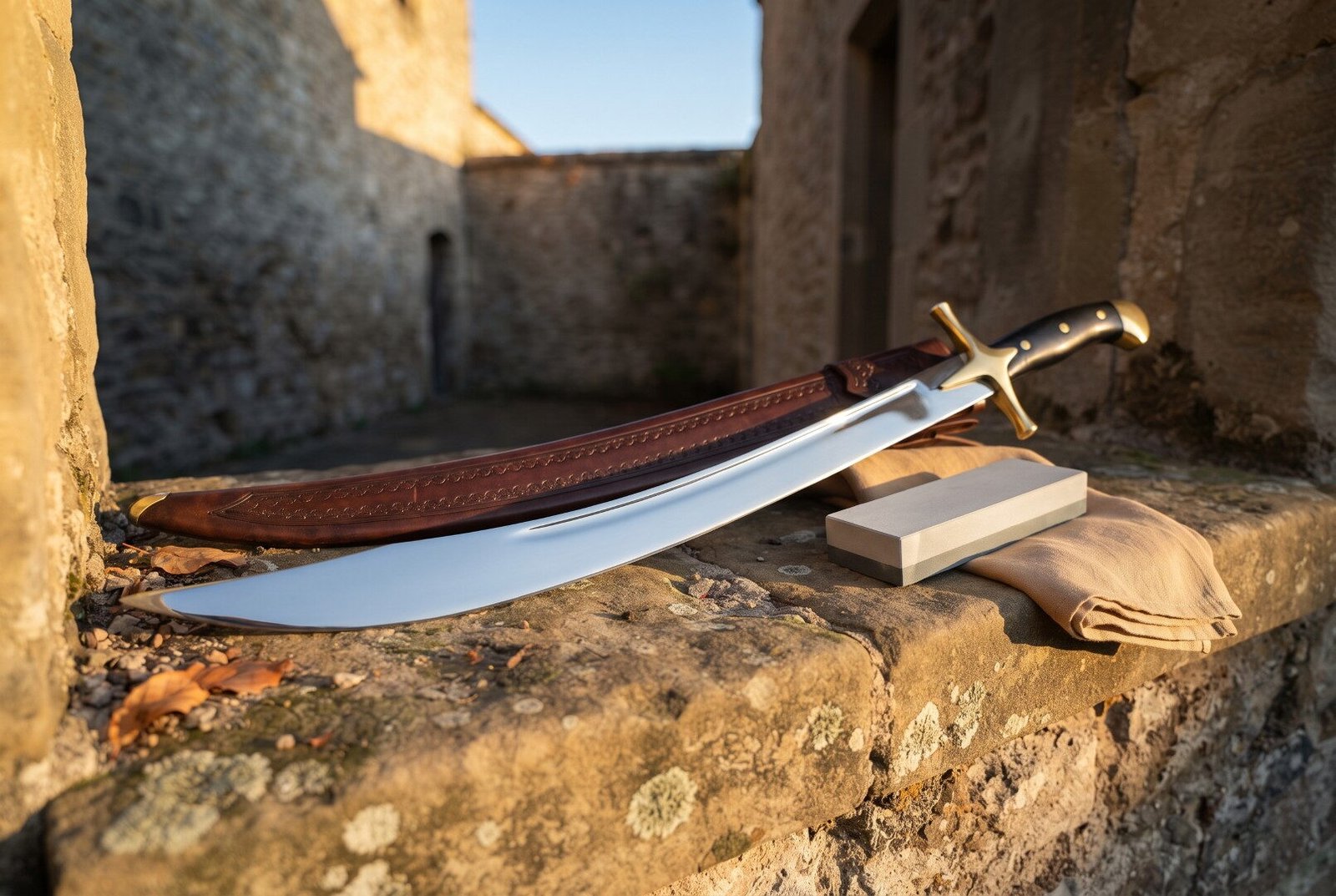
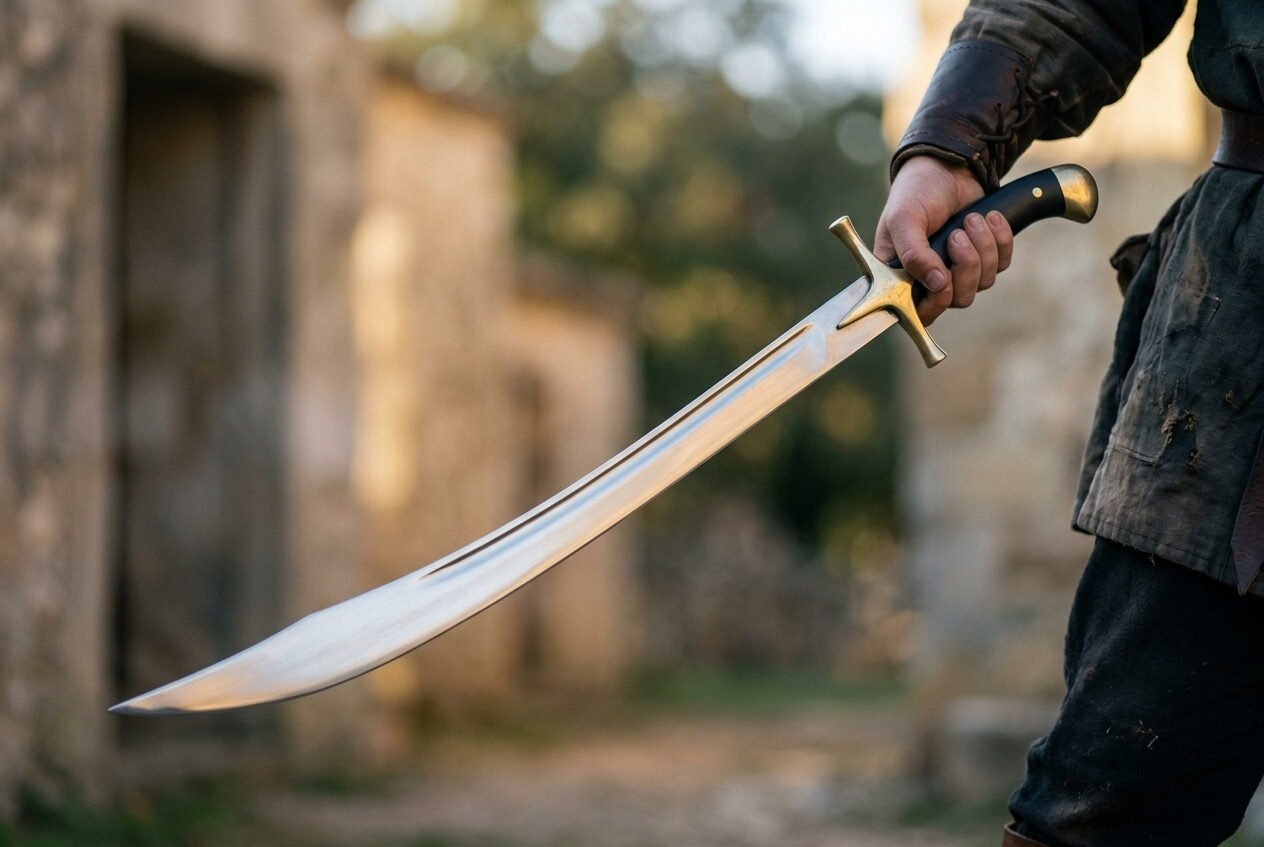
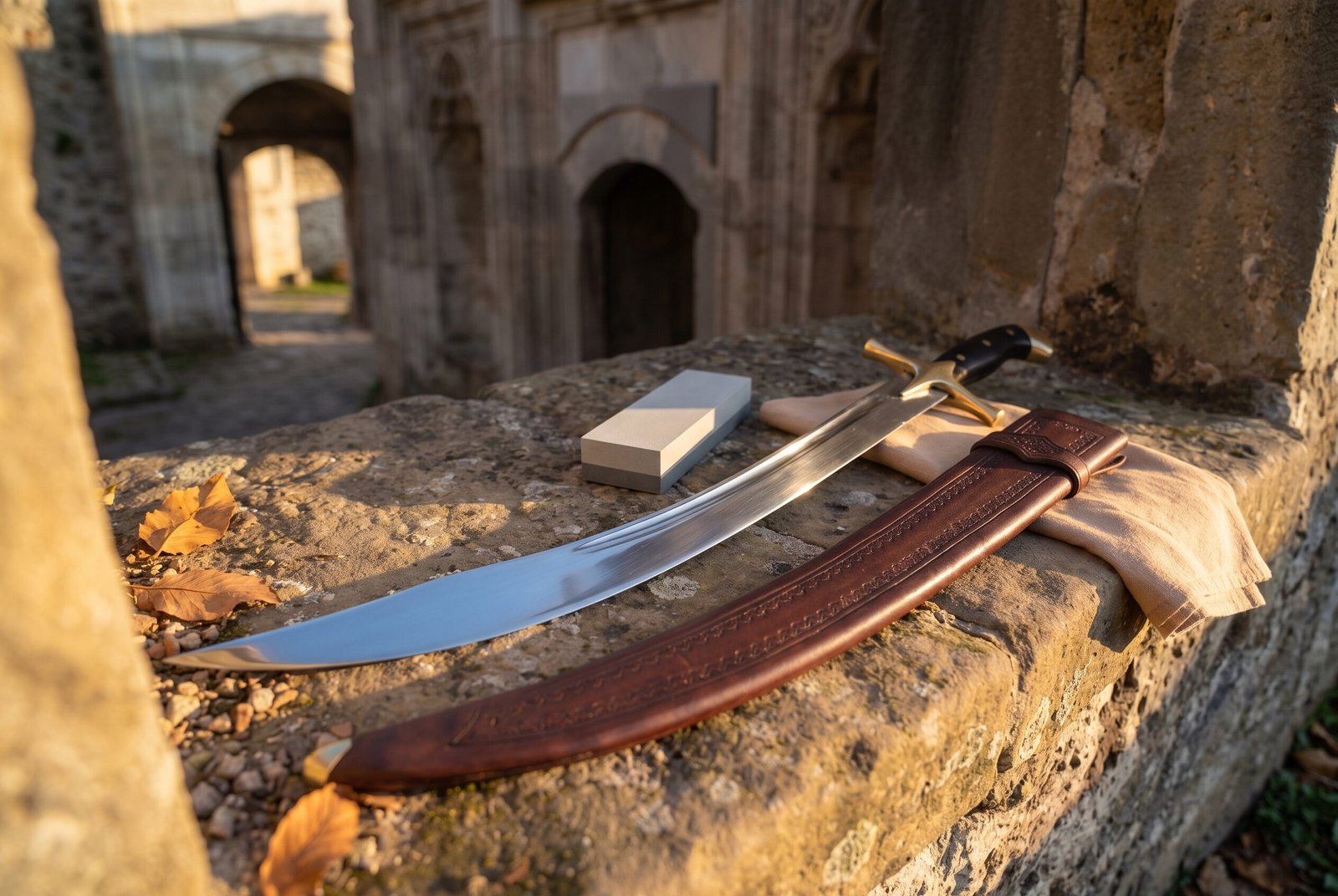
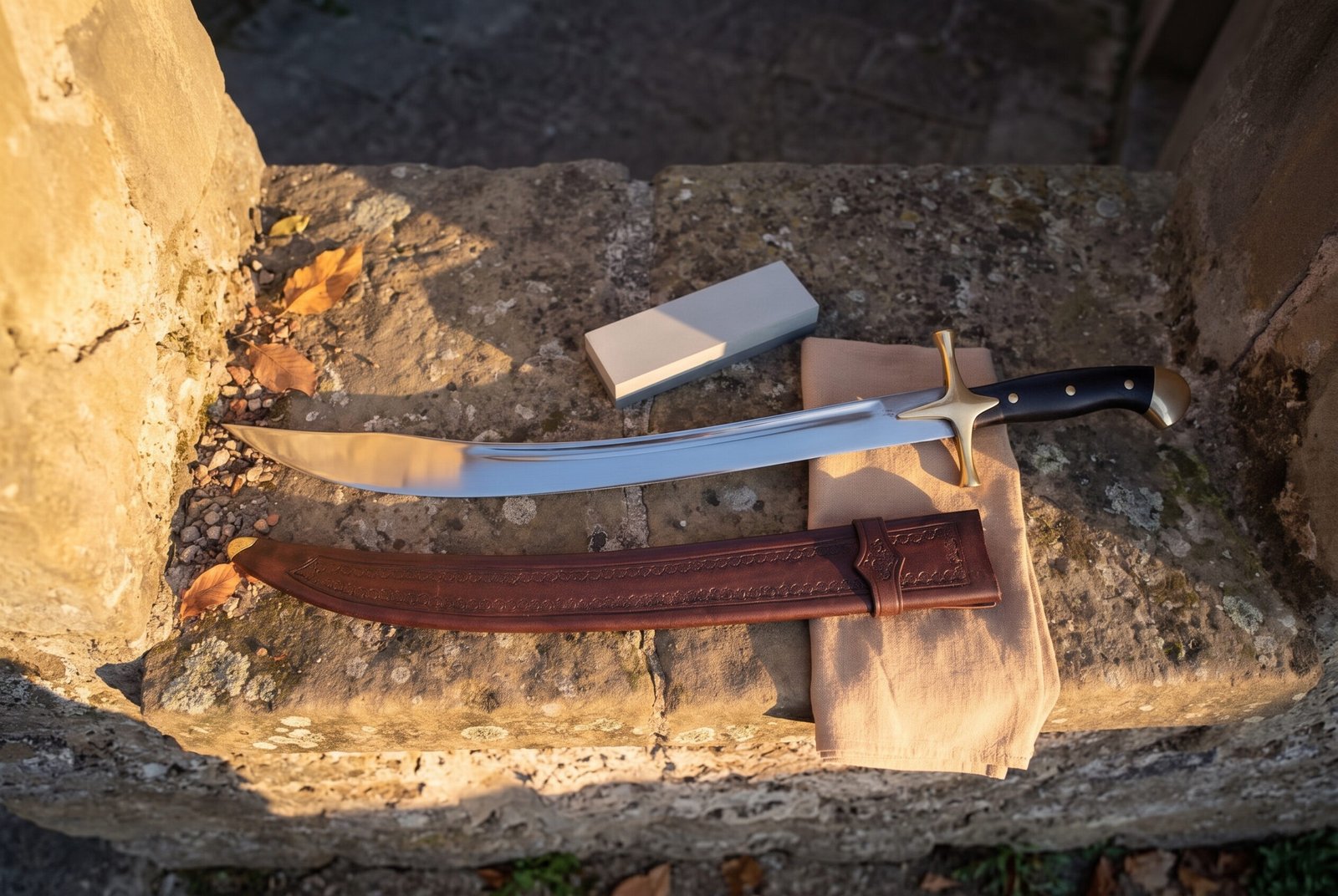
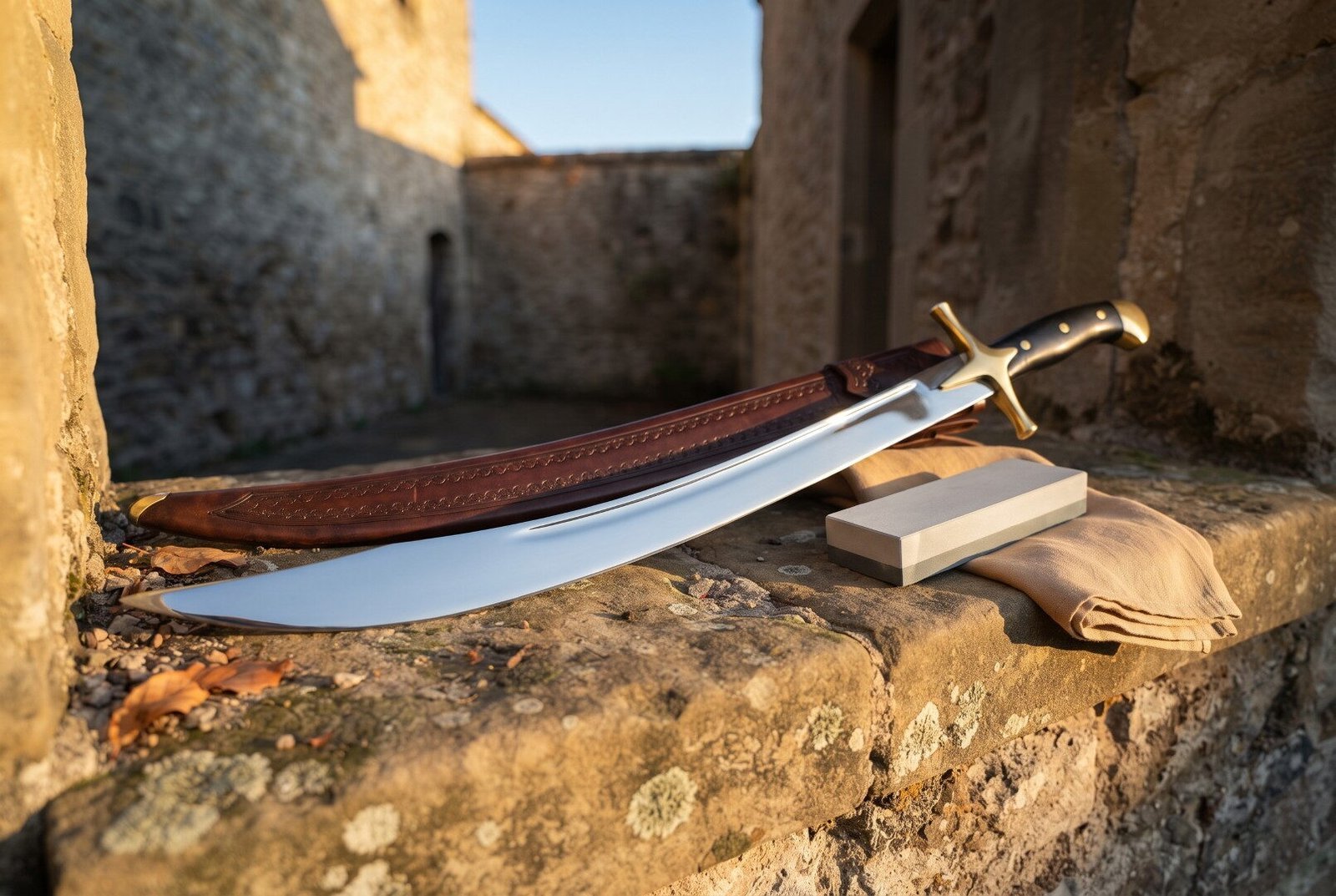
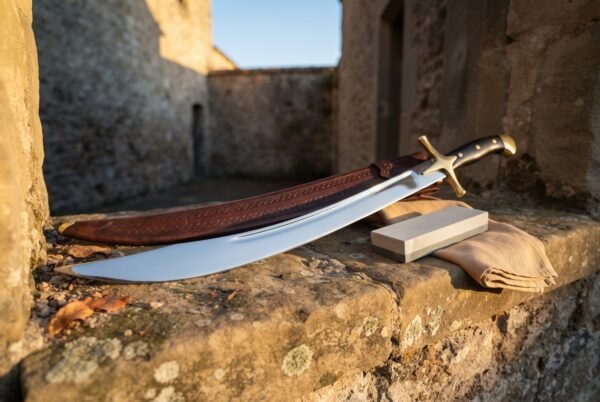
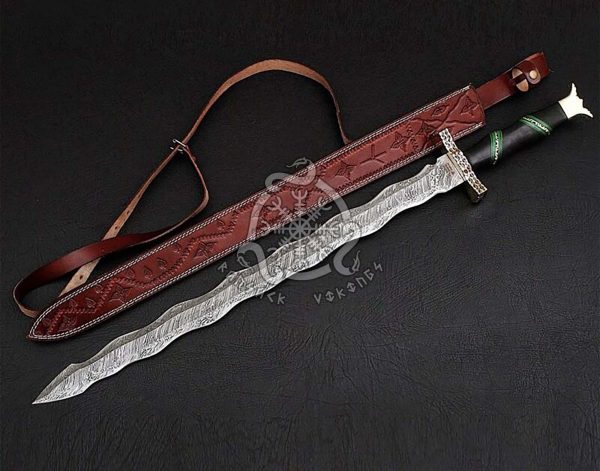
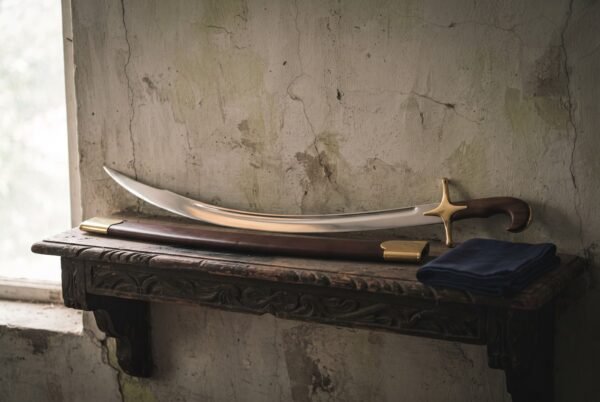
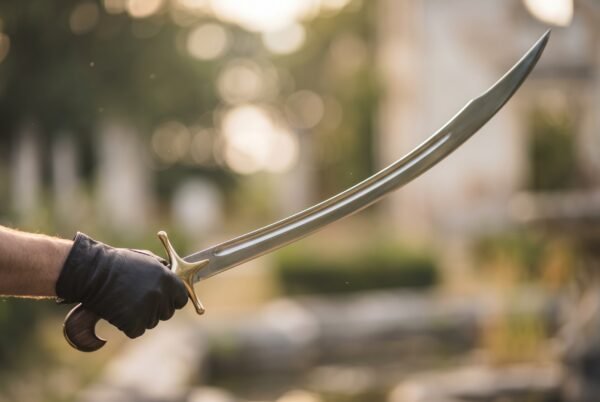
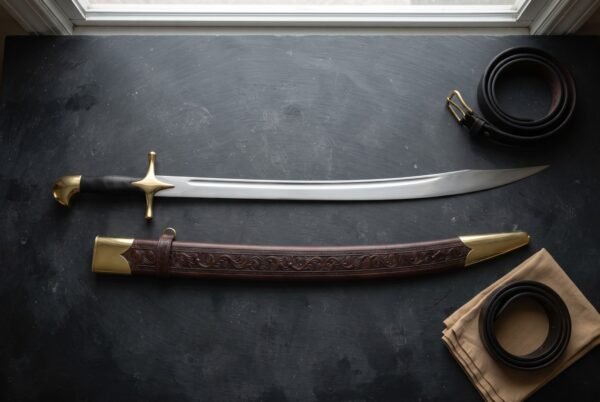
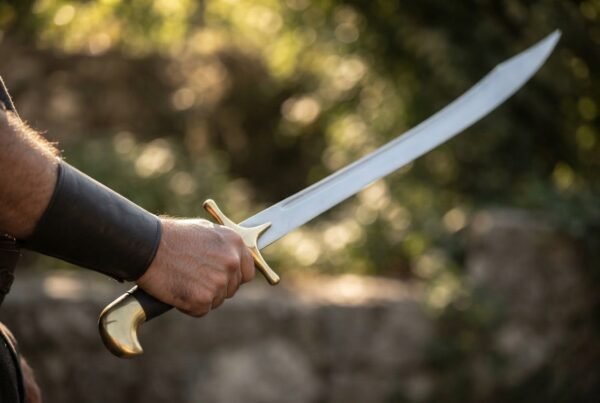
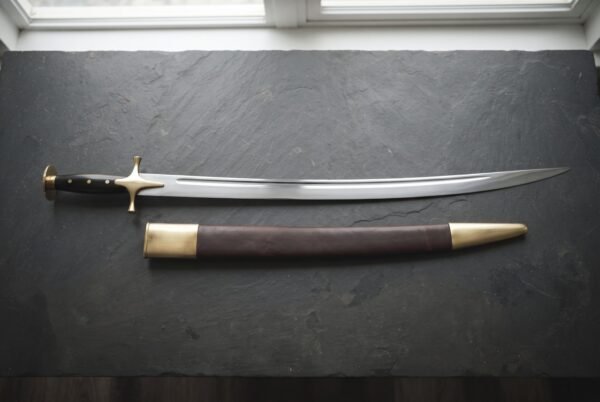
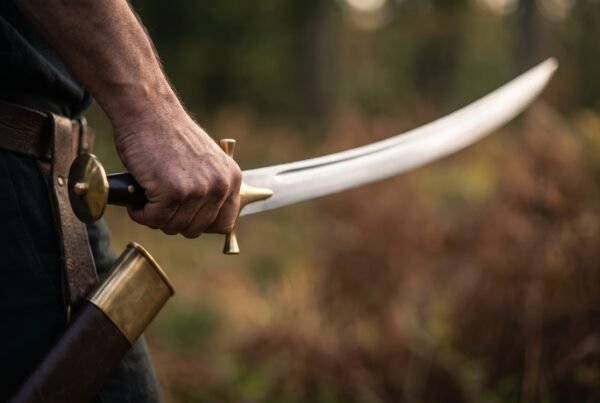
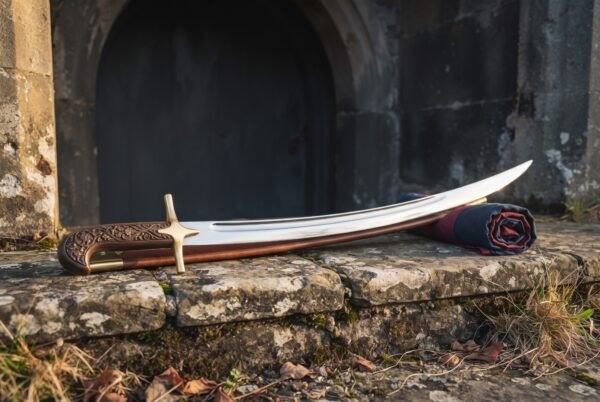
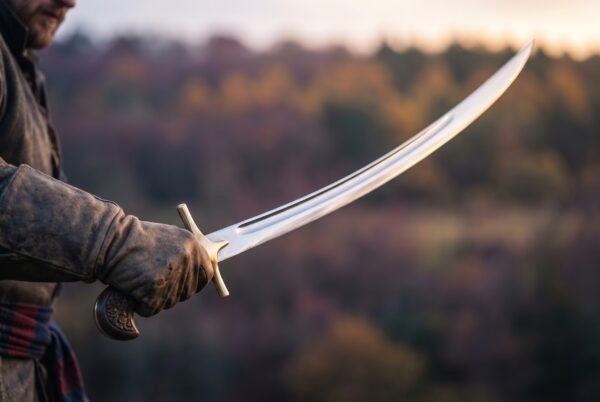
The Emberledge is a full sized scimitar sword, thirty seven inches overall, with a deep even curve, a broad cutting belly and a long fuller running from the guard out along the upper third of the blade. That fuller is the detail most people misread. It is not a blood groove, a term invented by Victorian romantics and kept alive by film, and it has nothing to do with suction or with letting anything out of anything. It is a structural feature, and it does the same job as the web of an I beam.
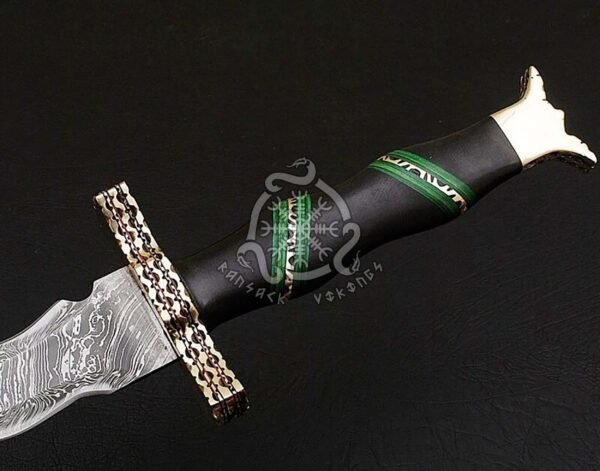
This one is forged and finished in the Czech Republic. The blade is 1095 high carbon steel, hardened, tempered and taken to a mirror polish. The hilt is a black hardwood grip pinned with brass between a brass cross guard and an angled brass pommel cap. It ships in a hand tooled leather scabbard, with a care card, and shipping inside the United States is free.
Specifications
| Steel | 1095 high carbon steel |
|---|
| Hardness | 54 to 58 HRC |
|---|
| Overall length | 37 inches |
|---|
| Blade length | 31 inches |
|---|
| Blade | Deep curve widening toward the point, broad cutting belly, long fuller near the spine, mirror polished |
|---|
| Guard | Brass cross guard with straight quillons flaring at the tips and short langets |
|---|
| Grip | Black hardwood scales fixed with three brass pins |
|---|
| Pommel | Angled brass pommel cap |
|---|
| Scabbard | Hand tooled reddish brown leather |
|---|
| SKU | RK-1388 |
|---|
What the fuller does
Take a flat steel bar and try to bend it. It resists bending across its width and folds easily across its thickness. Almost all of that resistance comes from the material furthest from the centre line, because the further material sits from the axis you are bending around, the harder it works. The steel in the middle contributes very little.
A fuller removes that middle steel. Forging a groove down each face of a blade takes out mass from the region that was doing the least structural work, leaving the spine and the edge, which are doing the most. The result is a blade that keeps nearly all its stiffness while losing real weight, and losing it from the part of the sword furthest from the hand, which improves the balance twice over. On a curved cutting sword like this one that matters, because the whole design fights a tendency to become slow at the tip.
There is a second effect that only shows up in a hand forged blade. Fullering is done hot, with a shaped tool driven along the blade, and it moves steel rather than cutting it away. Pushing the metal out of the groove lengthens and widens the blade at the same time, which is why a smith fullers before final grinding rather than after. The line you can see running along this blade was hammered in, not milled out.
Why 1095 high carbon steel and not stainless
1095 has just under one percent carbon and essentially no alloying elements. It is the oldest and plainest recipe for a hard cutting edge and it is still the right one for a sword. It hardens fully through a blade of this section, the fine grain lets an edge come to a true apex, and tempered back to 54 to 58 HRC it keeps enough spring to survive a mistake.
Stainless gets its rust resistance from chromium, and chromium at those levels forms hard carbides that make a long blade prone to chipping and to cracking under load. It is a fine trade in a kitchen knife and a bad one in a thirty one inch blade. The price of 1095 is that it rusts if neglected, which is a matter of a rag and a bottle of oil. We go through the comparison properly on Damascus versus stainless.
The hardwood grip and brass furniture
The grip is a pair of dark hardwood scales pinned through the full width tang with brass, so there is no hollow handle and nothing bonded that can let go. The scales are shaped with a slight waist so the hand finds its position without looking, and the brass pins are peened flush rather than screwed in, which means there is no fastener to back out over the years.
The cross guard is solid brass with straight quillons that flare at the tips, and the pommel is an angled brass cap over the butt of the tang. Brass was the traditional choice for sword furniture across the Near East and India because it casts into complex shapes at low temperature, will not rust against a leather scabbard, and stays visually warm against dark wood. It is softer than steel, so the guard on this sword is there to finish the hilt and to stop a hand sliding forward, not to catch another blade. Hardwood wants a wipe of oil once or twice a year if the sword hangs in a dry room, and the routine is on wooden handle care.
Engraving, runes and your own design
Use the rune converter on this page to turn a name, a date or a short phrase into Elder Futhark and we will cut it into the steel or the handle. If you would rather have a Viking pattern than a rune line, choose your own design in the engraving option above the add to cart button and tell us whether it goes on the blade or the handle. Where a piece already carries an engraved design, your chosen engraving replaces it rather than sitting alongside it. On this sword the fuller itself makes an obvious channel for a line of runes, which is a treatment that works particularly well on a mirror finish. See the engraving page for sizes and limits.
Care and sharpening
A mirror polish is the least forgiving finish there is on carbon steel, because every mark shows. Wipe the blade with a clean dry cloth after handling and keep a thin film of light oil on it. A fingerprint left on this surface will etch into a dull grey ghost within a week or two, and while that can be polished out it is easier not to let it happen. Oil monthly if the sword lives indoors, more often if it hangs anywhere that gets damp. Full details on steel care.
The sword ships with a working edge. To maintain it, follow the curve on the stone rather than trying to hold the blade flat, work three or four inches at a time, keep the angle steady and sweep along the arc so no section gets more attention than another. Finish fine and strop. Step by step on sharpening with a whetstone.
Made in the Czech Republic
This piece is made by hand in the Czech Republic, in a workshop that still works the old way. The steel is forged, ground, heat treated and finished by smiths who learned the trade from the people before them, and the wood, horn and leather are cut and fitted by hand rather than pressed out on a line. That is also why no two pieces come out exactly the same.
Ransack Viking is a United States company. We import these pieces ourselves, check every one when it lands and ship from our warehouse in Chicago, Illinois. Engraving is done here in the United States after the piece arrives, so your runes or your own design go on before it leaves for you.
A note on handmade variation
This scimitar sword is hand forged. It is not machine made and it is not bulk produced, so what arrives will not be a pixel for pixel copy of the photograph on this page. The hardwood grain, the tone of the brass, the exact depth and run of the fuller, the way the polish lies on the curve and the hand cut tooling on the scabbard will all differ a little, because each piece is worked by hand from natural materials. Dimensions, steel and build are the same every time. The character is not, and that is what you are buying.
Frequently asked questions
Is it sharp?
It ships with a real working edge rather than a razor edge, which is what suits a sword this size. If you want it keener, say so in the order notes and we will take it further before it leaves.
Is the fuller a blood groove?
No. That name is a Victorian invention. The fuller is a structural groove that takes weight out of the middle of the blade while keeping the stiffness, and it improves the balance as a side effect.
Can I spar with it?
No. It is a sharp, properly hardened sword, not a blunt trainer. It will handle mat and bottle cutting, but it should never be brought edge to edge with another blade or used against hard targets.
What is the difference between this and a sabre?
A sabre is usually narrower, more lightly curved and built with the point in mind as well as the edge. This is a scimitar, wider through the belly and curved harder, and it is a cutting sword first and last.
Can I have a name engraved on it?
Yes. Use the rune converter for Elder Futhark or choose your own design in the engraving option, and tell us blade or handle. Allow an extra week on top of the normal lead time.
How long does shipping take?
Free within the United States. Stock swords leave in two to three business days. Engraved swords are two to three weeks before dispatch.
What is in the box
- Emberledge hand forged 1095 high carbon steel scimitar sword
- Hand tooled leather scabbard
- Care card with oiling and storage instructions
- Certificate of hand forging
- Forged and finished in the Czech Republic
Explore the range
Browse the other scimitars, the full swords range, the sabres and the falchions, or read the guides.
Close to this one
Another in the same line is the Vinecrest scimitar, 39 inches overall. Next along the rack is the Brassbloom scimitar, 38 inches overall. For a straight comparison, see the Mossgate scimitar, 36 inches overall.
The Cliphawk short sword covers the other half of the same kit. Nothing here exactly right, build one to your own spec on the design your own page.
For partner drills and sparring we carry the Orlunde spadroon, and our smallswords and spadroons is a good place to start.

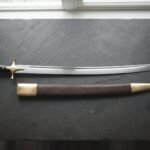
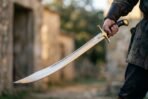
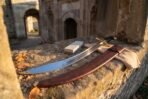
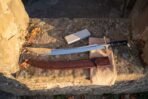
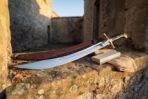
This sword is well made. Just a couple small things kept it from 5 stars. Wood handle looks great though it’s a little smaller than I imagined. Glad I made this purchase.
Really happy with this sword overall. Wood handle looks great though it’s a little smaller than I imagined. Would buy from this shop again.
This sword is fine. Just didn’t wow me.
Feels way more premium than the price suggests. Even the small engravings are crisp and clean. Came in a nice gift box which made it feel even more special. Shipping was fast and everything arrived well packaged.
My whole family was impressed when I unboxed it. Shipping was fast and everything arrived well packaged.