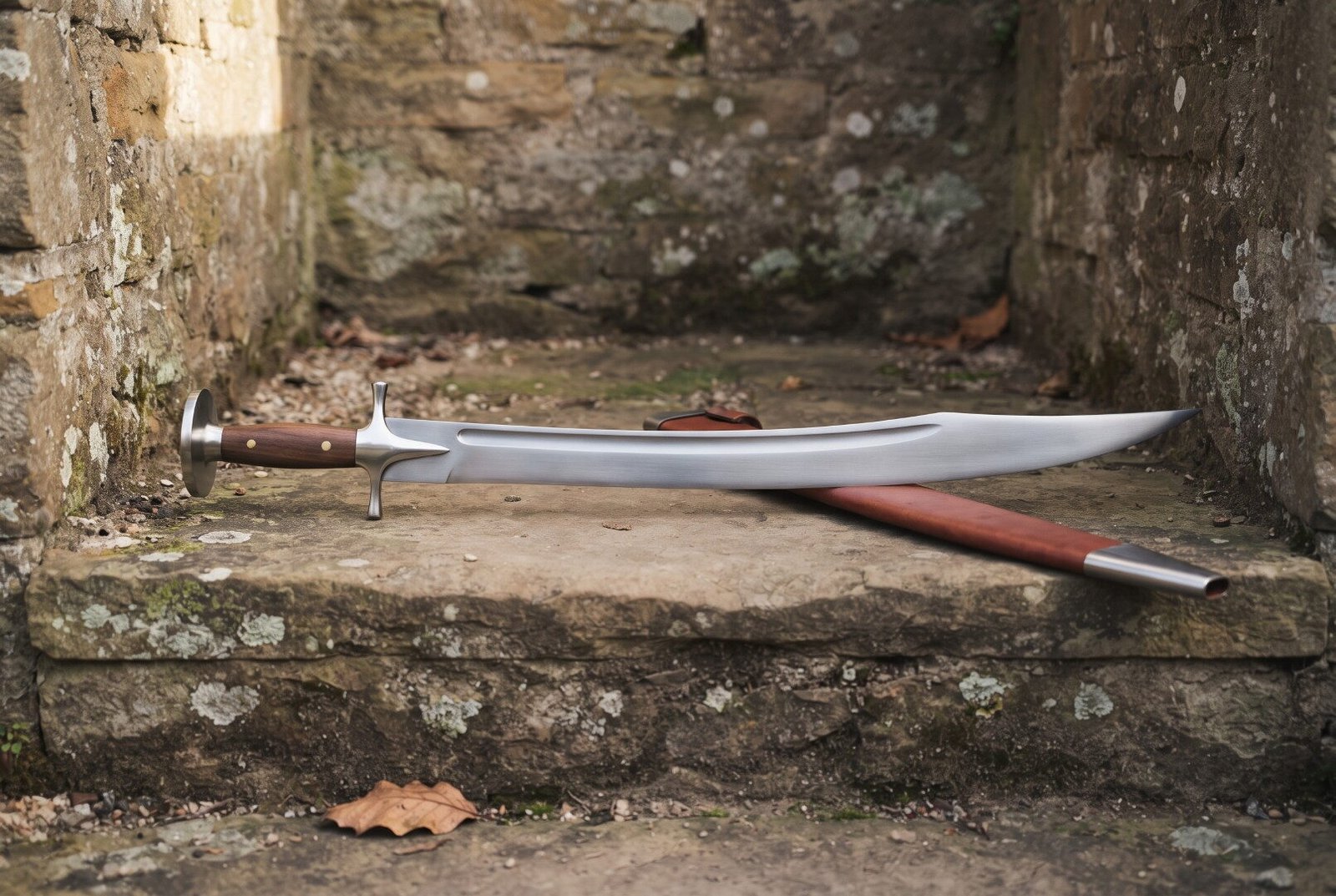
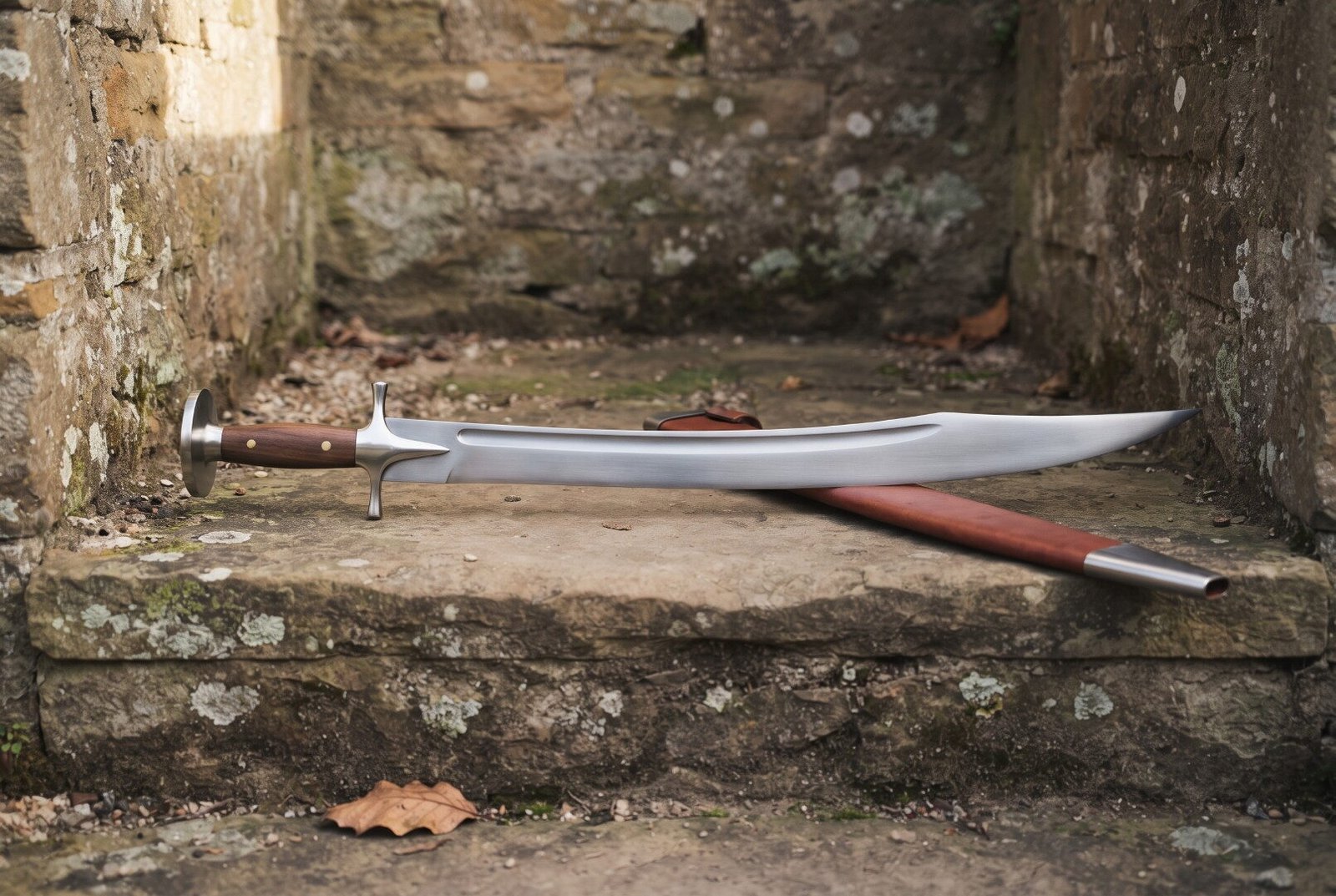
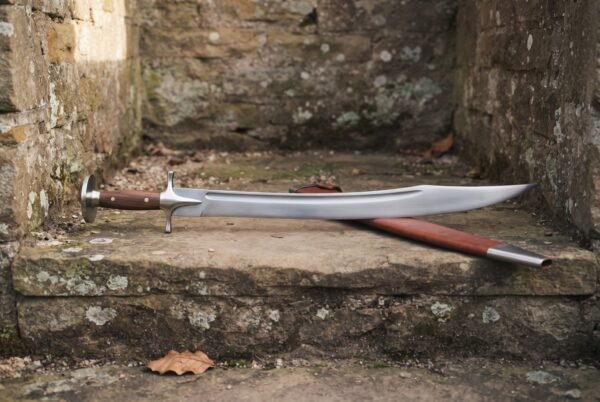
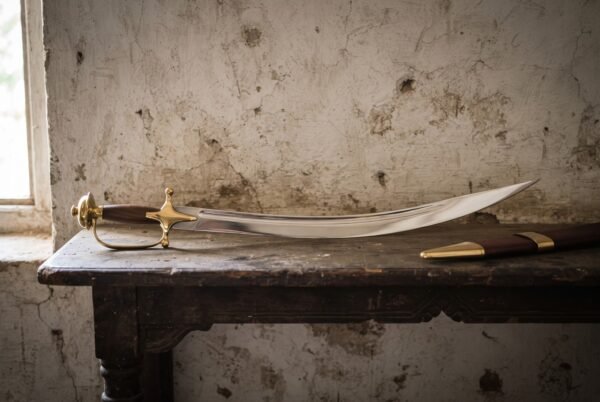
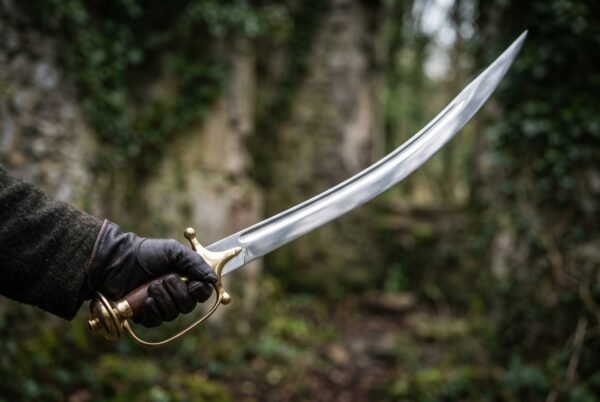
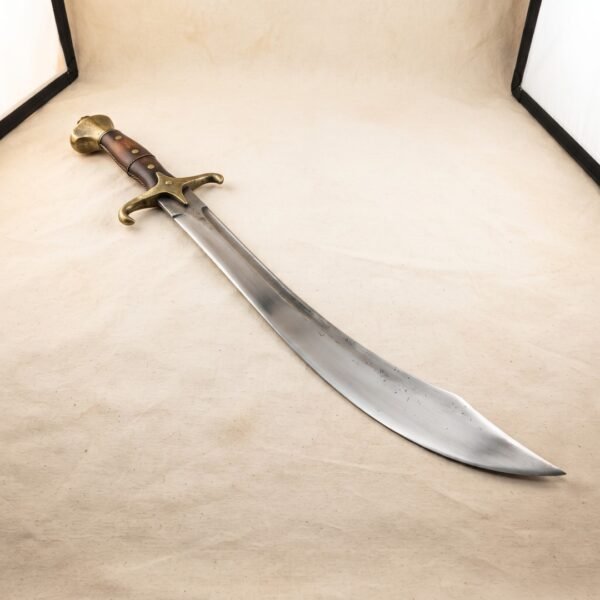
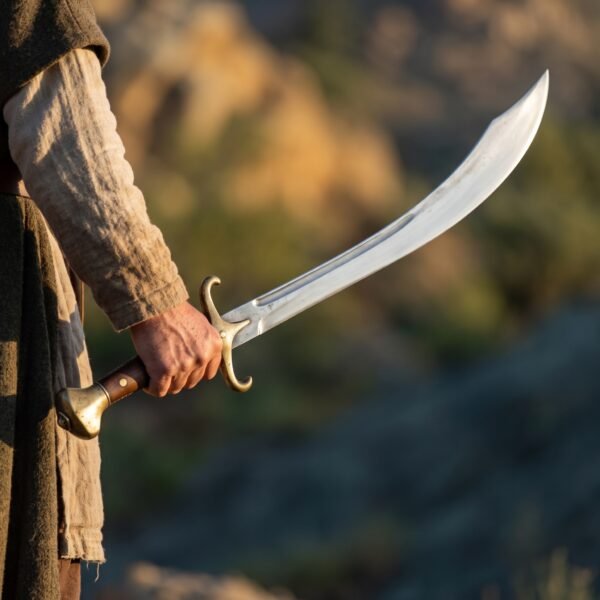
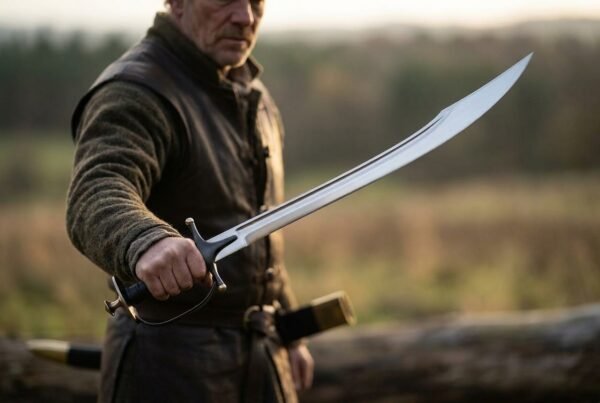
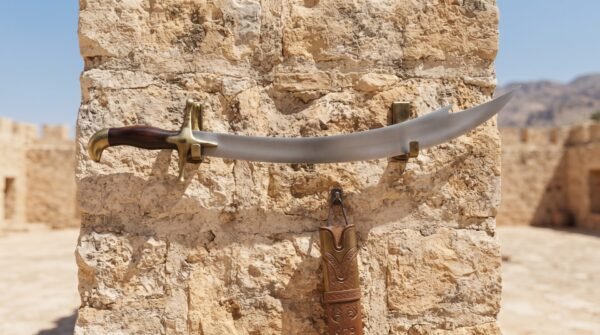
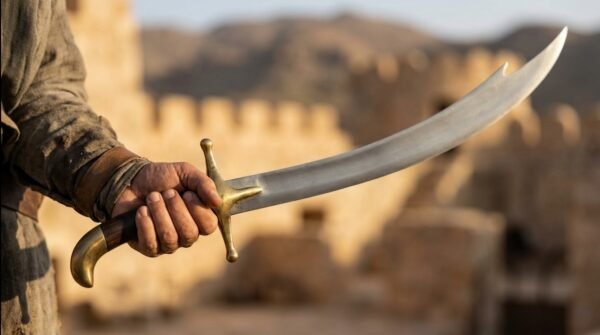
The Mossgate is a tulwar, which is the same sword as a talwar spelled the way British officers heard it in the nineteenth century. Both spellings are still in use and neither is wrong. What matters is the hilt: a disc pommel closing a swelling grip, with short quillons and, on this example, no knuckle bow. The bare hilt version is the older and more common form, and stripping the bow off changes the sword more than you would expect, because it takes several ounces out from behind the hand and lets the blade dominate the balance completely.
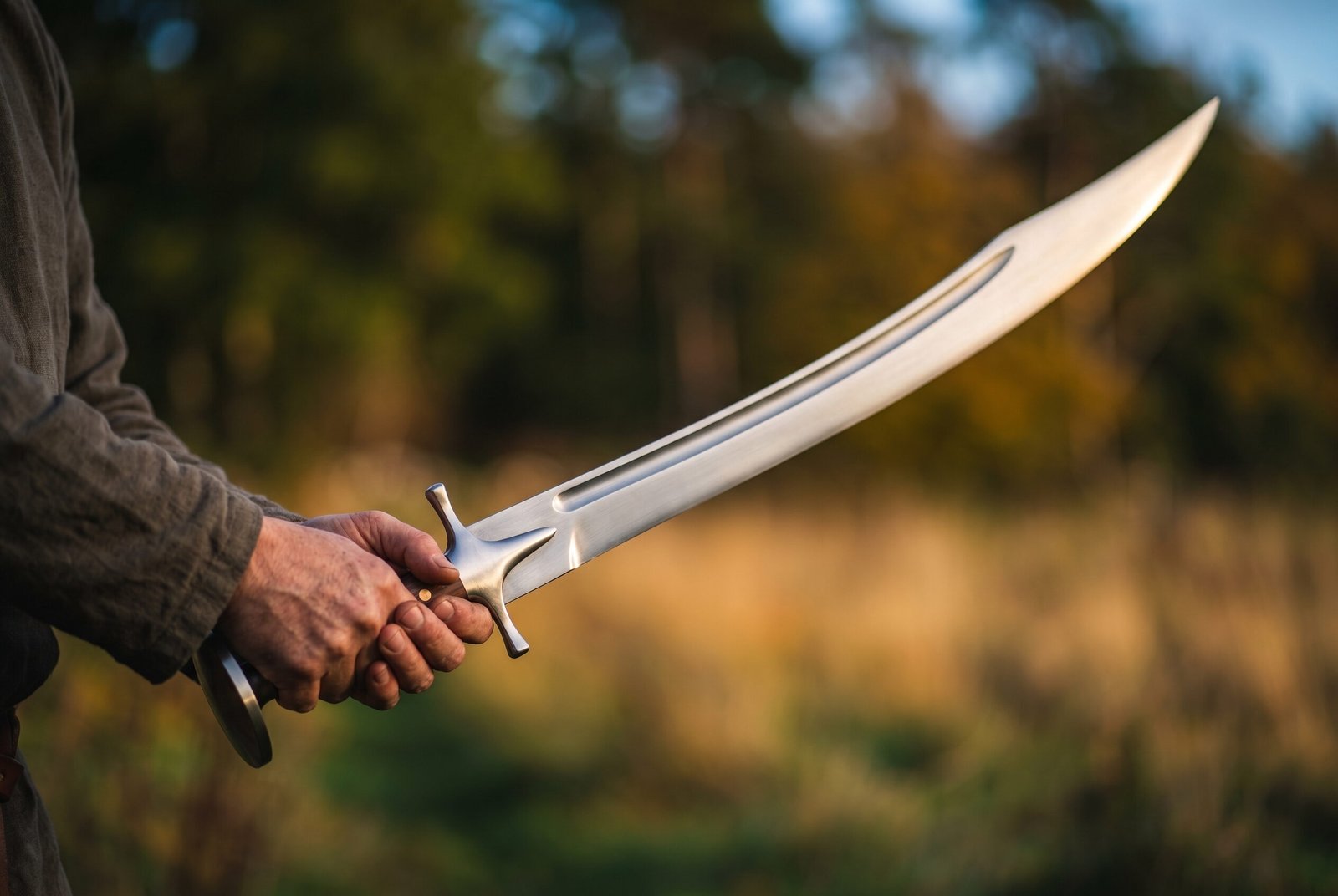
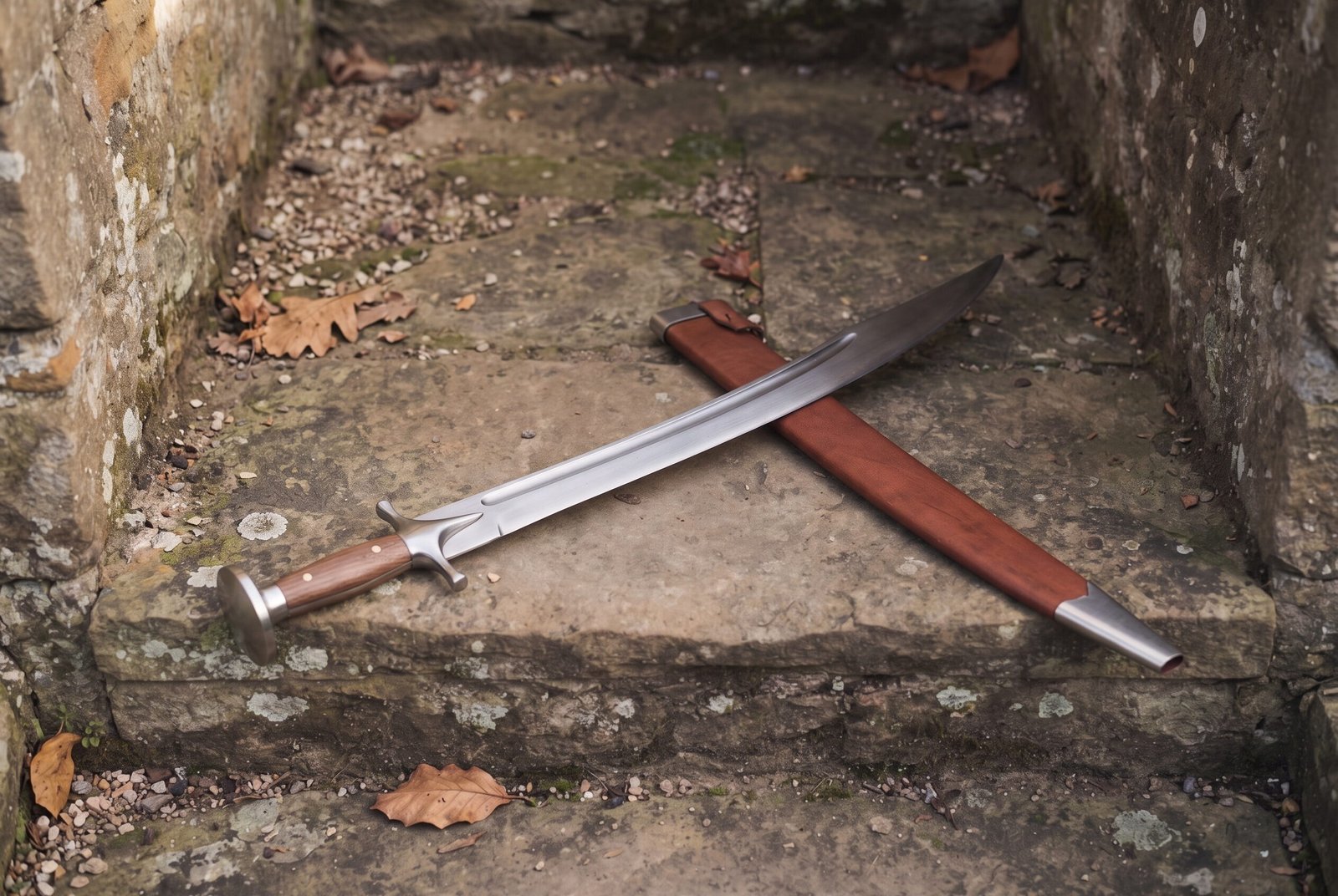
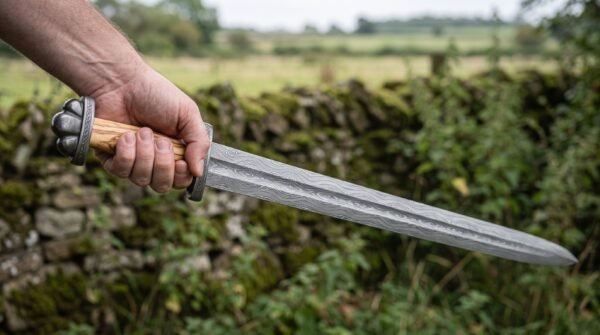
This one is forged and finished in the Czech Republic. The blade is 1095 high carbon steel with a deep curve, a wide flared belly and a long forged fuller, taken to a brushed satin finish rather than a mirror. The hilt is rosewood pinned with brass between steel quillons and a steel disc pommel. It ships in a russet leather covered scabbard with a steel chape, with a care card, and shipping inside the United States is free.
Specifications
| Steel | 1095 high carbon steel |
|---|
| Hardness | 54 to 58 HRC |
|---|
| Overall length | 36 inches |
|---|
| Blade length | 30 inches |
|---|
| Blade | Single edged with a deep curve, flared belly near the point and a long forged fuller |
|---|
| Blade finish | Brushed satin |
|---|
| Grip | Rosewood with two brass rivets |
|---|
| Quillons | Short steel quillons with a central langet running onto the blade |
|---|
| Pommel | Steel disc pommel on a short steel collar |
|---|
| Knuckle bow | None |
|---|
| Scabbard | Russet leather covered with steel chape |
|---|
| SKU | RK-1393 |
|---|
How much curve is the right amount
Curvature on a sword is not a matter of taste, and more of it is not automatically better. There is a real trade being made, and once you can see it you can read any curved sword in a museum case.
A deeper curve gives you a longer slicing action. As the blade passes through a target the contact point travels further along the edge, so the cut is drawn out and the sword bites rather than pushes. That is why the Persian shamshir, which is the most curved of the family, is such an efficient slicer against soft targets. But a deep curve also means the edge is presented at an increasingly oblique angle as the sword travels, so power falls away past the middle of the arc, and a deeply curved sword can hardly thrust at all.
A shallower curve keeps more of the edge aligned with the direction of the swing, so it hits harder and can still be used point first, but it loses much of the drawing action. The tulwar sits deliberately between the two: enough curve to slice properly, shallow enough that the blade still delivers a real chop, and then the belly is flared out near the point to put the power back where the deep curve was starting to give it away. That is the whole design argument, worked out over three hundred years by people who used these swords for a living.
Why 1095 high carbon steel and not stainless
1095 has just under one percent carbon and no meaningful alloying elements. That is why it is good sword steel. It hardens through the full thickness of a blade like this, it takes a genuinely fine edge because its grain is fine, and tempered to 54 to 58 HRC it stays tough enough to flex and return instead of shattering.
Stainless steels buy corrosion resistance with chromium, and that chromium locks carbon into hard carbides. It is a good bargain in a kitchen knife and a poor one in a thirty inch blade, where those carbides are where a crack starts under a shock load. The trade with 1095 is that it wants oil. That is maintenance rather than a defect, and we set out the whole argument on Damascus versus stainless.
The rosewood grip
The grip is rosewood in two scales, pinned through a full width tang with brass rivets and shaped with the swell through the middle that a tulwar hilt needs. With no knuckle bow on this hilt, the grip and the disc are doing all the work of keeping the sword in your hand, which is why the shaping matters more here than on a bowed hilt.
Rosewood is dense, oily and stable, which is why it was the timber of choice from Isfahan to Lahore. It does not go slippery when a hand warms it, it damps the vibration of an impact instead of passing it up your arm, and it holds a brass rivet without crushing around it. It will darken slowly with handling, which most people prefer. Once or twice a year, particularly if the sword lives in a dry heated room, give it a wipe of oil. The routine is on wooden handle care.
Engraving, runes and your own design
Use the rune converter on this page to turn a name, a date or a short phrase into Elder Futhark and we will cut it into the steel or the handle. If you would rather have a Viking pattern than a rune line, choose your own design in the engraving option above the add to cart button and tell us whether it goes on the blade or the handle. Where a piece already carries an engraved design, your chosen engraving replaces it rather than sitting alongside it. A satin finish takes engraving particularly well, because the cut edges catch light against the brushed surface instead of vanishing into a reflection. See the engraving page.
Care and sharpening
A brushed satin finish hides marks better than a mirror does, but the steel underneath is the same and it still wants oil. Wipe the blade after handling and put a thin film of light oil on it every few weeks. Pay attention to the steel disc pommel and the quillons, which are also carbon steel and which collect handprints more than the blade does. Surface rust caught early lifts off with fine steel wool and oil without damaging a satin finish. The routine is on steel care.
Store it out of the scabbard. Leather retains moisture and tanning salts and will mark a blade left sheathed for months even in a dry house. For sharpening, follow the arc across the stone, work three or four inches at a time, keep the bevel angle constant and give the flared section near the point the same attention as the base. Finish on a fine stone and strop it. See sharpening with a whetstone.
Made in the Czech Republic
Every piece we sell is made by hand in the Czech Republic. The smiths there work the way the trade has been worked for a long time, heating and hammering the steel, taking the bevels down by eye, and fitting the handle and the leather one at a time. There is no automated line anywhere in it, so small differences from one piece to the next are normal and expected.
Ransack Viking is a United States company based in Chicago, Illinois. We bring the pieces in ourselves, inspect them on arrival and ship them from our own warehouse. If you add engraving, that is carried out here in the United States before your order goes out.
A note on handmade variation
This tulwar is hand forged. It is not machine made and it is not bulk produced, so what arrives will not be a pixel for pixel copy of the photograph on this page. Rosewood figure varies from board to board, the brush pattern in the satin finish is laid by hand, the fuller runs a fraction differently on every blade and the russet leather takes colour unevenly by nature. The dimensions, the steel and the build are the same on every one. The character is not, and that is the point.
Frequently asked questions
Is tulwar the same thing as talwar?
Yes. Two transliterations of the same Indian word. Tulwar is the older British spelling, talwar the more common modern one. The sword is identical either way.
Does it arrive sharp?
It comes with a working edge, which is the right state for a sword of this size. Say so in the order notes if you want it taken keener before it ships.
Why is there no knuckle guard?
Because plenty of historical tulwars did not have one. Leaving it off takes weight from behind the hand and lets the blade lead, which makes the sword feel longer and more committed on a cut.
Can I use it for test cutting?
Yes, on mats and bottles. It is not a sparring sword, must never be used against another blade, and should be kept off hard targets like wood or bone.
Will mine look like the photograph?
Close, but not identical. The rosewood, the leather and the hand brushed finish all vary. The steel, the size and the construction do not.
How long does shipping take?
Free inside the United States. Two to three business days for a stock sword, two to three weeks for one that is engraved.
What is in the box
- Mossgate hand forged 1095 high carbon steel tulwar
- Russet leather covered scabbard with steel chape
- Care card with oiling and storage instructions
- Certificate of hand forging
- Forged and finished in the Czech Republic
Explore the range
See the other scimitars, the whole swords range, the sabres and the falchions, or read the guides.
Near neighbours in the shop
A near match for this one is the Hollowmoon scimitar, 36 inches overall. Closest to this in the range is the Vinecrest scimitar, 39 inches overall. If this one is not quite right, there is the Slatecrown scimitar, 36 inches overall.
The Crimsonhilt arming sword covers the other half of the same kit. You can have this made your way instead on the design your own page.




Did not expect this level of quality for the price. The craftsmanship really shows in the small details. Couldn’t be happier with this.
I collect stuff like this and this piece is on another level. Feels way more premium in person than the listing photos. Love it.
Photos don’t do this piece justice at all. Exactly as described and clearly made with care. Worth every penny. You can tell it’s real Czech blacksmith work and shipping from the States made delivery painless.