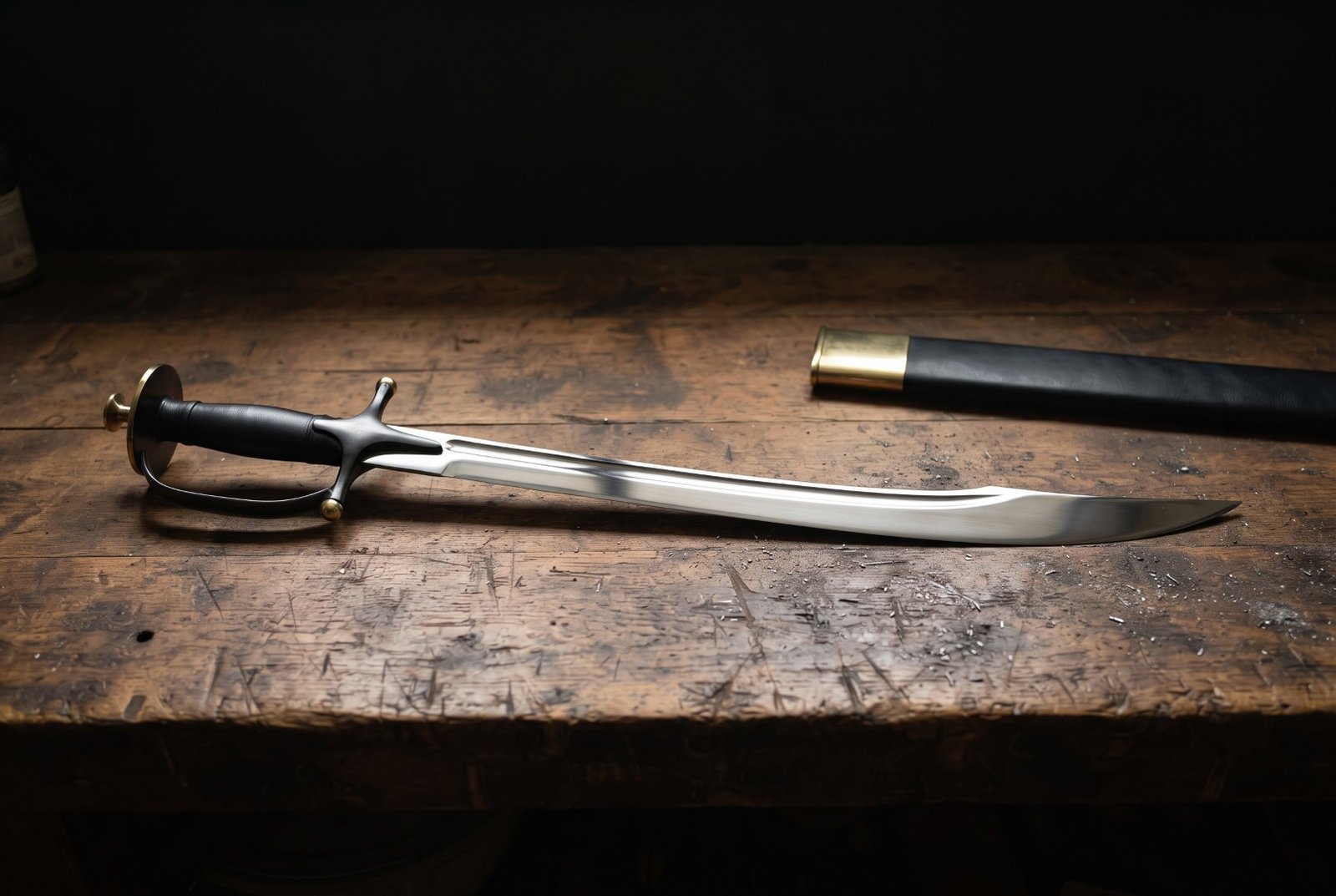
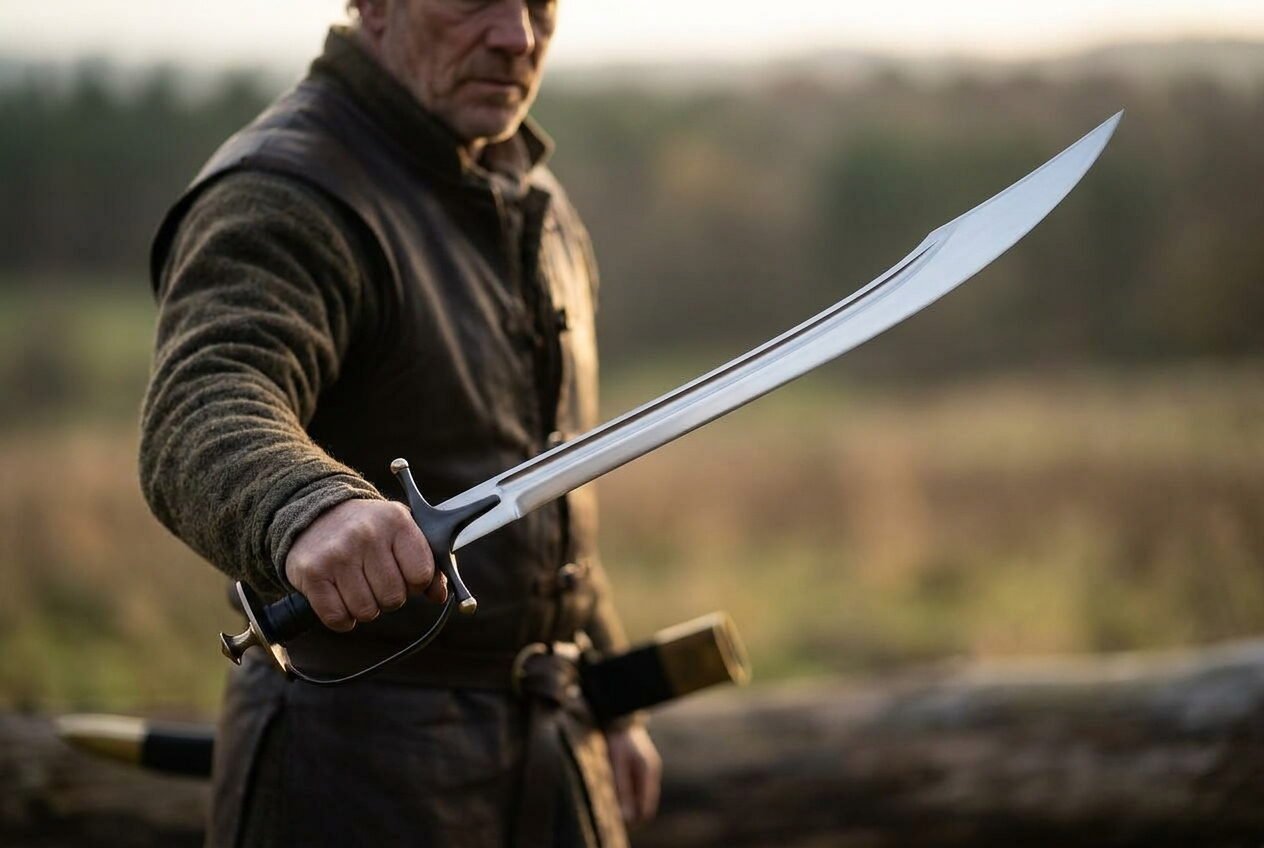
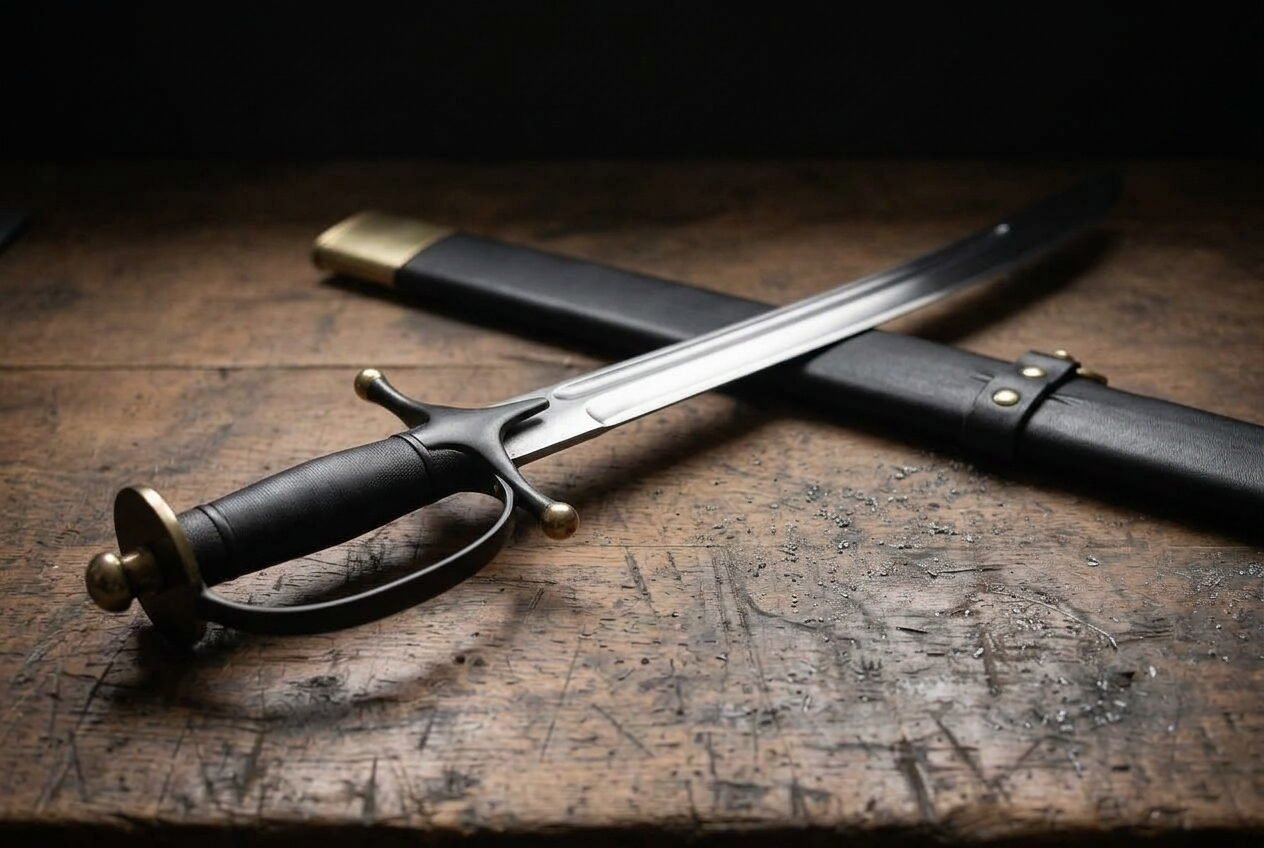
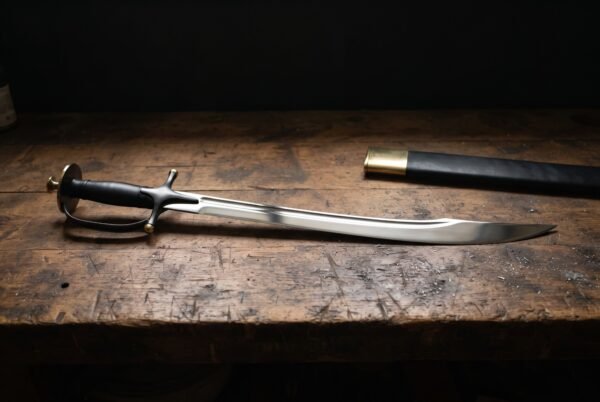
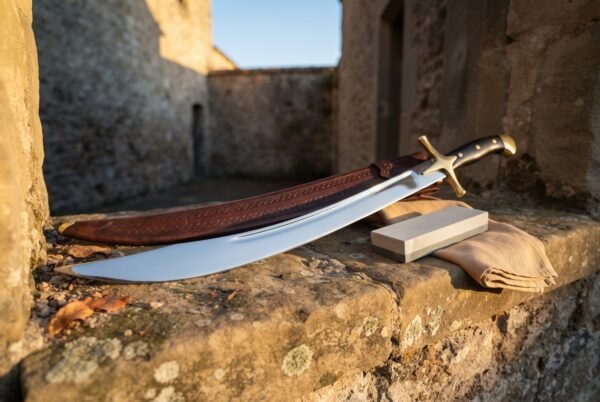
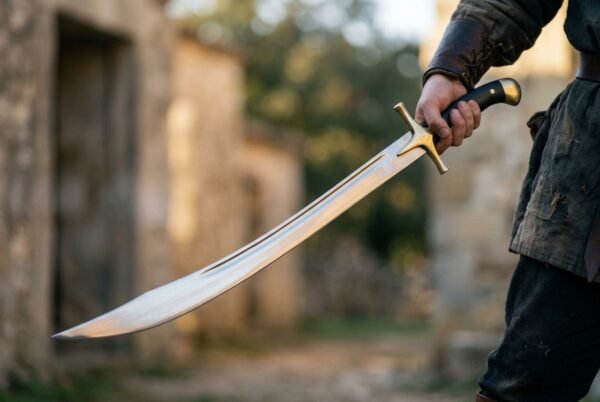
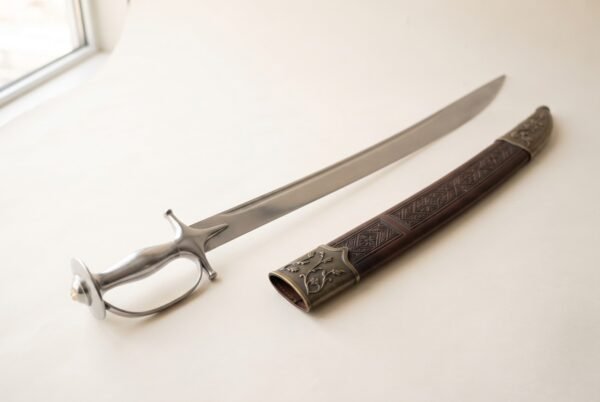
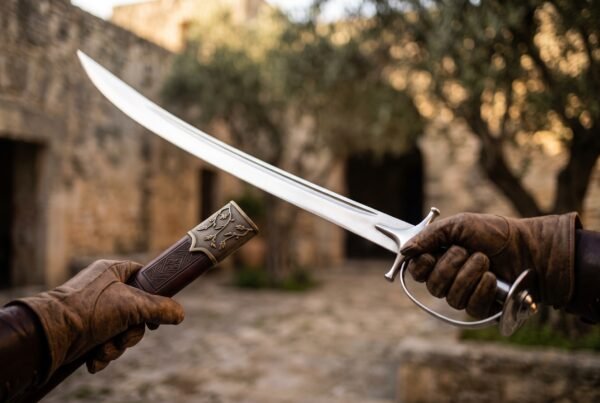
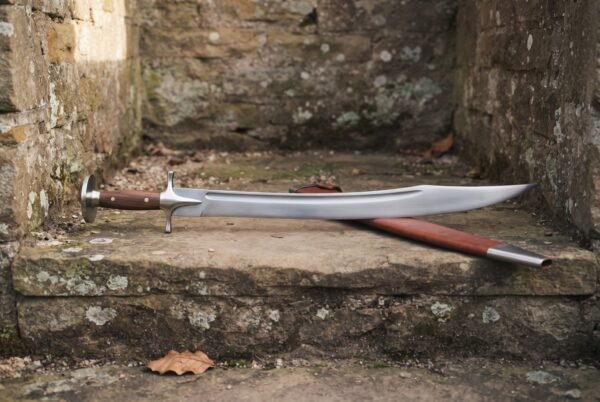
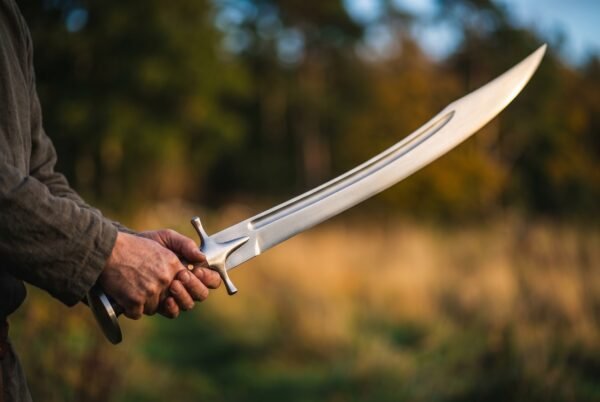
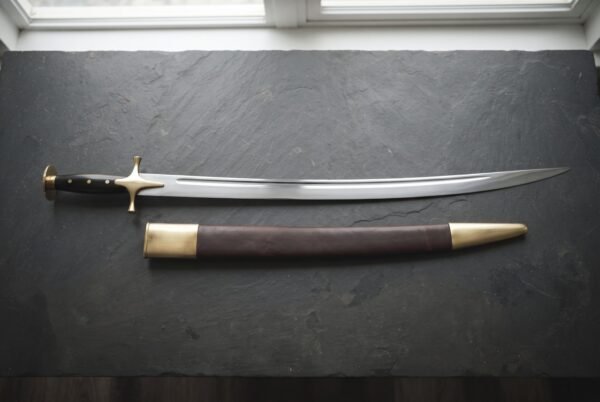
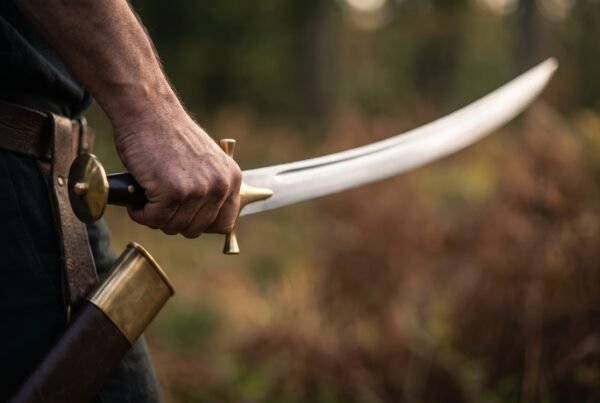
The Nightwheel is a talwar sword with a broad bellied blade, a knuckle guard, quillons finished in brass balls and a wide disc pommel closing the grip. The disc is what names the type. Everything above it, the width of the blade, the depth of the curve, the presence or absence of a false edge, varied enormously across northern India and none of it changed what the sword was called. Blades were traded, inherited, rehilted and remounted so freely that a talwar in a collection today can easily carry a hundred year old blade in a fifty year old hilt, and nobody at the time would have thought that odd. The hilt was the sword. The blade was a consumable.
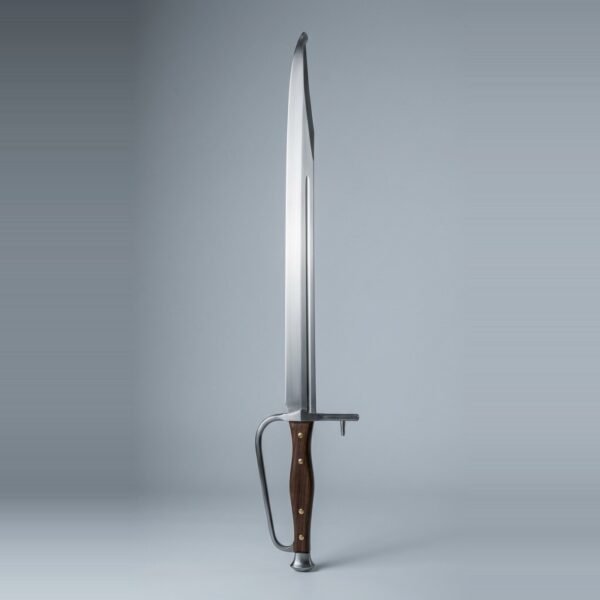
This one is forged and finished in the Czech Republic. The blade is 1095 high carbon steel with a deep curve and a generous cutting belly, hardened, tempered and taken to a mirror polish. The hilt is blackened steel with a black leather wrapped grip, a knuckle bow, brass ball finials on the quillons and a broad disc pommel with a brass button. It ships in a black leather scabbard with a brass throat, with a care card, and shipping inside the United States is free.
Specifications
| Steel | 1095 high carbon steel |
|---|
| Hardness | 54 to 58 HRC |
|---|
| Overall length | 35 inches |
|---|
| Blade length | 29 inches |
|---|
| Blade finish | Mirror polished, deep curve with a broad cutting belly and a fuller near the spine |
|---|
| Hilt | Blackened steel with a full knuckle guard |
|---|
| Quillons | Short quillons with brass ball finials |
|---|
| Grip | Black leather wrapped |
|---|
| Pommel | Blackened disc pommel with a brass button |
|---|
| Scabbard | Black leather with brass throat |
|---|
| SKU | RK-1391 |
|---|
Distal taper, and how a smith sets the balance
Look at this sword edge on and you will see that the blade is noticeably thicker at the guard than it is near the point. That change in thickness along the length is called distal taper, and it is the single most important thing a maker controls that a buyer never sees in a photograph.
Two swords can have identical outlines, identical lengths and identical weights and handle completely differently depending on how that weight is distributed. A blade with little distal taper carries its mass out at the tip. It hits hard and it is exhausting, because every change of direction has to fight the momentum of steel a long way from your hand. A blade with strong distal taper has the same total weight sitting closer in, so it starts and stops quickly, but it gives up some cutting authority.
A talwar of this shape is set somewhere in the middle. Enough taper to make the sword recover between cuts, enough mass left in the belly to make each cut mean something. It is achieved at the forge, by drawing the blade thinner as it goes out, and then refined on the grinder. It cannot be added afterwards. This is why a hand forged blade and a stamped one that look identical in a listing photograph feel like completely different objects in the hand.
Why 1095 high carbon steel and not stainless
1095 is plain carbon steel, just under one percent carbon, with nothing else of consequence in it. That plainness is why it makes good swords. It hardens through the full thickness of a blade this size, its fine grain lets an edge come to a real apex, and at 54 to 58 HRC it is hard enough to hold that edge and soft enough to bend rather than break.
Stainless steels resist rust because they contain chromium, and chromium binds carbon into hard carbides. In a paring knife that is a good deal. In a twenty nine inch blade it is not, because those carbides make the steel brittle in exactly the situations where a sword needs toughness. What you take on with 1095 is the need to keep oil on it. That is housekeeping, not a flaw. The full argument is on Damascus versus stainless.
The leather wrapped grip
The grip is wrapped in black leather over a shaped core, with the swell through the middle that a talwar hilt needs, and it sits between the blackened steel quillon block and the disc pommel.
The point of the swell is that it fills the palm without asking the fingers to close hard. Combined with the disc at the back and the quillon block at the front, the hand ends up braced at three points and can stay loose. A loose hand is faster, absorbs shock better and gives the wrist room to rotate, which is exactly what a curved cutting sword needs. Leather wants a little conditioner once or twice a year, particularly if the sword hangs in a room with dry winter heat. The routine is on handle care.
Engraving, runes and your own design
Use the rune converter on this page to turn a name, a date or a short phrase into Elder Futhark and we will cut it into the steel or the handle. If you would rather have a Viking pattern than a rune line, choose your own design in the engraving option above the add to cart button and tell us whether it goes on the blade or the handle. Where a piece already carries an engraved design, your chosen engraving replaces it rather than sitting alongside it. The broad flat of this blade just forward of the quillons takes a line of runes cleanly, and the disc pommel will take a short mark or a date. See the engraving page.
Care and sharpening
Wipe the blade down with a dry cloth every time it has been handled, and keep a thin film of light oil on it. Mirror polish shows every mark, and a fingerprint left on carbon steel will etch into a grey shadow inside a fortnight. Once a month with an oiled rag will keep a sword displayed indoors in good order indefinitely. Do not leave it stored in the scabbard, because leather holds moisture and tanning residue against steel and will corrode a blade that would have been fine hanging on a wall. Details are on steel care.
Sharpening a curved blade means following the arc. Work three or four inches at a time, keep the bevel angle constant, and sweep the blade along the stone so that the belly gets the same number of passes as the section near the guard. It is easy to over sharpen the middle and leave the ends dull. Finish on a fine stone and strop it. See sharpening with a whetstone.
Made in the Czech Republic
This is a handmade piece from the Czech Republic, made in a workshop that still forges, grinds and finishes by hand instead of stamping parts out. The smiths there have kept the older way of working, and the wood, horn and leather are shaped and fitted by hand as well. Two pieces of the same design will never be identical, and that is part of what you are buying.
Ransack Viking is a United States company. We handle the import ourselves, look over every piece when it lands and ship from our warehouse in Chicago, Illinois. Engraving is done in the United States after the piece arrives, so your design goes on before we send it out.
A note on handmade variation
This talwar sword is hand forged. It is not machine made and it is not bulk produced, so what arrives will not be a pixel for pixel copy of the photograph on this page. The leather on the grip has its own grain, the brass will take its own patina, the polish lies differently along every curve and the leather of the scabbard has its own grain. The dimensions, the steel and the build are the same on every one. The character is not, and that is exactly what you get for choosing something forged by hand.
Frequently asked questions
Does it come sharp?
Yes, with a working edge rather than a razor. That is the right condition for a thirty five inch sword. If you want it keener, ask in the order notes and we will take it further before it ships.
Can I throw it or spar with it?
No to both. It is a sharp sword with a hardened edge, not a trainer and certainly not for throwing. Light test cutting on mats or bottles is fine.
What is the difference between this and a sabre?
A sabre is a European cavalry sword, usually narrower, with a knuckle bow and often a thrusting point. This is Indian, identified by its disc pommel, and its blade is wider through the belly and built for the cut alone.
Can I have runes engraved on it?
Yes. Use the rune converter for Elder Futhark or pick your own design in the engraving option, and tell us blade or handle. It adds roughly a week to the lead time.
Will mine be identical to the photograph?
No. Brass tone and leather grain differ between pieces. The steel, the dimensions and the construction do not.
How long does shipping take?
Free inside the United States. Two to three business days to dispatch a stock sword, two to three weeks for one that is engraved.
What is in the box
- Nightwheel hand forged 1095 high carbon steel talwar sword
- Black leather scabbard with brass throat
- Care card with oiling and storage instructions
- Certificate of hand forging
- Forged and finished in the Czech Republic
Explore the range
See the other scimitars, the whole swords range, the sabres and the cutlasses, or read the guides.
Worth a look beside this
Next along the rack is the Ironlotus scimitar, 34 inches overall. For a straight comparison, see the Sandspire scimitar, 35 inches overall. Worth putting side by side with this is the Emberledge scimitar, 37 inches overall.
If you are putting a set together, the Palewind movie sword sits alongside it. Or start from a blank sheet on the design your own page.
The Sturvang sabre trainer is our blunt option for club training, and our HEMA sabre guide is there if you want to compare.



Reviews
There are no reviews yet